Episode Transcript
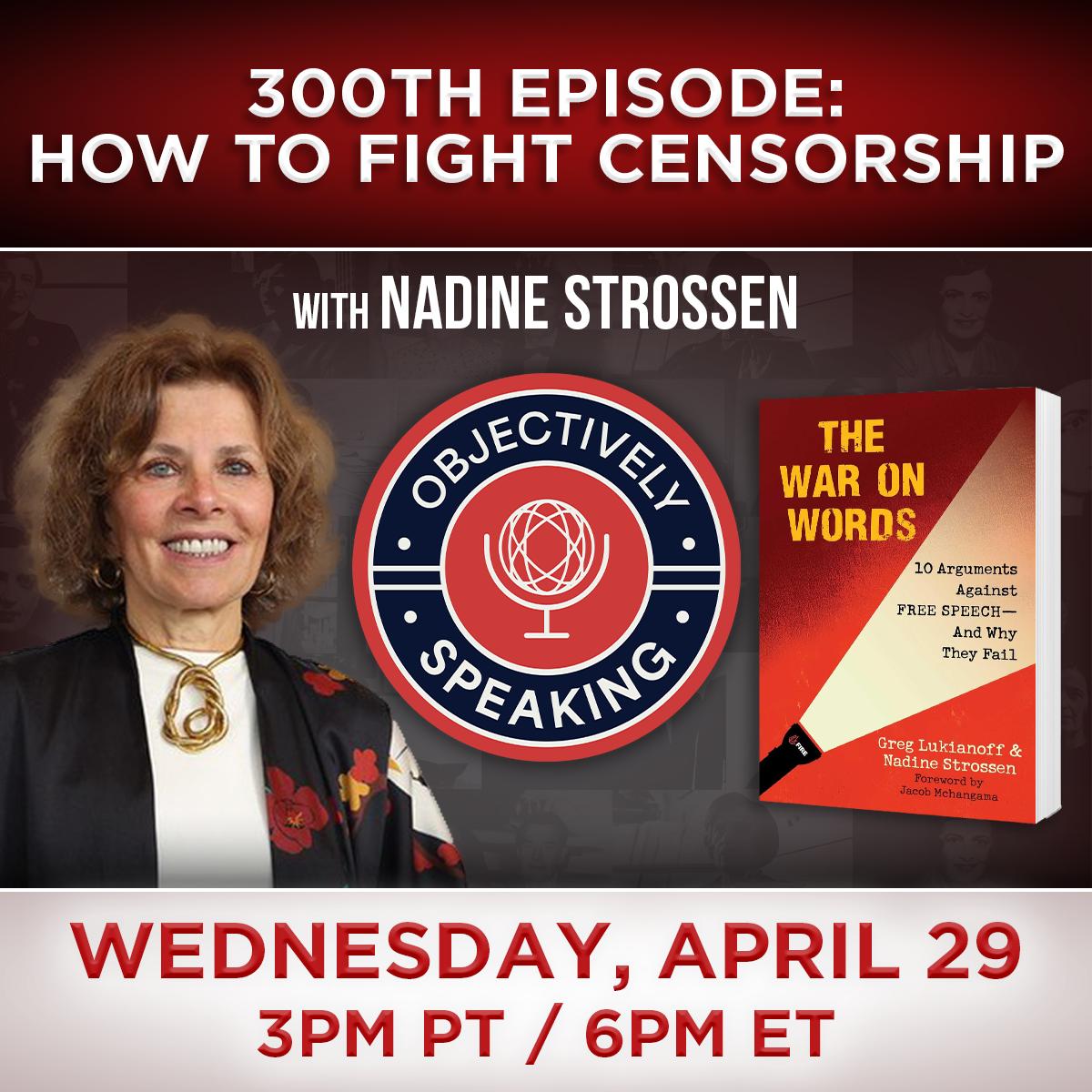
[00:00:00] Speaker A: And welcome to the 300th episode. Can you believe it? 300th episode of objectively speaking, I'm Jag CEO of the Atlas Society. I'm excited to have returning guest Nadine Strossen join us to talk about her co authored book, War on 10 Arguments Against Free Speech and why they Fail. As we mark the milestone of our 300th episode. I couldn't imagine a better guest and a more timely topic for today. Nadine, thank you so much for joining us.
[00:00:35] Speaker B: My pleasure to be back, jag, and congratulations on such a historic run and I wish you all the best for the next 300 and beyond.
[00:00:45] Speaker A: Okay, well, we'll definitely have you back on several of those. So last time you joined us, I think it was five years ago, it was to discuss your book Hate why We Should Resist it with Free Speech, not censorship. I believe that book was Originally published in 2018.
So in the intervening eight years have there been additional examples of hate speech restrictions proving counterproductive?
[00:01:16] Speaker B: Constant examples, JAG from all of the countries that were restrict hate speech. Let me give you the most ironic example. And very recently, Germany. I say the most ironic because I hear the most defenses of suppression of hate speech in Germany. People say, oh well, given it's anti Semitic and Nazi history, of course, it would make sense for Germany to outlaw anti Semitic hate speech, among other things. Well, very recently, George, Germany's very strict laws against anti Semitic hate speech have been strictly enforced against Jews in Germany for voicing criticism of certain policies of the Israeli government in the current war.
Germany telling Jews that they know what antisemitism is when they hear it. And also ironically, I'm laughing, but it's a bitter laugh, right? Because this kind of suppression is no better for quelling antisemitism than it is for protecting free speech. Quite the contrary. When people have used Nazi imagery for purposes of criticizing Nazis, that too has been punished very strictly as hate speech. German prosecutors saying, well, there is no exception for counter speech. So there was a recent incident where a rabbi pointed out an example of blatant overt anti Semitic hate speech online, saying anti Semitism is still a problem in Germany. And simply for quoting the anti Semitic speech, he was subject to prosecution. The prosecutor saying, there is no exception. It doesn't matter what the purpose is, we're categorically outlawing it.
[00:03:19] Speaker A: That's really ridiculous. And we're also going to later in this podcast talk about the fact that there were hate speech laws in the lead up to Hitler and obviously they didn't work very much and were quite possibly counterproductive.
And you know, I was actually at a talk by Elise Stefanik at the Reagan Library earlier this week and of course she was, you know, had her moment of fame for taking the university deans to task for their inability to say that calling for genocide would be considered a violation of the, the school's code of conduct. And of course, while I would agree that, you know, actual harassment, preventing Jewish students from, you know, accessing certain areas of the campus, that that should certainly be considered a violation of individual rights. On the other hand, if there are people who want to kill me, I'd rather that they self identify so I can avoid them.
[00:04:31] Speaker B: And you know, the university presidents were decried for saying that whether those statements should be punished or not depended on the context. I think there was a lot to be desired about their answers and about their overall past record, but they were literally correct. If you are participating in a demonstration and simply making anti Semitic or anti Muslim or any other kind of remarks that might be seen as hateful or discriminatory, that is your right. There is no exception to free speech in the United States for speech that conveys discriminatory or hateful ideas.
However, if in a particular context, such as you are directly addressing one particular individual or a small group of individuals and confronting that person at menacingly close distance and repeatedly shouting anti Semitic or other hateful slur, or as you yourself said, Jack, if you're conveying a bullying or intimidating or threatening, threatening or harassing expression by your, the physical circumstances going beyond the words, then it can and should be punished. I think the reason for a lot of people being very upset by the answers that were given by those university presidents is they did not go on to say what should be done to counter hateful speech. They are educational institutions. They should not simply say, well, we can't censor. They should take the next step and promote education information dialogue, using these as opportunities to give the students some information instead of they're just standing in campus and shouting warring slogans at each other. I think the other major reason for the negative reaction, which I certainly shared, was that if you looked at another context here were university presidents that had not supported freedom of speech for any any other kind of discriminatory or hateful expression against any other kind of minority group. If a black person or a gay person or a trans person, etc. Alleged that there was speech that made them even uncomfortable or that led to division, there was no university support for that kind of speech, even if it was speech about serious political issues, such as issues about affirmative action or about gender policy or biology and so forth. So I think the hypocrisy was really the problem there. The inconsistent invocation of free speech only when it is Jews who are the target of the hate speech.
[00:07:34] Speaker A: Yeah, certainly there was something a little rich about Claudine Gay, the dean of my alma mater, all of a sudden discovering nuance and context when it comes to free speech, given that the university falls at the very bottom of Fire's rankings.
[00:07:51] Speaker B: So, turning now to a Harvard alum, and I want to make sure that you are familiar with and hopefully a member of Harmony Harvard Alumni for Free Speech, which is a really wonderful group and has been having, I think, a significant influence on the new president and provost and other leaders at Harvard.
[00:08:12] Speaker A: Okay, I will check it out. I have told the Harvard fundraisers, don't call me. I am actively working to get you guys to have your funding withdrawn. But I will maybe moderate and see if there isn't a little something positive I can.
[00:08:29] Speaker B: Well, you can give your money to the Harvard alumni for free.
[00:08:33] Speaker A: I like it. Okay, I think I've just made myself. Is that my phone ringing again? No kidding. All right, turning now to war on words, 10 arguments against free Speech and why they fail, the book takes on 10 pro censorship arguments that are very much alive in today's culture. Is there one which you think is the most intellectually seductive, the one that even people who care about free speech sometimes fall for?
[00:09:03] Speaker B: Well, I hear these arguments over and over and over again, every single one of them. And the same is true for my co author, Greg Lukianoff. Between the two of us, we do many hundreds of public presentations on free speech each year. And we separately came up with our list of the arguments and the questions that we hear most persistently. And they were the same ones, I would say, in this moment, where we have seen the most recent episode of political violence just a couple of days ago.
And it's no coincidence that we chose it as the very first such argument that we addressed. We have a disturbingly high percentage of people who believe that words are violence.
And that includes, in one recent survey, 91% of college students believe that, at least to some extent, words are violence. Only 9% categorically rejected that false equation. And the reason why I say that is so disturbing, JAG is it dovetails with another disturbing statistic that about a third, actually slightly more than a third of college students believe that violence is at least some sometimes justified to silence a speaker you disagree with. And that is logical, right? If you think that words are violence, then it makes sense and is morally defensible, even justifiable and laudable to use violence to silence speakers you disagree with.
You may be interested. I'm sure your audience includes many conservatives as well as libertarians and others.
In the most recent surveys, the support for the notion that violence is occasionally appropriate to respond to disliked ideas and support for the notion that words are violence is increasing more rapidly among self described Republicans and even strong Republicans and conservatives. So this is. I don't find it a seductive argument at all. But I'm clearly in a minority when I say that.
I'd love to give you the counter argument if you'd like.
[00:11:41] Speaker A: Yes, please.
[00:11:43] Speaker B: Well, I mean, words are actually far from being violence, the antithesis of violence.
People ascribe a statement to Sigmund Freud, who knows whether he said it. It's a wise observation, no matter who said it, that civilization began the first time a person hurled words rather than stones against ideological opponents to resolve disputes, disputes at the most personal level, to the most global level.
Words, negotiation, communication, information, are precisely a way to avoid violence. Now, in fairness, again, going back to this notion that context is very important in determining which particular words are protected and which are not.
If in a particular context there is a sufficiently tight and direct connection between the words and imminent violence, then and only then the words may be punished. So take a very common situation when somebody says something that allegedly induces a third party to commit violence against the victim.
Of course the person who actually commits the violence should be subject to punishment. But in what circumstances does the inducing the violence inducing or allegedly violence inducing speaker, is that person also liable? The Supreme Court has said, and this goes back to the advocacy of genocide that we were talking about earlier, that even advocacy of violence or other lawlessness is constitutionally protected.
It can only be unprotected on the rationale of inducement, when the speaker intentionally incites, and the Supreme Court uses the term incites as distinct from advocacy, to be a stronger, more vigorous form of expression when the speaker intentionally incites imminent violence that is likely to actually happen imminently. And that was a standard the Supreme Court laid down unanimously in 1969 and has continued to adhere to. I am not aware of a single justice who has ever dissented from that appropriately tough standard. But if we back away from that and go back to the looser standard that we used to have, the so called bad tendency test, government was allowed to punish any speech that had a bad tendency that might potentially Possibly indirectly at some point in the future, lead to violence or other harm. And you can understand with that degree of latitude, the government was empowered to exercise unfettered discretion to pick and choose the ideas and the speakers it favored and those that it disfavored.
[00:15:11] Speaker A: All right, I'm going to dive into a few of these questions because what happens when I wait till, you know, the show is nearly over, the conversation has moved on, and we're like, well, we already Talked about that 20 minutes ago, so I think we're going to get to this. But I'll ask it now anyway. From iliation, how has social media changed the free space free speech debate? I guess that would probably go to the argument that free speech is outdated.
[00:15:37] Speaker B: You know, every single new medium of communication throughout history has always provoked the same response. Those of us who champion individual liberty and human, human rights are excited about this new potential to increase the opportunity for more of us to express ourselves and to seek out information and exchange ideas and information with others. But those who are of a less libertarian bent, shall I say, become worried precisely about the potential of so much more unfettered communication and emphasize the potential negatives. So social media is no exception, but I think it's really important to put it in that larger context. Jack, I've heard exactly the same, I would call them morally panicked arguments about the Internet itself.
Before that about violent video games, before that about cable tv. You know, when I was a kid, there was a moral panic about comic book books on tv, and certainly when the printing press was invented, there was an enormous panic about exactly the same communications enhancing potential. The supreme court has wisely said the first amendment's free speech principles apply to any form of communication. That it protects the right not only to convey information and ideas, but also to receive information and ideas. And the court and I certainly personally, along with other free speech advocates, recognize that speech in social media and other media can potentially do harm, even harm that falls short of being subject to punishment.
But that communication and that technology can also do a great deal of good. And there seems to be a human tendency to, an immediate tendency, if I may say so, to emphasize the negative. So, you know, we are constantly hearing about alleged disinformation and misinformation and hate speech and pornography and allegedly negative impacts on. On young people, especially young girls. But we take for granted we do not get the media attention to the enormous positive impacts of social media. You know, to my friends on the left, I have to point out to them how many of their social justice causes completely depended on social media to gain any traction. That was certainly true for the Black Lives Matter movement. That was true for the MeToo movement. The presidential campaign of Barack Obama was considered historical and able to succeed in large part because he was the first presidential candidate to harness the power of social media. So like any medium of communication, it can do great good as well as great harm. And turning to the government to pick and choose what can be said and what cannot be said is certainly a recipe for the greatest harm of all.
[00:19:12] Speaker A: Well, I think then Jackson Sinclair, you got your answer to what do you think about misinformation? Is it something we should address or does it give authorities dangerous power?
[00:19:22] Speaker B: So as the Supreme Court said in the most recent case in which it struck down or dealt with a law that out laud lies, the Supreme Court said in our country we have no need for Orwell's ministry of truth. Now again, in particular contexts, if a lie is uttered with intent or with recklessness and it directly causes certain specific demonstrable harm, such as defamation that intentionally harms somebody's reputation or fraud that intentionally spurs somebody to rely on a misrepresentation and to lose money as a result or perjury in a court of law that can and should be punished. But this looser concept of disinformation or fake news, depending on which side of the aisle you're on, you'll use different terms.
One person's disinformation is somebody else's gospel truth and it is for we the people to make our own decisions about what to believe and what not to believe. And again, the power of the Internet, including social media, gives us unprecedented tools for doing research and doing fact checking. And the community notes feature has been a very successful intervention in Taiwan, which has dealt with probably record amounts of disinformation coming from China and has completely eschewed government censorship to its credit.
[00:21:02] Speaker A: So you and Greg cite the 2024 future of which covered 33 countries and not only did it find an overall rise in popular support for government restrictions on of speech that people find pernicious, but specifically the US dropped from being the third most supportive of free speech to being the ninth. What's going on here?
[00:21:30] Speaker B: You know, this is extremely disturbing and I completely defend the media's right to emphasize the, you know, negative speech. I, I, I defend that right. But I think that people are being flooded with claims about the alleged adverse impact of certain kinds of speech. You know, I want to remind younger audience members, jag, that long before the Internet came along, the old Fashioned broadcast media and print media had a famous saying, if it bleeds, it leads. And interestingly enough, some scholars had a big study recently in the Columbia Journalism Review, thanks to the Internet, they had a database of, you know, decades and decades and decades of print and broadcast stories. And they did a very sophisticated search to look for positive stories versus negative stories. And they found that over time, the negative stories, including negative stories about speech and the harmful speech, had dramatically increased, perhaps for the reason of gaining more eyeballs. And so I think we really have to. Those of us who believe in free speech have to keep emphasizing its positive force and that we in the United States take very much for granted. And that's another factor. Jag, when I've had the privilege of speaking in countries that purely recently have shaken off authoritarianism, various forms of repressive sensorial governments in those societies, in Taiwan is a shining example, free speech is absolutely celebrated and prized. Whereas in the United States, we've taken it so much for granted that I think that people are naive when they believe that we have too much free speech. In that sense, I have to say, I'm an activist. And so I always have to see the glass half full. The glass half full of a lot of the increased attention to censorship and sensorial moves by the Trump administration and by the Biden administration that have received a lot of attention is that I think that people are becoming more concerned about free speech and more attuned to the dangers of censorship.
[00:24:12] Speaker A: Yeah, you know, it was interesting. I kind of picked into those statistics a little bit to say, okay, well, who are the other eight that are now above us? And there were the Scandinavian countries, and I was curious, you know, what accounted for their support of free speech and whether or not an environment of sort of ethnic and cultural homogeneity contributed to that. But the big takeaway was that in the countries with stronger free speech support was Venezuela. And we have a huge percentage of our YouTube subscribers are actually Venezuelans living in Venezuela. And I like to have that international connection because it's so easy to take for granted the protections that we enjoy here in the United States.
[00:25:04] Speaker B: Yes. And one would not wish repression on anybody. But I have to say, in this country, some of my strongest colleagues in the free speech movement and the academic freedom movement are people who came from repressive countries, including Russia and China and Saudi Arabia, Iran, and they are very, very sad to see support for free speech eroding in the United States and are on the ramparts to make sure that to stop that backsliding yeah.
[00:25:46] Speaker A: So the book also pushes back against sensorial efforts from both the political left and right. Yet the claim that free speech is a right wing cause has gained real traction. Where did that idea come from and what's the strongest rebuttal?
[00:26:03] Speaker B: First of all, people on the right, as well as people on the left, have free speech rights.
And I would absolutely defend the right, no pun intended, of even the most extreme right wingers, racial supremacists, and I've got a track record of doing that. They have free speech rights.
But the principles that defend the free speech rights of those on one end of the political spectrum are exactly the same principles that are necessary to protect free speech on the other end of the political spectrum and everything in between. I think the reason why so many on the left now have been dismissing free speech as primarily benefiting those on the right is that in the context where the left is ascended, such as university campuses and culturally elite institutions, it is the conservative views that are unpopular and therefore, not surprisingly, are the ones that tend to be suppressed, and therefore the free speech battles are fought on their behalf. Again, we have to give some credit to Donald Trump for making it clear that when certain conservatives gain power, they exercise that power to suppress speech. On the left and now on college campuses, certainly people have to be aware of the fact that those who are supporting DEI initiatives or who are supporting pro Palestinian causes and who are supporting certain gender ideology, all causes associated with the left, those are the ones whose speech is being targeted by the Trump administration and by many state legislatures and university systems. So now I think there is an appreciation that free speech is an indivisible cause. If government and other powerful actors, including state universities, have the power to suppress unpopular ideas, that is a power that is going to jeopardize every idea and every speaker, because every idea and every speaker is ultimately going to be unpopular in some context, in some geographical context, or some changing political context.
[00:28:45] Speaker A: The chapter that most resonated with me on a personal level was one talking, taking on the argument that shout downs of a speaker are justified. And the reason for that is an experience I had at Mercer University in Georgia a few years back, where a protester not only interrupted a speech I was giving on capitalism, but physically assaulted me after she seemed to think she was a he would and was removed. I tried to carry on my remarks. But I'll say this, looking back, if I had read your this latest book, I think I could have more productively used that time to talk about the heckler's veto, both from a philosophical perspective as a violation of individual rights, as well as from a consequentialist perspective about the dystopian future that would unfold if this practice became more prevalent. So if you had been in my shoes, what might you have said to that audience of students who, from the looks of things, seem to think it was the heckler's rights who were being violated and not mine or not indeed their own?
[00:30:00] Speaker B: You know, Jack, I actually was in your shoes. So let me tell you my anecdote and how I, I literally did handle. Actually, it's happened more than once. But one example that I particularly like is Justice Antonin Scalia, who was a good friend of mine and excellent on free speech, although we disagreed on some other issues and some aspects of free speech. But we debated each other all over the world and became good friends.
So a number of years ago, a student journal at NYU Law School was dedicating its entire.
Every year it would have a dedication to a prominent jurist. That year, the dedication was to Nino Scalia. And he invited a number of people to speak on his behalf at the ceremony where the the journal was launched. And I was honored to be one of those speakers. Well, this was shortly after he had written some opinion that this rejected claims for gay rights. I can't remember which one it was, but it was a very strong opinion rejecting the argument that there is a constitutional right to engage in same sex intimacy. So there were students at NYU Law School that were protesting in the loudest possible way, chanting and shouting that it was wrong for him to be honored, and it was wrong for those of us who were speaking there to be speaking there. And they shouted so loudly that I couldn't even hear myself trying to deliver my remarks, let alone the audience could hear me and the students when I talked. So let me give you the explanation that I gave to them. Yes, you have a right to engage in peaceful, non disruptive protests. That is a very important right and certainly one that the ACLU has defended over and over, and the Supreme Court, Supreme Court has upheld over and over. But the emphasis is on peaceful, non disruptive. Disruptive means that you are not only preventing the speaker from exercising her right, in my case, in your case, to convey information and ideas, but also the rights of the audience to hear the information and ideas.
So you can express your objecting messages in non disruptive ways, such as silent protest or holding up a placard, as long as it doesn't block the view of somebody that's there or peacefully walking out to Express your opposition and so forth. And I have to say, when I explained that to the students, I was really shocked because here were students at one of the most prestigious law schools in country, and their response to me was, but you and the ACLU defended free speech rights for Nazis in Skokie, Illinois, a town with a large Jewish population, including many Holocaust survivors. A very important case. They did not understand that in that case, the neo Nazis were not disrupting somebody else's speech. They were simply engaging in their own messages.
But this is a lesson that has not, unfortunately, been learned as thoroughly as it should.
Most recently, the most recent disruption that I'm aware of, again at a law school, which I think is particularly tragic, was at UCLA Law School just last week when there was a disruption of a Federalist Society event at which the General Council for the Department of Homeland Security was trying to speak and the student disruptors were asserting that they were exercising their own First Amendment rights. No, no, no, no, no. They were violating other people's First Amendment rights.
[00:34:11] Speaker A: All right. My modern Galt asks, are social pressure, boycotts, or public criticisms legitimate responses to harmful speech?
[00:34:22] Speaker B: Constitutionally, they are certainly protected in terms of legitimacy. I think that's a question that each speaker or person who's engaging in those tactics has to make a strategic judgment in every situation whether it is an appropriate and effective response. I think one of the examples that that was given was a boycott, and their context is very important. I, along with important free speech organizations, categorically oppose academic boycotts such as are being advocated now with respect to Israel, that is imposing group punishment on any scholar in any either Israel or the United States to have any collaborative relationship.
And I think that you should not, and I'm not aware if there are such efforts with respect to the United States. But if you object to a policy of the Trump administration, I don't think it is legitimate to say, well, therefore we're going to boycott American academics. And I think that the same logic, lack of logic applies to punishing either Americans who want to study abroad in Israel. We've had incidents of faculty members refusing to write letters of recommendation for students who want to participate in study abroad programs in Israel. I think that is a violation of academic freedom and free speech principles.
[00:36:06] Speaker A: All right, have a question here. Alan Turner, asking are emergency situations war, pandemics, terrorism, civil unrest, when free speech is most vulnerable, or is free speech always under threat?
[00:36:21] Speaker B: Free speech is always under threat, but it's an excellent question because the assertion of emergency is the most powerful engine for persuading people that free speech should be sacrificed and the emergency can be a war, it can be a pandemic, but it can also be concerns about children's welfare. I referred earlier to what I call to some extent a moral panic about the allegedly adverse impact of social media on children. Now I do not mean to dispute that there is some correlational evidence of some adverse impacts from exposure to social media. But I think the amped up rhetoric that you know, kids are subject to suicide and anxiety and depression increases pressure to leap to censorship as a purported quick fix rather than looking at the under deeper underlying causes and also potential uses of social media that can counter those very problems. You know, I was very struck that some of these recent cases where juries have held that social media played a contributor to role in the terrible mental health situation of the of the young people at stake. And believe me, I am so concerned about their welfare. It makes me concerned about leaping to conclusions about scapegoating social media and ignoring deeper seated causes. Because even in those cases there was evidence that social media played very positive roles in the lives of these struggling young people who did not have meaningful relationships in the real world, were isolated and alienated and were able to create relationships online.
[00:38:26] Speaker A: We see on both the left and the right more support for free speech when it appears to benefit our side.
What are some examples of free speech victories on behalf of one party with controversial views on one party side of the ideological spectrum that later benefit other groups with views on the diametrically opposite side of the spectrum?
[00:38:49] Speaker B: Analyst examples Jack, and I'm going to give a very recent one that involves the ACLU, the organization I was proud to had for 18 years.
A couple of years ago, the ACLU, a civil liberties organization. I think it's fair to say that the members are probably mostly to on the left end of the political spectrum as manifested by the fact when the ACLU agreed to represent the nra, the National Rifle association in the Supreme Court in a very important First Amendment case, there was huge protest among many ACLU members, including even ACLU staff members and a couple of the ACLU's state based, what we call affiliates actually descended and said, you know, just count us out. We're not supporting what the national ACLU were opposing. What the national ACLU is doing here? Well, the national ACLU to our credit resisted that objection with within the membership ranks and won a unanimous victory in the Supreme Court for the nra which has been the major precedent that has been used by the universities and the law firms and National Public Radio and all of the left leaning civil society institutions that are being defunded and otherwise retaliated against by the Trump administration. Because what happened in the NRA case during the gubernatorial administration of Andrew Cuomo, a Democrat, Maria Vulo, a member of his cabinet who had responsibility and power over the financial sector, was putting pressure on banks and insurance companies not to do business with the NRA because she and the Cuomo administration opposed the NRA's position on gun rights.
But that same pressure is exactly what the Trump administration is using against organizations on the left whose policies it disagrees with. And so thank goodness that the national ACLU won a victory where the immediate beneficiary were advocates of gun rights. But the ultimate beneficiary is anybody that is seeking to resist government pressure in order to express views that are unpopular with a particular government official or administration.
[00:41:44] Speaker A: So this is something that Greg talked a bit about in the book and I'm wondering if I could get your take on the difference between the marketplace model of free speech and the pure informational theory of free speech.
[00:42:00] Speaker B: Yeah, this has been Greg's favorite argument in support of free speech and I wholeheartedly agree with it. There are many independent we lawyers would say independently sufficient reasons for supporting free speech. So Greg doesn't oppose the marketplace theory, which is basically that the marketplace ideas is better suited to pursuing truth than government control. It's not a guarantee that we'll get there, but government control is a guarantee we'll never get there. But Greg's pure informational theory has independent value and that is I want to know what your ideas are. If you have and you alluded to this earlier Jack, if somebody has anti Semitic ideas I would rather know about it. And by the way, I would rather that government officials and law enforcement officials know about it.
Many anti terrorism counter intelligence experts and other law enforcement experts oppose censoring online hate speech, disinformation and so forth because they say that once you outlaw that speech that could potentially lead to violent conspiratorial action. It is simply going to be driven underground into the dark web where it is much harder for law enforcement officials to track and monitor it and take action to prevent and counteract any planned violence.
[00:43:39] Speaker A: So the book also cites two rules identified by Jonathan Rauch for the search for truth, the fallibilists rule and the empirical rule. How should we understand these rules and why are they important?
[00:43:55] Speaker B: You know, John Rauch is such a wonderful colleague and at the advocate and theorist about the values of free speech and as I understand those two points. They are really the essence of the scientific method, which is the approach toward all expression and pursuing not only scientific truth, but philosophical truth and every other kind of truth that John Stuart Mill laid out in his famous essay on Liberty. That every single idea should be put out there but or and every single idea should be subject to questioning and criticism and falsification.
And no idea should be accepted as true just because somebody asserts it, even somebody who has power and authority, that it has to be empirically demonstrated to be true.
[00:45:03] Speaker A: So you are the daughter of a German born Holocaust survivor who nearly died at Buchenwald, and you have said that you would support speech restrictions if they could prevent the repetition of the Holocaust.
But you go on to cite historical examples showing that not only are such restrictions ineffective, they're more likely to be counterproductive. The book uses Weimar Germany's vigorously enforced speech codes, or maybe selectively enforced as well as a historical case study. So what does it teach us about how such supposedly well intended restrictions work in actually in practice?
[00:45:47] Speaker B: Well, the Weimar Republic during which Hitler rose to power, 1918 to 1933, actually had very strict anti hate speech laws which were very vigorously enforced, including against anti Semitic speech.
There was a leading Jewish organization, similar to the Anti Defamation Week that had offices all over Germany and would the laws were enforceable either by criminal prosecutors or by civil lawsuits. And this organization exercised a lot of persuasive influence for prosecutions to be brought and for civil actions to be brought. And they concluded that in the vast majority of cases is the law was enforced fairly against anti Semitic speech. There were many convictions, including of leading Nazis, including of the publisher of Der Sturmer, a virulently anti Semitic publication.
Hitler himself was banned from public speaking in one of the German states for many years. And tragically we know that the result was not at all to stifle the rise of Nazism. The Nazis welcomed these trials as opportunities for propaganda platforms and increased the attention that the Nazis received and also the sympathy that they received.
[00:47:27] Speaker A: Right. So almost kind of a martyrdom effect. I wear this penalty as a badge of honor. So there are legal protections of free speech, and then there is also a culture of free speech. The distinction could be applied to privately owned social media companies who have a right to suppress speech on their platforms, but I would argue have a moral obligation to respect the culture of free speech. So is there a tension between maintaining a culture of free speech while also supporting a culture of justice and moral judgment, calling out bigots who direct racist, vitriol against particular groups, for example, while defending their legal right to do so.
[00:48:15] Speaker B: Absolutely. The title of my 2018 book, which you kindly referenced at the beginning is Hate why We Should Resist it with Free Speech, not Censorship. Note, the only verb in that title is resist. My ultimate goal is to effectively counter hatred and stereotyping and bigotry of every sort against people based on identities, against people based on their ideas.
And, and therefore it is essential to recognize that legal protection for free speech, that is preventing the government from engaging in censorship, is necessary but not sufficient if we are to meaningfully exercise free speech in our culture.
And now I'm making a report related but distinct point, and that is that most surveys show that, or I say all surveys show that most of us are engaging in very strong self censorship, including on campuses where one would expect freedom of speech to be most robust. People are self censoring on, not only voicing certain perspectives on controversial, controversial issues, but not even addressing certain sensitive subjects at all. And most of that self censorship is not because of fear of government punishment. And the major exception is thanks to Trump 2's deportations and threatened deportations against non citizen students and faculty members and others. If you are a non citizen, you really do have reason to fear government retribution for speech that it dislikes. But for American citizens, the major reason for self censorship is fear of each other.
Students are afraid of peer pressure, faculty are afraid of students. And so it's not enough to rein in government power to suppress speech. We have to.
Defending people's rights to be critical of ideas that they dislike, including hateful ideas, is very important.
But we can't get to the point where the criticism becomes calls for punitive retribution, calls for people to be fired, calls for people to be stigmatized and ostracized and punished socially because that leads to too much self censorship. So you can tell from what I'm saying, Jack, that this is a situation where we need a delicate balance. That's a phrase that often comes up in our legal system. On the one hand, we do want robust and vibrant freedom to criticize, even strongly criticize ideas that we disagree with. But the criticism should not become so punitive and so disproportionate that it completely shuts down the debate. It becomes coercive rather than persuasive.
[00:51:46] Speaker A: I'd say what we also need is we need more people reading Atlas Shrugged and Anthem and the Fountainhead and getting in touch with their eye and getting in touch with the courage to be disliked and to have others judge you. You might be surprised when you're willing to weather that kind of judgment and criticism and social disapproval, that you'll find others finding their moral courage as well. So, Nadine, we're coming up to almost the end, and I understand you are going on to another speech that you have to give this evening, but I just wanted to know if there was anything else that you wanted to cover, any of the arguments that you felt we didn't give enough emphasis to in this discussion.
[00:52:30] Speaker B: I will make another point, jag, which is I'm. I. It was wonderful to hear you mention the names of those books because I read them when I was fairly young and I had. I first read them when I was fairly young. And I have absolutely no doubt that they were absolutely crucial in helping to solidify my civil libertarian values. I remember several years ago I was speaking for a Reason magazine cruise and Nick Gillespie asked the audience members, you know, what was your gateway drug to libertarianism? And one of the alternatives was Ayn Rand. Another one was science fiction. I can't remember, but I raised my hand for the Ayn Rand. And I know it's very unfashionable. In many circles that I operate in, she's mocked.
But every time I reread the books, they stand the test of time. And thank you for encouraging me. I'm overdue for rereading.
[00:53:33] Speaker A: Well, I'm excited to hear that. And you will also be heartened to know that while she continues to be extremely controversial here in the United States overseas, that is just not the case. And that's why we are having tremendous success with our 22 John Galt schools globally and our international conference and the massive growth of our digital audiences overseas as people are becoming disillusioned with some of the failed isms and of the past and are searching for new ways to understand the world and their role in it. So, Nadine, what is next for you other than going to give this speech? And how can we follow and how can we support your work?
[00:54:15] Speaker B: Well, you can support my work, which is full time evangelizing about freedom of speech, by learning what your free speech rights are, learning the history of free speech and the history of censorship, and recognizing that what is at stake in every situation is not the particular message or the particular speaker, but the underlying principle. I have seen too many people who were so supportive of free speech and so against censorship when it was the right that was being targeted, flip switches and become very supportive of censorship and repression and even cancel culture when the power is switched and vice versa. So I just urge people to recognize what I think of as the golden rule of free speech.
If we want to have freedom for the speech that we love, then we must defend it for the speech that we love. Loathe.
[00:55:20] Speaker A: That is a very important and wonderful note to end this 300th episode of objectively speaking. The other way that you can support Nadine and our dear friend Greg is to go out and buy this book. I know I say all of the books are terrific, but this one's really special and I highly recommend the audio version as well.
So do yourself a favor, get a refresher and we'll circle back once Nadine has gotten her refreshers on Ayn Rand. So thank you, Nadine, and thanks all of you for joining us today. And I hope that you will join us next week for our 301st episode with journalist and playwright Jonathan Leaf joining us to talk about his book, the Priority Primate Myth, why the Latest Science Leads Us to a New Theory of Human Nature. I'll see you then.