Episode Transcript
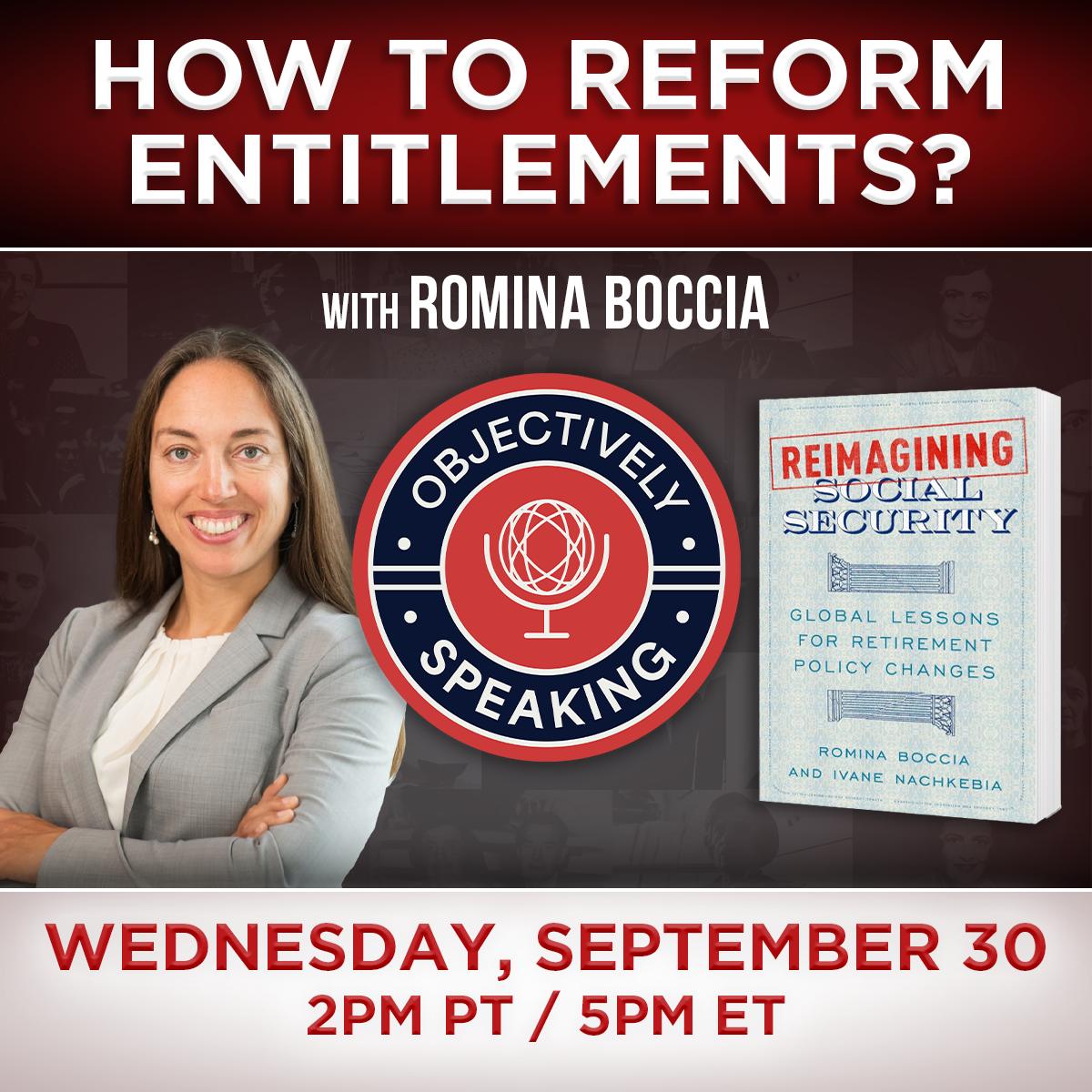
[00:00:00] Speaker A: Hi everyone. Welcome to the 321st episode of objectively speaking. I'm Jag CEO of the Atlas Society and I am very excited to have Romina Bhatia join us to talk about her co authored book, Reimagining Social Security Global Lessons for Retirement Policy Changes. Romina, welcome.
[00:00:24] Speaker B: Thanks so much for having me. It's good to see you again, Jaguar.
[00:00:29] Speaker A: So before we get started, our audience always enjoys learning about our guests origin stories. You grew up in Germany. Any early experiences or mentors that maybe helped shape your later public policy trajectory.
[00:00:45] Speaker B: Thank you for asking.
I did grow up in West Germany and I have this memory when I was 8 years old and my grandfather brought me to southern Italy to meet our ancestors there.
And. And I was just struck how the living conditions were so different. In western Germany. We had paved road, most families had automobiles.
Cats and dogs were confined to the home. In southern Italy it was dirt roads.
People were mostly walking, lugging things around. There was a lot of stray cats and dogs. So it was just a complete contrast for me and I. On that trip I also met a teacher from East Germany and we started a pen pal ship for about two years. And I regret that I did not keep those letters. But I learned a lot from her about what life was like behind the Iron wall.
And it just for me helped me understand the differences between what makes societies flourish and what causes people to be trapped in a cycle of poverty and hardship. And oftentimes it's, it's the rules of the game. And that got me interested later in life into economics.
[00:01:56] Speaker A: Well, and maybe reading Ayn Rand and Atlas Shrugged also had something to do with it. Apparently Atlas Rugged is the book that you've read more than any other book.
What were your takeaways?
[00:02:11] Speaker B: That's true. I read Atlas Shrugged three times. I think because I just enjoyed it so much. It was so refreshing.
I found the story extremely captivating. So I read it basically three times in a row, kind of like you would binge watch your favorite show. And it was just a story about the power of the individual and the state trying to crush the individual and industry and pushing back against that was something I found very inspiring.
[00:02:42] Speaker A: So you first moved to Washington D.C. as so many do, to become an au pair when what was the biggest culture shock in moving to the United States?
[00:02:52] Speaker B: From a personal perspective, it was just everyone was super friendly. In Germany, people tend to be more reserved unless they become your close friends.
And in the United States everyone was just extremely friendly. But that doesn't necessarily mean that they're going to be best friends with you. So that's something I had to learn.
I think also you have this aspect in commercial society where being very friendly is, is much more common. And Germany really doesn't have as much of a service culture.
There's some example examples I could share, but you really get, I feel, in the United States the impression the service culture is very strong, the customer is king. And in Germany, you're much more likely to have someone say to you you're wrong, even if you're, if you're the customer. So it's just different perspectives on how we conduct ourselves.
[00:03:47] Speaker A: So turning now to reimagining Social Security Global lessons for Retirement Policy Changes, tell us a bit about the impetus behind the book.
[00:03:59] Speaker B: Yes. So we are within six years of Social Security's trust fund being depleted in 2032, and the Medicare trust fund is not far behind in 2033. I have been working on budget policy for about 15 years now and the fiscal situation has only deteriorated. It's become much, much worse. And yet we seem even further away from a solution as the debt is now rising to be larger than the entire US Economy is measured by GDP with no end in sight, and interest rates are now costing more than what we spent spend on national defense or what we spend on all of Medicare. And yet Congress doesn't seem any closer to a solution to fixing those key drivers of growing spending. So with the book I wanted to look at, are we the first ones to be in that situation? No. It turns out that in the 1990s and early 2000s, many other OECD countries that have older populations hit very similar roadblocks. Their interest rates skyrocketed as their demographics collapsed. Kind of like in the U.S. now we're becoming an older society. People are having fewer babies. All of that adds pressure to the budget and especially through these entitlement programs, how can they be reformed? And so I wanted to learn from how other countries overcame especially the political obstacles to reform and then also what could we learn from the different approaches that they tried? So here in the United States we can make evidence based policy decisions instead of making all of the mistakes ourselves.
[00:05:48] Speaker A: You referenced that grim reality that in a few years the system could become insolvent and that payments could be cut by 21%. This is a big question, and I know we're going to spend a lot of the interview talking about it, but how do we get in this situation?
[00:06:07] Speaker B: How we got into the situation is really, it's politics. It's the fact that the United States doesn't have a constitutional balanced budget requirement. I think that's really the key.
Politicians have been able to promise benefits, curry favor with voters through bestowing them with benefits that they didn't ask their own voters to pay for because we've been able to borrow and borrow at fairly low rates. And that's what politicians chose to do. And that's the problem you run into when you are not limiting politicians propensity to deficit spend.
You may find yourself with bondholders eventually limiting politicians propensity to do so, which is why many countries and most US States have balanced budget requirements to prevent today's politicians from buying votes and making future generations pay for it. But that's really how we got there. Early generations in Social Security and Medicare made out like bandits. They received massive returns on the taxes they were asked to pay. And now we're down the road where those returns have shifted. And now we're basically talking about who has to bear the cost of reforming these unsustainable programs. We can no longer uphold these political promises that were ultimately not backed by anything real.
[00:07:39] Speaker A: So as you can see from the book, with its many bookmarks, I got a lot out of reading this book and it seems like in part it grew out of this panel that you organized. And on the panel you noted that Social Security is actually called old age and survivors insurance. Then you ask the question, what are we insuring against? Do you have an answer?
[00:08:05] Speaker B: That's right. I think that there is a legitimate case that could be made that perhaps one thing government can do best, that might be more difficult to do on a voluntary basis, especially for a very large, dispersed and diverse societies such as the United States, is to ensure against poverty in old age, to ensure against destitution.
Some people, through no fault of their own either, never had the opportunities, the skills, the talents, the motivation to work enough to be able to sustain themselves not just during their working years, but also when they were too old to do so.
Previously, generations ago, people would rely on their families to support them, but that's not necessarily the case for many people. Families moved apart.
Some people decided or couldn't have any children, so there's no one to look after them. So maybe it's a legitimate purpose of government, we could argue could be to protect old people from destitution.
And for the rest of us, perhaps even providing that longevity insurance that you just, you can plan for retirement. You know you're going to get older and there might be a time where you may not want to work as much or can't work as much or at all. But you don't necessarily know how long you're going to live.
And so that's a little harder to insure against that you might run out of money. But what the program does right now, it looks very different than that. So that kind of social insurance function I think could be a more legitimate use for a program like Social Security rather than what we're doing now, which is basically wage replacement for everyone, regardless of their ability to plan and save and invest for their own retirement or not.
[00:09:56] Speaker A: So we're going to get to audience questions in a bit, but I noticed that you have argued that terms like earned benefits, contributions, even the trust fund encourage Americans to think Social Security works like a retirement account. What is actually happening to the payroll taxes I pay and have paid for years?
[00:10:17] Speaker B: They're not saved on your behalf. I am sorry to be the bearer of bad news. They were already spent. The program works on a pay as you go basis. So the payroll taxes you and I pay today are immediately spent on benefits that seniors receive today. Nothing is saved on our behalf. We did a poll at the Cato Institute last fall and a quarter, one in four Americans believe that they have a private account at the Social Security Administration.
And about half of Americans, one in two are not aware that their taxes they pay today immediately go out the door to pay for seniors benefits. And so there's this whole myth and fantastical story that Social Security has been shrouded in that has made reforms incredibly difficult because if people believe it is their money and they're just getting packed what they paid in and maybe a little bit of interest, then it feels like an earned benefit. And then saying that we're going to reduce those benefits rightfully feels like theft.
The issue is that if people had actually paid for their own benefits and we're just getting back what they paid in maybe a little bit of interest, we wouldn't have a $30 trillion Social Security shortfall.
The truth is that most people receive far more from the program than they ever paid in taxes. And it's particularly true for earlier generations.
Let's talk briefly about the first Social Security recipient. I find her story so interesting. Ida Fuller paid in about US$23 in taxes and collected 1,000 times return by the time of her death over $23,000, which in today's terms will be about a half a million dollars. And so it just shows that these early generations got these massive returns because they paid in very little and got out A lot. But we're still digging through that legacy debt now, which is where part of the unfunded obligation that we're dealing with comes from.
[00:12:23] Speaker A: So you've described the current system as something like Robin Hood in reverse, with younger gener, younger people who generally have less accumulated wealth subsidizing older Americans who are on average have had decades to accumulate assets. But that's not really the fault of older Americans who've been paying into the system all of their working lives. Right.
[00:12:46] Speaker B: I agree with you. No, they were robbed the same as today's working generations are being robbed.
And they were robbed under a false pretense. Many of those individuals before the time you could check everything on Grok or ChatGPT or even before the Internet, whatever politicians told them and what the newspapers reported, that's what they believed. So I can't fault older generations at all for being under this false impression that they paid in and now they're just getting back what they paid in.
Unfortunately, those just aren't the facts. And so the problem is that we have this, this inner generational injustice that keeps perpetuating itself. It is one generation reaching into the pockets of the next generation. And it's not particularly fair to keep this unfair system going only because in the end, someone's going to be left holding the bag. But we can spread out that cost of changing the program across a wider group so both the younger and the older generation contribute to fixing the problem rather than perpetuating this injustice that in the end will also be a major contributor of the U.S. debt crisis that is already showing signs.
[00:14:05] Speaker A: So in the book you and in the panel you had invited other people that have worked on reforms in different countries.
How does the US Social Security system compare to those of other OECD countries?
[00:14:21] Speaker B: Well, I think let's focus on the positives because I certainly talked about a lot of the negative things I don't like about Social Security. But one thing that's really great about the US system is that we are one of the wealthiest countries in the oecd and we have some of the lowest taxes. And that means that Americans get to keep more of the money that they earn. And Americans are saving and investing that money at record levels. And so the retirement account assets that Americans have voluntarily accumulated are roughly 125% of US GDP. So more than the size of the economy and more than the national debt. Not that we should compare those two.
Not trying to make a suggestion here that there might be a pot of money for politicians to grab A hold of.
But that just shows that Americans work hard, they save, they invest, and they want to be able to enjoy those investments. And they also help boost economic growth and create capital for entrepreneurs and businesses.
You don't find that in as many other countries, the share of retirement income on average that Americans receive from the government versus their own savings, it's fairly low. In the U.S. americans are far less dependent on the government than our citizens of many other countries. And those are the kinds of features I want to preserve, that we aren't dependent on the government for financial security and retirement because the government hasn't been a good steward of taxpayer dollars, that the government is deeply in debt and we can't rely on politicians to tell the truth. And so Americans are better off when they save an account that they own and control or save by means that are most relevant to their particular context and family history.
And so I'm against compulsory savings. Some countries, like Australia that have very high private savings rates achieve them by forcing people to save in government managed accounts.
I'm a big fan of allowing Americans to save however they want to save, whatever rate they want to save and by whichever means. And Americans are doing that very, very successfully.
Where we're similar to other countries is that we have this earnings replacement scheme that the government has set up called Social Security, and it's severely underfunded. And so that's something we have in common.
And so there's different approaches that countries have used to reduce the spending on old age benefits as their populations are less able to support it because they're getting older, they're fewer younger workers to support those rising generous benefits. And then some countries have raised taxes significantly. I'd like to avoid that too, because I think one of the core strengths of the US System is that we have lower taxes so that people can use their money as they see fit and support their families, their communities and build businesses with it.
[00:17:34] Speaker A: All right, let's dip into some of the audience questions. Candace Morena asks what actually happens if the Social Security trust fund runs out of money? Is the retirement age going to be raised?
[00:17:48] Speaker B: So there is a current law specifies that if Congress doesn't act, the Social Security Trust Fund is depleted in 2032, that it would be up to the head of the Social Security Administration to determine how to administer an automatic benefit cut. That would be roughly 25% of current benefits. Estimates differ between 21% and 28%, depending on which model and assumptions you use.
So let's just split that in half and say roughly 25%, give or take, is the benefit cut that would have to occur. Now, the Social Security commissioner is not necessarily obligated to apply a 25% benefit across the board, including for the most vulnerable or poorest seniors who rely for most of their income on Social Security.
There is some debate that the commissioner may have discretion to concentrate more of those required benefit reductions. At the very top end, one of my colleagues, Andrew Biggs, has calculated that we could roughly pay out a $2,000 monthly benefit to everyone. And one way to do that is to say if your benefit is at or below $2,000 a month, you're getting your full benefit. And if your benefit currently is 3, 4, or $5,000 a month for some higher income earners, then you would also only get that flat $2,000 benefit. So that's what would happen if Congress fails to act. Under current law, the commissioner gets to decide how to allocate a 25% benefit cut. But I don't think that's what will happen because I think politicians would not allow an automatic benefit cut to take place.
[00:19:37] Speaker A: All right, Valiant, Mike says, I've heard a proposal that younger Americans be allowed to to invest part of their Social Security taxes in private retirement accounts. What do you think of that idea?
[00:19:51] Speaker B: I think we need to reduce Social Security spending first before we can cut the taxes that fund Social Security.
The problem is that right now the government collects about 12% on most workers wages up to a cap, which is about $185,000 a year, and goes up every year based on gains in average wages.
But that tax is not sufficient to cover even the current benefit. And if we just raised the payroll tax rate and made no other changes, we would have to go from roughly 12% today to almost 17% in order to keep benefits flowing without any cuts. And as you can see, that would be a massive increase for most workers. We calculate that someone earning about $60,000 a year would pay roughly $2,800 more annually in Social Security taxes. And their Social Security tax burden would be well over $10,000 annually on just $60,000 in income. So that would be a lot to bear for that individual if we cut younger people's taxes. Now, the problem is that their taxes are paying for today's benefits. So we have to figure out a way how we're going to make up for that even larger shortfall. One of the things we modeled is the Bush proposal from the early 2000s, when there was a Social Security surplus, so there was actually money to give back to workers in the form of tax cuts.
The proposal was to let workers keep half of their Social Security taxes and send half to Social Security and then they could invest their personal half. If we did that today, we would blow up the shortfall from a total unfunded obligation if you add in interest costs of about 50 trillion to blowing that to over 80 trillion. So we would accelerate the debt crisis. So the question is more where's that money going to come from to let younger workers whose taxes have already been called for in order to fund seniors benefits?
Unless you cut those benefits, we won't have the money available to let younger workers invest it. What we're really working against right now is this massive tax increase.
Rather than giving people a tax cut, although we've put forward a plan that if we slow the growth of benefits over time, raise their retirement more narrowly, target benefits towards poverty protection rather than income replacement, we could afford to give everyone a tax cut a few years down the road. But first we have to cut the spending, because if you finance it from debt, that's just a future tax burden. And you're not really making young people better off. If you're giving them a tax cut today, but you're just adding it to the debt later, they're just going to have to pay for it in the form of higher interest, higher taxes in the future, or worst case scenario, higher inflation.
[00:22:52] Speaker A: So you talked earlier about who gets stuck holding the bag if we move towards a lower benefit and a benefit that is more focused on poverty prevention rather than income replacement. Isn't it the highest earners who've paid the most into the system, who would actually be the ones holding the bag?
[00:23:13] Speaker B: Absolutely. And that's where sort of the consensus from both parties is now going. The real debate we're seeing in Congress right now is whether to raise taxes on those higher earners or to reduce their benefits. And the reason that higher earners are being targeted on both sides of this equation is that the core purpose, the original purpose of Social Security, was to provide poverty protection, and it was dressed up as this retirement savings account in order to build public support for what was really a hidden welfare program at a time when there were no other broad based welfare programs in the United States. So it was built on this shaky foundation that was a lot of propaganda, not a whole lot of truth.
And so what's made the program so expensive is buying political support from higher income earners by also giving them some benefit. Now the benefit that they receive is smaller in comparison to what they contributed in the form of taxes because the benefit formula is progressive. But even the way it's currently structured, it is, it's too expensive.
Now you could avoid that sort of means testing and targeting higher earners directly by slowing the growth of future benefits. You wouldn't actually make a benefit cut today. You would just keep benefits at their current level and then only grow them with inflation instead of growing them with average wage gains in the economy, which is what the current system does. And then if you instituted sort of a minimum flat benefit to still uphold that anti poverty protection over many, many decades, you would end up at something like a flat benefit where you're not specifically targeting higher earners. I think it be a more equitable way of getting there. But once you institute that flat benefit over time, you're basically still collecting taxes from all workers, but the benefit that they receive in exchange is much, much smaller, closer to that $2,000 on average, adjusted for inflation.
[00:25:23] Speaker A: So what lessons can we learn from countries who got ahead of their future insolvency crisis? What reforms have they implemented that we might want to consider and what should we avoid?
[00:25:36] Speaker B: Yes, so the things that I really like are several countries, about 19 countries in the OECD, have now adopted automatic increases in their retirement ages and they increase automatically based on improvements in life expectancy. And if we had done that, we would not have such a massive shortfall. Because one thing that's happened is when Social Security was first adopted, life expectancy was 64 and you could claim benefits at 65. So it's not intended for most people to receive a Social Security benefit. It was really targeting those individuals who outlived most in their cohort. Now Americans live more to like 78 years. And so most people eventually claim their Social Security benefit and then they claim it for many, many more years than used to be the case. And so if the age of eligibility grew with life expectancy, we wouldn't have the difficult politics of raising the retirement age. It would just be baked into the formula. So I think that is a really good change going forward.
If Americans are going to keep living longer, which is a wonderful thing, let's not translate that into more debt or higher taxes for younger Americans, but let's instead take advantage of those longer, healthier years. And people who want to can continue to work, and people who don't want to can save and retire whenever they feel like it and not have to wait until the Social Security benefit is available for them.
The other change that I really like comes also again back to this idea of politics, which has been really the biggest issue with Social Security.
And that is many countries have adopted so called automatic stabilizers where how much their benefits are allowed to grow is directly tied to the strength of their economy, how much revenue flows into the program and the age profile of their society. Especially when you have a system where younger generations pay for older generations. Things like your fertility rate, labor force participation are very relevant for how much revenue you can get into the program. The Social Security system has rigid formulas which where basically benefits are growing much faster than revenues and nothing happens to correct that mismatch. And several other countries, including Germany, Sweden and Canada, which we review in the book, have now adopted automatic mechanisms to rebalance things such that if your revenues get smaller, the spending that comes out of the program also shrinks. I think that's another great idea that we should move towards. That the trust fund would adjust more automatically without having to rely on politicians who are inevitably not very eager to make politically unpopular changes.
One proposal I'd like to mention from Sweden, because Americans often have this impression that Sweden is a socialist country. Sweden actually has partially privatized its old Age retirement program.
And the small share that they've begun to invest in private markets has grown much more rapidly than the government provided benefits such that over time they'll be able to shrink their government provided benefit and more Swedish people will be able to rely on savings in these private accounts that are invested and grow with the economy and beyond those rates. That was a change that was contemplated in the US in the early 2000s. Unfortunately, that change was not made. Now we're in a more difficult situation of making that without asking workers to save on top of their Social Security payroll taxes, which not everyone can afford. But if we shrink the Social Security benefit, we could get to a point where Americans too would rely less on the government benefit and more on their savings and investments in 401ks, IRAs, Iraq, etc. And if we can reduce the tax burden because we've cut the spending on Social Security, Americans will also have more money available to save in those private accounts that they own and control and that we shouldn't want the government to manage.
[00:29:54] Speaker A: All right. My modern Gault asks, have any countries tried major retirement reforms and later reversed them? I'm thinking in part with Chile. And when I was at Cato, I worked with Jose Pinera a bit on some of the pension reform proposals. Whatever happened to the changes that were implemented in that country?
[00:30:17] Speaker B: Yeah, so my familiarity with Chile is that great concept didn't work. Out as intended in large part because Chile has such a large informal economy.
So if you're not in the system, you're not in the system, you don't benefit from the system. And so for those individuals who were in the formal economy, their contributions to their retirement system were saved, were invested, they grew. But there was just such a large population, 40%, I believe, that were in the informal economy that basically weren't participating in the system. And then when they were too old to work, became a burden on the government and they couldn't quite figure out how to bring them into the system. So I think it's a very country specific case. If you look at Australia, which has a much, much smaller informal economy, they have a similar system to Chile, forced savings and investments with some government management.
And that's worked very well for Australia.
There are several downsides, which is why I'm not a big proponent of that system and prefer our voluntary 401k and IRA system.
But if you institute that and you get most people to participate, that can work very well.
Other countries, for political reasons have reversed some good changes. France comes to mind, they tried to raise the retirement age. The French population revolted and protested. And that was one change that was reversed.
[00:31:50] Speaker A: So it seems like your preferred model is closer to New Zealand's. What is attractive to you about their model?
[00:32:00] Speaker B: So New Zealand provides a basic benefit. It's a flat benefit around 1800-US$2,000 a month.
And you know that that's what you can expect from the system. So that is already superior to our current system where most Americans have no idea what Social Security benefit check to expect.
And so it makes it very difficult to plan for and save and invest accordingly. So it's much simpler, transparent, because that check is good for sort of the median worker and lower income workers, but perhaps not enough for a higher income worker.
What New Zealand has added is a voluntary retirement account where employers will automatically enroll their workers. That is more of a nudge rather than compulsion and workers can opt out. And so the idea there is that a lot of people, perhaps not me, but a lot of other people are concerned that if you leave it up to individuals to save for their own retirement, too many people won't take any action. And then they'll just be like, oh gosh, now I'm 70 and I haven't saved anything and this government check is not enough. And that will cause pressure to, you know, expand the government system, for example, down the road. And so isn't it better to force people on the front end to save for their own retirement. And what New Zealand has done is use the behavioral nudge and said most people would just stick with the default. So if we automatically enroll them, but we give them the option to opt out because they know something different, they don't want to do something else with their money, but we're making them take that action to basically claw their money back, then we can get very high participation rates in private retirement savings without having to force people. And so I like that system because it kind of meets the concerns of everyone.
It's not my sort of like, I would prefer that the government had no role in American retirement decisions or how much we save or invest or in what form. But we live in a democracy, so inevitably we're going to have to find a compromise. And I think New Zealand has just found a great compromise of protecting everyone against poverty, enabling most workers to save for retirement, but doing so without using force.
[00:34:26] Speaker A: So of course, the United States is exponentially larger than New Zealand. And lock, stock and barrel has the question, could reforms that worked in smaller countries realistically work in a country as large as United States? Is there something about the scale of a country that makes certain reforms less applicable or appropriate?
[00:34:49] Speaker B: It's a very good question. I don't think these particular reforms rely on scale. It's more that New Zealand has a much more homogenous society. One of the reasons that Social Security was not designed as a universal flat benefit in 1935 is because there were a lot of differences.
There was racial discrimination. There were concerns that if everyone got the same benefit but they didn't contribute the same amount, they didn't work the same amount, they were from different racial categories. There was a lot of racist discussion at the time that that wouldn't work. And I think that that was right at that time in that particular political and racial context. But I don't think that's the case anymore. Today we have a lot more welfare programs in unit sites from food stamps, Medicaid that are growing tremendously and enjoy relative high levels of public support among Republicans and Democrats. Sure, their concerns about fraud and abuse, but most Americans believe that these programs play an important role. And so they're very politically robust, like it or not.
And so I think now a flat benefit can work in the United States despite all of the income and other differences that we have.
The uk, the United Kingdom is a good example of a country that's larger than New Zealand and that is currently moving from an earnings related benefit very similar to what Social Security was or not as generous towards this flatter benefit. And it's going to take many, many, many decades to get there because it's basically a gradual transition which is also what I have been recommending. But that shows that you can not just start from scratch like new zeal with this new system, get everyone to adopt it, but you can also transition towards it over time as a larger country with a history of an earnings replacement program. And I think it makes sense also because we live in such a different time. Social Security is 91 years old. When Social Security was there, we didn't have these deep financial markets. We didn't have most Americans being able to save for retirement through their employers. More than 80% of Americans have access to an employer provided retirement account, full time work.
Only about half of Americans participate in those accounts. And some of that is the rigid rules. So one thing we could do to move more towards a flexible system where Americans rely less on the government and more on themselves is to adopt more flexible savings accounts. That's something that Canada has done, the tax free savings account or in the U.S. sometimes people refer to it as the universal savings account USA to make it a little more American.
That would allow people to save and invest for any purpose, including emergencies, home purchase, family formation.
It wouldn't come with all of the rules that the IRAs and the 401ks entail that are very complex for how you can get your money out. And the people in the United States that end up paying those penalties for pulling their money out early, often through no fault of their own, job loss, health emergency, they end up paying a tax penalty against the lowest income workers who can least afford that. So the people who are not participating in our 401k IRA system we need to look at who are they? It's mostly low income workers, workers with irregular hours that don't have steady paychecks or very young workers. And they all have their own reasons for why they don't want to lock their money away until they're 60 years old. And some of them are very legitimate and good reasons like they need the money now, they need the money for more important things and they'll save for retirement when they're a little bit older or they simply, you know, they can't afford it or they have something else going on. Maybe they're, they know they've got a big trust fund coming to them or they have a ton of real estate, whatever it might be.
The rigidity of our retirement system is something that we could work on Such that more workers would participate in savings in a way that works with their own life.
[00:39:10] Speaker A: So, Romina, you talked about this transition period that you envision being very gradual and tapered, but with the insolvency crisis just a few years away, how gradual can it be?
[00:39:23] Speaker B: That's a good question. It depends on when we start. So we just modeled a plan. We have a model at Cato that model Social Security.
And if we started next year in 2027, we could advance plan that would would do a slow, gradual implementation of a flat benefit over several decades without cutting anyone's benefit. So politicians could say, I'm not cutting any benefits, I'm just slowing the growth, which is very important to politicians.
It would increase the taxation on Social Security benefits, which is basically an indirect means test, clawing back benefits from higher income earners that have many other sources of retirement income building on that current policy.
And it would raise the retirement age gradually, but faster than the rate we've had since 1983, and then index that to longevity. And then if we need more revenue, we could, you know, ideally we would make actual benefits cuts. Cap benefits at the top end, for example, is an option.
Or you could, if you're looking at more revenue, because you have to have a bipartisan solution. Social Security requires 60 votes in the Senate. Then you could tax the health care benefit that your employer provides, which is kind of a win win, because part of the reason that healthcare costs continue to rise is that the government is heavily subsidizing employer provided health insurance. That has also depressed wage growth for workers as so much of their compensation is going towards the cost of their health plans rather than in their pockets. And so if you're going to have to bring in more revenue, that to me is one of the least economically damaging options because it addresses sort of the fact that the tax code isn't neutral when it comes to your cash compensation and other forms of compensation, like healthcare, for example, that causes other distortions. But if we wait until 2033, those options need to be a lot more aggressive. You won't get away with just slowing the growth of benefits. You'd have to actually make real benefit cuts to current beneficiaries because you just don't have any time to phase things in. The cash flow shortfall is here in 2032, and you would have to have much larger and more sudden disruptive tax increases that would ultimately undermine economic growth, which is why we should avoid that. So a lot of it comes down to when do we act? And then that tells us what options do we have on the table based on how large the population is that we're able to spread those options across so we can do this without doing harm.
But if Congress doesn't want to act for political reasons, then I'm afraid we're going to likely lock in much higher debt levels, much higher taxes, and we're all going to suffer because it's going to mean higher inflation, lower growth, and we'll only have Congress and ourselves to thank for that.
[00:42:33] Speaker A: All right. Alan Turner has a question which kind of mirrors one of my own. He's asking at what point does protecting people from financial risk begin to undermine individual responsibility? And I wondered whether or not there's any research on the displacement effects of programs like Social Security.
[00:42:53] Speaker B: Yes, there has been quite a bit of research, but I think this question has two components. And one is, does do programs like Social Security and Medicare and Medicaid long term care insurance crowd out private sector provision, crowd out private savings and capital formation? And the answer is inevitably yes.
The answer is yes.
And there's different empirical studies that try to identify that effect.
But overall, yes, if you know that you're going to have a big check and some highly valuable subsidized health care coming from the government, and that if you don't buy long term care insurance and you instead use Medicaid to pay for your nursing home needs when they arise, then why would you save and invest your own money or buy that insurance if you can just rely on the taxpayer when the time comes? And so it does create that moral hazard.
And then the other component is how much should we be protecting individuals against risk? And I think that's a valid question too, because a lot of the opponents to my plan that would allow Americans to rely more heavily on their own savings and investment will counter with saying, but you're putting all the risk on the individual. And I say no, that's what the basic benefit is there for. It gives you a floor below which you will not fall. That's the level of risk that we're going to insure against, but we're not going to insure against a living standard that you'd like to attain in retirement, like that should be the individual's responsibility.
And there are lots of tools and financial advisors and annuities that can help individuals offload that risk to the degree that they want to pay for that risk mitigation.
But I don't think the right approach is to put all of the risk on taxpayers, which is where it basically
[00:44:57] Speaker A: is now, so a couple of the remaining audience questions have to do with whether or not there's political will to address these challenges. And as you say, politicians are incentivized to avoid politically unpopular reforms and decisions.
So it seems that all of the political incentives are systematically undermining any realistic prospect of reform.
Senator Cassidy, Bill Cassidy, recounted that in your book. One, at one point, there were seven Democrats and seven Republicans on board to support a reform bill. But then President Biden in the State of the Union attacked Republicans on Social Security and the Democrats bolted. Obviously, we need more responsibility than that, but is it naive to expect it?
[00:45:54] Speaker B: I'm afraid so.
If you look at the examples of these other countries that have overcome political obstacles to reform, there are two main ways. One is they actually find response. They become responsible. In New Zealand, for example, the political party struck an accord that they wouldn't campaign against each other on retirement reform, and upholding that accord made the reforms possible. Now, that is very difficult. You have, you know, game theory implications. There's huge rewards for defection.
And we've become highly polarized, especially in our politics, where it seems to me very unlikely that we could find Democrats and Republicans to come to an agreement. They wouldn't attack each other on Social Security and Medicare because that's pretty much all they seem to do right now.
However, the other way that you can get around it is that you can use the help of an expert commission.
And that's something that Congress did with the GreenSpan Commission in 1983, the last time Social Security trust fund was being depleted. And pretty much throughout the history of Social Security, commissions have advised the Congress on reforms.
Now the Greenspan Commission actually failed. We've had a lot of advisory commissions and in Congress actually enacting policy changes, but under very different conditions. I think the most apt comparison is actually to the brac, the Base Realignment and Closure Commission, which was all pain and very little gain.
There were very few sweeteners in that process of closing obsolete military bases. And so Congress eventually came to the conclusion, we can't do it. There's no way we can vote to close military bases. Even if we know they're wasting money, they're obsolete. We can't afford to keep them around.
So they offloaded it onto an expert commission.
And that's how they were able to shift the blame away from themselves towards the experts. And that ultimately made what was very difficult politically, economically possible.
And I think the BRAC could be a good model for entitlement reform. We recently heard from former Secretary of Defense, Leon Panetta, who testified before the House Budget Committee about how BRAC worked and that Congress should seriously consider a BRAC like model for doing the important fiscal reforms to stabilize the debt, address the growing US Debt crisis and interest cost crisis. And that will involve significant changes to the entitlement programs, Medicare and Social Security.
And politicians don't want to carry that burden and have that blame for having to make those difficult decisions. And so offloading that onto an expert commission can make it politically possible to do so.
[00:48:59] Speaker A: So yesterday the Wall Street Journal reported on treasury auto enrolling 60 million children into Trump accounts. I'd love to get your thoughts on the Trump accounts in general, but I'm wondering if anybody has proposed letting kids put their Social Security tax dollars into these accounts once they start working. I realize as you answered that question earlier, it's not possible today, but if we were to take these reforms, might that be possible, say in 20 years or so? And if so, could that be another talking point in arguing for getting these reforms done now?
[00:49:39] Speaker B: Yeah, I think that the concept of the Trump accounts is a good one.
It's great that kids will have a savings account from the day they're born.
I'm not a huge fan of the thousand dollar government subsidy, but I am a fan of allowing parents, their employers, family members, friends and even philanthropists to contribute to those accounts like the Dell family has done so generously. And making that possible I think is conceptually very strong.
The Trump accounts should be reformed so they work more like universal savings accounts with fewer strings attached. And importantly, we should fix the tax treatment of the Trump accounts, which is unlike IRAs and 401ks and could be significantly improved upon to be more like a Roth like structure. So those young children who are having money put into these accounts right now don't end up with unwelcome and unexpected tax bill later. But conceptually I think it's a, a, it's a good idea and it's something that I grew up with. I remember when I was in, in elementary school, they came to us with little piggy banks and encouraged us to put money in them. And then they set up a spa book, it was called in Germany. It's like a savings book for us, which is basically a savings account at the bank. And you just learned at a very early age the importance of saving. And you had this, this savings account that was yours and you could put your Christmas and birthday money in there and save it up to get your license and buy your car when you were older. So from that perspective, I think it's a great idea.
[00:51:27] Speaker A: Well, what I find attractive is that it has kids investing directly into the stock market. Right. And so that it will force them, which, you know, maybe isn't great, although I suppose somebody can refuse the account if they want. But it, it is allowing kids and teenagers to actually participate in our capital markets. And that might possibly provide a hedge against all of the dunking on capitalism.
So we only have, let's see, about seven minutes left.
Social Security gets more public attention, but you've recently argued that Medicare may be an even larger fiscal threat. I want to give you an opportunity to talk about that or any, anything else that you'd like to address in, in these last several minutes.
[00:52:22] Speaker B: Yes. So Medicare poses the largest fiscal challenge. If you divvy up what will drive the growth in the debt over the next 30 years, over the next 75 years, 100% of our debt growth will come from these two entitlement programs, Medicare and Social Security. And two thirds of it will come from Medicare because Medicare, most of it, is unfunded. The payroll tax only covers the hospital insurance trust fund. But part B, part C, part D, the largest and fasting, fastest growing components of Medicare, already funded through general revenues, which for the most part means, means more borrowing.
And Social Security makes up about one third. Under the assumption that Congress doesn't allow automatic benefit cuts to happen and won't make any other reforms and instead will just continue to borrow to pay Social Security benefits in full.
Medicare is running out of money about a year after Social Security. So many people see Social Security sort of has the first trigger and a front runner for how Congress will handle the larger entitlement program challenge with Medicare. So the approach that we will see Congress take with Social Security will likely inform what they will do about Medicare. Although many members of Congress are already plotting if they can't just delay the Social Security trust funds depletion by maybe dipping into the disability trust fund for an extra year and then allow the Social Security and Medicare trust funds and the disability trust funds to all run out together in one big bang moment in, in 2033.
Because if there's one thing that politicians do well and that you can count on is kicking the can down the road. So those discussions are already underway. Medicare is also more complicated, right, because you have an entire healthcare industry that is lobbying for those services to be covered at higher and higher rates. More drugs, more treatments, and the share of the premium that Medicare beneficiaries are paying has been declining. And so the options there look very different. But it's even more important that we reform Medicare. And one big way of doing that again is to empower the consumer, empower the patient. Instead of laundering this money through the federal government apparatus and through the health care providers. If we gave seniors the Medicare subsidy directly through their hsa, through a voucher, if you must, that would put a budget on how much Medicare would spend and it would create more competition in the market with Medicare beneficiaries using their subsidy to buy health care in the marketplace, become more informed consumers if it was in the form of a health savings account, pocketing the savings. If they buy lower cost, higher deductible plans, the more incentives, market incentives, we can bring back to the healthcare system. That's how we drive down cost growth. And we see this in markets, in healthcare that don't rely so heavily on insurance coverage, but where people are more likely to pay out of pocket, like Lasik eye surgery, a lot of dental care.
You see prices declining and quality rising, which is what you see in free markets and consumer electronics and cars and other areas. It's when the government gets involved and subsidizes an activity and controls how it's carried out, that's when prices grow and quality declines.
[00:56:14] Speaker A: So if you could change one idea in Americans heads about entitlements, not a law, not a policy, but an idea, what misconception would you most want to reverse?
[00:56:29] Speaker B: That Medicare and Social Security are earned benefits, that that's their money, that they're just getting back their welfare programs.
[00:56:39] Speaker A: Okay, well, you heard it, folks. And again, the book is Reimagining Social Security Global Lessons for Retirement Policy Changes. And you can see from the bookmarks that I really enjoyed it and I think you'll get a lot out of it too.
So thanks. Romina, really appreciated your giving us this time.
[00:57:01] Speaker B: Thanks so much for having me and for the opportunity to speak to the Atlas Society audience today. I really appreciate it.
[00:57:08] Speaker A: Absolutely. And thanks to all of you who joined us and watched and asked a lot of great questions. Apologies in advance that I didn't get to all of them, but we'll try better next week. Make sure that you're going to join us when former DNC fundraiser Lindy Lee joins us to talk about her new book, Unburdened, a former Democrat insider's shocking account of political power betrayal and party collapse. See you then.