Episode Transcript
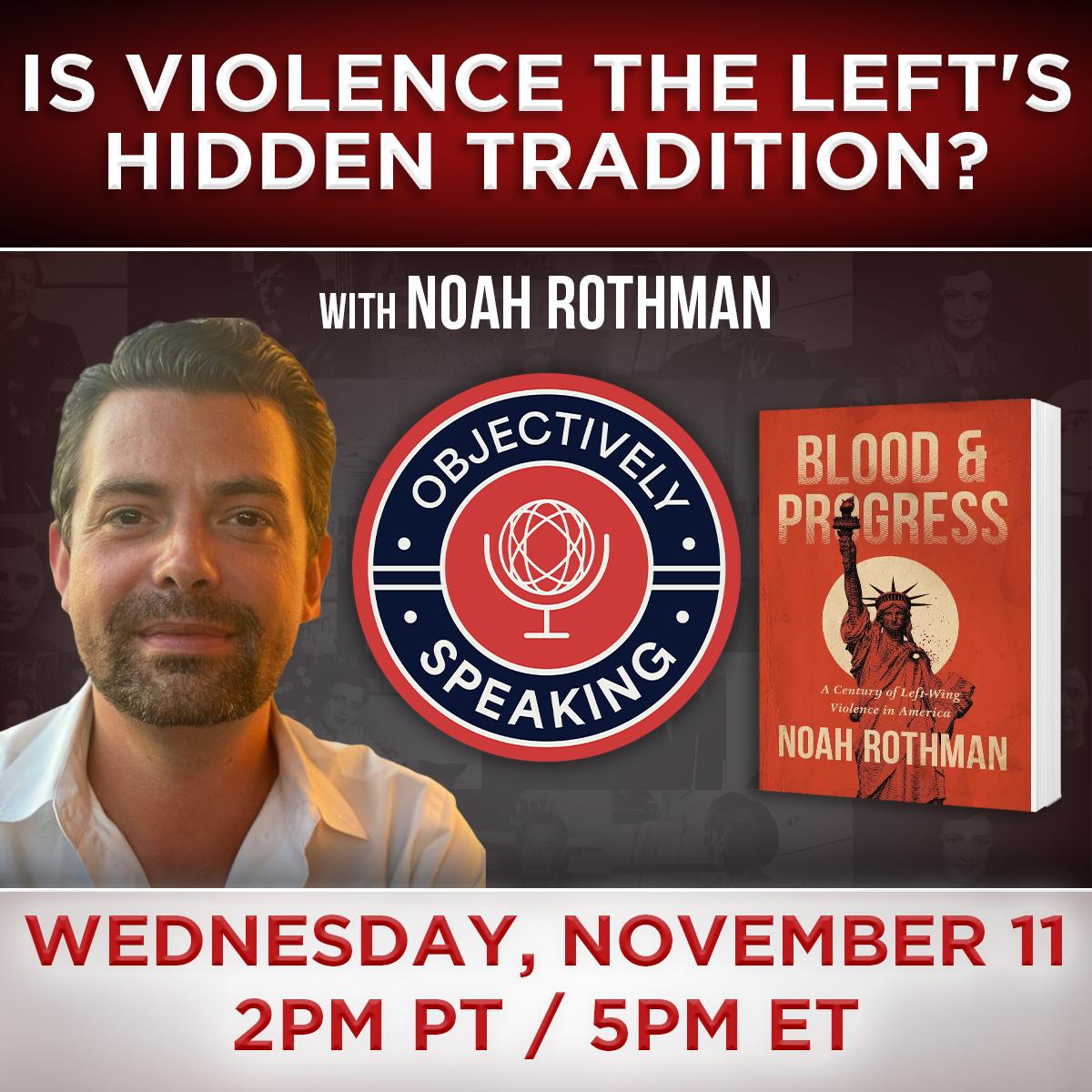
[00:00:00] Speaker A: Hi everyone. Welcome to the 327th episode of objectively speaking. I'm Jag, CEO of the Atlas Society. Joining you from Mamdanistan, that's not very charitable. Joining you from a very noisy New York City, the city that Ayn Rand loved. And I am very excited to be joined by Noah Rothman to talk about his first fabulous book.
It's called Blood and Progress, A Century of Left Wing Violence. So Noah, thank you for joining us.
[00:00:35] Speaker B: My pleasure. Thank you so much for having me.
[00:00:38] Speaker A: So I understand from my research that you started acting at seven and racked up more than 30 stage productions by the time you graduated from high school, then went to Drew on a performing arts series scholarship. How did the theater kid end up writing a book about a century of left wing violence?
[00:00:58] Speaker B: So I'm very impressed by your level of research into my background.
Yeah, that's, that's very much a trivia question at this point. But it is true. I started off my young career, such as it was, as a performing artist and got a scholarship to perform in college. And I had to think very hard about the nature of the, of the question in advance, how did this really affect my, my worldview and my work.
And I'm not sure that it did beyond an academic sense, in save insofar as that the study of literature and the study of drama and art in general provides you with the exposure to the breadth of the human experience and the human condition, which is an enlightening experience. It informs you that people are complicated, often quite irrational, motivated by more than numbers on a spreadsheet. But in sold art, art that is truly transformative and insightful into the human condition, is a sort of thing that is only possible in free liberal societies.
The kind of art that was produced, that is produced by totalitarian systems, is benighted and not satisfying and does not provide you any insight into the human experience.
So I moved away from performing arts after the September 11 attacks in 2001. I was a sophomore in college, and I resolved at that point. I was paying dues in the theater program, as anybody would, but I resolved at that point to do something perhaps a little bit more serious with my career. And so I was very, very much a fan of news. Talk radio in New York City in particular, 77 WABC AM, where I ended up taking an internship in sales, just to get in the door, because I wanted to be around news, but I wanted to be around news as entertainment, for lack of a better word. The analysis of news, the.
The way in which news packaged appropriately packaged in a way that's compelling and interesting and perhaps even a little provocative, becomes a form of art in and of itself. That's kind of what I wanted to do. So I ended up going to the news talk radio business, stayed there for a few years, bounced around New York City, ultimately went back to school to get a degree in my other passion, which is the former Soviet space and security policy in the former Soviet space.
And after I graduated with a degree in that from Seton Hall, I ended up moving into writing professionally. And the rest is history. I've been doing that since 2010.
[00:03:32] Speaker A: Well, it struck me what you said about art, because, of course, Ayn Rand was an artist first and foremost. She called art the indispensable medium for the communication of a moral ideal. And she talked about art as the recreation of reality according to an artist's values.
So I think having that early grounding in the arts may help you look at the kinds of values that are being promoted that are being celebrated in art and what they tell you about, about the health or the infirmity of culture.
So now turning to your book, Blood in Progress, your last book began when you complained to your wife that politics had ruined everything Fun. And she told you that was the book. So is there an origin story for this latest book?
[00:04:29] Speaker B: Yes.
So it was born out of a Commentary magazine essay was commissioned by my former boss, John Pod? Horiz, in December of 2024, in the immediate wake of the assassination of UnitedHealthcare CEO Brian Thompson.
And it was.
It had been the culmination of a decade's worth of work on my part. The origins of the the essay are the reward, the reaction from institutions, individuals in positions of political authority, entertainers who have significant platforms, many of whom just abandoned all propriety, all decency, anything remotely resembling a sense of civic responsibility to celebrate this act of human sacrifice. His name was cheered when it was mentioned on Saturday Night Live. Concerts celebrated him and his bloody work. His visage graced prayer candles, you know, in demand. Merchandise was sold with it. And politicians, in particular, left wing Democrats like Chris Murphy, Bernie Sanders, Elizabeth Warren, aoc All of them condemned the murder. But in doing so, they, all of them issued a very pregnant but at the end of their condemnation, but you have to understand that the health care system is, is such a disaster and everyone's angry about it. In Bernie Sanders's case, he said, but you have to understand it's not just the health care system that's broken.
It's the education system that's broken. It's the finance system that's broken, it's the election system that's broken, it's the housing system that's broken. Everything is broken. And what is the implicit remedy to that brokenness?
Total societal upheaval. Revolutionary churn.
It's always about the revolution. This was David Horowitz's insight. The issue was never the issue. The issue is always the revolution.
Briefly, to turn back to Ayn Rand, I remember an experience because her experience the stultifying education, educational system in, in the Soviet Union. It's important when you said art that it's the artist's vision, singular, not a collective.
And her free inquiry was discouraged and intellectual independence was punished. And Soviet Union is powerful stuff.
And I too had something of a. Why I ended up studying the Soviet space was I too had something of a. Of an ex. An awakening experience with Soviet history. In 1991, in. During the August coup, I was nine years old and I wandered downstairs. I actually had a friend over and I saw my parents watching events unfold on television and I saw in their face for the first time existential terror.
The prospect of the Soviet Union coming apart with hardliners and control of Moscow and its nuclear arsenal apparently was quite sobering to them. I had no idea what was happening. I was far too young. But I subsequently devoted my academic career to the study of security policy in the former Soviet space. As a result of my experience with that kind of formative, formative dread.
I am equally passionate about the prospect of civil unrest resulting from political violence.
The things I study are the things that scare me.
Thermonuclear weapons scare me. Communism scares me. Street violence in service to revolutionary political thought scares me. And that is what Blood in Progress, A Century of Left Wing Violence in America is about. It is about a nascent, perhaps even incipient revolutionary sentiment, a revolutionary ethic in this country that regards violence as an instrument of political utility and is not afraid to use it against their political adversaries. And it has been very effective. Over the space of the few short years that I've been chronicling the rise of political violence in this country, beginning in about 2016,
[00:08:22] Speaker A: I would say that I know you haven't yet gone embarked on your Ayn Rand literary journey, but given your professional interest in the Soviet Union and the culture and the atmosphere, I would possibly add we the Living, which is one of her earlier novels, but it's also one of her more autobiographical novels. And
[00:08:48] Speaker B: yeah, I'm woefully ignorant and this is my own failure in Ayn Rand's in works. And that is just something that I, I need to correct for. So I beg your indulgence there.
[00:08:58] Speaker A: Okay, well, so when we originally booked this interview, at least I could not have imagined that we would be having it in the wake of the blue tsunami and one of the most consequential shifts in midterms in terms of who controls the House and Senate. So I'm curious if you have any general thoughts, but more specifically, when it comes to the trends that you chronicle in your book, what sort of impact would, might a change like this have on either the left or the right? Might it be sort of a release valve for the left?
[00:09:40] Speaker B: So that is the big question, honestly, in my mind, is how this electoral wave impacts the political evolution of the progressive left and the activist left, not just the Democratic Party.
And there could be some counterintuitive and honestly kind of perverse effects. So the size of the Democratic majorities in the House and the Senate are pretty substantial.
We're looking at something like the composition of the House that looks more like the House looked like in 1962.
The Senate is a little less blue than it would have been during the height of the New Deal coalition, but is nevertheless now pretty broad. And these majorities encompass many different factions within the Democratic tent. It's very big. It's ideologically and geographically heterogeneous, which actually makes it easier for the majority leader in the Senate and the speaker of the House to form creative legislative coalitions that sideline the radical elements within the left, the democratic socialists and democratic socialist adjacent candidates. If this was a 13 seat majority, it would be really difficult for Hakeem Jeffries, for example, to form coalitions and pass legislation this very small rump. Nevertheless, you know, because it's so restive and so distant from leadership, not, not inclined to fall in line with leadership, it could do whatever it wanted. It could exact concessions from leadership, it could block legislation, it could hold the whip hand because it's so big they won't have that kind of influence.
But that could also have a radicalizing effect on the radicals on the far left who now would regard the system itself as wholly deaf to what they believe misguidedly are absolute moral imperatives. And if they think they're getting a socialist regime that will decouple the United States from the Zionist menace abroad and put billionaires in cages, they're going to be disappointed.
And what happens to you when you are disappointed with the political system, when you think it is just unresponsive to what you believe to be issues of paramount importance. One of two things. Either you withdraw, you resolve to. To wash your hands of this thing because it is just wasted energy, and that can be very depressing, which isn't itself psychologically healthy, or you resolve to radicalize and attack the foundations of this deeply immoral enterprise. So I'm very bad at predicting the future, but the scale of the Democratic Party's wins could have a moderating effect on the party overall while further radicalizing the already radicalized. That's what I'm looking for.
[00:12:19] Speaker A: Interesting. I hadn't, I hadn't thought of that.
Well, it's. In some ways it's a battle for the soul of the Democrat Party and it's a battle for the soul of the Republican Party as well. So you opened the book with reflections on the assassination of Charlie Kirk and its aftermath. Well, just last week, podcast hosts Jennifer Welch and Angie Sullivan read aloud social media posts that said we're digging up Charlie Kirk and doing it again, and then laughed for than 20 seconds. They then asserted that Tyler Robinson, the man accused of assassinating Kirk, was a MAGA person from a white MAGA family. Why does this falsehood persist?
[00:13:04] Speaker B: Well, it's a tough question.
My guess is that it helps, or at least it provides permission for really ghoulish and callous figures like these two broadcasters to justify their what is otherwise just naked, raw bloodlust.
And it gives observers permission to believe that they're still on the good side. They're still good people, even as they fetishize the murder of their political opponents.
Well, it wasn't really us or anybody us adjacent. It's a coping mechanism and there's a vast audience for this sort of thing, as their program demonstrates. And it's not just on the Internet either, but the effort, it's not. This is something that began within, and I'm not even joking, within hours, even minutes of the assassination of Charlie Kirk in September of 2025. And I describe it at the introduction of this book, just gratuitous in episodes one after the other of prominent broadcasters and political officials saying that either he deserved it or.
Or he like had it coming or he had it coming but we didn't do was a groiper. It was a far right radical.
It was somebody who. With who had. It wasn't even before the Israel conspiracy theories began to promulgate. This is. It was. It was an internal fractional dispute within the MAGA movement that took him out. Or alternatively, according to CBS News, within about a day or so of the assassination. They postulated theory that it was an example of nihilistic violent extremism, which is not a category within the FBI's how they categorize domestic political violence, domestic political extremism, or domestic violent extremism. Within that universe, there are little pockets of people who are, who fit within mostly, but not entirely right wing violence. Mostly, but not entirely left wing violence, anarchistic violence extremism captures most but not all political violence on the left.
Racial and ethnically motivated violence captures most but not all right wing violence, sovereign citizen violence, etc. Etc. Nihilistic violent extremism does not exist. It purports to claim that people mete out violence for the sake of violence because they engage in disordered thinking. Now, anybody who conducts, who performs an act of political violence in pursuit of social change is guilty of disordered thinking. They have alighted a whole series of events that go from a, act of violence, B, C, D, E, I and my family and society as a whole benefit. They are, they're obviously disordered in their thinking. But if you survey what they actually say, the practitioners of violence, and certainly the audience for political violence, and there's always an audience, it is very rarely the case that there is absolutely no motive here, that no one seeks to beget any general social change. They just seek disorder for disorder's sake. And it wasn't long before CBS just dropped that bizarre thread on which they pulled. But it all had the cumulative effect of convincing a plurality of people who responded to a YouGov poll about two weeks after Charlie Kirk's assassination that it wasn't a Democrat, somebody who was steeped in left wing ideology, somebody who was progressive to their core, as prosecutors and Governor Spencer Cox in Utah alleged within hours of the assassination, days, at least our days of the assassination, they said the people who responded that to that poll, a plurality of people said that it was a right winger who killed Charlie Kirk. It was a propaganda campaign from the beginning and it had its intended effect.
Why?
Why?
There's. I have many theories about this, but one of them being that there's an exploitable taboo here.
Whenever an act of obviously left wing violence occurs, as it did in this case, a lot of finger pointing happens from the political left and Democrats who get very sensitive and very defensive and they insist that all the violence, political violence, actually comes from the American right.
Now that's an expression of insecurity that's useful because what they're saying is Americans don't like political violence and we don't want to be blamed for being party to or accomplices in or even tacitly supportive of political violence. So we're going to accuse the other guys of doing it worse.
[00:17:28] Speaker A: Well, and, and they even put statistics to this. Right. There's.
What's the origin of the statistic that extremist violent murders. 76% are from right wing extremists and only 4% are from left wing extremists.
[00:17:45] Speaker B: Yeah. So that particular statistic, it was deployed by Congressman Seth Moulton in the wake of the murder of Charlie Kirk, I believe. And it's, it comes from the Anti Defamation League's figures. And the Anti Defamation League is just one of half dozen institutions that purport to have these databases that, that attempt to quantify political violence in the United States. And in quantifying it, they maintain that there's an overwhelming amount of right wing violence, whereas there's just a paltry amount of left wing violence. The University of Cincinnati's Prosecution Project is another. They produced a very popular infographic that circulated last conveying visually the notion that the American right is a bigger terroristic threat in the United States even than radical Islam by body count.
And if you dig into these individual cases, you begin to get very skeptical of the conclusions that they're retailing. When it comes to Cincinnati's Pro Prosecution Project, you have episodes that are claimed to be political violence from the right, but that no one would ever think of as being political violence.
They have somebody who graffitied the side of a church, for example, with hateful slogans. It's right wing violence. A homeless person wanders into a hotel and shouts racial epithets at the bellman behind the counter assaults that individual. That's right wing violence. Gang violence, prison violence, even intra family violence, as long as members of that family are of distinct racial or ethnic origin. That's right wing violence.
Cincinnati University of Cincinnati even claims that political violence peaked in the year 2019.
Which all of these things should pique some curiosity in those who are minimally interested in actually getting their hands around the issue of political violence in the United States. And it doesn't. And I'll tell you why. Because they're not, they're not interested. They don't want to know the actual answers here. When you flatten these events out into statistics and you're just looking at a spreadsheet, you end up eliding a lot of the motives that go into what these people who engage in disordered thinking are appealing to and specifically the audiences that they want to Impress because there is always an audience and there is an element of intimidation also that goes into the formulation of these databases.
There's a document that I kind of regard as a smoking gun. It was produced in 2021 for the Department of Homeland Security.
And in it it describes in detail, with citations how researchers who study left wing, violent left wing extremism face literal intimidation campaigns from their peers and colleagues. In the words of one of these researchers, they called it smear campaigns. They face social isolation. They face threats of retaliation for their work, including physical threats.
None of this seems to be of much concern to an industry that purports to be very concerned about political violence, but only when it comes from a single direction. And then they wonder why they can't comprehend the phenomenon of political violence in this country and certainly can't arrest its march.
Because it is a reciprocal phenomenon. It feeds on itself. One side takes inspiration from the other side, the other side resolves to mete out violence against their opponents. And the state, by the way, is always on the other side of this equation. Whether you're a right wing violent extremist or a left wing violent extremist, you are convinced that the state is on the side of the other guys.
And this is, this is something that you. That there's just very little curiosity about to a degree that I find very unnerving.
[00:21:23] Speaker A: All right. I haven't forgotten you, my audience. I just really love this book and have so many questions. We are not going to get to all of them. But Valiant Mike on YouTube who says he also loved the your your latest book asks.
He. He said it actually comment. He says. Absolutely bizarre some of the conversations I've had with people, some immediately abandoned decent decency towards someone once they reach an arbitrary net. Net worth. Kingfisher I actually think it was yes, Kingfisher who says really enjoyed the rise of the new Puritans.
He asks a question that is one that I was going to ask. Does your book explore anarchist violence in the late 1800?
Seems like many of those people would eventually find home within the progressive movement.
[00:22:16] Speaker B: Oh, it sure does, yeah. So Blood in Progress explores what I have identified as three distinct waves of left wing political violence in the history of the modern United States. Beginning in the late 1800s, but really kicking off in the 1910s. The late night aughts in particular were kind of a rebuilding year, but it was the anarchistic violence, labor movement violence preceded it. But the anarchistic violence of in particular the Italian anarchist sect really kicked off in the middle of the 1910s and sort of began to taper off after 1920.
But it was in my view the first of three major waves of left wing political violence. We're living through the third, but that one was the first. And it is shocking the extent to which the very recent scholarship and I say recent because it is this century but when we're talking about a timeline that's 150 years or so, that's pretty recent to me. It is only in this century that scholars like Beverly Gage and Jeff Simon and others have really cracked open the what they all call the forgotten era of political violence in this period. To hear the, you know, the American left tell it to.
Nothing really happened in the country between 1886 with the Haymarket riots in which by the way police officers were bombed and the 1919, 1920 Palmer raids. Except that the United States became terribly reactionary and oppressive to labor activists and immigrants. That's not even close to half the story.
The anarcho socialist movements of the 1920s conducted brutal bombing campaigns, carried out targeted assassinations in the name of not just labor activism but in the international proletarian revolution which by 1917 was a live project in Europe. Its intellectual lodestars include Luigi Gayani who is the spiritual and in many ways organizational head of the anarchist terrorists who are very prolific in their violence but also figures like Emma Goldman and Alexander Berkman who were unreconstructed Bolsheviks and found their way onto the Mitchell Palmer's Soviet arc.
But all of these figures were canonized by the socialist revolution's advocates. Luigi Gayani has kind of been memory hold.
But it wasn't just the anarchists. There was also labor unrest and labor bombings. Bombs according to the LA Times which reflected on the bombing of its own building in 1910 by labor activists not anarchists, just anti, just pro union activists.
Quote bombs detonated with regularity at non union construction sites bridges, viaducts, rail yards, foundries, derricks. In state after state businesses weighed the costs of further wreckage and often capitulated to their left wing tormentors.
So you know, the Palmer raids were terrible. They were an incredible abuse of power in the Wilson years. One of many abuses of power in the Wilson years. But the public absolutely had reason to fear labor activism and it's just elided in the historical record because the public turned on Mitchell Palmer. His presidential ambitions were ended by those raids and the Wilson government lost quite a lot of favor which complicates the socialist left's critique of America and Americans right, the notion there being that they're just com. They're just callous and indifferent to the plight of labor. No. Labor presented itself as an absolute menace in that period. And it wasn't until there was a significant policing, although overreach to a degree that really turned off the public, significant policing of the very few people who were actually engaged in violence. And the overreach of the movement itself when it began to target real innocence in acts of mass casualty events that were just appalling, that is what undid the first wave of left wing violence in this country. It's what undid the second wave of left wing violence in this country. And we have not seen that happen yet in the third wave, which is why I don't think it's over.
[00:26:23] Speaker A: All right. Jackson Sinclair asks something. Is there something inherent in revolutionary political ideologies that makes their adherence more willing to justify violence?
[00:26:38] Speaker B: Well, not all revolutionary adherence, but revolutions are, and war generally is accompanied by a certain level of social experimentation and a sense that all things are possible and a willingness to endorse what anybody would otherwise regard as extremist measures in order to advance a profound social upheaval. But it really is the socialist revolutionary movement that is inextricable from violence, socialism itself and collectivism itself. And we might talk about the French Revolution and Bolsheviks and their affinities for the French Revolution in a little bit, but the notion being, when you're talking about revolutions that are not as America's was, America's revolution was in many ways a conservative revolution because it sought to codify that which already existed on the ground.
Whereas many of these other revolutions are designed to a perfect the human condition, which is an impossible task, and B to upend an existing social order and in many ways mete out the kind of torment that the revolutionaries themselves believe they were victims of. The kind of persecution and torment from the ancien regime that they believe they were, they were on the other side of to. To give as good as they get.
And I think that is an element in particular with the socialist revolutionary left. But the socialist left also has a particular affinity for the Bolsheviks. And the Bolsheviks had the particular affinity for the Jacobins. So you really got to go back
[00:28:12] Speaker A: to.
[00:28:13] Speaker B: You got to go back to the 17, late 1700s
[00:28:16] Speaker A: in order
[00:28:16] Speaker B: to find the origins of it.
[00:28:18] Speaker A: Let's talk about that. Bolsheviks admiration for the Jacobins and specifically how they viewed and treated who they would designate as counter revolutionaries and their view of the terror.
[00:28:35] Speaker B: So the Robespierre quote that is on everyone's lips when this topic arises is Worth repeating in full if I, if I may quote. If the spring of popular government and revolution are at once virtues and terror, virtue without which terror is fatal, terror without which virtue is powerless. Terror is nothing other than justice, prompt, severe, inflexible. It is therefore an emanation of virtue.
So the Terror that the Committee on Public Safety instituted was a campaign of public hygiene as, as they pro, as they had it and as the revolutionary France had. You know, it's kind of gross from our perspective. But they were far more tolerant in revolutionary France of retributive violence against many figures, not just the nobility, not just the clergy.
But as the. As the revolution progressed, the Terror turned increasingly to the bourgeois caste, which is a very imprecise way of saying certain level of wealth, which is an equally imprecise way of saying an entire sector of society that is kind of subjectively defined.
And as one of the scholars who I quote said that the Terror essentially became class based very quickly. So the Soviets obsessed over the French Revolution.
They were really into the French revolutionary experience. Many of them had a great admiration for the Jacobins in particular, but they were also very self conscious. The Bolsheviks were very self conscious at the outset of the, of the October Revolution, shortly afterwards about comparisons with the Committee on Public Safety. They did not want to be associated with the Terror and tried to assure people who were supportive of the revolution that list there would be no red terrorists.
In 1920, the French historian Albert Matthias identified some real through lines similarities between Jacobinism and Bolshevism.
He said, one, they're both dictatorships, two, they're born of civil and foreign wars, three, they're class dictatorships operating on similar methods, terror requisition and taxes. And a final outcome, the transformation of all society, not just Russian society, not just French society, human society on the grandest possible scale.
And the Bolshevik revolutionary terror apparatus was, was certainly modeled on the French experience.
The historian Paul Johnson wrote in Modern Times, which is a fantastic if long book, that Lenin very quickly after the Revolution abandoned any notion of individual guilt.
He did not. And with it, Johnson says, the Judeo Christian ethic of personal responsibility.
Instead, the revolution became very fixated on categories.
Prostitutes, work shirkers, speculators, hoarders, et cetera, so forth. All of these very vague criminal classes were created so that the Bolshevik apparatus could turn on elements of the population that it did not believe were politically reliable.
And so it created a variety of categories that constituted class so that it could mete out class war.
The Chekist Martin Lapsus Said that the essence of Red Terror has nothing to do with what the individual had done, but rather quote, to what class does he belong? What are his origins, upbringing, education and profession?
So the accidents of birth mark you out for persecution in the socialist revolutionary state. And don't we see that everywhere today?
Don't we see the elements of accidents of birth marking you out for persecution today?
Maybe it's negative persecution, maybe it's designed to, to reduce your capacity to navigate the world. Or maybe it's positive discrimination and the belief that some individuals, or rather some classes of individuals, deserve to be elevated and given access to opportunities on the basis that they believe that they were shielded from having those opportunities. Unfairly that society is arrayed against them and blocked them from that which is their cosmic do.
Maybe there's some merit to that, maybe there's some logic to that. But to flatten individuals out into a category and to make them into undifferentiated components of an unlovely and ill defined whole that greases the skids for violence, that dehumanizes your subject and it gives you license to do to an individual what you would do to a group, because you no longer see an individual, you only see a category.
[00:33:25] Speaker A: Wow. Very powerfully articulated. Iliacin asks, and I'm not sure if you.
I don't think you cover this that much in the book. How does left wing political violence in America compare with similar movements in Europe or other Western countries?
[00:33:42] Speaker B: So the experience of the United States in the second wave of political violence in this country, which is in my view the. What I would describe as the Marxist guerrilla movements of the late 1960s, 1970s and very early 1980s.
And they were very European in how they conducted themselves.
The Weather Underground in particular, but also the Black Liberation Army. So Symbionese Liberation army, the faln. Half a dozen more, probably more than half a dozen more.
They were infatuated with Cuba in particular, very in orbit around Havana. And so they had tendrils linking them to the Soviet Union. But they were more or less inclined towards the Cuban style focalism, which is very attractive to people who are revolutionary in temperament but small in number. Because the logic of the Cuban revolution is focalism. And focalism maintains that you don't have to have the public on your side to engineer an evolute a revolution. That's not what happened in Cuba. What happened in Cuba were very small Marxist guerrilla movements ended up taking very key positions early on through military action, through targeted terroristic actions, and collapsed the state by with pinprick attacks. They didn't need the people on their side. That came later. So it's a very attractive idea if you're a small militant movement in the United States.
They, they tried to appeal to hearts and minds, in particular the Weather Underground, but for the most part they were not interested at all in persuasion. They were interested in intimidation, coercion and violence.
And outside the United States there's a companion book I describe it as, even though I don't know if the author would think of it that way. But Jason Burke is the author of a book called the Revolutionists, which I think is a very good companion to Blood in Progress. Because whereas I focus exclusively on the United States, Burke just completely ignores the United States deliberately and focuses on this very the same revolutionary movement in the same revolutionary period everywhere else. And what he describes is these same groups who are in orbit around Havana primarily In the early 1970s, late 1960s and over the course of the 1970s, they migrated away from Cuban style Marxism and toward Pan Arab nationalism as evinced by the regimes in Iraq and Syria, the Ba' Athist regimes. And then after 1979, they become full scale Islamists. They are infatuated with the Iranian revolutionary movement. They fall in orbit around the Islamic Republic.
And they are part of the Red Green alliance for the most part, which subsequently, and this is, this has become a term that everybody is familiar with just by virtue of the nature of political activism on the progressive left today. But it was kind of an obscure topic for a while. The Red Green alliance was just a blip of Iranian revolutionary history that you had to be a fanatic to know about. Now it's become very popular.
But a lot of these people were just attracted to violence. The ideology changes. Some say that, well, you know, the Iranian regime with its embrace of militant Islam filled the hole in their soul where God would have been. In the Marxian formulation, there couldn't be none.
And maybe that's true. But from Burke's telling the people who were the executors of violence on behalf of the Marxist cause, the Islamist cause, the Pan Arab cause, it was the violence that was a common denominator, not ideology. And I think we're seeing a lot of that in the movements of the modern political left today that is inclined towards political violence, or at least excuses political violence. They look a lot more like Jason Burke subjects outside the American experience than they do the Americans and even the migrants to the, to the United States who executed violence on behalf of socialist causes.
It is becoming much more European in that sense and much more foreign in that sense.
[00:37:51] Speaker A: So one of the most fascinating observations in your book was that of the Soviet Union's role in fomenting the kind of anti Israel, anti Semitic attitudes that are now spreading like a cancer. When did this start? And what were the Soviet Union's strategic aims in what, I don't know what else to call it, but a psychological operation?
[00:38:20] Speaker B: I mean when you say this it kind of sounds like crankery, right? It almost sounds like Bircherism that you're saying, well, you know, a lot of the Jew hatred we're experiencing now is a vestigial hangover from the Cold War in the Soviet Union's. Soviet Union's agitation. But it kind of is in the, as a, as a matter of statecraft, as an absolute necessity. The Soviet Union looked at the, the results of the wars in, in, in the Middle east in 1967 and 1973 in which they had funded and supported and agitated on behalf of the Arab armies and lost badly in both wars.
So can't beat them, the, the Israelis. So what do you do? You have to demonize them. And that is what they did. Soviet academia created a field of study that they called Zionology.
And Zionology was a project designed to demonize the state of Israel in bigoted and anti semitic terms.
They the Israel was described in, by Zionology's terms as a militant, chauvinistic, racist, anti communist ideology.
It was anti human and reactionary. It supported the evils of colonialism and neocolonialism. It was a white imperial outpost in the Arab world. It was a genocide there. It used rape and famine as weapons of war and so on and so on. All of these narratives are with us today. They have about as much basis in fact today as they did in 1973. And it was part of an effort by the KGB to discredit the, the State of Israel and the entire Zionist enterprise. And it was very successful within radical elements who were bought into the, to the Soviet project. The kgb. There's documentation about this. I'm not making it up. The KGB sought to discredit the, the Zionist enterprise in Israel by forging racist letters attributing them to the Jewish Defense League in New York and distributing them to black leaders and the heads of Arab missions.
This is around the time that the Soviet Union spearheaded a campaign to get the United nations to adopt the infamous Zionism is racism resolution.
Moscow concocted dozens of lies about Israelis forcibly sterilizing Arab women and planning to destroy Jerusalem's Al Aqsa Mosque, rather in advance of the reconstruction of Solomon's Temple. I mean, you still hear this stuff and it is just, it is not based in anything remotely resembling fact, but it is sort of a legacy of this vestige of an age when half the world looked to Moscow for guidance on these measures. And some of it is still with us today. Most in particular the efforts by the Soviet Union to equate Israel with Nazism and the Nazi regime and describing Israel as essentially the successor to the Nazi regime, which obviously the Soviet Union and all their fellow travelers are arrayed against. This is the modern origin myth that the Soviet Union was forged in the Great Patriotic War. So they describe anytime, you know, the Soviet or Israel engages in an act of defense, it's a blitzkrieg.
They are, they're engaged in, in genocide, just much as their Nazi tormentors were. And it's repeated everywhere.
It was a, a long lived project and it petered out after the refuseniks in particular were allowed out of the Soviet Union in its final closing days.
But its legacy is still with us. The literature is still with us. And all the sentiments that were promulgated very cynically by the KGB and Soviet elements only to advance the Soviet geopolitical position.
They have a much longer half life. It tells you something about the nature of, of anti Semitism, that it survived even the Soviets who tried to revivify it.
[00:42:19] Speaker A: So a major theme in your book is the permission structure or the ways progressive institutions, media have minimized, contextualized or romanticized left wing violence. What are the most consistent rhetorical moves you observed across different eras?
[00:42:38] Speaker B: So of the three waves, the 1910s, 19, all the hits, the 1910s, 1920s, 1970s, 1980s and today, the propaganda of the deed is one. That's what the Italian anarchists called spectacular attacks that are designed to galvanize a broader audience.
And there's something of a delusion in that Today we would call it direct action, or at least those who engage in black block tactics would, I think, call propaganda of the deed direct action.
And the, the notion that fuels it is this self delusion in which those who are inclined towards left wing violence convince themselves that everybody agrees with them, or at least a majority agree with them. They're just too cowed, too intimidated, too beholden to their material circumstances to rebel against the conditions that we all despise. Right?
So one big act of violence, demonstrating that the God can bleed, that'll galvanize everybody. They'll all join us at the ramparts and we'll finally kick down the edifice of this rotten structure. That's propaganda of the deed. It is apparent throughout the centuries small cell leaderless organizations is another.
Luigi Gayani ran one. The bla, the Weather Underground, the FALN were another. And we've begun to see something akin to that over the as. As the violence that we've been experiencing over the last decade intensified, particularly in 2025.
Over the course of that year we saw several attacks on law enforcement which is another feature of left wing political violence. They are very keen on killing cops, be point blank about it.
And we saw plenty of attacks on federal law enforcement last year. One of them was especially unnerving. It involved 10 members of a militant left wing cell and there was no ambiguity about it. They brought with them literature and banners advocating proletarian class revolution, kill the pigs, etc so forth. They were unambiguous. It's the press that didn't want to identify it. So if you didn't hear anything about that, that's just because media got very self conscious about it. But it wasn't a, it wasn't like a slap dash attack.
These they gathered in in the tree line surrounding this CBP office in Texas, used fireworks to lure their targets out and then opened up on them from overlapping fields of fire and ended up hitting two of their targets. Nobody was killed fortunately, but some were seriously injured.
And that to me was indicative of a small cell terrorist operation. And that's the sort of thing that we've seen, we saw through Italian anarchists, we saw it in the bla, et cetera and now we see it today.
Lastly, sort of the notion, again it's a notion, but it is consistent across the century which is the idea that systemic oppression licenses extralegal violence. However you define systemic oppression, it's a very elastic and sort of ill defined concept and it's one that's very subjective or at least lends itself to subjectivity. But it is apparent just about anywhere you see episodes of left wing violence unfold or even support for episodes of violence that have no political component to them. I'll give you just one example.
Also last year I believe it was a gentleman who was suffering from football related injuries, walked into head injuries, walked into a Manhattan high rise with a long rifle shot in a. A cop, off duty cop who was doing security. There was a shot, another person in the hallway went upstairs in pursuit of the NFL, thought he was going to the NFL's office where he would mete out revenge for the headaches that he suffered as A result of his CTE from playing football as a youth. He didn't make it to the NFL. He made it to the office of a real estate trust. And he killed an executive there by the name of Wesley Lepatner before turning the gun on himself. Act of violence. As senseless as senseless violence gets. Right.
There is a whole audience, and the Free Press's Maya Sulkin did a very good piece on this. There's a whole audience of people, some of whom use their real names to talk about how this was a act of revolutionary vengeance against the rapacious capitalist enterprise. And that Wesley Lepatner was obviously a bad person because she participated in commerce as we understand it, and that her murder was nothing to be sad about. It brings us all closer to the revolution in which you and I and everybody else who deserves it will get their comeuppance. It's a sick philosophy. It is. It is not something that anybody with an instinct towards national self preservation or even individual self preservation should inculcate. But there are a lot of people who see a pathway to power on the back of these pathologically violent delusions. And so they're nursing them, so they're incubating them. And we're seeing a lot more of it.
[00:47:38] Speaker A: Very dangerous. Now, before reading your book, I had not heard of Assada Shakur. So who was she? And what does her deification by the left tell us about the Project to Make Heroes or martyrs out of people who advocated or even committed political violence?
[00:47:56] Speaker B: Yeah. So she's one of the heroes and martyrs in my chapter, Heroes and Martyrs.
She was a militant activist, born Joanne Chesimard, self styled Assata Shakur.
She was a member of a particularly violent Black Liberation army cell that was. She was based in New York. She went down to Georgia with this cell. That cell was broken up. Many of its members were killed. She survived before returning to her native New York City to terrorize the area. Rob churches, rob banks to fund revolutionary activity. She was an.
An educated and passionate but otherwise unremarkable member of this Black Liberation army cell until her and her compatriots were stopped on a New Jersey highway in 1973.
A shooting broke out. Assata Shakur, as was one of the members who was arrested and convicted for complicity in the death of Trooper Werner Forester.
Now, her defenders say that she was set up, that she didn't have any participation in that, that she was actually shot in the hand, and therefore she was. It's evidence that she was surrendering. No court found anything like that, she was convicted and she was sent to jail. In early 1979, the remnants of the Black Liberation army, as well as an all female communist group called May19 and another organization called the Family, all of these Marxian guerrilla movements pulled off a. A prison break, broke her out of a prison that's actually just about 10 miles away from me. It's very close. In Clinton, New Jersey.
And Assata Shakur made her way to communist Cuba, from which she preached anti American radicalizing, you know, tracks and agitated against the United States, living very comfortably on the communist Cuban dime until she passed away in September of last year.
But there is a huge cult around her and there has been for decades. College campuses named buildings after her. She has dozens of glowing profiles in media outlets. Celebrities write songs about her. She's. She had her. They're her activist class that is beholden to her legacy, has the ear of many prominent people within the Democratic Party, in the press. When she passed away, npr, one of the NPR correspondents described her as, quote, a towering figure in American movements for black liberation and racial justice who, who took up arms in the fight against the oppression of black people.
She was a thug.
She was a murderous thug who killed a cop and who robbed churches.
But that has been recreate, reconstructed into a narrative as though she's Stalin herself, who, by the way, robbed churches and banks and killed people to fund the socialist revolution.
It's morally vacuous and it is all in service to popularizing the notion that violent revolutionary figures, as long as they're on the left, have virtue on their side.
[00:51:00] Speaker A: All right, we've got nine minutes left. And I'm definitely not going to get to all of my questions or the audience questions, But I did want to get to how you talk about the increasing percentage of young people who see that political violence is justified to prevent nonviolent behavior or speech that they disagree, such as, you know, fires, annual surveys. What can you tell us about that and where we're going?
[00:51:34] Speaker B: Yeah, so not good news. The. In 2017, UCLA pollster John Bellisinor surveyed young people 1829 and found that nearly one fifth of the students he spoke with, student, student age, said that violence was acceptable as a means of protest against speakers with whom they disagreed.
By the fall of 2022, the William F. Buckley Program at Yale did a similar survey of students and found that two out of five, about 41% of students believe that physical violence to prevent discrimination or the dissemination of dangerous ideas was warranted. So in other words, violence to protest speech in the fall of 2024, the Fire Surveys foundation for the Individual Rights and Expression Good organization found that a third of the 50,000 college students they surveyed believed violence might be acceptable as a response to nonviolent behaviors.
And last year, FIRE's 2025 survey found that the deterioration had continued. Still, fully one third of young people said that it was either somewhat or rarely accepted acceptable to use violence to stop people speaking on campus. But 34%, an increase of 2 points from the last year's survey, said that it was acceptable, which is a 10 point increase from FIRE's survey four years ago.
And it's even worse if you look at the generational level.
The majority, vast majority of baby boomers, the vast majority of Gen X, the overwhelming majority of millennials agree that violence is not acceptable as a response to nonviolent behaviors. But it's just 58% among Gen Z.
And when it comes to the Wall Street Journal wrote this quote, there's no meaningful difference between the attitudes of 18 to 26 year olds who are and who aren't enrolled in college when it comes to violence. So it it would be nice if we could attribute this to indoctrination on college campuses. The FIRE Survey does not suggest that FIRE survey indicates that the contagion is no longer so contained.
It is being disseminated not just through the professorate, but through TikTok and Instagram and the media channels that they pursue and in conversations with each other and at the workplace, who knows? But the bottom line is that there is a growing, if not outright celebration and acceptance of political violence as an instrument of utility in settling political disputes.
They're willing to tell pollsters that there's no stigma around it for them.
And that's maybe a leading indicator, a canary in the coal mine of where we're headed.
[00:54:23] Speaker A: That actually leads into a question from my modern gulps. The last audience question will take do you think social media has made political radicalization easier or has it simply made existing extremism more visible?
[00:54:39] Speaker B: Actually, that's a really good question and I don't know the answer to it. I wouldn't want to give a flip response because just because I'm very mistrustful of social media and say yeah, social media is doing it, I think probably a holistic exam exploration of the roots of this phenomena would say both and that it's not there. Certainly social media is fueling it. Certainly there are elements, anti American elements who invest in social media platforms in order to sow disunion and dissension and. And violent dissent.
I know that to be the case. We all know that to be the case. But it's not a monocausal thing. So it would be probably misleading to say that we. There's a panacea here. And if we just shut off, we just unplug the social media machine, we all go back to the way things were. I don't think that's how it works. It's probably a multifaceted phenomenon in which social media is just one of the elements fueling it. There's the problem here is a demand problem.
There is a demand for radical extremism. There is a demand to see your enemies brought low and to suffer the kind of ordeal that you believe they should suffer in your heart. That is a. That is a social sickness.
And I don't think it's. Social media is responsible for it. It's certainly amplifying it, but I don't think it's the origins of it.
[00:56:00] Speaker A: Well, with all of that bad news, is there any hopeful notes on which we can close? Or what can people do who are read your book, who are concerned about this future of the country? What needs to happen to stave off the rise in political violence?
[00:56:22] Speaker B: Yeah, so here's the thing. Whenever you write a book, your publisher wants, you know, they want to say, what do we do about this problem?
And the answer that I give at the end of this book is, I don't know.
I know that's not a satisfying answer, but I would never dare suggest that I have a pat answer to the problem of political violence in America that would be so hubristic as to invalidate everything else I'd ever written. Anyone who dares claim they have a pat answer to a problem that is as old as the country itself is selling you something. And I am selling you something. I'm selling you a book. But I'm doing so honestly, at the very least. Which is not to say that I have no recommendations. I have probably a half dozen recommendations about the behaviors that we can model, things that police and political professionals can do to reduce the incidences of radicalization in response to police action. For example, dispense with misconceptions that terrorist violence, for example, is a product of privation and want. It is not. We have documentation, social science, to demonstrate that people who engage in reactionary violence are often quite learned and often quite affluent.
And we can also, you know, reduce politics back to the place where it belongs. Right now. We have inflated politics so that politics no longer means elections and Legislation and the conduct of politicians within the. The conduct of their enumerated public duties. No, no, no. It means everything. It means the food you eat and the clothes you wear and the brands you patronize and the commercials you watch and the music you listen to and on and on and on. That's not politics. Even if it's political, it's not politics. And the fact that people think it's politics is radicalizing because the Constitution does not allow this government to alter the social compact, cultural compact from on high. It's. These things are unresponsive to politics. They're outside of politics. So conceptualizing them as politics has been terrible for the country, even though it's really good for people who make, you know, social media posts and videos. But do I have a response to, you know, to arrest the cycle of radicalization? None beyond the fact that we need to. We need to find a much more responsible political class, a much more responsible class of elites. And I just don't think the incentives at the, at the electoral level, particularly in the primary level right now, are enough to get good people into office. We've made it an impossible ordeal for anybody who's interested in actually advancing the American Civic Compact to get into public office unless they have enough money to insulate themselves and their families from anything like the discomfort that anybody else experiences when they're, when they're seeking high office. So the only people who seek high office now are people who are very radicalized, very narcissistic, or independently wealthy.
And that is a really unfortunate situation,
[00:59:11] Speaker A: at least to begin to come up with a cure or a recommendation or a therapy. One needs to be able to diagnose and be aware of the problem. That's why your book is so important. And I want to encourage everyone watching or listening to go out. The audiobook was also excellent, so I can highly recommend that. So I also can recommend what we're doing at the Atlas Society. I do think that education and also the conveyance of values such as tolerance and objectivity and individualism rather than collective guilt and collective identity is important. And it's something that we are day in and day out conveying to the young people that we serve. So, Noah, thank you so much for your magnificent, innocent book and thanks for joining us today.
[01:00:05] Speaker B: Thank you. It was a pleasure.
[01:00:07] Speaker A: Thanks everyone for your great questions. Sorry I couldn't get to all of them. I hope you will join us next week. I will finally be home in Malibu. Joel Trammell joins us to talk about his book. The chief executive operating system. The essential playbook for success in the CEO role. I'll see you there.