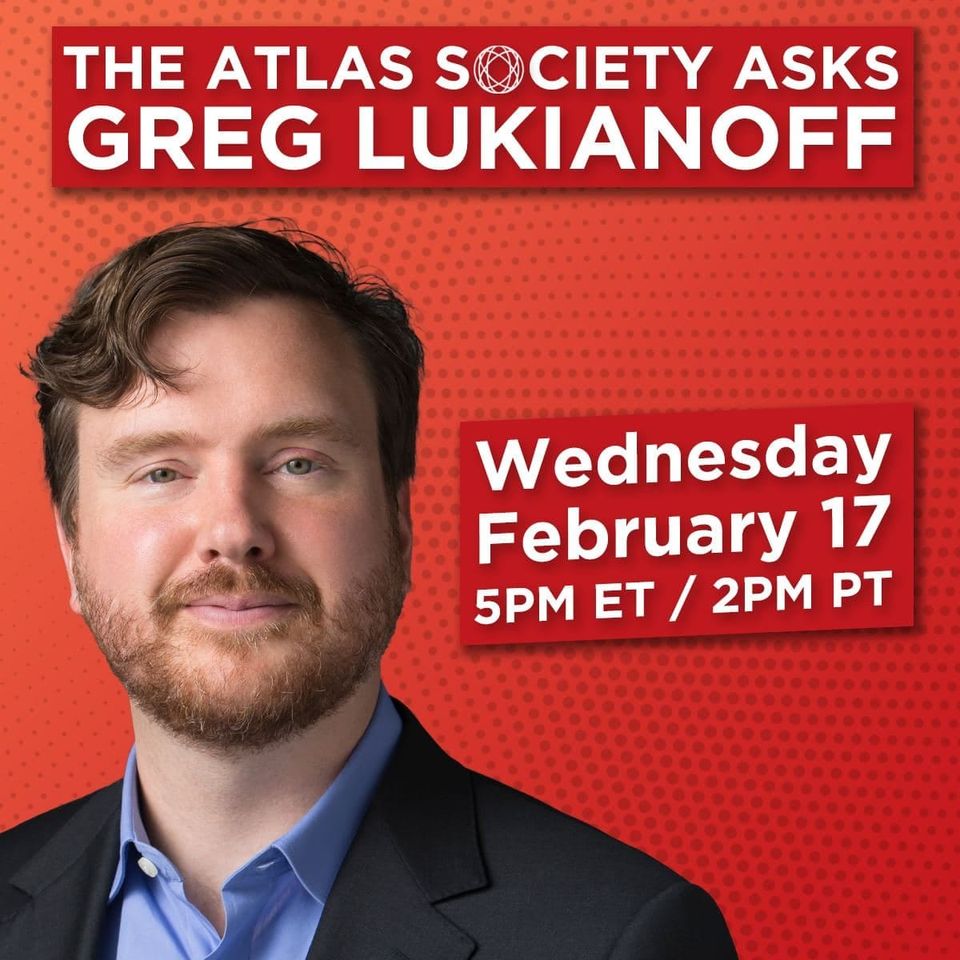
[00:00:00] Speaker A: My friends know me as jag. I am CEO of the Atlas Society. We are the leading nonprofit connecting young people with the ideas of Ayn Rand in creative ways. Today I'm so excited. We are joined by Greg Lukianoff. I'm going to get to his introduction in a second, but I want to remind you, if you are joining us on Zoom, if you're joining us on Facebook, if you're joining us on YouTube, please start teeing up your your questions for Greg. Keep them brief. Just type them into the chat or into the comment stream and we'll get to as many of them as possible.
So Greg is a First Amendment lawyer.
He is also the President and CEO of the foundation for Individual Rights in Education, known to many in our audience. As far as fire, which is a non profit dedicated to protecting free speech on college campuses.
He is also the co author of the Coddling of the American Mind as well as Unlearning Campus Censorship and the End of the American Debate. He is also the author of Freedom from Speech.
Greg is also an executive producer of Can We Take a Joke? A feature length documentary that explores the collision between comedy, censorship and outrage culture on both the left and the right. Greg, welcome. Thanks again for joining us.
[00:01:42] Speaker B: Thanks for having me.
[00:01:44] Speaker A: So your organization, Greg fire, protects free speech on college campuses and fights speech codes, but you fight for violations on both the left and the right.
You know, you say that there is pressure coming from both sides of the political spectrum.
It may just be bias on my side, but it seems to me like most of those attempts to pen up free speech is coming from the left. But elaborate, enlighten me.
[00:02:18] Speaker B: Sure Fire. We're nonpartisan and we defend free speech from all comers. And definitely because of the culture where the question always that seems most on people's mind is is it more the right or the left? And when it comes to campuses, you know, to the extent to which anything happens on campus, campuses are overwhelmingly outside of religious colleges, overwhelmingly left leaning. And that's administrators and professors, the whole thing. So a lot of times you are it's a pretty reasonable assumption when you know one side of the spectrum is in charge. If you're going to get in trouble on campus, then that's the political leaning. Generally when people get in trouble for things that offend the right, it comes from off campus, it comes from politicians, it comes from legislatures, that kind of stuff. And we defend students and professors in those cases as well. But what does frustrate me from the culture war lens is that we have an awful Lot of cases that aren't all that political.
They're just like a story as old as time. When people have power, they tend to see people who dissent from them as being threats.
They have this pesky thing called free speech that interferes with their ability to punish these people, but nobody's looking, so let's get them.
And we see an awful lot of cases that aren't all that political.
During COVID we've seen an awful lot of cases that are not really political. They're about public relations.
There was a case at NYU that got onto oh, and by the way, you caught us on a good day because today we came up with our 10 worst schools for Free speech list. And if you look at it, it's all over the political map. But a lot of are universities acting as selfish protectors of pr.
And one of the ones that really backfired was New York University right at the beginning of COVID decided to tell its doctors that they weren't allowed to talk to the press unless they ran it by the media department. And it's like, so a media flack is going to tell a doctor who also teaches what he or she can't say to the media. So we do see a lot of cases like that. Now, of course, the political correctness run amok cases, those absolutely happen. I can talk about some examples of those. But, you know, free speech is if it has to be for everyone or it's for no one.
[00:04:36] Speaker A: Well said.
So one of the things that I really liked about reading your book and listening to it on Audible, which was an excellent recording, is you talk about some of these larger cultural forces that are at play.
And you start off the book in kind of a humorous way of saying that you and Jonathan went to seek a guru and he told you guys these great untruths. So tell us a little bit about the three great untruths that students are being taught, and what are the consequences of encouraging people to think in that manner?
[00:05:18] Speaker B: So the idea is that it's as if we're giving a generation of citizens, of students the worst possible advice. And so in this kind of scenario that we open up with, the supposed guru tells us three things.
One, what doesn't kill you makes you weaker.
Always trust your feelings.
And life is a battle between good people and evil people.
And we're both like, this is the worst advice we've ever heard. This doesn't make sense in terms of pragmatics. This makes sense in terms of moral philosophy. And then we just turn around to the audience and say, then why are we teaching our children all of these lessons, if you think about it? And so the book is more or less trying to figure out what was so different about students who were hitting colleges around 2013, 2014.
They were less tolerant of speech. They were more likely to demand new speech codes, to demand people get disinvited from campus. But they're also more likely to justify those attempts in sort of quasi medicalized language, saying that, not that it would just be the case that this person's coming to campus, and I despise this person, and I think I hate their political views, which, you know, also as old as time. It was, this person can't come to campus because it will be medically harmful in a psychological way to not usually not the person making the argument, but some other, other person over there.
And this hit. This hit campus is like a lightning bolt. Like in 2013, 2014, prior to that, students had actually been our best constituency for free speech and then suddenly turned a switch. And so the whole book is trying to figure out where this was coming from.
And we highlight all the different ways in which we're conveying these messages to young people that are dysfunctional, that are the great untruths, that essentially words can hurt you forever and are likely to hurt you forever. Not true.
That you should always trust your feelings, that if you feel something, something has to be done. That's a cognitive distortion. That's something that if you decide that every impulse has to be met with some kind of either action on your part or worse, action on someone else's part, that's not functional. And then, of course, the very sort of classic idea of life is a battle of good people versus evil people.
That's not most of life. Most of life is that people are complex. And this is the kind of sophistication you're supposed to be learning in higher education. But surprisingly, in elite circles, the morality play has actually gotten shockingly simple.
[00:07:50] Speaker A: Well, so as we have a lot of objectivists who are joining us today and watching us on our various platforms, and I want to encourage all of you who are joining us to bring your questions for Greg.
But it is an audience that's particularly interested in how do we think objectively avoid cognitive distortions, avoid confirmation bias.
One of the things that I was the most surprising to me in your book, and because, as you say, you really talked about it as kind of something that happened rather suddenly, you know, so often when we talk about things that are cultural trends, Political trends. We use that old metaphor, you know, of the. Of the frog boiling in the pot. And this was. No, this was just actually more instantaneous.
One of the things that you cited was that, well, it's not so much, or it is maybe partially that it's politically biased administrators or politically biased professors.
You saying that campuses were just kind of struggling with more of a mental health crisis, that all of a sudden they were seeing students that were coming to campus that had various degrees of sort of a fragility.
Tell us a little bit about that, and what are some of the things that contributed to it?
[00:09:21] Speaker B: Yeah, so it was interesting because we wrote the original article, Coddling the American Mind, the thing that led to the book in 2015.
But I began it thinking about it way earlier, and I'm very candid about my own issues with anxiety and depression in the book, much more candid than I'd actually been with anybody. I just put it in the book and tried to pretend that, you know, I was talking to an old friend and realized that I, you know, really revealed a lot about myself. But as I was recovering from anxiety and depression, I learned cognitive behavioral therapy and CBT and objectivists will very much appreciate this. It's about not just arguing with others fairly. It's about rules for arguing with yourself fairly. And one of the things that I think is underappreciated for all of the, you know, moral philosophy about how irrationality can make you not just wiser, but also happier.
There aren't always the best examples of that. I mean, I'm a big fan of a lot of stoic thought, for example, But I do think it's really quite profound that the most successful intervention for anxiety and depression of the last 75 years has been a kind of internalized talk therapy where you investigate your own thoughts. And you don't ask yourself, am I seeing the sunny side of the street? You're not saying it's not power or positive thinking. You just ask yourself, is this rational? And the thing is, you can know all this stuff intellectually. So, like, if students. If people are listening and they're going to themselves, well, I know this. Intellectually, it's not good enough. You have to actually turn it into a habit. And the way you do that is by writing down when you have a thought. Like, I always give the example of, you go on a bad date, you get back, and you say, in a pit of despair, I'm going to die alone.
These are the kind of things that people think.
They think these exaggerated Catastrophes, thoughts. But what you do in CBT is you write down the thought and you. And you very methodically evaluate it and ask, is it a distortion? And something like that, that's catastrophizing is one distortion.
That's mind reading. You don't actually know if the date went poorly. That's fortune telling. That's looking into the future.
That's binary thinking, essentially, that either something has to be great or something has to be terrible. And you run all these things past yourself, and by the time you actually get it back to reality and just say something to yourself like, well, you know, I was sad because the date didn't go well. It suddenly has lost an awful lot of its power. And profoundly, this is one of the great interventions for anxiety and depression. So where am I going with this?
Back in 2007, I started noticing that administrators on campus seem to be modeling cognitive distortions. They seem to be saying, do catastrophize, do overgeneralize, do engage in binary thinking because you're always in danger. Which is also kind of like catastrophizing.
And it was only when. But the students didn't seem to be buying it. They seemed to just be rolling their eyes at it. And 2013, 2014, switch.
Students were coming in with this kind of cognitively distorted thinking, and it manifested in hostility to speech, the idea of obsession with safety. That essentially because they viewed not just themselves, but other people as extremely fragile. That's where you first started hearing language about safe spaces. And we predicted from in 2013, 2015, that if this is the way these students coming in, are thinking, this is going to result in, you know, some.
And we're, you know, I'm a lawyer, but I dabble in a lot of social science. We're expecting, you know, maybe a little tiny curve up on anxiety and depression, but due to these new trends. And it was like the anxiety, depression, the manifestations, unfortunately, in suicide. I mean, suicide rate doubled for young women between 2007 and 2019.
They also continue to go up for men. It was much, much worse than we thought. And it was really experienced as a crisis on campus. I think that campuses are doing things that are making it worse.
[00:13:33] Speaker A: So we recently had Lenore Skenazy, who you host.
Yeah, no, she was spectacular.
And she identified some ways in which media inspired fear, was leading parents to overprotect their children. And then the process kind of limit kids opportunities to develop more resilience and coping skills.
What advice do you have for parents and teachers to raise stronger More independent adults rather than, you know, weak, anxious, forever children.
[00:14:14] Speaker B: Well, I say this as a parent of a three and a five year old boy, Benjamin and Maxwell.
And I even do this series called Catching up with Coddling on my blog. The eternally radical idea where I do these things called coddling Caveats because I felt like we were told by our editor and some other people not to admit that you're an anxious parent yourself. And I'm like, people desperately need to know this.
I'm not recommending anything here that I find easy myself and my wife somet has to remind me of my own values on this stuff. But you have to, you have to encourage them to face their fears like that essentially. Like when, now when something scary comes on tv, particularly if it's not genuinely kind of like, oh God, if it's just something that one of my son is saying, he's spooked about it for some reason, like watch it to the end, watch the whole thing and you'll see where it ends and you'll get through it and you'll feel good about getting through it. And so basically making sure that you're challenging them.
The research, by the way, as I went deeper into after the book, the research on not dealing with phobias early, well, it's actually they're not even necessarily phobias, they're just aversions at first.
So not dealing with like an aversion to dogs or pets.
The research is horrifying on how not addressing that can lead to someone who has all sorts of avoidance issues and eventually develops many phobias. That's what they grow into. So you have to help your kids face their fears. You have to give them some responsibility, you have to give them some independence and you have to give them some time on their own to play on their own.
And this is something that when we were coming into the book, we were not expecting to pretty much universally hear from a development psychologist that no, they need free time. They need free time on their own child. Directed play outdoors is better.
So giving your kids a certain amount of freedom, do not schedule them from 6am a.m. to midnight, is really crucial. And it was funny writing this because I live on, you know, I live on Capitol Hill in D.C. like, and these parents, you know, like they're the kind of people who want to send their kids to the fancy, you know, schools. And I'm like, wow, they're doing the exact opposite. And that's exactly what we noted in the book. That essentially, and to be clear, like, I come from. I'm a first generation American. The, you know, when I was a kid we were like bottom quartile and we were very clear in the book that a lot of the issues we're talk about are not issues faced by people in the bottom half of the social economic stash. The issues there are very profound and very different.
Since we're mostly interested in what happened largely on elite colleges, we were talking more about issues that hit sort of the upper quartile in some cases frankly in the upper 5 or 1%. For the kind of people who go to some of these fancier schools and to some degree the over parenting to try to make sure that someone can get into a Princeton or Stanford or Harvard, it, it's rational because if you're concerned about your kids future sending them to a fancy school, unfortunately in my opinion we wildly over reward that at the moment. So there is some rationality to the paranoid parenting part. But the obsession with safety is a little bit odd. For this reason.
All of us above, you know, pretty much all of us, you know, above a certain age grew up in more dangerous times where we were more in greater danger of being killed in a homic, killed in an accident, killed in any variety of ways. By every measure it's safer now than it was when the rest of us were growing up. So the idea that you have especially safety obsessed parents coming out of the late 90s was a little bit ironic because it was possibly the safest time in human history to be a kid.
Literally being sure you give kids independence and also not to play too much into the hands of the safeties.
A smart independent kid who's used to actually figuring out things on his own is ultimately going to be safer in all sorts of circumstances because they know what to do rather than panic or hide.
[00:18:35] Speaker A: All right, so those of you who are joining us, ask your questions of Greg, of parenting, of politics, of course, free speech.
Greg, one of the most eye opening pieces that from you that I saw was an opinion piece that you wrote for the Wall Street Journal and in it you argued that there is no guarantee that the courts will continue to protect free speech.
It's something that we tend to take for granted. But why in the world would judges and lawyers move away from First Amendment protections?
[00:19:16] Speaker B: Well, because it's really important for people to know the history of even the First Amendment in the United States.
And this might be shocking to people who don't know the history very well. The First Amendment was not interpreted in any meaningfully legally strong way until about 1925, which is kind of shocking, but it wasn't really found to have much legal force until 1925. And that required a lot of cultural changes happening. But there was at least a strong tradition of freedom of speech in the United States.
And what happened was before 1925, that tradition started to sort of fade away. And the law, to a degree, was forced to sort of pick up the slack to a degree, because the repression, particularly during World War I and under Woodrow Wilson, it was getting really bad. So the Supreme Court figured out a way to revivify the First Amendment. And all throughout the 20th century, it was this phenomena of free speech culture, a cultural norm of free speech being resuscitated. At the same time, there was a legal norm of free speech being expanded.
So for all of my life, I didn't totally realize I was living in a weird little historical bubble of freedom of speech being pretty universally validated.
Right and left agreed. Not always on every case, of course, but who would expect that?
But largely, if there was a defining characteristic of being left of center when I was a kid, it was being pro free speech. That's all started to fall apart. And as the culture shifts downstream, potentially the law itself will shift too, because people start interpreting law in terms of their adjusted framework of the culture. And I went to Stanford for law school. I had teachers who were the proponents. The actual people wrote the speech codes that were defeated in the mid-90s. And they wouldn't talk about this. They knew this wouldn't be possible with a lot of students. But they wanted. They became, after being free speech purists in the 60s, even by the mid-80s, a lot of these people were saying, no, you know what? We're in power now. They wouldn't put it this way, but now that we're in power, we see free speech more as bothersome. And it has some negative effects if people can say racist or sexist or harmful things.
So let's do away with this. Let's figure out a rationale to undermine this. And a lot of this has unfortunately found its way into regulations. It's actually also found its way into international law. Some of these theories that were cooked up by scholars on campuses that benefited from free speech figured out ways to undermine it. So the overall point of the Wall Street Journal piece was simply that free speech culture is ultimately what protects and informs what freedom of speech means. And that's being undermined right now to a large degree.
I think people in K through 12 are being taught that free speech is the argument only of the bul, the bigot and the robber baron. And I always have to explain, free speech only exists to protect minority points of view. And this usually just isn't taught. And they don't even understand what I'm saying. And I'm like, no, no. Historically, the rich and powerful that you're concerned about, they were protected by being rich and powerful.
And then when you started having democratic countries, the 51% was protected by the vote. They had all, you know, in parliamentary systems, they had all the power in the world. So you have a big chunk of humanity suddenly protected. The only reason you need free speech is to protect minority opinions.
And this was something that is the reason why the gay rights movement, the women's rights movement, the civil rights movement, they all sung the praises of free speech because it's what made those movements possible. But the reason why everything's been turned on its head is that academia, one of the richest, most powerful, most influential institutions in the world, pretends it's not really all that powerful.
It's a nice little sort of like, oh, we're just trying to make the world better without owning its own power. So therefore, it's not willing to say it's like, oh, actually, we're power. And we don't really like free speech anymore. So we're going to. We're going to teach you, you know, ways to. Ways to undermine it. They don't explain that to their own students. We end up having to explain that to a degree.
And it's led to this ridiculous kind of idea that free speech is actually the argument of power when it's completely the opposite.
[00:23:52] Speaker A: All right, we're going to take a couple of audience questions, so please keep them coming and we'll mix them.
We have a question from Aaron Tao, actually a student and one of our Atlas advocates. He asks, as of the moment, there's no hate speech exception to the First Amendment. Do you see any upcoming cases before the Supreme Court that could potentially change that?
[00:24:22] Speaker B: This is true, and it's a common misconception that hate speech is not protected in the United States.
And it's common because that's the way it's about talked.
Students get the impression that it isn't protected speech, but it very much is in terms of the short term and the upcoming Supreme Court for the next several years. I'm not super worried.
I think that the.
And this goes to what is called the bedrock principle in First Amendment law, that you cannot ban things simply because they're offensive. It's too subjective. It Gives the government way too much power.
It just doesn't work very well. It's kind of funny because other countries have these laws and I hear about how they're enforced when I go over and speak at conferences there. And I'm like, you think that's working?
You're trying to figure out which cartoon will get you sent to jail. And for some reason the one on the left will get you sent to jail and the one on the right won't. This is ridiculous.
So I do think that the prohibition on hate speech is going to remain in the law for some time. What I'm worried about is when people who were educated in my generation or earlier all go the way of the dodo, that appreciation for free speech might not be as common in people who are educated, who graduated law school even five or 10 years later than me.
[00:25:45] Speaker A: And I made a mistake. Aaron did graduate from graduate school about four years ago, and that must be why he. He's been such a wonderful supporter of the Atlas Society. But he looks very youthful, Aaron, so let's take it as a compliment. Vicki has a question. She's interested in sort of the nuts and bolts of like, what tends to happen when you approach a university and you file a complaint and you say, we're going to challenge you on this.
Do they tend to back off pretty quickly? Do they put up a fight? Does it different every single time?
[00:26:25] Speaker B: It goes in fits and starts. It changes from year to year how universities react when they get a letter from fire. So the overall process is either someone submits a case to us online or we hear about it on social media or on Facebook and then we contact the professor and student who's getting in trouble. Increasingly, it's actually been more from news reports that we find them. That being said, on a really busy year, when I first started, nobody knew who we were, so maybe we'd get a couple hundred cases submitted. This year we got 1500 cases submitted. Yeah, and that's 50% up. Just because this summer was so hot in terms of what is called cancel culture. Really, really intense.
And what happens generally is first for case intake, we try to figure out, well, honestly, lately there's been some amount of triage trying to figure out who the most seriously ill people are and who the ones we can't help. Then we look into it.
Usually we will send a letter to the university explaining like, this is our understanding of the facts. Do we have this right? And the old and the model that we've always had, that still works actually in a Number of cases is that if one, sometimes they get back to us and they fix it before it's done. And interestingly, when we were less known, that worked more often, which I don't entirely understand why that. Yeah, I wouldn't expect that in my early days. I think it's partially when universities learned to kind of adapt to us. And I think there was a period where university presidents figured out, I want to pretend I'm going to punish this guy for what he said. You know, I'd really rather. I know we'll be on the losing side of a lawsuit, so I'll pretend I'm punishing him. Fire comes in and they go, oh, what fire made me do it. I felt like we kind of became a little bit part of the ecosystem, which is why we had to mix it up a little bit. And we do a lot more litigation now. We added our first ever vice president of litigation, Darpanish Chef. We got her from the Institute for Justice. She's amazing. We just also added the former head of the First Amendment Lawyers Association, Ronnie London is going to be running our.
We're going to have a fund to help professors who get in trouble with litigation fees. So we have to make a decision in a lot of cases. If the university won't budge, do we do a press release right away? Is this something that would be good for an op ed to get more attention on it? Is this something where we should go right into court so it depend on the individual cases and every so often you see, we get a case that's just so bad and the record is so clear because we take getting our facts right extraordinarily seriously that it's just like, okay, everything, press release, lawsuit, the kitchen sink, this one's gotta go.
[00:29:20] Speaker A: So I talked a little bit about the beginning the of of your book and the guru giving great untruths.
Another thing that I thought was surprising in the book was at the end you actually, after reading a lot of depressing trends and things that were very alarming and eye opening, but at the end you actually struck an optimistic tone.
And as the press went through, as the book went to press in May of 2018, so you had identified a few green shoots of positive counter trends, predicting that quote, things will improve and change may happen quite suddenly at some point in the next few years.
Now we're still a few months short of the three year mark, but I think a lot of what's happen especially in the past year would have been very difficult to predict.
[00:30:26] Speaker B: So
[00:30:28] Speaker A: in that time Period. I mean, did things get better or did they get a little bit worse?
[00:30:33] Speaker B: No, they got worse.
[00:30:35] Speaker A: I just wanted to check.
[00:30:38] Speaker B: We're always trying to be constructive.
That actually sounds even more optimistic than the way we would usually explain it. Because when you ask height and I back then, when people wanted our honest opinion, we're like, it's going to get worse. It's going to get worse before it gets better. It has to get better because this is unsustainable. But it got much more intense. And honestly, that's been a lot of my career. You know, like, first of all, when I started in 2001, it was easier to get in trouble for what you said on campus than I understood, even though I'd worked all over the place and had a good sense of, like, the grand picture of censorship.
And then it, you know, and there were ebbs and flows up until 2013, but then 2013, with the students actually suddenly being really bad on free speech. And not just the administrators. It was a whole nother ball game. And it's been, maybe 2016 wasn't that bad. But then you started actually seeing violence on campus. That was the Milo riots and the Heather McDonald at Keller Mount McKenna in California, Middlebury. We actually saw a professor get assaulted trying to protect her sparring partner, Charles Mur.
So that was all in the book. But since then, have things gotten worse? Yeah, the places where there are some green shoots are. There's more awareness of this space to a big degree. It's very hard to claim that this isn't a problem anymore.
As far as catching up with coddling the series we're doing, updating our findings in that the most. The clearest green shoot is actually Lenore is the work that let grow is doing. The idea of that kids need more freedom is something that we're making real headway with. Heterodox Academy being set up is really important, a scholarly sort of counterbalance to universities. But, yeah, I still think it's going to probably get worse before it gets better.
[00:32:35] Speaker A: Do you anticipate changes with the change of administration?
Do you think that's going to have an effect or these things happen outside of the political realm?
[00:32:49] Speaker B: Now, I will give Obama credit that he, when it came to free speech, he actually, when it publicly asked about this stuff, he was actually really good. Like, he talked about talking cross lines of difference. He even mentioned like, we don't want people being coddled. You know, after the article came out, we're like, all right, okay.
But his department of Education, we fought with tooth and nail. Because here's something that you've. That I feel like sometimes people have just been tricked into believing.
The vehicle for clamping down on speech that was proposed by Schol at places like Stanford and elsewhere, to make it sound like they weren't really just going after speech, was to reclassify offensive utterances as a form of harassment. Now, harassment is unprotected speech if it's defined as actual harassment, which is a pattern of discriminatory behavior directed at an individual. That's serious, severe, pervasive, all these kind of things, not just having an opinion, but they were trying to move the ball on that. So that harassment then became.
You could use that, essentially, because nobody. I remember being in law school, and I wasn't going to look at the new harassment policy. It's like, I don't want people to be harassed. But when you look at the history of the litigation, you know, in dozens and dozens of cases, that's the way they tried to get away with it. They tried to claim, oh, well, that opinion was harassing. It's like, actually, opinions are not supposed to be harassing. Opinion pieces are not supposed to be harassing.
And unfortunately, that started to get baked into the law and the Department of Education, because there's this weird interrelationship between what comes out of higher education and what. What ends up in the law.
And by 2011, when I felt like a lot of other things were getting better, the Department of Education got much, much worse, and they issued letters that decreased people's due process, for one. But then they redefined harassment as any unwelcome speech, and they tried to cabinet with just of a sexual nature. But in most jurisdictions, it became 14 different additional categories, including any unwelcome speech of a political nature in one jurisdiction, which is ridiculous. It's kind of like unwelcome political speech is now unprot, Laughably unconstitutional. So we have to fight that and fight that. And during the Trump administration, you know, to his credit, and really, Betsy DeVos, who gets a lot of, you know, gets maligned a lot. They fixed a lot of that stuff. They gave due process back to the accused. They limited the definition of harassment to actual harassment.
Now, we think the Biden administration will probably try to put some of that back back. We're pretty confident he won't put all of that back, not necessarily out of the kindness of his heart, but because there have been now been like, 160 lawsuits that universities have lost that have cost them a ton of money. Both on the due process ground and on the free speech ground. So we think that the. And also, frankly, partially to do fire's work and working with journalists now people have hundreds of stories of how this goes wrong, rather than in 2011 when these issues were much more obscure. People can go like, yeah, remember how much of a disaster those public policies were? Is now an argument you can make.
[00:35:51] Speaker A: Speaking of your work, you mentioned that you just today came out with the list of some of the most egregious campuses who are some of the worst offenders.
[00:36:02] Speaker B: Oh, my goodness. Well, we do a 10 worst list every year. And every year it's just such an interesting sort of grab bag of cases in terms of cases that I think have the most.
Have the most sort of concerning impact on academic freedom that I've seen. Among them is a case at St. John's College where a professor was trying to. Of history, was trying to talk about the Columbian exchange, about the.
When Europe discovered the New World, they found potatoes, they found new animals, there was trade, and it transformed the world. And the question for the historian, it was all of the, all of the pain and all the difficulty caused by that, Was it in the end good for human progress?
And apparently this got construed as him saying, and this is completely unfair, that quote, unquote, slavery was worth it. And that is not an argument this guy made at all. He's actually doing something that you have to do in a serious study of history is talk about pluses and minuses of different, oftentimes pretty morally terrible events. That's what serious people do. And he was suspicious, suspended for that. He was suspended. He's not allowed on campus at this point. And it's like, no, this will not work. Higher education cannot work if you can't ask serious questions and answer them a sober way because someone can come up with an explanation of how it's offensive.
[00:37:35] Speaker A: Vicki has another question. She says you said free speech violations come from both the left and the right. In your time with fire, have you seen a recent increase in violations that correspond with what you discussed about coddling of students?
[00:37:55] Speaker B: Have I seen more based in sort of like the safetyism concerns?
[00:38:01] Speaker A: Yeah.
Or also, are they more public versus private higher education?
The other thing that you had mentioned, which I thought was interesting when you're talking about the different economic levels, was that those at the very bottom end that were at the lowest income, that while they may have had more unsupervised time, but they were also more likely to experience severe traumas that would have
[00:38:34] Speaker B: incapacitated adverse childhood experiences.
It's an interesting area of study and it does tend to correlate that it if you have drug abuse in your family, if you've experienced. And the most common one, of course, is divorce. But when you go through all of these lists, the potential harm of acs seem real. But in terms of economic class, one thing that I found interesting, and the data seems to be supporting this as well, we actually have two new data mavens at fire, which has just been so much fun for me, is that when it comes to the really hot, you know, what's colloquially called woke ideology, it tends to be to be dominant more at the more elite colleges.
It's kind of like the idea of a luxury belief, you know, essentially.
And this pans out also in our survey data. When you go to the schools that have, you know, a critical mass of working class students, you have very much fewer of these kind of hot ideological topics. You still have cases where, you know, a administrator or president even throws his weight or around and wants a professor or student punished. Like the stuff that's as old as time or one thing that we've seen tons of over the years, and I hope we're turning a corner and defeating them. Free speech zones where universities are actually trying to say with a straight face, we love free speech so much. You can only be in this 20 foot wide gazebo that was Texas Tech University, by the way. Back in the day we see these ridiculous limitations. But when it comes to the stories of, of students being able to get someone fired, being able to get a student expelled, that kind of stuff, that tends to be more of a problem at the more elite schools, which really has me.
We're about to do. We're working on a preface for the second edition of College the American Mind. And the thing that I thought was influential was increased indoctrination in K through 12 because the anti bullying movement really spiked up in 2000.
Bullying is bad.
And I think that addressing it was about time we did something to address it. And I think actually, you know, certainly nobody need to be physically cruel to each other as they were when I was a kid.
But I think that unfortunately some of that curriculum got taken advantage of to tell people to tell students that they are physically more fragile than they are, that emotional feelings always have to be addressed, and that the world is separated into good guys and bad guys. And so I think that some of the ideology was taught more directly than I previously thought. Because the thing that we've had a hard time figuring out. We talked about all these causal threads, but why the discontinuity was so sharp. The major change that we saw, that lines up perfectly and the research is strong on this, is the first generation to have iPhones, social media in their pockets since they were little.
But I do think that there are some other factors at play that we might have missed.
[00:41:43] Speaker A: So speaking of social media and iPhones in your pocket, a lot of times when social media companies deplatform people or don't allow people on their platform, we're certainly seeing a huge. Well, I mean, it's a little bit relative, but we have seen significant numbers of people that were following us and liking our content. They've either just been deplatformed or they're just leaving because they are not happy with those platforms.
But the argument from libertarians, that gets repeated as well. They're private companies and there's no First Amendment issue here. Nothing to see, move along.
But I think you guys talk about that there are some negative consequences of sort of a cancel culture and a safetyism culture, even when it's perfectly legal.
Tell us a little bit about that.
[00:42:52] Speaker B: Yeah, I end up defending free speech culture a lot.
And I have this
[email protected] with my friend Ken White, who thinks that free speech culture is more of an amorphous kind of excuse that really just means people you don't think should get in trouble. But I take it more seriously than that.
And I think that I'm the bad American when I go abroad. And the way I explain, you're supposed to basically say, oh, well, this is your way over there. But our way is just a. Our little parochial way. I obnoxiously say no, actually, First Amendment jurisprudence in the United States is some of the smartest thinking through of how you have free speech in the real world ever done that. It actually is really pragmatic. It tries to figure out it limits the harm of censorship by trying to have very narrow categories of speech rather than a nonstop balancing test and modern. My position when it comes to social media companies is they should be as much as possible borrowing this wisdom because it makes a lot of sense. But the thing that I really try to.
I have an article on eternally radical idea, which is where I talk about the lab and the looking glass theory, that essentially the marketplace of ideas is a great metaphor that Oliver Wendell Holmes and Louis Brandeis came up with.
But it's only about this much about free speech.
That's the kind of free speech speech where you're trying to decide who is factually correct is the marketplace of ideas.
Free speech is huge. Free speech is all about people as they actually are. And so one thing that I've learned, particularly from studying free speech as it applies to academia, is that we're using the wrong metaphor. I use the lab and the looking glass that essentially the humanist project is to know people as they are. And this is important to democracy. This is important to the project of human knowledge. This is important to science, with psychology, obviously.
And from that conclusion, you have to remember it's always important to know what people really think and why. And as soon as you start looking at that from more of a scientific. A little bit of detachment and looking at what we're trying to know about the human race, the idea of censoring people for their opinion starts to look kind of ridiculous because it's like, what do we achieve there? I know less about the world. Am I safer for knowing less about the world?
Is ignorant safety? How could that possibly be? And obviously it's not. So I think that what's going on with social media companies, it has to be informed by both the law and the philosophy behind it, or else it's going to make some serious mistakes. And I think it has made some serious mistakes. I do think that there has been some of the things that social media gets bashed for have actually been not as bad as people have claimed, including Mark Zuckerberg took a lot of abuse for saying we don't want to be the arbiters of truth. He was absolutely right about that.
Truth exists, but knowing it is not easy and you need to test it, you need different opinions, you need experimentation, all this kind of stuff. So the idea that Zuckerberg is like, oh, well, this is surely true, should be policing, that does put them in a very difficult situation.
So I think there's a lot of wisdom that they can gain from, from existing law. But I do think it's sometimes kind of funny, particularly when conservatives want to get rid of section 230, because if they did, I can guarantee you the people who would suffer the most from that would actually be social conservatives.
[00:46:39] Speaker A: Very interesting. All right, there probably are a couple that are watching us right now, and so we might have time for one more question, so please type them into the comments.
Craig, you were talking about defending the American jurisprudence of free speech abroad.
Recently, France's Education minister under Macron expressed concern about American ideas on race, gender, post colonialism as undermining French society and interpreting them as a attack on French heritage. Do we have similar leadership in this country to make a statement or who are you seeing in the political sphere that are doing a good job in terms of free speech in the political sphere?
[00:47:38] Speaker B: Some of the people who have been best on it. Ben Sasse talks about this as a real problem. David French, of course, former good friend and former president of Fire, is very good on free speech. Amash has been. When it comes to people more on the left, it's difficult because it's so easy to get a pile on from your own side if you say, actually I think wokeism is dysfunctional, for example, but I think it doesn't mean they don't know that.
It's funny watching people sort of on the left bash Obama, you know, and the thing that was hard for my conservative friends to understand was that I lived in San Francisco, I worked for the ACLU in San Francisco. And when I would go there, I'm like, no, no. What you're missing is they genuinely think he's a neocon. If it gives you any idea of like how far out the spectrum actually goes. But I think that people are seeing how dysfunctional this is. I think what's going on at the New York Times, for example, with people getting fired for allegedly hurting people's feelings, there's just so many different cases at the times that at least it's in public view.
And I'm hopeful that something that can't be sustained won't be without a major disaster.
But we'll see. One prediction that Haidt and I have made a lot though, is that the current crop of students coming out of elite higher education are going to bring down some companies. Because if you think everything in your company is actually about internal conflicts among the individual students, how do you provide a product?
And I've heard this from business leaders that it has been dysfunctional and I think we're going to learn a lot from more about how it doesn't work.
[00:49:32] Speaker A: All right, Rad wizard is asking, what is the name of your book? Rad? It is the coddling of the American mind.
I'm going to ask the Atlas Society folks to throw in a link in the comments section so people can order it. Also, we're going to throw in a link to the FIRE website.
Dana Erickson asks help. She says, I have a 14 year old that we're trying to to get out of public school and asking for books. Well, Dana, we will be happy to provide you with copies of our graphic novels and would encourage you to have your daughter.
I'm going to assume that it's a daughter.
Think about joining our book club that we have at the Atlas of so, Greg, as we're wrapping it up, if you could run through again where we can follow your work and tell us also a little bit about without, you know, revealing anything before your deal is signed, what are some of the issues that you're looking at going forward?
[00:50:44] Speaker B: Oh, boy. Well, you can find
[email protected] or at the eternally radical idea.com they both go to the Fire website, but, you know, we have the URL. The eternally radical Idea is where I write my own thoughts on free speech and recommend books and have some fun to, you know, recommend things for nerds and albums every month. But I try to have a little bit of fun there. But in terms of the next big thing, well, after the preface and after I'm working on a legal textbook on first amendments, which are really shouldn't have agreed to do. But after that, the next book that I'm considering at the moment is one that's about the shift in who defends free speech. I jokingly refer to myself as the last of the old aclu, the youngest member of the old aclu.
And I think that we all saw this coming in the 90s, that essentially the defenders was going to switch and that we were going to end up that free speech once again was going to have to be fighting for its lives and that there's a relatively small group of us. But we think the world needs to know that that shift has happened and that they can still count on us to defend their speech.
[00:51:57] Speaker A: Well, Aaron Tao calls you the Last Jedi. So we're really thrilled about the work that you're doing. Those of you who are watching us, who care about free speech definitely make sure that you get his book. But consider supporting FIRE with a tax deductible donation, of course. The ATL Society also just came out with our latest Draw My Life, My Name Is Free Speech. And we've been having a steady stream of free speech advocates on our webinar. So if you like our work, if you're enjoying our webinars, we'd also love it if you would support us. So, Greg, thank you. Wonderful to see you. I really given now especially that you've just told me all of the projects that you're working on, the deadlines that you're under. I'm all the more grateful for your taking the time to come on and join us today.
[00:52:52] Speaker B: Absolutely. Real pleasure. Stay in touch.
[00:52:55] Speaker A: All right. Thanks everyone. See you next week. Bye.