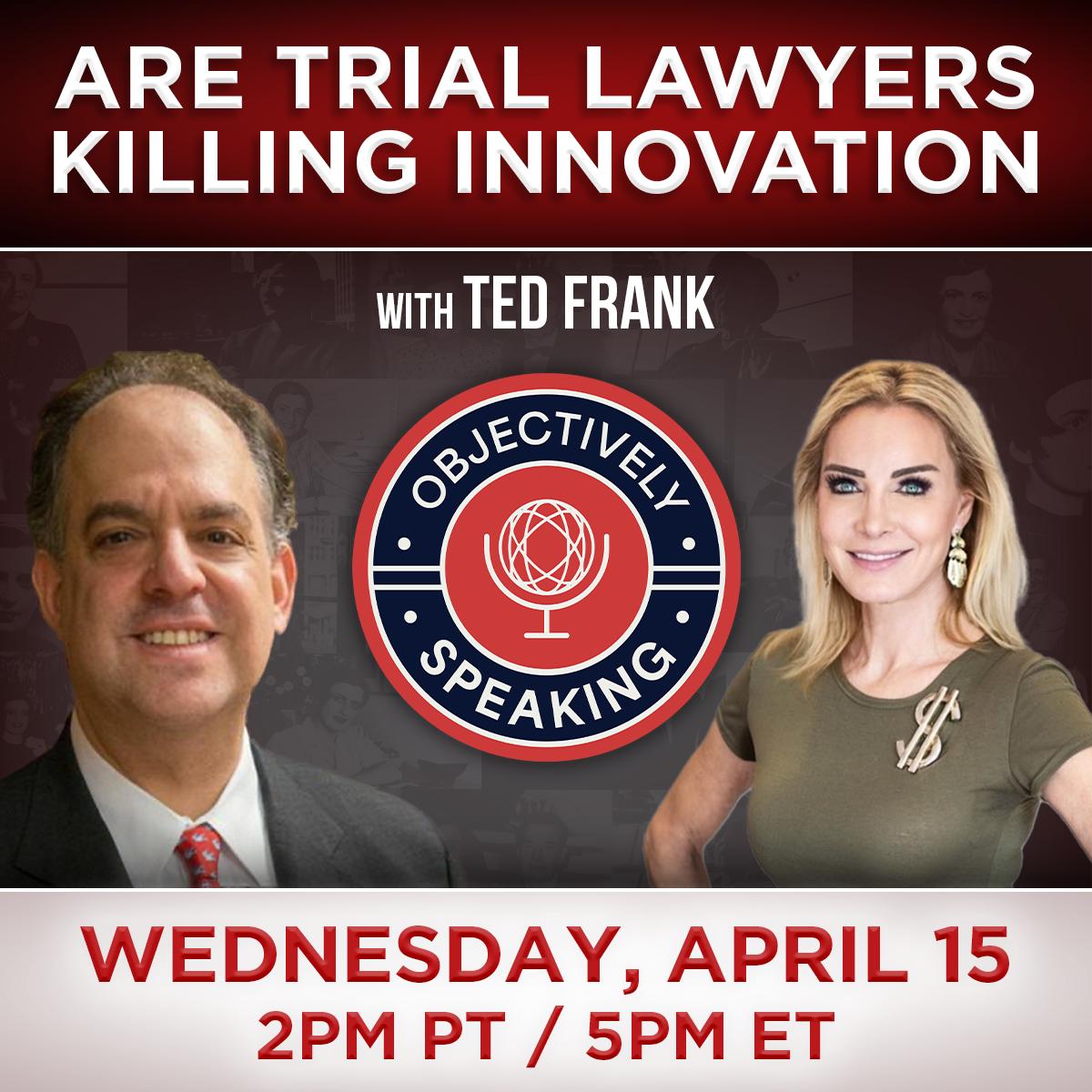
[00:00:00] Speaker A: Hey, everyone, and welcome to the 298th episode of objectively speaking. I'm Jag. I'm CEO of the Atlas Society. I'm very excited to have Ted Frank with us. He's director of litigation and senior attorney at the Hamilton Lincoln Law Institute. He's joining us today as part of our series of interviews focusing on tort reform and how litigation is used as a weapon to drive up costs, chill research and development, and punish risk taking that fuels progress. So, Ted, thanks so much for joining us.
[00:00:36] Speaker B: Thanks for having me. Glad to be here.
[00:00:39] Speaker A: So can we start with your origin story? What made you want to pursue law and how you became unsatisfied with the current legal setup, especially class action lawsuits?
[00:00:50] Speaker B: Well, I was always interested in economics and in public policy and. And law just seemed like the ultimate intersection of those things.
And going to the University of Chicago Law School and. And having that sort of academic bent to looking at the law just kept my love for it alive.
[00:01:14] Speaker A: Your X bio says you're focused on free speech and fighting consumer class action abuse, two things that might seem unrelated. Is there a through line for you philosophically between those two things?
[00:01:28] Speaker B: We're fighting for conservative values and American values.
So we're looking for places where litigation can make a difference. And we're in a world right now where a number of states are passing laws that restrict speech, and these present opportunities for litigation to make a difference. And since 2009, we've been fighting on the front of class action abuse, where lawyers abuse the system to extract money from consumers or at the expense of consumers for their own personal benefit without actually recovering anything for the class.
[00:02:13] Speaker A: So before we get into class action, and I've been looking forward to this for a while, I have to ask, you wrote the Sarah Palin vetting report for McCain in 48 hours. Does that count as the most read and least heated legal document in American political history?
[00:02:31] Speaker B: You know, you would have to ask the staff to what extent they read it. I don't know that it was least heated.
I said, you need to look at this video interview of Sarah Palin before you select her. And they said, oh, we looked at that. We thought she did fine.
So they knew what they were getting.
I think the vetting report was a formality for the people higher up in the campaign that decided that they were so far behind Obama in the polls that they needed to take a risk on who they picked as vice president. And actually creating that additional variance worked. They were tied in the polls until the the collapse of Lehman Brothers. In, in early September.
[00:03:18] Speaker A: All right, let's dive in.
You have made the case that excessive litigation can chill innovation. What is the clearest real world example where lawsuits actually stopped or slowed a beneficial technology?
[00:03:34] Speaker B: One example I think was in the 90s where litigation over general aviation, over the small Cessnas and private planes, really shut down the aviation industry in the United States until Congress passed some tort reform. Back then you could get bipartisan action to stop the, I apologize you, to, to get the.
You could get bipartisan action to, to get legislative action to, to, to save an industry that was adversely affected by litigation.
And so that is, I think, a very major example where private flying, even private flying versus commercial flying, and even 30 years ago when flying was much more dangerous than it is today, it was still substantially safer than driving the equivalent distances. But litigation over any particular plane accident effectively shut down what was being manufactured. And that stopped in the 90s until Congress revived, revivified the industry.
Another example I think is in a variety of drugs for pregnant women.
Every time a drug was developed for pregnant women to improve the state of their being, lawyers would invent fake causation to accuse the drug of causing birth defects. And that effectively made just any sort of drug development that affected pregnant women untenable. Because the upside was always offset by the downside.
Everything was the new thalidomide and everybody was being blamed for whatever. Birth defects would just happen as a matter of course.
And juries were just getting those scientific questions wrong.
[00:06:01] Speaker A: And you can really see how, you know, the, the appeal to emotion, the appeal to, to victimhood over reason, over objectivity over evidence is a lot of the kind of emotional push behind this kind of abuse of the system.
Now you have been called the leading critic of abusive class action settlements. You in fact debated Vanderbilt's Brian Fitzpatrick, who wrote the conservative case for class actions, arguing conservatives should prefer private litigation to government regulation. You support class actions in principle. So what's your actual vision of what a well functioning class action looks like and how far are we from it?
[00:06:47] Speaker B: Well, I think part of the problem is at the settlement stage and at the settlement stage you now have absent class members rights being affected.
And the judge in the American system is used to adversarial presentation. And that adversarial presentation disappears at the settlement side. But there really is still an adversary process happening in that you have the danger of the defendant who wants to get out of the case as cheaply as possible, and the plaintiff's attorney who while trying to win money for the class is also trying to maximize their own fee. And it's very easy for them to tacitly agree to a structure of a settlement that reduces the cost to the defendant while maximizing the attorney fee by creating the illusion of relief rather than actual relief. If you go to a judge and say, please approve the settlement that pays $7 million to the attorneys and $1 million to the class, the judge might say, why are the attorneys getting 87.5%? But if you can sort of invent value for fictitious injunctive relief or say that the settlement should be valued at what is made available, even though you know with actuarial certainty that the class will never recover that money because you've structured the claims process in such a way that historically the claims rate is going to be 1% instead of 100%, you can create the illusion of relief and, and get the same result that a judge might reject by simply by hiding the ball for the judge. And American judges aren't used to being investigators and rely on the adversarial presentation. And that often just isn't present within the system. So the lawyers can extract wealth from the consumers and in the process make a profit on what are meritless class actions.
You bring the lawsuits, and if there's merit to it, the lawyers can make a good profit. And, and that's the sort of entrepreneurial thing that Brian Fitzpatrick approves of.
The danger is that when the lawyers get paid as if they've won the case, when actually they haven't, that incentivizes them to bring the lawsuit that has only nuisance value or that only has a 4% chance of success.
And the fact that they've recovered so little for the class but still get entirely paid now makes it profitable to bring that sort of losing litigation, in part because the, the judge isn't scrutinizing the settlement the way that they should. So you just need legal rules in place that sort of constrain what sort of settlements judges can approve.
You need legal rules in place that punish lawyers for not being fully canted with the court when they're making what are effectively ex parte presentation without adversarial effect.
So, and it's not just the legal rules, but the, the judges have to apply the rules, and the, the parties have to understand that they're bound by the rules. So, for example, in 2005, one of the major ways that settlements were being abused was that they would create these coupon settlements where class members would get a coupon.
The, the settlement would be valued at the face value of the coupon. But even though maybe a single digit percentage of these coupons would be redeemed, it was treated as if they were valued at 100% even though they expired. We had this lovely settlement involving coupons where they were for flower delivery, but the coupons were only good for a year, but they weren't good over the Mother's Day week, they weren't good over Christmas week, and they weren't good over Valentine's week. So you would never actually use these coupons which had other restrictions that made them worse, less worth than their face value.
And we.
[00:10:59] Speaker A: That's ridiculous. I've never heard of. That is essentially, hey, we've won this case and all you've got is not even a T shirt but a coupon. Now, you have helped overturn settlements where plaintiffs got little or nothing or coupon. Has that made you an adversary of trial lawyers that don't want their class action payouts reduced?
[00:11:24] Speaker B: Certainly there are plaintiffs lawyers who very much do not like me. I've cost a number of attorneys a lot of money or I've made their jobs harder because the sort of zero dollar settlements that were common in 2009 when I started this are much less common now.
And I've certainly heard tell that the threat of my nonprofit coming in and objecting to a class action settlement has encouraged parties on both side to create better settlements than there would otherwise. But there's still lots of bad settlements out there.
[00:11:59] Speaker A: All right, I'm going to grab an audience question because I find if I just wait till we're halfway through or even at the end, the conversation has moved on. So iliation asks, has the tort system in some areas become less about justice and more about leverage? Not sure what that means.
[00:12:18] Speaker B: I mean, that's always the case, right?
Nobody gets paid for justice, they get paid for winning.
And that.
So the incentive is always to create a story that makes the deepest pocket liable rather than perhaps the most culpable parties. So hold retailers liable for a crime that happens in the, in the parking lot. The criminal is the one responsible for it, but maybe the store should have done something to prevent that from happening.
And so you see those sorts of lawsuits or you see car manufacturers being blamed for the accidents caused by bad driving or somebody doesn't wear their seatbelt and the lawyer makes up a story that the car's seatbelt system doesn't work and detached and caused the driver to be ejected when realistically that doesn't happen and clearly wasn't wearing the seat belt or blames the car for creating the accident when in fact the driver would have been safe in the accident if he wasn't wearing the seatbelt. There are some states that don't let car manufacturers defend themselves from litigation by by saying the driver should have worn his or her seat belt. So
[00:13:52] Speaker A: it does also come down to to a question of personal responsibility.
Valiant, Mike asks, is tort abuse more of an issue at the state level or the federal level?
[00:14:05] Speaker B: Certainly the, the, the belief is is that it's more likely to be happening at the state level in part because state judges are more likely to be elected so they're going to favor the in state plaintiff over the out of state corporate defendant.
At least that is the theory since Hamilton wrote the Federalist Papers about the need for diversity jurisdiction.
And certainly it's the way plaintiffs attorneys act in trying to structure their litigation in ways that there isn't federal jurisdiction.
So there are probably states where plaintiffs want to be in state court and there are probably there may even be a handful of states where plaintiffs prefer to be in federal court. But in general you see the worst abuses happening in a state court.
[00:15:04] Speaker A: All right, you are currently arguing in if I get this right re Google location history, litigation before the Ninth Circuit, a 62 million dollar settlement. 62 million dollar settlement where class members receive zero attorneys get 19 million and 42 million goes to a third party advocacy groups, many with pre existing ties to Google or the plaintiff's lawyers.
You've called this the CIS press, if I'm pronouncing that correctly, or the Cypress problem at its most extreme. How does a federal judge approve something like that with a straight face?
[00:15:44] Speaker B: Well, in the Ninth Circuit there's precedent signing off on $0 settlements where the parties agree to throw the money to left wing advocacy groups.
And it's unfortunate. And in this particular case, not only did it throw money to these groups, but it assigned the judge the unconstitutional role of being the grant administrator, saying here's a pot of money and you get to decide which of these nonprof benefits get how much money. And, and the judge was very fond and gleeful about getting to decide that this charity would get 2 million instead of 1 million or, or what have you.
And, but there was precedent permitting the court to do that and we're asking the Ninth Circuit to least narrow that precedent. And if the 9th Circuit won't, we'll ask the Supreme Court to shut it down entirely as many other circuits would have.
You couldn't do that kind of settlement in the fifth Circuit, you couldn't do that kind of settlement in the 7th Circuit. And I think a lot of other circuits would, would also reject it. But the 9th Circuit just has a history of signing off on $0 settlements and hasn't been willing to sort of reevaluate its precedent in that even though it never, those earlier decisions never really contemplated the abuses that those rules made possible.
[00:17:19] Speaker A: So what can be done? What kind of reforms might ensure that, let's say corporations don't have to extend the sanction of the victim fund groups that in some cases paid corporations and free enterprise itself?
[00:17:36] Speaker B: Well, I, I think corporations just have to have a backbone if that's what they don't want to do. And I think sometimes there's just a principal agent problem where the general counsel or the attorneys don't see anything bad about funding left wing groups that ultimately want to destroy corporate America or free enterprise.
Sometimes they're, they're funding left wing groups that they would be funding anyway.
[00:18:04] Speaker A: So
[00:18:06] Speaker B: it's unfortunately not always the case that the corporate CEO is an Ayn Rand hero that believes in free enterprise and like that, sometimes they just believe in the rent seeking and free enterprise is their enemy because it creates competition.
So I, I think, but in terms of just stopping it from happening and, and preventing lawyers from diverting money from consumers to, to their favorite NGOs, we just need, I think, judges to follow the legal rules. I think the existing legal rules prohibit these sorts of things. And there's just. Because once again, there hasn't been adversary presentation. There is just a lot of articles of precedent signing off on bad settlements.
[00:19:02] Speaker A: All right, Jackson Sinclair asks, is it just left wing groups or do big corporations also use litigation as a club?
[00:19:12] Speaker B: You, you can certainly see corporations suing to try to get a better deal out of say a merger and acquisition, or in lieu of competition, or trying to use their patents to block competition.
So there are, I don't think there are any noble parties here. I think everybody acts in their self interest and sometimes engaging in socially costly litigation is sometimes in a corporation's best interest at the expense of society at large. And that can happen.
So you just need to create legal rules that incentivize people to do the right thing in the beginning with.
[00:19:57] Speaker A: So along those lines, you recently exposed how fintech companies and claims administrators are quietly profiting from class action settlements through prepaid debit cards with fees that eat into recoveries, for instance. So it's not just the plaintiff's lawyers exploiting the system. There's also it seems an entire ecosystem feeding off of it. How, how deep does it go?
[00:20:21] Speaker B: I've, I've always, I've never been surprised in the other direction. There's always more corruption than I anticipate. So there certainly seems to be a kickback program in effect. Other people are litigating this, not us. This is far beyond the scope of what we can litigate. But hopefully there will be reform in this area and judges will look more closely at what's happening with class action administrators. To what extent are there kickbacks to the administrators from FinTech? To what extent is, are the administrators paying off plaintiffs attorneys to get their own benefits at the expense of the class?
There's a lot happening there. And you would think in a world where we have Apple Pay and PayPal and all these sort of electronic cash substitutes or electronic banking, that you would see much less of this.
And maybe that's happening in some ways and not others, but there's still a lot that remains to be done.
[00:21:41] Speaker A: All right. Alan Turner asks who does the most abuse in these cases? Lawyers. Judge juries.
Well, is there enough blame to, to go around?
[00:21:53] Speaker B: I mean, lawyers are just doing what's in their own self interest and we have legal rules that incentivize them to do things that are bad for society for their own benefit.
And they can, some, some of them are, are true believers and really are believing that they're making the world safer for America. Or you know, they, they certainly have the incentive to convince themselves that they're doing that.
Lawyers are often lawyers because they, they aren't capable of the economic understanding of the invisible graveyard and, and the costs of, of, of things that are happening.
And they only see the individual transaction and not the holistic view. And when it's in their economic incentive to do that, then that that sort of category area can, can happen.
And judges are following the law to a certain extent too. And, or judges believe that corporations are acting evilly.
Can, can they be blamed? And then jurors are following the instructions that the judges are giving them and, and following what the, the lawyers are telling them. So, you know, occasionally you do see expert witnesses just lying and, and, and you know, you, you see this in the vaccine litigation where just there was falsified data in trying to make pharmaceutical companies liable for autism when vaccines don't have any relationship to autism.
[00:23:40] Speaker A: So
[00:23:42] Speaker B: there's blame to go around everywhere, but we just need legal rules that create what Oliver Holmes, Wendell Holmes called the bad man theory of the law is that rather than worry about stopping the bad man. You want to create a legal regime in place where the bad man is incentivized to do the right thing just because it's in his self interest.
[00:24:03] Speaker A: Yes. All right. Well, speaking with sticking with juries for a moment, you've written about how juries systematically overestimate harms from products they dislike. The meta Instagram addiction verdict, 6 million potentially opening up the floodgates. Is that a case of that phenomenon and what's the mechanism? Are juries being misled by experts? It sounds from what you're saying in some cases that happens to be true or is it something else going on?
[00:24:33] Speaker B: Well, you know, I, I don't know if I, I don't want to opine on the merits of the Instagram litigation.
There's a case that, that Instagram was intentionally engaging in behavior that was addictive to teenagers and there are other studies out there that disagree with that and I, I don't know the answer to that.
Presumably both parties presented their evidence and the jury believed one set of evidence over the other.
Was the jury right?
Hard to say. It's I, as a public policy matter, I don't know that I would want that sort of scientific question decided by 12 lay people under the, the rules of even federal evidence, much as state law evidence.
So you know, there, but there is an answer to that question and I just don't know what that is. Whether Instagram should be liable. But certainly in other cases where somebody has a very sympathetic injury and you, you can blame the deep pocket and the lawyer can tell them you can fix this by, by punishing the corporation that did this to this poor benighted soul who's paralyzed now or burnt now or dead now and sometimes are soft hearted and want to do, want to reward the victim or the injured party rather than looking at the, and they're not asked to look at the holistic view. That's the job of the law to be looking at the holistic view of whether the recovery happens in the first place.
So I think that's a flaw in the system, certainly, but jurors are, I think, doing what's human right now.
[00:26:29] Speaker A: You had mentioned the invisible graveyard in one of your previous responses. We've got a viewer asking if you can unpack that for us.
[00:26:37] Speaker B: Certainly.
So take say self driving vehicles. It's, it's unquestionable.
And now there may be other problems with self driving vehicles in terms of autonomy, in terms of risk of government control, but in terms of safety, it's just unquestionable. The case that a Waymo or a Tesla self driving vehicle will kill many fewer people than even average human drivers. And of course half of the human drivers out there are below average and others are impaired by alcohol or marijuana or lack of sleep. So self driving vehicles can save tens of thousands of lives. Hypothetically.
And to the extent that litigation or regulation or otherwise precludes people from getting to use the self driving vehicle, there are going to be tens of thousands of additional automobile victims over the course of next year because people are driving unsafely rather than having the miraculous technology of AI self driving vehicles driving them.
But that's effectively an invisible graveyard. You don't notice that the lack of the innovation is causing more people to die than otherwise. You don't see the drugs that are not being developed because between litigation and Biden era legislation reducing the returns to innovation in the pharmaceutical industry, that drugs aren't being developed that can save people's lives. Certainly drugs that were developed in my lifetime and that didn't exist when I was born. When I was born saved my life.
But without the ability of pharmaceutical companies to be able to realize a return on the billion dollar cost of developing a drug, those drugs won't be developed and we will never know what people are dead because the drugs weren't developed that could have been developed.
[00:28:56] Speaker A: That's very helpful, thanks.
So what effect do contingency fees have on the incentives of the parties involved, including the lawyers? During tobacco litigation, Peter Angelos was on a contingency and tried billing a billion dollars for his 25%, which I understand was reduced. Is 1 billion in litigation fees the limit of good conscience in the current legal system? What would caps on payouts to law firms have helped?
[00:29:29] Speaker B: Certainly.
I'm sorry, I don't know why my phone is doing that.
Why?
Contingency fees create one set of incentives that can be perverse in that incentivizes attorneys to collect as much as possible rather than say the socially optimal amount.
But on the other hand, you have other legal rules, such as the zealously representing the client that would accomplish the same thing. So it's not clear how much lifting the contingency fee is doing there.
Lester Brickman has written about this. He has a whole book about the harms of contingency fees.
And some are persuaded by that and some aren't. I think it's a very interesting academic question what the optimal fee structure would be.
I think what we do see is especially with no bid contracts for state government litigation or in the class action system where Fees are often awarded ex post instead of through a bidding process that would reduce the cost cost to consumers that attorneys are consistently overpaid. What a market rate would would provide had there been real competition for the the contract for the the rule for a government not worried about happy to to pay a political favor to to a political ally rather than maximizing share taxpayer value.
So there are always those risks. How much of that is because of the contingency fee and how much of that is because of judges not performing the oversight that they should to protect the class members. How much of that is because of government officials thinking about being their own lawyer, being the lawyers getting paid like that 10 years down the line.
[00:31:37] Speaker A: Again, plenty. Plenty of time.
[00:31:41] Speaker B: Absolutely right.
[00:31:42] Speaker A: Another great question from Iliacin. Do you think, do you see tort abuse as a cultural issue? It appears more and more people see every harm and disappointment as grounds for litigation.
[00:31:57] Speaker B: Certainly Europeans absolutely make fun of us for it.
There's a different it's an American idea that there ought to be a lawsuit in a way that there isn't in other countries. And whether some would call that
[00:32:20] Speaker A: a
[00:32:20] Speaker B: plus for America, others might call it a minus.
Certainly we don't like emulating Europe in many other ways.
But the compensation culture, the lack of personal responsibility, the ability to collect even though the car accident or the ability to collect even though the car accident was your fault or you spilled the coffee on yourself.
We've created legal rules that permit people to collect even though they have culpability or even the most culpability.
So but that is, it seems to be distinctly American and that just doesn't seem to happen in other countries.
[00:33:08] Speaker A: We talked about the grave, the invisible graveyard before. Of course, there's also an invisible graveyard of all of the products and innovations that never get off the ground because of fear of litigation. So I'm just interested, from your perspective, what industries do you see as most vulnerable to litigation driven stagnation? Biotech, AI Pharma, Energy?
[00:33:37] Speaker B: Well, I think biotech is probably the most likely scenario. You saw litigation over implants that would actually sue the materials makers. And so materials makers would say, all right, look, we don't have any control over the underlying litigation. We don't have any control over how our products are used. We're just going to forbid our materials from being used for medical implants and that way we won't get sued for the medical implants. And so I think medical implant technology has absolutely been handicapped.
Everything here is at the margin, of course. Right. You can't say that innovation is completely stopped.
American ingenuity is, is, is great and, and people will find a way to get things done. And you know, and Elon Musk isn't afraid of getting sued for his full self driving. So there, there are people out there who, who will innovate despite the risks that litigation posed. But at the margin, it's absolutely the case that litigation creates problems or creates liabilities.
So you know, I've talked to people who were developing technology that would hypothetically.
So there, there's this known problem.
Because of regulation, children no longer sit in the front seat.
They sit in the back seat in the car seat. And because of this, you have every year just a couple of dozen parents through oversight through every once in a while it's because of neglect. But the vast majority of cases when this happens, parents just tragically forget that their quiet sleeping child is back there in the car seat and absentmindedly forget and leave the child in the car and the, the car overheats and, and the child dies and, and these are just tragic, tragic cases. The Washington Post ran an amazing story on about this 10 years ago, talking to some of the parents who went through this sort of tragedy. And you know, technology is possible that would stop this. And the risk is, is that if you advertise the technology as stopping this from happening the first time the technology doesn't work.
It will be the manufacturer of the technology who gets blamed and who gets sued.
And the, the cost of a manufacturer causing a child to die in an overheating car might, My God, the damages would be enormous.
And we completely wipe out any profits any manufacturer could make from the technology in the first place.
And so, yeah, I've never actually thought
[00:36:44] Speaker A: of that kind of switch that happened when parents began to drive their kids, put them in the safety seat in the back and thought through like what, what could possibly go wrong? Apparently a lot my modern Gult wants to know is there is any state leading the way with more positive litigation reforms or a more functional tort environment?
[00:37:12] Speaker B: I think Texas is famous, starting with Governor Bush, for really changing the scope of things. They're just really phenomenal justices on the Texas Supreme Court who shut down a lot of bad precedent.
There have been legal reforms on punitive damages, on attorneys recovering without paying the class in the class action system. And more recently they've created a corporate court designed to supplant what was happening in Delaware where attorneys were absolutely abusing the Delaware Court of Chancery to collect tens, hundreds of millions of dollars, extract that sort of wealth from, from corporations in litigation against the will of the shareholders in purely lawyer driven litigation.
And so you see delexit corporations stopping incorporating themselves in Delaware and moving to Texas or Nevada where they feel that they can avoid that sort of lawyer driven
[00:38:34] Speaker A: moving, voting with their feet. As have of course so many entrepreneurs and just regular people seeking relief from some of this blue state madness.
You talked about medical implants before. What about medical malpractice suits? Have some, have you seen some of those closer to frivolous? And how does that impact the quality and price of our health care?
[00:39:00] Speaker B: So I don't like to use the word frivolous because it has a technical legal meeting. And you often see pro litigation people sort of conflating the two definitions from the conventional use of frivolous. That just means a lawsuit that should never have been brought versus the technical legal definition, which is really something really, really, really out there.
And the what's the better description?
Well, you can say meritless or you can just say wrong.
You have a medical malpractice system that I think most often in obstetrician cases, that or neurosurgery cases where just things naturally go wrong. Surgery is risky, births are risky, and they blame the doctors for bad results that were not the cause of medical malpractice. But that a lawyer can tell a story that had the doctor done something differently, the patient wouldn't be injured, the mother wouldn't be injured, the baby wouldn't be injured.
John Edwards, the former vice presidential candidate and senator, made himself rich suing obstetricians over children with birth injuries that in no way could have possibly been caused by the doctor.
But you can tell the story that the doctor did X and should have done Y, and that's why this child is now completely brain damaged and injured for the rest of his or her life.
And those damages can be in the millions and millions of dollars and it's basically a bolt of lightning. It's not something an insurance company can predict other than that, well, you doctor, deliver babies and therefore this is going to happen to you from time to time.
And we're just raising the insurance rate for all the obstetricians because we can't.
Unlike driver safety, where, oh, you've, you've, you have tickets, you, you have, you have a bad credit score. We can look at certain data and figure out whether you're likely to have an accident, you know, the color of your car, the type of car you drive, whether you're divorced, whether you're a smoker, all These things we can actuarially figure out what, what your risk is of, of having to collect on your auto insurance. But for malpractice insurance, it's, it's completely, it's near unpredictable. You have the occasional doctor who's just utterly incompetent and, and eventually gets themselves losing their license. But that's just a small fraction of, of where malpractice litigation takes us.
[00:42:01] Speaker A: Well, you mentioned Elon Musk earlier, and he has been warning that we are in a battle for AI supremacy with China and that China could end up the winner.
Could fears of litigation and over defensive guardrails play a role in whether or not we can win that competition?
[00:42:23] Speaker B: Arguably, that's the case. Certainly Chinese companies don't have, you know, to the extent that the Chinese government wants their AI to succeed, they can shut down any possible threat of litigation against their own Chinese AI companies.
So there, there's always that friction in the American system, but some of that is litigation over property rights. And maybe that's a completely legitimate thing. If AI is training itself on copyrighted works, to what extent do the copyright holders have rights into, in the AI Especially when the AI is spitting out predictive text that was generated from these models or from the original text, sometimes verbatim.
So, and then you do have people who have psychoses related to their use of AI and to what extent does the AI AI encourage that? Should there be liability there, should there be consequences when, when that happens? And maybe you do need those guardrails. So I, I don't want to say that we have too much litigation over AI just quite yet.
It's possible, but I haven't seen it yet.
And I think whatever is happening there is, is happening at the margin. But, but the upside to actually.
Are we back?
I got a message that we lost the connection, but I think the, the upside to AI is just so gigantic that it dwarfs anything that might be happening at the margin on AI.
[00:44:25] Speaker A: Do you think AI could eventually perform most legal functions?
[00:44:29] Speaker B: I'm very skeptical of that.
We're very much a long, long way from that. And every once in a while I test AI models about things, and I've yet to see the AI that can draft a brief as well as I draft a brief.
[00:44:47] Speaker A: Interesting. Okay, well, there's a debate going on right now over whether or not the AI revolution is a bit overhyped. And we're hearing it from the, the horse's mouth that AI hasn't caught up to him. So talk a little bit more about your, your Work in particular, how much money you have. Your work has redirected from lawyers to plaintiffs.
[00:45:18] Speaker B: So it's over 200 million directly and just an unknown number indirectly. Right. Because the law has changed and lawyers have to follow the new law. We've created these landmark precedents and landmark precedents give incentives to parties to create better settlements than that would have happened. We would see much more cypre if not for the fact that we're out there creating a few threat to the approval of an all Cypress settlement.
So hundreds of millions directly and I would say billions indirectly.
[00:45:57] Speaker A: Wow, that is pretty impressive.
You'd mentioned the way they do things over in Europe earlier in our conversation.
Is there any chance that the US would ever adopt loser pays? Like might they have in. In Europe and if not like what. What's stopping us from doing that or who?
[00:46:19] Speaker B: I, I think there's very much a.
The, the legal culture is very opposed to, to loser pays. So even when Congress passes a loser pay statute.
Statute, the Civil Rights act had a loser pays provision when originally passed and the Supreme Court literally wrote it out of existence and hasn't fixed that. Even when state courts have said, you know, this is what the statute actually says and we're going to interpret the statute to mean what it says.
And the Supreme Court actually stepped in and said, well, we're the last word on, on interpretation of federal statutes and we've already ruled this way even though it's absolutely the opposite of what the statute says.
So there, there I think a very strong disincentive or, or there's just a very strong resistance to it.
There, there's are a lot of stakeholders who are very politically powerful that like the current system and I, we haven't had a federal tort reform since 2005 and I don't think we're going to have one in the near future between corporate America rejecting the Republican Party and the Democratic Party essentially captured by the trial bar.
[00:47:50] Speaker A: Yeah.
So it, you know, it is a bipartisan issue.
It seems to me like 20 years this was the hot topic. People were talking about it a lot.
We are trying to revive that conversation. It's part of the reason we're doing this series and the series of articles that we have on our website. Why do you think that shift has happened? Is it because both parties kind of essentially got in on it or do you feel actually we did make a lot of positive changes and reforms and partly some problems have been solved.
[00:48:27] Speaker B: I, I think a lot of it is that there has been a lot of progress made in the 90s and in 2005.
But I, I think also in the 90s, it was a bipartisan issue because the system had gotten so ridiculous. And however bad it is now, it isn't as bad as it was when a lot of these reforms were being called for 30 years ago.
And I think especially in red states where, which were, I, I think notorious for being plaintiff friendly.
At least, you know, Texas used to have some gigantic verdicts and Governor Bush really changed the scope of that. And a lot of that diffused the demand for federal reform because you could see that reforms could happen at the state level and many states did do those reforms.
But I think also it's stopped becoming a bipartisan issue. And now, especially after John Edwards was nominated for vice president in 2004, you could no longer criticize the trial bar in the same way without it having a partisan machine because that undermined the Democratic's chosen candidate for higher office.
And so the, the Democrats stopped entirely thinking about the question of tort reform.
And, and then on the other side of the aisle, once upon a time there was sort of a unity of interest between the Chamber of Commerce and the Republic Republican Party. And as the Republican Party has become more populist and has the Chamber of Commerce has moved to the left in the wake of the Obama election, there, there is no longer the sense that the Republicans don't feel like they owe the Chamber of Commerce anything and they're longer the constituency for that sort of tort reform.
[00:50:44] Speaker A: What are some of the basic incremental reforms that you would like to see? What, what gives you kind of cause for, for hope?
[00:50:56] Speaker B: Well, we have, I think on the class action side, I, I think in my lifetime we will see an end to abuse of Cypre. I think the Supreme Court will eventually rule on it.
Our 9th Circuit case, if the 9th Circuit doesn't reform its own jurisprudence, I think that's going to the Supreme Court. And I feel cautiously optimistic about that.
And there are a number of other places in the evaluation of settlements where the law has already changed, the legal rule is in place, and now there's just a dispute how courts should interpret the, the, the amendment that was created in 2018 and to what extent that does protect consumers.
And on some of these questions, Brian Fitzpatrick and I even agree, I think Brian Fitzpatrick has some even more radical reforms at the back of his book, as I've always joked that whatever Brian Fitzpatrick is making a conservative case for, it's not the American class action, but something that requires much more reform. Before we even get to what he's talking about. Talking about
[00:52:09] Speaker A: final any final thoughts, any cases that you are watching particularly keenly?
[00:52:16] Speaker B: Certainly my own litigation.
And you can follow
[email protected] we're the only ones who do what we do and we've been surprisingly successful at it. Beyond my wildest dreams.
We've had five different attorneys win appeals on on class action abuse.
Two of our attorneys have garnered three presidential nominations. My colleague, Anna St. John, former colleague Anna St. John, was sworn in as a federal judge yesterday.
You know, we just have this great little shop that has just sensational attorneys and provides a lot of bang for the buck for its donors and makes a real difference in this class action.
[00:53:00] Speaker A: Specific is well, thank you, Ted, for what you do and for the phenomenal work. And it sounds like you're you're also a victim of your own success with your colleagues now getting appointed to to the bench. So really admire your your record and, and we'll keep an eye on your case.
[00:53:21] Speaker B: Well, thanks for having me.
[00:53:23] Speaker A: All right. And thanks everybody else who joined and asked great questions. Sorry I couldn't get to all of them. But again, this is the first of a series that we're going to be doing on this subject. So head to our website and look at our event page so you'll know what's coming up. And join us next week when I will be off. But Atlas Society senior fellow Robert Krasinski will host a solo webinar exploring the true meaning of enlightened self interest and why getting it right is the foundation of a civilized society. See you then.