Episode Transcript
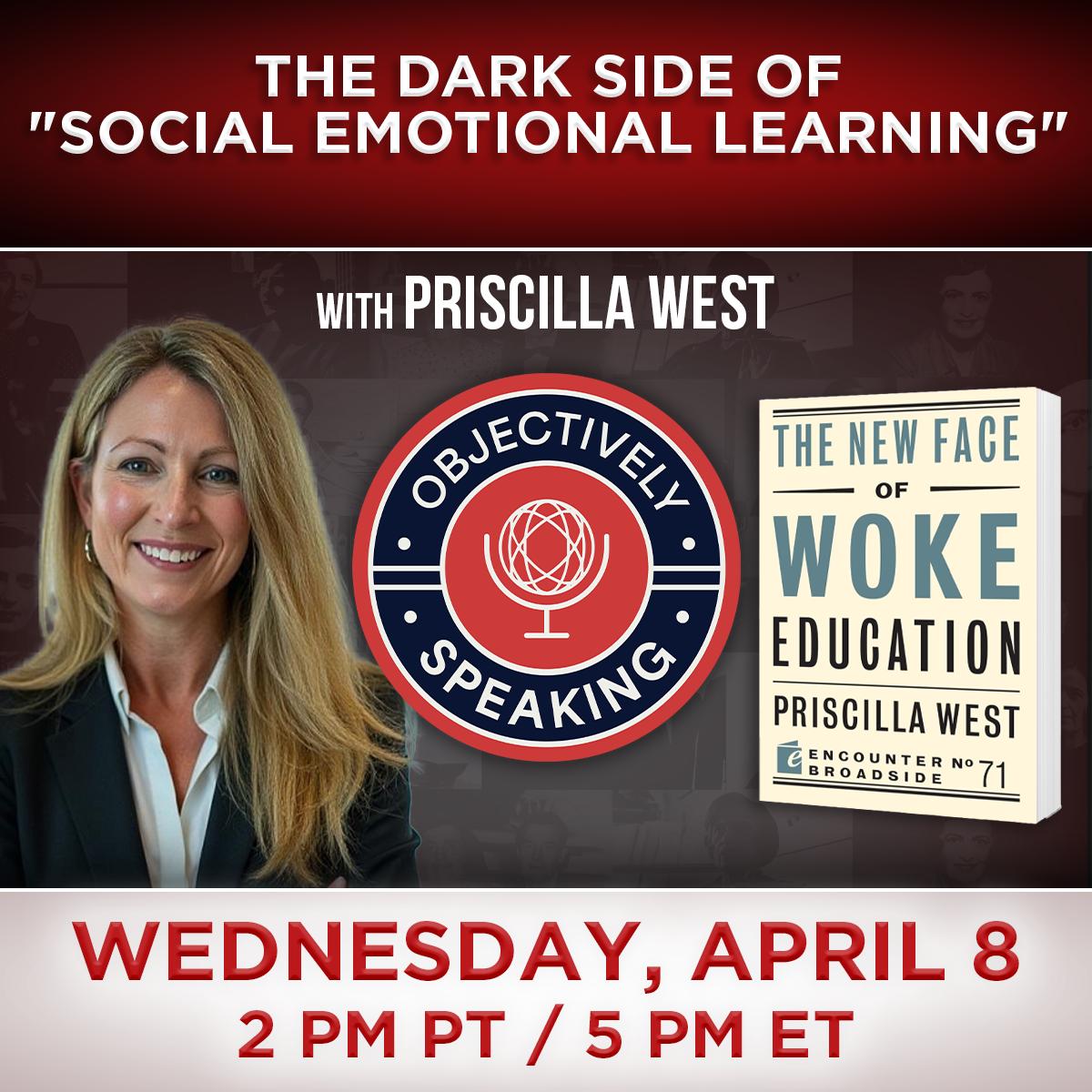
[00:00:00] Speaker A: Everyone, and welcome to the 297th episode of objectively speaking. I'm Jag, CEO of the Atlas Society. I am excited to have author Priscilla west join us today to talk about her new book, the New Phase of Woke Education.
And extra credit for Priscilla. She's in the middle of a move across Florida. So I really appreciate your taking some time out to talk to us today.
[00:00:28] Speaker B: It's great to be here. Thanks, jag.
[00:00:31] Speaker A: So Priscilla, before you were exposing the inner workings of the social emotional learning, you were engineering in refineries and trading jet fuel internationally. That's quite the pivot. What made you decide to trade the oil markets for education battles?
[00:00:49] Speaker B: Well, the oil markets had me living for three years in Caracas, Venezuela. And I happened to be there during the time when Hugo Chavez was coming to power, consolidating his power, rewriting the constitution, and in particular he was issuing government curricula for the schools. I don't know if you recall, but he had the government develop a Bolivarian school curriculum during that time frame. I had a lot of online arguments with communists, for lack of a better word, about school indoctrination. So that was really when I, I saw it happen. I saw it happen in real time.
At the time I kind of thought I was untouchable, that it would never, you know, it could never happen in the U.S.
so it was, it was an interesting exercise for me and I wrote, I wrote some op eds and published some things back home in the US about it, but I never expected to see it happening here in the US and when I've got kids in the school system.
So yeah, that's kind of my background and why I became so interested in this particular concept of sel.
[00:02:11] Speaker A: So SEL in Social emotional Learning, it's a name that seems so vague that it could almost mean anything. What precisely is it and how does it differ from the basics, reading, writing and arithmetic?
[00:02:28] Speaker B: Right, if only it were the basics.
It's an acronym that sounds perfectly harmless. It sounds beneficial. Even Social emotional learning, a lot of people think, and it probably began as that it's kind of an add on to the school curriculum. You know, feelings class, we're going to talk about managing our emotions, we're going to talk about empathy and kindness.
And to some extent it is.
But the bigger function of social emotional learning is that it is a framework for measuring students internal traits, their beliefs, their values.
So it's a lot of the scientists like to call it non cognitive. So skills and traits are being measured and tracked via these social and emotional Learning curricula.
[00:03:24] Speaker A: So who, who started it, who introduced the term, and how has it evolved over time?
[00:03:31] Speaker B: Okay, this is a deep rabbit hole. I. I feel like it probably goes back to the beginning of time.
If you've ever listened to Alex Newman, he calls them the, the utopians. They.
The utopians have always existed. Right.
It's the, the eternal struggle.
So this kind of idea of bringing children, shaping children's inner lives and bringing them along to this global consciousness is a recurring theme. But my broadside, my piece that I've published picks up in the 90s with a fellow named Dan Goldman, who was a Harvard PhD psychologist. And he went on a traveling fellowship to learn about ancient systems of psychology and Eastern meditation.
He had the backing of a group once. Once he came back from there, he wrote a book actually called Emotional Intelligence. Do you remember this book?
[00:04:32] Speaker A: Sure, yeah.
[00:04:34] Speaker B: It was on the end caps of all of the big bookstores.
Think I might have even had the book back in the 90s. But he had the backing of a group called the Fetzer Institute, which was a new age spiritualist organization.
And Dan and a few other officers from the Fetzer Institute, along with Eileen Rockefeller and few others, Timothy Shriver got together and they formed a. They spun off a new organization called castle. Have you heard of castle?
[00:05:09] Speaker A: Well, now I have because I've read your book.
[00:05:12] Speaker B: Right. I saw all those markers in your book. Wow, I love seeing that.
So castle, the Collaborative for Academic, Social and Emotional Learning, spun off from Fetzer, but Fetzer's mission openly was to promote a kinder world to. To. They were trying to get spirituality into education.
So they did it with this new organization called Casel.
One more little thing.
Before, before the 90s, there were some dialogues going on with an entity called the Mind Life Institute, and that also involved Eileen Rockefeller.
So this group got together, scientists and the Dalai Lama and other spiritual leaders to talk about how to achieve this merging of, you know, how to get spirituality into education.
So they were having these talks for a good 10 years or so before Castle even was formed. And they were very explicit in saying, okay, we need to get the Hindu words out of our dialogue. So. So that people don't recognize this as essentially religious in nature. So they started burying it in scientific jargon. They were talking a lot about neuroscience and even quantum physics.
The all is one religion was heavily imbued with quantum physics, but they decided to go with the neuroscience. And that's what Dan Goleman did when he wrote his book. He put the Eastern religious concepts in terms that weren't going to be off putting for westerners.
[00:07:00] Speaker A: So we had the book, we had the buy in from these institutions.
How did it then show up in the classroom? Is it a course? Do they break for math and then go to SEL training? Is it a curriculum just like really granularly? How does it show up for a kid?
[00:07:20] Speaker B: Right. Well, a lot of different ways, which is why I kind of refer to this thing as a mini tentacled beast. It's, it's hard to kind of keep all of the tentacles in your head at once. But the, in the beginning it was a lot of group circles and classroom circle time and things like this and teacher led, primarily teacher led. And, and there was certainly some teachers that didn't, were not indoctrinating. They really just. Most teachers probably had only the best intentions for the kids and really trying to help them manage their emotions. But there was always this deeper collectivist bent and it has sort of come out and gotten stronger through the years, but particularly with the advent of the education technology, the, the edtech. Because now you've kind of removed the teacher from the equation and you've got AI talking directly, interfacing with the kids and weaving social emotional learning concepts through all of the core academics.
But as far as what social emotional learning is doing to the kids, firstly it is reframing normal behavior, normal beliefs as privileged or oppressive or even sometimes if you're a little nicer about it, a lack of awareness.
Right. So just a normal kid bopping along in their day that you know, suddenly they're being told because they believe a certain way, they are not aware or that they are being oppressive.
Right, that's one of the things it does. But the social emotional learning activities and surveys, they use a lot of surveys and journal journaling and circle time discussions, reflection prompts, things like this, emotional check ins.
So they're, they're using all of this to extract students internal beliefs and, and
[00:09:24] Speaker A: then tracking it, tracking it over time.
[00:09:27] Speaker B: So tracking it over time.
[00:09:28] Speaker A: One SEL critic that you quoted argues that its ultimate aim is to quote, soften children at an emotional level, reinterpret their normative behavior as an expression of repression, witness or internalized racism, and then rewire their behavior according to the dictates of left wing ideology.
How is that pursued? Is it pursued through these questionnaires, through these discussion groups?
[00:10:00] Speaker B: It is. So if you're continually emphasizing identity, which they do, you'll notice throughout all of the curricula it's all identity groups, racial groups, identity politics, so you're emphasizing identity and then you are engaging students again and again in what they call perspective taking activities or role playing exercises.
And layered throughout this, you're embedding assumptions and how you word every problem. I know we've all seen this, you know, maybe in the math curriculum the problem is worded as the ear is increasing in temperature at 1 degree centigrade per X number of years. You know, that kind of thing. It just begins with the assumptions with no, no room for debate there. They're just built in.
And then another thing that the SEL programs do is a, what's called a Delphi technique. This was invented by the RAND corporation in the 60s for intelligence agencies. But it's an iterative process.
It's used today a lot in these, in roundtable discussions and things where you are engineering a consensus, you're producing a desired outcome by letting people discuss. You measure something or you survey something, then you intervene, you give feedback and then you remeasure and you do this again and again. And the feedback that's being given is designed to, to influence in this case the child. You know, you might, the child might see a pop up that says 80% of your sophomore class agrees with blah blah.
So it's a Delphi is used through some of these and it's now automated with, in the Edtech.
[00:11:52] Speaker A: Right. All right, well let's dip into some of these questions before we go too far into the conversation because I always find when I wait too long then the conversation has moved on and we can't be interactive. So lock, stock and barrel on YouTube asks Priscilla, is this movement driven more by ideology, bureaucracy or social pressure? I guess I'd add to that financial incentive.
[00:12:19] Speaker B: In the beginning I do think it was primarily ideology. A lot of the people who got this movement off the ground were socialists. They wouldn't have called themselves that.
[00:12:30] Speaker A: But looking back, workers, right, they believe that they were carrying agenda.
[00:12:39] Speaker B: A lot of, a lot of psychologists, but a lot of also new age spiritualist types were involved with this. So they were truly wanting to make the world a kinder, better place.
But then as, as it was operationalized, it was really built into Common Core is where this really came in and began, began to scale.
So then you had ed tech companies coming in and pouring money into this and calling it education reform.
But underlying all of it was data systems being built and installed.
So yeah, it did sort of morph more into I believe a monetary incentive.
And once, once you get governments and legislators bought in to these programs and to Common Core and social Emotional Learning. Then you get the government mandates, and the original foundation funding is then, you know, supplemented with government funding and enforcement. So it's.
[00:13:46] Speaker A: It's, again, all of the data is being harvested, and. And that is, of course, an asset that's very valuable to these companies. So at some point, you know, you have to kind of see who's. Who's benefiting. Okay, we've got a question here from Jackson Sinclair on YouTube asking Priscilla, Is SEL widespread in public education?
Stronger in some states versus others. And also, what about private schools?
[00:14:13] Speaker B: It is absolutely, in all 50 states.
Different states have different levels of mandates and standards, statewide standards for. For SEL.
Some states, you know, may have it K through 12.
Other states have, you know, it's there, it's built in, but they may not have a standard, but all 50 states have it for pre K.
And all 50 states are tied in to these statewide longitudinal data servers that are recording the SEL data right alongside the academics and the behavior and the attendance.
So it's everywhere. It's in public and private schools. As a matter of fact, private schools, they have their own data systems.
They may not tie in with the same longitudinal data servers directly, but they have their own systems. And I think we'll talk in a little bit about the accreditation and how the SEL plays into that.
[00:15:11] Speaker A: Yeah. At some point you say that this was even kind of morphed to infiltrate other organizations like Girl Scouts of America, Boys and Girls Club. What's happening there?
[00:15:25] Speaker B: Correct. Casel, the organization that really launched sel, has always said they set out to make SEL systemic. They use that terminology.
So it is not just in schools. It's really important for parents and teachers to realize that. That it is fully embedded. It's in, yes, Boys and Girls Clubs, it's in scouting, it's in a lot of extracurriculars. There are extracurriculars.
There's one called MUD that's designed by Yale, the Yale Child center, and it brings in shelter pets to teach kids about, you know, emotions and empathy and all of this. But it is explicitly designed around sel.
There are others that are these drumming circles and the drum. They.
It's about building, like, a group ethos, collective ethos, which, you know, might be therapeutic to some degree. But when you. When you are familiar with all of the discussion around getting school children into the alpha state in their, you know, and molding their inner lives, it. It becomes a little dystopian. They're trying to get kids into this basically, hypnosis if you've ever done a drumming circle, you know, it's. It is hypnotic.
[00:16:47] Speaker A: Right. And so again, just kind of almost priming children to be more susceptible to the warmth of collectivism.
[00:16:56] Speaker B: Right, the warmth of collectivism, exactly. Yeah.
[00:16:59] Speaker A: So what happened, you know, during COVID and the school closures? And all of a sudden, kids are at home and they are on LA tops. They're trying to keep up with their lessons.
Did that kind of lift the lid on some of these politicized learning and curricula? And what's been the reaction from parents?
[00:17:26] Speaker B: It definitely did. I mean, all of these moms groups sprung up. Moms for Liberty happened during COVID We all had the kids at home around the kitchen table on their laptops, and we're looking at these lessons.
What. What did they just say?
So that definitely happened. And the more people pushed back, the more SEL began to rebrand and morph. Here in Florida, where Moms for Liberty was, was born, we had resiliency education spring up. And conservatives loved it. It was, it was the same thing. If you, if you read it, all of the traits and skills that they're looking at, almost, almost every one of them directly overlaps with the Casel Core five competencies.
So, yeah. And since then, I've been tracking more and more of these frameworks that they're just constantly trying to sell it as something new. Right now I've been looking at Digital Wellness is one.
I think it's geared to getting skeptical parents who are skeptical of AI in education, probably a lot of conservative parents, again, sweeping them into this SEL ecosystem with something called Digital Wellness that's meant to bridge that gap and mitigate risks of online tech.
[00:18:49] Speaker A: So we had Abigail Schreier come and speak at an event a couple of years back. It was when she had just published the book Bad Therapy. And a lot of it talked about how this kind of therapeutic language and asking kids very personal questions in school, after school programs, even in doctor's appointments.
Is that an overlap with what you're talking about?
[00:19:23] Speaker B: Absolutely.
These systems are meant to store and track this data.
And one thing that's really frightening is that since 2011, the education data systems have been linked end to end with the labor data systems.
So anything that is recorded while your kids are in school has the potential to affect them all the way through their career. I'm not saying that's. That's definitely happening. I don't have any concrete examples, but the data is there. It's being stored and tracked lifelong and yeah.
[00:20:00] Speaker A: One of your kids had an issue with a teacher, or a teacher had an issue with them, and for whatever reason, really could be entering notes that would almost serve as a social credit type rating and affect their opportunities down the road.
[00:20:18] Speaker B: Absolutely, absolutely. You know, regardless of whether it's being used that way now, the architecture is being put into place.
So if your favorite administration doesn't use it that way, the next one may.
And every, every administration has advanced this agenda.
[00:20:36] Speaker A: What about the current administration? Do you feel that there's an awareness of this or have you had any luck in getting through to the Department of Education?
[00:20:46] Speaker B: I have not personally had any luck getting through. I know that Moms for Liberty has been, and I am a member of Moms for Liberty.
They have been involved with some, some roundtables.
But I'm not a big fan of AI in education at all. For the lower grades. I don't even think it should be in classrooms unless it could be a guarantee that it's a one way flow of information.
Not harvesting children's data, particularly this SEL data that is being classified as skills.
If it were a one way flow, if children were just being presented with textbook content and it were fully transparent, sure, no problem. But all of this data harvesting, you know, when they put a laptop in every child's hands in 2020, they, they were training the AI with our children's data.
Yeah.
[00:21:41] Speaker A: How does SEL specifically push kids towards political activism with, say, a social justice bent?
[00:21:51] Speaker B: Right. You've heard of Action Civics? There are so many programs that just explicitly say what they're doing, but school has just become an on ramp to social justice activism.
The James Lindsay talks about this. Actually, he says this really well when he talks about how the social emotional learning process, these lessons are just heaping guilt upon the kids. So you've got, you know, the white privilege and the, the privilege guilt and the climate guilt and the this guilt and the that guilt. So they're just priming children to want to be able to do something to relieve this guilt that they feel. So I do think that the constant focus on identity and privilege, power, oppression, yes, it is driving kids to try to fix it, to try to fix themselves, because they're seeing themselves through these critical lenses.
[00:22:47] Speaker A: Ilishin asks, what are some of the clearest examples of SEL in education? Is there a particular curriculum that is more compromised?
[00:22:58] Speaker B: There are so many of these curricula. One of the most popular ones is called Second Step. That one comes to mind. There are hundreds of these things as a Matter of fact, within four or five years of them creating SEL out of thin air, defining sel, defining the field, within just a handful of years, they had already published a review of 80 some odd SEL curricula. That was in the 90s, so I don't know how many SEL curricula there are now. But in every state also has something, almost every state has something called a portrait of a graduate, or your school may have a portrait of a Lear.
Very, very popular because they appear to be customized. But they're really all doing the same thing, which is tracking these social and emotional competencies right alongside academics, behavior, attendance, all of the standard kind of records.
So there are too many to name. They're all doing the same thing. I think it's like a whack a mole situation. Every time a parent group finds an SEL curriculum or an SEL infused core academic curriculum and they finally get it, you know, they spend years proving their case and getting it removed. Another one comes in and it's got the same data being tracked.
[00:24:22] Speaker A: So as a mother and as a member of Moms for Liberty, I'm wondering, you know, really trying to think of how this shows up for a student or a preschooler or a kindergartner. Do you have any anecdotes either from your own children's experience or others that you've run across that are examples of how children might be experiencing this?
[00:24:47] Speaker B: Oh, well, my kids were in a classical charter school, which was wonderful. No examples there.
Unfortunately, since we've moved, not so much, but we are in a private school.
However, it also has, it's an applicant Apple accredited or Apple star school I think they call it. And all of its curricula are also online and cloud based and SEL infused.
My daughter's AP classroom has
[00:25:18] Speaker A: what are
[00:25:18] Speaker B: they called, Teaching for Justice posters all over it.
And that, that one is the Southern Poverty Law center, which has designated Moms for Liberty a hate group.
So yeah, that's my personal little example. Ongoing.
It's everywhere.
[00:25:34] Speaker A: And what do you, how do you counsel your daughter? I mean, that's kind of the perennial debate.
Do you stand up and be counted and object and possibly be targeted? Or is it something where you just counsel them to keep their head low and discuss it at home privately?
[00:25:56] Speaker B: I showed my daughter the hate map and I showed her my name on, on the associated listings for our chapters. And you know, and I show her pictures of us at Moms for Liberty conferences, praying and doing all of our joyful worrying. And then I show her the other side of that equation and what it looks like. And she can see. Yeah, she knows. She knows who's got her back and who's out there fighting for her.
[00:26:27] Speaker A: So your book mentions an alliance of tech titans, politicians and testing companies driving sel.
Who are the key players profiting from or advancing this agenda?
[00:26:40] Speaker B: Right.
When I was doing my research and trying to figure this out, really, I started from the perspective that SEL was just a little an add on a separate class. I had no idea what I was getting into and how interwoven it was into everything. But it was, it. It really is a revolving door. There were a lot, A lot of the names from the Gates ecosystem, Microsoft, Common Core are scattered throughout and moving in and out of the testing companies, NWEA and the College Board and the credentialing companies, the accreditors, a lot of Aspen Institute, Castle, they, they kind of. Yeah, there's, there's a lot of overlap there.
So.
But the, the main players, I, I suppose the, the Gates ecosystem is a prominent, if, if I can call the whole ecosystem a player. But you know, sometimes I can't remember whether it was the Gates foundation or the, or Microsoft or one of his many funded, heavily funded organizations like the National Superintendents Group. Right. That, you know, launched Common Core.
[00:27:54] Speaker A: Valiant. Mike on YouTube asks, What about STEM? It looks like the hard sciences are loosening what should be rigorous standards.
[00:28:05] Speaker B: They are, they are. And I've not really looked into too much the STEM movement.
I was a chemical engineering major myself. I graduated in 94. My class at the time was almost 60% women.
And I don't know, I found all of this push for women in STEM trying to get women into stem. I find that baffling because we were already there and there really weren't barriers that I came across.
But the STEM programs, from what I understand, have been fairly well infiltrated. I'm not sure how well it sticks with science types. I think most of, most of my engineering friends, they see right through it. So hopefully that's the case with these kids.
[00:28:51] Speaker A: How did SEL training go global? Specifically with global citizenship education aligned with the UN's sustainability goals?
[00:29:01] Speaker B: Right.
That is important. It is not just in the US at all. You're right, it's.
It is global.
There are a lot of channels, but UNESCO primarily has operationalized SEL through. They create these frameworks, these global learning frameworks they have. Global citizenship education is one of them that weaves in the social emotional criteria along with the academics they have.
What's the other one?
Education for Sustainable Development is another big one.
And then you have the WEF, which has an alignment obviously with the UN since I think 2019. They've agreed to support each other and in all of their goals. So all of the WEF member corporations are the ones producing the curricula, the edtech, you know, so when, when the UN says we want sel, we want our framework followed, the WEF member corporations produce the learning materials accordingly. Right. So, yeah, and then the OECD interweaves it into their testing. So the PISA exam, the international.
I don't remember what PISA exam stands for anymore, but it also follows these frameworks and aligns to these global systems.
[00:30:31] Speaker A: We had touched really briefly earlier on accreditation and how now the accreditation system is being used to, to implement and to enforce this kind of social, emotional learning in schools. Talk, talk a little bit about that.
When and when in the process did that happen?
[00:30:54] Speaker B: Oh, yeah, I'm not sure when it happened. But if you look at the accreditation standards, all of the major accreditors also include social and emotional criteria. And they, they include really vague subjective terms like student voice or inclusive. School climate is a big one.
And again, some of these, some of the people heading up, say, Cognia, which is the largest one, Incogni's leadership, you will find Microsoft people, you will find Aspen Institute people.
It's just kind of the same revolving door, but it's a way to enforce this stuff without ever exposing it to public debate. It's a quiet enforcement mechanism. And you know, any school, any private school that has been accredited, so whenever it happened, I would assume it was in the mid-2010 to 2015 kind of time frame when Common Core was coming in and when SEL was beginning to underpin everything, whenever it happened. A school that had been accredited for years and years isn't going to want to lose their accreditation. That's not going to look good, Right. So they're going to just go along to get along. And the easiest way to prove that you are complying with these vague, subjective things, say digital flourishing is another one that some of them will mention.
The easiest way to do that is just to add some SEL tracking.
And the private schools, the independent schools, they have their own proprietary systems to do this and so do the International Baccalaureate schools. They have their own system.
[00:32:37] Speaker A: Right. So one of the most concerning things that I read about in your book was this whole media literacy angle that is being pushed via SEL training to encourage children to separate truth from falsehood. But doesn't that put Educational bureaucrats in charge of deciding what is true.
[00:33:00] Speaker B: What is true. It absolutely does.
And this is just a really a broad thing that they've done with the word literacy.
You've got environmental literacy, media literacy, digital literacy.
It's kind of the same thing they did with the word intelligence when they first pegged it onto emotional intelligence. That was the forerunner of SEL was emotional intelligence. And then you had social emotional learning. So you had intelligence and learning and now it's literacy.
So you're taking a word that we all knew to mean one thing and really pushing that, that definition.
But yeah, who is the arbiter of truth here? And if you do not agree with, say, the climate change narrative, are you, you're no longer literate.
[00:33:49] Speaker A: So we talked before about how it's infiltrated these after school activities. So let's get really granular. If your girl shows up to a Girl Scout meeting, what does it look like? Is it, is it a questionnaire? Is it a drum circle? Just still trying to wrap my head around what, how this manifests in a program like that.
[00:34:13] Speaker B: Yeah, well, I guess it depends on the program.
Several of the major, I'm trying to remember whether it was a YMCA or it was Boys and Girls Club, but several of them actually have received federal grants specifically to increase the online delivery of their programs.
So in that case, these poor kids who are being forced to go, go to their YMCA camp digitally, it's going to look just like it would look at school where they're, you know, the screen is delivering the stuff directly to their eyeballs.
But there are, there are a lot of programs, I think in Scouting you're going to get a lot of really good Scout masters who have no idea what we're talking about and would deny this because they are just not seeing it and not doing it right. I mean, my kids were in Scouts and we had a wonderful Scout Master and he would say, you're crazy. This stuff isn't in there.
So it's, it's going to depend if you get an activist Scout master. The frameworks are there if they would like to deliver this content. But I think at this point in time it's probably hit or miss if your student's actually going to get it. My, my daughter did not want to join. There was a running club at their school when, when they were little, at their elementary school and she wasn't too interested in doing it. It was called Girls on the Run. But my boy, I have boy, girl twins, and my little boy, he wanted to do it. He said, mama, I want to run.
So I asked the school if he could join, and they said no, it was just for girls. It was Girls on the Run. And I remember at the time looking into the program and I. I didn't like it. I looked at it online and there was something.
I couldn't put my finger on it at the time, but I remember kind of like, yeah, that doesn't sound very good. Sounded like real, you know, super uber feminist stuff. And I didn't want my boy to be in there.
But now come to find out, as an SEL researcher, Girls on the Run is explicitly built around sel. It, you know, markets itself that way.
So. Oh, gosh, now makes sense, right?
[00:36:19] Speaker A: Well, so what advice would you give to parents? How do you. How does one talk to one's children or one's grandchildren? Do you warn them about this? Do you tell them what to look for?
What would you advise them?
[00:36:34] Speaker B: I tell my kids. Not the same thing any parent is going to tell your kids, I think, in this day and age. Don't put anything into the computer that you don't want someone else to see or have access to. All of these times when it feels like you're journaling or you're taking a private survey and they tell you it's anonymized, it may be anonymized, but it can be de. Anonymized quite easily.
So just don't put it in there. It's a lifelong record, and you don't know yet how that is going to be used. You may never see how it's going to be used.
[00:37:05] Speaker A: Are there any ways for parents to opt out of this kind of training?
[00:37:12] Speaker B: I know that some states have opt outs, but when it is interwoven into the entire curriculum, even something, you know, we've said, we've talked about the curricula, we've talked about the extracurriculars, we've talked about camps and things. It's even the community partners. When schools partner with businesses in the community, even those are pushing the SEL competencies. So I don't know that you could opt out of a particular curriculum, but it's going to pop up everywhere else at this point. It is really, really underpinning everything in education.
[00:37:50] Speaker A: So you end by saying that to reorient education towards academic excellence, parents and policymakers need a different set of three Rs. They need to recognize, reform, and retool. Could you unpack each of those for us at some length?
[00:38:10] Speaker B: Sure. The recognize part is, I guess, the most important to me, because as you saw in the book, I go through lots and lots of examples of what this has looked like and there are still more coming out every day. So it's not going to stop.
Parents have just got to realize the crux of this is that they are extracting your child's psychometric data. They are making a map of your child's mind, how your child thinks and how to press your child's buttons. And they will use that to inculcate the approved worldview in your child.
The UN says it all over the place and it's happening. We've got to recognize that every program they come out with, whether it has to do with shelter pets or drumming or digital wellness, you know, any name they come up with. If you start looking at the framework behind it and if they're tracking things like curiosity or, you know, there's so many, they all sound like wonderful, wonderful traits.
But if they're tracking grit, if it's something really super subjective like that, that is not an academic skill or technical skill.
You're, you're looking at SEL infusion.
[00:39:28] Speaker A: So, so that's the, the, the recognized. What, what about the retool and the reform?
[00:39:36] Speaker B: The retool?
Well, this one's tough because if you start saying I want to get kids off of digital platforms, you know, you're a Luddite, people are gonna, gonna say, oh no, it's impossible.
It seems to be inevitable that kids have to learn on computers. I think that young kids should not be learning on computers. They can start using computers maybe a little bit in middle school and then they can go whole hog, maybe in high school. But there is no, no need for, you know, to teach kids the three R's in elementary school. You don't, you don't need a computer. We did it a lot better before we had computers.
So retooling. I'd like to see physical books, at least a lot more physical books make a comeback. And if we're not going to do that, if we're going to use the software, make it locally hosted software so that some of our data savvy parents could at least lay eyes on it and know what exactly it's doing, what exactly is the content being delivered to your children's eyeballs. So yeah, locally hosted software, or at least not, not cloud connected and reduce that two way flow of data from the kids back to these corporate servers. You know, I don't, I don't want Microsoft or Amazon Web Services sitting on a mental map of my child's brain.
[00:41:00] Speaker A: So that's the Ellen Turner asks, is there any data showing how SEL has affected new entrance into colleges? It seems like, like kids are less prepared for college today.
[00:41:14] Speaker B: Oh gosh. I don't really have data at the tip of my tongue on preparing kids to enter college. I do know that SEL is also thoroughly woven into the college coursework.
And you know, it was these gaps like college college entry data and wage data for college graduates. This is how a lot of how they got SEL woven into Common Core. How they got Common Core in the first place was people talking about the, these gaps, the pay gaps. It's always a gap that needs to be filled. A skills gap, a knowledge gap, a gender gap, a pay gap.
And we need data, we always need more data to fill these gaps and to level everyone out.
[00:42:01] Speaker A: My modern Gault asks, any encouraging signs that parents or educators are pushing back? Or are we really at the very beginning of the pushback where just even the very simple act of recognition needs to take place?
[00:42:18] Speaker B: I think plenty of parents are aware of sel.
I don't think that as many of them are really aware of the scope of it and what it's actually doing. I mean, it took me a year or two to figure it out myself and I probably don't know all of it. So yeah, we just need to keep pushing awareness and really driving home the scale.
The entire mission of schooling is changing or has changed. Unfortunately. It is not about the intergenerational transmission of knowledge anymore. It is about psychological management and behavioral management. More than anything, AI is going to do the thinking. It seems to be the way a lot of these people talk. AI is going to do the cognition and people are going to do the feeling and the relating.
[00:43:12] Speaker A: So what in all of the research for this book, what was one finding that most surprised you or challenged your, your promises going into it?
[00:43:25] Speaker B: I think, maybe, I'm not sure. I think it was that the, that these social, emotional competencies or whatever, that they're, that they framed them as skills. That's how they did this. Like how, how in the world did they ever get to the point where they could be tracking this stuff in kids? And it's because now we have this skills based learning, competency based learning. That's what all of this is about. That's why they're pushing this so hard, is because they need a way to, to create little digital tokens, little digital badges that describe every facet, facet of a human being, not just, not just solves linear equations or, you know, knows how, knows the Pythagorean theorem, but this one does not buy into gender ideology or that one doesn't, you know what I'm saying? So that, that, that got recast as a skill is so clever, really. It's, it's mind blowing. And to me that was sort of the crux of understanding what they're really doing.
[00:44:31] Speaker A: So, Priscilla, what is what's next for you and how can we follow your work?
[00:44:37] Speaker B: Well, I'm on Twitter and every time I find another one of these programs, I'll write up a little thread kind of exposing what it is, how they're, how they're disguising the SEL in this one.
But it's PriscillaWest77 on Twitter. And my next broadside should be coming out later this year, which is really going to delve into the Career Pathways system, which is basically sequential sequences of these digital credentials that include the SEL and how that's going to affect children's futures.
[00:45:12] Speaker A: Great. Well, we look forward to perhaps having you back on, so thank you, Priscilla.
Great.
[00:45:17] Speaker B: Thank you for having me. It's been great.
[00:45:19] Speaker A: And thanks everyone who joined. Thanks for all of your great questions. Be sure to join us next week for the first in our series of tort reform webinars where I sit down with Ted Frank, Director of litigation and and senior Attorney at the Hamilton Lincoln Law Institute to examine how litigation is often used as a weapon, driving up costs, chilling research and development, and punishing the risk taking that fuels progress in medicine, technology and beyond. So we'll see you then.