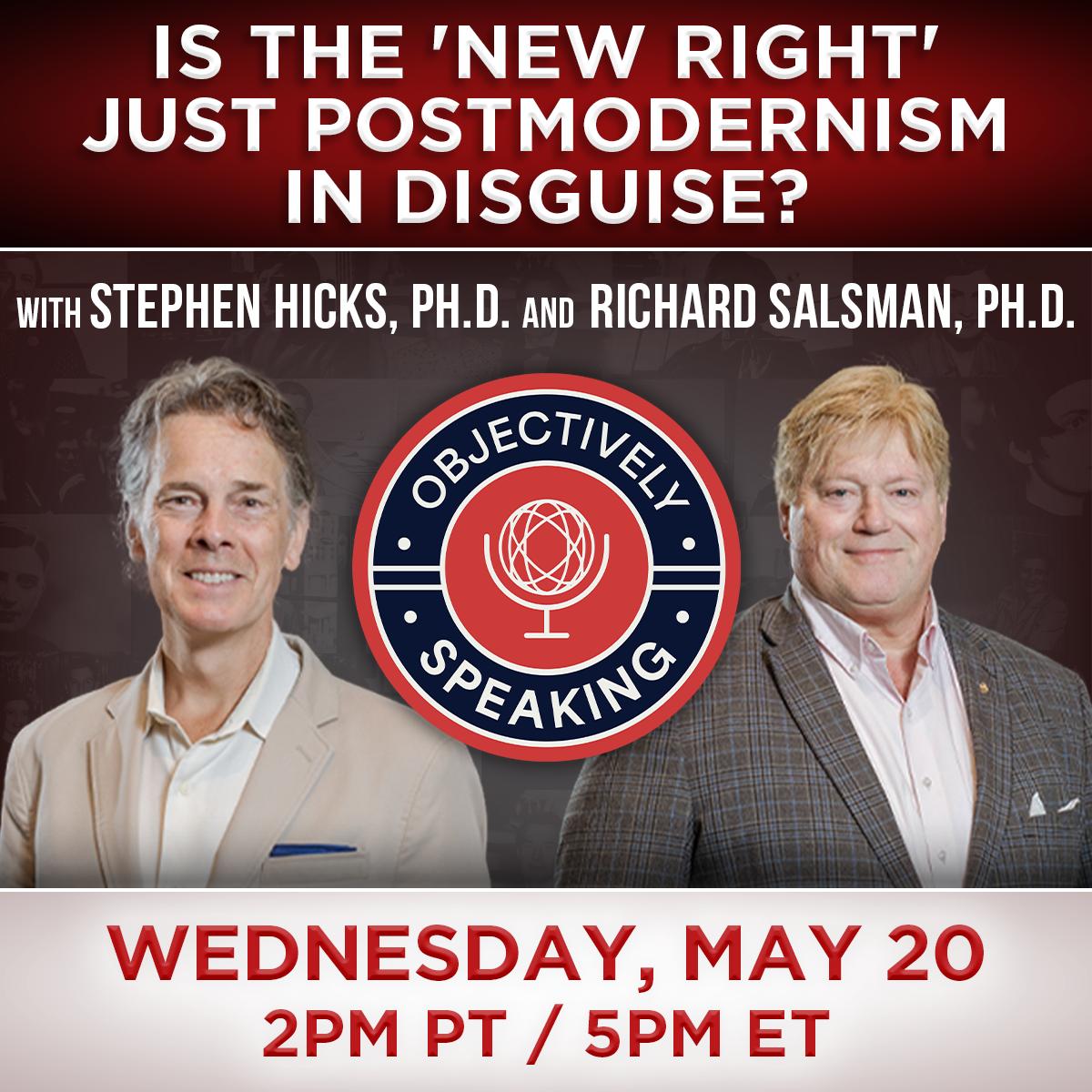
[00:00:01] Speaker A: One. Welcome to the 303rd episode of objectively Speaking. I'm Lawrence Olivo, senior project manager here at the Atlas Society. Jennifer Grossman has the week off, but I am excited to have with me at a society senior Scholar Stephen Hicks, and hopefully Senior Scholar Richard Salzman. He's having some technical difficulties, but we want to go ahead and get started with you today. The topic is whether today's post liberal New Right is genuinely charting new philosophical territory or simply repackaging the same critiques of reason, individualism and capitalism that have long animated the postmodern left. So with that, I'm going to pass things over to Stephen to get us started. Stephen, thank you so much for joining us today.
[00:00:48] Speaker B: Hey, a pleasure. Thanks for the intro.
So we do have a very broad topic about the New Right, as it's called. I think it's called the New Right in part because conservatism or the right is having a resurgence in contemporary discourse, not just in practical politics, but also in political philosophy and intellectual history behind that.
Partly, I think that's driven by electoral successes in the United States and some other countries by conservative right people, parties, some of the more populous, some of the more traditional, but also that the left, particularly the postmodern left that has been dominating the intellectual landscape and much of the cultural landscape for the last couple of generations, is kind of engaged on the defensive and there's a significant amount of pushback. So this New Right is surging. And as of course, it's a big tent movement, these labels are very broad. There are many substrands. And so, so on what I want to do is focus on a substrand that goes by the label of post liberalism. And one of the questions comes up frequently is what exactly is the post part of this? Because it's critiquing liberalism, it's critiquing the Enlightenment, it's critiquing modernity.
So is it just as with the postmodern Left, which also is critical of liberalism, modernity and the Enlightenment, another packaging or another flavor of the same sort of ideology?
Now, eventually, of course, when we talk about the Right, that's a fraught term, or if we talk about conservatism and pre modernism and traditionalism and so on, all of these labels are up for grabs. And depending on what part of the overall package an individual thinker or school emphasizes, different labels get to be used. So I've got here on the screen a grouping of four pairs of people, Jordan Peterson and Ayaan Hirsi Ali, I think are emphasizing more cultural conservatism.
Roger Scruton and James Orr, two British thinkers who are emphasizing a more national type of conservatism for some international flavor. Yoram Hazoni, Alexander Dugin or conservatives are on the right of a different sort, although have as many of the same targets. And I have given lectures and published written pieces on, on pretty much all of those figures. But I have not before discussed publicly the two American contributors, the two homegrown American contributors to the debate, Patrick Deneen and Adrian Vermeule. And they're the ones who are most associated with and most using the post liberal label. So I want today to take up and say a few things, primarily about Pratrick Deneen, as he is the most philosophical of them. And I'm a philosopher, philosopher by training. So I have four things I want to do in in my remarks. First, say that I love the post liberal label. Say why some definitional things about what postmodern post liberalism is, and then I'm going to become critical because I think Deneen in my reading is the most intellectual, well read, the most philosophical of this group of political post liberals. But this new version of conservatism is plagued by what I think of as weak history, sometimes terrible history, just as much of the left is plagued by terrible history as well, or using history in both cases for primarily political reasons. So I want to lay out three criticisms of the movements there and then take up the issue of whether the post liberalism is distinct from post modernism or whether it's another flavor of that. So let me plunge in with that now. Let me say why I really like, and I'm appreciative of, post liberal label. And here's the problem that I, and pretty much everybody who thinks about these issues, has been grappling with. So we take this as a standard survey from a few years ago of what's going on in ideological imbalances at college campuses. Everybody knows this is a problem.
Some people don't worry too much about it. Others think it's something that needs some serious reform.
We see on a regular basis surveys of ideological views or positions or political views of the faculty to show just how imbalanced things are. And this is a standard presentation of what the political spectrum looks like. So what we have is we put to a certain number of faculty members, thousands of them, what are your political views? And we give them two options. Are you a conservative or are you a liberal? And if you're not comfortable with those options, you say, well, I'm somewhere in the middle. So I'm kind of a moderate here. And then the survey results will show, as this one does, that about 80% of the professoriate thinks of itself as liberal in some sort, and Only less than 2% of the faculty members are conservative. And this is highlighting a real problem of intellectual diversity, ideological fairness, and the ability to teach students and even among the professors to have good robust debate. There is a serious problem here, but the labeling is just terrible because the only choices that we are offered really are these two very big tent labels. Either you're a conservative or you're a liberal, or you're some sort of blending in the middle. But if you're not a conservative, and this is typically what liberal comes to mean, anybody who's not obviously a conservative conservative, then that includes a huge number of people who are not at all liberal in their their view. So it's going to include people who are strong advocates of the welfare state, who are progressives, often with the paternalistic and techno authoritarian types of views, people who are social democrats, people who are socialists, people who are neo Marxists, all of them, according to this taxonomical scheme, they're not conservative, so they have to be liberal. And they are representative of the 80% or so of faculty who are not conservative. And this is very frustrating because most of the people whom I've got highlighted here are not at all liberal. If you take the 20 things that go into making one liberal, maybe they have one or two, maybe they have zero of those beliefs, but they are by and large illiberal and fundamentally anti liberal in their viewpoint. So we have a marketing, labeling, packaging problem that has been very prominent. So this is why, why I'm very encouraged when we turn to the literature about post liberalism, we want to say there's this thing called liberalism. We don't like it, we're attacking it, we think it's wrong, we think it's false, and we want to go post to it. The natural question then is to say, well, what is this liberalism that you are attacking, that you think has gone wrong, has failed, and that we need to go post with respect to and go do something else. And then suddenly everybody is very clear what the liberal, and it doesn't mean the welfare state, it doesn't mean some variation of neo Marxism or some sort of progressive paternalism or whatever it means liberalism. So here is the the definition that post liberals will say, this is what we are attacking. Liberalism is a broad intellectual tradition associated with thinkers such as John Locke, Thomas Hobbes, John Stuart Mill, and Later constitutional democracies grounded in individual rights, neutrality of the state, market society and personal autonomy. And I think that's a beautiful thing to see that as a statement of what liberalism is. There's no mention here of John Dewey, there's no mention of Friedrich Nietzsche, there's no mention of Karl Marx, there's no mention of Herbert Marcuse as somehow being liberal in some way. We are talking about liberalism in the robust sense. So I think just as a matter of conceptual clarity and getting the taxonomy more accurate, the post liberalism literature is doing a good thing for the discussion. Now, in my view, there's lots of popularizers of post liberalism and some who are more political activists, but they're doing a little bit of intellectual work.
In my reading, I think Patrick Deneen is the most articulate and well read and well grounded of the post liberals. And he wrote a very influential book published by Yale University Press in 2018, why Liberalism Failed. So I'm open to argument that of course there are lots of other people who are worth having a conversation about in the post liberal field, but I think that Dean is the best of the group. I'm going to have discussions about that as well. Nonetheless, what I want to do is say in Deneen, using him as the exemplary are we see what I see as the big weaknesses of the post liberal movement. And the biggest weakness is if you're going to engage in intellectual debate and if you're going to make commentaries about the trajectory of history and that we are in a certain cultural intellectual movement, we need to go on to something else. That this broad movement that we call liberalism was false from the beginning, that it's reached its nadir, that it's failed and so forth. You have to get the movement right, correct, that what you are talking about, and this is a steel Manning exercise and particularly for intellectuals. And so what I want to do is say what we have here is a weak use of history, that the kind of liberalism is a straw man in some cases, or a semi straw man that is certainly not portrayed anywhere close to its strongest arguments. And so what I want to do is just highlight in this brief discussion three major problems as come out of the post liberal tradition. The first is this theme that liberalism is beset by internal contradictions. So we say we started with liberalism in early modernity and it had these internal problems. Those worked themselves out and that's why current culture has all of the problems that we have. So we blame liberalism for them. It's an internalist dynamic.
Second, when we essay what is liberalism about? There's this constant, frequent claim that liberalism is an irrational doctrine. It's not based on objective principles or appeals to naturalism. Rather, it's a very subjectivistic, it's all based on desires, it's based on wants. And then third, the standard view, particularly by those who are more conservative, who want to maintain certain traditions, is that they don't like liberalism's constant critique and willing to upend various traditions, often traditions that they hold near and dear to their hearts. And so they will portray liberalism as an anti traditionalist movement, as rejecting all constraints, as a kind of whimsical, free for all, somewhat anarchic, culturally, politically ideological kind of movement. And I think that those are all historically bad claims to make, but they do make the heart and soul of the post liberal critique of liberalism. So let me put some flesh on that, on that skeleton. So here's Patrick Deneen in his famous book why Liberalism Failures, he said, this is the primary purpose of the book, I hope, to call attention to internal causes for liberalism's failure. I've got that highlighted that's not in the original. But the idea here is, here is liberalism. We can say that liberalism failed because it was attacked act from without, or there were things outside of liberalism. But the claim here is that liberalism is weak from within, on its own grounds, and that those are going to play out in a failure.
So it's the internal problems of liberalism that are fundamental. And then carrying on the quote, it's a failure that was generally undetectable to the denizens of liberal regimes who were largely satisfied with liberalism's apparent successes. So liberalism also sees itself as highly progressive. Maybe it's not perfect, but look at all of these things that we have done standardly. The acclaim is going to, well, those are not really successes. Those are superficial or only apparent successes. And then a related quotation making the same point, the irony. Now the iron. The irony is to speak of a contradiction, or at least an inconsistency, consistency, right where you're saying this, but you really are meaning this. The irony that liberalism's core value of individual autonomy creates structures that result in a felt loss of liberty for many citizens. So liberalism announces that it's in favor of, well, liberty, individual and autonomy and so forth. But when it works its way out institutionally, it structures society in a way that, that really it's a loss of liberty or proper liberty in some way. And that is again something that's internal to liberalism. Now this is a standard claim that modernity has internal failure. Sometimes the language is of internal contradictions.
And some commentators like to say, well, you know, the post liberals are talking about internal contradictions of the position that they are opposed to. That starts to sound like that system has its internal contradictions that are going to reach a nadir. And that's a kind of Hegelian analysis or kind of Marxist analysis. So maybe what we have here is just a repackaged Hegelian or Marxist kind of philosophy as well, but not necessarily. I want to lay out or set aside the contradictions point and just focus on the, on the internal part. So analogy I like to think about here is suppose we are engineers and we're designing and building a ship, and we build this big new ship and then we send it out on this ocean journey. And then we check in a week later or two weeks later as it's out on the ocean, we see how things are gone and we find out that the ship is in trouble. And we say, well, what are the causes of the troubles? And we might say, well, there are internal troubles with respect to the ship.
It's got bad engineering built into it, bad structural features, right? The motor was badly designed or the wrong size for a ship of that scale, or there wasn't enough structural fastenings and so all the vibrations have caused it to be weak, or it's just the weight distributions were inappropriate structurally. And so it's run into all of these problems as well. Now that then is to say the problem is with the design of the ship itself. It has internal problems and all by itself it's going to reach a certain failure point. It would be different if we then said there are external reasons why the design of the ship was fine. Of course, there are little flaws that emerge, but those, you know this, the ship's engineers can fix them as they go along. But really the reason why the ship is in trouble is because there are other ships out there that have been attacking it, you know, shooting weapons at it, right? And so on, are throwing bombs at it in various ways, or there are saboteurs from outside who came in and are undermining the processes of the ship from within.
So the analogy then here is to say it's important to recognize, of course, ships can fail for both of these reasons. And when we say that liberalism, and we take now current society as a liberal society that has got some problems that are going on to diagnose the problems as being the fault of the liberalism and the structures it created, as opposed to saying, in our society we have lots of, so to speak, intellectual saboteurs and other intellectual positions that are illiberal and sometimes they succeed in causing big problems for what's overall a liberal society. So it's not the liberalism parts of the problem, but rather these various illiberal parts, or that there are external to the liberal society, other kinds of societies, and they've been attacking liberal society in various ways and causing problems, disinformation, electoral interference, or whatever it is that they might be. And the liberalism society, the liberal society rather has not been able successfully to solve all of those problems. So this internal external distinction is important.
And probably, of course, the truth is going to be that current society has problems that develop both from internal and from external, external causes. But what's characteristic of the post liberals is to want to blame all or the lion's share or the huge majority of problems, not on intellectually outside of liberal forces or outside of the liberal society forces, but to assign all of the blame to liberalism as an intellectual system.
And I think that that is a bad historical judgment. And of course it's where we then have to do some further seminars. But nonetheless it's an overstatement. And I say we're starting with an assessment of where current society is broadly liberal. But obviously it's got a lot of non liberal elements in it. It's not also just like a ship able to go across the ocean and do its own thing. It's rather there are lots of other ships that are, by analogy, other nations that are attacking it in various ways and weakening it and sending saboteurs and so forth. So we have a lot of successes. And that's partly a disagreement with the post liberals there. They think we have a failed society right now. I don't think that that's true. But also we do have some weaknesses. And when we are looking for the sources of those weaknesses, I think we have to say, sure, liberalism is an ongoing intellectual and institutional project. And you know, it's like, you know, we sent the ship out, we're going to have to modify and change things and fix little problems as they emerge, but basically it's doing fine. And my judgment is that actually most of the problems that we are having is not from the liberal elements inside our society, but rather the illiberal elements within our society that have a lot of cultural and institutional, institutional power. So that's a big historical and sociological argument that has to be engaged. I do think the post liberals overstate the case about where the source of the problems is coming from.
Now a Second feature of post liberalism is when they are characterizing the modern liberalism that they are opposing, they're wanting to say that liberals get the anthropology wrong. That is to say, they don't think that the liberals have the right view of human nature designing society for human beings. And you know, we're not like, perhaps conservatives would like to say creatures who have a soul, who have higher dignity, who have a spirit. And of course we have this body, but we are capable of having our souls control our bodies. The modern liberals are much more physicalist, they're much more materialist, they don't believe in souls and spirits, right? That's all part and parcel of the modern package. And so they then conceive of human beings as not these potentially higher soul, spirit driven, but as more naturalistic creatures. And so how do human beings operate according to liberalism? And then here's Deneens in a couple of quotations saying this is what liberalism sees the human being as.
Liberalism redefines liberty as the capacity to satisfy subjective wants. Now here the point is a creature who wants, I want, I want, I want. And all of these wants are subjective. And both of those are important distinguishers. So that is to say we are not primarily creatures of reason, creatures of judgment. Of course we have wants, but our reason defines what our wants are and should be. And sometimes we say I shouldn't want that. I'm not going to back on the back on the basis of that. Rather I'm going to go with what my reason says. No, we are just wanting creatures. And these wants are just on the subject side, nothing objective about them, nothing intrinsic to nature, intrinsically good about them. So we're not taking guidance from objective reality or any intrinsic realm out there. We are just these desiring want, want, want creatures.
Modern liberals, the second quote, tend to see humans as creatures of appetite and will.
So liberals are all about subjectivity, they're all about wants, they're all about appetite, they're all about will. And nowhere is this to say that human beings are creatures of reason.
And I think this is a huge omission because if we look at the founding fathers, so to speak, of modern liberalism, and certainly of modern philosophy, there is a big debate over what it means to see the human being as naturalistic. Maybe we have a soul, maybe we have a spirit. But it's not clear what makes the human being the human being. And the leading liberal modernists do not by and large buy into all we are is subjective want, appetite and will. So here's a couple of examples so we're talking about the founders of modernity. Here is Francis Bacon. So here with his famous phrase knowledge is power. The most important thing about human beings is not wanting will appetites. It is our capacity for desiring knowledge, acquiring knowledge and using that knowledge, scientific knowledge, philosophical knowledge, all the different kinds of knowledge to advance the human condition.
And how do we do that? Well we have the senses, we have reason. This is the most important thing about what it is to be a human being. And we govern ourselves according to our knowledge. Now we do have this mental faculty of reason. It has enormous strengths and potential powers if we learn to use it properly. Bacon also believes it has some ill built biases and problems. So what we have to do is correct for some of those inbuilt biases. And some of those inbuilt biases are based on wants and desires and appetites. And so we do have these things, but they are subject to control by our capacity for knowledge and they are subject to the governance of that capacity. So the most important thing for the moderns is not subjective appetite and will and just grabbing for whatever you want. It is this capacity. Another example, here's Galileo, an early modern.
If you're more religious, that's fine. You said we're created by God. What does it mean to be created by God? And Galileo says I do do not believe, or rather I don't feel obliged to believe, that the same God who has endowed us with senses, reason and intellect has intended to forego their use and by some other means give us knowledge by which we can attain them. What is the most important thing for us as human beings believing still that we are created by God? It's not appetite, it's not will, it's not just subjective want, it is the use of your senses, it is the use of your reason, it is the use of your intellect that is the most important thing. And this is early modern. You know, Bacon and Galileo are giants on the landscape. And it strikes me as an entirely an omission when the post liberals are characterizing the modern liberalism that they are rejecting, that they don't mention this tradition at all. They go immediately to well if we don't have a soul then we're, you're just saying, well a bunch of animals running around with our desires and appetites and so forth. The omission of reason and the intellect and the power of rational judgment I think is a major weakness in the post liberal account of liberalism. Now sometimes this comes out a little more explicitly.
What about reason? What about Objectivity.
The argument here, read the quotation. Liberalism is insidious as an ideology. It pretends to neutrality. So when it's creating its judicial instruments, for example, or when it's creating markets, or when it's creating the political process, it's not having its thumb on the scale about what the procedures are going to be. It's neutral with respect to that. And we're just going to have lots of arguments and then decide political. We're going to have lots of arguments and then decide what the law is going to be, or we'll have lots of negotiations and then decide what the price of various things, goods, is going to be. And so all of this neutrality that is based into the ins, baked rather into the basic institutions of modern liberalism. We have a suggestion here that that is a pretend neutrality and it's a sneaky, insidious, it's not really rational objective neutrality. It claims no preference, blah, blah, blah. It ingratiates by invitation to the easy liberties, diversity, diversions and attractions of freedom, pleasure and wealth. So this neutrality is fake. Because really what liberalism is doing is it knows that people are going to go for the easy things, right? Smoking drugs and, you know, watching pornography, etc. Etc. Those are the things. And liberalism's coming along and saying you can just satisfy whatever subjective desires and wants that you want and we're going to be neutral with respect to, to that. But that attitude then of course is just going to lead to a hedonistic base, anarchic undermining of human potential. And this so called rationality really is just a fake overlay. So we have a rejection of the liberal account of reason and objectivity as a kind of front for something else.
Now the third thing I want to focus on is the attitude of toward tradition.
And of course we know that conservatives and people on the right more generally like to valorize tradition.
We know of course, that modern liberalism is very revolutionary and it has gotten rid of lots of traditions and reformed significantly many other traditions.
And to the conservative temperament and to the conservative mind, that seems like an assault. And it's very easy for conservatives then to overstep state the the nature of the liberal attack on tradition. But this is what we typically will find in post liberalism. And this is an inheritance from other forms of conservatism historically as well.
So the most basic liberal understanding of liberty is the liberation of individuals from inherited constraints, especially those imposed by custom, tradition, place and even family.
So the idea here is that we have a society traditionally that says here's the Family, an individual was born into a family. And there's lots of impositions and constraints upon the individual. And we want to free the individual from, from the family, maybe even get rid of families, right? Or you're born into a certain culture, or you're born into a place where there are certain customs that are being done. And the idea here is then that liberalism means you are liberal to the extent that you reject those inherited traditions, you reject family, you reject your place, you reject your traditions, and you see yourself as a free agent, unconstrained in some way.
Another quotation making the same point in slightly different language. The only limitation on liberty in this view should be duly enacted laws consistent with maintaining, maintaining order of otherwise unfettered individuals. And unfettered individuals is a, is a, is a slam. It's not quite a slur, but it's, it's meant to be unfettered individuals. Who wants to have unfettered individuals? And I always thought that this language is extraordinarily revealing because if we think about fetters, you know, they're the manacles that used to go around the wrists and the ankles of slaves as slaves were being led from one market to the other.
So the idea here is that we should all be wearing fetters. That is the proper status for human beings and maybe allowing a little liberty, a little individualism within that. But fettered individualism is the proper default state. And along come these modern liberals and they want to get rid of the fetters. Well, yes, actually we do want to get rid of the fetters. It doesn't necessarily mean that we want to get rid of all traditions and all constraints. Rather, the modern liberal view is and always has been much more nuanced with respect to the place of tradition. And what I want to do is contrast these true, the typical pre modern or the more strong conservative view of tradition always has been to say, well, who am I to judge what society has ordained in the Constitution? I'm born into a society.
I'm going to be molded, perhaps and shaped by it. And it sets the terms. And my first job is just to accept all of these, all of these traditions. I'm not, I'm not a revolutionary. I am a conservative. I accept my place in society.
Maybe I should accept them on faith, particularly if the traditions are more religious. I should be obedient. And this acceptance language, faith, language and obedience language is always very explicit or close to the surface in and is a marker of a more pre modern conservative approach to tradition. Now, the modern liberal view of Tradition is quite different. One is to say, obviously human beings throughout history have discovered some pretty important things and they've built some institutions that are pretty good, and we have inherited those. But what we are not going to do is just accept the whole package uncritically on faith and right and so forth. Rather, what we want to do is to exercise our reason, to exercise our judgment, to look at the actual experiments and to say some of these traditions in fact are not based on truth, so they are actually doing bad things according to our contemporary judgment. Those ones we will get rid of, those ones we will reform when necessary. But at the same time we are going to examine all of those traditions and some of them do seem to us to, to be based on truth. They seem to be doing something good. And we are perfectly fine with saying we will keep that tradition, we will strengthen that tradition, we will pass that tradition on to the next generation. So it's a nuanced judgment and a sorting of all of the traditions and a willingness to change that tradition, again based on reason, experience, the senses, judgment. And I think that's exactly the thing that is, if you find that problematic, that's the marker that your conservatism is taking you back in too much. More of an uncritical acceptance direction. So when we find post liberals saying, oh well, modern liberalism is just about throwing out all of the traditions and getting rid of all of the fetters and just saying people can just do whatever they want and they're just against all of the traditional institutions, I think that's a sign that this is not someone who has read deeply into and presenting a steel man version of the modern liberalism that they are rejecting. Now don't take my word for it. Here's just a couple of examples. Again, I'm going to the 1600s, Francis Bacon, John Locke, both of the 1600s. Here's John Milton again talking about tradition.
If men within themselves would be governed by reason, again, we should be governed by reason, not will, subjective appetites and just wants. We are rational beings. That's why we should be free and not generally give up their understanding to a double tyranny. So two tyrannies, one of custom from without and blind affections within. That is to say, custom without just whatever everybody else in society is doing or telling you that you are supposed to do. I'm going to exercise judgment about all of those social traditions and blind affections within. That is to say whatever I happen to be feeling like subjectively. That's not how I as a rational human Being particularly one who's going to be a free and responsible individual, should behave.
They would discern better what it is to favor and uphold the tyrant of a nation. So rational judgment is going to sort the social traditions and customs. It's also going to sort my passions. And that is how we are going to operate. Again, John Locke the the worst because he's the most influential from the post liberal perspective of the modern liberals. And again, it's not subjective will and just doing whatever you feel like. This is from his famous essay concerning human understanding. Men must think and know for themselves. So again, it's an individual and you're going to exercise your judgment freely. But it's an emphasis on reason, on thinking, on knowledge. That's the human thing.
Now, what about other people's views and traditions and customs that have come down? Well, not that I want a due respect to other men's opinions. So fine, I will have due respect for other people's opinions. But after all, the greatest reverence is due to the truth. It's not is it a tradition? But is it based on truth? Is it based on goodness? We should make greater progress in the discovery of rational and contemplative knowledge if we made rather use of our own thoughts than other men's to find it. Just basing yourself on authority, on tradition, on customs as they have come down, that is not to actually have knowledge. And so rather the only way you can get knowledge is by using your own mind, not substituting the judgment of other people in the past and so forth. And he goes on to make a very important point about the nature of cognition. If you really are interested in knowledge and truth, that has to happen in the mind of the individual. I think we may as rationally hope to see with other men's eyes as to know by other men's understanding. So the idea here is that we are rational, we can acquire knowledge, we can learn how to exercise judgment, and that's going to be how we are going to improve society. Not through throwing out all traditions, rather making sure that we understand the traditions that we are accepting and incorporating. And then of course, being willing to get rid of the bad traditions.
Now the final thing I want to take up is this issue about the post liberalism and the post modernism. What I want to say is I don't think the post liberals are postmodern at all. Instead I'm going to say they are pre modern. What they're trying to do is reinvigorate older pre modern traditions and that there are some overlaps with postmodernism. But they are overlaps of having a common enemy, not a common positive vision of what the alternative to modern liberalism is. So I want to say that I understand there are some temptations here, just because what you find is the postmodern leftists, for example, like Foucault and Derrida and Leotard, then Richard Rorty and so on, they will make big claims about modernism. It's failed, right? The Enlightenment is entirely a failure. And that's exactly what the post liberals are also saying. The modern project has failed. The Enlightenment was a big failure. They also will, in their more philosophical moments, both say it's the individualism that is the problem, it's the rationalism that is the problem. It's the emphasis on liberty or freedom that is the problem. And both of them will be critiquing the modern project for exactly that. Also, interestingly, both will say that it's an inner logic. If you take modern philosophy or Enlightenment liberalism and you play it out, the postmoderns say it was going to result in a disaster society and that's the terrible society they think that they are living in our current society. And that's very similar to what the post liberals say. If you take modern liberalism and you play it out across the generations, you're going to end up in a, you know, a narcissistic, empty, terrible society. And that's describing the society that we are laying around. So they do have the same negative stance with respect to concurrent society and what they take to be its historical roots. But here's when I think the differences are when you turn to what they are in favor of or what they think. The post part, once if we get rid of liberalism, what should we do? Well, the post liberals, I think this is where their conservatism, their traditionalism, sometimes they're soft advocacy. The rhetoric, rhetoric around religion is very interesting but, but subtle. In the post liberal theorists, what you find is that they are going back and being much more religion friendly or sometimes more explicitly saying, no, we need to have not just a kind of a reductive, natural, materialistic understanding of the world. We need to see the world as governed by a supernatural, supernatural being. And the postmoderns are usually atheist and they have no, no truck with that. So the post liberals are pointing us back toward religion in some ways, whereas the postmoderns don't. The postmoderns on the left, they're all sort of strongly skeptical when we look at their epistemological views, typically the post liberals are skeptical about many claims, but it's not a strong skepticism. And they want to substitute not just, you know, skepticism and a free for all social battle the way the postmodern left does. Rather, they're going to say we should know because we can appeal tradition or we can appeal to faith. So they do make some positive epistemological claims in a certain direction. They're not interested in deconstructing all of society and having things go down to conflict in identity politics. That's the marker of the postmodern left and its grandchildren. Now, rather, the post liberals almost always are saying we need to go back to our traditional understandings of society, the family, local communities, maybe the nations. But typically they like media, social, smaller units than that, neighborhood associations and so forth. So again, the post liberals and the postmoderns, at least the left ones, are pointing in a different direction. So my view is post liberalism is not postmodernism, rather it is pre modernism. That is to say, what they're hearkening to is going back before the modern world and finding what's good in those traditions or what's important in those traditions. Traditions and rebuilding society on the basis of that. Now, to go in with a couple of quotations from Deneen on this point here, for example, and I think this is accurate to his set of his views. This book is intended as a work of retrieval, an effort to recover older traditions and ways of thinking and living that have been displaced by liberalism. Just pausing there, the postmoderns, those on the left will say, yeah, the modern world failed, but the pre modern world also failed. So there's no going back to pre modernism. There's no fixing up modernism. We just have to reject everything and there's not really anything to replace it with. The post liberals are saying we have to reject modern liberalism and go back to an earlier time.
Now, picking up the quotation again, those traditions draw especially from the classical and Christian understanding of the human person and political community.
So identifying which of those older traditions he thinks is right. Now, the classical traditions are many and varied, so they're going to be doing some picking and choosing. There typically things more in the Platonic tradition, not so much the other one, the sophistic or the hedonistic or the stoic, and then of course, the Christian understanding of the human political community.
So it's pre modern, classical and Christian, and then even more specifically the tradition running from Aristotle here, I think particularly Aristotle's politics is what he has in mind, not necessarily other aspects of Aristotelian philosophy. But Aristotle, through Thomas Aquinas, understood liberty not as the absence of restraint, but as the capitol cultivated capacity to govern oneself toward the good. So my sense is, from my readings is that really it's not even the Augustinian version of Christianity, but it's more the Thomas Aquinas tradition, Thomism, that version of Catholicism, which is a long standing tradition now going back almost 800 years.
That is the one that the post liberal see incorporates the best of the Greeks, the Romans and the Christian traditions. That is what we want to revive now in the modern world. And that requires then rejecting liberalism, which broke away from, in their view, the older tradition. So just to close, I would say what we now have then is a three way debate. Often conservatives and postmoderns on the left will say really it comes down to a two way position. I don't see that as accurate. I think we do have now a significant number and vigorous, vigorously active pre modern right wing conservatism. And the post liberals are in that tradition as well. We also still have significant number of postmoderns who are on the left right around some sort of socialism or revised version of collectivism, politically and culturally. And both of those are distinct from each other as well as from modern liberalism, which amounts to a third position. And of course, I put myself, broadly speaking, in that position. I think objectivism is in that tradition as well.
And what we then have is a three way debate between these three philosophically distinct positions. All right, I'm going to pause there. Thanks for your attention. And kick things back to Lawrence.
[00:44:59] Speaker A: Perfect, thanks, Stephen.
Really great. Did that. And I saw a very active chat, which is really great. I want to see. I know Richard, you've been trying to rejoin. I want to give you the chance to maybe chime in. We've got like 15 minutes. Let me see if we can hear you at the very least. Richard, are you able to. To hear us or speak?
Looks like you're muted at the time.
[00:45:24] Speaker B: Oh,
[00:45:28] Speaker A: Okay. I think Richard's still having technical difficulties, so in that case, we apologize for that. We'll circle back to that at a later point. But we have, like I said, 14 minutes left. What we'll try to do is get to some of the questions from Q and A. There was one here at the very end for you. So, Stephen, that was asking why do pre modern political philosophies tend to prioritize hierarchy, authority and tradition over individual judgment?
[00:45:52] Speaker B: Yes, well, that's a. That's a good question.
I think that the two Issues there are or the two most important issues are intellectual capacity and moral agency and what's very common in pre modern political philosophy. Now here we're thinking of course, Plato, Aristotle and the others as the giants on that landscape. From their perspective, it's obvious, remember that people have different intellectual capacities.
So what they will then argue is that the difference between people who are very smart, able to think in terms of principles, understand the big picture and exercise judgment on complicated things, when we are talking about the important things in life, the decisions should be made by people who are of higher intellectual capacity. People who have lower intellectual capacity should not be given the reins of power. That's just a recipe for foolish policies or even dangerous and selfish destructive policies.
So partly then it's their view that the difference between the smart and the not so smart is so great that we can't really trust important decision making to the lower orders intellectually, so to speak. And the modern liberal view. One of the things that feeds into that, I think has been a more optimistic understanding of at least human capacity. That anybody who's born with a normal brain has the capacity to learn all of the basics necessary for life in order to become a self governing individual.
Maybe I can't do rocket science, maybe I can't do nuclear physics, maybe I'm not going to be a great inventor, but I'm not an idiot, right? And I can decide my own career, I can decide my own friendships, I can, I can learn how to read, run my own business and so forth. And so the capacity for self governance is there basically in everybody. And so we have to respect that capacity for self governance and then to extend that to politics where we say, well look, if politics is going to be governing everybody, the only fair thing to do is to give everybody a say in the political process. And so that means some sort of democracy say. And we have to have to work it out rather than excluding people from, from the, from the discussion. The argument there that reason can be cultivated, it's going to be a learning process over the course of the generations and there's going to be a winnowing out. Yeah, there's always going to be lots of uninformed and stupid arguments that are out there, but the better arguments can prevail across, across the various generations. The other thing I think is the moral agency point. And also in pre modern philosophies there's typically a view that the number of people who are capable of exercising their reason responsibly to govern their behaviors well, to develop their character in a noble and moral fashion, is again very few that the vast majority of the people, even if they know that something is bad, if they want it, they will do it. Even if they know that something is good, if they don't feel like it, they're not going to really strive for the good. It's only a tiny minority of people who really are committed to goodness, virtue, character development and so on. So you put those two points together then, the default, or not the default, but rather the strong tendency in pre modern philosophies has been to say that therefore political power really should only be exercised by an elite few who are smarter and who have better moral character. And they need to be the governors of the rest of society. Another characteristic then of modern philosophy, early modern philosophy, partly has been again a more optimistic view of human nature, moral agency, partly less belief in original sin, that people are not born saddled with original sin. People are born perhaps neutral. And with good education and good upbringing, they can develop their character in a positive direction. And again, that's pretty widespread.
And if their intellectual capacities can be developed as well, then of course we can have a perfectly functional and even progressive society by in effect, trusting people with their freedom.
[00:50:46] Speaker A: Okay, thanks for that, Stephen. I'm gonna bring Richard up again, see if we can hear him. I know he was trying. Richard, can you hear us?
[00:50:57] Speaker B: Starting to feel a bit like a seance.
[00:51:02] Speaker A: Can you hear us movingly on the Ouija board? Unfortunately, no. I still can't hear you, Richard. So we'll go to another question here. We've got about nine minutes left. But this ties into what you were just talking about, Stephen, this question, which is what brought on the question that you just answered. This is from lock, stock and barrel. Who asked, curious, Did Nietzsche agree with the Great man theory of history? And how should we distinguish a healthy admiration for excellence from a dangerous worship of power?
[00:51:36] Speaker B: That's a very interesting question.
Since you asked the question, it's about Nietzsche's views and not so much about the post liberals and, and the liberals. I will indulge and say, okay, we'll, we'll go off topic, so to speak, and, and talk about Nietzsche. Yes, for sure. I think it's fair to say Nietzsche is an advocate of the, the great man theory of history. You know, it's a one in a million human beings who is able to make up his own decisions about what his values are, be ruthless with respect to himself, prioritize certain goals, summon all of his energies and go off and do something great. Most people are Going to be a mixture of contradictory or conflicting desires. And they're never going to get their act together and go off and do and do, do various things. So yes, Nietzsche is an advocate of the. The great man theory of history. Now, one of the things that makes him different from modern liberals is that he thinks it's really a one in a million who's capable of doing this. Whereas the modern liberals will say basically anybody at birth you know, has the capacity for doing something pretty special. I don't know if everybody is capable of being a genius or being.
Or being creative. But, you know, you look at kids and when they are very young, you know, they're very playful. They're always making up games, making up this, that and the other thing, trying new things. And so the sense there is that as long as we don't destroy or stunt their capacities, it's amazing what basically pretty much everybody can, can, can go on and, and do. It may not always be with respect to intellectual power, but it might be with respect to emotional sensitivity.
It might be respect to physical dexterity and physical power. But basically everybody has the basic equipment to go off and do something pretty special in their life, at least with respect to them and maybe even on a world historical scale. Now, the second part of the question then is how do we distinguish a healthy respect for excellence versus a worship fullness of power? I think, Lawrence, you're right that this does tie into the first question. If we do go to the position of saying there's a certain number of people who have achieved excellence and they should have power over the rest of us just because of that, then that's going to be a dangerous culture, a dangerous political system. I say a culture more broadly because we do know is a common phenomenon. You know, people who are great artist, they will attract around themselves a circle of followers. And very often it's not politically required of them, but the followers will submerge their own identity in order to worship at the feet of the great artist or the great musician or the great athlete or the rich person or whoever it is. So there's a broader phenomenon to be worried about. Aside from concentrating political power in the hands of people, people who are, who are, are great, even if they are objectively great in some respect.
I think for the most part we do this. We do this pretty well.
We recognize that excellence, when it is achieved, is something special and we honor it. So we, we honor great athletes, we honor great musicians, we honor great novelists, we honor people, people who have, you know, accomplished some New adventure, some. Some physical adventure, or people who have done something heroic. And in many cases, we are surprised or not even too surprised that it is ordinary people who have dedicated themselves. You wouldn't expect that person from that family or from that part of the world or from that socioeconomic background, but that person decided to do something special and went off and did something special. And so when that happens, honoring that with. With applause, with buying the record albums, I'm dating myself a little bit there, buying the digital recording, paying for the concert, buying the book and so forth, and expressing verbally praise for that. I think that is the right way to honor excellence. And it doesn't in any way demean oneself. Instead, it's a way, actually, I think properly, of elevating oneself. Because you are saying, you know, I'm a human being. Here's another human being who has done something special.
And I, as a human being, you know, people doing things that are special matters to me, and that says something about me. And I am happy to be able to honor other people who have done something special. I'm not, you know, abasing myself or saying, you know, I'm not worthy to. To. To polish your boots or. Or anything like that. So I think that is the dividing line.
[00:56:33] Speaker A: Okay, thanks, Stephen. Richard, let's try. Third time's the charm.
[00:56:37] Speaker C: Hi, Stephen, can you hear me?
[00:56:38] Speaker B: Ah, yay. There he is.
[00:56:41] Speaker C: I have returned from my intergalactic travels. Stephen, excellent presentation. Much more integrated, I think, than if we had done it mutually. Here's what I wanted to point out or ask you in Deneen's why Liberalism Failed. If you look for a definition of the liberal period, he says 500 years ago.
And he basically says, Bacon Hobbes, if you. Those who know the dates, we're talking the mid-1500s. I would. He doesn't mention Luther, the Protestant, who obviously was rejecting Catholicism, but I think he might date it there. Okay, here's why I think it's interesting. If you pick 1500, say, as Deneen does, and then say there's a problem with the liberal era, he's conflating two things, both before 1500 and after the. After 1500. Conflation is classical liberalism, which I think you've rightly identified as. That's the true liberty position and what he himself calls progressive liberalism, which he dates from, you know, the Progressive era in the US which was a counter to classical liberalism.
And so Teddy Roosevelt and Woodrow Wilson and all that. Right? Now, here's what's interesting. The old right, as opposed to the New right, they opposed progressive liberalism, the old right, in the 1930s, 40s, 50s in the U. S. And those who gave rise to Hayek, Mises, Friedman, maybe even random. They were basically saying progressive liberalism being illiberal is our problem.
And Deneen's very weird because he basically says, yeah, they're a problem, but so are the classical liberals. So he rejected Frank Myers conservative fusionism, which tried to combine classical liberalism with the social conservatives. So I think that's important because that makes Deneen much more radical. He isn't just against standard issue, you know, New Deal type, what would. What we would call progressive liberalism. And now here's the other thing he does. Conflating pre 1500, he combines the classicals and the medievalists.
I mean, he's a Christian, he's a Catholic, so he really should be endorsing everything post Christ, which he does. But notice he is interested in drawing from Aristotle and some of the virtue ethics in the Greeks.
So except when you read him, he basically lumps all those together too. He'll frequently say Aristotle and Aquinas. And, And.
And as we know, those two sets of ethics and what they are, their view of man is radically different. So I. I just wanted to put that on the table, Stephen, to see whether you saw that. Because I think conflating post 1500 and conflating what we had pre 1500 makes him much more, I think, radical, not postmodern.
[00:59:41] Speaker B: Okay. Yeah. I think I'm gonna be more sympathetic on the second thing you're calling a conflation, but sympathetic to Deneen, but agree with you that he's disingenuous on the. On the first conflation. So I do think it's important that the verbal similarity of the progressive liberals and what we now call the classical liberals, that those two have very different intellectual genealogies, very different positions, variants, different institutional requirements. So it is an intellectual scandal and I think a very bad reading of history just to say, well, that's all just liberalism of. Of various sorts. So, you know, making that distinction called progressivism. Progressivism, fine. But it's not liberal in any respect.
Save the word liberal for things that actually have something to do with valorizing liberty. Agree, I agree. So. So I think that's a. That's a. That's a problem. And I think conservatives, by and large, are aware of that problem. At least the intellectual conservatives are aware of that problem.
They're aware that it's kind of a weird Americanism because the whole rest of the world does not confuse progressives. And various kinds of socialists and so forth. With liberals, they make the clear distinction. So it's a, it's a weird Americanism. And I do think the, the conservatives are disingenuous on, on, on that one. It's a useful packaging for them to say, well, those two are both liberal and we just want to reject the whole thing because they are opposed to classical liberalism and they are opposed to progressivism and socialism and egalitarianism. So let's just call that all liberalism to, to get rid of it. Now on the, on the other conflation though, as you're calling it, I, I want to be sympathetic to Benin here because within the Christian tradition before 1500, so let's leave the Protestants out, actually let's also leave out the, the Eastern Orthodox as well as to say, at least in the west, the Christian tradition up until 1500 was Catholicism. And that was, that was the only game in town intellectually and institutionally. But within Catholicism, I think it is fair to say that there is a deep divide between the Augustinian version of Catholicism and the Thomistic version of Catholicism on all of the important issues, except from your basic commitment to Christianity. There are huge differences between those traditions.
And within that tradition, they think they rightly oppose each other intellectually and institutionally. And much of the modern history of the Catholic Church has been going back and forth between more Thomistic and more Augustinian approaches. So I'm willing to say, and this is my sense of, of Deneen, that when he says he's a follower of Aquinas, he means it and he is accurate and that when he says. I don't think he says this very much, but all the things that we would associate with Augustinianism, you know, the, the terrible fallen nature of man, the helplessness that we're all sinners and only God has all of the power, etc. Etc. And the complete anti other, anti this worldliness and anti pleasure and total other for focus, the strong faith, all of that, I don't think that's in the need. I think he is a Thomist with more respect for the natural world, with some respect for the individual, as long as it's within the right communitarian framework, as he sees it as some sort of blending of reason and faith, although ultimately faith and tradition are going to be, going to be the, the governors there.
And so it is a blending of a kind of Christianity as Thomas Aquinas saw it, and that is, I think, legitimately incorporating a significant amount of Aristotelianism.
So his is not a Platonic Christianity, which I think would be more Augustinian, but it is a kind of Aristotelian Christianity, which is more Thomistic. So I'm not yet convinced that that's a, that's a conflation that you have to buy into and accept the whole medieval package, because the medieval package is already a mixture of some, some traditions that have some deep divides.
[01:04:20] Speaker C: Thank you, Stephen.
[01:04:23] Speaker A: Thank you, Stephen. And thank you, Richard, for being persistent in trying to talk to us today and share your input there at the end. Hopefully we can do this again and have you both for the full hour going back and forth like normal. But if you are watching this at home and enjoyed it and want to talk to either scholar or any of our other scholars in person, there is still time to register and get your ticket for Galt's Gulch 2026 in San Diego. That's coming up June 4th through the 6th. Otherwise, I do want to thank all of you all for watching. And if you want to see more videos like this, please consider making a tax deductive
[email protected] donate. Be sure to join us next week when Jennifer Grossman will be back and she will be interviewing Professor Randy Barnett, who has who will be talking about his book, Our Republican Securing the Liberty and Sovereignty of We the People, as well as his new book, Felony Review Tales of True Crime and Corruption in Chicago. We'll see you then. Take care everyone.