Episode Transcript
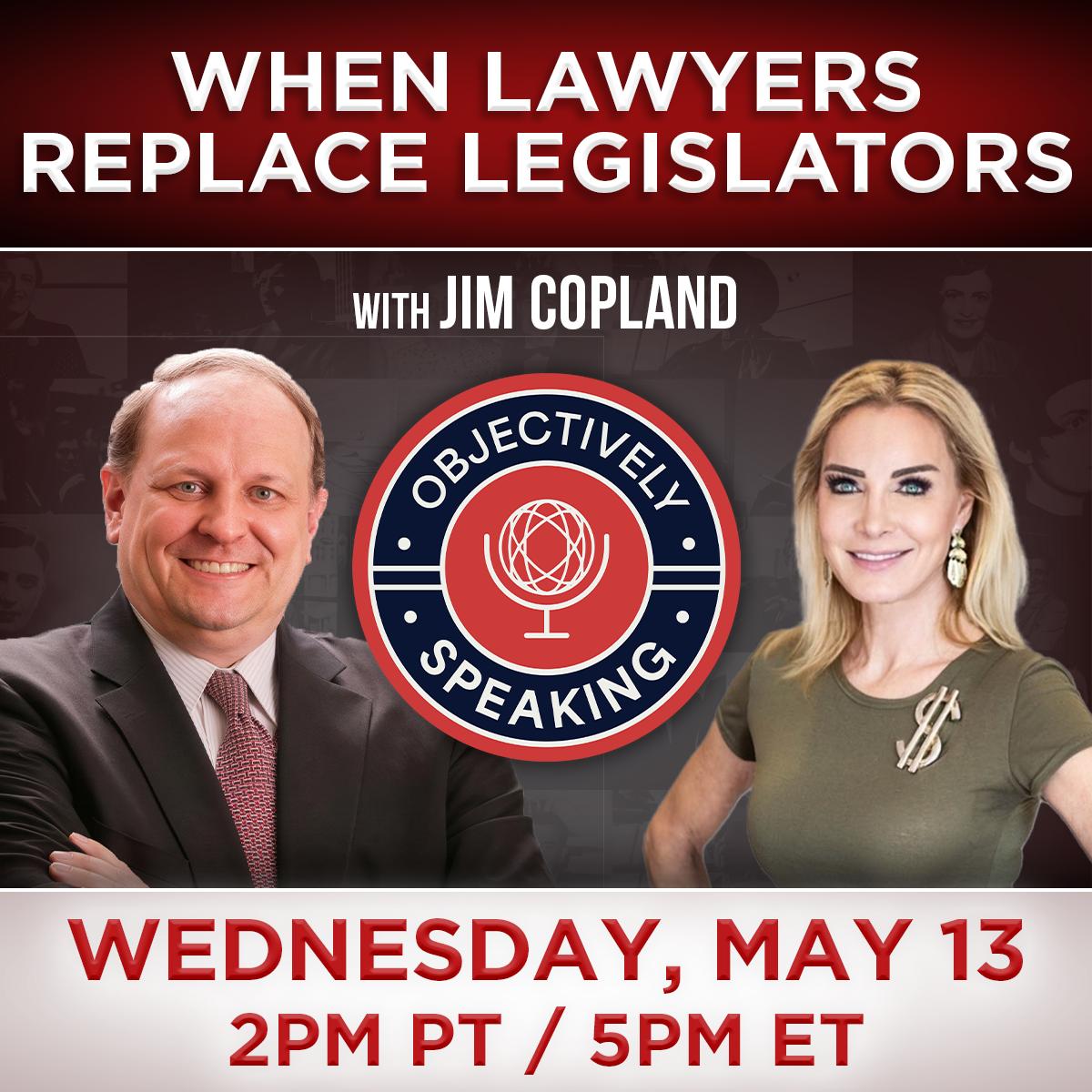
[00:00:00] Speaker A: Hey everyone, and welcome to the 302nd episode of objectively speaking. I'm Jag, CEO of the Atlas Society. I'm very excited to have Jim Copeland. He is senior Fellow and Director of Legal Policy over at the Manhattan Institute. He's joining us today as part of our ongoing series of interviews focusing on tort reform. He is the author of the excellent book the Unelected how an Unaccountable Elite Is Governing America. Jim, thank you so much for joining us.
[00:00:34] Speaker B: Thank you so much for having me. It's always a pleasure to be with our friends at Atlas.
[00:00:39] Speaker A: So you, I saw you had shared a story from your time at Yale Law School about your mentor, Judge Ralph Winter being the only Republican professor there in the mid-1970s. How has the lack of viewpoint diversity in elite law schools evolved since then and what do you think are the long term effects that it will have on the legal profession and public trust in the legal system?
[00:01:09] Speaker B: Yeah, I think the tale from the 1970s sort of suggests that, you know, it's not a new thing that elite law schools in particular, but it's really most all law schools tend to be very liberal or left leaning or Democrat affiliated or progressive or whatever you want to call it.
You know, the quip there was the late, great Ralph Winner was in addition to a professor, a judge, later chief judge of the Second Circuit Court of Appeals when I clerked for him. And the tale he would tell, he was always a great storyteller, is that he gave an off the record comment to a reporter when Gerald Ford nominated John Paul Stevens to the Supreme Court, basically saying, watch out for this guy, you know, he's not going to be a true conservative on the court, which of course he ultimately was not.
And he was quoted in the piece not by name, but as a Republican professor at the Yale Law School. And Judge Winter said, well, goodness gracious, John Paul Stevens never spoke to me again because I was the only Republican professor at the Yale Law School. Bob Bork was also a faculty member, but he was off in Washington in the government at the time. So, you know, you know, it's not a new thing. And this is, you know, right before the time when the Federalist Society was founded. Ralph Winter was the Yale faculty advisor originally and Chicago and Harvard were also involved in the founding. So you know, that, that it's nothing new, that there's sort of a left lean to law faculties. I think the fundamental shift we've seen over time though has to come as an outgrowth of sort of the critical legal studies movement. Critical race theory, criminal critical feminist theory, you know, which all sort of evolved in this time, in the 70s were really taking off and in the 80s in particular, getting more organized. And as these sorts of faculty member became tenured professors, there was a shift away from a sort of tolerance of robust debate.
When I was a student, and this was, you know, a couple decades after this episode in the 70s, this was the late 1990s when I was a student at Yale Law School, we had robust debates, we disagreed strongly, and I would say about 10% of our class affiliated with the Federalist Society or were sort of a right leaning cohort.
And the others may have thought we were strange, they may have thought we were wrong, but they didn't try to shut us up or shut us down.
There's been a real shift in that. I do think it's moved back a little bit.
But my friend and former colleague Wally Olson, now at the Cato Institute, wrote a book about a decade or so ago, School for Misrule, talking about the academic evolutions here. And my friend and colleague Ilya Shapiro, now at Manhattan Institute, last year wrote a book, Lawless, and talked about this sort of evolution and really these sorts of fights that we've seen trying to shut down speakers, trying to shout down federal judges.
I mean, the old guard school that I went to, where it was left leaning, I felt it meant that if you came out of that school as a more conservative or libertarian thinker, you were going to be sharper, right? Because most of the voices you were hearing, most of your sparring partners in class, including your professors, were on the other side of a lot of these issues. So you really got your arguments refined.
And so, you know, it didn't bother me particularly that I was in the minority as long as I wasn't punished or sanctioned or shut down in speech. I think now there's a shift in that. I think there's probably more social sanction and there's more of the notion that this sort of speech ought not be tolerated, that it affirmatively harms certain individuals if you express certain points of view, I think that's quite pernicious. I do think we've seen a little bit of shift back in a positive direction.
[00:05:01] Speaker A: I think you're absolutely right. We recently had Nadine Strossen on for our 300th episode to talk about this shift and how important it is to preserve free expression and particularly when it comes to our law school. So turning now to your book, the how an Unaccountable Elite Is Governing America, the Title contains quite a sweeping claim. Walk us through what you mean exactly by the quote, unelected.
Who are these people and why is elite the right word for them rather than say experts or professionals?
[00:05:45] Speaker B: Well, I mean, elite has a different connotation. I don't know that any of those three would necessarily be inaccurate. But what I'm talking about here is most of us who, who aren't most people, who aren't lawyers, who aren't political scientists, think about things in fairly simple terms. And those of us who grew up in the 70s, 80s, maybe even into the 90s, you know, who still watch Saturday morning cartoons would get the sort of Schoolhouse Rock informational programs on Saturday morning during, during the breaks, during the commercial breaks. And you know, one of these was this. I'm just a bill, I'm just a bill, I'm only a bill. And this notion, our Constitution, and it comes straight from our U.S. constitution, our constitutional foundations, where the legislature enacts the law, the executive enforces the law, the judiciary interprets the law. The very basic sort of simple concept is the one we all hear and we still have that constitutional structure.
But the sort of safeguards that have been built into this have been substantially eroded over time.
Such that we now have had going on almost 90 years of a situation where you get agencies that are quasi independent from the President doing a lot of regulatory rulemaking that is very minimally influenced by Congress. I mean, Congress will give some grant of power, but then the agencies have a ton of authority to execute, to both to write these rules, to execute these rules, and to interpret these rules. So you've got these administrative agencies in there that are what I call the rulemakers as well as the enforcers. And then we sort of have these other forces in there as well. So I try to go through all of these, what I call big government forces that are not accountable to, to our democratic process. In the book, one of those is our litigation system. Tort system is sort of a shorthand for it, but our broader litigation or civil litigation system. So we have these private enforcers which predate the Constitution itself, but it's metastasized into something quite different than it was originally.
And so we have this sort of growth of government through lawsuit. And we've seen that in regulating tobacco companies and now going after climate change, et cetera, et cetera. And then we sort of, what I call the new anti federalists.
Federalism is a great guarantor of liberty. Our structural Constitution is both vertically and horizontally designed to preserve liberty. The branches Disperse power amongst themselves. We also disperse powers among the 50 states. And so that's sort of the horizontal division of power.
But now we've got sort of grand lawsuits that can sort of sweep in so that you can have one state basically override the other 49 states through litigation. That's sort of the litigation prong of it. And we see aggression and aggressive use of enforcement as well as litigation power on the part of state attorneys general, even local district attorneys trying to drive regulatory capture when they can't get things through Congress. So climate change is sort of the most recent example of this, and it continues to this day.
[00:09:18] Speaker A: So the Constitution sets up an elaborate accountability system, as you mentioned, elections, impeachment, separation of powers, federalism. Where did the wiring break down?
And was there a single decisive moment or moments? Or has this been a slow drift across time?
[00:09:39] Speaker B: There definitely are decisive moments, and it's also a slow drift. But those are indecisive moments. Some of these very intentional, some of these almost by accident. Right. And so, you know, the Progressive era, and modern progressives claim this verbiage for a reason. The Progressive era, which is, you know, as we think of it, the early 20th century, the teddy Roosevelt, Woodrow Wilson era. And Woodrow Wilson was sort of the paradigmatic progressive, while Teddy Roosevelt was as well on the Republican side, with a different sort of flavor, was very conscious about trying to undo this sort of American constitutional system. Woodrow Wilson, who was a professor of political science and the president of Princeton University before he was a governor, and the president wrote his main academic works on this, saying, we don't trust the people with democracy. We want to be governed by experts, as you say, and we want to come up with systems to get around this.
Not only partially successful initially, in part because the courts pushed back, in part because he didn't have full majorities to do everything he would have wanted to do, although he did do things like the income tax, the Federal Reserve, other things. We think of today as sort of the cornerstones of big Washington federal government.
And then of course, in the New Deal, we saw that solidified under the Roosevelt administration. So it takes a crisis sometimes to get that political will. Big majorities and ultimately the Supreme Court acquiescing in an erosion of these sort of constitutional constraints. And we've also just seen things like litigation. We've seen almost by accident these things happen.
The way we handled attorney fees seems very sort of basic process based, not necessarily central.
But that was very different in the early Republican. It sort of shifted and shifted over time till we get these contingent fees that give the lawyers a stake in the outcome. And there are law and economic rationales for that. It aligns the lawyers incentives with the clients, but it also creates a lot more aggression in terms of the sort of lawsuits we see. And then we saw a reworking of the Federal Rules of Procedure, the Federal Rules of Civil procedure in the 1930s, and Congress basically delegated this to the courts and delegated it in turn to law professors and some practitioners in the bar and they basically rewrote all the systems. So it used to be really hard to bring a lawsuit in simple terms. Then it became really easy, right?
[00:12:21] Speaker A: Yeah, the incentives have changed.
Now I don't want to get too ahead of us because what I find is that our conversation gets rolling along and our audience has asked questions from, you know, 15 minutes ago. So I'm going to dive in and accept one from Candace Morena who asks how did Congress allow so much lawmaking power to move into agencies and courts? Convenience, accountability.
[00:12:51] Speaker B: You know, I think that the dirty secret is here that most people who become long term politicians are more interested in being in office than in the distribution of power to some degree. And so this is sort of. Justice Scalia writes this in one of his sort of big dissents from the independent council law back in the 80s, which sort of still shapes people's thinking on this. But you know, the separation of powers is, if you read the Federalist Papers and Madison's talking about it, the notion is, well, we're going to zealously guard our power against the other branches. And for about 100 years that was the case. It was also a much smaller federal government. As it got bigger, it became pretty clear that if we really want to get things done, we want to delegate that power. So if your view.
So part of it's ideological and part of it is just sort of what public choice theorists would call self interest in terms of vote maximization. But in the ideology, if you want to grow the government, well, our governmental design is designed to make that hard. You need majorities of both houses of Congress, which is basically a majority of the states and majority of states over time and a majority of the people in the House of Representatives. And then you need the President to sign on or you need super majorities. It's hard to sort of steer that ship and change it. But if you just write a broad open ended rule and then give it to the President to, to have his agencies do, becomes much easier to get from A to B. I mean we, we saw that with President Obama talking about pen and phone diplomacy or whatever. This has been the, the increasing trend. And then if you give it to these agencies, you can sort of create this unaccountable elite, as I call them, this sort of bureaucracy that has a mind of its own to some degree. And the president who gets elected can try to resteer this, but it comes very awkward to resteer it. And the rules have been written by the judges, the interpretive legal doctrines by the judges, so that it's often harder to scale back regulation than it is to write it new in the first place. And so that's where we've gone.
[00:15:06] Speaker A: We've certainly seen that with the early efforts in this administration of doge and how just viciously was resisted.
But I have another question. Conservatives have spent 50 years fighting to fill the bench with originalists. You and I were talking about the Federalist Society and those changes over the years, but now conservatives or originalists hold a 6 to 3 Supreme Court majority. Has the problem of judicial governance actually gotten better? Or, or have we just swapped one unelected ruling coalition for another?
[00:15:49] Speaker B: Yeah, I mean, I think it's gotten better. Now obviously I'm coming at it from the perspective of one who thinks a limited constitution consistent with the design of the US Constitution is a normative good. Right. So if you want a big socialist government and you want rule by so called expert elites and bureaucracies, you would think this is a horrible court. Right. But if you want to put guardrails in there around the elected branches, but do so modestly, I think that's where this court's broadly gone. And a number of the areas I talk about in my book, not all of them.
Since I wrote the book, which was published now almost six years ago, there have been positive developments. So the interpretive rules where going back to the 80s we had the so called Chevron doctrine, which was really, it was Neil Gorsuch's mom in the Reagan, as the EPA administrator under Reagan against the Natural Resources Defense Council in the original litigation on that, but that's now been repealed. So what that means is for years the courts were saying if the Congress writes an ambiguous law and we can't figure the words out, we will defer to the agency's interpretation.
There's some logic to that. But of all the things the court should be deferring to, the actual meaning of the words, which is what judges are equipped to answer, is probably not the one they should defer to. And what that effectively means is, well, if you get the new president in the actual meaning of the statute, changes depending on who's elected president can't be the right rule. They've jettisoned that rule.
They scaled back significantly on the power of these so called independent agencies. So what's interesting about all these moves is they are moves away from empowering broad governance by the executive branch without congressional oversight.
And that's, I think it's a good thing. Now, it doesn't mean Congress is going to do well and do its job, but it does mean you're not going to have these sort of unaccountable agencies going off in the other direction. And when we see some of the other, you know, areas where the court has shifted broadly from precedent and they've largely been punting issues back to the elected, you know, Roe v. Wade being a clear example of that. Disagree on that as a policy matter. But it's hard to say it's an imperial court when we're saying we're going to give it back to the people.
[00:18:28] Speaker A: There's a real tension at the heart of any rule of law argument. You want courts strong enough to strike down unconstitutional laws, but not so strong that judges become legislators in robes. How do we find the right balance?
How should those concerned with protecting individual rights think about courts that expand through doctrines, the unelected encroach upon the elected branches that, you know, never voted on these rules?
[00:19:01] Speaker B: Yeah, I mean, that is the irony here and I guess that's the sort of intellectual tension and me complaining about, you know, unelected rule and then saying, well, we need these unelected judges to enforce the rules against the other branches.
But there has to be some referee. Right. And whether you like or don't like Chief Justice Roberts sort of umpire analogy that he made famous during his confirmation hearings, there's got to be someone to sort of call these balls and strikes. And there's not an easy way to distill this. I mean, Sam Alito gave the Wriston lecture, used to be an annual lecture we gave at the Manhattan Institute, and tried to say, you know, put pin down his philosophy of judging and you know, each direction he would go in, you'd ultimately run into some sort of corner. It's not super easy. I mean, I think the modesty in the judicial craft requires judges that are willing to tie their own hands to some degree. And that's why you've seen this trend in conservative and libertarian intellectual circles mostly. And there's counter trends within that movement, but mostly veer towards so called originalism and textualism in Other words, you're tying your hands to the document, to the text, either the statute as Congress enacted it or the Constitution that supersedes it.
And that's where you stick. Now the problem is the Constitution itself is a pretty sparse document. It's open to different interpretations and there's good ways and bad ways to do this.
My bias is always to sort of tend towards an interpretation that limits the government because government can always grow.
But that doesn't mean you, you want courts to be crazy, right? I mean Scalia would say this back in the day. He's called himself more of a faint hearted originalist compared to Justice Thomas who I think, you know, is, is very doctrinaire on this. But, but you know, for instance, if, if, if the Supreme Court tried to overturn Social Security now when all these people are relying on it, or to toss out the Federal Reserve, doesn't mean we shouldn't reform Social Security or the Federal Reserve Board.
But if we did it by judicial fiat now, 100 plus years later in the case of one and 90 years later in the case of the other, that would be I think wildly imprudent. Which is why the doctrines of stare decisis or letting the decisions stand take root. I mean that's sort of a conservative posture that you don't have the law yo yoing back and forth, but there are rules they use. I mean obviously it can't be the case that just because it's been decided it can never be reversed. I mean, Brown versus Board is sort of the paradigmatic case where you know, the court came down one way and said you can have separate but equal facilities, etc. And in Brown v. Board they said now we got that wrong and they switched paths.
[00:21:53] Speaker A: Yes, very, very good example. So another question here from Iliacin. What about class action lawsuits? Are they a tactic that are, that is used to shift government policy and practice?
[00:22:09] Speaker B: Yeah, great question. And you know, one I cover in a whole chapter in my book because the class action device, and it's not limited to class actions per se, that's just sort of the common usage. But there's other litigation tactics that work the same way have definitely been used to drive policy outcomes. And you know, this is something. And we see it from the left and the right, let's be real clear. And we see it from people who are against government and supporting more government. And we see both types of litigation.
I think there are all sorts of conceptual problems. I think some sort of class action device makes sense because there are some types of Cases that are so common that it doesn't make sense to litigate each and individual one over and over and over. It's just too expensive so to merge them together. And it also can protect defendants in the sort of ordinary corporate litigation context if you have a defendant able to resolve the big block of litigation against it. On a product liability claim, for instance, product liability doesn't tend to work with class actions because they tend to be too individuated.
But for something like a securities claim, you don't want to have every shareholder separately.
Under state corporate law. There's ways of dealing with this. But if you did this federally, class action sort of makes sense. But the way we designed it was kind of on a napkin. I mean, again, the courts delegated a rewrite to a group of professors, and you had a Harvard law professor and his student on the ferry to Martha's Vineyard in the back of the car typing out this class action thing. And they came up with a design that had never been used before in the 1960s. And that's how we got stuck with it. You know, reforming it is, is tricky.
There have been efforts. There are, there are people out there now who are litigants. You know, my friend Ted Frank at Hamilton Lincoln Law Institution, you know, challenges bad class action settlements, but that requires someone doing it and requires someone doing it honestly and not, not just trying to get their piece of the pie. So the end of the day is if you have a settlement with the party and the business is going to want to settle it, they're often going to settle. So this is a big way to drive policy. We wrote the last major federal class action inform is the Class Action Fairness act of 2005. So a little over two decades ago, we did a lot of research heading into that and we showed how you would have a class action in Illinois holding a company liable nationally on a class for violations that were required by other states, laws and regulations. So a total mess is a little better under the Class Action Fairness act than it used to be. But this is a big tactic and it's sort of bottom up. And libertarians often instinctively say, well, we like lawsuits a lot better than top down regulators. And the real answer is if you care about limited government, you need both, you want to limit both, and you need to understand how they fit together.
[00:25:26] Speaker A: Right. Well, we actually had your colleague Ted Frank on as part of this series and I thought he made a very compelling case. But most Americans don't picture trial lawyers when they think about an unelected ruling Elite make the case. How does mass tort litigation function as a form of governance, not just dispute resolution?
[00:25:50] Speaker B: Largely because the trial lawyers themselves. And first of all, I do want to be clear that I'm not trying to just disparage the plaintiffs bar per se, and they are doing their job. Many of them do it admirably, and they are working with the rules that have been set before them and trying to get the best deal they can for their clients and ultimately, therefore, for themselves, given those rules. And as my mentor, the late, great Ralph Winner, used to always say, remember that the defense bar has the exact same economic incentives as the plaintiffs bar, which is one reason this is hard to reform. You know, if you start to clean up the litigation system, there's less money in it for both sides in terms of the lawyers.
But the basic analogy here is sort of why this becomes problematic. Because we do need a private dispute resolution system. And this is good.
But it becomes problematic when you get this systematized as a business.
Think about if your IRS agents who were enforcing taxes were able to get a cut of, you know, whatever they found in every audit. It would lead to much more aggressive behavior based on the incentive structure there. You know, this is sort of something historically seen with, like, conquering armies. Well, you let the. The conquering army gets to take some of the stuff from the people.
Doesn't. Doesn't. Doesn't work very well for the people on the ground there. Gives the conquering army a lot of incentive to be very, very aggressive. So, I mean, at the end of the day, a lawsuit is very different than a market transaction. So in a market transaction, you know, I have a phone. I like this phone.
If you like it more, I can sell it to you for, for more money. We're both better off.
This is how ordinary market transactions work. This is not how lawsuits work in lawsuits.
The. The plaintiff in the lawsuit has unique monopoly access to the government's monopoly use of force. In other words, the government takes the defendant's money and gives it to the plaintiff. This is classic redistribution of wealth. Now, it doesn't mean you don't need a private dispute mechanism. It doesn't mean you don't need lawsuits. It doesn't mean you don't need any litigation. You do. And, you know, I think there's a lot of merit in the system, but if it, quite obviously, if there are no guardrails around this system, it becomes pernicious and prone to government abuse and prone, prone to redistribution of wealth that people don't really understand. Because these rules are the backdrop and most of these cases are settled. And then you see these eye popping verdicts once in a while.
And along the way there are implicit policy decisions being made by some of these big cases in litigation that Congress is never voting on, the President's never signing off on.
[00:28:59] Speaker A: So you have talked about two great mitigation explosions in American history.
When were they and what contributed to those turning points?
[00:29:11] Speaker B: Well, the, the original sort of explosion we saw was at the turn of the 20th century, the late 19th century, turn of the 20th century. And of course what, what was happening on the ground, there was industrialization, railroads. A lot of these cases developed around railroads. And then you had this sort of emergence of a system where the old rules stopped applying, where lawyers got a cut.
They were able to take what's called contingent fee, a cut of the outcome. You know, so basically working on commission, the prohibitions on advertising still existed. But you know, there were ways around these so they could solicit business implicitly.
And you saw a sort of breakdown in the old rules. I mean, the US somewhat idiosyncratically developed this system where the losing party doesn't have to reimburse the other side's fees.
And it's actually hard to do.
But the European countries basically all do it, right? And we don't do it. And so what that means is that then when you get a system of rules that makes it easier to sue and you get procedural rules that make it hard to dismiss the case up front, you're going to get a wave of litigation. And so that's what we sort of saw in the early 20th century. And then the next sort of pivot on this was the procedural pivot in the 30s when we went to the Federal Rules of Civil Procedure. And before that you had elaborate pleadings, you had separate courts called law and equity.
They had different rules.
The law suits, law courts handled suits for damages. By and large, the equity suits are more things like what we think of as things like family court, corporate corporation law and things like this. In the 30s, they basically the federal level, merged these all together, got rid of the old federal common law. So you use the local state law in the states and there's rationales for a lot of these things. But this was sort of just a grand untested experiment. And what we really did was get away from pleading difficulty. You need notice pleading, and then the other side's got to respond.
Well, if you can notice, plead. And then the other guy, the other side's got to respond.
And they don't. And, and, and you don't have to reimburse them if you're wrong. You can already see just intuitively that you can generate a lot of costs on the other side even with a bad lawsuit. And when you combine that, the sort of next wave comes with the erosion of product liability defenses combined with the creation of class action in the 60s, and you get that next wave of litigation explosion in the 70s and 80s leading to the big asbestos litigation.
Vaccines were almost wiped out. Congress came in in 1986 to save the vaccine market. We were basically going to lose all vaccines based on these lawsuits.
And what have you, what have you, what have you. And it sort of peaked right around then in the late 80s. And then it's been sort of up and down, steady state since then. Significantly more expensive, you know, as a percentage of GDP than the European countries, like triple as much, but, but not on the same growth trajectory. But we continue to see, you know, litigation used as a tool for policy making as well.
[00:32:36] Speaker A: Well, one great example of that was the federal government's case against the UPS and FedEx. What were the different. What are those differences in how those cases essentially turned out? And what does it tell us about the government's ability to threaten corporations with ruinous penalties, to compel its preferred outcomes?
[00:32:59] Speaker B: Yeah, this is sort of the enforcement side of this. So the. There's basically two enforcement mechanisms you see when you have a law or rule. One is this private enforcement, things like class actions, private lawsuits. The other is the government is the enforcer.
And that's what we saw with the FedEx and UPS example that I pointed to in the book. And what we've seen evolve over the last 30 years or so, it's fairly new, is this interorum, sort of like settlement from the government without trial, where the government's assuming all sorts of regulatory authority that it wouldn't have under the law.
Implicitly, if the company settles and backs down and makes payments, agrees to have a government monitor, et cetera, et cetera. Now, there's often there may or may not be a real crime that's been committed. These are typically done in criminal, but also in civil contexts.
Most of them in the wake of the financial crisis against the banks were more civilly done by the Obama administration. But these developed in the first George H.W. bush administration. So it's been both parties.
The focus tends to shift depending on who's in power.
But with FedEx and UPS, you sort of had two companies accused of the same thing.
Basically they were Violating. They were being accused of violating drug shipment laws. And so people go online and start ordering drugs they may be coming from. And by drugs, I'm not meaning narcotics. I'm meaning, you know, things like Viagra or baldness pills or whatever. Now we've got more legitimate businesses that are providing those that are, that are, that are complying. But in the early days, you didn't really have that. You know, these were often patented drugs. They're really expensive. Oh, you can get them. And maybe they're coming from India or maybe they're coming from some illicit place somewhere. All of these shipments are illegal, right? And so the government's claiming, well, FedEx and UPS, you should have been really careful and rejecting these shipments because you probably had reason to know some of these were illegal drug shipments. And you know, we want to put a monitor in there and change the way you handle everything and look over your shoulder and basically use you as our, our drug cops.
You know, UPS decides to settle and, and settles for, you know, a relative pittance, like, you know, tens of millions of dollars. But they agree to let the government do all this sort of stuff.
FedEx says, no, we're not going to do that. We don't want you looking over our shoulder. We don't want you in our customer's business.
They come after them for billions of dollars in a suit in federal court. Now, fortunately for FedEx, they get in a federal court and the judge says, what in the world are you doing? And ultimately the suit, they walk away from the suit because they know they're going to lose. The judge is sort of apoplectic at what the government's doing here.
But you know, as I point out in the book, that's sort of a unique case in the sense that FedEx could have fallen, afford to roll the dice a little bit. A, it's big enough. If it had somehow lost, you know, it could afford the couple billion dollar hit because it's not a deeply regulated industry. Most of these happen in finance, in healthcare, with defense contractors, all of which, you know, if they even get a criminal indictment in some of these cases, you know, they could lose their ability to get defense contracts. They could lose their ability to get reimbursed under Medicare.
[00:36:44] Speaker A: So there's such an overriding, you know, incentive to make.
[00:36:49] Speaker B: They have to settle. As I, as I say in the book, it's like offers you can't refuse. This is Corleone negotiation strategy. You know, you don't have a choice in matter, you've got to settle and so the government's used this power to tell businesses what to do.
[00:37:07] Speaker A: So you also write about these information asymmetries in your book. These asymmetries that allow plaintiff lawyers the ability to exploit their clients with ever bigger contingency percentages.
Unpack that for us.
[00:37:25] Speaker B: Yeah, I mean, the secret here is the plaintiff's lawyer has information that you as an individual client, do not. Now, that's, let me be clear, that's not the case if you're a big business client. Right? I mean, if, if you're FedEx, you know, you're going to be able to get your own teams of internal lawyers to price your case, figure out what it's worth, and, you know, have an arm's length negotiation with your attorneys in terms of what you're paying them. But if you're just Joe Schmo on the street and you've got a potential claim and maybe you were genuinely injured by some defendant and you've got a legitimate case, what you don't know is what the law is going to say and how the other side is going to behave and how much work it's going to take for your lawyer to get you a reasonable settlement. So because these, because it's essentially 100% the default in plaintiff litigation, the case where you, you don't pay anything up front, you only pay if you win, right?
Which, which is generally good in a sense, because there are other ways to do it. And loser pays. Jurisdictions have other ways to do it.
They're more complicated, but, but it's good in the sense if, if you're an ordinary person, you're not going to be able to sue a big defendant who can run up hundreds of thousands of legal bills. It's sort of the same reason we, we don't have loser pays, but it creates all these other problems. And so you don't know what your case is worth.
The lawyer knows with a pretty fair degree of certainty what the case is worth. And that may shift over time.
And so sometimes they may drop out of a case if they thought it was worth something. They realize, oh, it's not, they want to back off of it. But this is why we see a sort of a standard contingent fee. And it's not perfectly flat, but these are not competitive fees. When you get 33% contingent fees.
And my friend Lester Brickman, now retired law professor, did a lot of work on these sorts of contracts and looked at them and showed that a lot of times lawyers were getting a standard fee cut for a case that they knew was going to settle by the insurance company of the policy limit. So let's think about it. It's like a car accident, sort of a standard tort claim.
If you've got a $100,000 insurance policy and you know that payout is going to be made by the insurance company every time, then basically for an hour's work you can get, you know, a third of that judgment. There's no competition on this because there's no real way for the individual who has a claim to value that claim. There is on the part of the lawyers and, and we see it a lot with mass torts and everything else where you don't know if you got a good or a bad claim. So you basically agree to a flat fee. That's why you don't see negotiations over these fees and you don't see variations much in this market.
[00:40:34] Speaker A: So one data point that really struck me from your book was how nine of the 10 most expensive good Google advertising terms were actually terms tied to mass tort lawsuits. How does this work and what does this tell us about how firms are recruiting plaintiffs for these class action suits?
[00:40:54] Speaker B: Yeah, I mean, listen, the Internet is a great advertising tool. It's the reason why local media's dead, right? I mean, the local newspapers are gone because who wants to get a classified ad in the newspaper? When you get a targeted Google search now, it doesn't mean mass media doesn't still get a lot of trial. All your advertising, if you stay up and watch TV at 2 or 3 in the morning or during the middle of the workday, you're going to see a lot of trial lawyer advertising.
And that's largely because people up at 2 or 3 in the morning or at home in the middle of the day are people who aren't working regular nine to five jobs. So the assumption is they may be good plaintiff caliber people that they could recruit to their, to their mass tort that they're trying to advertise for.
That said, there's nothing better than, you know, targeted search engine searching as an advertising mechanism. So if, if you are paying Google for search to get placed in Google searches, whenever anyone types mesothelioma, which is the deadly asbestos linked cancer. And while there's a lot of bogus asbestos litigation, people with mesothelioma got it from asbestos. That doesn't mean it's a good lawsuit because a lot of times the defendant company has nothing to do with the exposure, but there's a good claim there potentially.
[00:42:27] Speaker A: Yeah, I wasn't objecting to the use of Google terms. But just nine of the 10 most expensive terms were tied to recruitment for these kinds of suits.
What enormous, enormous industry it is. Now there was also another thing that stunned me from the book How Clinton Appointed Justice Janice Jack documented that 60%, 60% of plaintiffs seeking claims against U.S. silica had previously worked with the same firms that to seek restitution for asbestos related injuries. So what does this tell us about how these firms are generating their plaintiff lists? Right.
[00:43:09] Speaker B: We got really lucky that Janice Graham Jack, who's a great American, a great jurist, understood this stuff. Right? I mean, that's what it boils down to on a mass tort claim. I mean, the reason these Google search terms are so valuable is if you've got a mesothelioma claim, it's worth millions of dollars. There aren't many things you can advertise where the payoff for one customer, so to speak, is a million dollars. So it's a very valuable thing. Plaintiff's lawyers nominate. But what we saw here was there was a wave of litigation over alleged silica exposure. Silica is the same stuff that's in sand and can cause abnormalities in the lungs. If you breathe silica dust in, just like asbestos dust, it can cause abnormalities in the lungs.
And so what these plaintiffs law firms have tended to do is set up shop and we document this. I had a Trial Lawyers Inc. Asbestos report years ago that sort of documented they'd set up a big trailer outside of an industrial workforce. And they hire readers to take X rays. And lo and behold, most of these X rays show some lung impairment, may or may not be related to asbestos or silica gets in front of her court with these silica claims. And by happenstance, the firm that's defending the silica companies is the same firm that's previously defended against asbestos litigation. And so when they start running the plaintiff list through their computers, they're getting huge error rates popping out and like, what's going on with this? And they start looking at the computers and looking at the data and they say, well, it's reading an error because it's the same exact people that were in the earlier litigation that's already in our computer. And, and so you had the plaintiffs who'd already gotten paid saying we were exposed to asbestos, coming back to get exposed, saying we're exposed to silica. And the whole thing then started to unravel. And Justice Judge Jack just happened to be someone with a medical healthcare background and could start looking at all this stuff and Figuring out what a scam it was. And it really blew open the lid on the way this was actually happening.
[00:45:24] Speaker A: All right, as we're about to near the top of the hour, I'll take this last question because I feel like it's a good place to stop from lock, stock, barrel on YouTube asking, what do you think are the best reforms currently in place or proposed by advocates?
[00:45:43] Speaker B: Are we talking about tort reform or more broadly. Let me, let me, let me narrow it to tort reform and say, I mean, I think first and foremost, the incentives matter the most. And so how the lawyers get paid and more importantly, you know, or at least as importantly, you know, what are the procedural processes that create these shakedown points is the most important thing. So my former colleague Marie Griffin, now Marie Griffin Newhouse, wrote a good paper on how loser pays. Might work in the US because our system's a little different than in Europe.
But if you were going to come in with a lawsuit and, you know it's a mass tort and 80% of it's bogus, well, if the defendant was able to get repaid for the bogus ones, then all of a sudden that calculus shifts and you're going to really look for the good cases.
You know, we've got to get the doctrines aligned properly, because what's a good legal case and what should be a good legal case may not be the same thing, but that sort of incentive structure matters.
And how that plays into our pleading system, as boring as that sounds, and our class certifications, how we treat those, I think is the other big part. I mean, if you can just sue on a. Write your complaint down, and then the other side gets lots and lots of costs, you know, of course you're going to have an expensive litigation system, Right? But if you set up a system where the other side can say, no, we think you've got a bad suit, and we're going to offer to settle it. So it's basically sort of an offer of settlement or offer of judgment rule. We're gonna offer to settle it for X dollars. And there's already a provision about this in federal law. It just doesn't have the teeth it should have.
Then the defendant can say, okay, well, we'll settle this. We're gonna, we'll settle it for 100 bucks.
And if you, if you sue us and you get less than 100 bucks, then you gotta pay our fees. Right? You, there's complications in how do you execute this from A to B. But once you change the incentives of the Actors, it'll get fixed. It's sort of like the NBA draft and tanking.
[00:48:00] Speaker A: Right.
[00:48:00] Speaker B: The NBA is trying to figure out how do we stop tanking? Will you change the incentives? The same thing's true with litigation.
[00:48:05] Speaker A: How optimistic are you about the prospects of reform?
[00:48:11] Speaker B: I am probably less optimistic about that than I am the sort of meta, procedural, structural Constitution reforms. The reason is the structural constitutional reforms. At least when we've got this, you know, Supreme Court as it's currently constituted, you know, you can set these guard rails up pretty well. And I think, you know, we've got a majority of justices that are committed to doing that in some form or fashion once the cases percolate up.
In this one, we've got 50 different states. It's a federal system.
It's hard to see the justices aren't going to do it from the bench on this. So it's hard to see getting, you know, a, a filibuster proof Senate majority plus House plus White House willing to get this much in the weeds and sign it. I mean, it doesn't mean we can't have litigation reforms. The, the Private Securities Litigation Reform act happened under Clinton over his veto.
The, the Class Action Fairness act happened under George W. Bush. It's not inconceivable to get these sorts of reforms through, but there's still reforms about a piece of the puzzle.
And I think it's trickier to get this executed at the federal level.
At the state level, we've seen a lot of success.
Haley Barber did this in Mississippi. West Virginia really has improved its system.
Other states have taken good steps as well.
But the problem is the plaintiff's bar then just moves to another state and starts doing most of this litigation there to the extent they can, which is why Congress really has to act. And it's hard to get things through Congress. You know, I think I'm not fully. I mean, that's sad. I mean, as I said, it's been fairly flat for more than 30 years now where there's some up and down, but it's not taken. So, you know, is it still a problem in the U.S. sure.
That it costs three times as much to have our litigation system as it does in the eu? That's a problem. It's something we should address.
I do think the courts will get involved in scaling back some of the more adventurous policy making through litigation that, that's more explicit rather than implicit. Right. I mean, where they're trying to say, you've got to, you know, we're going after you on climate change and things like that when it's implicitly a tort tax that changes a lot of business behavior.
But it's hard to hard to come up with bright line rules from the bench on this absent congressional legislation I think becomes trickier.
[00:50:42] Speaker A: Well, I think that is why it's so important to keep this issue in the public eye and to educate the public on the hidden costs of these mass tort suits and class actions. So on that note, I want to thank you, Jim, for your wonderful book and for for joining us today.
[00:51:04] Speaker B: Thanks so much for having me.
[00:51:05] Speaker A: It's been a real pleasure and thanks to our audience. Thank you for all your great questions. Sorry I couldn't get to all of them. Be sure to join us next week when I will be on the East Coast. But Atlas Society senior scholars Stephen Hicks and Richard Salzman will host a webinar discussing the ideology of the new right and whether it is secretly postmodernist thinking in disguise. So we will see you then.