Episode Transcript
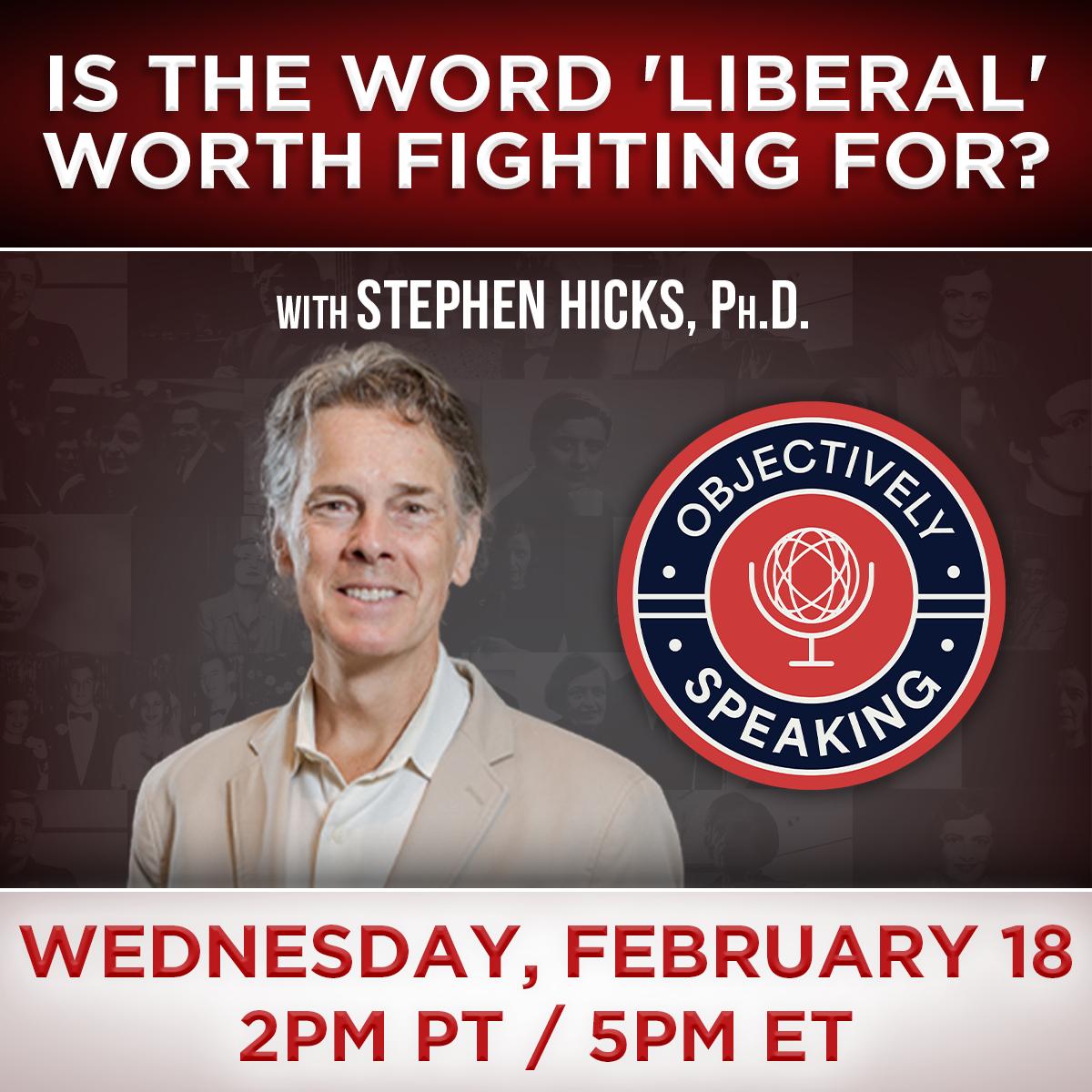
[00:00:01] Speaker A: Hello, everyone. Welcome to the 290th episode of objectively Speaking. I'm Lawrence Delevo, senior Project Manager here at the Atlas Society. This week, Jennifer Grossman has the week off, but I'm excited to have Atlas Society Senior Scholar Stephen Hicks here for a special webinar titled or answering the question, I should say, is the word liberal worth fighting for?
Whether you're watching us on YouTube, X Instagram, whatever platform, feel free to ask your questions in the comment section and we'll get to as many as we can closer to the end of the webinar. Steven, thank you for joining me.
[00:00:40] Speaker B: Hey, thanks for the intro, Lawrence, and for hosting.
So I I think we're all aware of the problem. When we want to have discussions about political issues, we want to use our vocabulary. And if we are careful thinkers and benevolent thinkers, we're listening to other people, how they are using vocabulary, and we want to have a good discussion.
But then the concept that's important to mainstream political discussion, like the concept of liberal, is highly variably used, and that's perhaps an understatement.
And the problem then is with that wide variable use, in many cases, people talk past each other or they end up spending all the time trying to find out exactly what the other person means by means of this concept. And there's always a temptation then to say, well, since the concept is so widely used in this particular social context, I will abandon my political vocabulary or my conceptual vocabulary, try to conform to get along with this social grouping here.
So I want to spend some time today talking about vocabulary issues, political vocabulary issues, and put them in a philosophical frame. And my philosophical frame is important here because political issues are, of course, important.
Language that we use to discuss is important. And as rational beings or beings of reason, reason really is our most important, important tool for figuring out what is in the world, how the world works, sorting it out for ourselves, and communicating with each other people.
So our general attitudes toward language and how we are going to use it are important. And then when we turn to specific subdomains like politics, all of the general philosophical framing, its importance assumes importance in, in that domain as well.
Now, the word liberal is one that's near and dear to me. I think of myself as a liberal, small L liberal, and already we're starting to add adjectives in front of the word.
And I think it's a hugely important political concept in contemporary times, historical times. And it is, it's a word worth fighting for. So that's going to be my conclusion. Inclusion. Now I'm speaking from the United States, where I spend most of my time. And one of the first things to point out is that the problems that we have with the use of the word liberal are mostly in the world, confined to the United States. Because of the place of the United States on the world stage, there's a lot of slippage and overrun. So what happens in the US Carries over. But by and large, when people in the rest of the world use the word liberal, we know what they mean. They mean that someone who thinks liberal thoughts believes in liberty with respect to religious matters, romantic matters, economic matters, social matters, political matters, et cetera. The operative concept running through is liberty. And someone who is a liberal is someone who thinks in terms of liberty in all of those domains and argues for and acts in a liberal way in all of those domains as well. When one comes though to the United States, though, we find many people, of course, who use the word liberal in that sense, but many, perhaps even the majority, who mean a wide variety of things that sometimes include that conception of liberty and sometimes include all sorts of people who don't think liberal things, don't advocate liberal things, and do not act liberally in any particular way. So it is a word of conviction, confusion, particularly in the American context. So I'm going to speak to that American context about how to handle this situation.
Now, I think the way the problem arises in the American context, you can go back in history, and liberal was much more univocally used. There was a more coherent, consistent and accurate use of the concept 100, 200 years ago. But political journalism in the United States has been dominated. And the way political journalism often works is lowest common denominator concepts. There are binaries that are operative in the United States. One's either a Republican or a Democrat. You're either on the left or on the right. You're either a liberal or a conservative. And the political journalism shoehorns everything into one of those broad labels. But since that is operating at such a high level of generality, trying to capture all of the disparate political landscape and so to speak, shoehorn it into one of two groups, it has led to a great deal of confusion. So if one, for example, in one's thinking, and this is somewhat understandingable, in political journalism, there are elections every four years, and the people who are going to win are either the Republicans or. Or the Democrats, then it's natural for political journalists to want to use those two labels. And then anything that's not strictly party politics, if they're Starting to talk about movements or ideologies or political philosophies that are associated with those two parties. They're looking for shorthand labels as well.
So they will then say the Republicans are conservatives, say, and the Democrats are liberals. And then anything, anyone who ends up voting for the Democrats is then labeled a liberal, even if all kinds of people who are not particularly liberal are, are, are voting for the Democrats.
So we start off with those two political party labels and then everything is shoehorned in downstream from that. Or sometimes people are not thinking about party politics, but their political vocabulary at the ideological level is to say there's a difference between conservatives and lib. But then again, they want to shovel everybody into one of those two groups. And then we have, well, of course we have big problems with the word conservative. But suppose we have kind of drawn a circle around a group of people and we think those people are all more or less conservative.
Then anybody who's not inside that circle is then going to be a liberal. But of course, outside the circle of conservatives, there's people of all sorts of political views. But this again, political, journalistic, at the ideological level shorthand way then means in that liberal tent we're putting all kinds of strange people under the same label. Or sometimes we try to think more graphically and people, again, this is simplistic thinking, but they like to think in terms of kind of one dimension. And it has a left end and it has a right end. And so at the right end we're going to say, here's a group of people we think are on the right, however we've characterized that. And again, of course there are issues there, but then anybody who's not on the right end must be at the left end. And if the liberals aren't at the right, they don't obviously fit in with the kind of people we think are stereotypical or prototypical representatives of the right that's on the left. And so the liberals then get lumped in with the left. And at that point what we then find is, as this rigidifies and becomes widespreadly used, the word liberal can sometimes mean very narrowly, people who think about liberty, act in terms of liberty, and advocate liberty oriented policies consistently. But these other journalistic methods have been said, well, you know, sometimes we, we mean people who are progressives and progressives sometimes have some liberal ideas, but they have lots of paternalistic and authoritarian ideas as well. Sometimes we're saying, well, these Democratic socialists, obviously they're not conservatives, they don't vote Republican, so they must be Liberal as well. And so now a kind of socialists start to be considered as liberals, or if we just have this simplistic left right set of labeling, then even Marxists and hardcore authoritarian socialists are then put under the label liberal as well. And at this point the label becomes non cognitive. And then we have the very serious problem.
So I want to say it becomes non cognitive because if you yourself try to start thinking in terms of those concepts, your conceptual apparatus starts to break down and you become a fuzzy thinker, at least for the time that you're using this vocabulary. But then very quickly, when you try to have meaningful communication with other people, it breaks down as well, because you know, this concept starts to become meaningless. So how to, how to deal with this situation?
Now I think the way to think about this is to first think of oneself as an intellectual, think of oneself as being philosophical, if not a philosopher. And put yourself first look at the phenomenon or the phenomena that one is trying to come up with categories for and assign labels for. Forget current usage, forget what's on the Internet, forget what's in the newspaper, forget what the media people are saying and so forth, so forth, and think for yourself. And when we're targeting to talk about political issues, we know that interacting with respect to other people, we can go for voluntary means, we can go for compulsory means, we can try to use physical force against people, or we can appeal to their reason and ask them to make choices. That is to say, we know there's a difference between respecting someone's face, freedom, their freedom of thought, their freedom of action, that is to say, to be a liberty oriented person. And so what we're trying to capture is my way of interacting with other people that puts their freedom or respects their liberty and other people's way of acting with respect to me that respects my freedom and my liberty, so we know what those concepts mean. And then when we are trying to think about sets of beliefs right in all of these different domains, or generalizing to religion and the economy and politics, and romantic rights and artistic freedom, and the liberty to advocate and challenge scientific ideas that you don't agree. So we're generalizing out and the core concept in each case is liberty, then it makes sense for me to think that liberal is the right concept or the right label to use for a position that encompasses that set of beliefs and policies with respect to each other.
The idea here is that I'm using my reason to try to figure out the world. In this case, I'm trying to figure out the social and political landscape to say that there are people who take liberty seriously, but then people who have non liberty positions in various ways. Then I will look at what seems to be the operative modes of thinking, the modes of behavior that they are advocating and think what would the label that would be best for them, right? Whether it's a paternalism, whether it's an authoritarianism, whether it's totalitarianism or whatever it is.
So here the philosophical point I think is important.
You are a rational person.
You are trying to figure out the way the world works. Your reason is the tool that you are using. And you want to keep your tool clean, you want to keep your tool sharp. That is to say, you want to have your conceptual categorization scheme worked out, the distinctions introduced where necessary, the definitions as clear and as sharp as one possibly could. And this framing, I think is important because you know, if we scale out, you know, our reason is our most important tool of survival.
How clearly and accurately we think and how well we pay attention to maintaining the integrity and the clarity of our tool. Our reason is our most important navigating the world survival mechanism. So here I think sometimes by analogy, sometimes out in the wild, you see birds and you know, the most important thing birds have to do is they have to be able to fly. Sometimes they fly away from predators or they are themselves predators, they need to be able to, to fly.
So what's very important to them, their most important tool of survival is their wings, their feathers. And they will spend a certain amount of time doing self maintenance with respect to their, their feathers, straightening them, keeping them clean, so that when necessary they can fly as well as they possibly can. And that enables them to survive and, and flourish. Well, flying is not that important to us, but thinking cleanly and accurately is absolutely important to us. So the maintenance of our cognitive apparatus, and that means clarity and keeping our concepts sharp and well defined for ourselves is absolutely important. So what that means is that when one finds people using concepts slippery and fuzzily, one will then have developed a habit of resisting that, being aware of that if something is not quite right, and not being the kind of person who then just easily, easily goes along.
So first do it for yourself. Now, of course, in a social context, this is where we run into the fuzziness.
And in social context we want to understand what other people are saying, but we also want our, our words to be communicatory with respect to, to other people. Now if we are trying to be clear in our thinking, that will naturally flow into attempts to use terms consistently cleanly defining terms and so on, offering clarifications when necessary. But then of course, we run into the problem that we sketched right at the beginning, which is the problem of lots and lots of other people who are using words that you would use this way, either very fuzzily or in a way that is opposed to the way that you would use it. And in some cases, it's an overwhelming number of people who seem to be doing this in your social frame.
You're on social media or you're at some meeting with lots and lots of people. And so the question then arises if there's a big gulf between what you think a good use of a label is and how a bunch of other people are using a label, should you resist that use of the label or should you, for social reasons conform and go along with that use of the word? So in the case of the word liberal, if we're in social context where people are just using that word in a way that doesn't seem particularly clear to you, is it worth fighting the. Fighting the battle for?
Now, I want to say that I think the best policy here is not to conform with fuzzy thinking, not to conform with evolutions or even revolutions of language away from a foundational language that has good usage and is on the side of conceptual clarity. Here, now, here, immediately, I want to divide our social situations into two. Sometimes we're in a. In a speedy conver context. You know, you're scrolling through social media and you're reposting things, or you want to make comments on various things and so on. So there the pace is fast, it's often very journalistic, and the people who are posting there are not necessarily very careful thinkers or deep thinkers about various issues. So that's one kind of context and come right back to that one. The other kind of social context though, is one where one does have time available. You're in a conversation with another person and that other person you know is a. Is a serious person and you do have time available to develop the conversation, to go back and forth, to do the arguments and so on.
Maybe it's, you know, at a bar or at a party or just over dinner or whatever. Or it could be in a more serious context. If you're a teacher, you're in the classroom and you have than the luxury of time. So whether and how to deal with conceptual confusions and mislabelings or strange labelings that come up, I think will be treated differently in those two situations. Now, the bigger picture. Suppose we are talking about the more leisured situation, so to speak. You're a professor in the class or you're a teacher in the class, or you're running a seminar, or you're, you're with someone and the conversation is open ended. So you can take as much time as possible here. I think immediately one needs to assess the kind of people who are using language. When we have political discussions, we know immediately, at least in my thinking there are three broad categories of people who engage in political discussions. There are those who are like you, they are serious about the issues, they are trying to figure things out. They're trying to come up with a category scheme for the political landscape that makes sense, that sorts people into the appropriate groups and they want to use labels in a way that the label says something about the category and they're going to use that label consistently. So if you are dealing with that kind of person, then it doesn't make any sense to go along with sloppy journalistic uses that are creeping into the, into the context. You take a minute, take a couple of minutes and that person will be open to the idea of saying yes, okay. We both have heard, you know, say this word liberal used to mean, you know, this big tent of people that include socialists and paternalists and proclaim progressives and classical liberals and so on. That really doesn't make any sense. Let's parse out the category and say if we're talking about socialists, we're talking about socialists, we're talking about paternalists, let's use the label paternalist. If we're talking about people who are about liberty politically, then let's use the word liberal. Now that person will appreciate your taking the time to clarify the language use because you're both doing the same kind of project. And then once the language is clarified, you're going to have a much more productive conversation anyways. Now a second kind of person though, that we know even in situations where we have time is a large percentage of people who are kind of, I think of them as kind of fuzzy sort of thinkers, right? And they're not people who are particularly committed to clarity and working out precise category schemes and proper definitions and so on. They're interest in politics, but in a way where they kind of know what they already want to believe. They have their good guys and they have their bad guys and they just want to use language in a quick and dirty way to indicate what their team is and the team that they're against, or the tribes they're against and so forth. And if you are dealing with that kind of person, then I want to say if that person is using language so sloppily, don't just go along with the sloppy language.
Now you might make the judgment call. It's not really worth spending a lot of time trying to convince this person to become more clear in his or her thinking. That might be a time judgment call. But you don't want to let the person who is a fuzzy kind of sort of thinker set the linguistic terms for the discussion.
Use your concepts the way you think they are best used.
You know, offer gentle corrections. If you think the person's kind of sort of fuzzy language is getting too far afield, try to bring things back as much. But point would just be don't expect too much from this kind of conversation, but nonetheless, don't let that person set the terms and you adopt their language just in order to have a conversation with them. That's just a waste.
Now the other, and I think this is a more important group when one starts to do serious politics is that in politics there are people who use language abusively and they misuse language as part of their strategy. So what they recognize is that language is used by groups in various ways, and people who are in, are committed to clear thinking and so on. And part of what they want to do is destabilize the thinking of people they see as their political enemies.
So to put it in, in, in language terms, you know, earlier we said language is a tool of thought.
But if you're in a context where you are not trying to communicate clearly and advance the discussion toward truth or a better understanding, if you are in a social context that is adversarial, you see the other person as an enemy. One strategy to use is to mess with their language. And that then means that they have certain words that they think are accurate. They have a conceptual schema that they think is true and workable, you want to destabilize that conceptual scheme. So what that then is doing is undermining your enemy. You're not using physical weapons. Instead you are using cognitive or anti cognitive weapons against them. And so there is a well worked out strategy within political activism of destabilizing language. Now propaganda more generally is the category here, but part of propaganda is disinformation. Part of disinformation is introducing language that causes confusion and communication to break down among one's ideological enemies. So in this case here, language is a weapon and it's to your advantage to, so to speak, take away your enemy's weapons.
And the way you take away your enemy's weapons is by making their, in this case language non communicatory, fuzzy, unclear. And people who are fuzzy in their thinking and non communicatory are less effective. And that's exactly the thing that you are, that you are looking for. And the point here then is if you have the time, you take the moment. Is this person committed to cognitive clarity? Is this a fuzzy kind of sort of thinker? Or is this person someone who is a political enemy who is abusing and misusing language as part of a political strategy? And if you are dealing with a person in that category, there are lots and lots of them out there, you do not want to let them set the terms of the debate because that's destructive of you. Just as you know in a the advice that military generals leave is that you don't let the enemy choose the battlefield. You choose the battlefield. In this case here, you don't let the enemy choose the linguistic battlefield. And if part of the strategy is on the part of the enemy, to take very good clear concepts like liberal and introduce fuzziness and confusions into them so that a generation later, or 10 years later, or two generations later, whatever the time frame is, that word doesn't mean anything anymore, or it can mean lots of different, different things and nobody's right corner, then that is a tactical success for the enemies and you don't want to let them do that. So in this case, if liberal is an important part of the political concept, then we have to resist what is part of the long game linguistic strategy of the enemies of liberalism to take that word and render it neutered or turn it into, into something else.
I want to say also that to the extent that one has time and one is thinking big picture, it's important to recognize that if you conform and give in, suppose you say, okay, you know this word, I've been using it, but now everybody or a lot of people seem to be using it this way in some completely different way. I'm just going to go along with that. And for this now category, I'm just going to introduce another label. If it is part of your process just to go along with other people's labeling, then whatever new label you are going to choose is just going to be subject to the same problems as well over time. And if you then say, oh, well now people are using this other label that I have chosen in a different way, I'm going to use this different label, then you're playing a losing game and it ends up being pointless. So that same dynamic is occurring. So the point here, I also want to generalize is to say here we're using liberal as the working example example that is important, important concept worth fighting for. But it's the exact same issues about all of the important concepts in our political vocabulary.
So you know, liberal is important, conservative also is important. But what's a terrorist, what's a domestic terrorist, what counts as a racist, what counts as hate speech? And of course, you know, we've been having debates about all of these and part of it is that these are capturing important categories of thought and behavior in the political language. And we do want to have labels for them and we want those labels to be clear for ourselves and communicatory with respect to each other. But then at the same time, we know that there are lots of people who use language in that fuzzy way, and so they are throwing that word out there, but the boundaries are not clear. And lots of things that you don't think should be in that category are being lumped in. At the same time, we know on all of those concepts that there are people out there for whom it's part of their linguistic military strategy, so to speak, to make sure that those concepts remain undefined, flexible, so they can use them however they want. And if it's an enemy concept or an enemy label, from their perspective, it becomes, becomes neutered and becomes useful. So not just those ones, the genocide, inequality, exploitation, privilege, colonization, affirmative action, justice, social justice, and so on.
There are no concepts and no labels that are immune to the same issues that we are dealing with with respect to liberalism or liberal as our working example.
So I think it becomes then a general policy always for oneself, look at the phenomena, categorize it clearly, what's in, what's not, and then choose the best labels and then fight for the use of those labels and resist what you think is the inappropriate fuzziness or anti use of those labels.
Now that's supposing one is playing the long game, one is thinking big picture. One has time in a conversational or social setting to develop these tactics. A lot of what we do, of course, is much more short term.
You're browsing your social media or it's in some sort of fast conversation and words just get thrown out there. I say in these situations, obviously since it's just a short term conversation, you don't have a huge amount of time and it's not going to be worth a lot of time to invest 30 minutes to write a carefully crafted response to something that people are going to glance at for three seconds.
Just don't go along with in that case, don't resist the temptation to repost memes that are using they might have some virtue to them, but they're using the wrong label. Just, just don't post that meme. Just forego that one. Or if you think the data that is being posted is useful but it's mislabeled, then post it. But just add a sentence or two with your own clarification about how you think it would be better labeled. And in fast moving conversations, don't just adopt other people's sloppy conversational tactics as you're going along. Use your own language clearly. And if they stop and ask for a clarification, well then that gives you the opportunity to introduce the corruption or the clarification.
So sloppiness is the theme here. Resist it however best you can. Sloppiness in our thinking is slow suicide. We can't afford sloppy thinking. Sloppy thinking leads to to sloppy action, and sloppy action leads to all kinds of failures. It leads to all kinds of injustices.
We can't afford that, particularly those of us who are on the intellectual side of things, who are activists or even professionals in the game.
Earlier I made the analogy to a bird paying attention to keeping its feathers and its wings immaculate so that it can survive and flourish in the world.
Here I think of other analogies. You know, if you are a carpenter, your most important thing are your tools. You keep your tools sharp, you keep your tools clean, you keep them in tip top conditions so that you can survive and flourish as a carpenter. Or sometimes I very gratefully think about airplane mechanics. Sometimes when I'm waiting for a flight I you can see them out there doing something on on the plane. And like the bird, it literally becomes a life and death survival. That big thing is going to go up in the sky.
Absolutely no sloppiness on the part of the airplane mechanic. Every wire in the right place, every fluid to the right level, every mechanical piece where it needs to be and so forth. Absolutely no sloppiness so that that plane can fly. And the same thing with our minds, zero tolerance for sloppiness so that we can flourish in our lives. So those are my remarks and this is a webinar slash seminar. So I don't want to take up the whole time.
So I now think we can turn things over to questions and some commentary back and forth.
And let me ask Lawrence to moderate if possible here, just if you can flag or highlight the comments or questions that you think are most useful for us.
[00:33:11] Speaker A: Okay, happy to do so. So looking through the chat, I'm going to bring one up here from a bit earlier on. This one comes in from Iliacin asking at what point does a political concept become so diluted that it ceases to have objective meaning?
And then the follow up to that is, is there a principled way to determine that threshold?
[00:33:30] Speaker B: Yeah, well, this is a, in fact a cognitive issue with respect to political vocabulary. And I don't think there is a formula or a recipe. So because our concepts operate at different levels of generality, so one has to, you know, scale up from, you know, the particular to the, to the universal or from the concrete to the abstract. And sometimes we are thinking more narrowly and sometimes more broadly. So it's always going to be an exercise of judgment call. Now, when we are talking about political labels, we're talking then about societies as a whole.
In many cases we're talking about millions of people, if not hundreds of millions of people.
And we know that they all have, say, different modes of action, different modes of thinking, different degrees of commitment to their thinking, different degrees of commitment in action to the things that they believe. So already it's complicated there.
We also know that we're talking about people acting in their family lives, in their romantic lives and their work lives, lives in their artistic lives, in their political lives, their economic lives as well. So it's extraordinarily general. So I think the only thing one can say is if, say I am talking about economic issues, then I look at the data. I'm looking at people as producers, I'm looking at people as consumers, I'm looking at them as traders, and how are they interacting with each other. And I consider a representative sample of interactions that are going on there. And then I categorize them. Well, these people are interacting this way and the fact is that they are acting in a different way with respect to each other than these people over here.
So I put these people in this category and these people in this category. And then I ask what's the best label for this category of people and what's the best label for that category of people. And at some point we might say, well, these people are over here, say, consistently respecting each other's liberty in all of their economic interactions. These people here sometimes do, but sometimes they are overriding people's liberty for paternalistic reasons because they think the people who are interacting are more like children or they're making a mistake that they need to be protected from. And this person's principle then is I don't always want to override their liberty, but I only want, want to override their liberty in cases where I think the person is not mature enough in their thinking and action. And so a label like paternalist might be appropriate there. Or we might say, well, there's other people who are consistently not letting producers and consumers make their own decisions.
Those people consistently say there needs to be a government that will make people act economically in certain ways. And so I put those in a different category. They're not the paternalists, they're not the liberals. What would be the right label for those people? And if they are, you know, dictators consistently with respect to economic matters? And I would say, well, yeah, economic dictatorship is the right word or some kind of socialism. And that's already a pretty broad label. And then we might start with breaking it further down. Point just is that it's always going to be a judgment call rather than a mechanical recipe that we can, that we can apply.
[00:37:18] Speaker A: Okay, looking at this more from maybe a history of language perspective, ILEC Numbers has a question asking, are there other examples where the old usage of a term comes back even once it's been so widely defined as the opposite?
[00:37:34] Speaker B: Yeah, that's very interesting question. I guess my immediate reaction is to say, I don't know, I, I would like to see liberal tidied up in the United States.
And I think that's a, that's a, that's a, a doable project.
We're, you know, increasingly in a, in a global society that's increasingly in a global language society. So already there are lots of international discussions and people are aware, you know, when they use the word liberal, if they're talking to Americans, they need to be a little more careful. But if they're not talking to Americans, then they can use the concept. So I think it's an open question whether the Americans will tidy up their political vocabulary and then go back to the historic norm, which I think is much, much healthier, or whether because America is, I don't mean the pejorative, but the 800 pound gorilla on the international scene, so to speak, its sloppy use will prevail, at which case the old concept will be abandoned and might not ever come back.
But I'm trying to think of examples that fit the criterion of the question where there was a proper use that was lost for a while, but then it comes back and I'm drawing a blank right now. So that's a, that's an interesting history of language question.
[00:39:04] Speaker A: One question from an objectivist perspective, at the very least, this is coming from Kingfisher, who's asking, is reclaiming a misused concept a moral obligation or a strategic distraction?
[00:39:19] Speaker B: Well, I would say it's both, because I think if we say strategically what Objectivism says, yeah, think strategically about your life. And that means thinking about it both in terms.
[00:39:35] Speaker A: Oh, looks like we lost you there for us.
[00:39:40] Speaker B: Over the course of a long stretch of time, one's life as a, as a, as a whole. And I think what I would want to say is that fighting for clear concepts and using labels that are descriptors of those clear concepts is strategically in one's best interest.
But then, you know, if you just push strategic up to the biggest of all pictures, that is what objectivist morality is, is about your life as a whole in all domains and your life across the main of its time.
It is one's moral responsibility to do that. So I think they should end up coming to one in the same thing.
[00:40:29] Speaker A: Okay, another question coming in here from the chat asking are current partisan divide, since you were talking about that, are current partisan divides best understood as competing interpretations of liberalism or as departures from it outright altogether?
[00:40:45] Speaker B: Yeah, that's interesting.
I'm reminded that at Galt's Gulch, San Diego in June, I believe it is, I'm going to be talking about partisan divides and polarization more.
So let me say a couple of things about this. I don't think that they are divides within liberalism. I think we do have an ongoing discussion and a huge number of, if we again speak from the American context, people who are liberal, but again, liberal still operates at a fairly high level of abstraction. And people who, there are competing schools of liberalism, not only on policies, how far down the road we go with respect to a particular policy.
Obviously we're talking about immigration, for example, what does liberalism imply for that? But also people who are more or less committed to liberalism across various domains and so forth. At the same time, I think what we call partisan divides is a much richer landscape and there's a huge amount of participation now in America, people who are just illiberal from the get go. They're coming out of various kinds of authoritarian traditions, sometimes on the left and sometimes on the right.
And no, they're just not at all liberal. But they do have prominent voices on the contemporary landscape right now. So all of that, of course, needs to be sorted out. But I think what you would end up with is at least, I don't know, two or three competing versions of liberalism at a high level of abstraction and probably four or five illiberalisms that are currently prominent as well.
[00:42:49] Speaker A: Another question coming in here from Instagram, ask when did the modern, loosely termed term for liberalism come about?
Is the term we use today even the same one that was used 20 or 30 years ago?
[00:43:06] Speaker B: Yeah, I think. Yeah. We have to then say if this is just a question of linguistic usage, then there's going to be, I think, different answers to that depending on what groups of people you're talking about who are using the language. I think it is fair to say that broadly speaking, liberal was univocal up until after World War I. I would say in. In the world, including the United States. But there was a shift after World War I, and my understanding is that that then because of the shift, some people started to recognize that we needed to start putting some adjectives or modifiers in front of liberalism. And so there was a distinction between liberalism and neoliberalism. And the neoliberals were, by and large, people who had wanted to update liberal economic thinking that the classical defenses of free markets were fine, but there had been some developments in economic thinking. And so some modifications meant we were doing neo liberal. Neoliberal was also started to be used by people who were anti liberal. They thought that free market economics or capitalism, whatever label one is using there, was wrong. They were interventionists or they were socialists or Marxists of various sorts of.
And so they wanted to dismiss these more updated versions of liberal economic thinking as outmoded. So they were using neoliberal as a. As a pejorative. But there also was another part of the landscape. And so I'm choosing the World War I era because progressivism as a cultural, social and political movement had gathered steam by the end of the 1800s, and it has significant roots outside of the liberal camp. These were thinkers who were much more in favor of centralized organization of society, more collectivized understandings of society. They were anti individualistic in varying degrees.
At the same time. They were American.
And so while they were collectivist and somewhat authoritarian on many issues with respect to politics, they still were American enough to believe in democracy and that people should be free to vote and free to argue about everything. So they were by and large free speech people. They were in favor of freedom of association and so on. So they had many traditional liberal elements as well, combined with these progressive elements. And that movement also started increasingly to become liberalism. So we had liberalism and then we had neoliberalism and neo, and all of them are being used at that point differently. So I think that was the decisive generation for the shift. And then things have gotten more complicated and messy as the 20th, 20th century went on.
[00:46:33] Speaker A: Okay, coming in here on YouTube from my modern Gault. Thank you for coming back. As usual, he asks, do you think contemporary journalists are consciously redefining liberal or is the downstream effect of postmodernist trends?
[00:46:50] Speaker B: I think it's. It's all three of those. I do think some of these are internal dynamics within liberalism. There are different sub schools of liberalism. Some of them come to the fore, some decline as the generations go on.
Some of it is liberalism blended with paternalism, blended with progressivism, even blended in some cases with kinds of socialism. So if you think of, you know, hippie types of socialism, they say, you know, we're into free love and freedom of speech and so on. We just want to have communal and collective decision making and collective decision making of the resources. So there are all of those things that are, that are going on. But I think you are right to highlight two other contributors in the question. One is contemporary journalism, which we know is constituted by many journalists who have some integrity and they are trying to do truth seeking and objective reporting and so on. But we also know there's been a huge increase in the number of anti journalists who are masquerading as journalists. And they want to use journalistic outlets as a form of activism. And for them, redefining bad terms from their perspective to obliterate, to hollow them out the meaning so you can substitute whatever you want.
That is part of their journalistic practice. And some of that is fed into by high academic theory coming out of postmodernism, where very clearly the postmoderns have an adversarial understanding of society. Everything is war, class warfare, gender warfare, group warfare in various dimensions. And language is just a weapon that we use. And so what you then want to do is identify your enemies, concepts, all of them, the language that they use, and find ways to hollow all of those out. And so liberal is quite consciously in the gun sites, so to speak, of postmoderns as well. So yes, to both of those groups, but other factors at work as well.
[00:49:02] Speaker A: Question from lock, stock and barrel. That kind of plays into this question. Just asks, he asks, would you consider identity politics, in part a politics of labels rather than principles?
[00:49:15] Speaker B: That's interesting. Leave that question up for a moment if you can.
I do think identity politics is first about politics and second about identity. As I said, identity do think it is about a politics that takes collectives seriously rather than individuals. And so they are very clearly going after any sort of principled understanding of the individual that sees itself as having agency, as having some autonomy, as having moral responsibility, as.
As properly being a free agent in that. In a social circumstance. So identity politics, in that sense, is a principled political strategy to try to redefine what it is to be a human being.
I do think it is also a psychological phenomenon, and here I'm stepping outside of my expertise, that there are many people who do not feel themselves a strong sense of personal identity and agency and control over forming who they are. Instead, they do feel themselves to be a constellation or a locus within which various other forces in the world, including social forces, are creating them and giving them their identity. So I'm not in control of the language that I learned. I'm not in control of. Of my. My economic background. I'm not in control of my gender identity. Instead, what there just seems to be is just this bunch of forces.
And what I think of as my entity here and now is just a temporary constellation of all of those forces as well. So in that case, it's not really a matter of principle. It's not a matter of philosophical political strategy. I think it is a psychological descriptor. But then again, I don't want to go too far down that road since it's not my area of expertise.
[00:51:29] Speaker A: All right, we've got about seven, six minutes left at this point.
Going back to sort of more historical perspective here, a question from Jackson Sinclair, who asks, in the long arc of history, do conceptual shifts like this signal decline or simply a transformation?
[00:51:48] Speaker B: Well, I'm going to say conceptual shifts are a result of new thinking that typically is originated by some very sharp individuals. And then they are successful in attracting a number of sharp individuals to sign onto it. And they will then say, instead of these categorization schemes of the world, instead of these causal understandings of the world, we substitute these ones. In some cases, they are discovering fresh phenomena, so they need to come up with new labels to describe them. Or they will say that the previous way of categorizing the world was incorrect, but the labels that were associated with that incorrect packaging are now confusing. So we are repackaging things in what we think is a better way and going to then introduce new, new labels. So I think it can be either of those at the same time. I think it also can be a sign of progress, because in many cases, conceptual shifts did involve replacing, you know, just bad conceptual schemes in the past or bad causal understandings of the way the world worked. So I think it's an open question whether it meets those two that you identified there or whether it represents progress. And so then we would have to start talking about conceptual shifts in particular and then form a judgment call about whether it's just a repackaging, whether it's a decline or whether it's progress.
[00:53:24] Speaker A: Okay, got about five minutes left. I want to make sure to give you time in case you have any closing thoughts. But one more question that's coming in here from the chat from Zoltan, asking or making the statement first, in Latin America, neoliberalism is a derogatory word used by the left to label any efforts to liberalize market as something bad. Is labeling, is this a deliberate intent to demonize the word liberal? So it's not the US perspective which you've been talking about here, but follows the same sort of tactics?
[00:53:55] Speaker B: No, I think I spent some time in Latin America. I think that's exactly right. It's, it's used as a, as a, as a bludgeon by the left to attack just liberalism in, in general. It's also the same thing happening in Europe.
So I'm aware of the exact same phenomenon there. This is partly why I wanted to resist. So we, you know, we say we have the word liberalism, which is perfectly good and worthy of defense. If we make the move of saying, well, we're moving from liberalism to neoliberalism, then our ideological enemies are just going to do the same thing with neoliberalism.
And so we just end up fighting the same fight with respect to neolism, except now we've just got extra syllables on there. So we haven't gained any ground. So we want to say, look, if you guys are, want to get hung up on neoliberalism, we will just use liberalism. The same thing I think has to do with the move from liberalism, broadly speaking, to libertarianism in the middle part of the 20th century.
Again, many people who are liberals consistently say, well, liberal is being abused and misused. So we're going to make up a new term. We're going to call it libertarianism. But that doesn't really solve a long term problem because now we have the same issues with respect to liberalism. What is it categorizing, what is it defining? And we have the exact same ideological enemies who want to introduce confusions about liberalism and use it as a pejorative as well. And then sometimes we then say, well, you know, we've got liberalism and modern liberalism and libertarianism.
I want to introduce a different adjective classical liberalism.
But then again, we're just going to have the have the same issue. So I do think for tactical purposes, not strategic purposes, it's fine to say libertarian or neoliberal or classical liberal at various points if it introduces a distinction for that particular audience at a particular time.
But I think the long game is to get back to the best label or the phenomenon that we are is near and dear to our hearts, and that is liberty consistently in all domains of life. And the best label for that just is is liberalism.
[00:56:30] Speaker A: I think that's a great way to finish up as we come here to the top of the hour. So I want to thank you again so much for doing this, Stephen. It's always really educational.
[00:56:38] Speaker B: Good. Thanks, Lawrence.
[00:56:39] Speaker A: Thank you. And I want to thank the audience for such great questions. You continue to impress us every week. So if you're enjoying this content, you want to see Stephen in person. I put the link in the chat to join us at Galt Gulch 2026 later this year in June.
And if you want to support us otherwise, please consider a tax deductible donation@Atlas Society.org donate and be sure to join us next week when Jennifer Grossman will be back and we'll be interviewing with rights advocate and political speaker Salish Huday about the Chinese Communist Party's campaign of repression, mass detention and cultural eradication of the Uyghur people.
Thanks again and we will see you then.