Episode Transcript
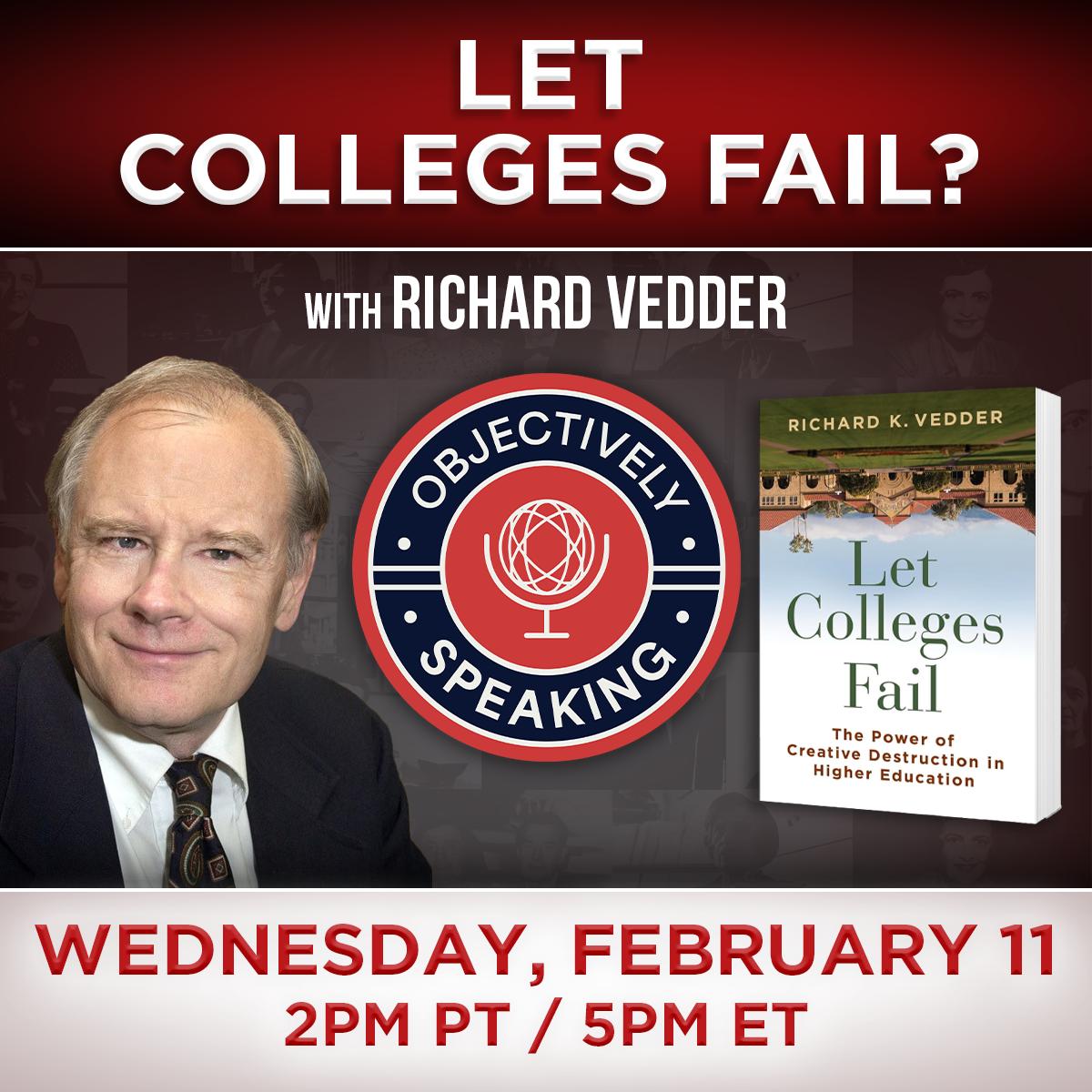
[00:00:00] Speaker A: Hi, everyone, and welcome to the 289th episode of Objectively Speaking. I am Jag, CEO of the Atlas Society. Today I'm very excited to welcome economist Richard Vedder to discuss his book, Let Colleges Fail, the Power of Creative Destruction in Higher Education.
Richard, thank you for joining us.
[00:00:25] Speaker B: Delighted to be with you.
[00:00:27] Speaker A: Okay, so first, your book has, I would say, almost a deliberately provocative title, Let Colleges Fail. Yet I personally have never read a book so jam packed with suggestions to help colleges succeed. So tell us, who is the intended audience for your message and what's been the reception so far?
[00:00:52] Speaker B: Well, the audience is anyone interested in higher education in the United States, or I guess anywhere in the world, but especially the United States.
People who are interested in the role of colleges and universities in our society, and that includes a large part of that audience, of course, are people who are academics themselves.
Professors, university administrators, members of boards of trustees, in some cases legislative personnel, people who have been following higher education issues and so forth. So it's a, it's a variety of people and. Yeah, sorry.
[00:01:38] Speaker A: Yeah, so I thought, I mean, I'm not a professional educator, although I guess in some ways we are, we are educating young people here at the Atlas Society. Sure, but, but I found it just really, again, jam packed with some terrific, very solid and in some cases surprising ideas which we're going to get into now. You have spent nearly 60 years in higher education, much of it as a distinguished professor, professor of Economics at Ohio University.
What are the biggest changes in higher education that you have personally seen over the course of your storied academic career is maybe the increasing lack, near absence, I'd say, of diversity of thought chief among them?
[00:02:32] Speaker B: Well, there certainly has been a decline in diversity and rabid discussions and arguments about the way the world works and the way it should work. I, I think there's been, within the academy, there has been, not in general society, but within the academy, within universities. There's been some decline in that and I regret it, of course, and it is certainly part of the picture. There have been a, you know, a number of things have happened. Students aren't working as hard as they were 60 years ago. Grade inflation has had a pervasively negative effect on students. They just don't work as much. Why work? You know, I'm going to get an A anyway or an A minus, so why do I have to work so hard?
So there have been a number of changes that have gone on. You know, I could go on and on about the this in various dimensions, teaching loads have changed a Bit. The research dimension has sort of increased in its importance generally over time.
The interest in undergraduate teaching among faculty has maybe diminished a bit.
Intercollegiate athletics has gotten wilder and bigger and so forth. So there's quite a number of changes.
I've touched on a few of them here.
[00:04:09] Speaker A: Yeah. Have you seen a change in the quality and preparedness of high school graduates coming to you and entering the university?
[00:04:20] Speaker B: Yeah, I think I have seen a change. You're asking an important question. The university should not get all the blame, and indeed maybe they should only get a 15% of the blame or a small percentage of the blame for what I am starting to see as a dumbing down of America, really, because the kids that are entering college today are not as sharp, not as well prepared, in my opinion, as the ones that were entering college a generation or two of go.
We become less rigorous in our expectations of students.
We demand less of them, we make them read less. For example, just pick one thing. They don't read as much.
[00:05:15] Speaker A: No, that's, that's true. It's one statistic that I frequently cite because of course at the Atlas Society we want to engage young people with the ideas and certainly the literature of Ayn Rand. And I think that perhaps some in our community haven't caught up with the fact that 50 years ago 70% of young people were reading fiction every day for fun. And that percentage is closer to 10% today. And so I think it's not just a failure of our institutions, but when young people aren't reading, they are also just not developing the synapses and the vocabulary and you know, repetitively also seeing again and again proper grammar. And I think that kind of really does not help and also kind of sets the universities up to have to play a kind of remedial role.
Now, turning to some of the major problems that you identified in your book, you identified 10, including falling enrollments, plummeting public confidence, suppression of unwelcome ideas, declining intellectual diversity, skyrocketing costs, minimal student learning, administrative bloat, decreased accessibility for the poor for return on investment, and wasteful use of resources.
If you were to rank, you know, maybe the chief failures, what would stand out to you as the kind of biggest drivers of this decline?
[00:07:03] Speaker B: I was afraid you were going to ask that question.
It is hard to rank them. A generation ago I would have said the cost factor. Higher education is inefficient, it's getting costlier, it's getting more expensive, more and more kids are finding it difficult to pay for college, et cetera. That would have been number one. In the last five or 10 years there has been a decline, in fact 15 years really a decline in enrollment and the demand for college, I'm sorry to use, this is economics terminology I'm using here. The demand for college has softened a bit and with that there's been more tuition.
[00:07:53] Speaker A: Whoops, looks like we may have lost.
Nope, you're back.
[00:07:57] Speaker B: Oh, okay. I, I hope I didn't do anything. I hope I didn't overly provocative that disrupt the technology.
[00:08:08] Speaker A: No, this is great.
[00:08:10] Speaker B: But anyway, we've, we've, we've had, I don't know where I was before we, in this, it had that little tech glitch. Glitch. But yeah, you said that there's been.
[00:08:22] Speaker A: A softening of, of demand.
[00:08:23] Speaker B: Yeah, there's been a softening demand. There's uh, so the cost factor is still there.
I put much less emphasis on it than I did 10, 20 years ago. I put more, there's a, Having said that, however, there is an enormous amount of inefficiency in higher ed. It's just, it's, it's grotesque.
Is it the greatest anywhere in the human race or in human activity? No, I think governments are pretty bad indeed. I find governments and I've worked for, well, I worked for Congress once. That's about as bad as it gets, I guess.
I, I, I see the same kind of inefficiency. We, we have 10 people to do what one person can do or two people can do.
I'm in a university. I just, I looked it up the other day that 1965 had one person involved with fundraising activities for the university. One person.
Now the last time I counted there were 75 people in the so called development office or advancement office. And this has gone on at every university.
And I've taught at private schools a little bit, you know, part time. I've taught at other state universities. I've been probably on 300 campuses I would guess over the years.
So I've been around the block a little bit and we are terribly inefficient. So that is a problem.
[00:10:01] Speaker A: Yeah. And I think that's going to be showing up more and more, you know, now with AI and basically everyone having access to our own digital assistant and our own digital researcher and scheduler and all of that.
That there's at least in the private sector there is going to be pressure on people to organizations and companies to remain competitive by constantly asking themselves do we actually really need this, this many people on, on the payroll? So we touched earlier on Young people showing up to college less prepared.
And so one would almost think that since they're starting out at a lower level, that by the time four years later they would show remarkable improvement. Right. Even more dramatic improvement. But one of your most striking claims was that in fact that's not the case, that college students don't often learn that much. You cited some research from research Richard Arum and Josepa Roska's Academically Adrift, showing that seniors, college seniors, critical thinking and writing skills aren't significantly much better than freshmen. So how big and widespread is this problem and why aren't we hearing more about it?
[00:11:27] Speaker B: Well, we should hear more about it. And the great inflation issue that I raised earlier is, is one reason we don't. I mean, you don't have to do much in college to get an A anymore. By the way, related to that and relates to an earlier point you were and I were both making about reading. When I started teaching my course in American Economic history in the mid-1960s, I required six books. You didn't have to read every page of all six books there was a textbook, but five other supplemental books you were expected to read as just part of your learning. Today I don't the most schools don't even teach the course anymore, which is regrettable because our historical background needs to be taught. But putting that curricular fact aside, today if I were teaching that course, I would have at most 3, 400, 500 pages of reading. 30, 40, 50 pages. 30, 40, 50 pages a week.
Most kids would only read part of that and skim the rest much more superficial.
And they would they miss so much because they don't get that. And they can get away with it because the professors don't evaluate them poorly for not doing the reading.
We don't want to hurt their self esteem, my hurt their ability to be mentally agile and alert and normal, et cetera, et cetera. There's all sorts of excuses we have for not making the kids work harder. And the professors need to work harder too, by the way.
[00:13:20] Speaker A: Yes. All right, well, and I need to work harder too. We're about a quarter of the way through this interview. I wanted to turn quickly to some of the questions because I tendency tend to kind of wait and then by the time I turn to those questions, we've already covered it earlier. So just one interesting comment here from Jackson Sinclair who says public schools don't teach. They teach you to regurgitate information also lock, stock and barrel.
I think makes a great point. Don't forget you used to be able to work and pay your way through college without having to go into so much debt.
And that is something that I think has largely disappeared. Although again, you cite some interesting places where students, low income students, are given the opportunity, in many cases the obligation to actually do some of the work of what otherwise would be, you know, blue collar or administrative staff to get through school and defray some of the costs. All right, question here from Alan Turner. What problem in the college classroom comes from professors versus outside pressures from investors and donors?
[00:14:42] Speaker B: There are sometimes outside pressures on professors, but as far as donors go, and I teach at a public university where most of the funding comes from public sources, either from the students themselves in the form of tuition fees or from governmental sources.
And I have. But I attended myself and I've taught at private universities, and the funding is where there's more private funding. And those funding sources are important.
I never felt when I taught at those schools or attended, I attended one. I attended Northwestern University myself.
I never felt that the funding issue materially impacted what I did in the classroom. Now, maybe I was, maybe I'm naive, maybe I'm wrong, but that was the effect of the feeling I had.
Money matters, there's no doubt about it. And universities, there is a big issue here.
The broader issue is who owns the universities? Who controls the universities? Who does the university belong to?
[00:16:05] Speaker A: Well, you suggest, in fact, that many colleges are now run more for the benefit of their staff and faculty than for students or for society. Can you elaborate on that?
[00:16:19] Speaker B: Well, sure. First of all, well, what does a professor do these days to pick the faculty, which, by the way, is a decreasing portion of the total staff at the university.
In the mid-1960s, when I started to teach, there were professors and there were some administrative staff, but there were probably as many professors as there were administrative staff. Now there are 2, 3, 4, even up to 10 administrators for every teacher. The teachers are almost an afterthought. Now, the process of teaching and disseminating knowledge and promoting discovery of new knowledge is the centerpiece of what colleges and universities are about. That is led by the faculty that has become subordinated to an administrative class, an administrative bloat, if you like, that has, I think, diluted the ability and the success of universities to do what it's supposed to, what they're supposed to do, which is disseminate knowledge and create knowledge, period.
[00:17:39] Speaker A: Right. So the subtitle of your book refers to creative destruction, a concept from Richard, from Schumpeter's Economics. So maybe first just kind of for Those unfamiliar with it give a little primer on what he meant by creative destruction. How it functions in the private sector, how it functions in capitalist economies or more mixed economies. And then how might it apply to higher education? What would that look like?
[00:18:11] Speaker B: That's a great question. And it's important because American capitalism, for that matter, capitalism generally, excuse me especially American capitalism, has thrived, has led to great prosperity precisely because companies and entrepreneurs are under the constant threat of, let's call it death, corporate death or company death, depth there. If they goof, if they make mistakes, if they're slow in innovating, if they're slow in using new technology, if they're slow in seeing new trends or taking advantages of falling costs in some areas, if they're slow at doing things, if changing, if that is the case, they often start losing money and often go broke.
You know, there are a lot of retail chains out there that were once very, very famous, important. Sears and Roebuck, Blockbuster Video. Blockbuster Video, good example. More recent example, sure, that have gone out of business.
Eastman Kodak was the photography company 40 years ago and was big and had enormous sales, is gone bankrupt and as a shadow of its former self, it still exists.
So if you, if you goof, if you don't aren't on your toes, and if you don't stay ahead of your competition, you can die. You, you are destroyed. But that's good because that means that there are new companies coming along with new ideas. They work great like crazy to stay ahead.
There's a pressure put on people to innovate in order to survive.
We don't have much of that in higher education.
You're going to survive no matter what. Harvard was founded in 1636 and Yale around 1700. William and Mary, there's not one of those early colleges that has disappeared.
Some of them have changed names to be sure, not one of them has disappeared. And if you look at the, say U.S. news rankings of the top 25 schools 25 years ago and now look at it today, it's hardly changed at all. It's hardly changed at all.
There's no pressure to change.
Severe pressure.
If you goof, you goof, you make a mistake, maybe you fall from 23rd to 25th in the U.S. news rankings.
But you don't go out of business. And it's that pressure that is in the broader economy that has allowed America to innovate, to be at the front tier of change and led to things like AI and so, yeah, self driving.
[00:21:28] Speaker A: Cars and all of the innovations that we're seeing today.
So let's talk a little bit about the rising cost of college, rising tuition costs. And you mentioned something in the book, the Bennett hypothesis that rising financial assistance, like loans, have paradoxically made college less affordable. How does that function?
[00:21:56] Speaker B: Absolutely. The federal government should be ashamed of itself.
Something that will not get any great disagreement from Atlas, but for very good reason.
The federal government in effect created good intentions I think were there originally myself in the 1960s, mainly a program to provide financial assistance to students in the form of. Some of it was in the form of grants. But the biggest program have been the guaranteed student loan programs. And these programs were non existent 100 years ago, just non existent, completely non existent. Now they became big.
So what did the colleges do? And Bill Bennett, who was the secretary of education and in the Reagan years, Bill Bennett wrote an op ed for of all places, the New York Times in 1987 where he says well it's, it's obvious what's happening, why college costs are rising so much is colleges can get away with raising their tuition because.
And aggressively instead of a little bit, they can raise them a lot because the colleges will simply.
[00:23:23] Speaker A: Looks like we may have lost him. There you are, you're back.
[00:23:27] Speaker B: Anyway, the car. Yeah, we're on and off here. Someone, someone doesn't like us, we need to worry about that.
But anyway, the cost of college has soared since the 80s when the programs, the federal student loan programs became big because colleges said hey, the kids can just go out and borrow the money. And so instead of raising tuition fees 2 or 3% which they in earlier period would have done, they raised them five or six or seven or eight. And so tuition fees were growing a bit.
Even in the 1940s, 50s, 60s and 70s, there's not much technological improvement in education. We still teach the same way Socrates did.
Not quite as well perhaps, but roughly the same with a few, you know, additions.
But so higher ed has.
Fees were rising modestly in the 1940s, 50s and 60s, but people's incomes were going up. So going to college became more affordable rather than less affordable until about the 1970s or 80s when the colleges started aggressively raising their fees. Instead of 1% a year more than the overall inflation rate, we raise them 3 or 4% a year more than the overall inflation rate. And so tuition fees grew. And ironically, who has been the biggest loser in all of this? Low income people, the ones that ostensibly wanted to help. Because as these high sticker prices started appear, a lot of kids just said I'm not even going to bother to apply to college. I can't afford to go to college. In some cases they thought that incorrectly, but that's what happened. And so the proportion of graduates of colleges today from the low income group, say the bottom quarter of the income distribution is no greater than it was in 1970. In fact, I think it's a little bit lower.
So we are not helping provide more access to the poor and the worthy low income people. But we have made higher education more elitist, if anything, but more importantly, much more expensive.
And where has all that extra tuition money and so forth gone? It's paid for the administrative bloat we hear about.
[00:26:10] Speaker A: Right.
[00:26:10] Speaker B: Where it's come from. Yeah, going to the professors. I mean, the professors have done okay, but the, you know, I'm not feeling too sorry for my colleagues on the faculty who teach right. Hours a week for 28 weeks a year, 30 weeks a year and get 120 $550,000. You know, I'm not there's a lot.
[00:26:32] Speaker A: But just in terms of like follow the money and, and where is it going?
So one thing that we don't talk a lot about, I, I don't think it's well understood is college accreditation. You know, particularly since there are educational entrepreneurs out there that are trying to open new colleges.
Our friend Marcia Enright of Reliance College is one of them. So you argue that it might actually be unnecessary or even harmful. So what is wrong with the current accreditation system?
[00:27:11] Speaker B: What isn't wrong with.
[00:27:13] Speaker A: Okay, let us count the ways.
[00:27:16] Speaker B: Yeah, at one point, I don't know. I think I came up with 10 major reasons.
One of the actually less important ones, but it's still somewhat significant. It's costly because accreditation visit. Most universities have a staff to deal with accreditation issues. I mean, most large universities, so it has added cost because accreditation teams come around and look at what you're doing and so forth.
That doesn't bother me as much as other things that happens.
Accreditation has been a barrier to entry to new schools, new innovators who want to enter the field, want to do things a little differently. They have a trouble doing that because they have to get accreditation. Who does the accreditation? Accrediting agencies. Historically about six major regional accreditation agencies across the country. There are some changes going on now, but this has been the pattern. These accreditation agencies, big accreditation agencies, are controlled by the universities themselves.
They're controlled by the adversities themselves. Their boards are made up of people who are on faculties at universities and so forth. So the universities control the accreditation process and they act like a cartel.
If someone wants to come along and do something a little bit differently, I'll offer say a three year bachelor's degree instead of a four year bachelor's degree.
I just picked that as one example.
They're told they can't do that because no one else does it. And we don't want to do that. We want to get that tuition money for four years instead of three years. And we don't want to let anyone try differently. So when new schools come along and new ideas come along, and they do come along, it's hard for the new institutions to break in.
[00:29:21] Speaker A: Yeah, I mean, it sounds like a.
[00:29:23] Speaker B: Total, total racket disaster.
[00:29:26] Speaker A: Yeah. So Blaine on LinkedIn had an interesting idea. Establish centralized AI accreditation. So wanted to get to a couple more of these, I thought very interesting questions.
Because they speak to something that you cover in your book. My Modern Gault says, I remember decades ago that companies would often invest in students to help them get through college or technical program and then come to work for them. Why does that not seem a thing? Because you talked about the West Point military model, right. That students can go there and get a free education in exchange for a commitment, a military commitment upon graduation. And you said, wouldn't it be great if Google or Tesla or SpaceX started their own colleges? But what about this question of what? When did companies stop kind of helping to pay for promising students college in exchange for an expectation of future labor?
[00:30:40] Speaker B: I've always been, I'm a great believer in American free enterprise system, but I've always been a little bit disappointed that the colleges have not paid more attention to this issue and put more resources into coming up with their own competition, if you like, to the traditional system, there's 40, 50 years ago, general Motors, for example, had a college in effect that it had that some people went to work for and then went to work for the company.
And that model I always thought was an intriguing model, but it hasn't been developed very much.
I guess college companies felt, well, it's an expensive thing developing our own university. We're in competition with other companies. We got to keep costs down. We'll just hire our staff from traditional universities who know that business. Well, do they know that business? That's debatable, but that was the argument. So. And the one area where there was some promise perhaps to change things came about 20 years or so. We started to have an expansion of for profit higher education universities in the business of making money.
And most of them were sort of non traditional schools reaching out Often to older students, older people who were working part time and so on. But during the, especially during the Obama years, to put a name on it, a specific name on it, the administration came down hard against them. We can't let people make money off education.
That's wrong.
That is a bad idea. So we, the for profit sector was pretty much wiped out in the decade between 2010 and 2020. Not entirely, but pretty much wiped out. And so anytime someone comes up with a new idea that's kind of cool and great, there's someone around who wants to stop on it to keep it from happening. The creditors, the federal government, Department of Education, whoever. And that's happened time and time again. We had some great new universities start in the last few years, and some old ones have been transformed. The new college experience in Florida is an interesting. A college had been around for years that has changed rather dramatically in the last 15 years. The university of Austin in Texas is an interesting experiment. There are a few experiments going on and some few things going on, but most of these people are having problems. We got to deal with the accreditors. We're having trouble getting accredited.
[00:33:47] Speaker A: It's definitely, it's definitely a big bottleneck.
This was a nice comment from Mark Shoup, who wanted to thank you, professor, for mentoring my daughter Allison, class of 2008, and also thank you for your fine book, Going Broke by Degree, she recommended to me some time ago. So that was very sweet.
Interesting question from Kingfisher. How much competition is there for becoming a professor today? Do you think that plays a role in how some colleges operate?
[00:34:24] Speaker B: Competition to become a professor? Yes, that's. That's an interesting question.
[00:34:30] Speaker A: Or maybe, you know, a flip way of Talking about that is potential overproduction of PhDs.
[00:34:36] Speaker B: Yeah, that's where I'm gonna go with that.
It's interesting.
In the 1950s and 60s, a whole bunch of new universities were developing, particularly public universities that were coming on the scene. And they all wanted to develop reputation, meaning they wanted to offer graduate programs mainly. And so a whole host of new PhD programs came about and some of the old PhD programs grew in size.
So we started turning out PhDs by the carload, by huge numbers in the 1970s and 80s and 90s at a time, by the way, in which enrollments were no longer rising as fast as they were previously.
So the demand for professors started leveling off. The supply continued to grow because we were turning more and more PhDs out.
So hence that of course, has caused a problem and many, many PhDs today go somewhere other than higher education to get jobs.
But in, in the process of all this, there's been some d. Diminishing of quality, I think, as some of these new PhD programs have not been able to maintain the quality standards that the old ones had.
And we have had some decline in the quality, I think, of what we do.
There's more to it than that, but that's part of the story right there.
[00:36:19] Speaker A: So one of your recommendations is to actually privatize state universities. How might that come about? What would it look like and what benefits might it bring?
[00:36:29] Speaker B: Well, there's several ways it could come about. Or you can at least get partial privatization.
Well, let's go back to Milton Friedman, for example. Milton Friedman talked first in Capitalism and freedom, I think, 50 years ago about introduced the concept of perhaps vouchers where people could get grants from the government. The government would still have a role to play, but they could use those grants any way they want and go to any school they want. They didn't have to go to the public school. I'm talking mainly here about K through 12, but the concept applies at the higher ed level as well. Why can't instead of giving money to universities, the producers of, of educational services, why don't we give it to the consumers of the education services? If we're going to give government money away, by the way, I'm not sure we should give government money away, but if we're going to do it, give it to the students.
Give them every student in the state of whatever state you want. New York, Pennsylvania, Ohio, California. Give them a 5,000.
[00:37:48] Speaker A: There we go again. But hopefully. Yes. And here he is. He's back. Can you hear us okay?
[00:37:54] Speaker B: Yeah. Can you? Yeah.
[00:37:56] Speaker A: Yes, we're good.
[00:37:58] Speaker B: So. So I've been getting interrupted by some technological obstacle out there.
But if we gave every kid who wanted to go to college, I mean by we, the government, meaning state government probably, although it could be the federal government. Give everyone a $5,000 voucher or a $7,000 voucher. But then say we're not giving any money to the universities. We'll give the money to the students and let them pick where they want to go to school and cut the universities out.
They can get funded if the students want to go there. That's closer to the free enterprise, private sector competitive model that we have in the broader economy. It isn't that, but it's closer to that. It's a step in that direction. So one thing we could do is just say we're not going to have what we call state universities anymore. We're going to have universities where some students are receiving governmental money to attend, but they make the decision where they go and therefore they decide how much tuition money from the government they're going to receive. The students make the decision, not the politicians and the university lobbyists and the others who currently make those decisions.
[00:39:25] Speaker A: That would definitely make these institutions a lot more responsive to actual market forces. So you had highlighted some colleges that have pursued other models, colleges that personally I hadn't heard of before, like Berea College or the College of the Ozarks. What could we learn from them?
[00:39:48] Speaker B: Well, good question.
There are some schools that have taken the mission, the idea that colleges should be affordable to low income people who are deserving and hardworking and they should take that mission seriously. Most colleges don't. They, they, they, the rhetoric is there, oh, we want to make college affordable and all, but then they go hire 100 new administrators and pay them ridiculous salaries and they close the buildings three months of the year and do all spend $20 million on athletics to let kids play around with round balls of some sort.
So they waste money. But Berea College is a college you mentioned that is a college in the state of Kentucky. It's in a very poor area.
To get into Berea College you have to be low income. I think, I don't think they want rich kids there.
Low income people can go there and they pay essentially nothing for their college education.
I need to modify that a little bit. They are, if they're eligible for Pell Grants, federal grants, they are obliged to take those grants and use and they pay a, a tuition that is essentially equal to the Pell Grant. So the money ultimately goes to Berea. Berea is a college, I think about 1500 students. It has been very, very successful over the years and has a nice sized endowment. But it also tells the kids, hey, we expect you to kind of work for your tuition free status.
If someone has to mow the grass on the campuses, someone has to paint the buildings.
Students could do most of that kind of stuff. We don't have to hire high priced unionized laborers who make 50, 60 thousand dollars a year. We can hire students to do that, pay them much less, let them in effect finance they're going to college through some work that they do for the colleges. So that's what Berea does. That's what the college. I think it's essentially what the College of the Ozark does. There's a school in New York City of all places called Cooper Union that's been around for a long time, since Abraham Lincoln I think spoke there in the 1860s.
And it's a small school, it used to be totally tuition free. I don't know if it still is.
But it seeks to provide zero tuition cost education for a modest number of students. I think upwards of a thousand students go there.
So it can be done if the colleges make that their goal.
[00:43:02] Speaker A: Right.
[00:43:02] Speaker B: I think it's kind of cool that some schools have done that.
[00:43:04] Speaker A: Yeah.
I just learned so much about really that even despite this enforced conformity and these negative trends, that there are still a lot of bright spots and some experimentation and examples that we can learn from. And we do need to, because you mentioned one statistic that frankly blew me away.
40% of freshmen who enter college don't graduate within six, six years. Wow. What is driving that attrition or the kind of delayed completion? And what does it suggest about the mismatch between students and institutions?
[00:43:44] Speaker B: There is a dramatic mismatch and some of it will happen in the best of systems. Kids, parents have a parent who dies while they're in college and they can no longer afford the college costs and they need to take care of the family. Other family members, you know, their special circumstances occasionally come up. So you would expect some attrition of entering freshmen. Just naturally maybe 5% or 10%, but we have much greater attrition than that. And part of the reason is the students are being pushed to go to college by the colleges themselves. The colleges want the tuition money, the colleges want the Pell Grant money, the colleges want the state subsidy money that they get. And so the colleges say, come to us, we'll make you a member of the middle class and you will have a nice house and live in the suburbs and, or wherever you want to live. And if you graduate from our school, and you will if you work hard. And so they promote that, and that often that is line is just simply wrong because a number of the kids who are entering colleges simply don't have the qualifications to succeed.
You know, 100 years ago, or let's say 19 45% of adults had college degrees. 5.
By 1970 it was up to 10.
I call this West Virginia PowerPoint, by the way.
And now it's up to over 30.
So it used to be going to college was distinctive.
It separated the bright, the unusually talented from the rest of the population. That no longer model is no longer the case because an awful lot of people go to college. And if you add community colleges and other things, the proportions are even larger. So colleges no longer have the luster as being sort of special places to the same extent that they did, say, a half a century ago or a century ago.
And so therein, a lot of kids say we got to go to college, but when they get there, they learn that things aren't quite what they expected them to be. And, and so they, they don't make it through.
[00:46:31] Speaker A: Yeah. Well, I would also think that maybe part of it, at least previously, is that you had this affirmative action that was pushing kids who were not necessarily qualified to perform the kind of work that was at a particular college. And I mean, wow, that would have to be, you know, pretty, pretty demoralizing.
So we've got about 10 minutes left. I want to turn to what grade you would give the Trump administration so far for higher education. He can't eliminate the Department of Education without congressional actions, so that's probably not going to be very likely. But he has cut the department staffing in half from 4,000 to 2,000.
What, what are some of the good things he's done, maybe some of the bad things he's done? And what would you like him to see, like to see him do next?
[00:47:26] Speaker B: Well, I will say this. President Trump is certainly energetic and he has done more stuff, rightly or wrongly, than any other president in modern times that I can think of with respect to higher education.
I think on the whole, he's done more good things than bad things.
I think the colleges need to be scared that they're going to lose their government money if they misbehave. I think they need to be push to do away with DEI and racist and sexist behavior that says that students should be chosen and selected and promoted based on attributes other than their ability. I think that's wrong. And I think Trump has aggressively gone after it, helped of course, by the Supreme Court.
But the Supreme Court that we have is three of those justices that went along with Students for Fair Mission versus Harvard were Trump appointees. So I think Trump gets a lot of credit for that. I think his attempt to dismantle the Department of Education are commendable and so forth.
I think some of the things he's done with respect to research grants have actually have a good intention and more good than bad. For example, one seemingly minor thing, but it isn't minor to the universities, is he wanted to cut the overhead provision. That is the money that we give to for research grants. All colleges get a certain amount for the researcher, but they get an extra amount to cover so called overhead expenses. And those amounts have been very high and have provided a profit motive almost for universities to participate. The universities vehemently deny that, but they're lying through their teeth.
And so the universe. He's gone after that. I think that was great.
He's gone after colleges that have engaged in deplorable, allowed protests to occur that are directed at specific groups. Anti Semitic behavior would be a prime example.
College campuses have gone amok that way. In many cases, he's wanted to crack down on that. I think, on balance, I think that's been a good thing.
So as I said, I give it more good than. More good than bad. That doesn't say he's been perfect, but.
[00:50:24] Speaker A: Right. Well, so maybe since this is not a place for grade inflation, a solid.
[00:50:29] Speaker B: B.
Yeah, I would give him a B.
You know, with Trump, you usually think of either A or F, because Trump is, you know, usually on the extreme. He's. He's not doing things in the middle of the road. He's doing things radically one way or radically the other way.
But when you average it all out, I think he's done a pretty good job. He's done a much better job than his predecessor, Mr. Biden.
[00:51:00] Speaker A: Right. Well, the whole thing with, you know, saying that he was going to forgive college.
[00:51:05] Speaker B: Oh, yes, you. You raised the biggest thing at all that we haven't talked about.
Biden was just giving away, you know, don't pay off your loans. You don't need to worry about that.
Just don't worry about it. We'll forgive it. Give it. And it was the grotesque policy, a horrible policy.
It's cost the taxpayers a lot of money. It's led to students feeling that they didn't have to meet their obligations.
It's led to.
It's absolutely horrible. As well as very costly to the government.
[00:51:42] Speaker A: Right. Well, and also just forcing people, the 70% who don't go to college, to subsidize.
[00:51:50] Speaker B: Yeah.
[00:51:50] Speaker A: More likely affluent 30. More affluent 30% who do.
[00:51:55] Speaker B: And even those who do go to college, the ones that are honest and pay back their loans religiously, were discriminated against by in favor of those who just ignore their student loans and just viewed them as.
Oh, well, we don't need to worry about that. It's. It's shameful. It's just shameful.
[00:52:16] Speaker A: All right, so in the few minutes that we have left, a quick recommendation that if a parent were to ask you today whether or not they should send their child to college, what would you tell them?
[00:52:32] Speaker B: I would say look at alternatives that Isn't to say don't send your kid to college.
First of all, is your student a good student? Is your student able to handle serious academic work? That would be a question I would ask before I reached a decision about whether to send the kid to college.
A second question I would ask is don't assume that all colleges are roughly the same, because they aren't. There are colleges that take seriously intellectual integrity, high quality standards, intellectual diversity, and that is a huge point. Too many colleges don't have enough diversity, diversity of thinking going on. And the leaders of some of those colleges are actually promoting that lack of diversity. So does the college promote an environment where people can think and say whatever they want, within reason, in a vibrant, challenging environment?
And there's a lot of schools that don't really meet that standard anymore.
[00:53:49] Speaker A: So do you do your research? And then I think it probably also often comes down to really asking your child what are his goals, what is important to him?
And going over, as you say, the alternatives.
So finally, what advice would you give to students in university now who feel pressure to self censorship or even falsify their views to avoid retaliation from teachers or ostracization from their peers?
[00:54:25] Speaker B: Yeah, that's a sad, that's an important question and it's kind of a sad one in a way because I have been on record as telling some conservative professors that they should sort of cool their ardor for what they believe a little bit until they get tenure, in which case they should raise hell.
Because we do need more people of diverse political perspectives in their profession and we're not getting them. And a lot of it is student self censoring and so forth.
Students probably would be well advised today for the most part to soften their criticism of policies just for their own self preservation. I find that regrettable, but it, it is a reality.
And one thing you could do is go to schools where there is freedom of thought and so forth. I imagine ATLAS could give students a list, could give a prospective student a list of schools, couldn't you?
[00:55:36] Speaker A: Yes, absolutely. And we could have a discussion with students from various different universities of that at our upcoming Gulch Student Conference, which is coming up June 4th through 6th in San Diego. So would love to have adults who are out there come and, and join us for that. But also if you have college age children or recent graduates or grandchildren in that category, send them our way. We'd love to see them there. So. Well, this has just been an amazing interview, so thank you so much, Richard. Thanks for this remarkable achievement of your book, all of the great suggestions and bearing with us through some of our little technical glitches. So really appreciate thoroughly.
[00:56:29] Speaker B: Thank you so much for inviting me.
[00:56:31] Speaker A: And thank you to our audience again for your patience. Candace, I particularly liked your hashtag let Vetter speak. Hopefully that wasn't directed against me. I didn't try to do too much interrupting today.
So thanks everyone for the vibrant comments. I will be off next week, but you hopefully will still be here because Atlas Society Senior Scholar Stephen Hicks will examine the use of the word liberal and whether it's a term still worth defending in the modern era.
I won't see you then, but he will. Thanks for joining.