Episode Transcript
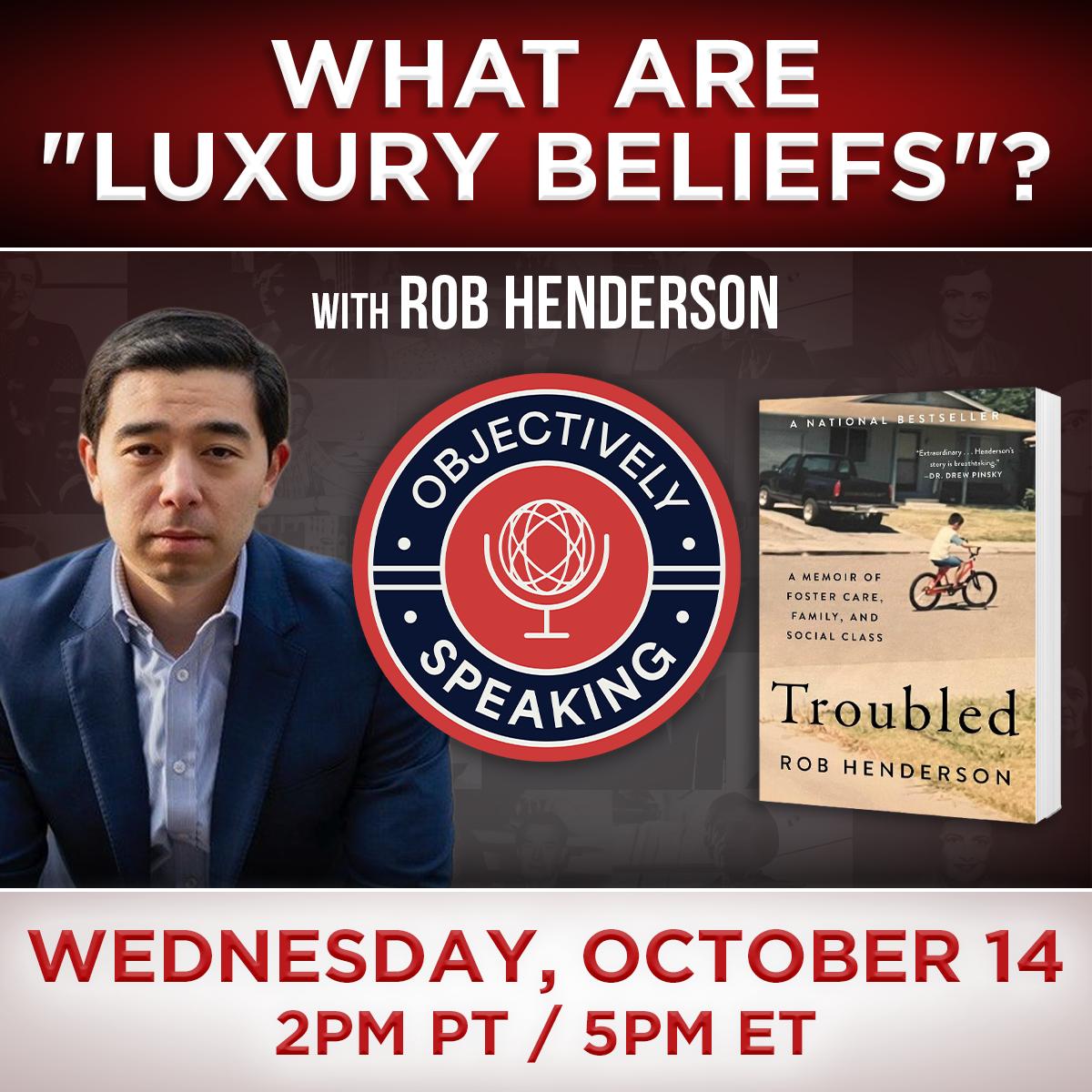
[00:00:00] Speaker A: Hi, everyone. Welcome to the 323rd episode of objectively speaking. I'm Jag, CEO of the Atlas Society. I'm very excited to be joined by Rob Henderson, one of the most interesting public intellectuals in America today and author of his best selling book, A Memoir of Foster Care, Family and Social Crisis Class. Rob, thanks for joining us.
[00:00:28] Speaker B: Hey, thank you, Jack. It's great to be here.
[00:00:31] Speaker A: So I am not just a reader of your book, but I am a subscriber to your substack.
And you recently ran a poll of your Substack subscribers and the results surprised you. You'd pictured a mostly younger male readership, yet your audience turned out to be more varied.
You were also struck by how many of your readers have lives they could not have pictured when they were 18. So I have to start with the question, how has your life turned out differently from what your younger self may have expected?
[00:01:11] Speaker B: Yes. Well, I mean, my life is dramatically different.
And I was interested. I've been writing an online newsletter for several years now, so I think we're coming up on six years.
And I've been on substack for coming up four years. And I was curious how many of my readers have had this similar kind of trajectory where, you know, is your life kind of better than you expected, worse than you expected? How different is it?
About 60% of my readers said their lives were dramatically different, which is the answer that I would have chosen if I were the one taking this survey.
And the reason it would be that way is as I describe in Troubles, I had a very unusual and kind of series of adverse experiences that led me into higher education and then to my subsequent career as a writer.
And just briefly, I was born into poverty in Los Angeles.
I was placed into foster care at 3 years old. Never knew my father. My mother suffered from addiction and living in the foster care system. I was adopted. And then from there there was a sort of periods of stability. But there were divorces and separations and financial catastrophes and a lot of other things that occurred that I witnessed firsthand.
Kind of emblematic of what's been happening in a lot of poor and working class towns all over the country.
So I fled as soon as I could. When I was 17, I enlisted in the military and with some setbacks and some hiccups along the way, eventually went off to Yale on the GI Bill and then off to the University of Cambridge to get a PhD on a scholarship. And then I was originally going to be a professor. I wanted to be a professor, but I finished my PhD in 2022, and this was not a great time.
If you are not kind of aligned with the modern progressive orthodoxy, it's very difficult to get a job in academia anyway. But if you are heterodox or have ideas that are outside of what people would prefer, the dogma of the day, then it's even harder. So started writing and then built an online following. Had a pretty successful writing career. And that led me to run that survey to see who's reading my work, who's interested in this material. And I was surprised to see just how many people had a similar experience to me.
And it was kind of hopeful, I thought, because there's a lot of pessimism out there and cynicism about, oh, the American dream is dead, there's no such thing as upward mobility.
But that's clearly untrue.
A lot of people have started in one place and have, with hard work and some talent and some luck, managed to improve their circumstances.
[00:04:27] Speaker A: So in preparing for this interview, I made the assumption that most of those tuning in would have read your memoir, Troubled. After all, it was a USA Today bestseller.
But given your own survey results, maybe I shouldn't be so quick to make that assumption. So I'm going to ask our viewers if you have read the book or started the book or haven't read the book. I'd love to just do a flash poll if we could get some answers. And then, of course, feel free to ask any questions for our guests. Now, I have read the book twice, and both times the experience nearly brought me to tears. Your first memory at three years old, bawling and clinging to your mother as the police are taking you away, the garbage bags in which you pack your meager belongings every time you are moved to a new house.
The foster family who treated their charges essentially as unpaid labor.
The adoptive father who refused to talk to you after your adoptive mother divorced him just as a way of hurting her. These and many other instances you recount in your book are enough to break anyone's heart. But beyond these, I suspect there's a deeper reason this book has affected readers so emotionally.
Why do you think that is?
[00:05:53] Speaker B: Well, I think one reason is, and this was not my expectation going in, was that people can relate to a lot of this. You know, when I was writing the book, I wondered, could anyone really connect with these experiences? You know, most people are never in foster care. They've never kind of experienced the same set of adverse events in their childhood and upbringing.
But you know, when I, after the book came out Readers would contact me, and they say, you know, there was addiction in my family, or there was a divorce, or there was, you know, financial downturns or mental illness or something that they could sort of relate to within the story that resonated with people. And I wrote the book to the best of my ability. I tried to write each chapter from the perspective of the age that I was during those experiences. So there's kind of, you know, two ways to write a memoir.
One way is kind of is the remembering self, which is you as you are now as a sort of mature, reflective adult, going back in time and offering commentary and reflection on these memories.
The other way is the experiencing self, which is you are attempting to recreate these events as you were at that time without the benefit of hindsight, without offering too much in the way of commentary, of just sort of letting the moments exist as they are and your reactions to them as you were at those various stages. And that's what I tried to do. And people could connect with it and said, like, I remember feeling that way as a kid or as a teenager, you know, being neglected or mistreated or overlooked in some way.
So, no, that was surprising and gratifying in a lot of ways that readers could connect with that. And the other thing is, a lot of those things that you'd mentioned, you know, the foster homes, the divorce, the ways that, you know, adults can be selfish and what, neglectful and those kinds of things, a lot of that isn't rooted in poverty. I think there's this myth that the only reason that people suffer or that kids in deprived or dysfunctional circumstances don't succeed is because of an absence of money. And the solution here is just more cash transfers, redistributive schemes.
It can all be solved with programs and government funding of some kind.
But in this book, I point out repeatedly that a lot of the bad choices people were making had nothing to do with money.
You know, there was some material deprivation and some struggle in that regard, but for the most part, a lot of these decisions were made for other reasons.
And, you know, if we could, you know, what I tried to do is sort of argue for a return to, you know, putting kids first, families first, that there's more to upward social mobility than money alone. A lot of it comes from attachment, connection and caregiving, responsible behavior, role models. And a lot of that can't just be signed with or rather solved with money.
[00:09:26] Speaker A: All right, we're getting some of our instant poll results back, and I'd say roughly half of people have read it. Valiant Mike has clearly read it. He says your life is inspiring.
Alan Turner started the book has half to go.
Candace Morena reread it leading up to the interview.
Modern Gault hasn't, but plans to do so and same with King Fisher. So that's good, guys. You're. You're not going to be sorry. Oh, you might feel a little sad.
[00:10:02] Speaker B: There's a good, There's a happy ending. So.
[00:10:05] Speaker A: Oh, yeah, yeah.
So you, by the time you were taken from your birth mother at 3, until the time you enrolled in military at 17, you were shuttled around to, I think, like 10 different foster families or situations.
Why did, why do kids get shuttled around so frequently and what effect does it have on. On them and did it have on you?
[00:10:32] Speaker B: Yeah, so the reason why we see this, you know, kids being placed, kids in the foster system in so many different, what they call placements in the jargon, is that, well, one important reason is that oftentimes someone from the family of origin can re. Enter the picture and take custody of the child. So, you know, as, as an example which is the case for me, was my. Was addicted to drugs. I was taken from her, placed into the system.
And in some scenarios like this, you know, the mother strings together a few months of sobriety and can take the kid back. Or maybe the father enters the picture or a grandmother or an aunt or someone says, okay, well, I can take the kid.
But if the child has been with the same foster family for, you know, a year, two years, three years, this can create obvious issues around loyalty and attachment where, especially for a little kid, you can imagine if a kid is taken at three years old like I was, and then they're five or six years old, you know, they've spent 40 or 50% of their lives with this foster family, they may be reluctant to go back to their mother or to some other family member. And so the way that the system has attempted to resolve this conflict is to intentionally prevent any attachment or bonds from forming. So they move the kid from one home to another every few weeks, every few months, definitely not longer than a year, so that those bonds never form. And of course, the bonds form in the other direction too, where foster parents can understandably become attached. They take a small kid in and start to feel affection and care and warmth toward him or her, and then off the kid goes. And after a few experiences like that, that can be very difficult. And I think that's charitably, maybe one reason among others, I describe the kind of coldness that I felt from most of my foster parents for my caregivers, where you may go into it with the best of intentions, showering every kid you get with love and warmth. But then if you see them go, you may start to protect yourself emotionally too, and not give too much, because you know that eventually the kid will be placed somewh else.
[00:12:56] Speaker A: So was there one chapter or one experience that was particularly difficult for you to write about?
[00:13:04] Speaker B: Yeah, I mean, so, you know, this connects to your earlier question, which I didn't fully answer, which was, what are the effects? Well, you know, the effects of constantly moving, at least in my case, and, you know, this is.
My experience is supported. It's consistent with a lot of the research on what happens when kids grow up without sturdy, solid attachments.
I was moving homes every few months.
The shortest day I had. There was one foster home I was in for, I think, three weeks.
And it becomes. Initially you get flooded with all of this negative emotions.
And it was extremely upsetting for me.
First being taken from my mother, and then the first foster home and the second foster home.
Each time it was. It felt like emotionally catastrophic.
But by the third home, fourth home, fifth home, you know, your.
Your body and your. You start to adapt psychologically in this way such that you shut down. You know, I experienced this kind of psychological numbness by that point where I was unwilling to feel anything because I knew on some level that it would just be extremely painful. So those emotions get switched off.
Was there a chapter that was particularly difficult? I mean, the first maybe three or four chapters were the most difficult.
The first one may be the hardest. It was really what I noticed was that as I acquired more agency with each sort of stage in my life, the easier the chapters were to write. When you're a kid, you're completely powerless. You are at the mercy of adults, parents, foster parents, caregivers, teachers, social workers.
They get to control every aspect of your life, understandably. I mean, little kids are not mature, sophisticated enough to obviously be off on their own or. But it just felt in a lot of ways, just sort of belittling, humiliating because I never felt like I was being listened to or heard in any way.
But then by the time I reached my teenage years and then adulthood and was able to make some decisions for myself, some good, some bad, those were easier to write because at least they were my decisions. And at least I was the one who was directing my life mostly in a positive direction, but sometimes not.
But yeah, those first few chapters, if I had known in advance how difficult it would be to write those. I probably wouldn't have agreed to write the book.
[00:15:47] Speaker A: Well, given the popularity of the book, I'm curious whether any of the people you write about, say foster parents, social workers or therapists, have reached out to you.
[00:15:58] Speaker B: Yeah, I mean, a few have a lot of foster parents and some social workers and people in the system.
And I haven't had any negative feedback from any of them. I think people are well aware that the system is imperfect.
It's broken. There are a lot of kids in need of homes, not a lot of families who are taking them in.
And, you know, these kids come from.
In order to be taken from your family, you know, something must have gone seriously wrong.
Oftentimes to do with addiction or mental illness or sort of overt abuse or mistreatment.
And, you know, it's just an ugly thing all around that people don't really want to talk about. They shy away from.
And I tried when I was working on Troubled, I tried to find other memoirs from foster youth, former foster youth, people who had had similar experiences to me. There are vanishingly few memoirs written by former foster kids. There are a lot of. Not a lot, but there are quite a few written by foster parents who are writing from their perspective as someone who, you know, takes kids in and cares for them.
But the thing is, if you enter the system, you probably had a pretty tough life already. And then the system itself doesn't always make it much easier, especially if you age out of the system.
There's not a lot of resources in place. So the trajectory to becoming an author or becoming someone who's in a position to speak about these things and get other people to listen, there just aren't that many.
So I tried to be clear that these were my experiences.
And other people who went through the system may have a very different opinion, but I haven't really been challenged on what I've said, so.
[00:17:50] Speaker A: Abigail Schreier spoke at one of the Atlas Society's events about her books, including Bad Therapy, which takes a dim view of most therapy. Now, given you're relatively helpful experiences with therapy, both as a child and then later in treatment during the military, I'm curious whether you read her book and have any thoughts about it.
[00:18:12] Speaker B: Oh, yeah, yeah. No. I'm an admirer of Abigail's work and I. I've interviewed her.
Her book Bad Therapy, and I think, you know, I agree with almost all of it. And, you know, some of her critiques aren't necessarily about therapy in and of itself, but the kind of the Therapeutic, the co opting of therapeutic language by the broader culture where, you know, schools have people, you know, teachers and so on, people who are untrained, who are not professionals, but they portray themselves as such and you know, borrow the language of therapy to over medicalize, you know, common, you know, experiences that adolescents and teenagers have.
In my case, you know, yeah, therapy was beneficial, but it was also a different time. It is possible, you know, reading Abigail's work, this is, you know, she's covering sort of recent events, kind of post great awokening, post identity politics era. Whereas I was going through my experiences as a little kid in the 90s where the LA County Foster Care system, you know, they had, you know, there was some mandatory number of sessions that kids had to go through.
And then after I was adopted, there was a divorce, a little bit more child therapy, and then in the military as well. And this was, you know, the late 2000s, early 2000s.
And my counselor at that time, you know, he was a former military member himself, he was a veteran. And so, you know, maybe the kind of therapy that I experienced was very different from what we're seeing now. I've heard these very kind of disturbing stories and if you read the statistics, a lot of foster kids now are apparently identifying as, you know, lgbt, trans, something like this. And you know, no doubt some of that is sincere and authentic, but I think a lot of it, you know, we've seen these numbers inflated for young people, for Gen Z, relative to other generations.
And at least in the case of the foster kids, I think what's going on here is that they, like, you know, my experience was feeling neglected, feeling overlooked. But if you can adopt the label of, you know, this additional marginalized category, then maybe someone will finally pay attention to you. Maybe you'll finally be able to get some help and, you know, find ways to, you know, get, get adults to listen to you.
[00:20:42] Speaker A: All right, we're about a third of our way through the interview, so I'm going to dip into some of our audience questions. My modern Gault asks, do you think elite universities are disconnected from the values and experiences of ordinary Americans? And was there for you a culture shock going to Yale?
[00:21:04] Speaker B: Yes, yes to all of the above.
There's a shocking gulf between people who attend and graduate from elite colleges and the rest of society.
And that was something I was unprepared for myself. You know, I came from kind of a working class background and my adoptive parents didn't go to college. I didn't really expect to attend college myself. I Think that is one of the.
One of the.
One of the things that distinguishes working class from middle class and above is did you take it for granted that you would go to college when you were a kid?
And so by the time I got to Yale, I was 25 years old. I was a mature student. I'd had a very different life than most of my peers.
And then I started hearing these strange opinions around.
This was sort of the precursor to the defund the police movement of decarceration, shut down the prisons we need to dismantle law enforcement. And then know it was just all of the attitudes around family, whatever was kind of received, or rather whatever was kind of conventional opinion.
You know, I often heard people take the opposite stance, and that led me to develop my idea of luxury beliefs. But this is a real problem because the people who attend these institutions, they are the ones who are going to be or currently are running, you know, running society, directing it, influencing it, shaping it. These are business leaders, political leaders, people who.
Media figures and so on.
And if they are not aware and connected to broader society, then I think this leads to what we're seeing now, which is this class divergence and a lot of anger and this feeling like, you know, people aren't. Aren't being listened to.
And a lot of people who attend these institutions are stuck in this trap where at least if they're in politics or if they're in some kind of business that turns a profit, they have to be aware of market signals of some sort. What do the voters want? What do the consumers want?
And so they have to do what they want. But then on the other hand, they also want to impress their peers. But their peers often are very different from ordinary people and they carry these luxury beliefs. And so they think there's this tension there that they're slowly attempting to resolve, which is one reason, among others, I think we've passed peak woke. It still exists, but not to the extent that it did a few years ago.
[00:23:45] Speaker A: All right, Flying Custard says, I've always believed in the importance of family stability. Why do you think emotional stability isn't as focused on as much as financial security?
[00:23:59] Speaker B: Why do we focus on financial security more than family or emotional stability?
Well, one reason, I think just because it's easier, it feels like a policy solution is within reach for financial security where if we could just get the preferred tax system or the right government program or redistributive scheme, that this feels like it's something, it's a lever we can pull it's within reach.
Whereas a lot of the problems that I describe in Troubled and in my other writing, it's some way connected to, but not always to financial circumstances.
And that's a harder problem to solve is promoting stability, care, attachment, love, because those kinds of things a lot of people are they shy away from talking about family or parenting or security for kids because this makes people feel weird and judgmental and they don't want to feel like that. So they retreat to discussions of economics to avoid discussions of family practices, of what's best for kids, of how adults can behave more responsibly.
And the only reason anyone would ever behave irresponsibly is because, you know, they lack money.
But a lot of the people who believe that will at the same time say that, you know, look at all of these irresponsible billionaires. So which is it? It is the absence of money, the source of irresponsibility or too much money?
I've never heard anyone resolve that contradiction.
[00:25:31] Speaker A: All right, let's see. We've got a question from Lock, stock, barrel. Do you think most foster children do successfully go on to live their lives or do you think that many have hang ups that, that follow them? You have some statistics in the book about levels of incarceration and other problems that seem to plague those system?
[00:25:57] Speaker B: Well, it's, the statistics are pretty dire.
The incarceration rates for boys in foster care, 60% of boys in foster care are incarcerated at one point in their lives.
If you look at the college graduation rates, they're pretty abysmal. So 3% of college, or 3% of former foster kids eventually go on to graduate from college, which is shockingly low if you look at the figure for children and families in the bottom income quintile. So basically, kids who are raised in poor families, 11% of them go on to graduate from college. So in other words, a poor kid in the US Is four times more likely to graduate from college than a kid in foster care.
And so it's part of, part of it is the lingering experiences, I think, from before foster care. But then during the experience, that extreme instability takes a toll.
You know, there are, there are a lot of obstacles in the way here. And ideally we would like, I think we would like to get to a place where we have fewer kids in the system in the first place, where the families are able to raise their kids and no one has to be taken from anyone. And we don't have the system of kids living in these impermanent and stressful
[00:27:27] Speaker A: circumstances, drawing on Your own experience and those of other foster care kids that you met while you were in the system, are there any changes that or reforms that could possibly improve the outcomes for these children?
[00:27:44] Speaker B: Oh, I don't know. There's probably no one silver bullet policy here.
One thing, and this is kind of a common response, is just more funding, more resources, and I think that that could help. In my case, the reason why I spent so long in the system before being adopted, you know, was because in part I think what happened was, as I had mentioned, usually someone from the family of origin returns in some form to take custody of the kid. But in my case my mother, she'd had multiple run ins with law enforcement, she was deported. My father, no one knew who he was. And so there was no way for me to ever be returned. So I'm in these foster homes and eventually the reason why I was adopted was because I had to go to one of these state mandated mental health checkups with a child psychiatrist and he noticed that, you know, what my circumstances were and then wrote a note saying, you know, I would recommend this kid be put up for adoption. And then that kind of got things moving. But that should have happened much sooner. That should have happened essentially as soon as I was placed into my first foster home. I should have been put up for adoption right away.
But because the bureaucracy is so over bloated and there are so many kids and so few caseworkers and just you kind of get lost in this complicated system.
But maybe if we had a more tailored approach to each kid to actually carefully read their files and see what their prospects are, what the realistic possibilities are, then we could probably at least help some, some non trivial number of kids.
[00:29:36] Speaker A: So one of the saving graces of your troubled childhood was your becoming a voracious reader of books early on. And in the many, many interviews I've done over the years, an early love of books stands out to me as a predictor of future success.
What did that early habit give you growing up and later in life?
[00:29:59] Speaker B: No, I've been a lifelong reader. I had to teach myself to read initially. I tell that story in troubled of no one read to me as a kid. And so this was. And I was terribly unfocused in school. I was changing schools and school districts all the time too.
Eventually I taught myself to read and then this was probably initially a form of self soothing.
There was a lot of chaos around me, unpredictability. But books were sort of a way to, you know, mentally at least escape from all of that.
And this reading habit, it kind of waxed and waned throughout my youth. I read a little bit less in high school and as a teenager, but still, it was a habit that I would come back to.
And a lot of it, you know, I was. I was drawn to inspirational stories. I probably couldn't have, you know, verbalized it or articulated it. But I think what I was, you know, I would read memoirs of people who had risen above their own circumstances.
And I found something that was inspirational about it, taught me that other people have been dealt a pretty bad hand and managed to turn their lives around in some way, and that maybe I could do it, too.
And also, the other thing is, I think it just kind of kept me out of trouble. Every minute I spent reading was a minute I wasn't getting into further misadventures with my friends. I mean, I was doing that anyway. But, you know, reading would.
I would sometimes spend evenings reading instead of drinking and driving or whatever else we were up to.
[00:31:40] Speaker A: So I am also a voracious reader. I read about two books a week, and I'm running an organization which is promoting books by an author that are not exactly short lifts. So it's been very depressing for me to see that we've gone from a time in the 1970s when 70% of kids read fiction every day for fun. Maybe that's 1 out of 10 today. So that kind of informs our strategy of using art and animated videos and graphic novels to engage young people with these ideas. But another disturbing reading stat was how few people actually finish the books they begin. And so I was very happy the vast majority of your substack subscribers finished reading Trouble because the later chapters covering your time at Yale are, to me, among the most fascinating of your book.
So before I get to some of the experiences that led you to develop your concept of luxury beliefs, perhaps you can encapsulate it for our audience.
[00:32:54] Speaker B: Luxury beliefs are ideas and opinions that confer status on the affluent and the credentials while inflicting costs on the less fortunate, members of society, people with fewer resources, fewer options. And a core feature of a luxury belief is that the believer is sheltered from the consequences of his or her belief. And, you know, there's more in the book and various essays that I've written about luxury beliefs. But the main idea here is that historically, elites displayed their social rank with luxury goods, with material possessions.
But, you know, as societies have advanced and we've grown wealthier, luxury goods, material possessions are a noisier signal of status. They still do signify Status. I'm not denying that. But in many ways, it's harder today to just tell who's rich and who's poor just by looking at them the way that it was when sociologists were writing about class 100, 150 years ago.
And so increasingly, we're starting to see people display their status with cultural capital, with luxury beliefs, that these kind of displays of taste, of opinion, of habit, of worldview outlooks.
And there's a huge drive here to distinguish oneself from the masses, from the commoners. How do you show that you are a member of this rarefied social group? Well, if common opinion is X, then you claim that actually the truth is Y, and immediately you're communicating, oh, I'm a member of the upper, upper middle class, this group, and I'm not just an ordinary person. I call this group the luxury belief class. These people who, generally speaking, occupy the top income quintile, top socioeconomic status category, and they're college graduates, and they hold opinions that they claim are helpful for the rest of society but are actually, in many cases, harmful.
Now, not every belief that someone holds, like, if you're an affluent, credentialed person, not every. That is. I'm not saying every belief you hold is a luxury belief. I'm speaking specifically about the beliefs that, one, display status and two, inflict harm on people who are lower on the socioeconomic ladder than you.
[00:35:28] Speaker A: So time and again at Yale, you encountered students who professed to embrace certain values or certain beliefs that they would never follow in their. In their personal lives. They would never, you know, give us advice to, let's say, a younger sibling.
[00:35:46] Speaker B: What.
[00:35:46] Speaker A: What are some examples of that?
[00:35:49] Speaker B: One example would be this fashionable view that hard work doesn't matter. You know, there's. The last few years, these attacks on meritocracy of, you know, it's not really about work or effort. It's about connections.
And a lot of the people who propagate this belief, students and graduates of elite universities, professors at elite universities, they themselves work incredibly hard. Like, they're well aware that it is the case that hard work does not always guarantee success. But if someone is successful, in almost every case, they worked very hard to get there. Even if there were connections and luck and all these other things that went along with it, they still had to work very hard to get there. So hard work is still necessary. But there was this downplaying of it, and there have been some interesting studies about this, where people who are relatively well educated and affluent, they're the most likely to Say that success is determined more by luck, whereas people who are lower on the ladder, they're more likely to say that it's about hard work.
And so anyway, so that's one, the other one is about family. So there are a bunch of different kinds of luxury beliefs. But the first conversation I had when I was at Yale that got me thinking about this was with a classmate. And I'd had multiple conversations after this, which was variations of someone saying that family was outdated, that we needed to evolve beyond this patriarchal, oppressive institution of the, of marriage, of monogamy.
And then I would ask, well, how did you grow up? Like, what were your family circumstances?
And every single one of these people, they told me that they were raised by two married parents. And this is, you know, if you look at the research on people who go to college versus don't go to college, there's a huge difference in terms of the family structure that they were raised in. There's a great book, the Two parent Privilege, by Melissa Carney, where she finds that the number one predictor of getting a bachelor's degree is being raised by married parents that outperforms family income, socioeconomic status. Whether you are a first generation student or not, it's just married parents.
And so then I would ask these, you know, my fellow students, I would ask them, okay, so you were raised by two married parents. How do you plan to raise your own kids in the future? Like if you choose to have a family? And they would tell me, oh, I'm probably going to get married and have some kids. That's how I was raised. Like, that's kind of what I would prefer to do. That's what's familiar to me.
And so what I was hearing from them was I benefited from this age old institution that helped me to get to a place like Yale. I plan to carry this benefit forward for my own children.
But my official public stance is that people shouldn't do this. This is a bad thing. We need to evolve beyond it. We need to get rid of this or dismantle it in some way.
And a more recent example, I'll finish with this final example, it's maybe the most intuitive, is the defund the police movement, which was at the height of this movement in 2020 and 2021. If you looked at the survey data, which I did, there were multiple surveys asking Americans how they felt about defund the police as a movement and as an idea. It was always the highest income Americans that were the most in support of defunding the police. And the lowest income Americans were the least in support of it. When you looked at political orientation, it was white Democrats were more in favor of this than black and Hispanic Democrats. And yet in the wake of that movement, violent crime did spike for a couple of years. And most of the victims of those violent crimes were poor, marginalized people.
And so these people were claiming, oh, we need to defund the police to help these communities.
And yet by supporting that movement, they were indirectly actually causing harm in these communities. And you know, in every single one of these cases, no one is ever held accountable for this. No one ever publicly says, I was wrong about this. It's just we move on to the next fashionable luxury belief while the people who have sort of less power and less influence are left to suffer the consequences.
[00:40:11] Speaker A: So in coming to terms with the political radicalization of Gen Z, I've interviewed those like Greg Lukianoff who attribute it to overprotective parenting and others who blame indoctrination from nearly universally left of center professors. I'm wondering whether you give one argument or the other more credence or do you find the competition and status games inherent in luxury beliefs to be a more compelling explanation?
[00:40:45] Speaker B: Interesting. I don't put much weight on the idea that professors are brainwashing the students or making them more left leaning. I think there's a little bit of it, but it's not the whole story. There was an interesting stat, I believe it was from last year, found that something like 80% of undergraduates claimed to misrepresent their views as more progressive in order to get a better grade on an assignment.
But I think more likely what's happening, you know, what's more so feeding a lot of the kind of campus unrest that we see, it's from the bottom up. You know, I've taught courses here and there, I've been teaching fellow, and I've interacted with a lot of undergraduates and delivered lectures at various campuses.
And I'll ask the students, the first question I ask is, have you ever withheld your opinion or self censored in a public setting on campus? And usually 80, 90% of the students will raise their hands saying, yes, I have self censored in some way.
And then the second question I ask is, do you self censor because you fear your professors, the administrators, the authority figures on campus?
Or do you self censor because you fear retaliation or some kind of consequence from your peers?
And overwhelmingly, it's peers. They're afraid of their friends, their classmates, they're afraid of being canceled Being mocked or humiliated or targeted online on social media or in these various apps, Yik Yak and these other apps that college students use where they spread gossip and rumors and, you know, badmouth one another. And if you are on the wrong side of the political line, then you're more likely to be targeted. So students are extremely wary and it's, some of it is the professors, but the majority of it comes from their own peers.
[00:42:53] Speaker A: Interesting, I hadn't seen that particular statistic. So while book sales and the overwhelmingly positive reception to trouble point to its popularity, I'm wondering, has there been any institutional resistance to the popularization of the ideas advanced in the book? And investigation by The Economist in 2024 on political bias in the New York Times bestseller list said that Troubled should have been in fourth place.
Or better yet, it didn't even make the list.
Could this be institutional resistance to ideas that threaten certain elites?
[00:43:38] Speaker B: Yeah, this is one of those things where you can never know for sure because, you know, a lot of institutions, you know, they're not going to flat out say, you know, they're not going to officially say, oh, this is, we're not going to have this person and we're not going to list this person or we're not going to invite this person because we disagree with their politics.
Sometimes you see that, but not very often.
And in my case, you know, my book is, at least I thought it was uncontroversial.
I didn't write it to be partisan. And I don't think anywhere in the book I even use the words liberal or conservative or Democrat or Republican.
You know, I just tried to give my experiences and then my understanding of social class, not from a left or right perspective, but just from, you know, for the perspective of someone who grew up the way that I did.
And now there were some strange things happening when the book came out.
You know, I was first time author, you know, no one completely removed from publishing. I didn't know anything about it, but I, you know, I knew what a bestseller list was and I always thought it was a list of books that sell the best. And then my, my editor calls me and tells me, hey, you made, you know, these, these other lists, but you were left off the New York Times list. And we're looking into this.
And then someone at the Economist who reads my, I wrote about this experience. I wrote about like this is strange, like I thought the New York Times list was about, was a list of books that are selling the best. And that turns out not to be the case because you know, we have internal data, my publisher, showing me how many books I sold. I write this piece in my substack. And then someone at the Economist emails me and we have a conversation. And then they do their own independent internal analysis showing that Troubled should have ranked number three or number four on the list.
And it was not listed at all. And so I think there is perhaps some concern that, you know, the ideas in this book might be threatening. I didn't intend for them to be threatening. I hoped that it would be sort of a message for change, for call for reflection, some introspection.
But I tell another story towards the end of Troubled, where by the time this book came out, I had written some essays, I had a piece in the Wall Street Journal and some other pieces where I was voicing my concerns about what was happening in higher education, what was happening on university campuses.
And so one of the deans at Yale knew that I had this book coming out and emailed me saying, hey, Rob, we know you've written some criticisms and some concerns, but we hope that you'll be gentle. And your book about what you say about your experiences at Yale. And I was just floored by this. You know, first I'm like, okay, you're Yale, like, who cares what I say about it? Like, you're still like, whatever I say is not going to damage the brand. You're still going to get thousands of people who are clamoring to get into your college anyway. Who cares?
But they're exquisitely sensitive to criticism. A lot of these institutions do not like criticism in any form. They're very fearful of it.
And I was not expecting this. So, no, I think there is that. And then if they platform these ideas or whatever, they would much rather silence people than make any effort to change themselves from within.
And we continue to see instances of this where if they put in as much effort toward reform as they did trying to silence their critics, then there would be no critics in the first place.
[00:47:11] Speaker A: All right, well, we have about, I don't know, 1312 minutes left. And. And we began this conversation with your substack. And so I'd like to end with at least one or two of the substacks essays that you wrote that caught my eye. But I see another audience question here that's probably on most of our viewers minds and it's from Lock, Stock, Barrel who says, do you think it's still worthwhile for young people to go to college? While not universal, I see rising group of people going into the trades.
So yay.
[00:47:42] Speaker B: Or Nay, I think if you. If you want to, I would never dissuade anyone, you know, if they, you know, are bookish or interested in some way. And as long as they understand what they're getting into that, you know, it's a. It's a mixed bag. College campuses, you know, your. Depends on the major, your peer group, the classes you take, you can still get. You can cobble together a decent education if you learn how to identify good professors and do your best to form relationships with sensible peers. There are a lot of student groups. I get invited to speak on college campuses by student organizations. Who are they run a free speech club or a heterodox club or something of just students who are not in support of the prevailing ideology. So if you can find your group and then find some sensible professors, you can get something out of the experience. On the other hand, if you are not inclined to go to college and you have some other interests, some other skills, you find other ways to make something of yourself.
You know, vocational training or the trades or something along those lines. Military. There are many options for an ambitious young person. So I don't think. I think it was a real mistake. You know, when I was a kid, the whole thing was college. No matter what, college is the big thing.
Everyone should go to college.
And now I'm seeing this shift where there are many options and many ways to make a good life.
[00:49:15] Speaker A: So one of your essays that caught my eye, perhaps not surprisingly, was what Communism Does To Kindness, which you reflected. Kindness has to be cultivated, and this only happens when it is in demand. A regime that rewards denunciation will produce denouncers. Can you unpack that for us?
[00:49:37] Speaker B: Yeah. Well, I wrote this piece, originally published in the Free Press, How Communism Kills Kindness.
And I was seeing what everyone else is seeing, this rise in the popularity of the dsa, the Democratic Socialists of America, and they were they.
Half of their leadership now identifies openly as communist. And then in one of their recent newsletters, they celebrated Mao Zedong's 132nd birthday.
And so I thought it was important for people to understand, well, who was Mao and what was life like under his regime?
And for me, the best starting point is this excellent book, Chinese Shadows by Simon Lees. And that's what I discuss in this essay of, you know, what was happening during this time. It was a lot of, you know, families informing on one another. This atmosphere of suspicion and mistrust, this constant kind of lying, this revising. They would constantly change the politically correct orthodoxy of the day. So then they would rewrite history textbooks, revise the descriptions at museum exhibits.
There's an old Soviet joke which I quote in that piece, which is that under communism, the future is certain. It is only the past that is unpredictable.
And I think we can see some parallels today in the US where we're seeing, oh, we're going to do some revisionist history of actually the good guys were bad and the bad guys were good and this kind of thing. But that piece about how communism kills kindness, how does it kill kindness? Well, if you belonged to the wrong social category, then cruelty was the right response rather than kindness.
And so if you were described as the daughter of a landlord, or if you were described as a capitalist, then it doesn't matter how you behave or what you've done in your life, you've been tainted by your class background. That was how Communists thought. Whereas if you were a member of the working classes, and then no matter what you do, no matter what you say, you're fine. But what was interesting here is that even these categories shifted. Where Mao himself, for example, was raised relatively well off by a prosperous landowning family, but he was always described as a member of the working classes because, you know, he was the dictator and he was in charge. Whereas if someone grew up in dire poverty but happened to voice the wrong opinion, then they would be recategorized as a bourgeois or a member of one of the disfavored groups. And therefore it was okay to send them to a labor camp or a reeducation camp or outright execution in many cases.
And so we see this now, I quote a statistic in that piece that after the UnitedHealthcare CEO Brian Thompson was shot, 41% of voters under 30 said that that was an acceptable act. And the reason why they say it's an acceptable act is because Brian Thompson was a member of the wrong category. He was a CEO, he was a rich guy. So therefore, the right thing to do in this case is to celebrate rather than to express the right human emotion of compassion and empathy to be humane in your response.
A lot of people misunderstand this. They think that, you know, you should only express empathy and compassion for your friends and your allies. But anyone can do that. The real test of the depth of human feeling is can you extend those feelings to people who you maybe dislike or to who your group maybe dislikes? I tell a story in that piece about Lev Kopalev. He was a Soviet Communist, and he describes how during Stalin's forced collectivization campaigns, he heard Lev Kopolev Heard the crying of children, their screams, and he initially felt compassion for them. And then he reprimanded himself, because in his mind, a good communist isn't supposed to feel that way. We're building utopia here. We don't have time for a bourgeois sentimentality. Okay, kids are going to die, but we're building a glorious future, and that's what we need to be focused on.
[00:53:51] Speaker A: And.
[00:53:51] Speaker B: And that's. That's terrifying when you sacrifice flesh and blood human beings for an abstract ideology.
[00:53:59] Speaker A: So in your essay is Striving Cringe, you explore why people sometimes admire effortless talent but disdain those who work relentlessly to achieve excellence. Why is that? Is that something in our culture, or is it maybe something in our nature?
[00:54:17] Speaker B: I think there's something probably both. But I do think there's something in our nature that we, on some level, we want to believe in magic. You know, we want to believe that people are just touched by God in some way or are born with these immense gifts, and that explains why they're able to do amazing things.
So, you know, I talk about in that piece, the story of Houdini, the great magician, the illusionist, where he would spend countless hours studying locks and mechanics, training his muscles, you know, rehearsing over and over and over again so that by the time he was on stage, the spectators would believe that a miracle had occurred because there was no other way to explain what he had done. And you see this. You know, I think you can extend that example to many other things where a lot of people who are successful, they work tirelessly behind the scenes. They study hard, they work hard, they're disciplined, they're focused, they're organized.
And people don't want to hear about all of the tedium behind that, all of the effort, all of the work, all of the obstacles and annoyances that go into success.
They want to believe some people are just born with it. And that's nice to hear.
The other thing is, if people hear that success comes from hard work and they themselves are unsuccessful, there is a feeling, I think, for many people of being judged of. If hard work is what leads to success and I'm not successful, I guess that means I haven't worked hard enough. That's not a good feeling. So instead, I'll think of success as something in positive instances. Oh, you know, some people are just born with it, and that's why they have their success, and that's, you know, good for them. And then in the kind of more toxic and negative sense, it's, you know, some People are successful because of luck. And therefore we need to completely dismantle and revamp society and have a revolution because the system is inherently unfair.
But no, I think this is responsible, I think, for a lot of the kind of anger around striver culture, cultural clashes. We're seeing a lot of this now of arguments around meritocracy and so on. And a lot of it boils down to, you know, what, what is actually responsible for success.
[00:56:38] Speaker A: So tell us about your next book.
[00:56:42] Speaker B: Well, we've talked a little bit about it. The title is Luxury Beliefs. It will be out sometime next year, most likely in the fall. And this will be less memoir and more so, just describing what social class looks like in the modern era.
And, you know, it's my understanding of how social class, the ideas of it have changed over time. What is social class? How does it differ from status?
What are the ingredients of upward mobility? What predicts downward mobility?
And I talk about Veblen, I mentioned him, some of the old school sociologists from before academic sociology was corrupted, people like Emile Durkheim, Max Faber. There's a lot of good work in kind of old school sociology of attempting to understand class from, you know, a lot of people, especially on the political left, when they talk about class, they're using this sort of outdated Marxist framework. But there's been a lot of good work since then. So I try to summarize it and communicate it in a way that's accessible and hopefully interesting and entertaining. And I tell some, some stories about my own life, too, drawing from personal experiences in some ways to update the reader. What's been going on in my life since Troubled was published.
[00:58:04] Speaker A: Well, you're going to get an invite to come back on this show. I can't wait to read it. So we'll let you get back to it. So thank you, Rob.
[00:58:12] Speaker B: Thank you, Jack.
[00:58:13] Speaker A: And thanks everyone for all of your great questions. I had also a lot more questions, but we just couldn't get to them all. Next week I will be off and Atlas Society senior scholar Richard Salzman will host a special webinar cutting through the confusing labels attached to capitalism, from crony to stakeholder and state capitalism. So stay tuned. We'll see you there.