Episode Transcript
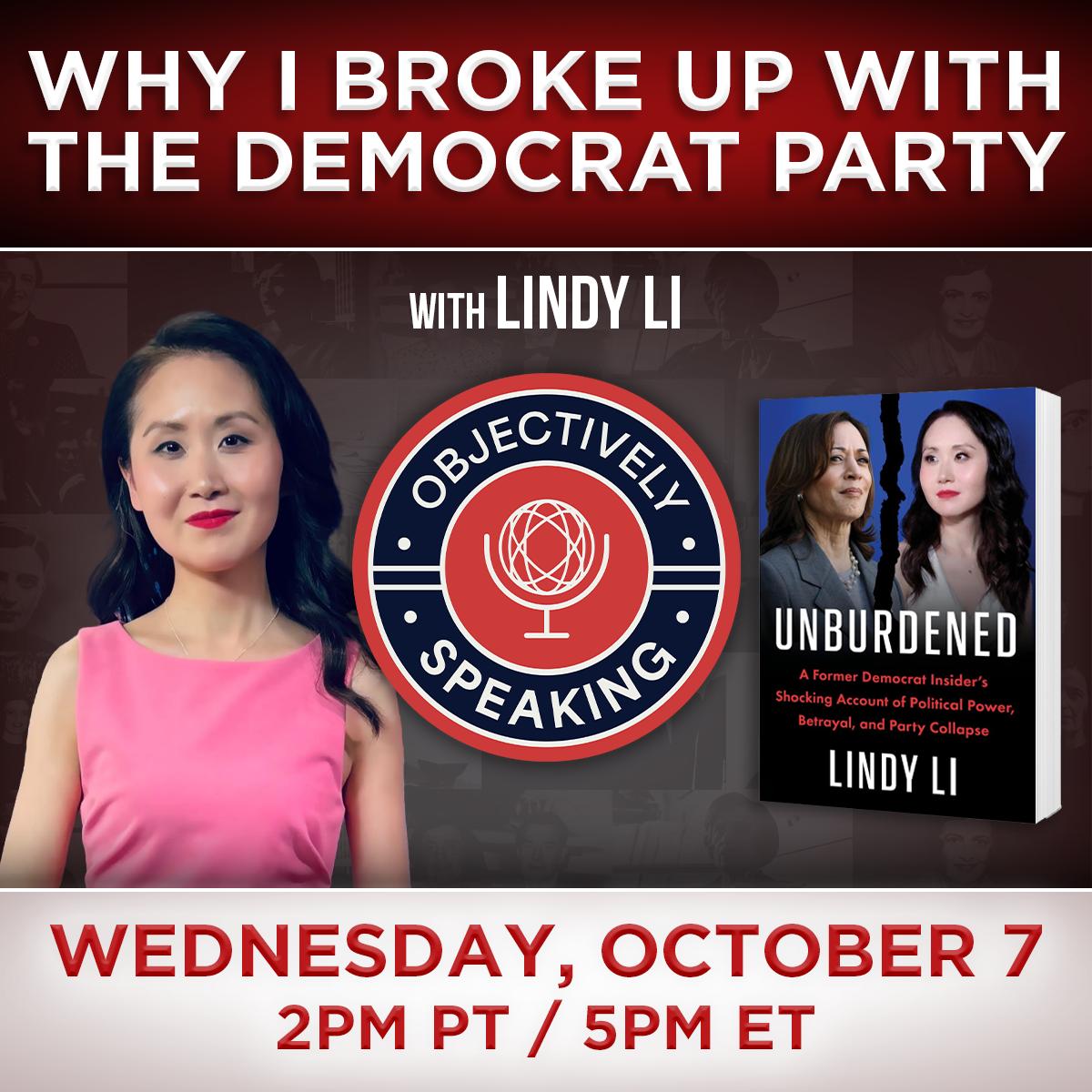
[00:00:00] Speaker A: Welcome to the 322nd episode of objectively speaking. I'm Jag CEO of the Atlas Society. I'm very excited to have Lindy Lee join us to talk about her book Unburdened, a former Democrat insider's shocking account of political power betrayal and party collapse. Lindy, thank you so much for joining us.
[00:00:27] Speaker B: I'm so happy to be here. Thank you so much for having me. Heard a lot of great things about
[00:00:31] Speaker A: you and likewise, looks like we now have some mutual friends in common. And I just wanted to congratulate you on your book. I know it's now a New York Times bestseller and it just was. As a former presidential speechwriter myself, it just was really so beautifully written and it reminded me of a certain book which we're going to get into in a bit. But our audience is always interested in our guests origin stories and yours is more interesting than most. You were born in Chengdu and your parents were farmers. So tell us a little bit about your parents experience coming to the United States and how that informed your outlook growing up.
[00:01:18] Speaker B: I applaud you on the very accurate pronunciation. First of all, that's very good. It's Ch. Chengdu. It's actually where the two pandas that. It's the same place where the two pandas we got recently came from.
Remember how during the state dinner the Chinese president announced that there would be two pandas? Yeah, it's from Chengdu. Chengdu is a panda panda genesis center of the world.
So my, my parents weren't farmers. My great. My grandparents were. My grandparents are illiterate farmers.
In fact, they can't even speak Mandarin Chinese. And my Chinese is bad to begin with. So they, the two, they. We have no way of communicating. My grandfathers are dead, but I have no way of communicating with my grandmother except through hand gestures because her level of education is so poor due to the Cultural Revolution.
[00:02:13] Speaker A: Yeah, well, just. She must be very proud of you
[00:02:18] Speaker B: that I don't think she realizes anything that's going on. It's hard for her to conceive, you know, like she has no idea. The New York Times bestseller charge. She has no idea of anything.
[00:02:29] Speaker A: What Princeton even means.
[00:02:31] Speaker B: She has no idea.
And it's hard for me to teach her. Like how do you tell her that's an entire planet. It's hard for me to tell her that, you know, I, she just knows that I'm doing a job like in general.
[00:02:44] Speaker A: Well, and she can just see that you're put together and you look beautiful.
So before we get into Some of my other questions we were talking previously. I said that the book, in a way, reminded me a little bit of aspects from Atlas Shrugged and that your story kind of reminded me a bit of Dagnes in that you had to learn to. You were trying to make something work. That was an unworkable situation. You finally needed to learn to shrug. So I didn't know till five minutes ago that you finished reading.
Was it Atlas Shrugged the day that you went to Princeton?
[00:03:28] Speaker B: So the day that I got into college, yeah.
[00:03:31] Speaker A: So what? Any characters or any ideas that you've really stuck with you.
[00:03:39] Speaker B: Actually, I don't think I realized the significance of that intersection until I started talking to you about it. I mean, what are the chances of me? I read a lot. I devour books like food.
I don't eat that much to begin with, but I am an intense bibliophile. And the fact that such a monumentous day coincided with Atlas Shrugged is also just a big deal to begin with. In Fountainhead, I thought was beautiful, but I wrote the book live, as in I had no idea how the book would end.
[00:04:11] Speaker A: Wow.
[00:04:11] Speaker B: So in retrospect, it's almost amazing how the two stories of the book were running on parallel tracks. And you said something very beautiful and poignant. You said, I tried to.
I tried to basically preserve something that was unworkable.
And it wasn't just the political situation. It was also my personal situation.
[00:04:36] Speaker A: Yeah.
[00:04:37] Speaker B: And I unwittingly wrote a double entendre in the first chapter.
I said, I'm gonna paraphrase it to protect some people. But I said, leaving a cult is like leaving a lover.
At least with a lover, you know, when he's going to ghost, when he's going to hurt you in ways that feel like love.
[00:05:00] Speaker A: Well, I do remember that line. And how.
In what ways? Like, how would you define a cult? In what ways did the party that you were leaving, the system that you were leaving, feel like a cult?
[00:05:16] Speaker B: I actually didn't write that about the party. I wrote that about though person, and it happened to illustrate the party dynamic perfectly. That was my first double entendre of the book. There are several in the book. I have never said this on air, but you make me feel safe. And by the way, Alex, the male protagonist of the book, is not actually Alex.
He's named Alex because Anna Karenina is my favorite book.
[00:05:46] Speaker A: Wow.
[00:05:47] Speaker B: And Alexi Vronsky is her lover.
That's why he's Alex.
I'm not here to ruin anybody's life so we can call him Alex. But there are a lot of little Easter eggs strewn across the book.
And I'm reading the reviews from readers right now, and most of the readers love it, but some just don't understand because they were expecting a very matter of fact, very easy to read document. But I'm not here for that. I'm never going to be here for that sort of thing. You come for me. You come to me, and I'm going to give you art. I'm also going to give you information, but most of all, I'm going to give you art, because I am an author first and foremost, and I. Yeah, I.
I'm not going to make any apologies for that. I'm going to hand you a work of beauty.
That was my intention all along.
And I know I caught some people. There's a minor faction of people who are caught off guard because they were expecting, like a straight, hard documentation. No, never from me. You. You can read somebody else's book for that. I'm not going to give that to you.
[00:06:56] Speaker A: Yeah, no, really. And also that came through in your narration. The audiobook is narrated by Lindy, and you can definitely feel the raw.
[00:07:08] Speaker B: Did you actually hear the audible? You heard the audible?
[00:07:10] Speaker A: Yes, I did. I did. I thought it was.
[00:07:12] Speaker B: I like you more and more.
Yeah, they let me keep the tears in the. On the final page, actually. That was my. And I know I'm not the best narrator, and it was definitely a risk for me to read it, but I also know there's no one on the face of the earth, obviously. I read that. I wrote the whole thing from front to back, and I. There was no ghostwriter. It was just me.
And nobody knows the jagged edges of the piece as well as I do. And nobody knows the heartbreaks and the heartaches and the betrayals more than I do.
I paid for this with my lifeblood.
[00:07:47] Speaker A: Yeah. No, literally.
So, Lindy, before we get into the book, I've always been curious about Chinese American political perspectives and the forces that inform them. On one hand, for modern immigrants, there is a direct experience with the failures of collectivism.
Yet Chinese Americans also attend college at higher rates than the population at large. And given their drive for academic excellence, I've wondered whether they're less likely to question their professors progressive pronouncements. Then further kind of confusing the mix is Trump's animus towards China and its penchant for saying, you know, things that understandably rub Chinese Americans the wrong way, like calling the coronavirus the Chinese flu. So how do you think about all
[00:08:42] Speaker B: of that, it's a really good question.
I think I mentioned in my book that my greatest inheritance is my. My Chinese parents worth. Work.
Sorry, work ethic.
They are unbeatable in terms of how relentlessly they pursue their dreams of creating a better life for me and my brother. It's almost.
It will wring your heart if you heard, if you knew how much they sacrificed.
And their commitment to integrity also. It's like their Confucian.
They're Christian, but they grew up in a very Confucian world. Like to treat others with dignity and honor.
And I'm very blessed that I inherited that.
And there's nothing more important than education in this, in this culture.
And I say at the end of my book. And my mom lambasted me the other day, even though I did give her a heads up.
My dad said two things to me seven years ago. He said, Princeton's not a big deal. Doesn't mean anything. They're still Harvard. He did say that.
And then he said, you're never going to get published without a PhD.
Well, times best selling author now.
[00:10:06] Speaker A: Yes.
I guess he's can eat his. His words.
[00:10:11] Speaker B: He doesn't though. It's a very Chinese thing. He's just like, oh, okay.
[00:10:16] Speaker A: Well, since you had some early seeds of objectivism planted in you, perhaps you will be less reliant on validation even from your dad.
So you describe an experience at a rainy Princeton graduation, which I thought was very interesting. A dean tried to sideline you. What happened?
[00:10:41] Speaker B: Oh my gosh, you're the only one. I've done a lot of interviews for this book. You're the only one who asked about that. I do know that.
I'm honored that you asked about that. Thank you, Jen.
[00:10:53] Speaker A: Well, I think, you know, it kind of for like a novel, it's sort of planted a clue.
[00:10:59] Speaker B: It's sort of for buildings. Roman.
[00:11:01] Speaker A: Yeah. That you were, you know, not gonna let people just, you know, steamroll over you.
[00:11:10] Speaker B: Yeah. And it's not that I'm not afraid. I'm scared.
Shit lists. And I go forward anyway. I plow forward anyway. It's not that I'm missing the fear gene. I have plenty of it, trust me. I'm terrified. But I go forward anyway because I know that I'm supposed to.
So what happened was I was only one to be elected class president.
President of Princeton four years in a row. As a woman ever, like, to this day, it's never been done before and it hasn't been done since.
And during that time, I could feel that I was treated differently the entire time. And I used to.
It used to really hurt me. I mean now, I mean, so many years has passed since then, but it used to really hurt me. And that applied to graduation day. It was pouring. Actually. There's footage online. You could still see the raindrops scarring the camera lens. You can still see it.
And Princeton Posted is actually online for those who need a fact check. But you need to Google Lindy Lee. Steve Carell. So Steve Carell, the actor, was my keynote speaker. He and I were supposed to speak that day along with the president University Shirley Tillman, but unfortunately it was raining too hard.
And the Dean of Princeton then, who's now the dean of Harvard, his name is Thomas Dunn. Oh, I still need to tell him that I need to tell him my book.
He said that I wasn't allowed to give my speech and that I needed to send it out as a PDF and he got to contextualize the whole thing because this is after four years of them just trying to contain me and deadened me.
And it was just the end of a long string for me of insults, basically.
And I'm not saying this denigrate my time at Princeton. I'm so grateful for the university. They gave me a full ride.
I would be nothing without Princeton. Princeton's my favorite place on earth. Every time I step foot on campus, I cry.
[00:13:17] Speaker A: So they were telling you, step aside, don't give your speech.
[00:13:21] Speaker B: I'm crying now. Oh my God. Yeah, they told me not to.
[00:13:24] Speaker A: Carol stepped in and gave you a piece of advice.
[00:13:27] Speaker B: He did.
Well, I only confided in him. I didn't even tell my parents because I knew they would be devastated to hear what the Dean said. What he said was very cruel because he knew that I was working towards this moment for four years. And he just said, don't give your speech. So I just told Steve, I said, dean Dunn said not to give my speech. And he said, once you're on stage, they can't pull you down, they can't pull you aside. So unfortunately for them, I had just been reelected as alumni president.
Actually still am. So I'm 17 years in the running, the longest serving officer.
And I went on stage to get acknowledged and it's there that I gave my entire speech.
And I could just hear noises behind me.
You could tell that they were not planning for it, but I gave my entire speech. Not their bridge version. I gave the whole thing.
And meanwhile I could see the raindrops just hurtling down from the sky. And that's when I knew that I was destined to be a leader. Like, I knew that this is for me.
I was born.
[00:14:38] Speaker A: It's amazing. It's amazing. Amazing. So in. In your prologue, you write that every 8th of November voters think that they decide the fate of the nation.
But that's an illusion orchestrated by the real architects who remain unseen and unaccountable.
So you got an introduction to this during your early attempts to run for elected office in Pennsylvania. What happened?
[00:15:08] Speaker B: I wanted to run for office when I was 24. I was the youngest woman to run for Congress when I was 24 because of Sandy Hook, which happened on my birthday. And it just seared itself into my memory as something that I needed to redress.
I naively took it upon myself to ensure that it would never happen again.
Just to kindly remind your viewers, 28 children were slaughtered along with six teachers that day on December 14, 2012.
And I knew I was going to run for office at some point, but I didn't know it would be so soon. And I guess when you're 24, you don't think that failure is even possible.
I've since lost that.
I've been ground down and broken by reality.
But I did try. I did try.
[00:16:03] Speaker A: And did the party kind of elders tell you again to step aside?
[00:16:08] Speaker B: They did, and I didn't listen. So they sued to kick me off the ballot.
[00:16:12] Speaker A: Wow.
[00:16:13] Speaker B: And my family had to spend $100,000 keeping me on and didn't work.
And the judge that ruled against me apologized when he did, but he said because of technicalities, there was something about notary. I'm not going to bore you with today, but there is a certain way that signatures need to be verified. Just trust me. That was a technicality. He apologized. He's like, they forced my hand. But I want to apologize on behalf of the Democratic Party. This is not how naturalized immigrants should be treated. And I applaud you for attempting to run.
His name is Kevin Robson. He's now a Supreme Court justice of Pennsylvania.
[00:16:54] Speaker A: Wow.
[00:16:55] Speaker B: And I want to thank him. I should have known then that I belonged to the wrong. I was part of the wrong party.
The way that he handed down his decision was the picture of grace.
[00:17:09] Speaker A: So how did you then get into fundraising?
[00:17:13] Speaker B: I didn't intend to get into fundraising. I hate fundraising, actually.
[00:17:18] Speaker A: Certainly isn't easy. It isn't easy, but you.
[00:17:20] Speaker B: Yeah, but I just happen to.
I think a lot of the skills coincide with retail politics, which I'm kind of good at. And.
And I'm also relentless. So A lot of the skills overlap, and I just happen to be good at it, but I'm not.
I hate it, man. I just hate it because I hate.
I know hate isn't strong word, but I actually do. I don't like monetizing my relationships. I like nurturing them. I like loving people.
And I say very crudely in my book, and I'm not going to make any apologies for it. Fundraising is a prostitution of relationships.
It just is.
[00:18:00] Speaker A: Well, as somebody who spends a lot of time fundraising for the Atlas Society, I definitely agree that there are situations where leaning on your friends can be a little stressful and a little awkward and, you know, makes them feel less, you know, valued for what they're bringing to the relationship. But I also see it as an opportunity to say, to be entrepreneurial, to say to people, when I find somebody that, like, oh, I have copies of Atlas Shrugged in my office and I give them out, and I've got copies in my trunk and I give them out, I'd say, you know, we can help you scale that operation. So I think for people that want to see a certain kind of change in the world, coming at it from an entrepreneurial direction is something where you're not just taking, but you're exchanging and you're providing value. A solution that they want to see in the world.
So the title of your memoir flips Kamala Harris's signature line, unburdened by what has been.
In writing your memoir, what burdens were you hoping to shrug off?
[00:19:18] Speaker B: The memoir wasn't just.
It wasn't just an act of writing. It was survival.
I needed to do it. It was existential.
It wasn't a commercial endeavor.
It was a visceral one.
I just needed to do it.
You know, a lot of, you know, a lot of politicians write books to get ahead politically or to prepare for their next run. I know such considerations in mind. In fact, if I had, I would have written the book a different way.
I was so deeply honest about my flaws, about the things that I contend with on a daily basis. I mean, you see everything.
[00:20:05] Speaker A: So you described the consultants who raked in millions by orchestrating deceiving donors, orchestrating a loss in business. Failure gets punished. What are the incentives in campaign politics that actually reward failure?
[00:20:25] Speaker B: Yeah, we laugh about 10% for the big Guy in relation to Joe Biden, but the less discussed grift is actually 15% for the big rift is what I call it.
Few Americans are aware that 15% of each dollar of ad buy goes into the pockets of consultants.
And if you're raising $2.5 billion over seven weeks, that is so much money.
People became overnight multi millionaires because of this failed effort by Kamala Harris.
There was nothing to show for it. The amounts of money that were pouring in unchecked and unmonitored, it's just so egregious. And to this day, there's no accountability. In fact, there are some donors who are not giving to the DNC and calling it the do not contribute. The DNC Do Not Contribute. Instead, because of my exposures, like no one, they've had two years to answer for everything I've said, right? They've had two years to Ashley Biden threatened to sue me.
A lot of people issue threats, but no one followed through because everybody knows I'm telling the truth. Everybody knows.
Everyone. Like from Nancy Pelosi down, everybody knows.
They just, right now, their strategy is to ignore me and hope that I will go away.
[00:21:47] Speaker A: So in your memoir, you describe a real personal affection for Joe Biden and an appreciation of his personal kindness to you. At what point did you realize that the endlessly repeated mantra, sharp as attack, was in fact a coordinated cover up of Biden's deteriorating condition?
[00:22:09] Speaker B: I started raising the red flag in 2022. I alerted the press. I spoke with members of the press, including Politico, about Joe Biden's condition.
I didn't just hope for the best. I tried to take action. I tried to use sunlight as a disinfectant.
And then in 2023, I started approaching party leaders, including the now chair of the Democratic Party, about Biden. And I asked him point blank, don't you think he's too old to run?
And he basically laughed me out of the room. He made me feel ashamed of myself for even voicing it.
And he embarrassed me.
So I, I certainly found out where the party was at, you know what I mean? Like, they weren't ready to entertain reality at all.
[00:22:57] Speaker A: Well, as you know, Ayn Rand says one can evade reality, but one cannot evade the consequences of reality. So I think that's what we're seeing in, in Lifetime now. So question here from one of our viewers, Lock, stock, Barrel, asks Lindy, have you heard from readers who went through something similar to your experiences in politics or another institution?
[00:23:27] Speaker B: Yes, absolutely. Maybe not on this, like, very.
This. This spiraled out of control in a way. Like, I, the backlash that I faced was national in nature. Like, I had members of Congress harassing me and the DNC chair and they started harassing my family. But people experience this in their own microcosms all the time at work, for instance, they don't feel like they can actually be themselves and expressing them, express themselves freely or in their personal lives, they've seen relationships torn asunder or political differences.
I think mostly from the left, by the way. I think the left just cannot entertain other views. They immediately assign you with malicious motives.
And I'm trying to be as objective as pun intended as possible.
Having been on both sides now, I would say the right is much more embracing of different views.
Like, they will not tear you down for having a slightly different. Different perspective. Whereas on the left, if you're not willing to say that men can be women, you are immediately labeled a bigot.
[00:24:48] Speaker A: It's crazy. Even here we are in almost 2027, and when I get pitches from vendors who want, you know, to sell us a service or a product, and I'm still seeing those pronouns in their bio.
[00:25:04] Speaker B: Yeah, yeah, I. I have half a mind to change my pronouns to fu, right, or normal.
[00:25:11] Speaker A: All right, another question here from Candace Morena. Was there a chapter or story that was especially difficult to put on the page? It's a great question.
[00:25:21] Speaker B: Oh, that's an obvious. There's an obvious answer for that. I. I don't know if the reader. Hi, by the way, thank you for that beautiful question. I don't know if you read my book, but the obvious answer is a final page.
[00:25:32] Speaker A: Yeah.
[00:25:33] Speaker B: I even say I rewritten this page hundreds of times, which I did. And I said rereading the book is like torture. You got to make it to the end of the book, and you'll know exactly what I mean.
And Jen.
May I call you Jen?
[00:25:51] Speaker A: Call me Jag.
[00:25:52] Speaker B: Jag. Okay.
[00:25:54] Speaker A: Yeah.
[00:25:54] Speaker B: I love that Jaguar.
I was telling my editor the other day, whom I love, he's the best.
His name's Eric. He's so great.
I said I needed to get this New York Times bestseller thing because I lost him.
I needed to get it, you know, I needed. I needed it. Sorry.
[00:26:21] Speaker A: And. And you got it. There you are. You know, sometimes the universe is waiting to hand you a pot of gold, but first you got to let go of the sack of. You know.
[00:26:33] Speaker B: I wonder how many authors had to pay this heavy a price to get it, though.
[00:26:38] Speaker A: I think Ayn Rand paid some pretty heavy prices. Yeah.
[00:26:42] Speaker B: That is true.
[00:26:43] Speaker A: Given how.
[00:26:44] Speaker B: Wow. This is the most. Usually I don't. People have seen me on tv. I'm never like this. I'm like, boom, boom, boom. Like a business. Right.
Wow. I guess I don't know, maybe it's just today, maybe, I don't know.
[00:26:56] Speaker A: It's a heavy day. It's a heavy day.
[00:27:00] Speaker B: You just feel safe, I guess.
[00:27:03] Speaker A: So to when we were talking about this cover up and your early attempts to sound the alarm say, hey guys, we can't evade reality. We can't, you know, gonna stumble down this alley and not going to end well.
So to what lengths did the White House and the campaign go to keep his condition under wraps?
[00:27:26] Speaker B: They went to the ends of the earth.
I, when I told the truth about him, they immediately excommunicated me. It wasn't even, there was no process. It was so sudden, like the moat, the castle door just immediately closed.
I never spoke with Biden again, despite seeing him every two to three weeks at that point, I was never invited to the White House again. To this day, I haven't stepped foot on the White House grounds.
I was treated like a hardened criminal.
And if you know anything about me, I'm like the most straight edge, law abiding person ever. I don't even drink alcohol.
Sorry. I'm like, I'm still.
[00:28:14] Speaker A: It's pretty raw. It's pretty raw.
[00:28:16] Speaker B: Yeah. I just.
[00:28:17] Speaker A: So, but like, what were some of the practical things? I think you described one situation where everybody had to put in, put their phones in Verity cases or leave them outside.
[00:28:28] Speaker B: Me.
[00:28:29] Speaker A: Yeah.
Okay. I didn't realize that.
[00:28:33] Speaker B: Yeah, yeah, I, I, I mentioned that they singled me out. They approached me on February 3, 2023, when I was co hosting Biden's first reelection fundraiser down the street in the Philadelphia Sheraton.
And they approached me and took my phone, put it in a Ziploc bag and put it in a cubby.
And I didn't get it back until both Kamala Harris and Biden were off the premises.
[00:29:00] Speaker A: And why do they do that?
[00:29:02] Speaker B: Because they knew I was a prolific tweeter.
They didn't confiscate other people's phones because they, they didn't have a social media following or whatever. They, they did confiscate some people. So I was like, whoever had a following, they took, you know, whoever had a social media footprint, they took their phones.
[00:29:21] Speaker A: Wow.
[00:29:22] Speaker B: And yeah, they just didn't want to risk me capturing any flubs.
And the chances of me capturing a flub are basically 100% because every sentence was a struggle for him.
In fact, I think I said in the book that I felt like a soccer mom or I felt like a mom who was waiting for the toddler to make it through, like, make it across the Room for the first time. Like, come on Biden, you can finish it. Let's go. Like I was like muttering underneath my breath just hoping that he would make it to the end of the period. Make it to the period.
[00:29:56] Speaker A: Yeah. I mean, it must have been like, you know, wanting to, to watch this train wreck.
[00:30:04] Speaker B: Train wreck. Yeah, that's exactly right.
[00:30:09] Speaker A: So I seem to remember you once said on Fox that you consider yourself a patriot concern, patriotic, conservative, but not necessarily maga, and that you don't do cults of personality. Do you see the Republicans in danger of repeating the Democrats same mistakes?
[00:30:30] Speaker B: I kicked myself for saying that because I'm very unfiltered. I don't, unlike Kamala, I don't rehearse my lines prior to interview. I just tell the truth. Like if I'm speaking from memory, why do I need to practice? You know, if it's your reality, why do you need to rehearse?
And I think part of the reason why people weren't able to relate to Hillary was that she was so manicured and orchestrated and that's just not who I want to be. I want to be maybe even uncomfortably real. This is just who I am.
But so when Shannon Bream asked me about where I am today, I just said I'm, I'm a America loving conservative, but I'm not maga. I'm just conservative. And that is the truth.
I'm just not going to leap from one end to the other. It just, I can't. The cognitive dissonance is so big.
Yeah, I just want to love this country.
That's. That's it. Now I feel completely liberated now. I'm not, I'm not straight jacketed by any ideology. I'm just whatever. I've been conservative all my life and people can rewrite my narrative all they want, but there's a paper trail of me espousing conservative values all the way since I was a kid, you know, so I'm not.
Yeah, so we shall see. I.
But I'm not going to be donning any hats or paraphernalia. It's just me.
[00:31:58] Speaker A: So as somebody who has also worked on campaigns, Senate campaign in particular, is this a problem with the Democratic Party or with campaign politics in general?
I again, working on campaigns, I've witnessed some of the same issues you described, including extremely high paid consultants with a pretty long and poor track record of winning campaigns. So are there differences
[00:32:32] Speaker B: in terms of consultants? I think the pyramid, the fundraising pyramid scheme is more prevalent on the DNC side. And I know that because I was on the Trump Vance inaugural Committee. So I can speak to both sides, and I firmly believe that the Democrats have some sort of pyramid scheme going on, and we can dive into that later, but it's a house of cards over there.
And in terms of the consultants, though, it might just be like a human thing, like greed.
[00:33:05] Speaker A: Right.
[00:33:05] Speaker B: Well, let me give you a specific example. Mike Donilon, Joe Biden's pollster, made $4 million from his truncated campaign, and he was poised to make another 4 million as a win bonus.
That is a lot of money.
That is a boatload of money.
And the actual chair of the campaign, Jenna Malley Dillon, was only making 300,000. For perspective.
[00:33:31] Speaker A: Wow.
So, Kingfisher asks, during the campaign fundraising, was there ever warning signs in internal polling that the campaign either ignored or hid from donors?
[00:33:50] Speaker B: Yeah, I say in my book that they outright lied to us.
I know that they did. They told us that we would win three to four battleground states. We ended up winning exactly zero.
They were very confident that we would win.
Jen o' Malley Dillon, the chair of the campaign, told us that to our faces. And then we found out after the campaign that Kamala Harris was never ahead, not in a single state. At best, she was neck to neck. In fact, the campaign stat was baffled by the public polling that had her doing better than Trump. They were baffled. They couldn't explain it.
[00:34:26] Speaker A: Crazy. You know, one of the other revelations that shocked me was the how the progressive celebrities headlining those campaign events were in on the grift. Can. Can you provide some examples and. And whether or not, you know, to your knowledge, the same kind of thing is happening on Republican campaigns in that regard?
[00:34:50] Speaker B: No, the Republicans are not drifting like that. In terms of celebrities, Absolutely not. I mean, Carrie Underwood performed at the inauguration for free.
And so. Yeah, absolutely not.
In terms of the Democrats, though, I.
I was the one who exposed the 2 million that went to Oprah. And then they issued a press release calling me a liar.
Turns out I was vindicated by their own FEC report.
$2 million did, in fact, go to something called Harper Productions, which is owned by Oprah.
Yeah, it's been two years. No apology, obviously. Oh, and they also called me a liar for saying that the DNC was in debt.
Lo and behold, in their FEC report, they said they were in debt and they put up their own building as collateral. Jack, I had to tell you, like, they villainize me and smear me as a liar.
And months later, when they hoped no one else was paying attention, they vindicated Me themselves, each and every time.
And of course, you know, people only pay attention to the initial report. They don't listen to the correction. As in like all they heard was oh, Lindy, whatever. But they didn't hear that. Oh, she, she was actually right.
She was right the whole time.
And that's what happened. You know, I was right about the finances and donors are listening and even though they're probably not speaking publicly because they don't want to go through the same that I did, they are the reason why the DNC is currently hundreds of millions of dollars behind the rnc.
[00:36:28] Speaker A: Amazing.
So I think people are still wondering who was running the White House as Biden's cognitive faculties were clearly falling apart. And you have an answer?
[00:36:47] Speaker B: I do, I do.
So Jill Biden in my opinion, was not smart enough to spearhead the White House, but she did steer the overall direction and she was the primary reason why he continued to run. That's number one. But in terms of like the COO position, that was Mike Donilon, whom I mentioned, Trump's, I'm sorry, Biden's pollster, Anita Dunn and Steve Richetti.
Those are the three co presidents of Biden regime and I like to say that they were the most powerful people you've never heard of.
[00:37:23] Speaker A: Well, so got another question here. Jackson Sinclair asking Lindy, do you think there is a blacklist now against you? It's probably a little bit of an understatement and that this makes it hard for you to work.
Do you think that others fear speaking out for just that same reason?
[00:37:45] Speaker B: Blacklist in terms of, first of all, I no longer need anybody by the way. So I, I want to make it abundantly clear and I don't think we made it abundantly clear at the top. I was not an employee. This cannot be underscored more. I did not receive a single penny for anything that I've done.
So you can't blacklist me. Well, well, you know, let me talk about the media angle. That's different. But in terms of jobs, you can't fire me because you never hired me and I'm not hirable. You couldn't hire me if you tried.
And I'm sorry, that, that sounds really strong headed but that is just the way it is.
I don't need anybody and I will never need anybody.
I'm going to live my life the way that I want to and I'm not going to make any apologies for it ever again.
I'm so sick and tired of perpetuating someone else's Charade. I am finally living in my truth in terms of.
So I'm not like some staffer in need of work. I just want to make that clear. I did it because I wanted to. I wanted to make a difference in politics.
[00:38:52] Speaker A: Okay.
[00:38:53] Speaker B: Does that make sense?
[00:38:54] Speaker A: Yeah. No, that definitely clarifies it. So that's good. Yeah.
[00:38:59] Speaker B: But in terms of the media blacklist, it's a different story.
Yes, I was banned from CNN and Ms. Now I don't give an F.
In fact, at this point, they did. The CNN didn't outright ban me at first. They put me in the 3am slot.
And I say in my book, only when that's. That's when only airport janitors are watching. There's something called CNN International, and it does, in fact, air at 3am and that's a slot that they put me in after I said that Biden was in decline.
[00:39:30] Speaker A: Yeah, well, good riddance to that. So you'd mentioned that really it was Jill Biden who was running the White House. But here's what I don't understand. I mean, Jill Biden presumably would have been more aware than anyone of her husband's true condition.
Biden's campaign leadership would have been with him in, you know, preparatory debate sessions.
With all of that, why did they let him go out on that debate stage?
[00:40:00] Speaker B: Jill wanted power so badly that she engaged in elder abuse, in my opinion, to perpetuate her own grip on power.
And it wasn't just her. It was also Hunter Biden who saw that his liberty was at stake.
It was a family thing. It was a family affair.
And they were willing to sacrifice their patriarch in his health for their grip on power.
That's what it came down to.
And, you know, I. I just don't think that I would do that to somebody I loved.
I just wouldn't at all. Especially if I suspected that he had cancer. And the most damning part is that she thought he had cancer during his pregnancy.
[00:40:48] Speaker A: See, that's just insane because he used
[00:40:53] Speaker B: to get up in the middle of the night and go to the bathroom eight times.
[00:41:00] Speaker A: So after that disastrous debate, what was where I was? Yeah, yeah.
What was your experience? How did that land with you? And also, what was the fallout with donors?
[00:41:12] Speaker B: Well, I was there for every minute of it.
The Daily Mail just ran a piece about how I claim to be one of the first people that Biden spoke with. I actually consider that a bit insulting. There's footage of me speaking with him right after the debate. So it's not a claim I was And I remember being so stunned.
I had nothing of substance to say to him. I just wanted to provide him with comfort. It was a human thing for me at that point.
It was so catastrophic that it was like, I just wanted to make sure that he was okay. I was, like, performing a wellness check on him.
[00:42:01] Speaker A: Yeah.
[00:42:03] Speaker B: And that same evening, the campaign asked me to put out a video attesting to his mental fitness.
I couldn't believe they had the nerve to ask me that.
[00:42:15] Speaker A: Yeah.
[00:42:15] Speaker B: I didn't, by the way.
[00:42:18] Speaker A: All right, another question here from my modern Gault. Great to see you. He asks, what mistakes do you think the Harris campaign made that were obvious to insiders at the time?
[00:42:33] Speaker B: We were so lucky for Harris. The FEC reports weren't due until after the campaign, so none of us knew what was going on.
So there are a lot of people now, they, like, hating on me and saying, oh, why didn't you say anything during the campaign? I literally didn't know because the FEC report is filed after the campaign. Given the truncated nature of it, we didn't have, like, weekly reports to see where the money was going.
And it didn't even occur to me that they would be spending $69,000 on her hair or $500,000 a night slapping her face on the Las Vegas sphere or $2 million on Oprah or Cardi B or Beyonce, whatever it was. It didn't even occur to me that anyone would do that because it was so wild.
It didn't even occur during the Clinton or Biden campaigns. It. It didn't even seem like a possibility.
So I did wonder about that. I. I used to think about, okay, this really seems like Hillary 2.0. We're doing all these celebrity concerts. It seems like we're preaching the choir. What are we actually accomplishing here? I do remember thinking that, but hoping for the best. But I was already very disillusioned by Harris at that point and going through the motions. And I say in the book that it was a personal thing for me. I. By September, I was doing it for somebody. I was doing it so somebody else could have access.
[00:44:00] Speaker A: Yes.
[00:44:01] Speaker B: I don't want to go into it right now, but I did it for him. Yeah, but at that time, I was not buying into the ideology at all. In fact, I was.
Sometimes I call the New York Post political porn.
And every night, I would just, like, scroll through the Post looking for indications that Trump would win.
Yeah, I was so sick and tired of the left, and I just kind of wanted to blow up the whole thing and be done with it.
[00:44:28] Speaker A: Your little Howard Rourke moment there.
[00:44:30] Speaker B: What did you say?
[00:44:31] Speaker A: You're Howard Rourke? Oh, yeah.
[00:44:33] Speaker B: Exactly. Exactly. And so by that time, though, I just wasn't. That wasn't my tribe. And by October 13th, I remember at the final keynote dinner for all the wealthiest people in the party, Governor Josh Shapiro was a keynote speaker, but there was somebody else, and his name was Tim. Sarah McBride.
And I remember when Sarah slash Tim walked on the stage, the entire room stood up in applause, gave her a standing ovation.
I didn't.
[00:45:08] Speaker A: Yeah.
[00:45:08] Speaker B: I'm not going to treat someone like a conquering hero because they got gender affirming surgery or whatever it is.
I'm sorry. I'm not going to take part in that charade. And the guy next to me was a founder of Zillow.
Spencer Riskoff, I think he founded Zillow. And everyone was, like, part of, you know, all of them were, like, CEOs of, like, Fortune 500 companies, and they were part of the charade. And I just sat my butt down and didn't engage. And I left the room as soon as I could. I just couldn't be a part of that. So, yeah, even way before the election, I knew it wasn't for me.
[00:45:43] Speaker A: There's got to be at least something a little bit freeing about not having to kind of present one face to the world and have, you know, different views.
[00:45:54] Speaker B: I can't live like that. I sleep better than I ever have.
[00:45:57] Speaker A: That's good.
So, listen, you also wrote that the party's own internal polling showed that Kamala Whatever was the weakest of all of the candidates that they have chosen to replace Biden. And I guess maybe that shouldn't be a surprise, given her disastrous 2019 primary performance.
Is this just the complete stranglehold that identity politics has on the Democrat Party?
[00:46:33] Speaker B: Yes. And the fact that I'm the first person to tell you about that poll is also very alarming. Everyone should have heard. Should have heard about it two years ago. Right. But they buried it.
And so the first time you're hearing about it is in my book.
Yeah, it's.
And by the way, the other people that they measured her up against were Gavin News Son, people to judge, Gretchen Whitmer, Joshua.
And she came in dead last.
[00:46:58] Speaker A: Wow.
[00:46:58] Speaker B: On every measure, on favorability, on electability, on everything.
But the party was being held hostage by certain factions who said, you know, we would never have it if you. You know, the black female base would never abide by the fact that Kamala Harris was skipped over they had no choice.
They became victims of their own grift in a way, you know.
[00:47:24] Speaker A: Well, I think it sort of speaks to Rand's benevolent universe premise. And it reminds me of Hank Reardon, I think, was telling Dagny all of that madness cannot last. It has to defeat itself.
You and I will just have to work a little harder for longer, that's all.
And there just is, you know, when your premises are wrong, when you're ignoring reality, you know, the, the outcome may take a lot, a little bit longer, but it, it follows kind of inevitable causality. We're coming up.
Looks like we have the 12 minutes. Quickly to Tim Walsh.
Why was he chosen? They're all, again, there seem to be so many superior candidates.
[00:48:13] Speaker B: I believe I called him a human tidal wave of underwhelm.
[00:48:16] Speaker A: Yeah, that was great.
[00:48:17] Speaker B: And that was actually one of my favorite phrases because I think that encapsulates everything about him. And I'm pretty sure he gave me Covid, but I'm not going to hold into that. But I'm very sure. I'm very sure. Like, what are the. I think it's. I would think it was him.
I had escaped Covid for a very long time, and then I was confined to a room with him for a few hours. And then, what do you know, I got sick.
Putting that aside.
[00:48:42] Speaker A: So did they not. Did they. Did they have a different opinion? Or was this just, you know, Kamala's own insecurity that she didn't want anyone to outshine her?
[00:48:53] Speaker B: That was it.
And I'm sorry, I'm, I'm sorry that I don't have a more scientific answer, but that was it.
I. I wish it were more.
Actually. It's just like such a great snapshot of the egos and personalities vying for control in the Democratic Party today. It's all about their own.
It's all about their own preservation and success. If she cared so much about their election, if she truly thought that the Republic were at stake, she wouldn't have picked Tim Walls because he's a bumbling fool. And that is nice.
But she picked him because Joshua Pierro was too intimidating and would have outshone her on the campaign trail. I mean, obviously also there was the anti Israel faction of the party. He never would have survived.
[00:49:48] Speaker A: So after your final break with the Democrat Party, you helped fundraise for Trump's inauguration. How did that come about, first of all? And what was that experience like?
[00:50:01] Speaker B: I didn't even try so hard, actually, that money just kind of fell into my lap a Lot of people were listening to my revelations about the Harris campaign, and they were sick and tired and horrified, too.
And they're like, we kind of just want to give the next president a chance.
And I'm not here. You know, I'm not a partisan hack, although some people want to illustrate me that way.
I want the United States President to succeed regardless of which party they belong to, because I love my country.
[00:50:34] Speaker A: Right.
[00:50:35] Speaker B: I was willing to give Trump a chance.
[00:50:38] Speaker A: Yeah. You also answered a question that I also had, like, all of these contacts that you had cultivated over the years. I was like, how, you know, there's not going to be necessarily any, you know, Republicans in your network that you could immediately turn to. But what I'm hearing from you is that you found that there were some donors, existing donors in your network that were also as sick of what was going on as you were.
Now, you've endured and survived several cancel culture attempts from the left, but also from the right. You've written how you found many in the Republican Party who gave you a warm welcome, yet Laura Loomer was a dramatic exception to that. Tell us about your experience with a cancel campaign from the right.
[00:51:33] Speaker B: I've never talked about her on air, so this is again, the first time I'm actually, I count myself lucky that I've escaped her wrath for the past year.
I guess she's just on to better things. That's fine.
That suits me.
I didn't really do anything to warrant that, I don't think. I've never spoken with her prior to that.
[00:52:00] Speaker A: She.
[00:52:00] Speaker B: She did force me. It was the day before Valentine's Day.
She did force me through a two hour struggle session to prove that I was American.
[00:52:09] Speaker A: That was. It's just really so, so hideous.
[00:52:11] Speaker B: And just thinking about it, that that is just one of, truly one of the most traumatizing things I've ever been through.
And.
[00:52:26] Speaker A: I mean, did it give you pause like that, you know, the line had been, the line that you've given so many years was that, oh, you know, these, these Republicans are racist. And then here's a Republican that comes to you, seems, you know, motivated, but it was.
[00:52:43] Speaker B: I knew she was just very personally upset at me. She wanted to bring me down because she wanted to be the one with all the attention.
I should stop here before she destroys my life again.
So I do want to say that.
That was very hard.
That was very hard. And no one should ever go through that.
No one should ever have to prove that they're American.
[00:53:26] Speaker A: So you, you know, looking back Laying the truth and your own pain bear in your memoir.
What, do you have any regrets? And if you could magically go back, would you, would you have done anything differently if you had the chance to do things over?
[00:53:49] Speaker B: Yeah, but not on the political side. On the personal side, I did the right thing. On the political side, I told the truth and I exposed the corruption when no one else did.
I have no regrets on the political side, I know I did the right thing.
And year, like year after year, I'm being vindicated. Vindicated with like FEC reports and actual reports.
Like everything I've said has been shown to be true.
So I'm very, I have no regrets.
I did an honest thing on the personal side.
I say on the last page that I regretted saying something that is, I think that's my one regret in my book.
[00:54:35] Speaker A: So, you know, the Atlas Society engages young people with the ideas of Ayn Rand. We have student conferences in the us, in Europe, we have John Galt schools for young people.
Thinking about a young person that might be watching this and listening today. You, Lindy, you've lost friends, followers, and a career for saying something that was true. What would you tell a 22 year old who is afraid to say what she sees?
Wow.
[00:55:13] Speaker B: Well, when, when you ask that question, I immediately think of what I would tell the 22 year old me.
And at first I would just tell her everything's going to be okay. And I would hug her that you're gonna make it. It's, it's gonna be okay.
[00:55:32] Speaker A: Yeah.
[00:55:33] Speaker B: And I feel that, I feel like that 22 year old feels like that she has the world on her shoulders. That's right after a podcast like this.
And I think that is just the number one takeaway. It's gonna be okay. Like, you make it.
You make it 13 years later, it's gonna be okay.
You're gonna go through the valley of the shadow of death, but eventually you're gonna be okay.
That's the first, that's the first thing. Because if you don't have that sense of reassurance, nothing else is possible.
And number two, telling the truth and doing the right thing is always worth it.
The reward might not be immediate, but it will come and people will see, just like in my case.
[00:56:17] Speaker A: Yeah, and I think also just, you know, the having a high opinion of yourself, having self esteem, having self respect is a currency that is certainly a lot more valuable and a lot more enduring than Jack.
[00:56:32] Speaker B: I don't know what happened today. You probably see my other interviews, but I'm Never like this. I'm very sorry.
[00:56:38] Speaker A: No, it's okay.
[00:56:39] Speaker B: I think no one has ever asked me about Loomer, ever. I'm surprised. Maybe they just never got to that point in the book.
[00:56:46] Speaker A: Well, I, you know, it made me embarrassed for the Republican Party to. To hear that. And, you know, I think that the Democrats would have saved themselves a lot of heartache and headache, you know, if they had kind of called out the crazy on, you know, the extremists on their side, the WOKE nonsense. And I think there's been a little bit of hesitancy for us to do that, you know, on the right as well, to say, you know, this, this woke, right, and the antisemitism, anti Americanism, anti Chinese, you know, bigotry that we need to say, you know, I'm not talking about canceling people, but I am talking about drawing boundaries and making judgments. And I think that, you know, if you don't do that, the consequences are going to come anyway if you just try to, you know, push, put your head in the sand. So we have a couple of minutes left?
No, actually, we don't. So, Lindsay, is there anything else that you want to leave with our audience? Any question I should have asked you, but didn't.
[00:57:57] Speaker B: This is. You are excellent at conducting interviews. This is so beautifully done. And I'm just very happy and honored to be here today and thank you for the chance to speak with your viewers.
I'm very proud of you and all that you accomplish, accomplished, and I thank you for your graciousness today and I apologize for the excessively human.
[00:58:22] Speaker A: This is good. This is good. This is. This is, you know, pain leaking, leaking out. So it's good for you.
[00:58:29] Speaker B: And I thought I had it contained. I'm gonna get it together on my next one.
The next one's gonna be like, like straight business, whatever.
[00:58:37] Speaker A: This is the same. This is the same space. And as I mentioned and any of our viewers that are out in the LA area, I told Lindy that if she ever makes it to Malibu, she's got a place to stay and I'm going to host a party for her and Lindy. I'm actually coming to Philadelphia, so maybe we'll be able to get together.
[00:58:54] Speaker B: I would love to see you. I would love to see you. Look, check out the view.
[00:58:59] Speaker A: Yes.
[00:58:59] Speaker B: Look at that skyline.
[00:59:01] Speaker A: Yes. Well, I'm not gonna.
[00:59:02] Speaker B: Probably shouldn't show up you where I live, but I mean, yeah, I'll see you.
[00:59:05] Speaker A: I'm not going to show you my view, but you'll see it. I promise. It's, it's, it's worth making the very scary drive up here to, to my fortress of solitude. So, so thank you, Lindy, again, folks, really. This is not a ghost written book. This is not an AI Book. This is a very real book and it's, it's very beautifully written. So I highly recommend it.
It's definitely gave me a lot more than I was originally anticipating. So thank you for that, Lindy.
[00:59:37] Speaker B: Thank you so much for saying that.
[00:59:40] Speaker A: That's.
Thanks everybody for your great questions. Sorry I didn't get to all of them, but it was great to see such lively action going on there in the comment section. And I want you to make sure to join us next week. Rob Henderson is going to be here to talk about his book, Troubled A Memoir of Foster Care, Family and Social Class, and also to talk about how luxury beliefs, a term that he coined promoted by elites, impose costs on those segments of society that are least able to bear them. So we'll see you then.