Episode Transcript
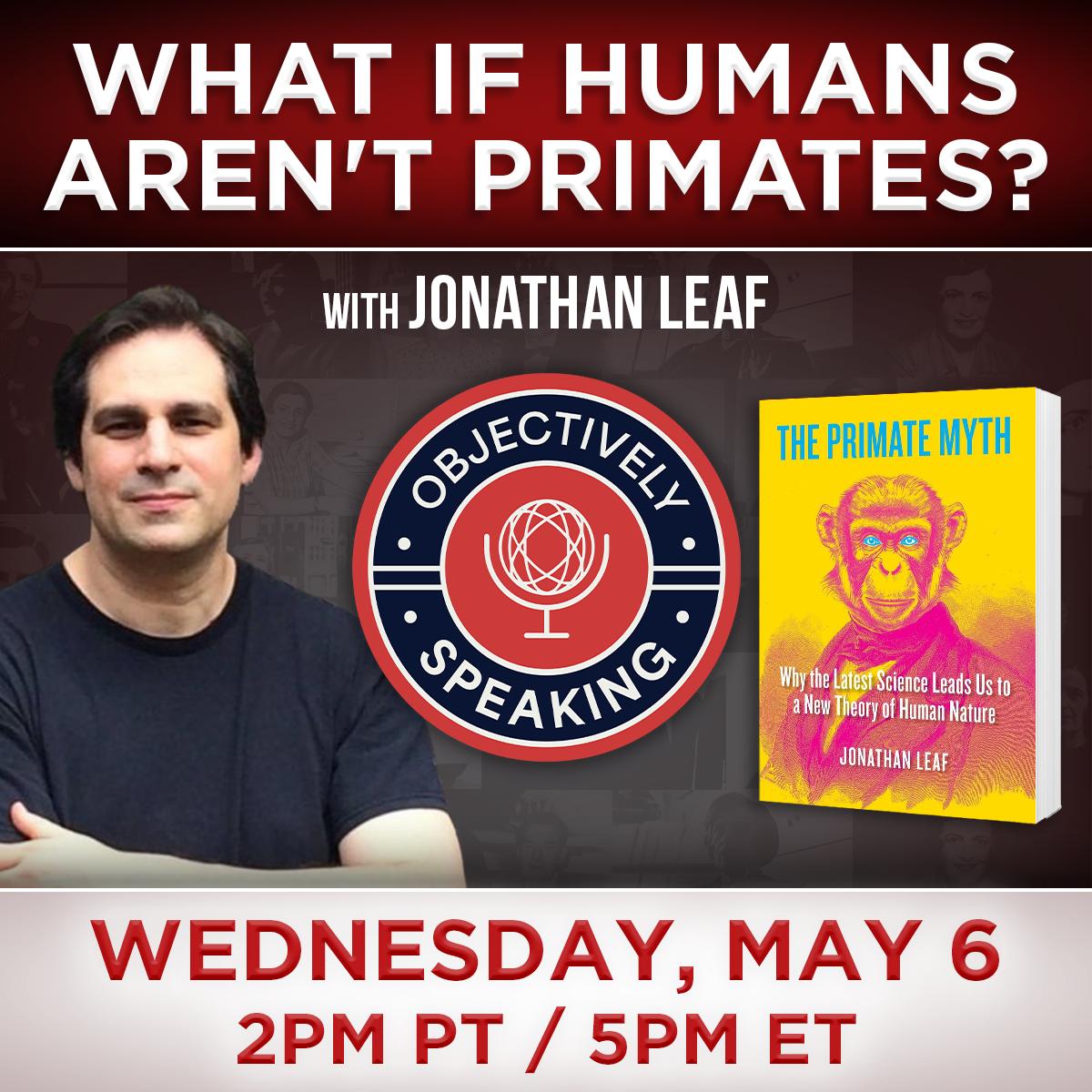
[00:00:00] Speaker A: Hi everyone and welcome to the 301st episode of objectively speaking. I'm Jag CEO of the Atlas Society. I am very excited to have journalist and playwright Jonathan Leaf join us to talk about his book the Primate why the Latest Science Leads Us to A New Theory of Human Nature. Jonathan, thank you so much for joining us.
[00:00:26] Speaker B: Thank you so much for having me on. It's both a pleasure and an honor. I'm very grateful.
[00:00:33] Speaker A: Before diving into your book, I was struck by the diversity of territory covered in your plays. The Russian poet, Pushkin, the sex researchers, Masters and Johnson of course. Marx. As we were talking about, is there a through line in the historical figures you're drawn to or. Or do you just follow your curiosity wherever it leads?
[00:00:55] Speaker B: I think the latter. Yeah. I just like it. I like a good story and hopefully one that other people are going to be interested in too.
And I guess that's right.
[00:01:05] Speaker A: It tells a little bit about your play about Marx, which I understand is now going to be headed back to the theaters in maybe a year or so.
[00:01:16] Speaker B: Yeah, that's the plan. So yeah, it's.
The play is loosely based on real events. I don't know if people know this, but Marx was distantly related to a famous German poet named Heinrich Heine, who when he was a young man was probably the most famous living German writer. And they both were basically there was no Germany in those days, but they were, there was a German speaking lands that were politically quite conservative and they were both very politically radical and they were thrown out of Germany and they wound up in Paris and they became quite close. Though they were very distant relatives, they were like third or fourth cousins. And the play is about how Heine got to know Marx and gradually came to realize that he was a terrible person and actually predicted, long before, you know, the middle of the 19th century predicted that followers of Marx would eventually take power possibly in Russia, and that they would kill an enormous number of people. And the play is.
It doesn't sound this way from the way I'm describing it, but it's, it's a, it's a comedy.
A lot of farcical things happen in the play, some of which happen in real life.
And it, but it's about a gradual awareness of how sinister both Marx and a lot of people around him were and how this came to the understanding of, of this distant relative is this poet named Heiner Khanna.
[00:02:42] Speaker A: Well, I think that's fascinating. I think our audience would find it too. So I hope you will keep us posted so that we can publicize it when it's hitting the theater. So you grew up in Trenton, New Jersey, graduated Yale in history, and then spent years as a New York City public school teacher before becoming a playwright and a journalist, which, you know, takes a lot of courage. And in your case, fortunately, it's paid off. That's still quite the unusual trajectory. Did teaching change how you think about communicating complex ideas to a broader audience?
[00:03:20] Speaker B: I guess so, yeah, absolutely. I mean, you have to present a way that people understand. You have to try to engage them. Yeah.
[00:03:29] Speaker A: So the book's title is provocative, the Primate Myth. You're not disputing evolution itself, but you are arguing that we've been miscategorized in a way that's actually distorted how we understand ourselves, lay out the basic case for our audience.
[00:03:47] Speaker B: Yeah, that's exactly right. So we're presented by primatologists and anthropologists as primates, but we're literally not primates. The definition of a primate is someone with flat nails. I'm going to show, as we do, in fact, have flat males and someone with what are called prehensile feet. Those are feet that are basically a second set of hands and. And are used for climbing trees, which is where primates spend much of their lives.
And we don't have prehensile feet, obviously. We have feet that are made for walking.
And There are about 500 species of primates. Every single one meets the definitional requirements, except humans. And the reason we don't is, of course, we don't spend time in trees and our diet isn't based on tree leaves.
And in fact, in my lifetime, and I have a feeling you're a good deal younger than I am, Jennifer, in my lifetime, there were actually six families of primates. One was called.
One is composed of the tree shrews. And at some point people said, well, you know, tree shrews actually have claws, so they probably shouldn't be in this order, though they do live in trees and they do eat tree leaves. And they were removed and they were put into a separate order called Scandantia.
But humans remain in the primate order, but we don't act like primates. We're not even that close anatomically to primates. Of course, we're closer to. We are descended from apes and we're closer to apes than anatomically than other animals. We can see that. But in fact, computer tests. I didn't even talk about this in the book, but computer tests have shown that humans are actually more dissimilar from chimps than frogs. Are from toads. Those are separate orders of animals. But that's the least of the differences.
And they used to claim that 98.6% of our genome was the same as a chimp. Well, it turns out that's not true.
It's actually more like 13 and a half percent different, which makes sense because we split from a common ancestor with chimps about 300 to 500,000, not years, but generations ago. And, and we left trees. We don't live in trees, we don't eat tree leaves. We have for most of our prehistory had a meat based diet.
And that raises an interesting question. How did we even get meat in large quantities? How did we kill large animals when we don't have claws, we're not particularly fast, we're not particularly strong, we don't have noses like true carnivores have that allow us to sent out where game animals are. And yet humans actually killed to extinction. It seems pretty clear. Woolly mammoths, woolly mammoths are 50% bigger than any elephant that exists in the world today.
So you know, we're talking about enormous animals, animals that were £20,000.
So how did we kill these animals? You know, animals that are just a tiny fraction the size of them. And the answer is that we learn to worked together, we developed language and we learned to hunt in groups. And we did this with very, very simple tools. You know, the tools that we use, like pikes. You cannot kill an African elephant or Indian elephant today with a pike. In fact, you can't even do it with a handgun. You can't even do it with an ordinary rifle. You need a special gun called an elephant gun or a machine gun and maybe poison too.
So to do this we had to really learn to be a cooperative animal. And we had to learn to. And finally we also had to domesticate ourselves. We had to learn to, in order to work together, we had to become a tame animal. Well, primates don't have any of these characteristics in any large degree. There's no primate that is domesticated, there is no primate that uses language. In fact, they're not particularly good at learning language as we can talk about more.
And for the most part they're not very cooperative.
You know, for instance, I talk about in the book, there was a study done where they created a contraption by which a chimp could either pull a rope and get a meal for himself, or he could pull a rope and get a meal for himself and another chimp that he didn't know. And they found the Option of getting a meal for another chimp he didn't know had no influence on chimp behavior. They don't really care very much about other chimps. They don't work together particularly well.
They do a small amount of hunting. It's about 1 to 3% of their diet. The bigger the group, the less effective they are in terms of getting meat for each individual chimp.
They don't really work together very well. They're very unlike people, and they're extremely violent. We can talk about that more.
[00:08:25] Speaker A: So why not make them right?
And some of the instances of violence and cannibalism that you share in the book are kind of puts the lie to this kind of pastoral, pacific narrative that we've all been told.
The book opens with a story about Theophilus Painter, a zoologist who apparently looked at ambiguous pictures in a microscope, came to some inaccurate conclusions that went unchallenged for three decades. Who was he, and why did you choose to open the book with him?
[00:09:08] Speaker B: Well, I just thought it was an interesting story to try and get people engaged in the story of how we gradually come to learn about our own ancestry.
Painter is someone who's kind of been forgotten. The important scientists of the early 20th century never won the Nobel, but, you know, an argument could be made that he probably deserved it. He did a number of important things. One was he took the first pictures of human chromosomes, which he misinterpreted, as you mentioned. He thought that we had 48 chromosomes, and it took about 30 years for people to figure out that the images he had created, which were based on slides and then photographs and then his own renderings, were wrong, that we actually only have 46 chromosomes. He thought we had the same number of chromosomes as chimps and gorillas. Turns out we don't. It's one of the reasons why we can't mate with chimps and gorillas. We just have a really, really, really different genome, contrary to what was claimed over the last 20 or 30 years, Nature magazine, that came out in April of last year, which was done by 123 of the top geneticists in the world. And it clearly showed that our genome is very different than that of a chimp genome. But getting back to Painter, so after doing that, he did something really significant. He was the first person, along with a partner, to do tests of fruit fly chromosomes.
He and his partner showed how mutations move from one chromosome to another. So this is really fundamental stuff in biology.
And because of the enormous amount of attention that that research deservedly got, he was made the president of the University of Texas. And then he kind of intersected. It's also an interesting story.
He wound up being one of the crucial segregation and desegregation.
So he was sued as the president of Texas in a case called Sweatt vs. Painter, which went to the Supreme Court.
Sweatt, who wanted to attend the University of Texas Law School, was represented by Thurgood Marshall. And the Supreme Court said, you have to desegregate the University of Texas Law School. He fought that he was in favor of segregation. He was from the South.
When the court ordered him to desegregate, he did desegregate the University of Texas Law School. And that case is the case that led directly to Brown vs Board of Education, the end of legal segregation in the United States.
He played a very important role both in the development of modern genetics and modern science, but also, interestingly, in the whole history of desegregation in the United States. Though not on the side, maybe this is why he's kind of been written out of history. Not on the side that's regarded as enlightened.
[00:11:49] Speaker A: Right.
So everyone watching or listening has seen the famous illustration of man's evolution. I'm going to ask that we put that up. The classic March of Progress illustration. It's the iconic depiction of human evolution showing a sequence of figures transitioning from a knuckle walking ape on the left, through several intermediate hominid forms with progressively more upright posture to a fully erect modern human on the right. How did that image and the narrative it represents become so firmly entrenched? Is it a combination of scientific error and just the simple fact that humans look more like apes than, say, dolphins or horses?
[00:12:37] Speaker B: Yeah, it's a little bit latter. I mean, we do, again, our anatomy actually isn't that similar to chimps, but it's clearly more like chimps or gorillas than it is like, as you say, dolphins or horses or whales or elephants. On the other hand, there are basic metrics by which we can show that we're really not much like chimps. So, for instance, all primates sleep a great deal. They all sleep upwards of 10 hours a day. Humans sleep very little. We tend to sleep about seven hours a day, which is closer to the characteristic of a herd animal. All primates have explosive strength. They're wild animals. They're incredibly strong. They can rip your arm out of its socket, they can pull your nose off, et cetera. And they do these things.
Humans have great endurance, like herd animals. We have among the greatest endurance of any animal but we have very little explosive strength. We're not wild animals.
There are other examples of this. We also have a different type of digestive system.
We have a different shaped heart. They have, like, a round heart. As we all know, our heart is.
Is heart shaped.
So there. Our brains are much, much bigger. If you, if you look at animals that have large brains relative to body size, what's called encephalization quotient, you would never bother looking at chimps and gorillas as models for humans.
You would look at animals like whales, dolphins, elephants, animals that also are very good at communicating, that are tame, that are cooperative again, that have many of these characteristics that are essential to our rise as a species and our ability to create so many things that modern life, Modern life we depend upon.
[00:14:11] Speaker A: All right, well, I'm going to dive into a few of these audience questions before we get too far ahead of ourselves. And they're asking about something we talked about 30 minutes ago. Well, first of all, lovely Candace Morena says, interesting book. I only just started it, so I have a fun journey ahead. Yes, indeed you do, and so do the rest of you if you pick it up. And I also can highly recommend the audio version. Alan says, always fun to find new ways to talk about these topics and historical figures. Too much glorification of Marx today. Indeed.
Ilia Shin asks, when people study animal behavior, particularly primate behavior, how much is human political or social ideas being projected onto the behavior we observe?
[00:14:59] Speaker B: Oh, I think an enormous amount. And I think insofar as the book has importance, real importance, that's. That is the reason to read the book.
One of the many questions the book examines is, why do people get into wars? Why do we have wars? And primatologists have been consistently promoting the idea that we have wars because this is what primates do. They're very violent. They're very aggressive. Well, I point out in the book there is no case. It's never happened.
It has never happened that a democracy in which women vote has ever gone to war with any other such country.
And we noticed something about wars.
All the animals that we use in wars are domesticated animals. We use horses, we use dogs, we use dolphins, we use elephants, we use camels, we use pigeons.
And we also notice that the animal that is the most warlike, that has the most wars is the ant in the most brutal wars. And ants are obviously very obedient animals. So we need to think of war not as an outgrowth of human aggression. And by the way, the examples that primatologists have given of War, we could talk about this at great length among chimps are really poor examples. They really don't stand up to serious critical investigation. There are really more indications of just how violent they are and that they do form into troops, but the kind of organized slaughter that you see in human conflicts, they're reflections of our obedience. And if you think of humans less as a primate and more as a herd animal, which can be manipulated by psychopathic leaders or who can be manipulated by psychopathic leaders, then you get a much better sense why wars take place. A gigantic problem.
And also why totalitarian regimes, whether we're talking about communist or Nazi, fascist or Islamist, why these regimes are so profoundly dangerous. They're really good at getting young men to put on uniforms, to train with bayonets or rocket propelled grenades, whatever it is, and go out and kill people.
And this is a profound problem that we are naturally a very obedient species. I know a lot of what Objectivism is about is teaching people not to be herd animals.
And I don't profess to be an expert on Objectivism, but I think that that is something that's just critically important. And it's one of the profound problems with our species that we are naturally very obedient. We're intellectually passive, we can take up crazy ideas, Marxism being a classic example, based on the fact that other people believe them or based on propaganda. It's an enormous problem.
[00:17:36] Speaker A: Yes, well, you know, of course we were talking about Peter Thiel earlier and he's in addition to being an admirer of Ayn Rand and Objectivism, he's an admirer.
And this whole idea of mimeticism and how we have this tendency to just kind of pick up what we see others doing. What Ayn Rand might call being a second hander and why it is so important to engage young people with the ideas of objectivity, of reason, of individualism versus the collective collectivism, and also just integrity, making sure that, you know, your values are matching your, your actions. Okay, another interesting question here from Alan Turner. Now you guys are making my job way too easy. Although I do have many questions of my own.
Alan asks, what are your thoughts on orangutans? I remember from Darwin's writings that he originally viewed them as more similar to humans than chimps.
[00:18:34] Speaker B: Yeah, I think in some ways that's true.
They're much less violent. In fact, I mentioned the book. I talk about how we've been influenced by examples from popular culture of the idea that humans are like chimps. So the planet of the Apes movies and other examples. But I also say that one of the rare instances of a story that was popular that isn't completely implausible, that involves primates, is the Clint Eastwood movie Every which Way But Loose. You know, he has this orangutan that he goes and drives around. That's not totally implausible. They're not that violent, they're not that dangerous. Could you have a pet orangutan? They're not domesticated animals. I wouldn't recommend it. But it's not totally implausible. Yeah, in some ways, they probably are a lot more like us than chimps.
[00:19:18] Speaker A: So when we talk about this primate model, this theory, what have been some of the negative consequences of believing modern humans are the direct descendants of the primate, primitive primates?
[00:19:31] Speaker B: Well, so one, as I just mentioned, is this. These wrong ideas about war, but it applies to many different things.
So here's another one.
You know, chimps are extremely promiscuous, as are bonobos. They're, you could argue it's a subspecies of chimp, pantraiglete chimp, or you could argue it's, it's a separate species, panpiniscus.
Both are super, super promiscuous. They never know paternity.
And so some people have argued, oh, you know, people can be like that.
So, for instance, there's a popular book called Sex at Dawn, which argues people can engage in polyamory based on this model. But actually, people are not naturally polyamorous. We're relatively, relatively, I want to use that qualifier, monogamous. And we know this, going back about 300,000 years, humans have had a fairly small difference in physical size between men and women, what's called sexual dimorphism. And that's an indication that we're naturally pretty monogamous species. And it turns out that if you look at genetic tests that have been done in recent years all over the world, that humans have the lowest rate of false paternity, sometimes also called extra par fertilization. We have the lowest rate of false paternity of any mammal species ever studied.
Primatologists had promoted, in some cases, they promoted the idea that we were capable of polyamory. In other cases, they'd focused on why people cheat. But what's really interesting and what's really significant is that we have these incredibly low rates, usually like 2%, maybe at most 3% of false paternity. And that gets into the whole question, why are we so actually naturally monogamous?
Also important to point out we have natural experiments in the Consequences of non monogamous societies. One of the ones I point out in the book is there are two types of Mormons in the world.
Most of us know Mormons who knock on our door and they're very polite, conscientious, industrious people who are members of the Latter Day Church of Jesus Christ of Latter Day Saints. There's also a small offshoot sect, they call themselves traditional Mormons and they practice polygamy. And there are only maybe 50,000 tops in the world.
And their society is totally messed up. All the things that we associate, all these good qualities that we associate with Mormons, they display none of them.
They're not educated.
They have very high rates of criminal conviction, incest, violence, all sorts of criminality, low levels of income.
And that's a function of the fact that they don't have a monogamous society.
So all sorts of problems crop up.
[00:22:13] Speaker A: Not good. Not good.
I was curious, to what extent does the primate model still hold academic and institutional sway? Is it, Is there an active debate? Is there just a kind of consensus on one side or the other?
[00:22:32] Speaker B: It's overwhelming. I mean, if you look at an anthropology textbook, the parts that deal with primatology, they're very strongly based on the idea that humans can be understood as a primate species, as a characteristic primate species.
The books that have indicated that we are like primates, books like Franz de Waal's Chimpanzee Politics, to some extent, to some extent, Jane Goodall and I have a lot of admiration for Jane Goodall. It's a complicated subject, but Jane Goodall's books, Robert Wright book the Moral Animal, they're really based on the idea that we can look at chimps and to a lesser extent, gorillas, and we can get some sense of how humans naturally are. But the problem is we can't. And it really gets back to those three things I mentioned before. The fact that we're domesticated, we use language and we're highly cooperative. These are just not traits that you see in primates. So trying to understand primates and then use that as a means to understand people, it doesn't really work.
[00:23:36] Speaker A: Right.
[00:23:37] Speaker B: Let me just mention one thing in particular.
One of the most interesting questions about humans is that when we're born, we don't know how to walk. We're what's called neonates, and we have very big brains, much bigger than any primate.
So it raises a question, with our big brains, which control our capacity for voluntary movement, why can't we walk? Why can't we walk for an entire year after we're born, typically.
And it seems that most of. And our brain is developing very rapidly during that period.
And it seems that most of what our brain is, is it's learning to listen to speech and to begin to speak that we're mastering language. This is so integral to what it is to be a human, and it's just not something that we see in primates. And in fact, as you may know, dogs can learn many, many, many more words than chimps can.
I don't have as big brains relatively, or in absolute terms as chimps, but they are language oriented, they've evolved alongside us and they're language oriented and they're cooperative and they're tame and they have these qualities that we have. Chimps don't.
Your voice track.
Can you hear me?
[00:25:06] Speaker A: Oh, there we go. Sorry about that, I muted myself.
So I was wondering about, you know, you mentioned this experiment with the chimps pulling one lever or another to get food for themselves or food for themselves and a fellow.
So the. This idea of empathy and trying to project that onto primates doesn't work. What about human empathy relative to some other species that you looked at?
[00:25:32] Speaker B: Well, many mammal species, there are parts of the brain that are associated with empathy. There are quite a few.
One is the amygdala, which there are two on each side of the brain. Another is a region called the supramarginal gyrus. There's also a region called the anterior marginal gyrus.
There are several regions in the brain that we know play a role in our capacity for empathy. And they've even found in the case of the anterior marginal gyrus, that the bigger it is, generally speaking, the more empathetic people are. And this is true in many mammals, strangely.
And they've also found. There was a study done with rats, and rats could be pretty empathetic towards other rats. Not towards people, but towards rats.
They did a study with rats where they put them in adjoining cages and a rat could press a lever and get sugar, which they like, or a rat could not do that. And they started when the rat would ask for. When a rat would do this, they would actually strike a rat next to them.
They found many rats stopped asking for the sugar, then they detached the anterior cingulate gyrus in their brain.
They stopped caring about what happened to the other rat. Now, here's the strange thing. This is true in a variety of mammal species, that these parts of the brain are associated with empathy. But it turns out with chimps, the bigger the anterior cingulate gyrus is the more domineering or potentially violent they are. It seems to function differently in chimps specifically than it does in humans and rats and many other mammals. They're not really. Their brain basically wasn't designed for empathy. It also has much different ratios of certain types of neurotransmitters that are associated with tameness. Maybe not surprising.
It also turns out that female chimps who are extremely violent, as well as male chimps, have incredibly high testosterone levels, which you don't see in human females.
A lot of the book deals with both neuroscience and biochemistry, and the neuroscience and the biochemistry seem to suggest these animals are very different.
[00:27:46] Speaker A: So let's talk a little bit about preferential homosexuality. I thought this was a fascinating section of the book. And you describe it as distinctively human behavior, something that the primate model simply can't account for. What is the evolutionary argument? What does it tell us about the nature or nurture theories of homosexuality?
[00:28:09] Speaker B: Well, that part of the book is very speculative and I freely acknowledge that. And I think some of the critics who gave the book's gotten, by the way, shamelessly say the book's gotten amazing reviews. I just saw one that came out on Friday that ended by saying something or no, it was actually. Yeah, I guess it was Friday that said Leaf has done a service to humanity. I mean, it's gotten phenomenal reviews. There was a review in New English Review that said this book should be read in schools all over the world. So the review's been great. But people have criticized some of the things I said in the book about possible reasons for preferential homosexuality.
So it seems to be that not everybody's persuaded by what I had to say.
[00:28:46] Speaker A: Well, let's hear it.
[00:28:49] Speaker B: Yeah. One thing that I suggested was, and there are other species that display preferential homosexuality. We know of it, for instance, in sheep, Interestingly, another example of how some traits that we see in humans we also see in herd animals, but not primates. So primates, in some cases, they're pansexual, like chimps, but they don't display preferential homosexuality, which by the way, is like suicide. And that's another subject the book delves into are things that conflict with traditional Darwinian explanations of human evolution or evolution in general. After all, you don't advance your causes of survival by killing yourself. You don't advance your cause of survival by mating with your own sex. So the question is, why do these things appear? Well, one thing that I proposed, which may be some evidence, and again, some People said, you know, you're going a little far. Field here is it may be related to this issue that language is so critical to our survival. We know that male homosexuality, preferential homosexuality, is more common than female preferential homosexuality.
We also know that males who have Asperger's spectrum, Asperger's, autism spectrum disorders where they have trouble with language, but they're very good at mathematical problems and certain types of logical thinking.
This is a very male thing.
And when we think about male homosexuals, sometimes we think about kind of effeminate traits, but we also think often of people who are very good with language, let's say Oscar Wilde. So it may be that, you know, our need to be good at language. It's associated with developments of parts of the brain that are more associated with women than with men. And some men. Where this pops up, it may be because, you know, the brain has been designed to be really good at language. That's. That's what I, I threw forward, put forward as a possible explanation, but we don't really know, but we don't decide. And a number of other things I talk about in the book, like joining cults. These are things that conflict with traditional Darwinian explanations of human evolution or evolution in general.
[00:30:59] Speaker A: All right, another question from Lock, Stock, Barrel. What about dolphins? He says, I've heard they are pretty intelligent, but also that they can be violent as well.
[00:31:10] Speaker B: Yeah, absolutely. I mean, their mating patterns are pretty violent, but they're most, for the most part, they're actually even more tame and even more tractable than humans.
Some people who are listening, what are they called? Dolphinaries, where you can go and you just go into the water and you hang out with the dolphin and they do tricks for you. It's amazing how tame these are animals are many times, many times their size. They could obviously beat us up anytime they wanted, but in general, they tend to be pretty tame.
And yeah, they have very big brains and they're highly intelligent and they use language. We don't really know about how they use language. We also have evidence based on machine learning that elephants seem to use language. And we know that both dolphins and parrots actually name their children.
In the case of dolphins, bottlenose dolphins, Atlantic bottlenose dolphins, because the society is matriarchal, the name is based on the mother's name rather than the father's name.
[00:32:10] Speaker A: So before you mentioned. Jane Goodall said that you admired her work, Having done all of the research and written this book, how do you think overall about her legacy? What aspects do you think she got right and where maybe did she go astray?
[00:32:27] Speaker B: Well, the thing she did and she and her associates that are amazing. I mean, in her case, she did something that nobody else has ever done and they won't allow people to do anymore, which is she actually fed chimps from her own hand. I'm not talking about reaching into a cage. I mean, she actually went out in these chimp communities in Gombe and. And she actually fed them from her own hand. That's amazing. She was able to create such a rapport with the animals that she could do it with some reasonable degree of safety. And just to give an indication how violent they are, studies have found that the average chimp researcher, for the most part, they observe them with binoculars because they're so dangerous.
In three years you will see a corpse of one chimp killed by another chimp. And in eight years of field research, you will actually see a chimp kill another chimp. So they're super violent, they're very dangerous.
You know, they bite people's fingers off and they, you know, they rip our ears off and they do all sorts of dangerous. And they. And they also engage in filial cannibalism, that is, they will eat babies, chimp babies, including even sometimes chimp babies from their own troop or even their own chimp babies.
And it was Goodall's research that really revealed all of this.
But she's. I would compare a little bit to Christopher Columbus. You know, Columbus has become this enormously unpopular person now in intellectual realms, but he changed our world. He was a brave, highly intelligent and daring guy who really changed our world. And I think there's a little bit of that with Jane Goodall. What they have in common is that it's not clear at the end of his life that he fully understood that, no, he hadn't gone to India, he'd gone to the Caribbean.
And Goodall reported on all these things like filial cannibalism.
But it's not clear that she really appreciated. There are comments in her books, like in the Shadow of man, where she says, the longer I work, the important thing is the differences from humans. But then there are other comments where she seems to think, no, you know, there's a continuum. And I think if you actually look at the evidence she presented, it's pretty clear there's not much of one.
[00:34:30] Speaker A: Right.
So of all the reasons that primatologists cling to the primate model and insisting that it must be our guide in understanding human nature, one stood out.
It's that at some point you write all chimp researchers have had a relationship with a baby chimp. Can you unpack that for us?
[00:34:52] Speaker B: Yeah. In fact, if you see pictures of. Franz de Wal was one of the people who's probably most important in promoting the idea that humans are like chimps. There are plenty of pictures of them with baby chimps. And baby chimps are adorable and they're not super violent. And you know, we all know about, for instance, Michael Jackson and bubbles, or many of us know about he had this baby chimpanzee, but they had to give up bubbles as they have to give up almost all Nam, chimpsky, all these chimps, when they get to five famous chimps and they get to five, six, seven, eight, and they start to go through puberty, they get super strong, they get super violent and you can't live with them anymore. And people who tried to live with chimps, you know, the stories are horrific about what happened.
You know, people getting their noses ripped off, you know, children being beaten half to death, people getting their faces pulled off, you know, et cetera.
[00:35:38] Speaker A: You touched earlier on suicide and the prevalence of human suicide and compared to other animals, how does that challenge both the primate model and what do we know about other species?
[00:35:52] Speaker B: Well, primates have never. Primates don't commit suicide. There's no documented case ever of a.
None. There is no documented case ever of a primate committing suicide.
But in human society, it's a gigantic problem. Worldwide, most countries, there are many more suicides than murders.
And this is puzzling. So, you know, why do people commit suicides? Why do people join cults and kill themselves for the cult, you know, like Jonestown or the Haley Bopp or, you know, going back in time, we can, we can mention many others. Why do people, you know, do what kamikazes did or Roman soldiers falling on their swords?
And it gets back to if you think of our species as something of a herd animal or pack animal starts to make some sense, it doesn't make sense from traditional Darwinian thinking. And I'm not rejecting Darwin by any means, but if you think of humans as an animal that's very obedient, that's very tractable, that wants to be accepted, that gets its identity from being part of the group, that wants to please leaders of a group. This is most humans, this is most of us. I include myself, then you begin to understand these problems. And suicide is usually a problem. Either of there's altruistic suicide where you offer to kill yourself for others, which is fairly rare. In Western society.
And then there are types of suicide where you're embarrassed, you're ashamed, you feel you've lost your place or status or position.
And these things are so big with humans that we will actually kill ourselves. I mean, what I'm saying is fundamental to what it is to be a human being.
And one example of this is, a notorious example, is that when people are arrested for minor offenses, they will often, in the first 24 hours after their arrest and imprisonment, they will kill themselves. They'll get a bedsheet. You have to be very careful when you take people in.
But it's ridiculous. You were arrested for a traffic offense, you were drunk driving. Why would you kill yourself? But people are so preoccupied with shame.
And it can be overwhelming to a person who is feeling these emotions. And so we will actually kill ourselves. And this is a huge problem. It's a lot. Again, it's very fundamental to what it is to be human, Totally unlike what a primate goes through.
[00:38:03] Speaker A: What about other species? You have a section in the book about whales that beach themselves. I'd always thought that was an accident, but apparently not.
[00:38:13] Speaker B: No, they do it both individually and collectively, and they've been doing it for hundreds of years. They're highly intelligent animals. They're not doing this by accident.
They will follow a leader and they will actually be trustrand themselves or they'll do it individually. So it seems to have a lot of characteristics that are common, too. And dolphins as well. It seems to have a lot of characteristics in common with what we know about human suicide. And in some ways it's even worse because it's more often collective.
[00:38:40] Speaker A: One of the things that surprised me in your book was that on several occasions, human beings nearly went extinct. Extinct. I guess I missed that in my courses on human history. So first, how do we know that? And what were the cases of the near extinction events?
[00:38:59] Speaker B: Yeah, they call them bottlenecks. And probably the most prominent one, they think took place about 70,000 years ago. So genetic tests indicate that about 70,000 years ago we got down to about a thousand humans, maybe even a hundred, and barely survived.
And probably the reason we survived, and interesting things about the idea that we should have different order, a separate order for humans, is that fairly recently in genetic history, which, say, going back or less, Even less than 100,000 years ago, there were actually four hominid subspecies. There were humans, Homo sapiens. There were Neanderthals, There were Denisovans who lived in East Asia. And then there was another hominid species called Homo florensis which lived in Indonesia. They were called the Hobbit man and the other three disappeared, so they didn't make it through the bottleneck.
And it may be that if all four still existed, and by the way, all four could interbreed and people of European descent have small amounts of Neanderthal ancestry. People of Asian descent had small amounts of Denisovan ancestry.
It's possible that, you know, people would be more receptive to this idea that we really need a separate order because we're so unlike primates as again in our, you know, many, many cases, our basic behavior and morphology.
But you know, why did we.
My, my belief is that it was when we invented language because that seems to reasons to think that's when language first appeared, that's when a lot of art first appeared.
That was our invention of language that allowed us to survive.
[00:40:39] Speaker A: Did the invention of art and the invention of language change how we looked, how we viewed ourselves?
[00:40:49] Speaker B: Yeah, there were dramatic changes in our physiology.
Our teeth have been getting smaller. This has been happening for at least 30,000 years.
One of the odd things about primates, for instance, chimps and gorillas, is they have enormous canines but they, in the case of chimps, they eat very little meat and the case. And they won't eat scavenger meat, they won't eat carrion at all. And gorillas eat absolutely no meat. So why do they have these enormous teeth? Well, they're for fighting, they're actually for fighting and they're for what's called display value. They're for, you know, threatening other chimps and gorillas. We have small teeth, we're a domesticated animal. The irony is that we do eat a lot of meat. It's in fact in preheat 50% of our diet or more.
More than for instance, bobcat and lynx eat many times more than a bear eats.
So it was really the base of our diet.
We've had changes in our teeth, we've had changes in our brow ridges. We've all seen pictures of these Neanderthals with the big brow ridges. The big brow ridges are associated with high testosterone. So that's an indication that our testosterone levels have been falling, which male and female, which makes sense given that we're increasingly less violent.
So yeah, there are a whole bunch of different changes. And also in the last 10,000 years, since the invention of agriculture, people got somewhat smaller actually.
[00:42:09] Speaker A: So if the primate myth has been driving bad policy, bad psychology and bad self understanding, what are some of the things that change if we accept Your correction.
[00:42:22] Speaker B: Well, I hope we'll have a better attitude towards things like some of the things we mentioned, like suicide, war, marriage. You know, these things are really essential. You know, I got married late in life, and I was very fortunate. I married a wonderful woman.
But, you know, your life, if you. If you marry a good person, your life is probably going to be happier. Of course, if you marry a bad person, it might be considerably worse. I think there's actually research to that effect.
But it does seem to be important in terms of the rearing of children, which as Jennifer, you and I were jag. As you and I were talking about before the show, my wife and I don't have. But it plays an important role in the rearing of children. So that's really fundamental, understanding the cause of war and not blame. One of the things that's really terrible that's happened in recent years is that people living in the west have blamed Western democracies for wars. There are a lot of people right now are blaming our conflict with Iran on the United States, but Iran has been attacking us for 47 years. They have a national holiday, November 4, where they celebrate their taking of American hostages and they call for the destruction of America and Israel.
And they have been engaged in assassinations all over the world and terrorist acts in Argentina, assassination attempts in Japan, Norway. It's a long list.
They've been at war with us, and we can't blame ourselves for the fact that we've recently been fighting with them. And this is just one example of many. You know, you can talk about Ukraine and Russia. It's a long list. Don't blame the democracies for war.
Democracies are not the ones who are starting the war. Democracy, certainly, in which women vote are not the ones who are starting the wars. We may be responding to avert threats and violence, but we're not starting the wars.
[00:44:17] Speaker A: So one of my past podcast guests shared some advice he had received from Charles Murray, who said, if you set out to write a serious book and it doesn't change your mind on at least half a dozen issues, you've done it wrong. So were there things that surprised you or ways that you changed your mind over the course of researching and writing this book? Important book.
[00:44:44] Speaker B: Yeah, absolutely. Thank you for saying it's an important book.
Yeah, tremendously. I mean, I mentioned the book, the immediate genesis.
My parents were psychologists and they. And they worked in the field, and I grew up learning about neuroscience.
So I had some familiarity with some of the issues in the book before I Started work on it. But the immediate prompt for the book was I was with a friend and.
And he was with his dog. He's a great lover of dogs, German shepherds in particular.
And he was with his dog. And he leaned over and very, very quietly whispered to me that he was going to Pennsylvania to visit his wife and daughter in his car. And I asked him later, why did you do that? And he said, well, the dog gets very upset. He knows the word car. And he gets very upset when he hears the word car because he knows I'm going to be leaving for a few days.
He lives here in New York.
And that really got me to thinking, because you could never have that kind of experience with a chimp. First off, they wouldn't know the word car. They might know some basic words, but they would not know the word car. They wouldn't have that kind. They do get upset if they don't have companionship, but they wouldn't get really upset that you were going away for two or three days.
And that got me thinking about some of these subjects. But war is an example of something I didn't think about at all until I started writing it, writing the book, you know, and I didn't have highly developed thoughts about suicide or cults, you know, really, you know, why do humans. You know, we know now that human sacrifice took place in every inhabited continent during early history and prehistory.
And the list of civilizations in which it was found is extraordinary.
And, you know, for instance, the Philistines, for many years, the Phoenicians, for many years, it was believed that it was just a myth, though it's in the Bible. And the Greeks and the Romans all said the Phoenicians, the Philistines, that they killed babies, their own babies.
But now we've actually found hundreds of tiny little skulls in places like Sicily, places that they lived.
And that gets you thinking, what is this about? I didn't even begin thinking about it until I started working on the book.
[00:47:00] Speaker A: So we've covered a lot of territory, and perhaps we've covered all of it, but maybe not. So I just wanted to give the next few minutes, as we're wrapping up, back to you. If there are any aspects that you feel it's important for our audience to consider.
[00:47:17] Speaker B: Well, I'd love for people to buy the book, and I'm very grateful to you for having me on. But I would mention something that I think is relevant to fans of the Atlas Society and of you, which is, you know, you and I, before we got on the air were talking about capitalism.
In the book I just, I mentioned Milton Friedman's observation that no one on earth knows how to make a pencil.
It's only through collective action that we can construct a pencil. Well, in the book I didn't refer to Milton Friedman because I know people.
He's a polarizing figure.
But what he was saying is really true. You know, we depend on cooperation to an unbelievable extent. I mean, a pencil is a very simple example. But you think about a cell phone or this conversation that we're having, which is, you know, using global positioning satellites and this very advanced communication technology and computers. No one could possibly ever design a computer on their own. It's just beyond belief that it can actually happen. It's all these people working together. And that depends upon capitalism and also depends on a money system.
Chris Barter. You could never do this with Barter.
In a way, the book is saying there are important and distinctive things about humans that we need to recognize. But it's also saying these important things are very much connected to our capacity for cooperation and our capacity for capitalist
[00:48:44] Speaker A: interaction and our capacity for reason and rationality and our ability to pursue our enlightened rational, long term self interest. And so again, this has just been magnificent. Jonathan, where can we follow you? What's next for you? What, what can we do other than go out there and buy the book, which I believe a few of the people in our audience have already done.
[00:49:11] Speaker B: Yeah, I have a substack. I have Twitter, you know, you can find plays I've written and books I've written.
[00:49:16] Speaker A: Well, thank you, Jonathan. And thanks to all of you for joining us today.
Be sure to join us next week for the second in our series of tort reform webinars where I sit down with Manhattan Institute senior fellow Jim Copeland to talk about his book the how an Unaccountable Elite Is Governing America. We'll see you then.