Episode Transcript
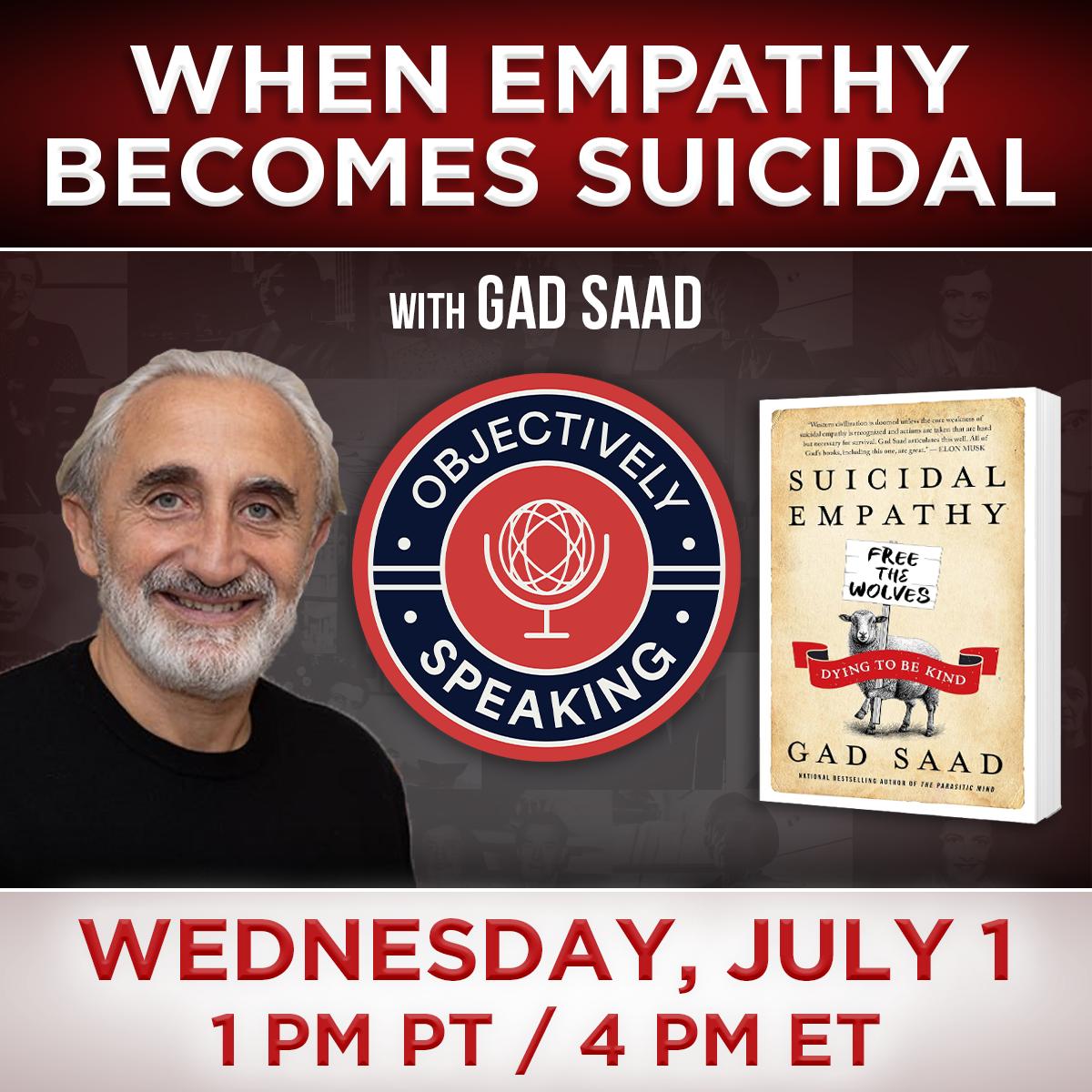
[00:00:01] Speaker A: Welcome to the 309th episode of objectively speaking. I'm Jag, CEO of the Atlas Society. I'm very excited to have returning guest Professor Gad Saad join us to talk about his fabulous new book, Suicidal Empathy. Dying to Be Kind.
Gad, thanks for joining us.
[00:00:26] Speaker B: So good to be with you again, Jack.
[00:00:28] Speaker A: And of course, thank you for also joining us at Galt's Gulch in San Diego. The students gave very high marks to that discussion.
For those who have been living under a rock, you may not.
You might need another refresher. Dr. Saad is a professor and an evolutionary behavioral scientist. He previously joined us on Objectively Speaking to discuss his last book, the Parasitic How Infectious Ideas Are Killing Common Sense.
So God, Is suicidal empathy one of those infectious ideas or is it an evolutionary impulse that's gone haywire?
[00:01:11] Speaker B: That's a great question. So it's the parasitic ideas that eventually lead to the proclivity for suicidal empathy. That's why I'm so glad that in the introduction you, you referenced both the parasitic mind and suicidal empathy because they're really collectively part of a singular narrative. We are both a thinking and a feeling animal. In order for someone to hijack your capacity to reason, they have to hijack both your cognitive system and your affective system. The parasitic mind described what happens to your cognitive system when it is parasitized.
And then I complete the story by explaining what happens once you're affective. Your emotional system is parasitized. And let me give you a concrete example of how it's a one, two punch. Take for example the parasitic idea of cultural relativism. Cultural relativism basically purports that you're in no position to judge the cultural values and the cultural beliefs of another culture. That would be imperialism. It would be racist for you to do so. If another culture wants to cut off the Clitoris As a 5 year old girls, it's not for you to say that it's not a good thing. Well, if I internalize the parasitic idea of cultural relativism, it then renders me incapable of saying that we may not want to allow people who share those values as part of our immigration policy. So cultural relativism and results in the suicidally empathetic position of open borders.
[00:02:47] Speaker A: So for those encountering this idea for the first time, how do you distinguish healthy empathy from the pathological version? Where does the line get crossed?
[00:02:59] Speaker B: It's really great that you asked that question because most of the completely erroneous criticisms of my framework and my book stem from the following false accusation that I am arguing that empathy is bad and I'm doing no such thing. Right? As an evolutionary behavioral scientist, I fully recognize that as a social species it makes perfect rational sense that we've evolved the capacity to empathize. For you and I to have a meaningful conversation, I need to put myself in your mind and vice versa. That's called cognitive empathy or theory of mind. We want our physicians, our veterinarians, our therapists, our spouses, our best friends to be empathetic. So within well calibrated regions, empathy is wonderful. But like most things in life, the problem arises when there is too little or too much of something. This is exactly what Aristotle referred to in his Nicomachean Ethics when he talked about the golden mean, right? If a soldier, excuse me, if a soldier is cowardly, exhibits no courage, that's not a good thing. If he exhibits so much courage that he becomes bold and reckless in his risk taking, well, he's going to quickly die. There is some optimal level of courage somewhere between those two extremes. That's exactly how I define the difference between rational empathy and suicidal empathy. Suicidal empathy is when empathy is hyperactive, it misfires. It's is invoked in the wrong situations, towards the wrong targets. Put all those together, you end up with the suicidal manifestation of an otherwise adaptive mechanism.
[00:04:46] Speaker A: So throughout the book I got the feeling that the way you were using the word altruism was different from the way objectivists might understand it. I wanted to check at the outset of this conversation whether it was a difference of small semantics or a deeper one.
You seem to be using altruism interchangeably with benevolence, kindness, generosity. And perhaps most of your readers would understand it. But Auguste Comte, the French philosopher who coined the word altruism in the 19th century, meant something more radical, that the fundamental moral duty was to live for others. He insisted that self interest always be subordinated to the needs of others, to to the needs of society. Personal desires, ambitions or happiness were only morally acceptable when they serve the greater social whole. Do you see altruism as equivalent to benevolence, which at least open objectivists would see as a self interested value and virtue. Or do you see it as a rejection of self interest?
[00:05:54] Speaker B: More fundamentally, being altruistic could itself be a manifestation of self interest. So they don't need to be pitted against each other. If you understand the term altruism from an evolutionary perspective. And so let me explain that at a more granular level. Take for example the mechanism of mutualism. Mutualism is when two animals will engage in a dyadic relationship that might seem altruistic, but in reality it serves the interest of both in a, quote, selfish manner. So take for example, cleaner fish. So these are fish that have evolved the capacity to go into the mouths.
They're sort of underwater dentists. So this ominous looking fish that has this sort of jaws of death will open its mouth at a particular station and. And this smaller fish will go into the mouth of this larger predatory fish. At first you would think, my goodness, he's committing suicide. But they've evolved this mutualistic relationship because the larger fish needs that smaller fish to go in and clean out morsels and clean out parasites. So therefore, what might seem as though it is behaving altruistically in one definition of that word, it's actually in its own selfish interest. Now, let's apply to the human context.
Evolutionary psychologists argue that there are two types of altruism that have evolved that are perfectly consistent with a quote, selfish perspective. If I jump into a river to save three of my biological children, each of those children share on average half their genes with me. So if in the service of jumping into the river and saving them, I end up dying, but I save three children, that would make permission perfect evolutionary sense if we understand that evolution operates at the gene level. But why would I ever jump into the river to save a friend who is not biologically related to me? Well, here we talk about what's called tit for tat, right? We've evolved reciprocal altruism whereby under certain condition, it would make sense for me to jump into the river to save Jag, even though she's not biologically related to me, under the understanding that in the future there might be an opportunity for you to reciprocate and kind. So I use the term altruism in this very specific evolutionary sense.
[00:08:30] Speaker A: That's a really fascinating perspective.
So going back to our conference, where again you were hit at Gulch Gulch, Our chairman, Jay Ler, talked about the belief in human agency as a potentially unifying principle for those seeking a return to civic discourse and mutual respect.
What is the relationship between the belief in human agency, the idea that we can act to change our circumstances, and that we bear a responsibility for our actions? How does that relate to one's relative vulnerability to suicidal empathy?
[00:09:11] Speaker B: Yeah, great question, by the way. I had the chance to interact with Jay both at the conference and subsequently. He sent me a lovely email. And so we're trying to formalize our relationship Since I'm going to Ole Miss at the Declaration of Independence Center. So there are some real natural allyship that we can develop there. So. So thank you for allowing me to meet this wonderful guy. But in any case, human agency is actually contrary to many of the suicidally empathetic positions that I cover in the book. So take for example, what I, when I refer to in one of the chapters that. To blank slate felons. Why do I use that term? Blank slate is a term that is used in the study of the human mind. It's a social constructivist view. It basically argues that we are not born with any biological imperatives. We are all born with equal potentiality, tabula rasa, empty minds. And it is only the vagaries of the life trajectories that we face that then define our life trajectory. Now why is that blank slate? Because if you really internalize that parasitic idea, then the felon doesn't have personal agency, right? So if, and especially God forbid, if he's a felon of color, I, I hate that phraseology, but let's use it. So if he is a black man who is born, according to the suicidally empathetic into an irredeemably white supremacist, racist society, he's already been punished existentially. So now you're going to hold him accountable for the 167 previous felonies that he's committed and he's been arrested for. That just seems so mean and so lacking in empathy. Why don't you give him a second chance? And by second chance, we mean 165th chance because we are kind and compassionate people. We owe it to the felon of color. So in this case, I have removed his personal agency. He doesn't have any personal agency. That's why he's, you know, accumulated this long criminal rap sheet.
[00:11:18] Speaker A: All right, I'm going to pause with my questions to take a few from our long suffering audience. And thanks again guys for sticking with us last week when Batya Angar Sargan had to leave him. I didn't get to go get to your questions, but we've got one here from Ilike Numbers Asking. Did Elon encourage you to write Suicidal Empathy? I'm glad if he did. And I should also point out that here on the COVID we've got a quote from Elon Musk. Quote, Western civilization is doomed unless the core weakness of suicidal empathy is recognized and actions are taken that are hard but necessary for survival. Gad Saad articulates this well. All of Gad's books, including this one are great.
[00:12:07] Speaker B: That's a lovely endorsement.
Well, no, he didn't. He's not the one who compelled me to write the book. I actually discuss how that came about, which I'll mention again here. But what he did do is he kept both privately and publicly, implore me to write it more quickly. At one point, he had even posted, he said, can you please release at least chapters one and two so that everybody can read them? Because I kept saying, guys, I'm working as fast as I could on the book. So certainly he's been a huge champion and supporter of my work. But what led me to write the book is. Well, I'd already mentioned the concept of suicidal empathy in the parasitic mind, which came out in 2020. And so it's nearly 10 years ago because I started writing the book, you know, a couple of years prior to that.
So that idea was simmering in my head. And at one point I had written this sort of long tweet where I was explaining the framework of suicidal empathy. And subsequent to which, I head off to my email account and I have an email from Eric Nelson, the executive editor at HarperCollins. And he basically puts the link to that tweet and then has a subject heading. I don't remember the exact words. I mentioned them in the book, but something to the effect of, looks like we found your next book, let's talk, or something like that. So. So, you know, he. He definitely deserves the credit for having, you know, served as a catalyst. I mean, I had already thought about that that would be my next book. But then receiving such a compelling email from, you know, the executive editor at HarperCollins made me think, okay, I think maybe we're onto something. Let me hurry up and write that book.
[00:13:54] Speaker A: That's a great story. Okay, Valiant Mike also, lots and lots of endorsements in the comments for this book. So folks, if you haven't read it and it's a great audiobook as well, go out and get that as well. Valiant Mike says, based on the uneven enforcement of justice today, do you agree that a society can becomes so focused on avoiding cruelty that it loses the ability to enforce standards? It reminds me of Ayn Rand's quote that pity for the guilty is treason to the innocent.
[00:14:30] Speaker B: Exactly. And of course, that has to be the case, but it applies to endless situations. So I'll give you one example.
It's mean that I'm speaking now. If I were a suicidally empathetic person. It's mean to not allow, you know, poor people who would like to come and share in the wonderful, exceptional society that America has created to not let them in. Don't. I mean, you were, you JAG were just, you just won the lottery by fluke. It was through no design of your own that you ended up being born in the United States. Don't you think that that existential lottery winning should be extended to other people and so they should be allowed, if they came in illegally, to stay and they'll contribute and they'll be taxpayers or. Well, let me contrast that with what I had to do to get my visa. Now I'm known. And you know, Elon Musk is my big champion, but he's hardly the only one. There are many, many people in the most senior positions in the current administration that are huge champions of my work who would love for me to be nothing other than American.
And therefore you would think that I've got an easy ticket to get into the United States.
[00:15:42] Speaker A: States.
[00:15:43] Speaker B: I've been a professor for 32 years.
I've been a professor at Cornell, at Dartmouth, at UC Irvine, at Northwood University.
Yet I had to go through an astoundingly laborious and costly process for me to get that paper that would allow me to be a resident of the United States. So by which logic would it be the case that Hector Gonzalez is, can get into the United States? Because poor boohoo hoo Hector. But I have to actually go through another process, the legal process, so that I can have the privilege of living in the United States. Either we are equal under the law or we're not. So this two tier process whereby some people are holy and privileged and we don't have to worry about the law for them is not the way you want to organize society.
[00:16:37] Speaker A: One of the things I thought was very interesting in your book was how you compare and contrast the Stockholm syndrome with the Oslo syndrome. What are the differences and which one comes closer to approximating suicidal empathy?
[00:16:53] Speaker B: Interestingly, they're both, in one form or another, Scandinavian.
The Oslo syndrome is something that arose when the Israelis in their negotiations with the Palestinians kept thinking, you know, if we give this and we give that and we're for a bit more pliant this way and that way, then they'll come around to, you know, finally being willing to coexist with us. And although what I'm about to say is not necessarily within the tight rubric of the hostile syndrome, the story with Yahya Sinwar would be a manifestation of the Israeli suicidal empathy whereby he was imprisoned for life for all of his terroristic Activities. But then in 2011, I think, I can't remember the exact year he was diagnosed with a brain tumor. And the Israeli surgeons, because they are bound by the deonthological principle of the Hippocratic oath, thought, well, it doesn't matter if he's an avowed enemy who would like to eradicate all of us. Our primary duty is to save him. Well, they did save him. And then in a subsequent prisoner swap he was released from his life sentence. And then the way he repaid the Israeli society and the Israeli surgeons who saved him was that he meted out all of his empathy by being one of the architects of October 7th. So that would fit under sort of the also slash Israeli suicidal empathy. Stockholm syndrome is when a, for example, a kidnapped person be, starts feeling empathy and sympathy towards the, you know, their kidnappers, as, as in Hearst, if you remember, in the 1970s. Now in some cases it's not really a, an actual manifestation of Stockholm syndrome in that you start pretending to empathize with your kidnapper because it becomes a survival strategy. So there are recorded cases where a woman, for example, had been kidnapped by, you know, a sadistic sexual serial killer. But by forcing him to humanize her, by having an interaction with him and hence appearing as though she is empathizing with him and so on, that served as the mechanism by which she ended up freeing herself. So Stockholm and Oslo are not quite the same thing, but hopefully you got the distinction.
[00:19:29] Speaker A: Yeah, it's a very interesting distinction. So one of the more difficult examples you share in your book was that of a Colorado man who housed in his home a 20 year old employee who was a Venezuelan illegal migrant.
What was the painful lesson he learned and what does it tell us about suicidal empathy?
[00:19:50] Speaker B: Well, it basically says that I'm going to shut off the module in my brain that calculates statistical regularities and hence risk navigating through risk. So let me, let me give another example of that and then I'll come back to that Colorado example.
I've always said that my children, I mean now they're older, they're, they're teenagers, but when they were young, never ever, ever a sleepover party.
Never. Why? Because the one who's going to abuse your child doesn't come with horns. He doesn't come with a tattoo that says potential child molester. He is your uncle or their uncle and your brother and your grandfather and the really sweet neighbor. I can't tell who is potentially the molester of my children. Therefore, I never put my children in a situation where they could be victimized. Therefore, I calculated the statistical probabilities and the payoffs of all of this possible states of the world, and I decided that I'm going to act accordingly. Well, what the Colorado man said is I'm not going to succumb to this idea that, that men are dangerous because very few men rape. And I'm not going to suddenly marginalize the noble illegal migrant from Venezuela or whatever because he's probably just a young guy who's hardworking. So I'm willing to bet the bodily integrity of my teenage daughter in my utopian statistical calculation.
Oops, I guess it didn't work out. And I guess she had to pay with a very beautiful rape. That's exactly what suicidal empathy looks like.
[00:21:42] Speaker A: Very difficult. All right, Alan Turner asks, are there particular institutions or mediums where idea pathogens are particularly effective or maybe virulent, for example, universities or social media?
[00:21:56] Speaker B: Well, every single parasitic idea that I describe in the parasitic mind, which then leads to suicidal empathy, every single one was spawned on university campuses because as I like to remind people, and Orwell already had that prescient insight, you know, many decades ago, it uniquely takes intellectuals to come up with some of the dumbest ideas. And the reason for that, it's not because inherently professors are dumb. Clearly they're not, right?
The reason why they are prone to spawning these parasitic ideas is because many of them are fully untethered to the autocorrective mechanisms of reality to slap them back out of their stupor, right? So if I am a humanities professor or in some of the activist field of the social sciences, I could pontificate all sorts of nonsense. Up is down, left is right, men are women, war is peace, America is slavery, Islam is peace. Because I can pontificate those things and I don't bear any costs for that. As a matter of fact, I'm likely to be rewarded with a shared professorship and tenure. The more outrageous my comments are, that's why many of the applied disciplines are less likely to be parasitized. So, for example, the business school and the engineering school, while they too can have parasitic ideas flourishing in their midst, they're less likely to be so because it's difficult to build a predictive consumer choice model using lesbian dance theory, mathematics. It's very difficult to build the bridge in engineering school using queer architecture because there is this thing called reality that will slap you with back out of your idiotic stupor. So. So to answer that question, it all starts from academia. Then we train the next generation of degenerate imbeciles to become our journalists, our filmmakers, our playwrights, our prime ministers, Justin Trudeau and so. But patient zero is always at the university ecosystem.
[00:24:19] Speaker A: All right, Zoltan, you asked sort of a similar question. Let us know if that answer that he just gave spoke to what you were inquiring after.
So, God, you write that prior to George Floyd's death, white murderers were twice as likely to have their races mentioned as counterparts as compared to their black counterparts.
After Floyd's death, this skyrocketed to seven times more likely. What's going on?
[00:24:50] Speaker B: So that's what I call.
It's a mixture of linguistic empathy, epistemological empathy, and so on. Meaning that sometimes, according to the suicidally empathetic, you need to cook the manner by which you convey information because there is some higher noble goal. So after St.
George Floyd, you know, died, then we had to all do our part to be allies to black, to Black Lives Matter. And so one of the ways that journalists did that is they highlighted the fact when exactly as you said it was a white murderer versus a black murderer. Now, related to this concept is what I call forbidden knowledge. Let's suppose you have data that suggest that blacks are much more likely to kill whites than vice versa or just commit murders in general per capita. Now, that may be an unassailable, incontrovertible fact as it is. But sharing that information becomes part of forbidden knowledge because there is a higher goal in this case where. Which is don't further marginalize the communities of color. Now here there's a very important distinction to be made, and I don't think I had mentioned it during our wonderful chat in San Diego.
The difference between deontological and consequentialist ethics.
Deontological ethics are absolute statements of, say, truth. So, for example, if I say it is never okay to lie, that would be a deontological statement. If I say it is okay to lie to spare someone's feelings, that would be a consequentialist statement. Now, for many things in life, it makes perfect sense for us to be consequentialist. But when it comes to freedom of speech, freedom of inquiry, journalistic integrity, presumption of innocence in the justice system, those things, by definition, have to be deontological. If you apply a consequentialist ethos in a. In a deontological sense, you really violate some of our foundational principles. So what these journalists are doing is they are violating a deontological principle, which is always tell the truth. Don't massage it for Some greater noble goal.
[00:27:19] Speaker A: So one example from the headlines. A 23 year old woman says she was attacked on a Manhattan subway by a Romel Burke, 32 weeks before he allegedly killed a 76 year old retired teacher by shutting him down station stairs. When asked why she refused to report on her own assault, she confessed. I regret it 100% and I actually feel really bad that a man lost his life. But she goes on to explain her motive. Quote, maybe part of me was just like, I don't want to put another black man in jail, but at some point, if you're a criminal, you're a criminal. So this young woman was taking the scenic route to sanity. But she eventually gets there. In the end, her compassion, all of it was reserved for the man who tried to kill her. For herself and for people like her, there was none to be spared. So what explains this kind of psychology and maybe also, you know, talk about differences between the sexes in terms of vulnerability to suicidal empathy?
[00:28:27] Speaker B: Let me take the first part first. Well, okay, I'll take the second part very quickly.
Even for well modulated, well calibrated empathy, women score higher on empathy than men. And there are very clear evolutionary reasons for that. And so it doesn't, it wouldn't surprise anybody that when it comes to the miscalibrated version, the pathological, the suicidal version of empathy, they're more likely to be afflicted with it. Now that doesn't mean that there aren't many men who are also afflicted with suicidal empathy. But usually they don't have the morphology of Navy Seals. And we can talk about that if you want later. Usually they, you know, they, they cry while watching Bridget Jones diary. They have a Foula, they, they hug the tree. They cry when they fill up the gas because it is the through the rape of Mother Earth that I am filling up my gas. So they're very kind and compassionate men. But leaving that aside, what is the mechanism that explains that woman? Well, I'm going to give you two other examples that are a lot more hallucinatory than the one that you gave. The one that you gave actually happened after I had finished writing suicidal empathy. But there are two examples that I discuss in the book that are much, much worse. One, a woman is gang raped by several men in Germany. Those men were speaking Farsi and Arabic. But if she were to tell the cops that they spoke Farsi and Arabic, then that might marginalize the noble Middle Eastern community. So she lies to them and says that they were speaking in German because she wanted to protect those communities. Now, in this case, the other woman wasn't victimized. She was going to be victimized, and then she ended up doing what she did. In this case, she was gang raped and her reflex was to protect the gang rapist. But there's even a worse example of that that I discuss in the book jag.
A white woman, white progressive woman who is a lot more enlightened than us here on this chat, wanted to demonstrate that black men are inherently nonviolent. And it's only the white supremacy of America that creates this false narrative that black men ever commit violence because we otherwise can't come up with a single example throughout all of recorded history of any black man ever committing violence anywhere. Okay, so she goes to Haiti. I don't know why it was Haiti, but she goes to Haiti, to Port au Prince, to actually demonstrate that in sort of the natural habitat away from white supremacist America, they they're all just lovely and kind and peaceful. Well, there's this little thing called reality that ended up slapping her both metaphorically and literally when a Haitian man took her to the rooftop and raped her violently all night.
At the end of that experience, when she came back to the United States and wrote an essay which was published, so. So you can go and see the reference in my book.
She, her conclusion. Jag, you ready for this?
[00:31:34] Speaker A: Yep.
[00:31:35] Speaker B: She was thankful for the experience of being violently raped because she recognized that this otherwise perfectly peaceful, perfectly noble black guy was expressing his pent up hatred of white supremacy in Haiti. Right. So while living in Haiti, he was very angry at the white supremacy in the United States, and so he used the vehicle of this white woman to express his rage. So she was ultimately thankful for that experience.
Well, I'm here to tell you as your resident evolutionary psychologist, that women have not evolved the emotional calculus to empathize with their rapist. But you asked, why is that? How does that happen? So here I'm going to use a term that has gone viral when I call someone a wood cricket. Why do I use that term?
A wood cricket abhors water. It wants nothing to do with water. But when it is parasitized by a hairworm and it's a neuroparasite, the hairworm goes to the wood cricket's brain, and then the hairworm needs the wood cricket to merrily jump into water, commit suicide. Because the only way that the hairworm can complete its reproductive cycle is in water. And therefore, once that hapless wood cricket has been parasitized, it has lost the ability to invoke its survival instinct. That's precisely why I use the neuroparasitological framework to explain these phenomena, because hashtag queers for Palestine, hashtag Jews for Madani, are literally human manifestations of the wood cricket.
[00:33:26] Speaker A: Well, a lot of these examples seem absolutely insane, which kind of goes to some of the questions that we're getting here.
Is this actual delusion or is it. To what extent is it like virtue signaling? I'm. I'm part of your tribe?
[00:33:42] Speaker B: It's a bit. It's a bit of both. So there. So early in the book, in chapter one of Suicidal Empathy, I talk about various precursors to suicidal empathy, one of which is narcissism.
So I want to be able to stroke my luxuriant hair while admiring myself in the mirror of moral preening. I am such a good person. I'm such an enlightened person. Right, so Narcissus died while, you know, admiring the reflection of his morphological beauty. What these narcissists are doing to your point, to your question, is that they are admiring themselves because they're just better people that have transcended the earthly calculus that you and I might abide by. So that would be one example. But of course, there is an element also of that where you actually have internalized. Truly, you're not just engaging in virtue signaling. You truly believe that you are a good person if you internalize those suicidally empathetic values. And let me give you a personal example.
A few months ago, I had some knee issues, which often arises to people of my age who've been soccer players in their earlier lives. And I was going to a physiotherapist for some, you know, some help with my knees. And at one point, I hadn't. I was still working on the book at that point.
It hadn't come out yet. She said, oh, are you working on anything these days? I said, yeah, I have a book coming out soon. Oh, what's it about? Suicidal empathy. Oh, give me. What's. What is that about? So then I gave her the example of the open border policies as the ultimate manifestation of suicidal empathy. Well, she was aghast with horror.
[00:35:20] Speaker A: She.
[00:35:20] Speaker B: She could not. She could simply not believe that someone could have such a callous heart as what I was expressing. So why wouldn't you want millions of people from Afghanistan and Waziristan to come to Canada just like you were given a chance to come to Canada to escape the Lebanese civil war? I don't think when she was expressing sort of her disappointment at my dark, callous heart. She wasn't engaging in virtue signaling. She genuinely believed that it was simply wrong to not allow anyone who wanted to come to Canada to refuse them entry. So it's a bit of both.
[00:36:02] Speaker A: Well, that example of this sort of endless empathy for people who live in faraway lands and saying, well, why not? They all deserve a chance to come to America or to Canada, reminds me of the example that Charles Dickens gave us in Mrs. Jellyby in Bleak House. This was a woman who was so consumed with her philanthropic mission to Africa that her own children go hungry and her own household falls apart. Dickens called it, quote, telescopic philanthropy. Moral energy that is directed at distant abstractions, distant peoples, while real obligations go unmet nearby. Now that was in 1853, suicidal empathy. Essentially a 21st century civilizational scale version of Mrs. Jellyby. And if Dickens could see it so clearly 170 years ago, why have we forgotten that lesson?
[00:36:59] Speaker B: Yeah, I remember you asking that fantastic question and referencing Dickens, and I wasn't aware of that reference. Before I answer your specific question, I want to mention a point which I don't think I had mentioned in the San Diego conference.
One of the reasons why literature is so powerful is because when properly done, literature is a window to our human nature, right? So there's literally a field called literary Darwinism, which basically is the study of, you know, novels, novellas, all forms of literature via a Darwinian lens. So rather than looking at literature through a Foucault lens or Marxist lens or feminist lens, you look at it through the proper lens, which is powerful.
Narratives in literature withstand the test of time precisely because I can read an ancient Greek poem today and fully understand the meaning of what that ancient Greek poet was saying. Because the software that runs his mind and is exactly the same as the one that runs yours and mine, notwithstanding the fact that he doesn't know what an iPad is or what a plane is. Right? The software is identical. So it does not surprise me that Dickens would have picked up on that insight about the frailties of the human mind. But now, coming to the exact question that you asked, it's not that the reflex of suicidal empathy is only current. What is unique about the current period is that it took a specific set of parasitic ideas that were spawned in the last 50 to 100 years to result in the suicidal empathy that we are currently seeing. You follow what I'm saying? So take for example, 300 years ago.
It's not as though people didn't succumb to parasitic ideas then. Right in the northeast.
This was a way that you could conceivably organize your neighborhood.
I think that Linda might be a witch. So you know what? Let's whisk her out of the house, throw her into a body of water, and if she swims, that proves that she is a witch. And if she drowns, oops, I guess we were wrong. She's not a witch. And that idea was internalized by a group of people at a particular time period. So the capacity to be parasitized by bad ideas and is an inherent feature of the architecture of the human mind. But the fact that a specific set of parasitic ideas has resulted in the current manifestation of suicidal empathy is specific to this time period.
[00:39:50] Speaker A: So we'd mentioned the Oslo syndrome before and we haven't really talked about your remarkable origin story.
Growing up originally, early childhood in the Middle East.
And you know, I wonder if the experience that you had seeing people who actually, you know, wanted to see you dead, kind of helped immunize you to this kind of, you know, delusional suicidal empathy or at least made you better able to spot it.
[00:40:26] Speaker B: Fantastic question. Thank you. And the answer is an emphatic yes. It's not the only, only reason why I'm so clear eyed about the world, but it's certainly one of several factors that allow me to see the world as it is rather than through a utopian, you know, colored prism, colored thing.
Look, Lebanon was the ultimate manifestation of what happens to a society that is rooted in identity politics, because everything in Lebanon is viewed through the prism of the religious group that you belong to. As a matter of fact, in Lebanon, there's an internal ID that you had to carry, not unlike, say, a passport, but it's for inside domestically. So that if the cops stop you and say, show us your papers, that internal id, which in Arabic the word is hawiyeh. So if you show the Hawiyya, the most conspicuous feature of that card is your religion. It's not your height, it's not your eye color, it's not your weight, it's not your name, it's which group do you belong to? Are you Maronite? Are you Shia? Are you Dizi? Are you Sunni? Are you, God forbid, Jewish? By the way, Jewish in Arabic is yahudi. But that's not what was written on that card. It was written Israeli means Israelite. So it was even greater animus if you were stopped somewhere, somehow you ceased to become Lebanese, you were an Israelite. Even though I had nothing to do with Israel, I was born in Lebanon. My parents were born in Lebanon and so on. So because of that, because I saw what happens to a society where, whether you could be President of Lebanon or Prime Minister of Lebanon or speaker of the House in Lebanon, it. It is specifically tied to a specific religion that's called, by the way, a confessional parliamentary system.
So having seen that, having had to wear really good running shoes so I could sprint really fast to outrun those who wanted to behead me, then I come to the west and I look around and I say, wait a minute, there is a political party in the United States that aspires to have the Lebanese model, meaning identity politics. It's insane. So a lot of my recognition of the dangers that we see in the west regrettably come from the childhood that I had in Lebanon.
[00:42:56] Speaker A: Yes.
Building on that, you've argued that Jews are often placed outside the empathy hierarchy. Could you unpack that for us?
[00:43:06] Speaker B: Right. So, okay, October 7th happens. It's, I mean, you know, we don't need to rehash it, but it's the day where Jews were most killed up since the Holocaust in unbelievably brutal ways. Now, you would have thought that that would have bought those pesky Jews, you know, some leeway of empathy.
Let's give them three months of carte blanche empathy before we start hating on the Jews. No, on. On October 7th. On October 8th, as you well know, Jack, there were already preemptive protests about the Israeli retaliation that had yet to happen. So we were already screaming about the looming genocide that the IDF was going to do, but not a single retaliatory weapon had been fired yet. So within 24 hours, the mean Jews had lost the right to empathy. And then of course, once we've got the leveling of Gazan buildings, well, then clearly the Jews are not deserving of any empathy. This is what, by the way, I called the amnesia of causality. We no longer remember what led to The Israelis retaliating. October 7th really never happened.
It's lost in the memory hole. And if we could remember it, it's probably justified that October 7th happened because of the main occupation and the genocide of the Palestinians, supposedly. And so therefore, according to that logic, according to Mamdani and his gang, the Jews are not deserving of any empathy. It's unbelievable. It really is shocking even for someone like me, who, who comes with the background that I've come from. I was astounded by the level of Jew hatred I personally faced. So after October 7, it became difficult for me to go to campus at my Montreal university because I was this high profile, very outspoken Jewish professor. So if the anonymous Jewish students were afraid to go to campus, could you imagine the kind of target I had on me? It was unbelievable.
[00:45:24] Speaker A: Well, we talked about how that kind of identity politics ended in Lebanon and you've said that a civil war is coming for the West.
Do you mean more of a moral and cultural separation or an actual shooting war? And do you see it as inevitable because we've gone too far? Far? Or can we still pull things back even if more people start to reject unquestioned suicidal empathy?
[00:45:52] Speaker B: You can go back to content that I've produced for several decades where I say, if we don't right the ship, there will be a repeat of the Lebanese civil war that I escaped. And then people would then say, you are such. You're so hyperbolic. Why do you exaggerate this way? No way. What are you talking about? Well, it's because they didn't have the capacity, the power to extrapolate into a future from current trends. Right. If you live in Montana or you live in Wyoming, or you live in a beautiful neighborhood in Utah, what is this Canadian professor talking about? Lebanese civil war. I'm walking around in beautiful Jackson Hole and it's beautiful. And there is no Islam. What is he talking about, this idiot? Well, because you can't extrapolate from current conditions. But then you close your eyes and you open your eyes. Well, now you have Dearborn, Michigan. Well, but that's just Dearborn. Well, but now you have Patterson, New Jersey. Well, okay, but that's just Patterson, New Jersey. Well, now you have Minnesota. Well, okay, so now we have Dearborn, Patterson and Minnesota, but that's it. Nowhere else. Well, go check what's happening in Texas, in red blooded American Texas now. So the Islamization of a society doesn't always happen in 14Ns. In some cases you come in and you kill everybody who's not Muslim and it takes four seconds to take over. In some cases it's a 500 year process.
And so you have to have the capacity to read the patterns and then extrapolate from those patterns. So am I saying that civil war is looming on American streets by next Wednesday? No, but give it another hundred years and get back to me. And then you. I'll be sitting in the back and you can come and tell me that I was right all along.
[00:47:49] Speaker A: Okay.
In your book, you shared a wonderful observation by Bono who said, in the United States, you look at the guy that lives in the mansion on the Hill. And you think, you know, one day if I work really hard, I could live in that mansion in Ireland. He says, people look up at the guy in the mansion on the hill and say, one day I'm going to get that bastard. It's a different mindset.
Do you think that's still true? If it seems that young people in the United States are much more prone to envy than older generations,
[00:48:26] Speaker B: yeah, you're exactly right. And I will. Let's apply it to arguably the guy who lives in the highest of the biggest of those metaphorical mansions. His name is Elon Musk. The. The front. The blurber in the front cover of my book. Right. I. I say that. Do you know what a Rorschach inkblot test is? Have you heard of that term?
[00:48:50] Speaker A: Yeah, of course. Yes.
[00:48:51] Speaker B: Okay, so the Rorschach inkblot test, which, you know, has been, you know, invalidated at this point, but it's. Okay, let's talk about it. It's. It's called a projective technique, meaning that I'm going to show you a fuzzy, amorphous looking stimulus and then ask you to tell me what you're seeing. And based on your answer, I'm going to be able to understand certain repressed things that you might be, you know, holding back. So, and that's why it's a projective technique. You're projecting some latent motive or latent feelings and so on. It comes from psychoanalysis. And I've always argued that how you react to God. Sad. I am a Rorschach in blood test because if you love me, I can usually predict the type of guy you are. If you hate me, I can predict the type of guy you are. So usually very confident men who are not in any way threatened, men by my strong person personhood, say, I love this guy. Guys who cross their legs, like Justin Trudeau, also called most of my academic colleagues. They go, he's so mean. He's so uncouth. Right? So it can't be right. I'm the same guy. But you projected different things to that same guy. Well, now let's apply it to Elon Musk.
People can look at Elon Musk and say, what is the secret sauce that causes him to be such a visionary? And can I somehow emulate that secret sauce? And he's a personal friend of mine. I'm not in any way envious of his great success. If anything, I rejoice at his great success because he's doing incredible things that we should all be thankful for. But If I am bathing in the beautiful infinity pool of, of covetousness of envy, then I look at Elon Musk, Elizabeth Warren, aoc, Bernie Sanders, and just like the Irish in the Bono thing, I say, get that guy. He doesn't, he shouldn't have that much money. It's unbecoming for him to have that much money. Take all of it from him.
I think we can both agree that one of those two outlooks supports a meritocracy, meritocratic, beautiful society and the other one leads to socialism and communism. It's been tried for 100 years and it has failed everywhere because it is anti Darwinian.
[00:51:26] Speaker A: Well, yeah, it also kind of goes back to that question of agency that we started out with. If you look at a person, an Elon Musk, or a country, the United States, Israel, and your impulse is either, wow, look at that success, look at this place where they're making deserts bloom, look at all of the millionaires and billionaires. Or if you, and you say, what's the secret? You know, what's the secret sauce? How can I emulate, how can I partner? Or if you look at something or someone that succeeded, successful, and it makes you feel small, it's almost because you, you don't have that self esteem that you could actually rise to the, you know, highest level of your capability.
[00:52:13] Speaker B: And I'll give you one quick example, maybe that's apropos given that we're currently in the middle of the World Cup.
Lionel Messi, who I'm a huge fan of, maybe I'm his biggest fan, although he has billions of fans, had failed many, many times with the Argentinian team. And then the latest coach came in in 2019, I think his name is Scaloni. And he basically said, I am going to build a team that is completely revolving around Lionel Messi so that every single other part of the machinery of that team is willing to die for Lionel Messi, right? And he picked his players, by the way. These are all international world class players that could certainly have an ego saying I'm not going to die or play for Messi. But if you listen to them speak, literally every single one to the last of them will say, I am willing to kill and be killed to make sure that this guy wins. Well, guess what? They, they found that team, none of them had the ego to say, no, no, no, but I want to be the star. Recognizing that it's perfectly okay for him to be the man. And they won the World cup and look what they're doing in this current World Cup. So oftentimes people who are very self confident can recognize the value and the power of someone else without it diminishing them in the least bit. And so one of the reasons, by the way, why I think Elon and I can sit down with each other and have these wonderful conversations is because we really come towards each other with zero ego. I mean, I've interacted with people that are obviously astoundingly less accomplished than Elon, but I can't stomach talking to them for five minutes because I can very quickly sniff out that they're these sort of narcissistic me, me, me, thumping their chest, whereas Elon and I sit with each other, two guys, let's talk ideas, let's enjoy each other's neuronal activation patterns with zero pretense. That's why we get along.
[00:54:21] Speaker A: Well, I think that also comes back to the question of semantics. I would say that's not because you guys have zero ego. It's because you have strong egos. You have a strong sense of yourself and you're not looking for validation or conversely to see somebody else torn down in order to provide that sense of self.
So in the just couple of minutes that we have left, I've got last two questions for you.
In Atlas Shrugged, Ayn Rand observed that, quote, the sanction of the victim is the willingness of the good to suffer at the hands of the evil, to accept the role of sacrificial victim for the sin of creating values. So of course our student conference, Galt's Gulch, is named after the place where in the novel, the productive people have withdrawn that sanction, have refused to continue to be sacrificial victims. For those in the grips of suicidal empathy, what is the cure? How do we encourage them to withdraw the sanction of the victim? Other than, of course, read this book.
[00:55:28] Speaker B: Well, and as you were speaking, I put up a copy of the book in 1957 edition of Atlas Shrugged.
Look, I, I experience that exact reality that Ayn Rand discussed in, in her novel in Canada, right? Because Canada is built on a gigantic parasitic taxation system that basically argues that it is existentially unfair for some people through the hard labor of their work of their minds, to make a lot more money than others.
So the benevolent empathetic overlords called our provincial and federal government is going to come in, is going to tax us at a rate that almost renders us as complete slaves. Let me mention some of these realities. The highest federal tax bracket in The Canada is 33%. The highest provincial tax rate in Quebec is 25.75%. Both are applied. So at the higher ends, we're getting well into the high 50s. Now, the money that's left to you, the government doesn't say, okay, well, that's yours. Now, we've already stolen, Gad said, most of your book royalties, which were, by the way, garnered outside of Canada, 99% of them. We get the royalties for that book. We were your co author in that book, right? Not only we were your co Author, we were 58% your CO author. Okay, fine. But then when I go out with the 42% that's left and I buy something, then I get double consumption tax, I get a federal tax, and I get a provincial tax at the rate of 15%.
Once I then pay my property tax, my carbon tax, my school tax, I'm left with about 30, 35 cents to the dollar. Meaning, let's put it another way, from January 1st to about August 31st, I work fully for free for the government.
Starting in September, the government allows me to keep the toils of my mind, called my books.
Well, isn't that what Ayn Rand talked about? Because what did I do? I simply one day said, I'm no longer willing to be raped this way. I'm no longer willing to be the primary victim of the ultimate parasitic Ponzi scheme whereby a few of us fund the largesse for everyone else in our society. 40% of Canadians don't pay income tax, but I get taxed a lot, lot for free health care, right? So what did I do? I disappeared. Just like in the Ayn Rand thing. I said one day, well, there is a country called the United States, while hardly perfect, while it too has too high of a tax rate, it's certainly a lot better than Canada. I'm going to Mississippi, where they currently have an income tax income tax rate of 4%. And, and they're trying to bring it down to 0%. So what would I tell those people? Well, it's very hard to tell them anything because in such a parasitic welfare state, 95% of the people benefit from that parasitic taxation. So every time I go on social media to complain about the manners by which I've been financially raped, people say, boo hoo hoo, rich Jew, why don't you write another book so we can steal all your proceeds? So they don't empathize with me. Rather they think I'm a bad guy for complaining that you stole all my money. So unfortunately, the Ayn Rand reflex of those guys to remove themselves from society is really the only solution. That's why the SADs are heading down to Mississippi.
[00:59:30] Speaker A: I'm very, very excited about that.
And hey, God, you just have two more months to work until you get to start enjoying some of the book. So good luck with that.
And again everyone, I want to give my wholehearted endorsement to this book not just because I loved it, not just because Elon Musk loved it, but because my father, Dr. Brosman has finished reading it and he loves it too. So you can't get a higher endorsement than that. So thank you God. Thanks so much for joining us.
[01:00:05] Speaker B: Thank you, Jack. Pleasure talking to you.
[01:00:07] Speaker A: Cheers. Thanks. And thanks everyone. Thanks for your great questions. Make sure to join us next week when returning guest Doug Casey joins us to talk about his new book the how to Become Competent, Confident and Dangerous. We'll see you then.