Episode Transcript
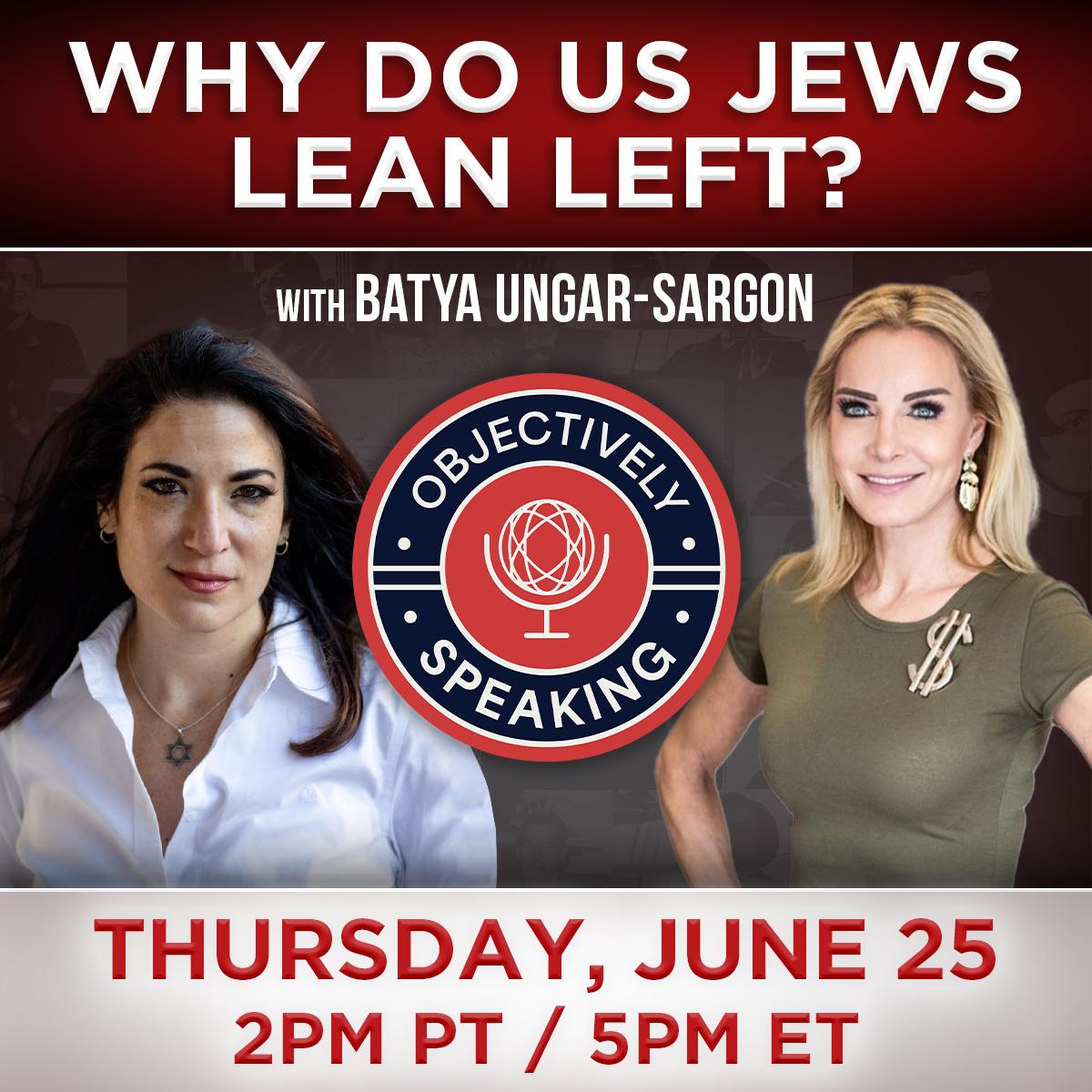
[00:00:00] Speaker A: Hey everyone. Welcome to the 308th episode of objectively speaking. I'm Jag, CEO of the Atlas Society. I'm very excited to have returning guest Batya Angar Sargon join us to talk about her new book, the Jews and the Left. Batia, thank you for joining us.
[00:00:19] Speaker B: Thank you so much for having me. What a pleasure to be here with you.
[00:00:23] Speaker A: And I want to warn our audience, she does have a hard stop to not going to be able to be with us for the full hour. So I may limit a little bit some of our audience questions, but this is such an important book, so we're going to dive right into it.
So I'm glad you wrote this book as over the years I've been frequently asked why the majority of American Jews overwhelmingly align themselves with the Democratic Party. And I've never felt like I had a satisfying answer. Part of the difficulty is that the ideological affiliation appears to be in conflict with their self interest, whether socioeconomic or in support of Israel. How would you describe the contradiction?
[00:01:11] Speaker B: Right. I think you laid it out perfectly.
So throughout the 20th century when people would pose this question, there was a sociologist named Milton Himmelfarb who's quoted, he's actually misquoted, but it's a great misquote. So people attribute it to him where he said that Jews earn like Episcopalians, but they vote like poor Ricans, because throughout the 20th century, the richer you got, the more likely you were to become a Republican. And yet Jews were very upwardly mobile and yet they stuck with the Democratic Party. So this was sort of a great mystery.
I go throughout the book through the reasons for why they were democrats throughout the 20th century, a lot of which made sense at the time.
The problem is that now there's a big conflict between the two most important parts of their identity. Most American Jews are very proudly liberal and they're also Zionists. And right now, today there's a conflict between those two things because the left has turned on Israel.
The Jews, though most Jews, two thirds of Jews, stay with the Democratic Party despite the fact that it's very clear that the party itself has embraced its radical left fringe and turned on Jewish interests. And the reason for that is exactly why the Milton Himmelfar quote, quote today does not make sense anymore. Today, most over educated, over credentialed elites are Democrats and most working class people are Republicans.
So we've seen a big political realignment to where that profile of the American Jew in the mid century as somebody who was, you know, a professional, highly educated, well off And a Democrat that is now the. The classic demographic of the Democratic Party. And Jews are kind of demographically stuck. They can't quite uncleave themselves, despite the fact that, as you put it so nicely, they're in a party that is inherently at odds with their own self interest.
[00:03:09] Speaker A: Yeah. You know, some of these socialist victories that we recently saw, I mean, put aside Zoran Mandani, one of the socialists elected in this just previous swing. I. We're putting out a photo of her holding the Hamas headband.
How, how Jews could possibly vote for somebody like that. It really boggles the mind. But we're going to walk through it because, you know, I learned a lot when I read this book, including the role of the. The labor movement. But, you know, if you ask many progressive Jews themselves, they will say that their liberal orientation is an extension of the rel. Religious tradition of Tikkun olam.
What is that? And what is wrong with that particular orientation?
[00:03:57] Speaker B: Right. So Tikkun Olam is. It means fixing the world, and it is the way in which the most liberal Jewish branch, the Reform movement, has redefined what it means to be a religious Jew so that it will be an extension of Democratic Party politics.
So an Orthodox Jew like me looks at that and says, you've literally taken the Bible and tried to morph it and taken every line out of it that fits with Democratic Party politics. Like welcome the stranger. Oh, that must mean we have to have an open border and so on and so on. You know, take care of the, the widow and the orphan. Oh, that must mean we must have a very robust welfare state. Right. And then of course, left out all of the stuff that didn't quite, you know, jive with them, like stoning gays, you know, like having a nation state of our own. Right.
And, and, but, but this was very much part of that evolution of the most liberal of the Jewish branch, which was also the biggest to conform to the politics and infuse them with the spirituality because they had lost touch with the actual spirituality of Judaism.
[00:05:05] Speaker A: Yeah, I mean, some of, some of what the statistics you'd shared, which I had not been aware of, just 21% of American Jews say that religion is very important to them, compared to 41% of American adults who are. 53% of American Jews say that religion is not important to them compared to 34% of American adults. And just 26% of American Jews say they believe in the God of the Bible compared to 56% of American adults. Do you think that that kind of spiritual vacuum has gotten filled up with social justice activism.
[00:05:47] Speaker B: It could be. I mean, those numbers sound very distressing, but compared to Democrats.
Right. They're exactly the same. Right.
And I do think that, you know, having a spiritual vacuum can cause one to mistake things that are politics for something much deeper. And it also causes people to hate the other side, which I, I really don't like and really don't agree with, especially in this context, because it's the other side that kind of has our backs as Jews.
So I. Yeah, I think that's a very student observation.
[00:06:22] Speaker A: So many of our viewers won't be familiar with the three different streams of Judaism, Orthodox, Reform, and Conservative. Can you break those down for us real briefly?
[00:06:32] Speaker B: Yeah, definitely. So Orthodox are Jews who still follow the law. Judaism is misunderstood as you, you know, as if the monotheism piece of it is the most important piece of it. But for Orthodox Jews like me, the thing that has been carried through as a through line is the observance of the law, which is laid out in the Bible, but even more extensively in the Talmud.
Reformed Jews get got rid of the law completely. So they will eat shellfish, they will eat pork. They don't observe the Sabbath, but they have this tikkun olam, like liberal orientation. And to them, that is the sum total of their spiritual commitments.
And then the Conservative kind of split the difference. They're somewhere middle. So, like, they'll drive to synagogue on Shabbat, but they probably wouldn't eat shellfish or pork.
So those are the three mainstreams. The Reform is by far the largest, but it's also the one that intermarries at the highest level. We're talking 75%.
So the grandchildren of Reform Jews are often not Jewish, more often than not, whereas Orthodox Jews tend to have many more children.
And also they don't intermarry. So 90% of them marry other Jews and their children are raised Jewish and they're raised religious. So, you know, in 30 years, the American Jewish community is going to be much more religious, much more Orthodox, and much more Republican, because Orthodox Jews vote for Republicans at 75%, whereas, you know, 2/3 of liberal Jews and non Orthodox Jews and Reform Jews will vote for Democrats.
[00:08:01] Speaker A: So one of the most compelling aspects of your book, Bhatia, is your appeal for Jews to see their history in America in its entirety, including the early colonial and founding era.
And toward that end, you share a story of which I'd been previously unaware, and that is the unusual circumstances in which the first Jewish settlers to New Amsterdam, now New York, City in 1654 arrived. What were those circumstances and what did the reception from early colonists reveal?
[00:08:38] Speaker B: So 23 Jews arrived here in August of 1654. They were refugees from Recife, from Brazil, which had been a Dutch colony. And the Dutch had given Jews private rights to practice their religion. They couldn't do it publicly, but they could do it privately.
But the Spanish Inquisition was on and Brazil was retaken by the Spanish. And they gave the Jews three months to leave. So 15 ships full of Jews left for Amsterdam to go back there. 14 arrived safely, one was blown off course and changed, you know, the course of Jewish history. They were beset by pirates and then rescued by a French captain, De Lamotte, who was on his way to New Amsterdam, this booming port town. And so he took them there.
When they got there, de la Motte did not want to give them back their belongings because he said that they owed him money for the trip and they had no money because the pirates had taken all their money.
So there was this lengthy court case. On the one hand, the colony was very receptive to immigrants, but on the other hand they felt that Delamat could not be just ignored. So what was decided was that their furniture would be sold at auction and the money would be used to pay Delamat for the. For the travel.
And the Jews left the courthouse and were just utterly shocked to find that their new Christian neighbors had bought up all of their belongings at auction and simply handed it back to them in what was probably the first act of Christian charity on these shores.
The head of the colony, Peter Stuyvesant, was a raging anti Semite and he tried immediately to force the Jews to leave. But they appealed to the East India Company, who reminded him that many of the shareholders were members of the same nation and he should stop trying to enrage them. And the Jews were allowed to stay.
He then tried to persecute them in other ways. He said that they would not be allowed to stand guard duty and instead they would have to pay a fine.
And Aser Levi, the Jewish founding father, simply said no, he would not pay a fine. He would stand guard duty like everybody else. So again they wrote back and forth, East India Company. And again they said, give the Jew his rights.
And so ASR Levi stood guard duty. And the minute he did that, he went right back to the courts. And he said, well, now that I stand guard duty, I demand all of the burghers rights, the citizen rights that come with standing guard duty. And he was granted those as well. And this is emblematic. Of how the Jews were treated in America from 1654 up until this day. Wherever antisemitism has reared its ugly head, it has been met with opposition, inoculated by the American population writ large. And the most interesting thing about Osser Levi is he became the most litigious person in New Amsterdam. He sued everybody, but especially he sued government officials who insulted him or he felt did a bad job. And, you know, one expects a litigant to be unpopular. But Oster Levi was one of the most popular, if not the most beloved member of the new colony because he was teaching people how to stand up for their rights. And that was how they saw him, as a person who was worthy of respect, because he demanded it and he demanded his rights. And they were sort of like, oh, that's how you get your rights. And it was almost like he understood what this country was going to become before it did. And that, too, was very emblematic of the Jewish experience here.
[00:12:04] Speaker A: So fast forward to the gilded age and its aftermath. Between the last couple of decades of the 19th century and the first couple of decades of the 20th, over 2 million Jews immigrated to America, fleeing pogroms and economic hardship in eastern Europe and Russia. Now many of them flocked to cities like New York and entered the garment industry as low skilled labor. How did that experience shape their political consciousness?
[00:12:33] Speaker B: So they built the labor movement.
They showed up here, they were horribly exploited, mostly by Jews who had gotten here a few years before them and managed to take advantage of the wonderful capitalism here and, you know, save a little bit of money and open a sweatshop. And they would fill it with these new immigrants who would work in these sweatshops. And then, like, the magic of American capitalism would do its thing. And within two or three years or five years, they would have saved a little money, and then they would start their own sweatshop.
It was really incredible. The Jewish proletariat turned out to be a very short lived affair because they were so upwardly mobile.
But at the time, you know, 1900s, they were working class, they were proletariat, and they were exploited.
And at first they just kind of accepted their lot. There was a lot of depression. There was a lot of, like, deep, deep spiritual angst. There was a lot of suicide.
People would get very sick.
But slowly they started to form this class consciousness. And it wasn't, interestingly, the radicals and the communists and the socialists from Russia who were able to organize the Jews because they had a contempt for religion and a contempt for Yiddish. They didn't Love the working class. It was the people from amongst the working class. It was teenage girls and the Yiddish newspaper that was publishing their stories as if they were worthy of being told. That gave them this feeling of I deserve life. I deserve life beyond just working 16 hour days, 7 days a week in the dark and having, you know, nothing to live for.
And slowly but surely they started to build unions and labor unions and the labor movement.
And they were the reason that we have a five day work week. The New Deal was written thanks in part to the Jewish experience, this horrific Triangle shirtwaist factory fire, that Frances Perkins, who was FDR's labor secretary, stood outside and watched as 146 girls burned to death. And she said, 60 years later, that's where the New Deal came from. So they really built up the labor movement, they built up the socialist movement. But then, because they were so upwardly mobile, they were really in search of a political movement that had both a healthy respect for the dignity of labor, but also a very healthy respect for capitalism. Because that was their profile, that was their demographic, and they found that in FDR's New Deal.
[00:15:05] Speaker A: So you write that there were three main periods of antisemitism in the United States. What were they?
[00:15:11] Speaker B: Yes, I think the ones that I described was there was the Gilded Age.
So what happened during the Gilded Age was you had a new crop of robber barons, as they were called at the time, these great industrialists who were sort of suddenly overnight turned into millionaires. And there was a lot of them. And so they wanted entree into, you know, New York high society. And of course New York high society wanted to reject them. And part of the way that they did that was they would start calling them Jew and so forth. They used a lot of anti Semitic language as a way of kind of keeping keeping out the new money from the old money.
There was also a period, I think the second period I talk about was around the First World War.
This was when the Leo Frank lynching happened. But also there was a big turn against Europe and also against the cities and against city culture in the South. And there was sort of that would bleed into anti Semitic remarks. And then of course, you know, you had in the run up to the Third Reich, you had Henry Ford, you had Father Coughlin, Charles Lindbergh, these guys all really loved the Nazis and tried very hard to bring in anti Semitic language into the Republican Party.
They were more successful than one would have liked, but much less successful than they would have liked. And ultimately their anti Semitism was defeated. The way all antisemitism is defeated in America. There's just no appetite for it among the masses.
[00:16:43] Speaker A: So you know, the fdr, the New Deal growing out to an extent of the labor movement, with which the Jewish proletariat was very involved. But of course there's FDR's prosecution of World War II against Hitler and Nazi Germany. What should we know about this period?
[00:17:02] Speaker B: It's so interesting because the Jews at the time were worshiped. The ground that FDR walked on, they thought he was the Messiah. They saw him as this great warrior against Hitler. He could do no wrong. He got 90% of the Jewish vote in 1940, I think was the last time he ran.
Just an incredible number. What's interesting is that when the Jews started coming here, the refugees after the war, they could not understand this because to them FDR was the man who did nothing. FDR was the man who allowed an anti Semitic State Department to prevent even the Jews who had visas from coming here, including Anne Frank's family.
They were just so deeply anti Semitic. At the end of the war, in the last year, he appointed a war refugee board. They saved about 250,000 Jews, but they did much less than they should have. And my friend Toby, who I sit next to in synagogue, who's a Holocaust survivor, told me, you know, when we first got here, she said we would hear the Jews talking up Roosevelt, that he was this God to them. And we would say, but why he let our families burn. And. And then Toby said to me, and we quickly learned to keep it to ourselves.
[00:18:13] Speaker A: So you write that the third chapter of American history, cementing many American Jews liberal orientation was the civil rights movement. Why did northern Jews play such an outsized role in and how did their attitudes sometimes differ from those of southern Jews?
Wanted a different approach.
[00:18:35] Speaker B: So the narrative that most Jews today would tell you about this is flat wrong. They will give you this intersectional narrative. They'll say, look, all oppression is, comes from white supremacy. And we cannot fight antisemitism without also fighting Islamophobia and anti black racism. And this is why Jews participated in the civil rights movement, because they were oppressed and they wanted to help their fellow oppressed black Americans. This is the exact opposite of what actually happened, which was Jews knew they had never been oppressed here. They knew that they were the luckiest Jews to ever walk planet Earth.
And they felt that as a burden that they owed their black neighbors who had not been treated in the same way, who had been oppressed here, who had faced state sponsored Oppression by the United States.
It was the exact opposite of what most American Jews today, liberal Jews, will tell you.
They knew that they had won the lottery and that we had never been treated in this country the way that blacks are, although we had been as recently as at the time of the civil rights movement 20 years earlier in the Holocaust.
All across Europe, the northern Jews were agitators.
Over half of the white freedom riders who risked their lives were Jews. 70% of the lawyers who worked on civil rights law were Jews. And they would come down on the buses and then they would get arrested. And southern rabbis would go to visit with the prisoners, and they'd be shocked to find prisons full of Jews. There are some beautiful stories in the book about, like, the. The very moment that a black activist realized he didn't actually know any white people, he only knew Jews, like every white person he knew was a Jewish person.
But the Southern rabbis, they were very important, but they had a very different approach. They didn't believe in the marches and the ostentatious nature of the activism. They felt that that created a recalcitrance in their neighbors. The southern rabbis were not segregationists. They very much opposed it on spiritual and religious grounds and as Americans. But they felt that when the northern activists came down for their marches, they created in the white population a resistance to an integration process that had already started and was already slowly chugging along. And the southern rabbis were actually much more endangered than the northern Jews who came down because, of course, the Klan started to attack them.
The shul synagogues across the south were firebombed.
Many of the rabbis were almost killed by the Klan.
An amazing thing happened, though, and I've never seen this talked about anywhere else. And it's that when the Klan came for the Jews, the South turned on the Klan. So on three separate occasions, when the Klan tried to firebomb, successfully firebomb synagogues, the local white population was so horrified that they had come for the Jews that they sort of said, you know what? Maybe the civil rights movement is not so bad, because I don't want to be on the same side as the people who are against it, who are bombing our Jewish neighbors. And this is just an incredible piece of American history that I had never seen anywhere before.
[00:21:48] Speaker A: I think that is one of the things that I enjoyed most about your book was that it wasn't just kind of focusing on instances of anti Semitism or bad things that happen, but putting it into the larger context of how welcoming this country has been and your appeal for Jews to see themselves as part of American in a positive way. So let's now turn to Israel, how its founding and defense against hostile neighbors shaped modern American Jewish political consciousness. Of course, there's the 1948 War of Independence and how that was a turning point from sort of a pre1948 diversity of opinion, some reformed Jews and others were non or even anti Zionist, towards a broader acceptance. But, you know, the 1967 Six Day War had even more of an impact. That's when Israel faced threats of destruction from Egypt, Syria, Jordan.
The acute anxiety triggering the PTSD of the Holocaust was later replaced by pride when Israel achieved a stunning victory. And yet the anxiety lingered.
Why was that?
[00:23:08] Speaker B: It's a mystery. I wasn't quite able to answer.
There's a lot recorded about it. Rabbi Abraham Joshua Heschel talked about it, how you would have expected the Jewish community to emerge from the victory of 1967 jubilant. But they didn't.
They emerged with this misapprehension of themselves as endangered.
They couldn't quite shake.
I mean, you got to understand in the weeks leading up to 1967, they were convinced there was going to be another Holocaust. It was a horrifying time.
And American Jews had a lot of guilt at that point about not having done enough for Jews of Europe.
So you have this guilt and this anxiety and this feeling of helplessness like we're watching from the sidelines. The American government said that the Israelis could not fire the first shot. You have five Arab armies basically preparing to go to war and do a genocide, you know, finish off what, what Hitler started.
And it was, it was a horrifying time. In the Jewish day schools across New York. People told me stories of how, you know, they didn't. There was no learning. The teachers would pull down the map of Israel, they would turn on the radio in Hebrew and just point and show the exact progress of the armies. And
[00:24:24] Speaker A: that would be a pretty traumatizing experience to go through. But do you think there was also perhaps a little bit of dissonance where, you know, liberal Jew Jews at the time saw that some of their political fellow travelers were not celebrating Israel's victory, but also bemoaning it and just beginning to have an inkling that something, something isn't right here?
[00:24:48] Speaker B: Definitely, yeah. I mean, you have to understand this was the time of, you know, the Vietnam War. America was very unpopular with the left. Israel started to be seen as an extension of that militarism and military might and strength was seen in a negative Way as it is now. And it was really the start of the left, what I call in the book, worship of weakness. The abandonment of the, of. Of the pursuit of the goals, the noble goals of Dr. King's vision of equality and equal opportunity and freedom and, you know, being powerful and all that stuff, being good to where suddenly, you know, the cowboys were the bad guys and the Indians were the good guys. Right? Where suddenly, you know, weakness and abjection was seen as virtuous, whereas power and strength were seen as inherently evil, especially when wielded by white people.
[00:25:41] Speaker A: So we talked about Jewish involvement in the civil rights movement. What is responsible for the shift in attitudes among significant segments of black Americans towards Jews from the relatively positive through the mid-60s to resentment and expressions of anti Semitism during the black power era?
[00:25:58] Speaker B: It's such an important point and it's one that causes a lot of pain today still for many American Jews.
After Dr. King was assassinated, his movement was taken over by this black power black separatists Black Panthers movement.
And they rejected Dr. King's vision that America could make good on its unfulfilled promises to its black citizens. They rejected his desire to live in a colorblind society where we're all judged based on the content of our character, not the color of our skin. They didn't see themselves as belonging to the same nation as their white neighbors. They saw themselves as belonging to the same movement as the global post colonial movement. So they identified with African nations traditional trying to rid themselves of white colonists, and they identified with the Palestinians.
And one of the ways that young people and activists throughout the movement used to show that they were part of the edgy, cool vanguard embodied by Malcolm X. And these separatists, rather than what was being seen at the time as the cringy old fashioned Dr. King vision of integration was a very anti white language entered the lexicon. And because the only white people they knew were Jews, that language quickly turned anti Semitic. And that was the start of the fraying of this coalition which had a few more bumps down the road. There was a big protest that erupted between a high school education board in Brooklyn that ejected all of the Jewish public school teachers. Most of the teachers were Jews and they decided they only wanted black teachers. And the union, of course, sided with the Jewish teachers.
There was the Crown Heights riots. I mean, there were other flashpoints.
I will say I kind of. I don't think most black Americans have anti Semitic views. But the activist set, like Black Lives Matter, for example, explicitly celebrated October 7th.
And I think if you don't have enough ties to the community, it looks like this is, you know, these are the leaders. This is the leadership celebrating it. I do think much more of the black leadership is still in the black church and those people remain, you know, pro Israel, but they don't get as much airtime.
[00:28:24] Speaker A: So knowing that we don't have a lot of time with you, and again, apologies to those who've been asking great questions, but maybe we'll get Batya on for another time too, because there's so much to go through in this book and again, I highly recommend it. I especially recommend the audio version which Batya herself narrates. So hey, you know, if, if this host thing doesn't work out for you, you have a possibility of falling back as an audible narrator, but like speeding up to the current day where modern Jews find themselves in a post October 7th world.
You know, throughout my life, the only experiences I'd had with antisemitism had been from those on the left. Now that's changed. Now we're seeing a rise of anti Semitism on the right.
What is driving this? Is it conspiratorial thinking about Jewish globalists and financiers?
What part is being driven by our modern day Father Coughlin's? And also, you know, whether part of it is just pent up frustration from like conservatives over the fact that the majority of American Jews consistently side with the Democrat Party and are their opponents on most policy issues.
[00:29:45] Speaker B: I think that might be some of it. I don't really see this as taking off on the right. There's been a very concerted effort to contain it.
Nick Fuentes came out as a Democrat recently. Tucker Carlson recently said he's no longer a Republican.
So I don't know that even the characters who I'm sure you're speaking about, maybe not, but that they really embody some sort of significant portion of the right.
Young people tend to be leftists. So there are some young people who have turned anti Semitic who are, you know, happen to be pro life.
But in any other poll, in any other American era, they would just be coded as leftists. Like to me this is a deep seated anti Zionism that is veering into anti Semitism, but it makes no sense on the right because people on the right have no problem with nation states. And the people on the left who hate Israel hate America as well. Those things really go together and they hate Trump.
It's kind of hard to love Trump and really hate Israel because Trump is so pro Israel. So I think it's, you know, much more marginal, to say the least, on the right when it comes to someone like Carlson. I really don't understand it, but I do get asked about it a lot on my show on News Nation. I've had, you know, Republican senators and congressmen and members of the cabinet and journalists, pundits, influencers, and they're all asking the same question, what happened to Tucker Carlson? Because this is not who we are. This does not reflect the Republican Party, which is even more pro Israel now than it was before October 7th.
So I think that the shift, you know, you've seen this a number of times, like Marjorie Taylor Greene, Thomas Massie, Tucker Carlson. These people become obsessed with Israel and Israeli wrongdoing and Jewish wrongdoing, and suddenly they find themselves, you know, on CNN and on the Young Turks and, you know, like, they have much more in common now with people on the left.
This is something it's that most American Jews just don't even know about. Like, it's very, it's very strange. Like, it has not filtered through at all. But as somebody who's following this very closely, I think that's true.
[00:31:59] Speaker A: So how, as somebody with four nephews, how did the terrorist massacre on October 7th in Israel and its aftermath, you know, especially on campuses, how did it affect the views of young Jews, specifically in America? And any evidence is changing the political orientation of older, liberal Jews as well.
[00:32:25] Speaker B: Young Jews on college campuses got much more conservative. Like, almost overnight, polling started to reflect that because they were exposed to the worst of it and they were gaslit about it.
So they became extremely pro Israel and even more likely to vote Republican and much less likely to identify as liberal or very liberal.
I find that it's older Jews who are finding it much harder to acknowledge what's happened to the Democratic Party.
And I think that's just. There's this.
They just hate Trump. They hate Trump. And so it really colors everything, like, they cannot, you know, I think it's hard for them to acknowledge that something bad is happening on their side because there's this knee jerk, while the other side is even worse. So it's rising on both sides, but it's not treated equally on both sides. Trump kicked Tucker Carlson out of the Republican Party.
He rescued every single one of those Israeli hostages that none of us thought were ever going to see the light of day again.
So it's, I do think after the era of Trump, things will change, although I do think the Democratic Party will moderate as well. So I'm not sure you're going to see a mass defection of American Jews to the right.
But like I said, future generations will be more conservative.
[00:33:41] Speaker A: So in the last few minutes, we've kept you even longer than you were able to spend time with us today. But any last thoughts? Maybe in researching, writing the book, what was one thing that surprised you the most? Or any last thoughts with which you'd like to leave the audience?
[00:34:00] Speaker B: You know, from the moment Jews arrived on American soil, it was revolutionary for us. It was like the soil itself rejected Jew hate.
They felt like all Americans felt that this was the promised land.
And it's just so important to reclaim that history.
On our 250th birthday, it is so important for us to remember who we are and that this is our homeland and to keep everything in perspective. In that perspective, the soil itself rejects Jew hate. And that remains true today.
There's terrible things happening on both sides. Trust me, I see it on Twitter in my mentions. I'm not a very popular person on either side.
None of that matters. Your fellow Americans still love you. And I think that's the thing I want to leave people with.
[00:34:53] Speaker A: Well, thank you.
That's a wonderful note on which to end. As I like to say, you can't be objective if you don't have perspective and sometimes widening the lens to remember how much we have to be grateful for. So I'm grateful for you.
Thank you. And grateful for all of you that have joined us today. Thanks for your patience. Promise we'll go longer next week and we'll get to more of your questions because next week we'll be joined by Gad Sessions. Sad, who is going to talk about his new book, Suicidal Empathy. Dying to Be Kind.
See you then.