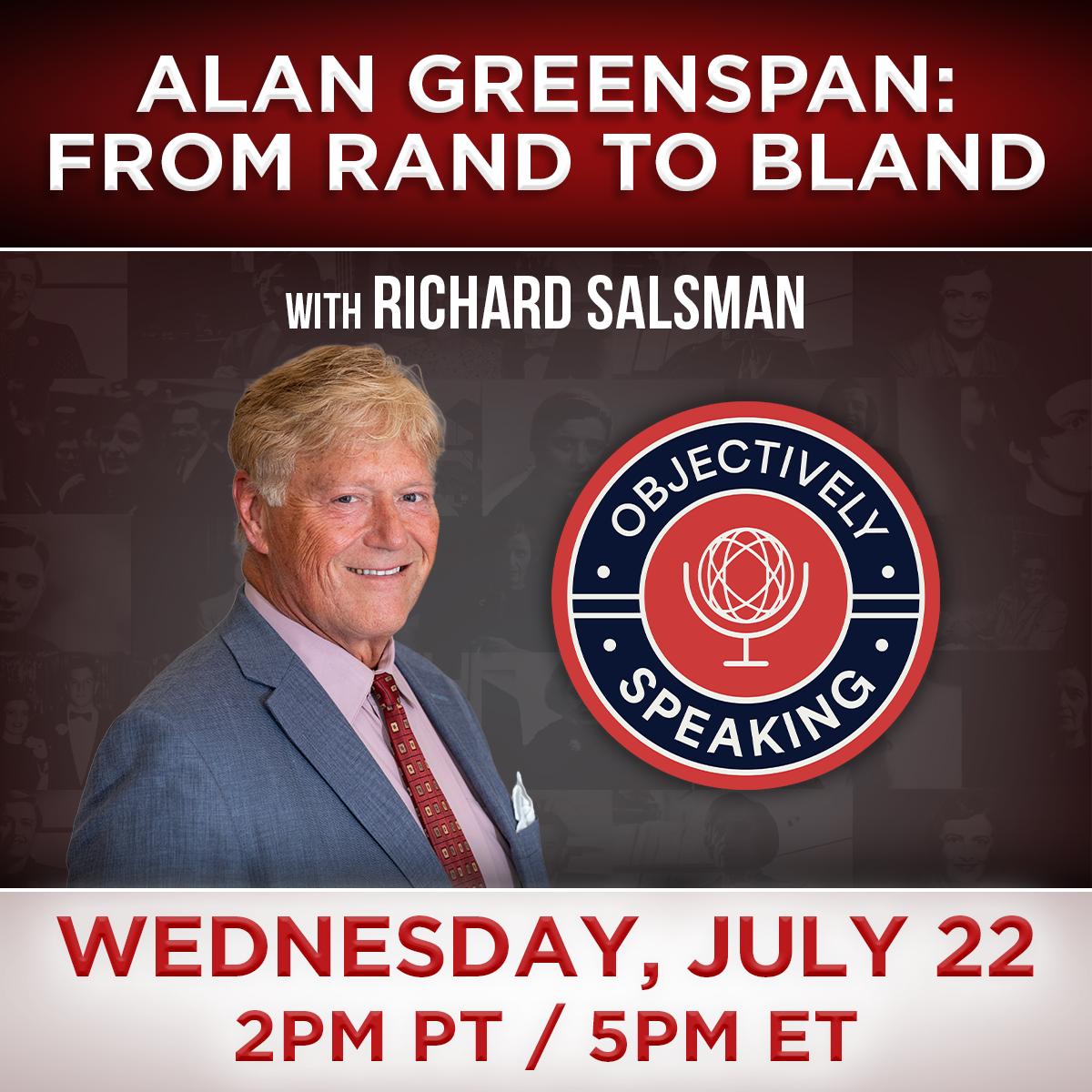
[00:00:01] Speaker A: Hello, everyone. Welcome to the 312th episode of objectively Speaking. I'm Lawrence Salivo, senior project Manager here at the Atlas Society. Jennifer Grossman has the week off, but I'm excited to have with me today Atlas Society singer scholar Richard Salzman, for a exploration of the life of Alan Greenspan from his early career sets and reputation, partly due to his affiliation with Ayn Rand and also some of the less than honorable compromises he made that he believed were necessary in becoming the monetary central player planner at the Federal Reserve.
So if you have any questions before we get started, just asking you, please leave them in the comment section and we'll try to get to as many as we can near the end of the interview. So with that, Richard, I'll pass it over to you.
[00:00:51] Speaker B: Thank you, Lawrence, and thank you all for joining. I suppose I'm in a unique position, as I think about it, to talk about the legacy of Alan Greenspan, who died at age 100amonth ago. So this is mid July. He died in June because, like, he's an economist, so am I an economist. Spent time on Wall street, so did I. Became an economic forecaster. So, so have I been since 2000.
Object knowledge of objectivism. Me too, as a forecaster for the last 25 or so years, many of those years, the 18 that he was at the Federal Reserve, I read all his speeches. I had to read all his speeches, unfortunately, and the testimony in order to determine or guess what the Fed was going to do and to help advise customers clients to manage their portfolios. So it's a deep interest to me. I've been at it a long time. I became an objectivist in 1990, 79 or so. So this was only a dozen years or so after Capitalism. The Unknown Ideal was published in 1966, where he had three main essays, one of which on gold and economic Freedom is perhaps the most famous because it advocated for free banking and the gold standard, which is the opposite of what we have today, which is central banking and fiat money. And the fact that in 1987 Reagan nominated him as head of this institution, which for decades prior he had been criticizing as fraudulent, actually. So I'll quote from that in a moment, makes it all the more interesting. So I'm going to talk a little bit about his ideas. I don't want to get too much into the biography, although the biography is interesting. Mostly I want to talk about the ideas, the relationship with Ayn Rand, how she changed his view of things, and perhaps more interesting for those in this audience, for Those of us who are pro liberty and face an illiberal political economic system, the question becomes how do you interact with that system? I don't mean just passively. How do you choose if you wish to, if you want to take the path of going into politics or going into policy advice or even going into think tank, say in Washington, there's this enormous difficulty of trying to bring your principles into practice without sacrificing your principles.
And at times he was actually good at this, at times he was not. And maybe that's just a lesson itself. He is worth studying from the standpoint of that he is probably, I would classify, as I think about it, the most prominent influential economic policymaker in the United States in the last 50 years. I can't actually think of anyone else more so. So it's all the more interesting, especially to the Atlas Society audience, his relationship to Ayn Rand and whether that, to what extent that had anything to do with his success and his trajectory.
Well, I want to just start with something he said about her in the mid-1980s. So I'm quoting and by the way, my sources here, he's written three books since he left the Fed. He was at the Fed from 1987 as Chief of the Fed till January 2006.
And he did political work prior to that, which I'll reference in the Ford administration, in the Nixon campaign, actually 67, 68, way far back.
And he was on a Social Security Commission in 1983. We can talk about that. But I'm drawing on one book is called the Age of Turbulence, which he wrote in 2007, which is interesting because he wrote it just before the economic crash of 2008.
And we're going to see that one of his comments about one of his testimony in Congress after that crash, because he's out of the Fed by now, but a lot of his policies probably contributed to that crash. His denunciation of capitalism, not really capitalism, but of self interest and free markets as an excuse for that. It was probably the low point of his later life, which is a shame. So I'll quote that as well. The other book is also philosophical, believe it or not, the Map and the Territory, subtitled Risk, Human Nature and the Future of forecasting. That's 2013 or so. Now he also wrote a book in tandem with Adrian Woodridge called Capitalism in America history 2018, but that's not that as philosophical, it's more historical.
Now, in Barbara Brannan's biography of ayn Rand in 1986, she quotes him as saying the following, and this is in the mid-80s, apparently she got an interview from him at the time. This is one year before he becomes fedhead.
At the time, I'm quoting now, Alan Greenspan. At the time I met Ayn rand in my mid-20s. This is 1952, by the way. I had already developed a strong admiration for the efficiency of free market capitalist economies.
She demonstrated to me, however, that not only was laissez faire capitalism an efficient and productive system, but was also the only system consistent with political freedom. By confronting issues I'd never previously encountered, a whole new view of society was opened up to me. Ayn Rand was instrumental in significantly broadening the scope of my thinking and was clearly a major contributor to my intellectual development, for which I remain profoundly grateful to this day. All right, to this day, unquote, meaning 1986. To Alan Greenspan's great credit. He never said anything other than that about Ayn Rand.
I mean, in a good sense, he never repudiated her. He never criticized objectivism, he never said, I regretted my affiliations with her every time he was. And he was repeatedly asked whenever he got new positions, what was his relationship to Ayn Rand?
Was he still friends with her when she was alive? She died in 1982.
Did he still admire her? He'd say, yes. Her philosophy? Yes.
How she changed your life. Yes, universally, for the better. So very principled in that regard. In today's vernacular, I guess it would be called never threw her under the bus.
Okay, so that's that. But there's some other really fascinating quotes in some of these. Well, I just went to his books and I've read them all. But then I went back to him in recent weeks just to his mentions of Ayn Rand. So here's how he defined in Age of Turbulence. Here. How, here's how he defined her philosophy. Quote, she emphasized reason, individualism and enlightened self interest.
Objectivism championed laissez faire capitalism as the ideal form of social organization.
This is him writing in 2007.
All very accurate. She was unrelentingly analytical, ready to dissect any idea to its fundamentals, yet an openness in the way she approached conversation.
I showed my logical positivist colors and said that there are no moral absolutes. This is what he said to her face at her apartment in the early 1950s.
She was quite effectively demonstrating the self contradictory nature of my position. I'll tell you in a moment what logical cause of is. But he goes on, I prided myself on my reasoning ability and I Thought it could beat anybody in the intellectual debate. But talking to Ayn Rand was like starting a game of chess, thinking I was very good and suddenly fun, and finding myself in checkmate after a few moves, unquote. I really love that quote, by the way. Logical positivism, Greenspan says when he was younger and he was very analytical and he's very much interested in math and statistics and things like that. And, and he says he watched the success, now this is at the end, World War II, the success of Oppenheimer and the Manhattan Project, and learned that many of those scientists were logical positivists. So, so he started reading logical Positivism. If you know logical positivism is a philosophy pioneered by Ludwig Wittgenstein, and it basically eschews all metaphysics. It says philosophically, to heck with metaphysics, all that's real is anything that could be measured, like literally measured in a petri dish or measured with numbers or measured with empirics.
So strictly empirical. All values were considered subjective and not definable or measurable. There'd be no metric, therefore out of bounds.
So it's a, you could call it rationalistic, but it's actually a hyper empiricist view.
And it's one of the reasons he became known for. And people would joke about Greenspan just immersing himself in these arcane details and economic statistics of, you know, railroad loadings and cotton prices and things like that. And it seems so range in the moment, concrete bound. And you can see why if you met someone like Ayn Rand who's talking big ideas but is still respectful of markets and still think markets are wonderful, that that would be intriguing to him and why it would open him up. Anyway, he says that having met Ayn Rand and interacted with the group for, for those number of years, probably eight or nine years intensively, he got a much better sense that moral values, the value of capitalism, social systems generally, started investigating human nature. We're not all robots, you know, we have free will.
And that it opened up his horizons. And I'm guessing he probably would not have succeeded at the extent he did in public life had he not met her. He would have remained, I think, a very narrow, concrete bound, little economic analysis in the bowels of the Bureau of Labor Statistics or something like that. It's my guess.
Now here's another quote. Ayn Rand became a stabilizing force in my life.
It hadn't taken long for us to have a meeting of the minds, mostly my mind meeting hers. And in the 1950s and early 1960s, I became a regular at the weekly gathering at her apartment. Now, those of you who know this is A East 34th street, they would meet every, I think, Saturday night, a dozen of them or so.
She was a wholly original thinker, sharply analytical, strong willed, highly principled, and very insistent on rationality as the highest value.
In that regard, our values were congruent. We agreed on the importance of mathematics and intellectual rigor. But she had gone far beyond that, thinking more broadly than I had ever dared.
She was a devoted Aristotelian, the central idea being that there exists an objective reality that is separate from consciousness and yet capable of being known.
And then there was the Aristotelian ethics that individuals have innate nobility, that we must flourish by realizing our potential.
Further on, I engaged in all night debates and wrote spirited commentaries to her newsletter with the fervor of a young acolyte drawn to a whole new set of ideas.
It was only as, now get this now. It was only as contradictions in my new notions began to emerge that my fervor receded.
Well, since he's talking about a contradiction, let me, let me give you one he names, then I'll talk about the three essays that ended up in Capitalism, the Unknown Ideal. But here's one example he gives, which I think is very interesting because I actually sympathize with this.
He says now this is him thinking later. And if you remember, Ayn Rand wrote an essay called something like how to Finance Government in a Free Society.
And it was on taxation. And she took the view that all taxation was necessarily immoral.
And that's not actually my view, but I think it was an unfortunate view that she took. My view is that taxation was legitimate if it funds legitimate government.
And we're not anarchists, so we do have legitimate government or can define itself. And then of course the taxes can't be punitive or discriminatory against some versus others. But notice what he says. He says, one con. This is Greenspan. One contradiction I found particularly enlightening.
According to Objectivist precepts, taxation was immoral because it allowed for government appropriation of private property by force.
Yet if taxation is wrong, how could you reliably finance the essential functions of government, including the protection of individuals rights through police power? The Randian answer, that those who rationally saw the need for government would contribute voluntarily, seemed inadequate to me. People have free will. Suppose they refused, unquote.
So I cite that because when he talks about less fervor, some of this sounds like which you Typically will get this. Someone will say in their later years, oh, I was, I was a wild eyed young kid, you know, going off as I was an acolyte. I went off the deep end with. I'm not saying he said that Alan Greenspan was not that kind of person. I mean, Ayn Rand jokingly called him the undertaker because he was so dour even then in his mid-20s and he always wore black suits and dark ties. And the joke around the group was, and he knew this, he says this all the time, she called me the undertaker. A mortician is not like a wild eyed, crazy ideological young kid.
But here's a but. Notice he's saying, I don't want contradictions either in my thinking. And this when you realize what he would eventually become in public policy, namely a public finance guy, someone focused on taxes and budgets and fiscal responsibility or irresponsibility, the central bank, this kind of tax issue. I could see what would bother him.
Now. Then he says further, I still found the broader philosophy of unfettered market competition compelling, as I do to this day, to this day meaning 2007. But I relentlessly began to realize that if there were qualifications to my intellectual edifice, I couldn't argue that others should readily accept it. Let me repeat that because this is the move into politics.
I still found the philosophy of unfettered market competition compelling, as I do to this day. But I reluctantly began to realize that if there were qualifications to my intellectual edifice, I couldn't argue that others should readily accept it.
By the time I joined Richard Nixon's campaign for the presidency in 1967, I had long since decided to engage in efforts to advance free market capitalism as an insider rather than as a critical pamphleteer.
I think that's very interesting because there's a good and bad in this. First of all, you have to understand, in 1967 Richard Nixon's reputation was not terrible, it was high. He was making this great comeback and he was the law and order president. And there was no sense at the time that one, that in three years he'd take us off the gold standard, impose wage and price control, set up the epa. I mean, it was just, he was a complete disaster. Quite apart from Watergate and interestingly, Greenspan view at the time, and objectivists who knew him at the time actually applauded him going as an insider on the grounds that he would keep things from getting worse. In other words, that he wasn't going to go in and transform the place into capitalism or go back to the gold standard overnight. But that why not? If you have the reputation and he was developing it at the time, why not try to join a campaign?
Remember, the only other choice was McGovern who was terrible and try to make the policies better.
So that's what he did. And I just think this, this idea at this point where he's thinking, you know, I don't want to be a critical pamphleteer. The pamphleteer is a very derogatory comment. Right. Like someone just like lobbying and criticisms from afar. Many people do that today. It's called bloggers or podcasters or whatever, having no influence. So you can see this desire to have some influence and the fact that he was building a reputation where Republicans would call upon him. And it started with Reagan, I mean, excuse me, it started with Nixon, then he worked for Ford and then Reagan hired him in 1983 to re examine Social Security and then Reagan named him as fed chair in 87. So he was always in the Republican establishment from my standpoint, the more pro capitalists or the less anti capitalist of the two parties. So give him credit for that.
But this gives you kind of an insight into his view of what would be more interesting to him and what would be. Yes. Would it make him more powerful? Possibly.
But I think he also know, I think he also knew that institutions were what they were. He said at one point I knew going in that there was a constitution and then I had to pledge to uphold it. Then I had to pledge to uphold, including the laws of the lands. And he says at point one point, many of which I disagreed with.
So it's not like he could go in there and start blowing up things. That was not the expectation. But this is where the difficulty comes, where certain choices are made and you're in the room, you're in the room with everybody else and someone's coming up with something stupid and what do you say and what can you do? And if you're outvoted. Let me just give you a couple of obvious examples off the top.
The Nixon wage and price controls and going off the gold standard in 1971.
Greenspan was not in the administration at the time and he certainly was against that.
But he came back into the administration at some point and oddly enough, in the year 1974, when Nixon was about to resign and when Watergate was just all over the news and things were in great turmoil and it could have been the case that nobody else wanted to work for Nixon at the time. So Greenspan got the job. But interestingly, Nixon nominated him as Chief Economic advisor in the White House, nominated Greenspan, and based on his knowledge of what he had done in the campaigns, and that was called the Council of Economic Advisors. So. But right in the middle of the nomination process, Nixon resigns, so Ford takes over. Ford was the vp, so Ford took over.
And Ford had talked to Greenspan and he said, why don't you stay on and we'll nominate you. And he did become Council of Economic advisors head of it under Jerry Ford starting in fall of 1974. So he was confirmed by the Senate, I think it's required the Senate, and became chief Economic advisor.
[00:19:24] Speaker A: Now.
[00:19:24] Speaker B: One of the first weird things economically that the Ford administration did, you have to be old enough to even remember that this happened. The inflation was terrible. The economy was in recession. The 73, 75 recession was terrible.
And Ford had this idea where someone. I hope it wasn't Greenspan. I've never been able to pin this down. Got the idea of issuing WIN buttons.
Wynn was an acronym for whip Inflation. Now, and businessmen and union leaders were supposed to wear this on their suits and lapels to remind themselves not to ask for price increases and wage increases. Now, you can't think of a dumber theory of inflation than that.
And it's just either. I know Greenspan didn't advocate for it, but there's an example of. Can you imagine him in the room when someone came up with that? Including printing up all the buttons and either shaking his head or biting his lip or saying nothing or saying something. I don't remember him ever on record saying anything about it. But it's just pathetic, just outrageous. Now, fast forward to another case. 1983, Social Security Administration is issuing reports saying we're going to go bankrupt soon. Well, that's been going on for decades. That's still true now. And so Reagan asked Greenspan to head something eventually called the Greenspan Commission.
It was supposed to study Social Security. Now, what would Alan Greenspan say about Social Security in the 1960s? That it was a Ponzi scheme, which it is even today. That it's a fraudulent government pension program that taxes people, forcibly takes money out of their paychecks and redistributes it. It's a pay as you go system, meaning there's no trust fund, just an awful system.
And Reagan is basically asking him not to dismantle the system, but to gather big thinkers and actuaries together to, quote, unquote, fix the system and salvage it and put it on a sound basis for at least the next. I don't know, 70 years or so. Now, if you're a total principal free market guy, do you say no?
You could do that. You could say no. Or he's thinking somebody else is going to head that commission and Social Security is going to become even more onerous than I think it is. Now, again, I'm not getting into his head, but he took the job. And here's what was. Here's what resulted. After a year, the Greenspan Commission came up with the idea. And again, it wasn't just him. It was a whole bunch of people. And it was this bipartisan effort. So it was part Keynesians, part free marketers, part conservatives, Republicans, Democrats raise the payroll tax rate, duh.
Cut benefits by making them taxable, and then raise the retirement age gradually over 40 years from 65 to 67, which is what it is today. So in other words, you could call them tweaks, but in each case, you know, making the system survive. But it's still a Ponzi scheme, and he got criticized a lot for that. Now, by the way, this is a year after Ayn Rand died. So there isn't much, interestingly, there isn't much in the way of Ayn Rand commenting on Greenspan, because this is later years of her life when she's more frail and sick and had lost her husband in 1979. So, so this period between 1979 and 1982, when she dies, Reagan takes office. Greenspan is appointed by Reagan. There's not a lot of Ayn Rand talking about, although she hated Reagan, there's not a lot of her talking about Alan Greenspan's performance in government. There just wasn't enough for her to see. However, one of the highlights of her time with him, told by her and others, is her visit to the Oval Office. So when he was sworn in by Jerry Ford in 1974, I think it was, or might have been early 75, as Council of Economic Advisors. You can look this up. There is photos of Ayn Rand and her husband Frank and Alan Greenspan and Alan Greenspan's mother and Jerry Ford in the Oval Office. So one of the few times Ayn Rand, two times Ayn Rand went to the Oval Office later, it was, I think, to meet the Prime Minister or the President of Australia.
So that was a huge moment and wouldn't have been possible. And she knew that Alan Greenspan didn't have to do that. But she was at his side. No one else, just that group when he was being sworn in the Oval Office. So a testament to how much he admired and respected her and credited her at a big moment like that with a goodly part of his success.
Okay, when I quote, I'm quoting now. When I agreed to accept the nomination as chairman of President's Council of Economic Advisors, I knew I'd have to pledge to uphold not only the Constitution but also the laws of the land. Many of which I thought were wrong.
The existence of a democratic society governed by the rule of law implies a lack of unanimity on almost every aspect of the public agenda.
Compromise on public issues is the price of civilization, not an abrogation of principle.
Notice that he would reject the view of some Objectivists who I think go completely over the top. By the way, the same Objectivist who, when he was in government at the time, were absolutely convinced that he was a mole saving us from going full status. I never believed that.
But then when he got less principled over time and seemed to be doing things that were not so nice to capitalism or capitalism reputation, they thought he was the devil and the demonic and claimed that they knew all along that he was. This is the kind of tripe pushed by Harry Binswanger and others. So that's not true either. That's not valid either. But notice he is grappling with this issue of I have these different views.
We're not actually following constitutional government now. And he doesn't consider it a compromise, an abrogation of principle. He's got his principle. I actually remember him testifying when he was nominated as Fed chairman in 87. And he was asked specifically, do you still stand by the essays you wrote in Capitalism, the Unknown Ideal, including there's three of them, including that the preferred monetary system is gold standard and no central bank.
And an essay on antitrust saying the antitrust laws are unjust and arbitrary and should be abolished.
And by the way, one of the underappreciated essays in that book, the Assault on Integrity. That's actually one of the best essays he wrote in the book. The Assault on Integrity is a criticism of the regulatory state.
It basically says that regulation makes it impossible for worthy businesses to develop an asset called reputation because the government, by regulating ahead of time, basically makes that competitive advantage of reputation, branding and warranties and things like that. Nugatory.
And so it's a wonderful. And when you think about it, three different issues, money and banking is one and antitrust is another. These are huge. And then the regulatory state. I recommend you read all of those because they're all very excellent. Anyway, I just wanted to mention that because the issue of compromise versus abrogating principle, he was quite aware of.
Now, as to the moment in the Oval Office, listen to this. It did not go without notice publicly that Ayn Rand stood beside me as I took the oath of office in the presence of President Ford. Ayn Rand and I remained close until she died in 1982. And I'm grateful for the influence she had over my life. I was intellectually limited until I met her.
All of my work had been empirical and numbers based, never values oriented. I was a talented technician, but that was all.
Now, here's another take, and I wanted to mention this because in all the readings of Alan Greenspan, it's very interesting to me, there is no mention of Ludwigon Mises, Friedrich Hayek or Henry Hazlitt.
And part of this is Greenspan was sympathetic, believe it or not, to Keynesian economics, which is not pro capitalist economics, because that's where he was trained before he met Ayn Ryan, that that was the thing. In the 40s and 50s, everyone was a Keynesian.
Richard Nixon actually said at one point, we're all Keynesians now. And Greenspan cringed. But here's what he says about the post World War II era. After Greenspan, after World War II, when I first read Adam Smith, first time I ever read Adam Smith, regard for his theories was at a low ebb.
Laissez faire was a term of opprobrium, disdain. The most prominent advocates of free market capitalism were iconoclasts like Ayn Rand and Milton Friedman. Now, actually, they weren't famous actually in the 40s and 50s.
He's missing the dates here, but the pendulum of economic thinking began to swing in Smith's favor in the late 60s, just as I began my public career, unquote. So this is interesting because Friedman, as you know, is not a consistent advocate of capitalism. In fact, Friedman's an advocate of central banking and fiat paper money.
The complete opposite of Greenspan's view in 1966. And notice in 1966, that's about five years before the US went off the gold standard.
So it was already becoming creaky. The US was deficit spending for Vietnam and other things, and we were losing gold. And people were starting to agitate for going off the gold standard in the 60s.
Whereas Greenspan stands up and says, I'm not only for the gold standard, I think the central bank's wrecking it.
I think the central bank and this chronic deficit spending is eroding the gold standard. That's a good prediction because in five years it was gone. Well, at that same time, in the mid-60s, Milton Friedman had already spent a decade denouncing the gold standard and saying, get rid of it and go to floating exchange rates.
And he thought he could get the Fed to behave by making it increase the money supply by some fixed percent every year.
So that's an interesting. The fact that you put Ayn Rand and Milton Friedman together is weird.
He should have said Ayn Rand and Mises, Hayek, and especially Hazlitt, who had written complete decimations of Keynesian economics, which apparently Greenspan never read, which is interesting. Now here's another take on why would he not become an Austrian economist?
Why would he not read or cite Mises? Mises and the Austrians, if, you know, went out of their way to denounce empirical economics? I mean, they literally said, don't bother with numbers. Numbers are meaningless. Empirical, empirical regularities are not how you validate economic principles. Rothbard, who followed Mises, famously said, I believe in a priori extremism. You know, in other words, you just assume everything. I can see why Greenspan would not truck with any of that. I wouldn't truck with any of that if it's presented that way. Mises is one of the greatest economists ever. But Green. But the empiricist, logical positivist Greenspan, who doesn't seem to have even met Mises, even though he was alive in New York and so was Hazlett, Haslett and Mises knew Ayn Rand and Frank.
There doesn't seem to be any bringing together of these great economic minds, and I think that alone is interesting. But I think it's because Greenspan did not respect an economist who did not show some familiarity or respect for numbers.
[00:31:38] Speaker A: Okay,
[00:31:41] Speaker B: quote Ayn Rand persuaded. This is Greenspan again. Ayn Rand persuaded me to look at human beings, their values and how they work, what they do and why they do it, how they think and. And why they think the way they do. This broadened my horizons far beyond the models of economics I'd learned. I began to study how societies form, how cultures behave, and to realize that economics and forecasting depend on such knowledge. Different cultures grow and create material wealth in profoundly different ways.
All of this started me with.
Started for me with Ayn Rand.
She introduced me to a vast realm from which I'd shut myself off, unquote. So. So here's another example of him basically saying, she brought me out of this empiricist box. Now, I want to say something about.
I'm going to quote now from Gold and Economic Freedom, the famous essay from the chapter in Capitalism, the Unknown Ideal. Because another moment in the early 80s I mentioned the Greenspan Commission on Social Security, but there's another commission that Reagan convened called the Gold Commission.
Now in this was in 1981 or so soon after Reagan took office, inflation was rampant.
There was a real genuine interest in returning to the gold standard, believe it or not, which we'd been off for a decade, but going backwards a little bit, 1966, first listen to what Greenspan says about the gold standard and the welfare state. I'm quoting here.
An almost hysterical antagonism toward the gold standard is one issue which unites statists of all persuasions.
They seem to sense, perhaps more clearly than many consistent defenders of laissez faire, that gold and economic freedom are inseparable, that the gold standard is an instrument of laissez faire and that each implies and requires the other.
Further down, the ideal is a full free banking, fully free banking system and a fully consistent gold standard.
And he goes on to say that that was most closely approximated in the decades before World War I. If you know that's the classical gold standard with no central bank.
Further quote. The abandonment of the classical gold standard made it possible for the welfare status to use the banking system as a means to an unlimited expansion of credit.
The financial policy of the welfare state requires that there be no way for owners of wealth to protect themselves, unquote.
Further down, stripped of its academic jargon, the welfare state is nothing more than a mechanism by which governments confiscate the wealth of the productive members of society to support a wide variety of welfare schemes.
This did not sound like the Alan Greenspan of later years when he used to testify before Congress on monetary policy and he'd go out of his way to be obscure and indecipherable and incomprehensible.
That essay ended with this is the shabby secret of the welfare statist's tirades against gold.
Deficit spending is simply a scheme for the hidden confiscation of wealth.
Gold stands in the way of this insidious process.
It stands as a protector of property rights.
If one grasps this, no one, one has no difficulty in understanding the status antagonism toward the gold standard.
Unquote.
That's just fabulous stuff.
See? So although Island Greenspan may have become less principled, less, how would you describe. Passionate. I mean, this is rationally argued, but it's passionate too. And he stripped himself of all that he went back to the more undertaker. Dour Greenspan once. Once he got into public office, and maybe he had to do that because couldn't survive otherwise. But here's what's interesting, though. I'm looking at an essay, can the US Return to a Gold Standard?
That's the title of it. It's in the Wall Street Journal, September 1981.
So this is only 15 years after gold and economic freedom, and it's by Alan Greenspan. And I'll just summarize it for you because it's so interesting. And again, another example of how do you negotiate and navigate this bridge between your ideal world and what actually stands before you?
So this is a summary of his advice to the Gold Commission. He was one of dozens of economists asked for their view. Some of them said, don't return to a gold standard. Some of them said, return to a gold standard. Ron Paul said, return to a 100% gold standard. So there were all these proposals, and now here's what Greenspan actually argued, which is so.
And the one time ingenious and the one time just nefarious, just ridiculous. He actually says the US Cannot return and should not return to a gold standard.
And of course, everyone could look and say, even Alan Greenspan doesn't think we should return to a gold Standard. This is Mr. Gold Standard. And now the reason he gave is something like this. Inflation is so high and volatile, it was like 14 or 15% that we don't quite know at what price to go back on the gold standard because it's like 800 an ounce now.
And when we went off the gold standard in 71, it was $35 an ounce. So I mean, this is somewhat technical for this audience, but you do have to, if you go back on the gold standard, you have to have a re entry rate where there's a new gold price and it stays at that level. And he basically said it's incalculable and if we go back at the wrong rate, there'll be a disaster, the financial system will fall apart, we'll lose all our gold.
So though, instead of giving up, he then goes on to say, however, if the central bank could somehow get inflation down to a more reasonable level, like below 2%, where people don't even think about it anymore. And he didn't say how it would do that.
If it could do that, it could basically replicate what the gold standard delivered, which was low inflation, then he concludes with, but of course, if they can do that, then we don't have to go back on a gold standard.
So this is quintessential this is the quintessential Greenspan halfway through going from Rand to bland, what I call the subtitle of this talk, that you see what he's negotiating, he's not coming out for the goal. And he's probably thinking to himself, I could come out and say, yes, adopt the gold standard now and dismantle the Fed, and he would have been dismissed as a crank right now. Maybe he should have been dismissed as a crank, but instead he says, no, let me do something. And here's what's interesting, that's precisely what he did when he became Fed chairman.
For all the criticisms of his policies during his time at the Fed, and I have many, it's undeniable when you look at the numbers that from 87 to 06, the inflation. I've looked at all these things, the inflation rate was lower than in the prior 18 years.
It was lower than in the subsequent 18 years. So those 18 years of Greenspan inflation was brought down to something like 2% a year, which is still too much, but much closer to what was delivered under the gold standard.
And other things like growth of the economy, performance of the stock market, level of the bond, you life checked everything, the foreign exchange value of the dollar all performed in a superior manner under Greenspan compared to the period 18 years prior to him being there. What is not as good is the performance under the gold standard. So put it this way, if you line up those performance metrics, the period under the gold standard is number one.
All the numbers are better under the gold standard when no one even remembers who the Fed chairman was.
But second, getting the silver medal is Greenspan years.
And third are these others who weren't free marketeers.
So it's one of the reasons he has a high reputation, grudgingly, for some people who hate objectivism and free markets, they're grudgingly saying he is one of the best central bankers, or they call it the least bad central bankers in America of the last 50 years. And there's some truth to that. I'm looking at another essay which is so Weird from 1999 and now he's still Fed chairman.
Who needs gold when we have Greenspan?
So that's a headline that's a op ed by Floyd Norris, who was the economic editor of the New York Times.
Now what's interesting about that is around this time people were starting to talk about the Greenspan standard as if it was equivalent to or some version of the gold standard. But of course we weren't back on the gold standard. But apparently Greenspan was looking at the gold price as an indicator of whether monetary policy was too loose or too tight, as they call it. If the gold price was going up, and he had respected what gold meant, remember, so we're not on the gold standard. But he was the first central banker to say, no, I'm going to actively look at the gold price in the marketplace and if I see it starting to go up around the time it was like 300 an ounce, today it's 4,000 per ounce.
If it goes up much above 300, I'm going to try to reduce the growth rate of the money supply and do other things, interest rate changes and things like that.
And, and the other way around, if it went too low, that would be a signal that not enough money was being. So see the idea that, yes, I'm a central planner, but I'm going to try to replicate what the gold standard delivered. What did the gold standard deliver? A fairly steady gold price and therefore fairly steady purchasing power of the dollar.
So he knows it's central planning.
He knows he can't adopt the gold standard and tear down the Fed. He's asked to head the Fed and he's thinking, I could say no, but who else would head the Fed? Some Keynesian who would have given us the kind of inflation that was given to us by people in the 70s.
Okay, one last thing I'll leave you with and then I'll take Q and A. I think Lawrence and I Talked about leaving 15 minutes or so for comments, questions. I wanted to finish with something because all the interesting comments he makes about Ayn Rand's influence on him, the idea that he came to her as a logical positivist who, in one of his first meetings with her, he, he said, I don't even think I can prove that I exist.
So apparently in a couple hours, Ayn Rand convinced him that he does exist. And there's empirical evidence of this.
It actually sounds crazy because. Is she saving Alan Greenstein from psychosis? No, this is how the logical positives were. But when you fast forward all to the tail end of his career and one of the. I mentioned earlier, one of the worst things he did was after the financial crisis of 08. And remember, he's out of the Fed now, he's two years out of the Fed. But I think there's a lot of evidence for the last policies he implemented just before leaving the Fed dramatically raising interest rates, thinking the housing boom had to be crushed.
He was a big believer, unfortunately, in the idea that There were market bubbles.
Irrational inflated values caused by irrational exuberance was one of his famous phrases. That was from January 96 when things were just fine. The Soviet Union was over, we were growing, the economy was growing, the stock market was going up and the dower. Greenspan was always suspicious of a stock market that went up too fast, you know, to, to check, to question that as a central planner. What, what hubris.
But anyway, he wasn't the only one who believed in quote, bubbles. And what was the, what's the idea of a bubble that markets left. Isn't that not. The Fed's not causing it? No. The view was markets on their own are overbidding prices and they're, they're irrationally exuberant. Euphoric, he would say. Sometimes they were euphoric.
So after the crash of 08, he was asked to come back to Congress and testify about what he thought of it. And in one of the worst performances he ever gave, he was pushed and asked, well, what do you think caused the collapse of the housing market, mortgages, the stock market, mass unemployment? He said, self interest.
He said, I thought self interest would make these Wall street guys tend to their risk profiles, that would make them careful about the lending they would do. And I was wrong. I was wrong. I see that free markets left not sufficiently regulated, free markets not fully tamped down by central bank interest rate policy can get a lot of whack and then crash and burn.
Terrible. And of course everyone looked at me and said, well, if even Alan Greenspan thinks capitalism caused the 2008 financial crisis, to me, if you said to Alan Greenspan in 1966, don't you think capitalism became a scapegoat for the Great Depression and the stock market crash of 1929, wasn't that actually caused by the Fed and Smoot Hawley protectionism? He would say, yes, yes, capitalism took it on the chin and it was completely unjust. And yet that's what he's doing in 08, blaming. In effect, he didn't use the word capitalism, but basically blaming free markets for that catastrophe. Is it because he had been the fed chairman for 18 years prior? Is it because he had adopted the policy which he probably should have known would cause a crash, but he probably welcomed it privately, yes, we need to bring these prices down and so didn't want to blame himself or the Fed?
This is the low point of the Greenspan story.
But in this book I want to finish with this because it's so weird because it almost takes us back full tilt to it's not Greenspan, the Undertaker from the 50s, the mechanical logical positivist, you know, only looking at data, only looking at statistics, he goes completely the other way now.
And in his book called the Map and the territory, which is 2013, it's presumably a book about forecasting. But now this is five years after the crash and he's like rethinking, how could we have gotten, how could we have not predicted the crash?
I didn't predict it. The Fed's models, these quantitative models didn't predict it. Most economists didn't predict it. That's not true.
So he starts going off on another tangent. And the first chapter, the very first chapter of the Map and the Territory is called Animal Spirits.
Animal spirits.
And if you know anything about canes, Canes coined the phrase animal spirits.
And it's from the 30s.
And in explaining, seeming to explain the crash and burn of that time, Keynes said, no, this is due to free markets. This is due to people who get euphoric at some point, they bid up prices, detach from reality, and then eventually things pop, the bubble pops, and then they go the other way and they're way too fearful and then they won't invest at all.
So think of it. This is a boom bust theory or a theory of the business cycle, which is totally psychological and totally emotion driven.
That's the theory of what market makers are doing. But I would say it's also the, quote, analyst, Keynes, Greenspan here, they're the emotionalists.
It's almost like they cannot explain with their numbers what happened. They cannot explain with tax rates or tariff rates or Federal Reserve interest rate. Those are all numbers which you could point to and say, yes, that would definitely tank the economy. No, they don't go there.
They don't go there. So for a very odd reason, you know, inexplicable reason, I should actually say, because the numbers are there, they are quantifiable. But animal spirits. So, quote, I was drawn, he says in this book, I was drawn to the sophistication this is initially to the then new mathematical economics when I was a graduate student in the 50s. But my early fascination was increasingly tempered over the years by a growing skepticism about its relevance to a world in which the state of seemingly unmodelable animal spirits is so critical a factor in economic outcomes.
And I won't go on, but the animal spirits is the idea that people go through ways. And there's herd mentality too, herd behavior.
So people not being independent in their judgments. So Greenspan thinks this is a very big part of human nature and that he's starting now to blame human nature for these cycles. Quote, we humans appear a truly homogeneous species, but at root, what are we?
We're driven by a whole array of propensities, most prominently fear, euphoria and herd behavior.
But ultimately our intuitions are subject to reasoned confirmation.
So be aware of this.
It's not just Greenspan, it's Greenspan taking up a theory of the business cycle or the boom busts of markets, which is totally emotion driven thinking. People are just emotion driven that there's no rational expectations in markets. It's just not true. It's very difficult to succeed in markets by being emotional like that. Some people are, but usually the people who are lose their shirts and lose their clients and have no more influence on the markets. So I think this is another example of once you get into you are the central planner, you've adopted policies that might have caused the boom bust. You don't want to blame yourself.
What do you blame? You either blame free markets, the self interest of Wall street bankers that somehow took a vacation and started making bad loans for no reason whatsoever, or this inherent human propensity to be irrational.
It's so odd coming from a man who, having met Ayn Rand, said I really came to appreciate the importance of rationality. But see, this doesn't mean he was convinced that everyone is rational. I think you can say I'll close with this. I think you might say some objectivists might say this and I think it's a mistake. Well, I was with Ayn Rand. I really learned the value of rationality and how it is important to human achievement and flourishing.
But these same objectivists are telling me that the whole world is going to crap and they're going irrational.
And so yes, that's what I find too. Look at these market makers, these wild, you know, bidding up AI prices and Internet Stein, Internet boom and housing booms. You can see why someone might slip from humans must be rational to very few of them are. And what can I do as a central planner to stop them from being so irrational?
All right, I'll stop there, Lawrence, and take comments or questions.
[00:51:35] Speaker A: Perfect. Thanks, Richard. Okay, so first question that I'll pull from is from Robert Begley.
It's good to see you. So his question is, would you consider Alan Greenspan the most influential objectivist ever to attain political power, particularly given his role in bringing Iron Ran to the White House.
And then he follows us up with part two of this question.
And what does his career reveal about the difficulty of remaining true to one's principles.
[00:52:09] Speaker B: In answer to the first part, I do consider him, I don't think you can think of anyone else the most influential Objectivist influenced, how did you put it? One with political power. Yeah, I mean, they were economic policy positions, but very powerful.
Now, as to what it says about, well, I think what it says about bringing your, what I call bringing your principles to practice, especially in the public sector. This isn't just, you know, bringing your principles to the job where you might have a fight with the boss or disagree with the mission of your company or your group in the public arena, where, you know, this is already a mixed system. I mean, he had said that in 1966. He's saying the welfare state is this corrupt thing, that it's confiscating the wealth of it. And when he's asked to serve, he knows he's entering a welfare state system.
And on the one hand, I think it's a lesson in how do you bring your principals to that job?
Speak up in the room as best you can. Are you just mitigating the absolute disasters that could result otherwise? You have to always keep in mind, it's very difficult, keep in mind what the right ideas are.
And it's all a matter of bridging.
How large is the gap between what you believe and know to be right and what they're asking you to do?
When it's, we're going to print up win buttons, that's a huge gap.
However, when it's, do you think we should go back to the gold standard? I don't think that's a wide gap at all. So I'm more disappointed there. Like he should have been bolder about saying, yes, we should go back to the gold standard. Here's how to do it, even in this very difficult context of high inflation.
Social Security Commission, much more difficult if he had said, listen, this whole system is wrong.
I want at least some contributor to this commission to give us a privatization plan.
Okay? So we may, at the end of the day, because I'm outvoted, come up with all that they did. Higher tax rates, lower benefits, longer retirement age. But could there have been no sub report or minority report saying, here's how to dismantle it? Because it's not as if those plans had not existed. Cato had a plan for safely, fairly quickly dismantling Social Security without screwing anyone.
And I say the same thing about the Fed, even though I'm somewhat sanguine about what he did at The Fed. It wasn't the worst possible Fed chairman performance ever.
For 18 years, I never saw anything come out of the Fed, out of all those research departments saying anything nice about the gold standard.
He could have done that easily. He could have easily asked researchers. Researchers, I mean, they have 400, 500 PhD economists there to do studies while he was there on the gold standard. Also the history of the gold standard, going back to the gold standard. What could be done with the gold standard. Other countries were collecting gold, it's true, in the ex Soviet satellites they were collecting accumulating gold. They still are with the hopes of maybe returning to their own gold standard. So it's not completely an impossible thing. So what I'm getting at here, Robert, those are really good questions, is, yes, the most important objectivist influence policymaker ever, and that the challenge is to find the gaps between the principles you're bringing to the job and try to narrow the gap or try to bridge it as best you can. There is an argument for being an insider who tries to prevent policies from being worse.
And one last thing, I would say it really maybe shows you the power of what I would call institutions, you know, including the entire welfare state. It's a huge institution and one person with a set of ideas isn't going to overthrow the institution. You're going to need more people with more such ideas. I think he's an interesting case though, because he is a case study. I guess one of the reasons I'm talking about, I mean, I think that people always should like revisit this. It is an interesting. And other libertarians, people who are libertarian, might have their own cases of, well, when we tried to get rid of the draft, we did. We got rid of the military draft in 1973. That is a wonderful case study of a very bad government policy which libertarians and Objectivists alike, including Greenspan, contributed to getting rid of to go to the old volunteer army.
So there are cases of success like that. So he's an interesting case from the standpoint of what does it take to bring your principles to practice and when did it work and when did it not work and why?
It's a tough one. I'm still learning about it.
[00:56:54] Speaker A: Great. So we've got about four minutes left. So let me get to this question here from Flying Custard, who asked how much can or should we credit Greenspan for the long economic expansion of the 90s or the 2008 financial crisis?
[00:57:11] Speaker B: I think in the first case you can credit him with the long expansion of the 90s. For one main reason, which I didn't really bring up at all. He did not really believe, although he occasionally would say it, he did not really believe that fast growth and a low unemployment rate would cause a higher inflation. That's in Keynesian economics, that's called the Phillips Curve. So he repeatedly said, these are productivity gains. This is real wealth creation. He wasn't calling the economy a bubble. He would often call the stock market a bubble. But in that regard he let it ride and was a little more hands off than a typical central banker would be. So that's why I give him credit for the 90s.
It also helped that the Soviet Union went away, by the way, the risk factor generally in the world went down enormously. But Greenspan rejected this Phillips Curve idea that fast economic growth necessarily causes inflation. And had he believed in the Phillips Curve, what would he have done? He would have raised interest rates to slow down the economy much more frequently.
[00:58:09] Speaker A: Government.
[00:58:10] Speaker B: And on the 08 crisis, I do blame him for that because he knew that by raising interest rates enormously just before he left that it would make a whole bunch of mortgages go broke. I think he knew that and I think he knew that in turn that would depress house prices. I don't think he knew they would crash 40%. I think he was hoping they would crash like 10%.
But the fact that he was even hoping that they would crash because it was his job allegedly to take air out of the bubble was really a huge mistake.
And so he's responsible for the good ride of the 90s. And he's responsible, I think, in large part for the 08 crisis. By the time Bernanke oversaw that crisis, the Greenspan policy was already in place of having interest rates very punitive, and Bernanke didn't change it in the least.
So it was really Greenspan's policies that were set up before he left and then kept in place until the market crashed.
[00:59:08] Speaker A: Okay, I do see one other question I'll run by you just because I think it's really relevant to what you were talking about here. This comes from my modern Gault asking, do you believe Greenspan entered government hoping to restrain central planning from within, or was he already willing to accept Federal Reserve's basic premise?
[00:59:25] Speaker B: I think the first. I do think there's evidence that in the beginning he had much more of the view, especially as bad as Nixon was and Ford to some degree, then I'm going to be in there just to stop bad stuff from happening.
And then things got better. It definitely got better, although he didn't think, I don't think he really credited the supply siders. He almost never credits the supply side revolution of tax cuts and they were for gold based money, but. And so by the time he's asked to look at The Social Security Commission, 83, by the time he's asked to head the Fed in 87, things are getting enormously better under Reagan.
So by then it's not so much him saying I got to save the thing from being on fire, it's more like these are very interesting, powerful positions that I would like to assume.
Except in both cases he kept the Social Security system going and, and the Federal Reserve System, ironically, he gave it a better reputation because he was there for 18 years.
In the years since, how long has it been? 20.
In the 20 years since he left the Fed. The Fed's reputation, as you know, is shit.
I mean, the money supply is boomed and they've just wrecked it. And you could say, well, boy, people are just praying they're an Alan Greenspan type comes back. But again, it's not people. It's not Kevin Warshit, it's not Bernanke, it's the institution. The institution is fundamentally corrupt. It's fundamentally inflationary.
It is doing exactly what he said in 66 it was made to do to help finance the profligate welfare state. That's what central banking is. Alan Greenspan knew that and when he was at the central bank tried to minimize it doing that.
That's the only way to put it.
And the subsequent Fed chairman don't give a damn.
They have none of his knowledge that this is a really dangerous instrument, this Federal Reserve, and we shouldn't be dickering around with markets and causing crises and then having to print gobs of money and lower interest rates to 0 and fund any damn thing that the treasury asks for. Greenspan was able to avoid a lot of that, but it helped that the Soviet Union went away in the early 90s and there wasn't massive deficit of spending in the 90s. It was going the other way. And the budget was actually balanced at the end of the decade.
The US budget was balanced for four years in a row, mostly because defense spending came down.
And Greenspan actually was testifying. They were asking him, Dr. Greenspan, what should we do now that the Federal Reserve doesn't have to worry about financing deficits?
And he actually thought that a new policy had to be adopted. They had no idea that in the last 25 years or in the subsequent 25 years we go back to massive deficit spending more than ever now, more than even occurred during World War II.
That's where we are now.
So I hope this helped. It's an amazing career and I think it's a lot of lessons to be learned about it, especially for those who are principled for liberty and then want to work in government in some capacity, knowing it's becoming more authoritarian and more reckless.
You can say I don't want to have anything to do with it, but then will things get worse?
Probably so. It's a fascinating choice. And he made a bunch of them, some good choices, some bad.
So I hope this helped everyone.
I think it did.
[01:03:00] Speaker A: I, I, I really enjoyed it. So thank you so much for doing this topic, Richard. And I think our audience really appreciated it as well.
[01:03:06] Speaker B: Okay, great. Thank you.
[01:03:09] Speaker A: And thank everyone for joining us and doing all of your questions I was looking through and really appreciate it. And if you enjoyed this interview today or this discussion today, or if you destroy any of the other interviews that Jack does, be sure to support our
[email protected] donate. And be sure to join us next week when JAG will return with another returning guest, Jeffrey King, who will be talking about his new book, Steve Jobs in Exile, the Untold Story of Next and the Remaking of the American Visionary. We'll see you all next time.