Episode Transcript
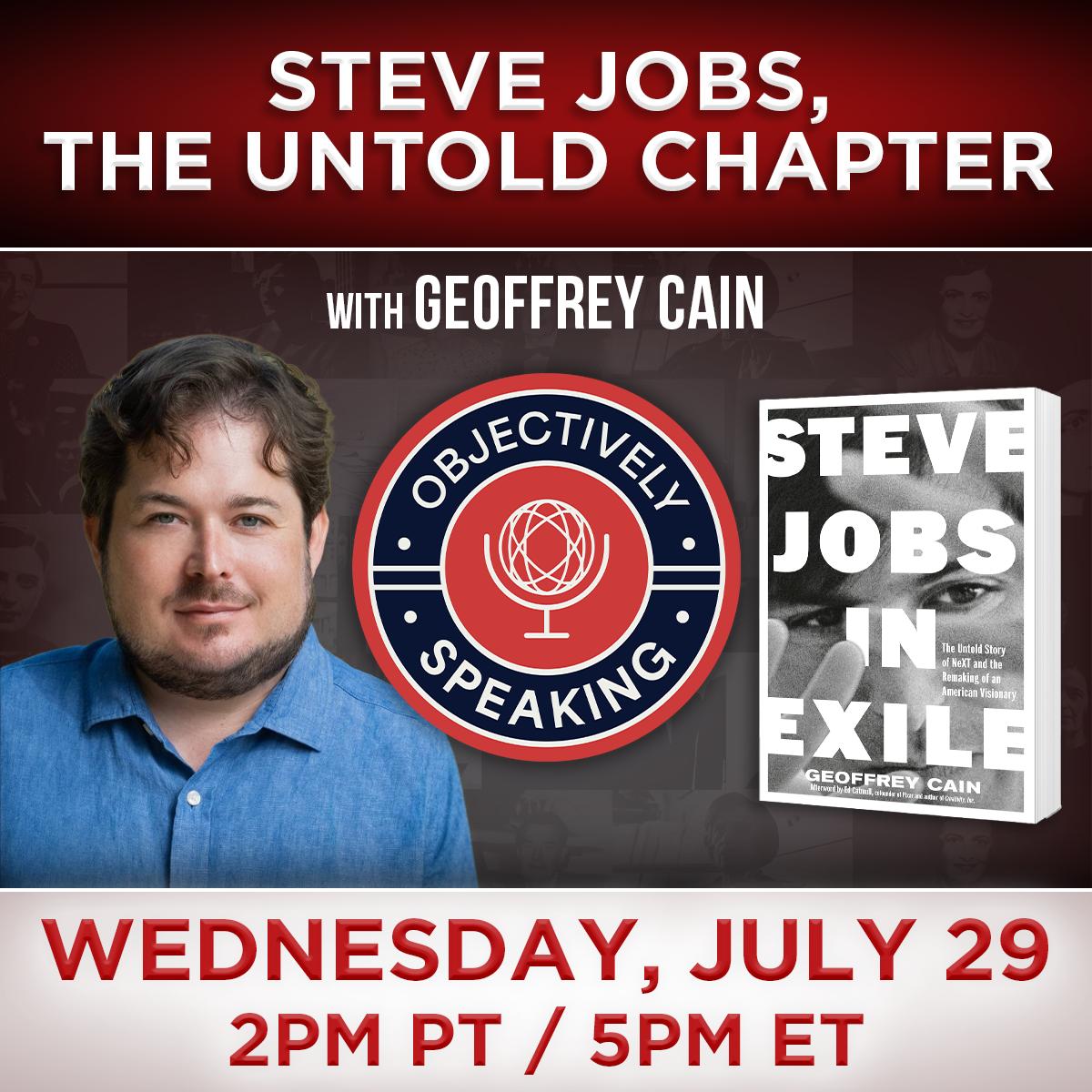
[00:00:00] Speaker A: Hi, everyone. Welcome to the 313th episode of objectively speaking. I'm Jag, CEO of the Atlas Society, and I'm very excited to have returning guest Jeffrey Kane join us to talk about Steve Jobs in Exile, the untold story of Next, and the remaking of an American visionary. Jeffrey, thanks for joining us.
[00:00:27] Speaker B: Great to be here. Jag. Good to see you again.
[00:00:29] Speaker A: Yes. And I want to apologize in advance. Hopefully this is not going to be an issue. But folks, as you may notice, I am not in the studio. I am on the road. I'm actually here in Houston, Texas, and I am at the mercy of the consistently unreliable hotel Internet connection. So we're going to try to do our best.
Jeffrey, about Samsung, about surveillance states. In fact, you know, you, you wrote about really, in a very prophetic way, talking about how the beginning of using this surveillance technology in one area of China has now become a global phenomenon. So I'm curious, what pulled you towards Steve Jobs lost decade, if you will, as, as your next subject?
[00:01:26] Speaker B: Right. So it was a topic that I think it found me as much as I found it. And you're right, previously I was writing about topics that were a little bit different. I wrote a book called Samsung Rising, about the rise, the emergence of the Samsung empire of South Korea, one of the most powerful companies in the world.
You know, rightfully a successful company. I wrote about the Chinese surveillance state, a book called the Perfect Police State. I was in China, I was kicked out for my reporting, and I was looking into how surveillance technology is being deployed to create a perfect surveillance dystopia where everything you do is tracked. Now, you know, when I was originally there and I was writing about this topic in China, it was about 10 years ago now, and time goes fast. But, you know, just cracking that book open again recently, I realize that this dystopia is starting to envelope much of the world. And, you know, obviously, you know, China is a communist country and it has, you know, its own communist system, but the way that we've deployed cameras and software and, you know, so, so much out there that documents our everyday life in such detail and it's, you know, sent to the government and sent to companies really is something that took. I did not realize how big this topic was going to be. I thought it would be more confined to China, but that's not true. And so the question is, how did I land at Steve Jobs? Well, the stories I was writing about before were essentially stories of the wilderness years of people and companies and success stories.
One of the great facets of so much literature and so much biography is the fact that great people, great visionaries, great leaders, and also great companies, not just individuals, have almost always gone through a period in the wilderness. And by wilderness, I mean a period in which they were ousted from the comforts of everyday life, where they had to be tested by the world, tested by what people needed from them, and had to find their true calling. And then once they were able to face a certain demon, whether that demon is, you know, an actual opponent, an actual opponent out there in the world, or an inner demon that had been haunting them, once they had learned to face that down and to become who they were meant to be, this is a profound moment when they're able to return and to do great things in the world. And me being a technology writer, author and biographer, I was drawn to Steve Jobs because I knew that he was one of the most written about visionaries and entrepreneurs of our era.
But there was an entire period, a stretch of 12 years of his life when he had been just knee deep in the wilderness, trying to navigate a series of setbacks of failures. He learned a lot about himself and he learned a lot about what the world truly needed from him. And he came out changed. And he came out changed in the sense that he was fired from Apple originally and he was finally able to return to Apple, the company he co founded, and he was able to save it from bankruptcy. It was about 3/4 away from bankruptcy, according to some estimates. And he was, he was able, with the lessons he learned from failure, to lead Apple into greatness. So if this period of life had never happened, these 12 years from 1985 to 1997 at a company called Next Computer, if this failure had never happened, he would have never returned to Apple. And that means that today there would probably be no iPhone, no MacBook, no iPad, and in fact, no Apple to speak of, it's very likely that Apple itself would have collapsed and gone bankrupt and out of business.
So, yeah, it's something that.
It's one of those profound stories of failure, but how failure can lay the foundation for what it is that you truly need to do for your calling.
[00:05:38] Speaker A: Yeah, well, I mean, and along those lines, the book opens with this quote from Steve jobs at a 2005 Stanford commencement speech. Quote. I didn't see it then, but it turned out that getting fired from Apple was the best thing that could have ever happened. To me, the heaviness of being successful was replaced by the lightness of being a beginner again, less sure about everything.
It freed Me to enter one of the most creative my life.
So most of us in the audience are familiar with that triumphal arc. What happened in those 12 years to turn his resentment into gratitude?
[00:06:25] Speaker B: Well, the resentment began because he was fired, as you just said. He was removed from Apple, the company he co founded. And he decided that he was going to outdo Apple, that he was going to make a computer that was so much cooler and so much more cutting edge and revolutionary. At Next Computer, he said that he wanted students in Stanford dorm rooms to be able to cure cancer. Literally, that was his goal. That's extremely ambitious and it takes a long time to get there. I mean, we have, you have to remember that this was 40 years ago and even today with developments. And I were just starting to see this potential where artificial intelligence can solve mathematical problems that have confounded us for hundreds of years and find medical cures to diseases that have always haunted us.
Steve Jobs was so far ahead of his time. And what happened was that he, in being so far ahead of his time, was in a failure mode for 12 years.
So the resentment was building because he would release these computers. He released these new systems that were really at the frontier for the 1980s and the 1990s. But the market kept rejecting him. It's kind of a lesson in how capitalism works and how the markets work.
You can have the greatest idea ever. I mean, you can be a brilliant visionary, you can be a genius. And Steve Jobs was very much a genius. I mean, he had, he had that talent, but his talents were misplaced because he kept trying to force feed consumers and force feed computer users with these systems that they just simply didn't need. You know, he would say, this thing is beautiful. It was a perfect cube, a computer shaped like a perfect cube, made of this exotic magnesium alloy, which is very expensive and painted in a matte black, black.
You know, these are cosmetic features, beautiful artistic and aesthetic features that drove up the price. The computer was, you know, in, in the 1980s, it cost more than $10,000 with all the necessary add ons to make it work. I mean, in today's money we're talking that's like a year's of a year's worth of tuition at the typical private university. So imagine that. Imagine somebody, you know, releases a computer today and tells, you know, students like, yeah, you're going to pay $80,000 a year for this, this computer that's going to change your life. I mean, most people wouldn't buy that at all. No matter how beautiful and how revolutionary the system is. So his resentment came from the fact that his products were failing. Something that we don't remember about him. We tend to remember him solely as a success.
And second, his resentment continued building because he wanted to get revenge on the people who hurt him. He wanted to show them what he was truly made of. And by building this structure, building this company as a monument to his own genius, but also a monument to his own vengeance that he wanted to see, you know, he wanted to see his own work be vindicated. In the end, he was setting himself up for. For enormous failure, which eventually culminated. He literally fell very close to personal bankruptcy. During these years. The people who knew him best said that he had about two to three years worth of Runway left in this company.
These were not public companies. He didn't have a ton of investors. And the investors he had, he had chased off.
So two to three years. Imagine that. Steve Jobs at rock bottom, he's being rejected. His co founders have left him. His investors are angry at him. They've left him. And because he is now being marked as a failure, the media is calling him a snake oil salesman. Literally. That's what Fortune called him.
And if this had gone any differently, if he had continued on this path of failure without learning the lessons he needed to learn, he would have been forgotten and written out of history. You know, he would be a footnote. We might remember the old Steve jobs of the 1980s, but he would never have been the larger than life figure who we now know, the guy in the black turtleneck who holds up that black rectangle, this beautiful machine that he says is going to change the world. That was only possible because he had been through the crucible, the fire and the tribulation of what it feels like to be so hurt and so beset by failure that you have no choice but to pick your life up and to do something great with it.
[00:10:54] Speaker A: Yeah, you know, we were talking right before we went live.
You had this. This great kind of thought experiment. What would a conversation between Ayn Rand and Steve Jobs be like?
Because they both were visionaries, right? They both had a message or a product or a technology or an aesthetic that they were bringing forward. And in some cases it was important, embraced, and in other cases, it was resisted. And I think that, you know, we forget the Fountainhead was rejected, I think 12 times before it eventually found a publisher. And, you know, even. Even the Atlas Shrugged was a wild popular success. But of course, you know, it was savaged not just by critics on the left, but on the right. And, and that kind of like, leads to a certain resentment and a desire to overcome, to have vengeance. And of course, you could see how Ayn Rand might have been carrying, obviously, even a bear wound with what the Bolsheviks did to her country, to her father, to her family.
And so sometimes it takes that burning desire to bring something new, but also prove others wrong, to come forward and persevere against such adversity.
All right, let's turn to some audience questions. Flying Custard, I haven't seen you here before.
He or she is asking how much of Jobs eventual success came from personal development and how much came from favorable circumstances or good timing.
Timing wasn't very good for him.
[00:12:42] Speaker B: But yeah, yeah, actually that's a very good question because there's no single answer. And it really is a mixture of both. It was personal development, but understanding how to use timing to your advantage. Steve Jobs in the late 1980s, so the year 1988, I have old emails that have never been published by him. And he was talking about deploying advanced AI systems to solve scientific problems and medical problems. He was experimenting with a, an exotic AI programming language that he was going to put on these computers. And, you know, I mean, this was a time when AI like, I mean, this was the age of the Terminator movies and AI was still so far off. I mean, it sounded like a fantasy to so many people. AI was just not ready yet.
This is only one example of one of the things he was doing. He also had invented this, rather not invented the software, but he had adapted a kind of software called Object Oriented Programming, which is essentially, think of it as if you have an iPhone. It's essentially that drag and drop, these little items on the phone or on the computer called objects. If you're developing software, you don't have to go through lines and lines of code to create it. You just drag and drop things and you put an item there and a box there and a dialog box here and there, and you have your software. And that was revolutionary because, you know, in the same way that developing, you know, the automobile required many components and parts that had to come together first. This was the equivalent revolution in software because now the components were coming together and with all these parts starting to fit, software was finally beginning to make sense. So without this revolution in software, we, we wouldn't have been able to develop the worldwide Web invented on a next computer. We, we wouldn't have been able to develop, you know, many of the other you, you know, the operating system, the Apple operating system, like a lot of these Things came from Steve Jobs specifically in this failure period of his life in the late 1980s.
The World Wide Web did not catch on until ten years later, even more than ten years later.
[00:14:55] Speaker A: The.
[00:14:57] Speaker B: The operating system did not get on every iPhone until 20 years later. So we're talking a guy 20 years ahead of his time. Artificial intelligence did not become a force until 30 to 40 years later, just the last 10 years.
So the question here is, you know, how do you take that vision, that brilliant vision, and how do you develop it and mold it into the here and now and understanding what actually works in the moment that you're in?
So he was able to harness timing. That's one of the big lessons of this period.
The timing is so important, and, you know, you can have a great idea, but if you miss the market, that. That free market out there moves by its own logic. And if you're two years too early, that's two years of lost time. Because the moment that you release something two years early, every competitor out there is going to jump on it. They're going to take it for their own idea, and they're going to release it two years later.
And they were not the innovator, they were the copier, but they're going to be more successful than you because they had timing on their side. So it's really a lesson of Steve Jobs navigating failure and trying to learn how the arc of history works. The arc of history is not always orderly. There's a Marxist. You mentioned the Bolsheviks earlier, Jag, and, you know, like, that's a great example. They were trying. They had a historical theory, and they tried to force it onto the world, onto their countries, and they created atrocities. I mean, millions and millions, millions of people dead because they had this. This grand vision of what history was supposed to look like, and it turned out to be wrong. It just wasn't true. Now, obviously, we're not talking about Bolsheviks in the life of Steve Jobs. This is a much tamer topic. But it's kind of a similar, you know, I guess a comparison that, you know, he was just so forceful in the way that he tried to put things out into the world, but he was creating disaster after disaster for himself because you can't force history to move in one direction. You have to use history.
You have to bring it towards your will and see how to harness it to do something great.
[00:17:12] Speaker A: Yeah. You know, in reading the book, listening, actually, it's a great audiobook, folks. So if you're an audiobook person like me, then I highly Recommend it. But it actually reminded me of another visionary entrepreneur that I personally worked for for about a dozen years.
Because just as Steve Jobs could be mercurial, could be gratuitously cruel to people that disappointed appointed him.
This particular entrepreneur that I worked for, David Murdoch, who was the owner of Dole Food Company.
He could go on a rant and a rage for hours.
And I always asked myself, on one hand I said, well, you know, these are the guys with the billions and you can't argue with success. But on the other hand, how much more successful might Jobs have been or might, you know, Murdoch have been if they had, you know, maybe taken their rational self interest and, and asked themselves, if I alienate all these people, if I get this terrible, you know, reputation, how might that not advance my goals?
[00:18:29] Speaker B: Right, That's a great question.
So rational self interest, I think that's the key word. And Steve Jobs in, in the next computer period of his life, he was not acting in rational self interest at all. He was being completely irrational. And one of the things that I found writing the book that was so fascinating was that there were these moments, there are these touch points throughout the story where Steve Jobs has everything lined up for him. I mean, he, he has a clear rational self interest to sign the contract, to take the payment and send the product, but he repeatedly self sabotages and blows up these wonderful deals that his backers have been setting up for him. I mean, people who work so hard to make him a success. And he keeps self sabotaging and rejecting their help and then just, just creating chaos in everything that he does.
So what's interesting about these touch points is that if he had acted in rational self interest and he had taken the route that the market was pointing him towards, all of the history of technology since then would be completely different. So let me give one example.
He was going to sign a deal with IBM.
IBM was the computer giant of the age, the 1980s and the 1990s, kind of a, you know, lesser known company today. But that was the pinnacle of technology at the time. And they were going to take his software called NextStep, which was the extremely advanced software that he was developing, and they were going to port it and put it onto IBM computer workstations in the 1980s. Now IBM has massive distribution, massive company appeal in particular. So, you know, we're talking, you know, millions of these machines going out into the world with the Steve Jobs, the brilliant operating system that he had created.
Companies, you know, like Disney would be buying this, you know, compaq all the big, you know, companies of the day, ge, General Electric and so forth, they would all have this at their corporate headquarters and they would have just thousands of these machines at each building. So that is an entrepreneur's dream. That is what you want, that you want big contracts, you want big customers who can keep you afloat because that is the cash cow that keeps the company going. But Steve Jobs was so stubborn and so difficult and he only wanted to sell his brilliant computer to university researchers, to scientists, to the brightest minds of the time.
And he wanted them to use his computers to win Nobel prizes and solve major problems in math and science.
So this is self sabotage and this is not rational self interest.
A rational market player would have taken that deal with IBM that sets up your cash cow and then, you know, that money flows into the higher end of the market that you're trying to develop, which is the brilliant computer that can, you know, for researchers, that can solve mathematical questions.
That's how markets work and that's how businesses work. And by the way, he made the same mistake at Apple when he was younger. That's one of the reasons he got fired from Apple, because he did something similar. And I won't get into the weeds here.
So if this had gone any differently, here's what would have played out. This is what the people who worked with Steve told me. Steve signs with IBM. IBM, you know, essentially absorbs Next computer and puts out its software. Steve Jobs never returns to Apple. And then today we would have a different technology ecosystem. We would have a choice probably between the Microsoft Windows computers that a lot of us use and then we would have computers loaded with NextStep operating system.
So that would be like the replacement for Apple. So Steve Jobs would have been much wealthier much earlier. He would have had kind of a different legacy cemented.
He's lucky in many ways that he was able to recover from the these failures later. But it's just so fascinating how these decisions that appear throughout the story, it's like Steve has clear decisions he can make. And if he makes the decision just a little bit differently, all of the history of technology since then would have gone in a completely different direction.
[00:23:05] Speaker A: Yeah, you talked about him creating chaos around him.
In reading your description, there was a lot of drama as well. He created a lot of drama. And as I was listening to this, I was like, somebody should get a hold of this. This would actually make a really unique and really interesting film.
Who knows, maybe Pixar will.
So question here before I get to that.
You mentioned Microsoft. How did the rivalry between Steve Jobs and Bill Gates play out within this context?
[00:23:42] Speaker B: Bill Gates was the villain to Steve Jobs, but, you know, if you were Bill Gates, then Steve Jobs was your villain. It depends on where you stand. And the disagreement between these two men came down to a fundamental philosophy of goes beyond technology alone. It's a philosophy of life, a philosophy of business, and a philosophy even of art.
Steve Jobs believed that technology should be best deployed on a closed and heavily proprietary system that, you know, you buy your iPhone, you buy your Macintosh, and it is closed with one operating system, one piece of software, and Apple controls it end to end. So it's like when you buy an Apple computer. His. His vision for Apple was that Apple sells artwork. It's like you're buying a Macintosh computer or an iPhone today, and you know you're buying a beautiful piece instead of just a tool that you can use for this or that. But Bill Gates was the pragmatic one, and we tend to forget this today, but Bill gates in the 80s and 90s was far, far more successful than Steve Jobs. And that was because Bill Gates was willing to work with the market and work with people.
So companies such as IBM, you know, Hewlett Packard, Compaq, these were the computer. The hardware makers of the day, Dell computer.
And he said, look, we will divorce our software, our operating system, from one single computing system, and we will make it flexible. So you can load Microsoft Windows on any PC.
And it's like, if you want to use Windows, you can use Windows on whatever computer is sitting around in your office. And people like that, because it didn't confine them to one closed system where they're trapped in this. Trapped in this Apple cage. It's a beautiful cage. It's like a cage made of gold. But nobody wants to be in a cage with Apple. Not at the time.
But that has changed since then.
Originally, Microsoft Windows was the massive success. Windows 95 made Bill Gates a billionaire. This was at a time when Steve Jobs was already being written out of history and written off as a failure.
But Steve decided in the end to adopt that Bill Gates sensibility. He realized that you do have to take different elements of your product, and you can't sell the whole bundle together. Sometimes you have to pick things apart, and you have to take your software and you have to sell it on other people's computers. You just can't control the whole thing. It's just not realistic. And what we tend to forget today, Apple is so successful today with the close, closed, proprietary ecosystem. Hardware and software fused together into this beautiful technology.
But the only reason Steve Jobs was able to pull this off with the iPhone was because of these years when he built a strong negotiating position. He needed, you know, he needed different things. He needed money in the bank, he needed a great team, he needed a great software that he could sell to people. But he could only achieve this through these lessons. And once he was able to sell, you know, sell, act in that rational self interest, as you said, build up a strong position where you have cash reserves, you have, you know, lots of computers on the market, so you, you, you can dictate to the market what it is that people need. Once he did this for about 15 years, building up this position, then he was able to develop that proprietary closed iPhone. He would walk into a telecoms company and he would tell them, we're going to do it this way and I have the power to negotiate here, so we're going to do it how I need to do it. And that's why he was so successful later.
[00:27:32] Speaker A: Yeah, we touched on Ayn Rand a little earlier, and I don't know whether or not Steve Jobs ever read the Fountainhead, but it's likely he would have, at least in those earlier days, much more identified with Howard Rourke and his unwillingness to compromise the integrity of his vision and go and, you know, break rocks in a quarry rather than capitulate. So, all right, great question here from Alan Turner. Great to see you, Alan. He wants to know, how did NEXT employees view Jobs during this time? And did any of them follow him to Apple?
[00:28:13] Speaker B: Yes.
So some did and some did not. But the way that they viewed Steve Jobs during this time was, one, extremely difficult, but two, extremely talented at bringing their greatest work out of them. They would often compare Steve Jobs, his personality, to a street hustler. And, you know, he's like, he's like a hustler who could look.
Look at you and peer right into your soul and figure out who you are and what you wanted and what you were good at. And he just had this ability. I think it's something that came naturally to him. He would find somebody who was really talented and he would push them to their limit and he would get them to produce great work. One of the most common remarks that people made about Steve, you know, they look back at working with him at Next Computer and they say, I don't know how I did that. I don't know how I created that. It was so far ahead of its time and so visionary. If I had been at any Other company, I would not have been able to be that creative. But for some reason, Steve was able to take this out of me. And they were resentful for many years. A lot of them were angry because he treated them badly. I mean, he was always a jerk and he would be difficult and he would berate people.
And, you know, they. They carried this anger with them until Steve died.
But once he died, a lot of them looked back and they forgave him. They saw, you know, the difficulties. It was a hard time in their lives. But they looked back and they thought, wow, you know, there's a whole other side to this. And, you know, they're not justifying being abused by a boss, but they. They were saying, you know, it's just to. To be able to reach that height. You know, there's something almost mystical about it that they can't put in physical form. It's like he's just able to bring out this brilliance in people that even they did not know that they had. So I think that's a key lesson for any entrepreneur out there. You know, I think a lot of entrepreneurs tend to get lost in their own vision and they forget sometimes, you know, what the people around them are truly great at. And I think what separates a good entrepreneur from a visionary entrepreneur is that exact ability to reach into somebody's, you know, look at their eyes, reach into their soul and to pull out, you know, just brilliant work that they did not realize they were ever capable of.
[00:30:43] Speaker A: Yeah. All right. This hearkens back to our earlier conversation. So we can hit it quickly, lock, stock and barrel. Asking if you have any thoughts about researching or publishing anything related to flock. The flock cameras we talked about.
[00:30:59] Speaker B: Yes. So the. My previous book called the Perfect Police State.
So, you know, we live in a society of surveillance.
Surveillance capitalism. That's what they call it. It's a surveillance society.
And, you know, back when I was a foreign correspondent in China, it was something that alarmed me because, you know, I would.
I would go about my day and go about my business, and it was very obvious that to me that I was being surveilled constantly by systems, by humanless systems. And to give one example, I was, you know, one time sitting in a tea shop in a western region called Xinjiang, which is the far west of China, where they had first developed some of these AI systems about 10 years ago. And I was having a conversation with some people, you know, and it wasn't a sensitive conversation. It's just me just chit chatting in the morning and the government had installed a surveillance camera in the corner of this tea shop. And as we were talking, the camera, I saw it. The camera turned right towards us, and then suddenly there was a flash. And I realized that we had just been photographed by, you know, either an AI system or some police officer sitting in an office somewhere. That's the level of intrusion that people in China have to deal with now. And it's worrisome. The worrisome part, you know, this is, you know, I'm sure Ayn Rand would have a lot to say about this. She was, you know, very much about individual liberties. And I think that this would just disturb her and shock her. But then there's also, you know, George Orwell and Aldous Huxley, these other intellectuals of that same era. And I realized that I was living in, you know, what these exact intellectuals had predicted. You know, they. They predicted a total surveillance state. They predicted, you know, methods that police and governments would use to intrude on our civil liberties. And China was ground zero for that. But now, you know, what concerns me is that we have this in various forms everywhere. And I often, you know, when. When. When you originally asked me to do this interview, I was kind of thinking about that, just reflecting on, you know, if Ayn Rand were around today, what would she think about the surveillance capabilities that were developed, that we are developing now? And are we reaching a stage, you know, as AI becomes more powerful, where they're simply going to get out of control? Is it simply that we're going to be surveilled 24 7? So, just to give one more example, I was reading an article today about the next frontier of Data technology called 6G. So we're now in the 5G system, and there was a technologist who was commenting that the sheer power of 6G combined with artificial intelligence means that we probably won't even need cameras anymore everywhere. It will simply be that if you're standing behind a wall, these systems will be able to measure your heartbeat and figure out where you're standing, just with various devices in your room, like camera, not even needed. That's the stage that we're reaching. And that's what deeply concerns me about the way that we harness technology and what purpose we're trying to use it for. Because I see technology as a tool for human liberation. This is supposed. This is actually what is. In Steve Jobs in exile. He was building, trying to build liberating technologies, creative technologies. And technology is a tool. It's something that we should be using to bring out our better angels. That we should use to advance science and to advance art and to, you know, we could truly create a wonderful world with the tools that we have. But we're moving in a direction that of oppression in which we're going to have to wonder, you know, if, if I'm sitting alone in my living room and I have a 6G system, you know, in my house, am I simply being surveilled and I have to be careful, you know, what I say in my own home, Is that where we're headed? And I hope not.
[00:34:57] Speaker A: Yeah. You know, you mentioned Ayn Rand and there, and also Orwell in 1984 and, and Ayn Rand wrote a sort of dystopian novella in Anthem and it came out about 12 years before Orwell published 1984. And she had very different visions. Right. So in her vision, when a society rejects individualism and embraces collectivism, you don't move forward to the technologically equipped an opticon. Right.
You actually regress to more of a primitive condition.
But you know, with, with these technologies, it does tend to kind of favor Orwell's vision rather than, than the one presented in the Anthem. So we shall see. All right. Iliation asks any parallels between Steve Jobs and Anthony Apple and what you, Jeffrey, saw with the rise of Samsung?
[00:36:02] Speaker B: Oh yeah, absolutely. And so they are different stories. I mean they are, they did have different paths. But what I found fascinating about Samsung, I, I guess I would say the par, the one parallel is wilderness. And one of the things, you know, I think actually Ayn Rand might appreciate this about South Korea, which is the country where Samsung comes from.
South Korea was once extremely impoverished. It was just a horrifically poor poorer than in the 1950s. It had come out of war, the Korean War, which had devastated it. The communist regime of North Korea had invaded South Korea.
Three million people died. There was a U.S. and United nations intervention and many American soldiers died there too, defending their freedom. And the story of South Korea is tied up with the story of Samsung. They call it, the country is jokingly called, half jokingly called the Republic of Samsung because Samsung is so omnipresent there. But what happened is that the South Korean people learned to harness certain types of capitalism and you know, export oriented growth to build highly successful companies that would take on the world.
So they, what they realized is that South Korea was, you know, because it was so poor, it didn't have much of a consumer market. Who, like, who can you sell to? You can't sell much to anyone in South Korea in the 1950s, there's just no money there. And so they realized that the only way to come out of poverty would be to undertake a capitalist model of selling to Japan, the dominant country of the time, and America and the Europeans as well, you know, sell them what they need, sell them the chips, sell them, you know, the computers. Eventually, and with each stage, just elevate what you can do. Elevate, like, the possibility of what, what it is that you can sell. So you're getting more and more advanced. And eventually they, they overtook Japan, they overtook companies like Sony, and then they went head to head with Apple, the, the Samsung versus Apple as one of the classic smartphone wars. But nobody thought that this was possible. I mean, even maybe 20 years ago, it would have been unthinkable that South Korea would have gotten that far to be able to take on a company like Apple on the world stage. So the question here is, you know, what is the parallel? And the parallel is, you know, what it is, what it means to be in the wilderness. South Korea as a nation was in the wilderness. It was utterly devastated, and yet is one of the greatest industrial and capitalist success stories in the world. Just, just a sheer undeniable success story. And, you know, there are critics out there who, who try to argue that, you know, South Korea has social problems, you know, which it does, but, you know, compare it. North and South Korea used to be one nation. I mean, they, it used to be one kingdom. The, the, the Koreans were one. And look at the outcomes. Look at North Korea under communism. Look at, know they've had famine, they've had millions of people die in all kinds of atrocities and purges. And look at South Korea and look at, you know, what happened with that enormous victory. I mean, it's just, it's a huge vindication for the capitalist model. And I, I'm so fascinated with South Korea for that reason.
[00:39:28] Speaker A: Right.
[00:39:29] Speaker B: So, yeah. So anyway, I'm, I'm digressing a bit, but I'll just say that the parallel is that, you know, both Apple and Samsung, both Steve Jobs and Samsung were venturing through this wilderness, these dark nights of the soul, when they had to figure out what it is that they truly stood for. And once they were able to figure that out, what we stand for, then they were able to make their mark
[00:39:53] Speaker A: on the world, right?
Well, yes, and you can see that stark difference between north and South Korea from space, because one country is lit up with technology and progress and life, and one is completely dark. Again, vindicating Ayn Rand's premise that once you embrace Communism and collectivism, you regress rather than advancing. But we'll see. You know, one thing I either didn't know or maybe I had forgotten, he talked about Steve Jobs becoming a larger than life character. Well, he also wanted to, to be a larger than life character. And early on in this exile, apparently he was considering entering politics. But one of the stumbling blocks you describe is that he couldn't decide whether to run as a Republican or as a Democrat. Well, you know, that was a different reality. If you were wanting to run for, let's say, governor in California today, you're only going to get elected as a member of one party. But do we know anything about his, did he have any firm ideological beliefs about capitalism free enterprises? He was philosophical, but what were his thoughts about how an economy and a government should be run?
[00:41:18] Speaker B: So when he was younger, he was not a very political person. He was mostly influenced, influenced by, you know, more non political ideas. So Zen Buddhism was highly influential on him. And you know, he very much self identified as a hippie when he was young and literally he used that word to describe himself. So he went to Reed College and you know, he would smoke marijuana and he dropped out.
You know, he, he had a girlfriend and they, they had a daughter together and he treated her quite badly. He refused to give her, you know, he would. So his paternity was proven, but he refused to give the court order payments, you know, to his poor, poor daughter Lisa.
So, you know, he was very much on this path of, of, you know, the, the broken soul, the person who was, you know, searching for that, that aesthetic Zen quality, but who in his personal life, you know, couldn't quite live up to the ideas and the principles of, you know, what it truly meant to be a spiritual or a, you know, a Zen devotee. You know, that, that requires discipline, it requires focus and meditation and, and all that.
So his political views were never really that well developed when he was younger. And even when he was at next computer, he resisted working, you know, with a lot of groups that he considered political.
So, you know, he was going to sell to the Pentagon, he was going to sell computers to, you know, the intelligence agencies. And he repeated, these were big contracts that actually would have saved him. But he refused because he just couldn't bring himself to sell to, you know, the man as he would the establishment, that sort of thing.
So what I found fascinating, and this story hasn't really been told anywhere else to my knowledge, it was Ross Perot. I don't know how many listeners remember Ross Perot. He was the populist, you know, the. Very much a civil liberties and free market oriented populist candidate from the 1990s, ran for president twice. And what he was famous for was that he, he blew right past the established political parties and he got something like 20% of the vote in 1992. That, that hasn't, I mean, that's very, very rarely happens. And he proved that you don't need to be Republican or Democrat. You know, if you, if you just have these, if you have good ideas that appeal to a large chunk of the voting population, you can have a serious shot at becoming the president. And that was not very common back then. So Steve Jobs ended up, you know, their, their relationship was rocky because Steve Jobs would not take his mentorship. But Steve Jobs, in the end, he did end up revering and liking Ross Perot and his ideas quite a bit. That's something that I learned about him, and I think it speaks to a kind of individualism that Steve Jobs had. Steve said in an interview once that, you know, he, he would vote for Ross Perot, that he supported his presidential candidacy.
And this was even after their relationship had broken down. And I think that reveals quite a bit about the Steve, the political mindset that he didn't really reveal a lot to people. And it was that he truly believed that, you know, you could make it in life. You know, if you stuck to the basics. You know, for a lot of people, if you, you know, if you work hard, if you, you know, reap the reward of, of your work, then you know, you will be generally okay in life. And of course, some people, you know, have hard circumstances, but for the most part, the rule holds.
And as Steve went on through life, you know, he did become, he would meet Bill Clinton. He had a relationship with Bill Clinton when he was president.
I found old correspondence between the two, but I never really got the sense that he was a major Clinton supporter. I think it was more of a, you know, like if you're a celebrity, if you're famous, you know, you naturally have a relationship with the president at the time.
So, you know, I think Ross Perot really explains a good deal about his politics. And, you know, if anyone, it's worth reading about Perot and his work and his thinking, because I think, you know, if anybody were to read about that, listening to this show, I think that would reveal quite a bit about what Steve Jobs truly believed.
[00:45:37] Speaker A: Interesting. Well, another really important thing that was happening during this period was while NEXT was burning through piles of cash, Jobs was also Personally funding Pixar through years of losses.
What do we, what motivated this kind of perseverance?
[00:46:02] Speaker B: So the perseverance was many things.
There's no one factor there. But I think the biggest factor for Steve was an irrational belief in his own abilities.
Irrational to the point where he believed that he could con, he could keep self funding two companies for about 10 years.
And even as these two companies failed repeatedly, these two companies were next Computer and Pixar.
We know Pixar for Toy Story today, but this was before that. This was when the future was not clear and Pixar was not doing well. He truly believed that he could keep self funding these companies with minimal help from other investors and that the light would come at the end of the tunnel. That's truly irrational. I mean, there's no other way to put it.
And I think that Steve, you know, he, he had this ability to get so focused on his goals.
It was something this irrational force that was both a strength and a weakness. It was a strength because it gave him such incredible perseverance. I mean the typical entrepreneur would have given up after a few years and gone and done something else. They would not have continued on this failure pass path. But then the, the, the downside to this is that he wasn't able to in his younger years apply this perseverance in ways that were actually rational and that would see a return on his own investment. It, I guess the way that I would put it is that it was a build it and they will come philosophy. I build the greatest computer in the world and people will knock down the path to my door and they will buy my computer. That never happened. He closed the computer, the hardware division at Next Computer, major failure Pixar. You know, he truly believed that if I make the best computer graphics and make brilliant stories and films with these computer graphics, the success will naturally come. But that's also a lesson that did not happen.
He, he had to get a lot of people on board. He had to convince Disney and a lot of skeptical figures about the merits of Pixar and why they should replace the old hand animation, the two dimensional animation, with the next wave, which would be computer graphics, which is now ubiquitous but is not, was not by any means, you know, a thing back then. It was just not, you know, Hollywood was not buying his story. So it wasn't, you know, this force of will that he had, it was a strength, it was a weakness. But he had to learn to harness it in a way that would advance his vision rather than just hoping that Other people would come to him. And that was one of the big takeaways of this period.
[00:48:48] Speaker A: Yes, I always say that sometimes someone's best strength is also their, their biggest weakness. And being learning how to channel it in the right direction is the dividing factor. So we've got 10 minutes left. So I'm going to take one more audience question from my modern Gault, who's asking, do you see any entrepreneurs today who embody Steve Jobs mindset at all? Or perhaps even a little too much?
[00:49:22] Speaker B: So I'm going to start with somebody who does not embody the Steve Jobs mindset because I think that this comparison is often made and it is simply not accurate.
People often point to Elon Musk and say that he is the modern Steve Jobs, but that is absolutely 100% not true. And the reason is because Steve Jobs was highly focused. He would go focus on one beautiful aesthetic, world changing product.
He wanted the one iPhone. He went into Apple and he cleared out. He canceled about 70% of its products when it was close to bankruptcy. And he said, we're only going to build, you know, four things. We're going to build two computers and we're going to build two phones. Like that. That was the, and I'm paraphrasing, but that was like the rough idea that he had.
It was not the case, you know, with Elon's rise that, you know, Elon was operating in this matter. Elon spends, according to his biography by Walter Isaacson, Elon spends, you know, one hour a day. He'll focus on rockets for one hour and he'll solve an engineering problem. Then he'll go over to, you know, X and to social media and then AI and then this and that. I mean, Elon is just all over the place.
So, you know, like it's, I'm not saying one approach is better than the other, but I think that if both men, if Steve were still alive today and both men were kind of commenting on each other, I think that Steve would, he would admire Elon. He would say Elon does a lot of really cool things, but he would say Elon needs to focus. And I would guess that Elon would probably say, you know, Steve is way too over focused and he's focused on products that are going to get old fast and he needs to, he needs to put his eggs in different baskets. That's sort of the Elon approach.
I think that, you know, if there is one person today who might be the closest to Steve Jobs, you know, it's, it's hard to say for sure, but I think that maybe Dario Amadai at Anthropic.
I've noticed. I read about these figures quite a bit, and Dario seems to be quite focused and quite purposeful in the way that he does things. I see.
I don't think that they're the same personality. That's not what I'm saying. But I think that attention to focus, the attention to thinking about the purpose constantly of what it is that you're creating, as opposed to simply putting out on the market and trying to sell it.
Steve was always thinking about, what is the core purpose of what I'm doing here? And if he couldn't figure it out, if you would ask an engineer, so why did you build this? And if the engineer can't answer in one sentence, Steve would just tear them apart and say, this is useless. It's going to fail on the market because you need to know in one sentence what that purpose is, or else nobody else is going to figure it out for you.
And I think Dario is kind of similar in that way. I think that he's the one I would probably point to.
[00:52:20] Speaker A: All right, well, if Jobs could read this book or listen to it about his exile years, what do you think he might bristle at? And what do you think he might grudgingly admit that you got right?
[00:52:36] Speaker B: Yes. So that's. It's a tough question because it's hard for me to be completely objective about my own work, of course. And that's, you know, a weakness that I think every writer has to grapple with. But I think that if Steve were still around, let's say I sent him a copy of the book and said, hey, Steve, can you, you know, give me your feedback on this? You know, Steve was very difficult, so I think that he would.
He would tear certain parts to shreds and, you know, he would say other parts are good. He. He had this thing called the hero shithead roller coaster.
It was this thing he did where he would call people a hero one day and then he would tear them down the next and call them a.
And I think he would treat me that way, too. He treats everybody that way, you know, So I think that he would, you know, look back. I think that he would probably agree with the relationship between him and Bill Gates.
I think that that is.
It's very well covered in the book. And I think that he felt that way at the time, and I think that he continued feeling that way throughout his life. That Bill was, you know, Microsoft was kind of this tacky company that didn't have much taste. He always criticized Microsoft. They have no taste. They have no art.
Their. Their relationship, Bill. Bill and Steve softened later and, you know, they made amends and they made deals, and, you know, they were pragmatic in their dealings together.
But I think that's the part where he would look at it and he would say objectively, yes, that is true about me. The one thing I wonder about is that, you know, since Steve was always this very forceful character who was so inside his own vision, I wonder how he would feel about the way that I documented and researched his repeat failures. Would.
I don't know what the answer is. It's very hard to speculate. I mean, you know, we're speculating about a very complex figure, so take this only as speculation. But the thing I wonder is, you know, would he have been able to step back and look, you know, later in life, look back at the failures entirely and kind of see what truly went wrong in every case?
You know, the things that I documented, these were his former colleagues who were involved in the failures, telling me what they witnessed, showing me documents. I mean, it's all factually accurate. It's all true, and I can document it. But when somebody is being written about in biography, it's like the biographer's problem. The people involved in a topic, the person that you're the subject you're writing about, you know, you're going to bring things to them that they sometimes didn't quite realize about themselves, that other people are saying about them. And sometimes they, you know, vehemently disagree and, you know, they will say, well, that never. That didn't happen, or, you know, I don't remember it that way.
One of the tasks of the biographer is not just to recount how your subject saw themselves in their own words, but how the people around them who can be more objective about, you know, witnessing this person and what they were really like, documenting their view, too, and trying to get a full picture of the strengths and the weaknesses and the various facets of these very complex historical figures.
[00:55:39] Speaker A: Final question.
You know, when I have these interviews, I often ask authors what they learned, how their. Their mindset may have changed on account of what they learned while researching and writing the book. And I think one of the best moments of this interview was actually off mic when we were preparing to go live and you were talking about lessons you learned and how you might or might not be attempting to apply them in your own commercial ventures.
And so for young entrepreneurs, for young innovators, for people who might be thinking about starting a business. What lessons from Steve Jobs experience in exile might they apply to their own new ventures?
[00:56:31] Speaker B: A step outside of your head. That's the biggest lesson. That's what Steve has.
[00:56:35] Speaker A: Retard max.
[00:56:37] Speaker B: Is that the term that they use?
[00:56:38] Speaker A: Oh, yeah.
[00:56:39] Speaker B: I haven't heard that one before.
[00:56:41] Speaker A: Apparently, Marc Andreessen developed an infatuation with this YouTube channel which is about retard maxing. And it's exactly what you're saying. So you two are kind of reaching the same conclusion, which is don't. Don't overthink it. Get outside your own head.
[00:56:58] Speaker B: Right, right. It's easy. As an entrepreneur and as an author, too, we all have this problem. We get so dedicated, so close to our own work, that we can't step outside and ask the question, do I really get everything or am I getting everything? Am I understanding everything? And this is why you need good people around you.
You need people who will push back against you. And that's what Steve learned in this time of his life. We tend to think of Steve Jobs as a tyrant, that he would run around bullying people constantly. And he. He was very tyrannical in his. The early part of his life. But as he aged, the people he hired, he wanted them to push back, he wanted them to fight, and he wanted them to defend their ideas tooth and nail and to show him why he should trust them. And I think that's one of the keys to success. If you're building a business, you need people who are not, you know, yes men, you need no men. You need people who are going to tell you why you're wrong. And they're not going to be scared. You know, they're not worried that you're going to fire them. They really need to. They really need to tell you what you need to hear.
[00:57:55] Speaker A: Well, fortunately, I can say we have plenty of those people at the Atlas Society, and that is perhaps partially responsible. Responsible for the tremendous success we've achieved over these past few years. So again, join us. Next week, I will be back in the studio. We are going to be speaking with Calvin Coolidge, Presidential Foundation Chair Amity Schlaise. She's going to join us to talk about her book, New Deal Rebels, an anthology of critics of the New Deal. We'll see you then.