Episode Transcript
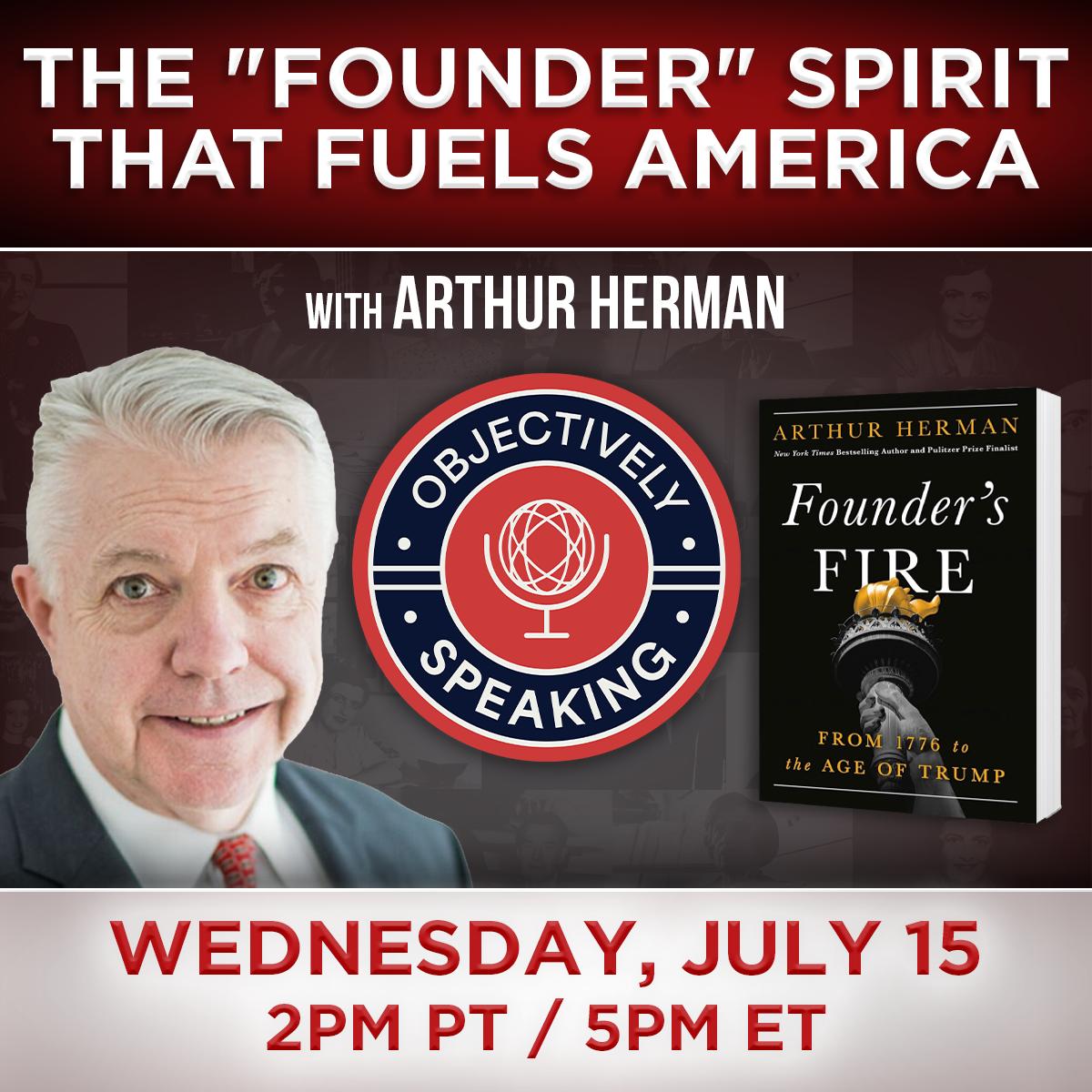
[00:00:00] Speaker A: Hi, everyone. Welcome to the 311th episode of objectively speaking. I'm Jag. I'm CEO of the Atlas Society, and I am super stoked to have returning guest Arthur Herrmann join us to talk about his new book, founders fire from 7,076 to the age of Trump. Arthur, thank you for joining us.
[00:00:23] Speaker B: It's a pleasure to be here again.
[00:00:26] Speaker A: So are you surprised by the super hot reception of your book? We were talking before. You just came from a lunch with a certain senator and he brought his copy all heavily annotated and bookmarked.
What do you attribute the popularity of this particular book at this particular moment to?
[00:00:50] Speaker B: Well, I gotta say, as you point out, it's very gratifying to have that kind of response and to have people get the message right away that this is a book which on one hand is a celebration of the original founding, the America's founding on the 250th anniversary. One of the reasons why we did this book and timed it when we did, but also I think, two, those who have realized that when we talk about founders, that we're not just talking about founders in terms of the founding Fathers or founders in the political stance, but we're also talking about founders as being the soul of the entrepreneurial tradition in America, the one that really embodies what I think of as American exceptionalism and what I wanted this book to do in terms of its historical sweep from 1776 and the setting within which the. These group of men, the original founders, put together a declaration of Independence and take that bold and very risky step of declaring independence from the greatest empire in the world, Great Britain, at the time, that you can watch this same spirit of vision, of this drive, this sort of can do attitude, and the willingness to take risks, in fact, in certain circumstances, to risk everything in order to achieve that vision. That you can trace that same kind of a spirit, what I call the Founder's Fire.
You can trace it all the way through the major episodes in American history. And this is what the book does and brings it right down to today, to the. The way in which we've seen political forces and economic forces shape around the second Trump administration, in which we sort of see a gathering of founders who come to realize that the time has come for. For a similar kind of refounding of the purposes and direction of American governance, that the role of limited government, of recognizing and celebrating the spirit of free market capitalism, of entrepreneurial capitalism, of founder capitalism, that that moment has come again.
And that although there are we see counter currents running in certain isolated pockets in American, American politics today.
That, that what we really, what I think we've really sensed now taking place is that there is a fundamental sea change that's taking place in our politics and our economy that really is one that I think someone like Ayn Rand would be very pleased about.
I think to think that, I like to think that this is a book that, that she would be interested in reading and, and celebrating as well.
[00:04:13] Speaker A: I think she would. Obviously, Atlas Shrugged is full of. Of founders and re founders and, and great entrepreneurs and industrialists.
But speaking of founders, you begin this book with the story of Zach Yatagari. Who, who is he? And what does his experience tell us about how entrepreneurship is viewed by many of our elite institutions?
[00:04:39] Speaker B: I found Zach's story really fascinating when I first heard it. It's this young man, high school student at the time, who had created basically an AI driven app, a very simple little thing, the kind of thing that you'd expect some contestant to bring to bear on an episode of Shark Tank. And I talk about Shark Tank in the book because I think that's also a television program that really captures that entrepreneurial American spirit in very powerful ways. But Zach's experience was to create this app that made him and his business partner basically millionaires while they were in high school.
An extraordinary story, but a great success story.
And yet he found that when he was applying to colleges, universities, that he was getting turned down at one elite institution after another and that the, and that what he had accomplished, the singular success that he had accomplished as an entrepreneur, as a founder, seemed to rack to matter not at all.
Or America's leading educational institutions and colleges against him. In fact, in fact, you could say, couldn't you, that it probably, it probably hurt his admissions chances for. By being involved in something that, that was actually bringing value to the world, to customers, as well as, as well as the success for himself. And I thought that this opposition between, on the one hand, the American spirit of capitalism, of entrepreneurship, of founderism, I can coin that phrase, and then of the, of, of a status quo, an educational status quo which is blind to the value of that entrepreneurial spirit, that this opposition, opposition and confrontation between these two forces would make a, a great way to start this book. Because what the story I tell in Founders Fire is of a way of seeing American history in a fresh light. I think of a, of a constant struggle and confrontation between, on the one hand, this founder mentality that Zach as a teenager really embodies and epitomizes and on the other side, what I call this manager or managerial mentality, which is about de. Risking situations and enterprises, which is about slowing down the progress and development of capitalist enterprise.
And then ultimately in its more extreme versions is one that kind of subsides into this sort of bureaucratic inertia and even, let's face it, sets the stage for a kind of socialist, a collectivist kind of mood which is that those who do get rich and enriching our lives are doing so unfairly and that we need to find ways in which to restrain that energy and dynamism and creativity.
[00:08:15] Speaker A: Yeah, that.
[00:08:16] Speaker B: That embodies the capitalist, the capitalist spirit. So American history. This is a, this is, this ongoing conflict is what I'm getting at, that we see played out and that I, I spell out in the course of the book.
[00:08:28] Speaker A: Yeah. You know, it reminds me of in Atlas Shrugged, the star family heirs running 20th century motor into the ground.
So I'm wondering if that manager capture is the default fate of every great enterprise, including America itself.
[00:08:47] Speaker B: Well, you know, that's a wonderful way to pose the question and I think you've really got something profound there because as I explained in the book, it is the fate of so many successful corporations and companies of one in which the original vision and drive and creativity innovation of the founder in the next generation, either generationally in a. In a sense of the. The sons and daughters who then take over the corporation or the enterprise, but also simply the next generation of managers and vice presidents and others who step in to help to manage the success that this great corporation has achieved thanks to its founders vision and drive. That what you see is that the creativity tends to get smothered and begins to sort of slip away. Sometimes for the best motivations we have to slow everything down because we want to be able to enjoy the success we have or consolidate the success we have here.
That we want to be able to move more incrementally in order to not to arouse the ire of competitors of government.
And eventually what can happen?
It's not the case every corporation, but it is, I think, very typical. The life cycle of corporations is that the bureaucratic mentality takes over and the desire to take risks is drained away.
The push to new horizons, to adopt new technologies begins to. Begins to fray and eventually disappear.
And eventually the corporation becomes then part of the status quo and itself then becomes challenged by a new wave of founders who step forward. And I point out how this happened when you look at big companies like an IBM for example, which was A very dynamic company in the hands of the hands of the Watsons when, when it was originally founded. Enormously creative and innovative. But it gets bigger, becomes big blue, and then grows to become this mammoth, you know, sort of monolithic presence. And what happens is it is then challenged by a figure like Steve Jobs who has a very different and innovative version of what computers can do and how they can relate to people's lives and become part of their, part of their everyday life in ways that IBM and IBM's managers were never able to conceive or understand.
[00:11:38] Speaker A: Yeah, no, I think so.
[00:11:40] Speaker B: There's an historical cycle.
Yeah, I see the cycle that takes place of, of birth, of growth and then of slowing growth to stagnation and then decline. And then out of that, out of that comes a rebirth, a rebirth and a re growing. And that's been a big part of American history. Those moments of those, well, decline and
[00:12:04] Speaker A: then rebirth on that kind of refounding. Because you say that, you know, founders aren't necessarily just responsible for origination, for starting something new, but that a founder can also be part of a re founding. So I'm wondering, you using one of the examples in the book, is Diocletian the Roman emperor, how does he illustrate that concept?
[00:12:31] Speaker B: Well, this is, this is of course not part of, this is long before America's history and long before, but it is. Diocletian is part of a generation of soldiers, soldier emperors who come in in the third century, third century of the Christian era, who confront the fact that the Roman Empire at that point sprawling as it does from the Pillars of Hercules and, and Gibraltar all the way across North Africa, across Europe to the Tigris and Euphrates rivers, that this is an empire that's gotten way too big for being administered or controlled or even, even governed by a single emperor.
And after a series of upheavals and near extinction of the Roman Empire in the course of the third century, is Diocletian and his colleagues.
These are not men born to the purple. These are not men from the senatorial aristocracy. These are men who've in, in Dian's case, worked his way up from buck private to become emperor based on his skill as a soldier and his understanding of military strategy, that this is an empire now that needs to now be governed not by a single man, but by four men. The Tetrarchy, as it's called, co emperors, who divide the empire, the Roman Empire in half, Eastern half and then the western half. And each of them having a co emperor, a Caesar who serves under them as their subordinate. And the result is he not only saves the Roman Empire, but also creates a division of labor that enables the Roman civilization to survive and survive in the eastern part of that empire. In fact, for the next 1,000 years.
It's a again the kind of creative leap of a re founding of the Roman Empire in this way. And I think one of the figures I focus on in the book Founders Fire in American History, who does this is Abraham Lincoln, who sees an opportunity when the Southern states decide to secede, that this is an opportunity to carry out a refounding of the American Republic, of the American ideal expressed in that Declaration of Independence, of that all men are created equal. That a refounding to make that statement finally and irrevocably true by ending slavery and then refounding the American Union on the basis of free men and citizens coming together instead of having a union which is half free and half slave.
It's the kind of moment that happens very rarely in American history, but it is ones that give a new sense of life, a new sense of purpose and direction for, for America and for the United States.
And, and I think that for that reason I include Lincoln. Although he never created a business himself in any kind of way. We don't think about him as a founder in a business sense, but as a founder in a refounding sense. As you just put it, he's a hugely important figure
[00:16:17] Speaker A: at a business. He did have a role that I read about in the book in creating the trans continental railroad system. Can you elaborate?
[00:16:26] Speaker B: That's right. And he, look, he was a corporate lawyer. We forget this.
His background was as working with Illinois's biggest railroad company.
And he understood business very well. He understood how it worked. He understood particularly the railroad business and understood how the railroads could create a connectivity that America at this point sprawling across the North American continent, desperately needed to bring the settlements and states like California in the west, bring that together with the big and growing industrial and manufacturing hub in the Northeast and then across the great agricultural and growing settlements of the plains states, to bring this all together.
That this was what a transatlantic transcontinental railroad could do in ways that Lincoln understood would give again a sort of new spirit, a new birth of freedom for America alongside.
Alongside that which the. The, the end of slavery and the reunion at the end of the Civil War was to bring as well.
[00:17:47] Speaker A: So we are about a third of the way through and I'd love to get to some audience questions before our conversation moves too far beyond where we've already been have a lot of fans here. Professor Lock Stock and Beryl Kingfisher also says big fan of the Cave and the Light and he's going to check this one out too.
I have a question here from Iliacin. Who wants to know any influence for this book from the Great man theory of history?
[00:18:23] Speaker B: The Great Man Theory of History. Well, I think one of the things that I think people appreciate about my books and not just about Founders Fire, was also true of Freedom's Forge, Cave and Light, which King Fisher kindly mentioned.
My book 1917 on Woodrow Wilson and Vladimir Lenin, who have a very different role in world history and in American history than the figures that you'll read about in Founders Fire.
But one of the things that I do appreciate and I think that I express in my books is the importance of individuals, of leadership, of individuals who at key moments in time and place are able to recognize an opportunity to move and to change the course of history, the direction of a society, the nature of an enterprise, even a business enterprise, for example.
And that my books and the stories that I want to tell are not just about great statistics or great companies or of great trends in history or in society or in economics, but the role that individuals play in moving history forward, of moving our story as Americans, as part of Western civilization, as part of, as part of humanity. The role that individuals play in those key moments and advancing that.
I think that's one of the things people appreciate about Freedom's Force. The book about World War II mobilization, it wasn't just about statistics and production numbers and how many planes we built and how many, how many machine guns were made by this company or other. And so it was about the men and women who made that possible, who made that advance possible. And so for me, Founder, the, the role of a, of a personality, a person with that vision, with that drive, with that sense of the risk is worth it for the opportunity that it presents is one of the things that, that I believe is, is shapes the course of American history in really profound and in beneficial ways. And again, I think it's something when I think about the life of I am Rand, when I think about herself as a founder, I mean, I think doesn't she really fit that all of those characteristics that we're talking about here, Founder, the role of individuals. And, and don't you think, when I'm thinking about this now as we're talking about it, don't you think that's one of the key messages behind Atlas Drug, which I still think of as her masterpiece is that it is these incredibly creative individuals who are being forced out from the powerful role that they can play in moving society and moving America forward.
That the institutions are there to push them aside, to push them out, and they have to then take refuge in another place where that sense of individual creativity and power is made possible. And I think of a young man we started with, our friend Zach.
I mean, he's exactly like one of those characters from an Atlas Drug point of view who's being shoved aside by the big universities, by the Harvards and the Yales, and who want no part of his creativity and no part of that role. But I'm going to say something else. This is a long answer to this question, but one of the other themes that I think we have to understand about our, about Founders fire is that I think the Founding Fathers brought to us and left for us a legacy, a legacy that I see as really involving three very distinctive and important gifts to America, ones that really are able to perpetuate and to grow and foster that founder mentality and founder direction.
The first of those gifts was the gift of presidential power, the creation of a President within the Constitution who had that kind of founder characteristics, who could take bold action knowing that legislatures, that the Senate and the Congress that was being created by that same Constitution would be one filled with men who would not be interested in taking bold action, but would instead want to deliberate and talk and compromise and engage that there had to be a place in the Constitution where that strong, powerful executive action would be possible. And so they created the position of the President of the United States.
The second gift, the second gift that they give, which comes directly to the point that we're talking about, was the creation of the Patent Office of creating within the Constitution itself in Article 1, Section 8 of the Constitution of making, of establishing the right of inventors and discoverers and scientists to keep possession of what they discover, of what they invent and what they create. That that is theirs to do with as they see fit and to carry forward and to use in the ways that not the government wants to use them, not the way corporations want to use them, but the way they see it, benefiting mankind, of benefiting the society of fellow citizens here. And that's a hugely important gift that they gave to us. That, that, that unleashed, as Abraham Lincoln says, who was a patent holder himself, as he says, that unleashed the fire of genius as part of the culture of this new America that was being created by the Constitution here.
[00:24:52] Speaker A: Well, yes, of course, Professor, I don't
[00:24:55] Speaker B: think there's any other society in the world.
[00:24:57] Speaker A: Yeah, very interesting examples of tie ins with, with some other historical cases. And of course, you know, the concept of property rights of ownership of one's creations was very central in Atlas Shrugged.
Dagny and Hank discover this abandoned machine that would have powered energy without using any resources, just out of the air. And Ayn Rand, I believe, was talking about that founder mode, that founder energy, when she spoke of those throughout history, throughout centuries, who took the first steps down new roads armed with nothing but their own vision and of the hostility with which they're greeted by their peers. Quote, the man who invented fire was probably burned at stake by those he taught to use it, end quote. So how would you explain this hostility? Is it envy? Is it fear? Is it a combination?
[00:26:02] Speaker B: I think that's a good question. I think a lot of it is fear.
And we're talking about energy, aren't we? The kind of, the energy that flows from an individual that has that vision, who has that drive and says, this is what we have to do. Who, where we have to go with this. And, and that's alarming to ordinary citizens. Most people, let's face it, you know, prefer a quiet life and don't mind the idea of a life in which, you know, you go to work from nine to five, you go home, you turn on the television, open a beer, what's for dinner, and that, that is, that, that is a.
There's nothing wrong with that life. There's nothing wrong with it, but it is one that can be fiercely challenged by those. Someone who says, I've got a really great idea and let's go to work on this right now, and this is the direction we're going to be going and where we're going to be heading with it.
That, that, that can be scary. And then you have those who are, who are not just fearful of that or, or intimidated by that kind of energy, by that kind of drive and vision, but who have a direct stake in the institutions that are being challenged and disrupted by precisely that kind of founder energy.
And it's, they're the ones then who struggles, stir up the ordinary citizens and say, these guys are dangerous. What they're engaged in here is a threat to everyone, and we have to find ways in which to stop them from placing the rest of us at risk.
[00:27:51] Speaker A: Do you think Cornelius Vanderbilt, the hostility and the vilification of Cornelius Vanderbilt was an example of that?
[00:27:58] Speaker B: I think it's a very, I think it's a great example. Cornelius Vanderbilt, John D. Rockefeller, Elon Musk, right, Abraham Lincoln. I mean, look at the ways in which he was attacked even by his own side. If you think about the northern side during the Civil War, who were terrified by the kind of vision that he had, and, and who saw his vision of a, of a free republic, his vision of a transit land, of a transcontinental railroad spanning, spanning the continent from end to end, who saw that as a dangerous threat?
Who see a figure, a founder like Donald Trump? I think what I see in the book, I talk about him as, and remind us that he is himself, that founder. He comes from that culture, he comes from that mindset.
And although he grew up in a family that was involved in real estate in New York, he really broke away from the very comfortable corporation and business that his father had founded in middle low income housing in Queens and Brooklyn and ventured out into Manhattan, into the heart of Manhattan, at a time when the city was teetering on the brink of bankruptcy, when nobody in their right mind was investing in large real estate projects on the island of Manhattan in the mid-70s. And instead he said, I see opportunity where others see risk, others see danger. I see opportunity went in and built a real estate empire that changed, changed the shape of the, the shape of the city in, in deep and, and powerful ways. But the opposition that he faced, that he faced throughout that career, and you know, I have fought, I have followed Donald Trump's career for 40 years now.
You know, he was when I worked on Wall street in the mid-80s.
And the way in which my colleagues talked about Donald Trump with this loathing and this hatred of seeing him as this charlatan, as this showman, just the way they talk about him as president, exactly the same way was the way in which my Wall street colleagues talked about it.
[00:30:37] Speaker A: I wouldn't have expected that because, you know, you remember back to the 80s and there were a lot fans, a lot of celebrities, you know, who are now very critical. But, you know, looking at the tariff regime, industrial policy, pressure on the Fed, a skeptic would say that's manager mode with a founder's temperament. The state picking winners and losers. How do you square economic nationalism with the free enterprise spirit you're celebrating?
[00:31:08] Speaker B: Well, that's a really, that's, that's a difficult question. And it's one which I think I can find myself thinking about it in two ways. One is, of course, the celebration of free market capitalism and the way in which government intervention, government regulation, can dampen and restrict and even go in, as we've seen Go in totally the wrong direction in terms of where government policy perceives winners, perceives opportunities in ways that it doesn't really understand where the real opportunities lie? Because it's really all about supporting its own status quo here. And it is, I think, easy. And I think traditionally it is likely to see tariff policies, industrial policy, very much in that light of seeing that as government intervention in ways that dampen the entrepreneurial spirit, in ways that impose unnecessary costs on society and on unnecessary costs on those who are ordinarily the beneficiaries of new technologies, of new directions in the economy and direction. Perfectly understand that.
But at the same time, I think we can also think about industrial policy and tariffs in a different light.
And it brings us back to the questions about energy.
And that is the question of where is the energy? Where is the energy flowing? And where can entrepreneurial spirit find new directions and new venues in which to flow, in which to move? And if we think about tariffs and in that way, which is the way in which I think Alexander Hamilton did with his original report on manufacturing, we think about it the way Abraham Lincoln did, who was a strong supporter of tariffs, the tariff policy for the United States in the mid 19th century, that of seeing it in ways in which allows the entrepreneurial energy of American companies, domestic companies and manufacturers to move into the world in. In. In ways that. That have leveled the playing field with those companies and countries that. That use tariffs precisely in the way that we've just been talking about as barriers, as ways of protecting stagnant, or ways of protecting industries which are on the decline, or that would in fact lose customers, lose market share if it wasn't for the role of government protecting them? If we think about industrial policy in that way, in other words, where is it that government can most facilitate the flow of founder energy, of innovation and direction? Here, then I think we can think about tariffs and economic nationalism in a different way than we do it. If we think about it simply as either government intervention versus laissez faire, free market capitalism versus de registe state directed capitalism. There are ways in which to thread that needle differently, which I think in our course of our history has happened.
And that might be ways in which to think about the current debate about tariffs in a slightly different light.
[00:35:05] Speaker A: Can you talk about the role of American founders in winning the great wars of the 20th century? Also maybe some examples of how the managerial mindset has fared in military conflicts?
Sure.
[00:35:22] Speaker B: Well, one of the other gifts that our founders gave to the United States and from. From the very Beginning was, and I talk about this also in the book was the creation of the Springfield Arson.
And we owe this to another founding father, who is Thomas Jefferson.
When Jefferson was in Paris after the, after the Revolution, he met an inventor there, a French inventor who was making muskets from interchangeable parts.
And Jefferson was deeply impressed by this development of what this inventor was. In fact inventor said go ahead, make one, make a musket yourself. You can see how easy it is to do using interchangeable parts. And Jefferson did so. He writes the Secretary of War, Henry Knox and said we need to have a place where we're doing this too, where we're in working and extending the development of these interchangeable parts as a way in which to make muskets and make firearms more efficiently and more and cheaply and in greater numbers than ever. And so the Springfield Arsenal became the seat at which this kind of work on what we call technology, industrial technology for national defense took root with the creation of the Harper's ferry Arsenal in 1790, following close on it. And the result was that these were not just sort of storehouses of weapons, but these were laboratories where independent contractors, men like Eli Whitney for example, invented the cotton gin, came to work on and to perfect new technologies and new ways in which to make weapons the way in ways in which to speed up the technological development for the sake of national security. And this becomes a foundation, a tradition within how America protects itself and defends itself.
And that is relying on the private sector again the energy, the creativity, the drive and innovation of private sector as a way in which to.
Ways to enhance and to build a strong national military and a strong national defense. Not relying on some mega corporation like Krupp in Germany or Vickers in, in England in order to carry out this development of, of of new technologies, but turning to the private sector to do it. It's what Lincoln did during the Civil War, enlisting America's leading industrial companies and manufacturing companies to arm the north against the South. A huge advantage which the south could never even appreciate or approach in the course of its. It simply didn't have the industrial base that Lincoln and his and his team were able to, to tap into and to make central to the war effort. It's one that also happened in World War II and a process I described in my book Freedom's Forge, but which I review and talk about in a broader sense in Founders Fire of how Franklin Roosevelt turned against his. His real instincts, his New Deal government knows best instincts and handed the process of mobilization to for war over to a private. To the private industry and to the leaders leaders of private industry in order to achieve well the greatest military industrial complex in the world.
One that armed not only United States for two for two fronts on the Pacific and the European theaters, but armed our allies as well, including including the Soviet Union in order to fight that war and to defeat fascism.
It was a missed opportunity in World War I when Woodrow Wilson decided to that that he would mobilize for the United States for war in Europe by adopting a top down government knows best approach. And the result was chaos. I talk about in detail in. In founders fire of how nothing was able to be produced in time and that when American American boys finally went over to France in 1917 and 1918 to fight in. In the war that they had to rely on equipment produced by the French or by the British because American equipment simply didn't arrive on time and wasn't made possible again because that managerial. We know best. We'll figure out how to do this and tell industry what to do and how to function and what needs to be made and when turned out to. To backfire. And I think in many ways what we've seen especially since the end of the Cold War has been a reversion to that kind of managerial mentality with regard to our. Our current defense industrial base which is only beginning to change now.
What I see underway now.
With.
[00:40:55] Speaker A: Yeah, Peter Thiel Palmer lucky bringing you know, new invention, founding new ways of waging war. Would you say that McNamara in Vietnam was an example and perhaps kind of the acceleration of that managerial mindset?
[00:41:15] Speaker B: I think he was the embodiment of it and really represented the. Both the virtues in many ways the virtues of that managerial mindset but also many of the flaws and ultimately tragic outcomes that resulted when the managerial approach, when everything has to be boiled down to numbers, when everything has to be strictly directly controlled by the lawyers and the accountants and in which any kind of independent or creative thought or direction has to be shoved aside in order to keep things moving on a predictable and incremental way in, in defense of. Of. Of McNamara when in his corporate career there's no doubt that he brought a discipline, a fiscal discipline to Ford Motor Co. When it was in various serious strengths, when it was its fortunes were beginning to sort of fray at the edges. It had become one of those companies that had grown and expanded far beyond its founders original dream and direction and needed somebody to come in and straighten out the books and to really sort of refocus on what kinds of automobiles would be produced and how much the, the.
How much of a kind of overhead we're willing to assume in order to become competitive in the auto, in a highly competitive automobile market as well. But when he brought those same, those same virtues, that same managerial skill over to the Pentagon as Secretary of Defense, the result was to basically fit America's ability to arm itself and to, To.
To arm itself to acquire the weapons and systems that it needed in order to maintain its leading edge. Here he created an unbelievably complicated budget system. I sat in on and helped a congressional commission, spent two years with them, in fact, in 2022-2024, working on reforms of the Pentagon budget system that McNamara had originally created and had readily established and become more and more complicated and more and more slow moving as it became part of the bureaucratic, bureaucratic reality of the Pentagon. That's changing rapidly now today in powerful ways. But also it also was an approach that he brought to a war being fought in Southeast Asia, in Vietnam, in which the same approach of doing it by the numbers, of doing it incrementally, of carrying out a strategy which took no account of the need for bold action, of the. Of realizing that we were facing an opponent who could only be confronted with a, a, With a commitment to victory, a commitment to, To. To a final settlement of this conflict. In many ways, the result was a war that spun totally out of control, far beyond McNamara's control.
And we forget there were half a million American soldiers in Vietnam there, in the. In. In the late 60s, fighting a war that without end, without a clear vision of victory, but one in which the numbers all worked. And so it was one in which we were locked in by the managerial mindset in ways that became a tragedy not only for America and divided America in, In. In. In ways that we still are divided today in the post Vietnam era. Our politics, our sense of ourselves, whether our 250th anniversary is something to be celebrated or something to be. To be deplored.
All of it comes out of that post, that experience of the Vietnam War, the trauma, the war, but also to a great tragedy for the people living in Southeast Asia, the boat people, the, the killing fields of, in Cambodia, of the, The. The. The lives that were having to submit to the tyranny in. Of communist governments across that, across that region.
All of it flowed from a mismanagement of a war by a man and a team who thought that they were doing the best, doing the best, when in fact they were creating the worst.
[00:46:26] Speaker A: All right, we've got 10 more minutes to the show. So let's see if we can get a couple of quick answers to a few audience questions. First, we've got praise from John Brown who says thank you for hosting Dr. Herman. He is a terrific historian. His book how the Scots Invented the Modern World is highly recommended. And a question from Alan Turner.
Can a founder type mentality be taught or is it more sui generis?
[00:46:58] Speaker B: Can it be taught? Well, I think, I think it's a, I think it's a, it can be a learned skill.
I don't think it's.
Is it a nature versus nurture issue? I don't think so. I think very often what you see, if you want to sort of see the founders, the founder mindset, the founder way of, way of seeing the world, if you want to see it on display, turn on your television sometime. Catch Shark Tank.
Catch the Catch the. Either on the. On its host network on ABC or reruns on CNBC or the vision video digital clips that you can catch on Hulu and elsewhere. And you'll see these young people, some of them still in grade school, who have stepped forward with this idea. I'm going to create a product, I'm going to create a service which is going to benefit my neighbors, going to benefit everyone I know and expand into a business that will not only make a great deal of money for me, but will also, in fact change people's lives. And you say, where did these kids learn this? Well, of course they learn it from parents, they learn it from mentors in school.
They learn it from a, a learning from watching sh. Shark Tank.
The, the number of people who have been inspired by, to start their own businesses to create this by watching that one television show.
It's extraordinary the impact that it has had now over the years as a, as, as a, as a watchable, compellingly watchable show. And turning people from being, let's say that, you know, easygoing citizen into. I want to be a founder. I want to create my own business.
All of that makes me think that it's not something that is innate, that it's not something that's built into the DNA somehow. Maybe not even built into a family of founders who pass that, pass that, that ambition past that, that willingness to take risk to their kids here. But it is something which you can catch, you know.
[00:49:16] Speaker A: Yeah.
[00:49:17] Speaker B: And catch, catch the fire. Catch the fire and then use it, and use it to transform your life. And then, and this is the most important thing and the most exciting thing to transform the lives of others by what you do by what you create, by the service,
[00:49:34] Speaker A: catching the fire. Do you think that it's also possible for the fire to be extinguished? Right. After many, many decades of communism in Russia, in Eastern Europe, you know, we fail to see many great founders emerge. We've seen, you know, people that are willing to manage previously nationalized industries. But after a certain point, do you, just as you can ignite it, ignite and catch the fire. Can, can we also extinguish it?
[00:50:09] Speaker B: That's an interesting question. Here's what I'm thinking is if you look in the course of history, I'll take one example, one country, and that's Great Britain, right? In the 19th century, Great Britain was alive with that founder's fire, really, even in the 18th century.
And they are, that's those founders who created the Industrial Revolution. It's the founders who turned Britain into the greatest dynamic economy in the world, changing the world in powerful ways through the growth of the Industrial Revolution and the scientific discoveries and breakthroughs that are part of, part of that change in direction here. And then, and then in the 20th century, the managerial approach, the imperial approach to understanding society and the direction the future took over. And what's happened, the founder spirit has died, almost extinguished altogether. A few little glowy embers are left in certain kinds of places. I know some founders, some fascinating people, entrepreneurs in Britain, in Scotland. I met them when I was writing how the Scots Invented the Modern World book.
They're in France, they're there in Germany.
But the weight of government, of society has weighed down on them and dampened and their opportunities and the ways in which they can catch fire. But then you look at what happens in those countries. You were just mentioning Eastern Europe, countries that have lived under communism. What happens that at the first breath of freedom, the founders spring up, right?
You look at the, the, the, the, the, the former, the republics that were once part of the former Soviet Union, Estonia, Poland, Lithuania, Latvia and, and, and the way in which the, the free market ideas, entrepreneurial spirit catches fire in those countries and with those societies in, you know, creating new companies, creating new kind of possibilities. Here look what's happening to your own organization and to the Atlas Society in places like Venezuela and elsewhere, where that message, the message that you spread and that you, you, you bring to them about the value of free markets, the value of entrepreneurship, the value of individualism, of finding, finding that kind of receptive audience of people who understood what it was that their governments took away from
[00:53:00] Speaker A: them
[00:53:03] Speaker B: by law and by police state tactics, but which remains Alive and is there waiting to be reignited, waiting to rise up again here. I see. This makes me so optimistic about what this book, what it can communicate, not just in America, I think, but to that Founders Fire is part of the human condition and it's there, waiting to be reignited in all of these places, in places like Cuba, in places like Iran, in places like Venezuela, that is waiting for this and just needs the right messaging, the right opportunity and a willingness on the part of governments and societies to say, you know what, we've held you down long enough.
Now let's see what you can do for us when we turn you loose.
[00:53:57] Speaker A: We have three more minutes left. Is there any last message or anything that I didn't get to ask you that you think I should have?
[00:54:06] Speaker B: This has been great. I really enjoyed the conversation and you've clearly read the book very, very carefully and profoundly. And that's always gratifying to an author being interviewed in a discussion and talking about his work and talking about what its implications are.
I would hope that people, when they pick up a copy of Founders Fire will see not only a new way of thinking about American history and not only a new way of thinking about the place and importance of American business and why it is that America's business is business. I think this book helps to explain that, but also that they can think about themselves in new ways. They can ask themselves, am I a founder? Do I have those qualities that he's describing in this book and that radiate throughout American history and are leading figures here? Or maybe I'm a manager. Maybe I'm someone who is more comfortable with that, but who can recognize the value and support the value of, of the founders who are with us and what they bring and the, and the value that they contribute to our society so that I can say to them, do your job. I'm not going to get in your way. And let's see what you can bring to the benefit of all of us.
[00:55:23] Speaker A: Yes, you could be a founder, you could be a manager, you could be a re founder. Taking an esteemed legacy company, movement, organization and finding new ways to breathe new life into it. That's what we've tried to do here at the Atlas Society. So thank you, Arthur, really appreciate it and can't wait to have you on again. You're so prolific I can hardly keep up with you. What are you working on now?
[00:55:50] Speaker B: Well, I'm working on a number of, a number of projects, but you know, we never really had a chance to go back and discuss we talked Cave and Light.
But I'd love to talk about one of my earlier books, too, whether it's one like the Freedom's Forge, the World War II mobilization, or one that really explores the darker side of humanity and of that, of, of how we got to where we are. A book like 1917 on Woodrow Wilson and, and, and, and, and Vladimir Lenin, which I book, which I think in many ways has a lot of relevance in today's changing political atmosphere and what, what we're seeing arising on the left today. That might be a really interesting book to talk about as well to your audience.
All right. And to get their questions.
[00:56:39] Speaker A: Yes. Well, as you've seen, you have a lot of love here from the Atlas Society audience, so we'll definitely have you on again. And to my audience, thank you so much for joining us. Thanks for all of your great questions. I hope you will join us next week. I will be off, but Atlas Society senior scholar Richard Salzman will host a special webinar discussing the life of Alan Greenspan, from his early affiliation with Ayn Rand to monetary central planner at the Federal Reserve. So we'll see you then. Thank you.