Episode Transcript
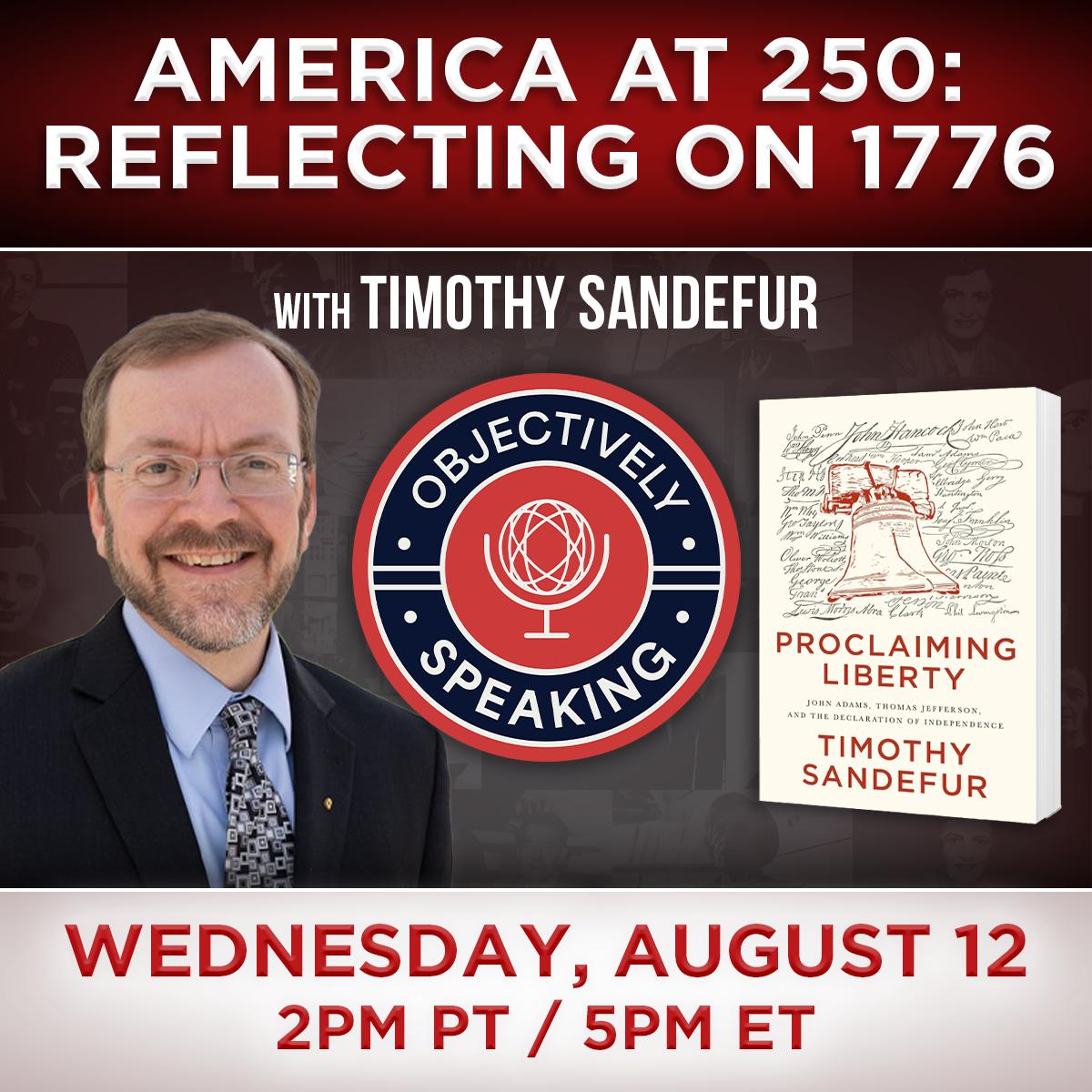
[00:00:00] Speaker A: Hi everyone and welcome to the 315th episode of objectively speaking. I'm Jag, CEO of the Atlas Society, coming to you from San Francisco. So excuse the sirens and cries of deranged people in the background. I'm very, very excited to have returning again and again. Guest Timothy Sanford can't keep up with all of the books that he published. I think this is maybe his 10th. But he can correct me. This, I have to say, was absolutely one of my favorites. Proclaiming Liberty, John Adams, Thomas Jefferson and the Declaration of Independence. Tim, thanks for joining us.
[00:00:44] Speaker B: Thanks for having me back.
[00:00:46] Speaker A: So if I understand correctly, you went into this project as a self described Jefferson guy, but the book became as much about John Adams as Jefferson who. What did you discover about Adams that most changed your own view of him?
[00:01:02] Speaker B: Oh, that's a great question. Yeah, I did come into this as a Jefferson guy and my original idea was to write a book about Thomas Jefferson. And I discovered that really you can't just talk about Jefferson and the Declaration of Independence. For one thing, he was so young at the time. He was almost 10 years younger than Adams. And Adams had been involved from the beginning in the, in the crisis that led to American independence. And Jefferson was so young that he was in school during a lot of that period. So it really had to be about the two of them together. And I think if I had to say, the one thing I found most interesting about Adams was what a radical person he was. I mean, today you often hear people say that Adams was kind of the more conservative guy and there's some basis for characterizing that way. Although words like liberal and conservative are not really very helpful in many ways in understanding this period of time because, you know, what do we mean? What were they trying to conserve and all these complicated questions. It obscures more than it helps. In reality though, Adams was quite radical. He was very much a believer in overthrowing long standing principles of the, of the American system, if that was what was necessary to vindicate the principles of liberty and equality and justice that the revolution was fought for. So it was that and then his personality. I mean, he's cantankerous, he's, you know, self critical and bitter and jealous and he's got a lot of bad qualities for his personality. But at the same time those really make him in some ways very relatable. Jefferson is a much more, he's much more concerned about his public image or at least his historical image. And so he's very careful about how he behaves in public. And so I Found myself sympathizing with Adams even sometimes when it was things that may not be good to TRA character traits, but he comes off as a very relatable person in the crisis of his times. You know, he's a, he's a middle class guy basically. He's a lawyer with a family that he has to support through his own two hands. And he's facing this, this what ends up being a colossal crisis that just severs the British Empire.
[00:03:13] Speaker A: So it really was remarkable. And you talk about Jefferson, Stephen, studying at the time when Adams was already well on his way. I really liked the comparison and the descriptions of these two men's education from which I learned that apparently Jefferson loathed Plato. Can you tell us more about that?
[00:03:35] Speaker B: Yes. Jefferson read Plato for the first time when he was in retirement, actually, which is kind of surprising that because he was so classically educated. But he, he was more of a fan of the Roman historians than of the Greek philosophers and even Aristotle, although he admired Aristotle on a lot of issues. On politics, Jefferson said that Aristotle had little to teach us on politics, primarily because the ancient Greeks did not have the idea of representation which our system uses. And so he said in a letter that Aristotle was of not great usefulness in understanding political issues in America. But Plato. Jefferson read Plato as in retirement. He read the Republic and he writes this delightful letter to John Adams where he says, you know, he says, I was reading this for recreation, but it actually turned out to be drudgery. And he says, how the, the so called Christian world could have given reputation to a man such as this is a mystery to me. He says thousands of volumes have never explained Plato for the simple reason that nonsense can never be explained.
And Adams writes back and says, oh yes, I agree with you completely. I'm so glad you hate Plato also. The only thing I ever learned from Plato is that you can cure hiccups with a pinch of snuff, which indeed does, is mentioned in a, in a Platonic dialogue. And so it's, I think it's very revealing philosophically that the American founding fathers had little toleration for figures like Plato, who talked in great abstractions and these notions about, you know, eliminating private property and privacy and all these sorts of things. For one thing, Americans were much more practical. They had had to live basically independently for a century and a half before the revolution. And they were much more concerned about stability, the rule of law and the pursuit of individual happiness, which of course is an idea utterly alien to Plato.
[00:05:29] Speaker A: So at one point Adams was Considering a religious career, what eventually dissuaded him from going in that direction?
[00:05:37] Speaker B: Yeah, actually, it's. It's related to what I just said, actually, because Adams tells the story that there was a religious dispute his neighborhood over a preacher who was kind of called to account for, you know, being a little off doctrine. And there was a meeting of the church members at his father's house. And he was a young man at the time. He was there at the meeting, and he watched the argument. And he writes in his memoirs, he says, I. What I observed were these people arguing over these things that didn't have any real consequences and didn't really have any provable facts to them. And it was all this sort of abstractions and dogma. And he says, and I realized that if I was to pursue this career, I would have to take these positions and cling to them dogmatically, even though they didn't really have any reality to them. And that dissuaded him from a religious career. Not that he didn't like to argue.
Adams loved to argue. He just found that he was more comfortable arguing in the law over things in the real world.
[00:06:41] Speaker A: Now, Jefferson, I understand, rejected supernatural aspects of religion. Can you tell us more about that? How did he view, like, Jesus as a savior versus a philosopher?
[00:06:55] Speaker B: Yeah, Jefferson did reject orthodox Christianity. He was a deist in the sense that he believed that there was a God who had set the universe in motion and then sat back and left it that way and did not interfere or manipulate the. The human world in any way.
[00:07:12] Speaker A: And he.
[00:07:13] Speaker B: Late in life or he's a president, actually, he spent his spare time, a couple nights, cutting up the Bible with a pen knife to remove any passages that he thought were not genuine, that he thought introduced Plato's ideas or that introduced mysticism and miracles and things like that which he thought were. Were had just been added over the years, like legends. And he ended up with a short pamphlet called the Life and Morals of Jesus of Nazareth, which consisted, of course, he did it in English, Greek, French, and Spanish or something like this, because, of course, it's Thomas Jefferson. But he ended up with this pamphlet that's about the morality of Jesus, but contains no mysticism or miracles or anything like that.
And he believed that this was actually a pious act in this sense. You know, Jefferson is working at a time before the Darwinian revolution.
And so the prevailing way of reconciling religion at science at the time is what's called natural theology. And natural theology is the idea that God is revealed to us. Through the scientific reality of the world. If there's a God, then he's manifested in the physical nature of the universe. And Jefferson was also heavily influenced by Epicurus, the ancient Greek philosopher, who believe that everything is made of atoms.
And so Jefferson concludes, he puts these two things together, he concludes later in his life that the soul itself is made of atoms. And he writes this really interesting letter to John Adams where he says people who claim that the soul is a mystical, supernatural thing are actually atheists.
And his reasoning is this mystical, supernatural things don't exist.
So if the soul is supernatural and mystical, then it must not exist. And if you deny the reality of the soul, then you're really an atheist. If God exists, if the soul exists, these things must be atomic in some way and therefore corporeal. And the soul must therefore be something like smoke or something that's made up of atoms. It's a very interesting speculation on his part. And Adams himself, John Adams was a little bit more orthodox than that, although he was by no means an orthodox Christian.
But it's very interesting to see them working at these ideas of the Enlightenment and scientific discoveries and things in an era before Darwin and so forth, trying to reconcile these with the ideas of traditional Christianity.
[00:09:38] Speaker A: Just have to observe that we've got quite the Tim Sandifer fan base going on in the comments, and I'll turn to those in a little bit. But tell us about Jefferson's work for Samuel Howell and how that fit not just into his other freedom cases, but also how he thought about slavery.
[00:09:59] Speaker B: Yeah. When Jefferson was a young lawyer in Williamsburg, Virginia, he took on a number of lawsuits called freedom cases, in which he represented people who were accused of being slaves, and his job was to defend them from that charge and argue that they were not slaves. Now, a lot of the records of these lawsuits have been lost, unfortunately, because there was a fire that burned down the house where he was living at that time only a few years afterwards. And so we don't know a great deal about these cases, but the Howell case is the one we know most about. And what happened there was a man whose mother and grandmother had been only partly black, was a. He was serving as a. He was serving in a denture, and his master sold him. And he claimed that he was not a slave for life. He was only a slave for a term of years under the law of Virginia at that time, which did not extend lifetime slavery to people who were partly white. It's rather complicated. I explain a little bit more in detail in the book, but the Point is that Jefferson was charged with arguing that the man was not a slave. And he had some interesting statutory arguments about why the laws did not apply to him. But then he concluded his argument with the proposition that all men are created equal with liberty and that they cannot be deprived of that liberty justly. And that the legislature of Virginia, he says, if one should be found wicked enough to do so, would have to deprive Mr. Howell of his liberty. Now, the other side of the case was represented by Jefferson's own former law teacher, George With.
And the judge in the case was the governor of the colony at the time. And unfortunately for Jefferson, after he was done making his argument about equality and liberty, the judge banged the gavel and ruled against him without even hearing a word from George with, because Jefferson's challenge to slavery was considered so outrageous and radical that it could not be tolerated. You know, those sorts of things are often left out when we talk about Thomas Jefferson today. It's become very popular to say Jefferson was this racist. And, you know, the American Revolution was actually fought to preserve slavery and so forth and so on. And actually, I think a lot of that overlooks things like this incident in Jefferson's life and other cases where Jefferson tried hard to do something about slavery only to be shot down.
Unfortunately, the lesson he learned from that was that there was no hope of doing anything about slavery. And that meant that later in life, when he actually might have been able to do something about slavery, he was too reluctant to make the attempt because of what had happened when he was younger.
[00:12:37] Speaker A: So Samuel Adams and John Adams were second cousins. How did their political styles differ both during the Revolution and in the lead up to it?
[00:12:49] Speaker B: Well, so Samuel, for one thing, Samuel is much more well known than John. For much of their lives, Samuel is the famous Adams. John is not very well known. There's this very famous story about when John was sent to Europe as ambassador and he's in France and he meets various French noblemen and they all mistake him for Samuel Adams. Oh, the famous Adams. And he has to say, no, I'm his cousin John, right?
So Samuel Adams is very well known during the Revolutionary era, and for much of that, John is not.
Samuel lives in Boston and John lives in the country. John is the country cousin. In fact, Samuel doesn't even know how to ride a horse until John teaches him.
So they're very different men in that way. Samuel is significantly older and he has a real talent for personal politics. He is a guy who knows everybody in the community, and he's able to get things done. He's able to mobilize people, especially the Boston Mobile, when necessary, by Boston mob. I mean, the crowd of working people who would make the. The public displeasure known either through riots or through other kinds of protests and things. And, of course, it's Samuel who's probably responsible for the Boston Tea Party. He probably masterminded the whole thing, although he was also so good at secrecy that we don't really know for sure. In fact, his biographer says in. In her book that the one night we know for certain where Samuel Adams was is the night of the Boston Tea Party. And that's because he was very careful to make sure that everybody could testify that he was nowhere near the boats that night. Right. John, on the other hand, he's much more. He's a tri. He's a lawyer.
He likes to go in the courtroom and argue things. He likes to write and publish. Samuel does, too. In fact, Samuel's very highly educated. He has a master's degree in political philosophy from Harvard University, which was very rare at that time. So Samuel is highly educated, but John is more, you know, your trial lawyer, incidentally, for any lawyers in the audience, I think that's really a revealing thing. Jefferson is an appellate lawyer, and Adams is a trial lawyer. Jefferson wants to go to the library and look things up, and Adams wants to get down in front of the jury and argue out a case. Right.
[00:15:02] Speaker A: All right, I'm going to get to these questions. As promised. My modern Galt asks, aside from Roman thinkers, were there any modern contemporaries, Locke, Rousseau, etc. Who were a big influence on the Founders?
[00:15:17] Speaker B: Oh, yes. Well, certainly Locke was. And of course, in these kinds of histories, people often talk about John Locke, and rightly so, as being the most important political thinker for the Revolution. He's, you know, the. The founding grandfather. If we have founding fathers, John Locke is the founding grandfather. But I. It should be emphasized he's by no means the only one. There's another political philosopher of the same time as John Locke who's unfortunately overlooked a lot today, and that's Algernon Sidney. Sidney wrote a book called Discourses Concerning Government, and Sidney actually was killed for his work in opposing the King of England for his tyranny. He went to the gallows for his fight against the Stuart tyranny. A great martyr for liberty. And for those of you who have tried to read the political philosophy of John Locke and stuff, if you find it a little difficult to understand, I think Locke writes pretty clearly, but it is kind of hard for some People to understand his 17th century writing style, Sidney is a lot easier to read. Sidney is actually a lot of fun to read because very polemical. He writes in a very timely sort of pugilistic style. He likes to punch people in the faces and he's. And he's really eloquent. So I strongly recommend Sidney. But also their ideas were not entirely original to them. They were working on ideas that had been created by a previous generation. John Milton, for example, the great poet of Paradise Lost, was also a political philosopher. And you will find a lot of Locke's ideas in his writings, including in Paradise Lost.
So there was a long tradition of political philosophers who would have influenced founders. I will say this about Rousseau.
You will sometimes hear that Rousseau influenced Jefferson and that's completely false. I know of no evidence that Jefferson was influenced in even the slightest degree by Jean Jacques Rousseau.
And certainly people like James Madison were repulsed by Rousseau. Rousseau's ideas were considered exotic and bizarre by the American founding generation for the most part.
[00:17:21] Speaker A: Here's an interesting question from Alan Turner asking, Do you think the way the Declaration of Independence was written was designed to ultimately make the abolition of slavery inevitable?
[00:17:36] Speaker B: Yes, I do.
And I should add a caveat that in a couple months I'll be participating in an online discussion on just this topic. So keep your eyes open.
Yes, of course. The most famous spokesman for this idea is Abraham Lincoln, who says that the Declaration and the Constitution were written in order to put the public mind in the so that it could rest in the assurance that slavery was in the course of ultimate extinction. And he's right about that. The Constitution, for one thing, is silent on the term slavery. It doesn't use the word slavery or slave, and it only obliquely refers to it in a few passages as an existing practice and provides it with no legal security except for the protection for importation, which ends in the year 1808. So very limited, if any, security for slavery in the Constitution. And the reason for that, of course, is because the Founding Fathers recognized that slavery was evil and said so in their writings over and over again, including in the Declaration of Independence, when they say all men are created equal. It has become kind of a popular cliche nowadays to say that the American Founding Fathers did not think that all men meant all men. And that's absolutely false.
That is, in fact the holding of the US Supreme Court in the Dred Scott case. That's what this Dred Scott Case case said, is that all men doesn't mean all men. And if you read that opinion, there's only one piece of evidence that the Supreme Court puts forward for this idea, and that is that the founders did not eliminate slavery immediately on July 4, 1776. It's the only piece of evidence for the proposition that all men doesn't mean all men. But there's all sorts of reasons why the founding fathers didn't end slavery immediately on July 4, 1776. For one thing, they could not do so. If the Continental Congress had tried to do that, it would have failed and it would have destroyed the Congress. Nobody would have listened to the Continental Congress if it had tried to do that, and it would have simply wrecked the independence movement.
So to blame them for not having proclaimed liberty to the slaves on July 4, 1776 is naive and asinine in my opinion. And it ignores the fact that slavery had never been abolished by any society in the history of the world for moral reasons before 1776. It had never been done.
And history showed quite the opposite, that when slavery was tinkered with, it often ended in race war. So the American founding fathers recognize and say that slavery is evil, but they don't know how to deal with it. And that's not terribly surprising because I don't think if any of us were in their shoes, we would know how to deal with such a colossal evil that pervades the entire country. But keep in mind also that slavery is being abolished by several states at this time. Throughout the last quarter of the 18th century, many states eliminate slavery and no state creates slavery. So there appears to the Founders to be this one way movement toward liberation and that causes them to believe that slavery will eventually be eradicated both by moral and economic practical reasons. It's only in the 1830s that you see the rise of a pro slavery ideology in the United States that is the explicitly anti capitalist pro slavery ideology of the south, which is the first anti capitalist ideology in American history and whose ideas have been borrowed by every single anti capitalist ideology in the years since.
[00:21:03] Speaker A: So Adams describes a particular moment in history when quote, the child independence was born. What was he referring to? And why in retrospect do you say that's an exaggeration?
[00:21:16] Speaker B: Well, so he's talking in his, as an old man, John Adams, you know, he's a little bit bitter toward Thomas Jefferson because now he's been defeated for the presidency. Jefferson is very celebrated and famous. Adams is viewed as, as largely a failure. And, and you know, he, he was the father of the Sedition act and all these sorts of things. And so he's a little Bit bitter about the Virginians. He has some good reason to be bitter about the Virginians. Slavery is a good example of good reason to be bitter about the Virginians.
So he's writing his memoirs and his letters to friends and during this period he's sort of trying to claim that the revolution was really a Northern thing and that the Southerners were kind of late to the game. And there's some good reason for making that assertion.
So John Adams writes late on, he says, well, really the child independence was born when the lawyer James Otis stood up and challenged the constitutionality of general warrants in Massachusetts in the 1760s. General warrants were efforts by the were a tool that was used by the British ministry to search people for violating the customs laws or the tax restrictions on importation and exportation and things like that.
And James Otis did indeed bring a heroic challenge to the legality of general warrants.
However, this was before things like the Sugar act and the Stamp act, which were laws that announced Parliament's new effort to force the colonies to be subordinate to the Parliament in London. And that was really what the war was about.
Otis was no doubt a hero, a great leader of the American revolutionary cause. But it's kind of an exaggeration to say that it was all started with his fight against General Lawrence, as heroic as that was.
[00:22:59] Speaker A: All right, Candice Morena asks, in celebrating America's 250th birthday, was there anything that you were happy to see people celebrate? Was there anything that you think was overlooked?
[00:23:13] Speaker B: Oh, what a delightful question.
I think I was very happy to see any celebration of the American 250th anniversary. You know, America, the United States of America is the nation premised on these self evident truths of equality and individual liberty that we are very fortunate to say live in the hearts of ordinary Americans. Despite the best efforts of our intellectual class, the, the professors, the so called scholars, unfortunately many of the judges use their best efforts to try and persuade us that in fact all men are not created equal and that the truths of the Declaration are not actually true and that it's just political rhetoric and that it's just a historical tradition and that the revolution was really just fought over the traditional rights of Englishmen. And all of this is not TR True. And so I'm very pleased to see that ordinary Americans, if there is such a thing, still love and cherish and believe in the self evident truths of the Declaration notwithstanding. However, of course there are some things that I wish people would pay a little bit more attention to and There are some things about the celebration that I think could have been done a little bit better. I don't know if you saw the Ken Burns documentary on the revolution. I liked it quite a lot.
But as with all Ken Burns documentaries, there are some flaws in there.
You know, there's the suggestion that the American Constitution was based on the Iroquois Confederacy, for example, and there's no evidence of that.
And there's of course the, in many of these documentaries, I don't, I don't think that one. But there's a lot of these documentaries that say, oh, you know, all men didn't really mean all men. And that's just not true. So that's unfortunate. But fortunately for us regular Americans understand and appreciate and believe in the doctrines of the Declaration, particularly those who have escaped regimes overseas and come here to find liberty in a new country.
[00:25:11] Speaker A: One of the things that surprised me in the book was how many conservative judges do not see and reject the idea that the Declaration is part of our legal tradition and that some are even like Bork was so hostile to the ideas that it represented. Did you, Was that a surprise to you or is that something that you've been thinking about for a while?
[00:25:41] Speaker B: It's something I've been thinking about for a while. So you'll notice that the book is dedicated to my, one of my mentors, Harry Jaffa, who was an outspoken advocate for the ideas of the Declaration of Independence against his fellow conservatives on just this point. And he published several books on this topic, including a marvelous little book called Storm over the Constitution where he, he calls his fellow conservatives to task for their denial of the self evident truths of the Declaration. People like Bork and Justice Scalia and Justice Rehnquist, who unfortunately, although they call themselves conservatives, were in many ways much more influenced by the progressives of the early 20th century, people like Oliver Wendell Holmes and others.
The reason why 20th century conservatives tended to reject the doctrines of the Declaration of Independence and in some cases reject the Declaration even more firmly than that. Right. Justice Scalia claiming that it is not a law, for example. The reason why 20th century conservatives did that is because they're very skeptical of the idea of abstract principles in politics.
Take for example, the historian Russell Kirk. He was very skeptical about the idea of abstract principles in politics because he thought that if abstract principles govern politics, you're going to end up with something like communism. The problem with communism is that it's this abstract philosophical idea being implemented in the political world and that's what we need to avoid. Instead, what we should do is rely on tradition and custom and habit instead. Very. An idea that's largely associated with Edmund Burke.
Well, the problem with that is that it's completely incorrect. The American Revolution, of course it was fought for abstract principles. Those abstract principles are articulated in the Declaration of Independence and they are in fact true principles.
And the idea of tradition, habit and custom doesn't really get you very far in combating evil. For example, slavery. It is impossible to fight against slavery except by invoking the principle that all men are created equal. You cannot fight slavery on the basis of tradition because slavery is one of the oldest traditions in the history of the human species. It's probably older than, it's certainly older than monogamy.
Right. It's, it's older than, than literacy. It's probably, it may be older than religion for all I know. Right. Slavery is a very old tradition and so you can't fight it on the grounds of tradition.
Tradition also is purely arbitrary unless it's based on philosophical principles such as the equality of all mankind.
So there unfortunately a lot of conservatives were misled into denying the self evident truths and embracing the very principles of the, of the progressives whom they profess to disdain.
Now I'm glad to say that I think a lot of that has faded away over time. Today the leading conservative intellectuals, for all of their flaws and all of their strengths reject I think the ideas, the anti Declaration ideas of people like Bork. I take for example on this US Supreme Court the probably the leading conservative mind is Justice Thomas. And Thomas firmly at least says that he believes in the principles of the Declaration of Independence. So I think that idea has largely passed. But it is pretty shocking that 20th century conservatives were so resolute and outspoken in their opposition to the Declaration of Independence.
[00:28:50] Speaker A: All right, elation asks between Jefferson and Adams. Whose political philosophy do you think has aged better?
[00:28:58] Speaker B: Oh, Jefferson's by far. Absolutely Jefferson's.
So Jefferson late in life was asked to explain the difference between him and his Federalist opponents. And he was, he was actually quite generous in the way he did it. I thought he said the difference is this. There are people who believe that you cannot have a political society based on reason and deliberation and, and rationality and that's it. Instead they think the only way you can have a political society is based on hierarchy and tradition and illusion.
And what I mean by illusion is what Edmund Burke meant in his reflections on the Revolution of France. Burke says what we need is pleasing illusions that will cause people to subordinate themselves into classes and work in selfless servitude. This is not an exaggeration. This literally is what he says.
And Jefferson rejects that idea. He says that people can govern themselves by recourse to reason, deliberation and understanding, instead of being fooled by the rhetoric of politicians and priests and historians and so forth. Right.
And I think that that has been vindicated. It's. If nothing else, it's vindicated by the collapse of communism in the late 20th century. Jefferson wrote in his last letter, all eyes are opening or are. All eyes are open or are opening to the rights of man.
The general spread of the light of science has laid open to every view the palpable truth that the mass of mankind was not born with saddles upon their backs, nor a favored few booted and spurred, ready to ride them legitimately by the grace of God.
And that principle has been vindicated the world over, except in those hellholes that are still ruled over by theocracy and dictatorship. And those are simply the exceptions that prove the rule.
[00:30:56] Speaker A: So one thing your book makes clear is that the revolution didn't suddenly begin with the Stamp act or taxation with representation. Without representation, you trace a much longer struggle over who actually had legitimate authority in the colonies. Is there and conceivable alternate history if you want to put your science fiction hat on, in which the colonies remain colonies and not declare independence? And in such an alternative history, what decisions by Britain or the colonists would have had to have been made differently?
[00:31:38] Speaker B: Oh, this is. What a fun question. Okay, so I think the answer in the long term is no. I think America was destined for independence in any event. And Thomas Paine actually says this in common sense. He says, you know, everybody really knows that America is going to be independent someday, so it is might as well be now. Right. And I do think that there was probably no his, no path, no option whereby in the year 2026, the United States would still be subordinate to England. I could be wrong, right? You could, you could. You know, there's still. There is a British commonwealth, but even in the British Commonwealth, Canada and Australia really are independent countries. Right. They profess allegiance to the king and they still enjoy some benefits of. Of that connection. But it is nowhere near like what it was in the 1760s. So I think that is the most that an alternative historian could hope for.
And as Payne points out, you know, a continent cannot be ruled by an island.
And I think the American population was growing so rapidly. That was a point that Ben Franklin emphasized time and again. He's like, we are growing so quickly. There is no way the parliament of Great Britain can govern us. And I think he was right about that. So I don't think that's possible. But I can play alternative historian with you in this regard. I do think there was a moment that really could have changed a lot, and probably for the worse. And that is in 1775, the Continental Congress, against John Adams's will, sends another petition to the king, the so called olive branch petition to King George iii, which is kind of the last gasp at effort at reconciling America and Great Britain. And Adams doesn't want to do this. This is the idea championed by John Dickinson of Pennsylvania.
And incidentally, I should add, Dickinson has this bad reputation as a result of that. And his refusal to sign the Declaration of Independence. He's sometimes portrayed as like a Tory or something, and that's really not fair. Like the movie 1776 or even the HBO John Adams miniseries kind of portray him as an enemy of American freedom. And he was not John Dickinson.
I'm not a Dickinson fan myself. But he was in fact a hero of the American Revolution who served honorably in the military during the war for freedom. And Jefferson admired him. And so we should go a little.
We should be nicer to John Dickinson.
But anyway, he concocts his idea of let's petition the king again. And John Adams, like, no, don't. You know.
So they finally agree to do it, and they send this petition. And what happens is King George ignores it. And in fact, not only ignores it, but proclaims the Americans to be out of his royal protection, which is the last straw. I mean, it is George's pronouncement that America is out of his protection that causes the Americans to, quote, acquiesce in the necessity for independence. That's how they put it in the Declaration. If King George had instead issued a public statement saying, hmm, you know, the Americans make some good points here. I'm gonna think about it. Give me six months.
I think that would have destroyed the Continental Congress. I think it would have wrecked the independence movement. And I think at a minimum, it would have delayed ultimate independence in America. It would have caused the colonies to start fighting amongst one another, and it would have. It would have. Who knows what would have resulted from that. So that was really the moment when George made his one big mistake. I mean, he made a whole bunch of mistakes, but that one is the one, I think that's pivotal. If he had just pretended to take the petition seriously. History been a lot different, or maybe
[00:35:23] Speaker A: even take it seriously, right? I mean, think of the tax base that he forfeited if he said, you know what? I'm taking a trip, I'm bringing my retinue, I'm going to talk to the Continental Congress and we'll try to figure this out. We'll work together.
[00:35:37] Speaker B: Yeah, because he did send, you know, George did send a so called peace commission to America, but it was very delayed. It arrived only on July 14, 1776. So too late.
And the, the peace commission was not authorized to negotiate with, negotiate with the Americans unless the Americans accepted parliamentary supremacy. Well, that's not negotiation. That's just surrender. So there's this rather amusing moment when Adams and Franklin go down there to meet with the peace commission and the commissioner is embarrassed to even meet with them, and they're embarrassed to meet with him. And, and he says, well, he says, I'm not authorized to address you as members of the Continental Congress. And Adam says, you can address me any way you want as long as you don't address me as a subject of King George III.
And the, the, he's the, the general says Mr. Adams is a very decided personality, which is certainly true.
[00:36:35] Speaker A: Talk about awkward.
So this I thought was interesting as well. Parliament criticized the colonies, calling them hypocrites for advocating for their own liberties on one hand, and yet having the institution of slavery. And yet, at least at this time, Britain wasn't exactly a force for abolition itself. So how did the hypocrisy cut both ways?
[00:37:04] Speaker B: Yeah, that's right. So, you know, one can point to the hypocrisy of the Americans for maintaining slaves while professing individual liberty. And even the Americans said so. In fact, the remarkable thing is how candid the American revolutionaries were about the evils of slavery. They did not pretend that slavery was somehow compatible with the revolution. They openly acknowledged that it was inconsistent with the principles that they were fighting for and consequently that slavery would have to be ended somehow.
That, of course, was the hard part, was how. Right. But they were quite open about that fact, and that's important. That is not something to ignore, because I know of no other example of something of a phenomenon like that.
Where can you point to another example of a revolution where the leaders say, you know, by the way, we are every day violating our own principles, and we recognize and acknowledge and admit that fact, and we're gonna have to do something about it. That's, that's really cool. Right? That's, that's openly admitting that slavery is evil instead of trying to pretend that it's okay.
Parliament of course, is, is being hypocritical in criticizing the Americans for slavery and yet maintaining and perpetuating slavery and in, in some ways fighting the war to preserve slavery.
Right. The, the, there's this famous proclamation. Judge Lord Dunmore, the Governor of Virginia issues this proclamation that any slave appertaining to a rebel who is willing and able to take up arms to join the. The British forces will be liberated. Right. And some historians have even called this something like an Emancipation Proclamation and said that the Americans were really fighting to preserve slavery because of this. This shows that the British were the anti slavery force. That's nonsense. For one thing, Lord Dunmore's proclamation did not free the slaves. It only applied to those who were enslaved by rebels, not to those who were enslaved by Loyalists. Anyone enslaved or Loyalist would still be returned to his master by the British military. Also, it only applied to those who were willing and able to bear arms. So no women, no children, no elderly. Right. Nobody with religious scruples about serving in the military.
And even those who did join the British military often found themselves relegated to menial tasks and provided with no medical care of any sort. And they died by, by droves, even shocking numbers, even by that day's standards. And many of them were simply re enslaved after the war, as I explained in the book.
So the, the idea that the British government was somehow opposed to slavery is really rather silly. The British did later become forces for the abolition of slavery, but that wasn't until the 19th century. In the 1770s in fact, the King of England had issued a proclamation and issued an order to every governor in the country telling them to veto any colonial legislation seeking to limit the importation of slaves because this was harmful to the Royal Africa Company which was the world's largest slave trader and was basically run by the British government. So the idea that Britain was somehow anti slavery on principle is really quite silly.
[00:40:09] Speaker A: All right. Valiant Mike asks would you argue, I don't know if he means argue or agree that the modern understanding of economic rights is compatible with what is written in the Declaration of Independence.
[00:40:26] Speaker B: Well, I suppose it depends on if you mean by the modern understanding of economic rights, if you mean the idea of like a right to health care and things like that which people say certainly not right. The right to the fruits of other people's labor is contrary to the principles of equality and liberty articulated in the Declaration of Independence, which say that I have a right to myself, I have the right to the fruits of my own labor and I have the right to pursue my own happiness. And of course, if I choose to help somebody else, obviously that's part of the pursuit of my happiness. But that it is not the role of the state to take away the fruits of my labor to make other people happy, because that is in fact, subordinating one person to the. The desires of another and depriving that person of happiness by doing so. Right. Jefferson, in his first inaugural address, says, the sum of good government is one which shall restrain men from injuring one another, but leave them otherwise free to regulate their own pursuits of industry and improvement, and shall not take from the mouth of labor the bread it has earned.
So that conception of economic rights, rights to things that are paid for by other people's labor, is wholly incompatible with the principles of the Declaration of Independence. But we talk today a lot about things like economic liberty, right? The right to earn a living. It's the title of one of my books, and that absolutely is compatible. In fact, it is what the Declaration refers to as the pursuit of happiness. When you look into what that phrase was intended to mean, among the principal things that it was intended to refer to is the right to earn a living without unjust interference by others or by the state.
And this was a particularly important issue for Thomas Jefferson. And I point out in the book, I think Jefferson doesn't get the credit he deserves for being an advocate of laissez faire.
Today you'll often hear people talk about Jefferson, say, as being like, anti capitalist or, you know, he hated big. Hated factories and he hated big cities and he hated capitalism. And really, that's not very. That's not accurate. It's not fair. And you will, by the way, also hear people say that Alexander Hamilton was a champion of capitalism, which is crazy. Alexander Hamilton was by no means a champion of capitalism. He was a mercantilist who believed that it was the government's responsibility to choose what industries should receive investment.
That investment being, of course, tax dollars taken from people like you and me. So Jefferson starts out as an advocate of economic liberty in a really striking way, and a lot of his own early writings before the Declaration of Independence. He complains that Britain is depriving the Americans of their economic freedom. He says we are entitled to. This is a favorite phrase of his, a free trade with all the world, and we're entitled to it. He points to the Treaty of Jamestown of 1651, for example, which is in which Parliament promised the Virginians free trade with all the world and then went ahead and ignored that promise.
Other laws like the Hat act which made it a crime for an American to make a hat out of fur caught in the colonies. If you shot a fox on your own farm and you wanted to make a hat out of it, you weren't allowed to. You were supposed to ship the pelt to London to be made into a hat there and then shipped back to America. The Iron act, which made it illegal to make retail goods out of iron in the colonies. You had to ship the iron to England to be made into horseshoes and nails and then shipped back to America. Jefferson complains about these things in his book, his little booklet called the Summary View of the Rights of British America, which is the booklet that got him the job writing the Declaration.
And so Jefferson is really an advocate of free markets. Even late in life, even in his retirement, he translated from French a book by an economist named Destut de Tracy, who was an advocate of laissez faire and an acolyte of Adam Smith. So I don't think Jefferson gets the kind of credit he deserves for this. And that is what he's referring to by the pursuit of happiness. People who arrive in America with nothing to their name except the labor of their two hands, they have the right to pursue economic opportunity, and that's what the pursuit of happiness refers to. Long answer to a short question, but it's something I'm really passionate about.
[00:44:36] Speaker A: So in addition to being accused of hypocrisy, patriots are also accused of being radicals. But you write that they actually saw themselves more as conservatives. Yeah. What were they conserving?
[00:44:49] Speaker B: Yeah, yeah, that's right. I mentioned earlier that the terms conservative and liberal are kind of useless. And this is a good example of why. Because in some ways, the Americans are really more conservative than Parliament. Because what had happened was the fight that led to the revolution began with a dispute over Parliament's authority.
And Parliament was asserting in the 1760s that it had supreme, absolute, unlimited authority to do everything that is not naturally impossible. That's a quote from William Blackstone, who was the judge, who was really one of the leading advocates of that theory. The Americans pointed to an older theory of the unwritten British Constitution. They said, no, we believe that our Constitution is understood through tradition and habit and custom and documents like Magna Carta and these traditions and habits and documents and things, they all show that Parliament's power is limited and that our laws are made in our own local colonial legislatures, not in London.
And so they were pointing to an older theory of the Constitution, while Parliament was asserting the newer, more radical theory of the Constitution that it had absolute power.
So if you had gone back in time and you were to ask John Adams and Thomas Jefferson, are you conservatives? They would. They might have said, yes. They would have said, well, we're trying to preserve the older conception of the Constitution. And it's Parliament that's advocating this radical, dramatic new idea that Parliament has supreme absolute power.
So that's another reason why terms like conservative and radical kind of are misleading sometimes. But, oh, I should add Parliament itself accused the Americans of being overly conservative.
Lord north gave this speech in Parliament where he said the Americans call themselves Whigs, but they're actually Tories.
What he meant by that was that the Americans were adhering to this old conception of the Constitution that said that they owed their allegiance to the King and to their local legislature, but not to Parliament. And Lord north, who is a Prime minister, is saying, that's an old fashioned notion. It has been superseded by the idea that Parliament is supreme and unlimited. So, yeah, the Americans in some ways were, you might say, reactionaries.
[00:47:01] Speaker A: All right, well, we are actually coming up on almost the remaining 10 minutes. So I want to put in the back of your head, Tim, anything that we may have not covered that you really want to leave this audience with. But first, I'm going to get to this comment, not a question from David Wilson, who says, thank you for writing Freedom's Furies. Learned a lot about Ayn Rand, Rose Wilder Lane and Isabel Patterson that I had never read elsewhere. And I have to say that's still, if not my favorite, then one of my favorites of your, of your books. And the question makes me wonder, as someone, I don't know if you call yourself an objectivist, someone who's very well familiar with philosophy and with Ayn Randolph, were there moments that you kind of thought, wow, there's a connection there that's similar. Ayn Rand would have agreed with this one, not agreed with that one. There's no mention of Ayn Rand in the book. But someone with Ayn Rand on the brain. I was just wondering.
[00:48:10] Speaker B: Yeah, actually. So there are obviously some very strong parallels between Rand's thought and that of the American Founding Fathers. Rand is unique in one respect, in that she's an atheist believer in natural rights.
Typically, you find that natural rights philosophers like Locke and so forth, they tend to believe that the, these natural rights derive from a supernatural source. And Rand doesn't. She, she's a true natural rights person. She thinks they derive from nature and not from a divine being.
But relatively speaking, that's actually a pretty Minor distinction, because the, the 18th century theology, as I said earlier, there's natural theology, it's very naturalistic way of understanding what we mean by God, for example. So even that distinction is not very strong. But if I had to point to the one thing that I think is most parallel to them, there's a letter that Jefferson wrote to James Monroe when Jefferson was serving in the Continental Congress. And he's very worried about his wife's health. His wife is back in Virginia and she's not healthy. In fact, she ends up dying from, probably from the consequences of childbirth.
And Jefferson is very anxious to leave the Continental Congress in Philadelphia and go back home, but he's not allowed to because he still has to serve out his term. And Monroe writes to him and says, well, you really gotta, you know, really gotta to serve your country, Tom. And Jefferson writes back this letter where he says the idea that the state has the right to all of the services of its members, of its citizens is slavery and not that freedom for which we fought. He says, if indeed a man is made in some degree for others in a greater degree, he is made for himself.
And I think that really distills Rand's philosophy to ascendants that we are made for ourselves. We have the right to our own lives and the right to pursue our own happiness. Nobody else has a better right to my life than I do. And I think it's really revealing that the authority of the Declaration of Independence, with its assertion of the right to pursue happiness, would also say that we have the right to own ourselves and that to be subordinated to the state because of our, its need for our services is a form of slavery.
[00:50:27] Speaker A: So is there a way, as we are now in our 250th year, that discussions of the Declaration of Independence can help to serve as a unifying point?
Or do you feel that it's still very deficive depending on which political tribe you ascribe to?
[00:50:52] Speaker B: Well, unfortunately, it is true that they, that our political tribes today dispute over even such fundamental ideas as the idea that all men are created equal or that they are endowed with inalienable rights. And there unfortunately are a lot of people out there who think that our rights are given to us by the state and that the idea that all men are created equal is a myth, or that the Founding Fathers didn't really mean it, and all these sorts of, of nonsensical ideas. Fortunately, that, as I said earlier, I think the Declaration lives in the lie in the, in the hearts of most Americans and serves and will always serve as a rallying point and. And not just a rallying point, but a stumbling block. Right. That's what Abraham Lincoln calls it. He wrote this famous letter where he says.
And what he says of Jefferson is also true of Adams. He says, all honor to Jefferson, who had the presence of mind to insert into a merely revolutionary document an abstract truth applicable to all men and all times. And so to embalm it there that it might serve as a stumbling block to the very harbingers of reappearing tyranny. And I love. What I love most about that letter is the phrase merely revolutionary.
Jefferson inserts into a merely revolutionary document this abstract truth applicable to all men and all times. What Lincoln means is that everybody has revolutions. Every society has had revolutions. Some countries seem to have a revolution like every six weeks. But in America, our revolution is different. And the reason is because of this abstract truth that is always and everywhere true. And if you find somebody who denies those abstract truths, whether they call themselves Republican or liberal, they are not blood of the blood and flesh of the flesh of those who wrote the Declaration and those who live the American dream today.
Fortunately, we have, I think, at our hands all the tools necessary to defend those ideas.
I've been throwing a lot of Jefferson quotes in here. I'll throw in one more. Jefferson says in his first inaugural address that if there are people out there who would overthrow our republican form of government, let them stand unmolested as symbols of that freedom with which error of opinion may be tolerated, where freedom is left free to combat it. I think this the strongest government on earth. I think it's the only one where all men at the call of the law would fly to the standard of the law and meet invasions of the public order as matters of their own personal concern.
In other words, Americans love America. They aren't forced into obedience toward America. They love America. And the reason they love America is because the Declaration of Independence reaches out to them and touches them and says they are free.
[00:53:29] Speaker A: Well, I'm very proud to be a part of the free Society coalition and to have the outlet society be a part of it. It is bringing people together to have these discussions about.
About the greatest sentence ever written, you know, the beginning of the Declaration of Independence. And they've had quite success with that. So perhaps we can put the link in our comments because they have some great resources, including a brochure that can serve as a discussion guide for those conversations.
So I'll give you a choice of whether or not there's something Else you wanted to make sure that our viewers or your readers take away from this conversation, whether about this unique period in history, this unique document, or these unique founders.
[00:54:32] Speaker B: I would just add that, you know, we, I think all of us on this call are concerned about the future of America and concerned about defending the. The nation that we love very much. And I'm. I make no pretense that. That my book is somehow neutral. I, I quite openly say that I, I write. Wrote the book as a. As a.
An homage to a country that, that I love and that I think makes a great difference in the world. If we are going to defend it for future generations, if we are going to rescue it from the horrible threats that are facing it from right and left today, the only way we can accomplish that is to understand its principles. And understanding its principles starts by looking at the history and the ideas and the people who built this country as a refuge for all mankind. As the, as the poem says, as mother of exiles. America is mother of exiles, or it is nothing.
[00:55:31] Speaker A: So, Tim, given your prolific record of. Seems like coming out with a new book every one or two years, I'm wondering if you're either working on something now or more broadly, you have a bucket list of things that are interesting to you and that you would covet an opportunity to really spend a year going deep with the subject.
[00:55:55] Speaker B: Oh, yeah, I do kind of have a bucket list. I will admit. I don't have a particular project that I'm actually hammering away at the. At the moment, I'm tinkering with a few little things. Of course, it's bad luck to talk about a book until it's finished, so I shouldn't tell people too much more, but I have some things that I'm tinkering with. One thing that I've. One project I've been working on is a series of scholarly articles on certain provisions of state constitutions, which is very important for the legal work that I do here at the Goldwater Institute. We. We go to court to defend and amplify the legal protections for individual liberty that are found in state constitutions. We go to state court a lot to vindicate those rights because state constitutions can protect your freedom more than the federal constitution can. But unfortunately, a lot of scholars have not really spent a lot of time on the meaning of these constitutional provisions. So I've been doing a series of the articles on that. I have one coming out on a provision of the state constitutions that says why government exists in Arizona. Our Constitution says government exists to protect individual rights.
And it's actually one of very few constitutions that even uses the phrase individual rights. So I wanted to get into why. So I've been tinkering with that and I have a few things also on the side, but I don't have a major project that I'm at work on at the moment.
[00:57:08] Speaker A: And your poetry, let's not forget your poetry. That's right.
[00:57:11] Speaker B: Yeah. I've been working on a series of translations of the French poet Edmond Rostand, who is the author of Cyrano de Bergerac. And I have one of my translations is in the current issue of National Review, for example.
[00:57:23] Speaker A: Oh, terrific. Well, I will go and check that out. So, Tim, this has been fantastic. Thank you so much for joining us.
[00:57:30] Speaker B: Thank you so much.
[00:57:31] Speaker A: And thanks to all of you for your great questions, your great comments, your great love that you showered our guest with. Make sure to join us next week. I'll be back in Malibu and I'm going to be speaking with Alexander Hammond. He's going to talk about his book, Heroes of 65 People who Changed the World. We'll see you then.