Episode Transcript
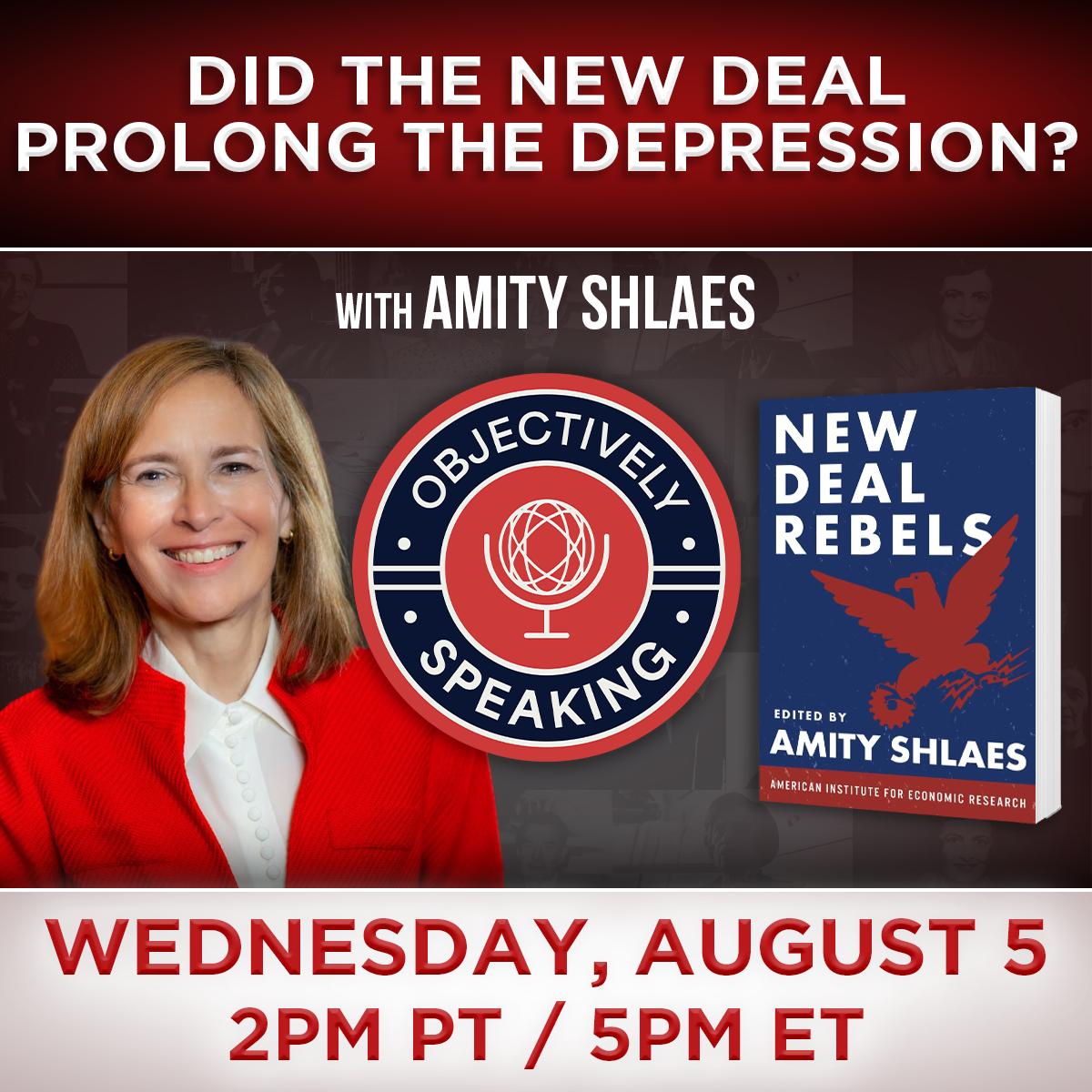
[00:00:00] Speaker A: Hi, everyone. Welcome to the 314th episode of objectively speaking. I'm Jag, CEO of the Atlas Society. I am very excited to have Amity Schlase join us to talk about New Deal Rebels, an anthology of critics of the New Deal. And as you viewers can see, I have it bookmarked in many places. So, Amity, thank you for joining us.
[00:00:29] Speaker B: I'm glad to be with you and your tremendous audience.
[00:00:34] Speaker A: So we had some hard negotiations behind the scenes, and Amity has a extremely busy schedule, so we're. She's just going to be joining us for 45 minutes. I may or may not be able to get to all of your questions. And, Amity, before we get to New Deal Rebels, I'd like to touch on your books, the Forgotten man, and also about the Depression and the New Deal and the one that made you an intellectual superstar.
What first made you suspect that the conventional story of the Great Depression and the New Deal was incomplete or in some cases, flat wrong?
[00:01:19] Speaker B: Well, thank you. Well, what is the conventional story?
The conventional story is unclear, but, I mean, we all have little pieces we got from our parents or maybe in school. Well, the economy broke and the government didn't always fix it very well, but it tried, and it was admirable in that effort to fix the economy.
And we kind of like Franklin Roosevelt because he was a good war leader and we all pulled together in World War II. Is that a fair summary?
[00:01:49] Speaker A: Yeah, I would say so. Yeah.
[00:01:51] Speaker B: And it definitely approved. I don't know. It's something to do with incoming inequality and.
[00:01:56] Speaker A: Right.
[00:01:56] Speaker C: And we wouldn't have had the Depression
[00:01:57] Speaker B: had there been no income inequality, something like that. Right.
[00:02:02] Speaker C: So.
[00:02:02] Speaker B: Well, is that true?
[00:02:03] Speaker C: And I was just noticing today or yesterday, someone sent me a little conversation between Margaret Hoover and David from two very dear old friends of mine, and they were trying to figure out the Wall Street Journal line on that they
[00:02:15] Speaker B: were talking about Wall Street Journal in
[00:02:17] Speaker C: a day such as during the Reagan years. What did the Wall Street Journal think about the Great Depression?
[00:02:22] Speaker B: And they had their views.
[00:02:23] Speaker C: I don't think they had enough time, frankly, for. For the depth of their knowledge. So they were. They were cut short.
But the truth is about the Wall Street Journal, which is where I worked when I began to think about this book, didn't really know what caused the Great Depression. I know that because when I announced I was going to write Forgotten Man, I was on the editorial board and I told that to my boss and he said, you can't write about the Great Depression. And I said, why Is that. And he said, because I haven't made my mind up yet what happened. And I am the mighty editor of the Wall Street Journal. He's a lovely man, but he was the boss. And I thought, oh, okay, that makes me want to write the book even more, though it might offend Bob Bartley. And I had to kind of live with that and worked hard to do a book of which he might be proud.
I don't know if he was or wasn't because he passed before it was truly done. He saw parts of it, but we were very much working on tax together
[00:03:20] Speaker B: at that point anyway.
[00:03:22] Speaker C: So what really happened?
What, what did Bob mean? He. What he meant, was it a Smoot
[00:03:28] Speaker B: Hawley or a bad tariff?
[00:03:31] Speaker C: Or was it the monetary policy that gave us 10 years of great Depression? Or what actually happened? And we all know the books that we read. And the answer is all of the above.
That is a recovery is like a human. You can anthropomorphize recoveries. And every year in the Great Depression, recovery chose to stay away for a different reason. Where is she? She didn't come back. You know, where is she? Oh, she doesn't want to be here. But if you want to summarize, I think the best summary of why the Depression was so long, not what started it, because don't think it was necessary for us to have 10 years, notwithstanding the severity of the initial crash.
Government made it worse.
That's the answer. The government made it worse. And you can pick your angle, but in different ways. Sometimes monetary. The early period, which Friedman and Schwartz cover. Sometimes regulatory, sometimes uncertainty, economic uncertainty. They didn't have a vix then, but they had a general sense of the uncertainty. And one could go on and on. So the government made it worse. Or as Benjamin Anderson, one of my favorite on the period who died actually shortly after, alas, he wrote a book called Economics and the Public Welfare. And in that book he said the problem of the Great Depression was caused by the government playing God.
And when the government failed, instead of desisting. Here I paraphrase, instead it played God more vigorously.
More that is, it did not desist. And that's what made the Depression so long and hard. And when what we're talking about is double digit unemployment for 10 years, forget
[00:05:15] Speaker B: about the stock market, but that didn't
[00:05:18] Speaker C: come back either, obviously.
What is a Great Depression? Double digit unemployment for 10 years as a crime in the United States, because
[00:05:28] Speaker A: it doesn't have to be so apparently.
I think that J.D. vance gave Trump a copy of Your book in.
[00:05:42] Speaker B: No, no. Mike Pence. I don't think J.D. vance.
Yeah, I don't think. Well, I mean, without knowing of either, I think in your notes. You wrote me a note. M. Pence.
[00:05:51] Speaker A: Right.
[00:05:52] Speaker B: But it could have been J.D. vance.
J.D. vance is involved, like in the story. I'm sorry, I didn't mean to cut you off, Jack.
[00:05:59] Speaker A: No, that's okay. But then, you know, afterwards, and you're. You're correct, it was Mike Pence.
References to the forgotten man started showing up in Trump's speeches. I'm just curious what you thought about that when you heard it.
[00:06:13] Speaker B: Well, the forgotten man does not belong to me.
It's a very old phrase, but it's good. I. I do think Vice President Pence understood the book.
I don't. I. I don't know J.D. vance very well, but Vice President Vance, but, but Pence, you know, used to have a radio show and I used to go on it before he was a big politician and so he heard. I, I think he. I went on it for a tax book I wrote long ago. So that was nice that, that lawmakers are trying to use some of the facts in the book to inform policy.
The phrase forgotten man is quite useful. It's actually from a man named William Graham Sumner, who taught for decades and decades at my college, Yale University.
And Sumner had a beautiful little algebra where he said, you know, he laid things out.
And we have a cartoon version of this, too, if you ever want to lay it out for your grandchildren. It's in there.
A, a man at the top wants to help X, the man at the bottom.
Okay, we all want that. And B wants to help X. We all want that, too. We don't want the man at the bottom to suffer.
But perhaps there's a problem when A and B get together and pass a law that coerces C into co funding, there perhaps could a perhaps dubious project for X. So C is the forgotten man.
[00:07:40] Speaker A: Yes.
That's beautiful. And you have that everywhere, you know,
[00:07:46] Speaker B: because I love it. And Sumner is kind of a little bit canceled because he was, you know, eugenicist to some extent. But I don't think we should cancel all these interesting minds who are eugenicists, you know, who believe things of which we don't approve or which we think are wrong. I like to take a mind for what it is.
I don't like to cancel people. So Sumner was incredibly influential and he was incredibly perceptive because he anticipated the interest group politics of both parties.
That is, how do you win an election you pay off three interest groups, A, being sorry, X, Y and Z, and you forget that CS to give them money for X, Y and Z. And the X, Y and Z may not actually need precisely what you're funding by squeezing C, and so on and so forth. It's a very good thing. You can teach it from the fourth grade, too. I've never tried the fourth grade, but I believe that this little Sumner algebra, and Roosevelt turned it. Franklin Roosevelt, which is why I chose the title. He said the man at the bottom of the pyramid was a forgotten man.
But that wasn't Sumner's original. Sumner's original is the taxpayer who bears what's done for the man at the bottom. So it was a meme or a theme or a trope, whatever English literature kind of phrase you want to use, or political economy phrase. It was a phrase that was around and they pretty much remembered Sumner.
So it was a little bit mischievous of the Roosevelt administration to turn Sumner against himself.
And the speechwriter, whose name was Ray Moley, or one of the speechwriters was wonderful man.
He later founded Newsweek with others. And later he kind of said, well, I really meant. I don't have the book in front of me, but he kind of said, I really meant Sumner's forgotten man. But at the time, he was just finding a good phrase for fdr.
[00:09:55] Speaker A: Right. Well, as a former.
Sorry myself, I know that kind of pressure and sometimes your intentions for the speech are not, you know, what eventually comes out of the President's mouth.
Now, in New Deal Rebels, the anthology, excellent anthology, you demonstrate that New Deal critics came from a wide range of backgrounds. I mean, you know, including Ayn Rand and John Maynard Kean. So what is the common thread that kind of united them in this critique?
[00:10:34] Speaker B: Well, there are a lot of critics. There were African.
[00:10:37] Speaker C: African American critics.
[00:10:39] Speaker B: There were.
It goes on and on from left, right, middle, underneath and overneath, so to speak, over the. The New Deal.
[00:10:48] Speaker C: What unified them?
[00:10:50] Speaker B: Frustration at the poorness, the poor quality and inconsistency of the New Deal policy.
Then also outrage at the arrogance of the New Deal policy. But I really recommend Hofstadter's book about Age of Reform, which I'm just reading
[00:11:10] Speaker C: from my current book, which is about the Gilded Age.
[00:11:14] Speaker B: And Hofstadter says, well, the New Dealers
[00:11:19] Speaker C: didn't get to write enough about themselves
[00:11:22] Speaker B: because they were so busy with the New Deal.
[00:11:26] Speaker C: And that's true. The New Deal was tremendously active. A lot of laws were passed in the Hundred days. Quite famous. 1933. And then so on and so forth. Were they consistent? Not really. So they were just a bunch of
[00:11:41] Speaker B: impulses in an economic emergency, or as
[00:11:45] Speaker C: it was, I'm not sure the emergency was as quite as bad as it was depicted. It was depicted as lasting all decades. We can question that or emergency, we must act or we will go. Communist, lesser evil argument for the New
[00:12:02] Speaker B: Deal, which I don't think holds up at all.
[00:12:05] Speaker C: But anyway, there you go. So the. All the critics were like, what? How dare he? He's so arrogant. And plus he's inconsistent. He doesn't even make sense by his own arguments. It's kind of like I will say, but I won't go on putting a tariff on generic drugs from Canada. It doesn't quite make sense if you want to help old people.
[00:12:26] Speaker A: Right, right.
[00:12:28] Speaker C: What is the impulse? Well, the impulse might be political. It might be fun.
[00:12:32] Speaker B: Fun was a big.
[00:12:33] Speaker C: FDR was incredibly mischievous and as was tr, his cousin and predecessor in the office.
[00:12:41] Speaker B: So I don't know. But.
[00:12:42] Speaker C: But often New Deal policies worked against one another and that must have been extremely disconcerting.
[00:12:48] Speaker B: And then there were the people who
[00:12:50] Speaker C: lost their business because of the New Deal. And they had a more serious gripe,
[00:12:55] Speaker B: in a way, in a more media
[00:12:57] Speaker C: gripe, shall we say.
[00:12:59] Speaker A: How did the farmers react? Those farmers that were being told to plow under their fields in order to, I guess, limit supply and drive up.
[00:13:12] Speaker B: It was a great moment. The whole thing was a great moment of monetary confusion over money policy.
And we're still confused, but they were.
It was sort of like modern monetary theory. Forgive me, it really didn't make sense.
The administration on some days, in some parts, thought they had to push prices up no matter what.
No matter what because prices were low. Well, price low prices may not be bad, as we know, even deflation may not be bad. It may not be as heinous as. As alleged in our ear. So anyway, prices were down.
And one way to push up prices is to curtail supply.
That was the hypothesis.
And you could also shove demand and supply curves around in some kind of illogical way. But it was a little bit Alice in Wonderland. It didn't quite make sense. So they told the farmers they would pay the farmers if the farmers destroyed their crops and sold less, and then the prices of the commodities the farmers produced would go up.
And that would help how? Because of course, the consumers didn't have quite as much money as usual because
[00:14:22] Speaker C: the Depression was on.
[00:14:24] Speaker B: So there's a beautiful letter in there, I believe, from a lady farmer. And she writes, you Know, we can't even look at a piece of bacon over here because we can't afford bacon. Because you may have. You push the bacon prices up. And in order to push the bacon prices up, we had to.
Had to kill so many hundreds and maybe thousands of little pigs before their time. And there was something especially hurtful about the slaughter of pigs even before they grew up piglets to curtail supply. So there were dramatic stories. It was also almost like a Disney cartoon. Right? The poor piglets going to their death. It was awful. And so there would be piglets and there would be corn that was trampled over rather than harvested. And they had to train the mules to trample over the, I think the cotton anyway, crops growing in Texas. And the mules did not want to step on crops because all their life the mules have been trained to step over the plants and preserve them.
And I would have liked to be there to watch a poor farmer beating a mule so it killed a plant that he had so carefully planted in the ground just a few months back. Right.
So isn't that sad?
[00:15:44] Speaker C: Yeah, no, it's just counterintuitive.
[00:15:46] Speaker B: And Lyndon Johnson was around because he was in Texas. And I know that was a big deal in Texas, this curtailment of supply. So destruction of plants, that is crops and livestock.
And you have to wonder, I can't remember if Lyndon Johnson said what he made of it, but he was part of the New Deal, so he knew.
[00:16:06] Speaker A: Right. So in your book, you. You reference that FDR famously said, the only thing we have to fear is fear itself. But you write that quote, it was the New Deal itself that fostered fear, prolonging the trouble. How so? How did it foster fear?
[00:16:27] Speaker B: It's 100% the uncertainty. When you have an arrogant regime that does things unexpectedly and in a different direction and then it revert, you know, unexpectedly, and then it reverses course.
[00:16:39] Speaker C: Right.
[00:16:40] Speaker B: It's hard to take. Nixon did this too, by the way, if you go back, and I think Nixon's having a little bit of a revival, but he was a terrible economist because he didn't understand and he acted 100 politically in his econ.
So, you know, one day price controls, wage controls, another day talk of free market. So Roosevelt was a political, political animal and he promised what he thought would get him votes. And it did get him votes, his actions, but they didn't. They prolonged the Great Depression and eventually a kind of Stockholm syndrome set in, where we were afraid as a nation of so afraid of the Depression that we clung to the, to the administration, which was a, a likable administration in terms of the way it talked to citizens, you know, through the radio shows that, that, you know, by the, you know, fireside chats and, and, and, and the obvious goodwill of the New Dealers. They wanted to help other Americans in addition to be powerful.
[00:17:43] Speaker A: Right.
[00:17:44] Speaker B: As people do. They're a mix.
But it, it, it just didn't work. And the fear itself, the uncertainty, eventually has an effect in markets.
There was a period, Let me see
[00:17:56] Speaker C: if I can recall this.
[00:17:57] Speaker B: I don't know if it's in that book, but in Forgotten man, where I have a page or two about this, that, where domestic investment, private investment went neg.
[00:18:07] Speaker C: Rare.
[00:18:07] Speaker B: That means companies aren't investing in their future. They're not buying equipment. It's, it's pretty rare. And that was due to uncertainty of companies because taxes would go up and down. There's some truly awful taxes.
Yeah, you know, that came and went in the New Deal. They had an undistributed profits tax, which sounds like something that might be invented right now.
We're going to have a wealth tax event at the Coolidge foundation in January, and we hope you all come.
[00:18:35] Speaker C: This will be in Washington.
[00:18:37] Speaker B: Because wealth taxes are suddenly in, in
[00:18:40] Speaker C: the states and also under discussion in the federal level.
[00:18:43] Speaker B: And they're not very good because they
[00:18:47] Speaker C: eat at the essence of companies and hurt investment.
They're not very good for a lot of reasons. They're immoral. But in the case of companies, they hurt investment, which hurts productivity, which means what?
[00:19:00] Speaker B: That you can't make more and the
[00:19:03] Speaker C: economy recovers more slowly? Or you get a junk economy made of
[00:19:09] Speaker B: politically motivated policies rather than policies
[00:19:13] Speaker C: that truly foster productivity. So then you get an economy that's something like the economy after our financial crisis in 2008. It's kind of a junky, overspending economy, spending on the wrong things.
[00:19:26] Speaker A: Yeah. Well, I'm glad that you mentioned the immorality of these wealth tax proposals.
So often people just focus on the consequences and don't make the argument that, you know, it's not only that socialism is impractical, it's also immoral. It's also incompatible with the protection of individual rights and property rights. I mean, Ayn Rand said, without the right to private property, no other rights are possible. So I'm wondering, these various critics that are in this anthology, were there some that were also making the moral case against the New Deal, or was it mostly.
[00:20:08] Speaker C: Oh, yes. Oh, yeah, definitely. I sort of like Garrett. Garrett. Have you heard of him?
[00:20:12] Speaker A: Of course. Yeah.
[00:20:14] Speaker C: Well I really hadn't. I mean I'd seen the name, but Garrett Garrett and Garrett Garrett actually wrote a novel about a railroad innovator that foreshadows Atlas Shrugged.
Railroad innovator whom he called Gault as well. But his was that I did not know.
I didn't know it either. And I think Ayn Rand was a beautiful scavenger. I'm not saying this to impugn her.
So you know, she wrote theatrically but. But he wrote about a railroad and I mean and he is. He really did not like the New Deal and was one of the most eloquent descriptor describers of it.
Sumner, Benjamin Anderson playing God.
When you say someone's playing God, you're not talking pragmatically, you're not offering utilitarian answer. You're not saying it worked or it didn't. You're saying it's wrong to play God because only God can play God. That's what Anderson said.
I like very much the European writer. I think she might have been Swiss. Anyway, her name was Odette Coin who went to visit the Keun. She went to visit the.
[00:21:30] Speaker B: The Great.
[00:21:40] Speaker C: Because she had no stake in it. And she said the flabbergast. I'm again. But she said the flabbergasting thing I have found is American labor is conservative. That is they the American labor didn't really want a revolution.
And to argue non stop as the administration did that if we didn't have a New Deal we would have a revolution as in Italy or as in Germany or as in Russia, I think was a false argument or exaggerated.
[00:22:08] Speaker A: Anyway, talk a little bit about the Wagner Act. What did it do and why was its overturning so dramatic?
[00:22:20] Speaker B: Yeah, this is of Robert Wagner. He was a lawmaker from New York, 1935.
We talked before about buying constituencies and interest groups and how politicians succeed at that.
Well, the biggest constituency that Franklin Roosevelt connected with bought whatever verb you want to use, I don't want to be too negative about it. So let's just say connected with and chose to do something for maybe something he thought was just. But was labor, organized labor. So John L. Lewis and so on. And he said, dear Labor, I'm going to give you the Wagner Act. We don't really have a strong national union law. So I'm going to pass the Wagner act with Mr. Senator Wagner. And the Wagner act created the closed shop. It was stronger than any labor law we have now. That is if you wanted to work somewhere you had to belong to the union.
And it, you know, the jurisprudence on it only happened, happened after it became law. So it wasn't clear. But as it was originally interpreted, the union thought it gave them the right to occupy the factories. Getting back to the issue of property rights.
So they did the so called sit down strike. It was a very powerful pro union law. It also created all the union hassle that we live with today and all the bureaucracy that is the National Labor Relations Board, the labor courts, the weird lexicon of labor that makes you not even want to get involved. I mean, you know, labor, it's another organized labor is another world. But what happened when they got the Wagner act was the unions didn't strike so much until the election was over. The unions waited politely until the election was over and then they struck even more.
And that thousands of days that companies were non productive days, factories were idle because of these tremendous strikes.
And the wages that the unions demanded were very high for a period when unemployment was 10% or more.
So you're demanding high wages in a time when employers can't pay those wages. What happens to the employer and what recourse does the employer have? None, because the courts in the White House seem to be friendlier to the striking unions than you. So the poor companies were really in a bind.
And how do we know the wages were high? If you. There's some very nice work by, let's see, a fellow named Harold Cole and, and his partner Lee Ohanian, often a name we hear bruited about for a Fed post.
They looked at the price of labor over the course of the entire 20th century and they see in the later 30s that it was out of trend high.
[00:25:31] Speaker C: Well that's perverse.
[00:25:32] Speaker B: Out of trend high price of labor in a. When there's unemployment of 15% as there was in 1937. Is that weird that the employers were stuck? It's a measure of how stuck the employers were and everyone recognized it that the Wagner act was too strong to pro organized labor. And we basically edited down the Wagner act through a law called Taft Hartley soon after World War II. We could say we neutered the Wagner act if you want. We made it easier to work for a company if you weren't in the union. Although unions were still fairly strong, as we know from the story of Detroit. But the surprise for me in writing the book was how much damage the Wagner act did. And if you want to account for the unemployment in the later 30s, I don't think you can write it all off to monetary. I don't I don't think even Milton Friedman would, though. There was a discrete action, the doubling
[00:26:32] Speaker C: of reserve requirements for banks under another law that had a contractionary effect when it came to money. That does not explain 15% unemployment.
[00:26:40] Speaker B: I would credit that 15% unemployment of 37 or so to the uncertainty and to the awful high wages of the labor law.
So that's pretty bad because if we'd only had a five year Great Depression, it would have been a Great Depression,
[00:27:01] Speaker C: but we would remember it much less than our 10 year Great Depression.
[00:27:06] Speaker A: Okay, in the 15 or so minutes we have left, I'm going to take maybe a couple of audience questions. Again. I warned you guys at the outset we, we didn't have much time with our guest today, so apologies. And I also see that some of our viewers are jumping in to answer questions from other viewers. So thank you, my modern G, for that answer. And Mike, do let me know if that is satisfactory.
[00:27:33] Speaker C: I can't even see that. So I'm unawares. You've got me unawares.
[00:27:36] Speaker A: Anyway, all I can tell you, Amity, is you got a lot of fans in this audience.
They are really quite excited and I think very eager to go, go out and pick up a copy of New Deal Rebels. But here's a question that I was also kind of thinking along these lines. Valiant, Mike asks, do you see any parallels between emergency measures taken or justified during the, the Depression and what we've seen more recently with COVID And that in my mind, you know, when there is a crisis, when there is an emergency, when, you know, voters are clamoring for it to get fixed, there is an incentive for politicians to do something, do anything, even if there's uncertainty about what's the right thing to do and say that they have the solutions with greater certainty and certainly greater arrogance, as you've remarked then. Well, we're going to try this and if it doesn't work, we're going to iterate.
[00:28:43] Speaker B: Yes is the answer.
[00:28:44] Speaker A: Okay.
[00:28:46] Speaker C: You know the line that a crisis is a terrible thing to waste.
[00:28:49] Speaker B: I believe that was from when, from
[00:28:51] Speaker C: Rahman, Manuel, Is that right?
[00:28:53] Speaker A: Yeah.
[00:28:54] Speaker C: You know, when people are petrified. And that's why I referenced Stockholm syndrome too.
[00:28:58] Speaker B: When people are petrified, you, you're playing
[00:29:01] Speaker C: to a different part of their brain.
[00:29:02] Speaker B: And, and some, some, some results are
[00:29:06] Speaker C: easier to get than when you're just talking to the logic part of their brain. You're talking to the fear part.
[00:29:14] Speaker B: Wars also do that.
[00:29:17] Speaker C: So certainly I hadn't thought of COVID I was thinking about 2007 and I was thinking about World War II as well. In World War I, we kind of nationalized the railroad. I'm not sure why, but we had a pretext because we had an emergency.
Getting out of the war or completing the. You know, that was wild.
[00:29:41] Speaker A: All right, another question here, which kind of grows out of that previous one, Kingfisher asking, did the New Deal permanently alter what Americans expect of the president during an economic crisis?
[00:29:56] Speaker C: I think it permanently altered what teachers expect of the president during a crisis. And that's enough, right?
Every school teacher thinks it was pretty good.
It's a. It's a sad truth, but in my experience, that's true. I'm talking About K through 12 and most college teachers, too.
So they think that a good president is a kind president and can perhaps save us.
[00:30:25] Speaker A: Right.
[00:30:25] Speaker C: Like a teacher. And I. I'm sorry about that because I'm a teacher by temperament, but I'm shocked at the.
At the acceptance of teachers of this notion given the unemployment, given the evidence, remember? And we try and get at this in this wonderful book. I say it's wonderful because it's not mine. It's these poor authors whom no one listened to, partly because they were too angry from the 30s. But I mean, the evidence was right there. The unemployment just stayed.
So the New Deal wasn't working, and yet we have this mythology.
[00:31:02] Speaker A: Yes, and that's why we need this book to help to correct the record.
So I was wondering, how did you go about picking the best critics? Were there so many or were there so few that it made it relatively easy?
[00:31:21] Speaker B: We had a meeting. This is an American Institute of Economic Research project, and I want to thank Will Ruger, who was the head, and now Sam Gregg, who's the head, both of whom support this book.
We had a meeting, and at aier, they have some interesting thinkers. So I learned from them in particular, for one reason or other. I don't know if he was officially with AIR or not at that time, but he's wonderful. Robert Wright, who wrote subsequently a book or published subsequently a book on the New Deal from a public choice perspective, that is just great. It costs a lot because it's an academic book, but I know one of you can fix that up and get them a commercial edition.
Robert Wright. It's the best book on the 30s I read in more than a decade.
And I. I couldn't recommend it to highly. And he had some comments, so we had some back and forth. Aier likes Garrett. Garrett, and they were right. So I got to know Garrett. Garrett. I Like William Graham Sumner. You know, I put Calvin Coolidge in there because I, I'm Coolidge's biographer and my main business day to day is Coolidge and the Coolidge foundation, where I'm chairman.
[00:32:38] Speaker C: So.
[00:32:38] Speaker B: And Coolidge knew, understood so well what was wrong with all these ideas even before they happened. So you can find him anticipating and trying to prevent, particularly with insurance, for example. He understood the beauty of a large demographic pool, you know, actuarially, and that if you have a large enough pool, insurance isn't too expensive.
So he saw a necessity for Social Security. He thought everyone ought to buy life insurance and pension insurance, which I think is probably the right answer, sort of like the, the other end of life to school vouchers. And he tried so hard to sell that, but alas, he did not really succeed well enough. So, so, so anyway, AIR was a wonderful sponsor and we're about to do a new edition. And so if you buy this book now and write me advice, maybe that will help me to improve the new edition of New Deal Rebels.
[00:33:39] Speaker A: Well, I would have. My humble suggestion, of course, what you might expect would be to include more Ayn Rand. And you did include her.
And speaking of which, you'll. It'll be no surprise that one of your columns that caught my eye, you wrote back in 2009, was called Rand's Atlas Is Shrugging with a Growing Load. And you were arguing that Ayn Rand remained relevant not because of, you know, Soviet communism was returning, but because of what you called state capitalism. Government and established companies colluding in the name of economic rescue at the expense of entrepreneurs. Is government taking stakes in tech companies. The next phase of this, of course,
[00:34:26] Speaker B: you know, state capitalism is kind of a concept if you look at Europe, and there's a tipping point when half of the people work for. Receive money from the government.
It's hard for your economy to be free because people will always vote for more benefits.
Maybe we've.
In the olden days, like Reagan years, we used to.
Jennifer, we used to say America is
[00:34:51] Speaker C: different
[00:34:53] Speaker B: than Europe, but less. Less so now, you know, less so so now. So so many people are dependent on the government that it's hard to win an election other against.
Against more spending from the government to people. And that, that's the change in our adulthood, which is a really disappointing change.
Yeah. Well, underline the part of Ayn Rand that you want to include, and I think that's great. I was thinking also, if there's something about her that I don't know that needs to go in the introduction. Send me that too. She certainly understood she worked for Wendell Wilkie.
[00:35:34] Speaker A: Right.
[00:35:34] Speaker B: And I discovered that when I was writing Forgotten Man. And in the cartoon version of Forgotten man, there's a picture of Ayn Rand campaigning for Wilkie, which I like very much. Drawn by artist Paul Rivosch.
[00:35:46] Speaker C: A rendering of Ayn Rand.
[00:35:50] Speaker B: I love it too. So.
[00:35:52] Speaker A: So, you know, we both work in institutions where, you know, fundraising is a part of the job. And I don't know your experience, Amity, but so often I meet with donors who are pessimistic and just feel America is over.
And I like to remind them, like, can you imagine how you would have felt if you were faced with a New Deal and this aggressive government centralization and authoritarian rule? And in your book, you notice you make the case that the New Deal's critics achieved important victories only later, including post war limits on union power, presidential tenure and executive authority.
So do you think that successful policy change usually operates on a much longer timetable than, you know, we might think of in terms of the present day?
[00:36:52] Speaker C: Absolutely. I'm glad you asked this.
[00:36:53] Speaker B: I think it's an important point.
[00:36:54] Speaker C: It's a great frustration to donors, It's
[00:36:57] Speaker B: a great frustration to voters.
I want the change in my lifetime. Well, it's not always given to us to get the change we want in our lifetime or timeframe and it's not always given to us to be appreciated in our senior years more than we were when we were young. Life is uneven like that. But that doesn't mean our work is lost.
It just may be a little slower than a political cycle.
[00:37:26] Speaker C: So, you know, the great impatience to get.
[00:37:28] Speaker B: I, I don't think the Republican Party
[00:37:30] Speaker C: can be fixed in two years, no matter how much spend on it right now, because it doesn't know what it wants.
[00:37:35] Speaker B: So that's going to take a few
[00:37:36] Speaker C: years and maybe another party or a shift. Right. We don't want to get into, you know, but it's not going to happen
[00:37:44] Speaker B: as fast as, as some would like
[00:37:46] Speaker C: and that's very frustrating.
[00:37:48] Speaker B: What will.
[00:37:50] Speaker C: But, but sometimes ideas, as you say, and that's what I tried to bring out in the intro to this book, do find, you know, do thrive and grow just after some of the actors are no longer on the stage or a few political cycles later, such as the Taft Hartley act weakening the Wagner act, also the amendment to the Constitution that said no more four term presidents, that came after. So the country actually recognized some of the errors of the New Deal. Did the country acknowledge those errors? No, but there you can obviously quote Reagan. There's no limit to what you can achieve if you don't care who gets the credit, because you often don't. You might not be the one they want to give credit to, but that doesn't mean you didn't have some causal role that you can relish. And at least, you know, say, boy, I'm lucky I had the opportunity to point these things out. And if the people then quote you back later without saying your name, well, that's the way life is. It doesn't matter. None of us is truly original anyway. We're just recycling old ideas. So.
So I'm at peace with that. But a lot of people, you know, want an action now. And I sometimes feel that, first, they're too dark, and second, pouring money now into politics particularly, is not so effective.
[00:39:23] Speaker A: So in the last very few minutes we have, I would love to know, looking back at the Forgotten man, any. Any conclusions you might qualify or revise or express differently after nearly 20 years of further research?
[00:39:43] Speaker B: Well, there are people I would have left. I would have included. I didn't manage to get, I think.
But a lot of.
A lot of the cleanup for Forgotten man is in my book Great Society, which is about the Great society in the 60s. And Lyndon Johnson is there, so. So that's all right. Or Richard Nixon, or, you know, even. I think I wish Moley were in there.
[00:40:07] Speaker A: This.
[00:40:07] Speaker B: This new dealer who then got to magazine writing and really understood he was a wise man.
So I addressed some of the same themes and even some of the same people in a later book, Great Society, and then I addressed some of them in a prior. In a book that came after, even though it. It's a prequel in time in the Coolidge biography. And the Coolidge biography is now more successful than the Forgotten man in terms, you know, it's selling more so.
And if the Forgotten man is what they did wrong, the Coolidge biography is what they did right.
So they go together.
No, I. I think I've had enough opportunity for correction. What I would say is I would never get any meaner than I've been.
Sometimes I wish I'd been less mean.
[00:40:58] Speaker C: You don't need to be mean if your argument is.
[00:41:01] Speaker B: Holds up.
[00:41:03] Speaker A: So that's a good segue into this final question. Tell us a little bit about the Coolidge foundation, its work, and how we can get involved.
[00:41:11] Speaker B: Oh, thank you for asking. There's a lot of commonality with Atlas and Coolidge because Coolidge was not a compromiser.
He wasn't building the middle road in a.
He really had a free market tax program, incredibly bold, which demonstrated that when you cut rates you can get plenty of revenue, sometimes more, but always plenty. And prosperity there is so. And also he understood the immorality of what he called over taxation. Legalized larceny. I like that. So we're having a conference in January called the Larceny Conference and we hope you come. That's going to be at the Library of Congress and probably at the Mayflower Hotel.
So we hope you come. We hope Atlas maybe can participate with us.
But what we principally do is educate young people.
So we have about a thousand a year we get to one way or the other. And most of them are scientists in our core program anyway. Not most of them, sorry, but most in our core program, which is the scholarship and senators, because we have an academic merit scholarship program which really is quite quantified.
So the people who tend to win it will. Will have, you know, they'll be physicists, baby physicists or baby engineers. And that means they're different to the more politically young people. They're not planning to get an internship in Washington and be a journalist, they're planning to be a physicist. And they're often candidates for, if they're
[00:42:45] Speaker C: in medicine, they're often candidates for
[00:42:49] Speaker B: MD PhDs, which are the mega scholarship you get if you're truly gifted in medical science.
And so to them, it's not so much that they have mislearned history, it's that they haven't learned it because they're scientists. They've really been focusing on collecting what they need to be pre med or to get a PhD in chemistry or biology or, you know, or math.
And they're wonderful students. So there'll be about 100 of them there in January and they're about to got a hundred of them this summer plus another hundred from our debate program.
And all these kids learn all about Calvin Coolidge because you know, people, you could teach Coolidge principles as if they were just market principles. But in my experience, people like heroes and Coolidge embodies these principles. So they learn through cool, which Coolidge said personal rights and property rights are the same thing.
[00:43:46] Speaker A: I love it. I love it and I love that.
[00:43:49] Speaker B: But he, I don't think he knew her.
[00:43:50] Speaker A: So that your program is, you know, so many non profits charities out there about, well, you know, helping the needy and the sick and the, you know, unfortunate in one way or another. And but we, we forget that our future rests with the atlases. Our future rests with the John.
And so.
[00:44:14] Speaker B: And you know, we all have projects
[00:44:16] Speaker C: to help people who need help.
[00:44:18] Speaker B: We believe in that. But there is some value in recognizing the extraordinary achievement of extraordinary achievers. And in our time, insufficient attention goes to that. And I know, I think you have some, some scholarships, too. But in insufficient attention goes to honoring sheer quality and sheer effort. And we felt with our small scholarship, only five win a year, though 4,000 apply, that somebody had to put that
[00:44:48] Speaker C: up in the sky.
[00:44:49] Speaker B: That effort and talent and achievement are honored. And so we did that with Coolidge.
[00:44:56] Speaker A: I love it. Yeah. I mean, to say that they are neglected is an understatement. If anything, right now, they're vilified and pointed out to be the source of our problems rather than the source of our solutions. So, Amity, thank you so much for joining us today and, and for all of the great work that you do. I'd love to have you back when your new book comes out, because the Gilded Age, or the Golden Age, as I like to call it, is something that is very near in my.
In, in my heart. So thanks, everyone. Again, apologies for not being able to get to all of your questions.
Please be sure to join us next week when we have our most returning guest ever, Timothy Sandifer, to be talking about his new book in honor of our quincentennial. So we'll see you then.