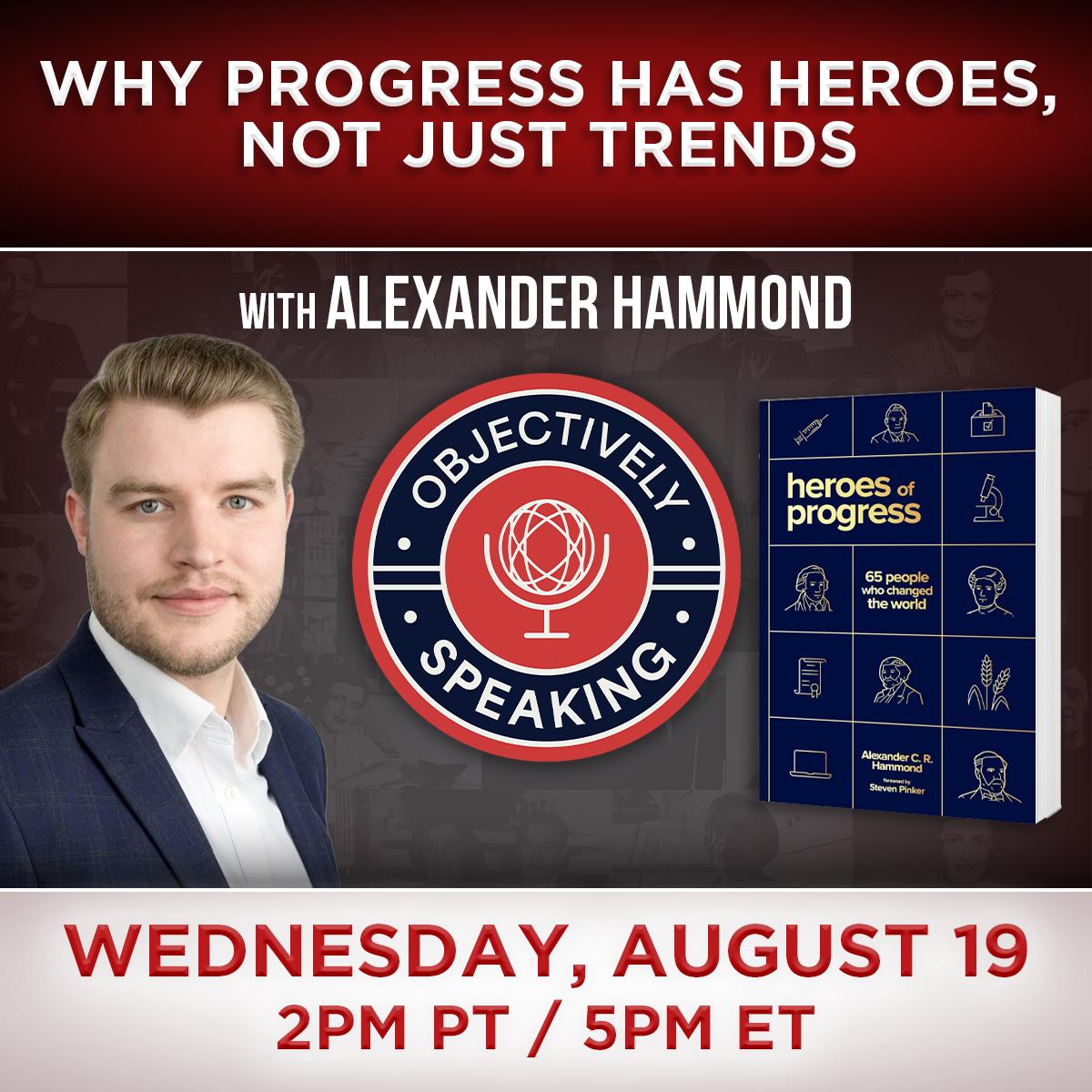
[00:00:00] Speaker A: Everyone and welcome to the 316th episode of objectively speaking. I'm Jag CEO of the Atlas Society. Apologies especially to our regulars for our slight delay, we had some technical difficulties. But I promise you it's well worth the wait because I'm very excited to have Alexander Hammond join us from Switzerland where it is I think past 11pm he's going to join us to talk about his book Heroes of Progress. 65 people who changed the World. Alex, thanks for joining us and thanks for your stick to it.
[00:00:41] Speaker B: Iveness, thank you so much for having me. It's a pleasure to be here. Yes, 11pm Here in Switzerland, joining you from the attic of my Swiss house.
Yes, great to be here.
[00:00:53] Speaker A: Yes, well obviously very hard worker, working 24 7. We're going to want to hear a bit about your new endeavors but our guests are always interested in a bit of our audience is interested in our guests backstories. So tell us a little bit about yourself, where you grew up, how you became interested in these ideas of human progress and how you got involved with the liberty movement.
[00:01:23] Speaker B: Yeah, so I grew up in the United Kingdom, as you may have been able to tell by my accent, but haven't really lived over majority of my adult life.
I became interested in classical liberal and libertarian ideas at about 17 years old while I was at school and then moving on to university.
Just so happened that one day everyone in my university knew my views of course. And one day I just happened to be sitting next to a housemate at the time who opened an email from the Adam Smith Institute and the Institute of Economic affairs, which is a great two great classical liberal think tanks in the uk.
The second he opened that email I just so happened to be looking over nosying at his screen and I saw that it was an email about what's called Freedom Week. It's a summer seminar for a week long that brings together students interested in classical liberal ideas along with lots of great scholars in this movement and lots of friends who I know you've had on your podcast before.
From there the rest is history really. I immediately found the cater institute online, said oh I really want to work rare managed to do an internship fair a year later, finished my studies in Exeter University down south in the UK and then began working at Cato. And I've moved around different free market think tanks, set up my own initiative that focused on African prosperity and trade and very recently now I'm back at Cato but most of my adult life not been in the uk I'm afraid it's hard to compare to Switzerland.
[00:03:11] Speaker A: Yes, I would definitely choose where you are if I had to choose between the two.
So we both have Cato in our background. I was director of education policy there and it's a great place to work. Of course, the chairman of the board of the Atlas Society is also chairman of the board at the Cato Institute. So it's a happy family.
And speaking of history, you started writing these profiles as a Weekly
[email protected] how did you go about choosing the heroes you profiled?
[00:03:47] Speaker B: Yes, my Heroes of Progress.
The goal of it really was to uncover people who have saved or improved, tangibly improved the outcomes of millions of people.
That was the goal from the outset. Often these are unsung heroes, not always, but often they could be from a range of backgrounds, whether it be agronomists whose hybrid crop saved a billion lives, or intellectuals who changed public policy and pushed the world in a free direction. It could be business people whose inventions raised living standards and revolutionized how we communicate, or other parts about our lives, or scientists that had huge medical breakthroughs that eliminated diseases and ended pandemics.
So quite simply, those in the book, if they did not exist, many of us would not be alive and if we were alive, would be far poorer, hungrier, sicklier, less free and less enlightened.
Each biography as well is, I'd say, historically verifiable. So I don't really touch on the ancient world because it's quite hard to verify who actually did what and when and how.
So my earliest hero is from 15th century all the way on to the modern day.
[00:05:11] Speaker A: Well, it's your book and not my book. Although I would say that those Heroes of progress might, if there's a second edition, might want to include some of the great artists and novelists and Ayn Rand, certainly. I mean, Cato co founder Ed Crane called her the greatest all time recruiter for the liberty movement. And it's certainly a way that many, many people come in and start, get, get more involved and get more educated.
So running the Atlas Society, running a non profit, one of the frustrations that I sometimes encounter when meeting with donors is sort of a pessimism like, oh, the world is going in the wrong direction. There's nothing that we can do about it. You know, we're doomed. So I think I'll just say spend my money and my time hanging out on my yacht. But your book is a real antidote to that. What do these breakthroughs of the past, these seemingly insurmountable challenges and problems. How can they better inform our mindset and sort of an informed optimism today?
[00:06:20] Speaker B: Yeah, I would say to the friends of Atlas Society, they're really not in bad company, though.
If you look across not only America, but the world, people are feeling pretty gloomy. Half of all young Americans report feeling anxious all or most of the time. It extends to about one third of people when you look at the whole population.
YouGov regularly does studies that asks people if they think the world is getting worse or better. And it's Normally in the UK, Switzerland, US it's always 65, 70% of people think the world is getting worse.
So I think what these people tell us and show us about the world is that real, tangible progress can still be made. This progress can still improve millions, if not billions of lives.
That progress is not just an abstract phenomena in the data.
As you know, I work for human progress, which is. Does a lot on the data that shows how much better the world is getting, looking at extreme poverty for mortality, life expectancy. But I feel this book goes beyond just the data to show that progress is not only possible in the abstract and in the data, but that drastic leaps have happened ample times before.
And quite frankly, because they've happened so many times before, it'd be really foolish to think they can't happen again or they're not currently happening again when we look at new technology around us.
[00:07:51] Speaker A: Yes, one of the things that I point to when I'm talking to my pessimistic donors and friends is I can certainly remember 10 years ago when I came to the Atlas Society, that I thought Latin America was doomed. And I, you know, in my less benevolent moments, was more akin to Ayn Rand saying, brother, you asked for it. And I was frustrated. Why can't they learn from these mistakes again and again and again?
And, you know, as I went on, I learned that it, it wasn't just the same as any other region of the world. There has been a historical entrenched effort by the Soviet Union and the, and Cuba to really go out, recruit labor movement activists, bring them back, educate them, indoctrinate them.
But, you know, 10 years ago, who would have predicted that we would have Argentina and Peru and Ecuador and El Salvador and Chile and, you know, all, all of these places that are now Colombia, most recently turning towards freedom. So it's important to remember that no fight is ever truly over with no hope of reprieve or reversal unless we say it is. And it also tells me a little bit about gratitude, you know, which is one of the big themes of ours here at the Atlas Society, I like to say you can't be objective if you don't have perspective. Now Steven Pinkert wrote your forward and talks about, quote, historical ingratitude, end quote.
What do you think ingratitude towards these people actually costs us?
[00:09:37] Speaker B: I think ingratitude and not only in gratitude but just the act of not knowing them, forgetting them, it not being taught at universities and schools for example, I think all round it leads to less permissiveness without gratitude. For a heroes that have come before, I think it's far less likely that we would look at the types of environments and societies that they came from that made their innovation possible.
In turn, if we're not looking at what makes innovation possible, I think this makes crackdowns on basic freedoms that are crucial for progress.
Speech, freedom to associate, take risks, disrupt the status quo, give it a try in the market. As the great historian Deirdre McCloskey always says.
I think crackdowns on those things are far more likely if we don't know or don't care about the results that we've yielded.
And I think ingratitude as well really touches on, I think it makes people think that the progress we've seen around us is much more of a natural baseline as such, rather than a fragile hard won achievement that could be undermined at any time with the wrong actions or wrong policy decisions or a lunatic with nuclear weapons. It's a fragile thing we have and to be grateful for the hard worn trodden path that's came before is crucial.
[00:11:14] Speaker A: Yeah, Matt Ridley also blurbed your book, but he, he's famously argued that innovation is a collective, almost seemingly inevitable process. Ideas having sex. Your book puts individuals at the center. Is there a tension there?
[00:11:35] Speaker B: Yeah, that's a great point.
So yeah, Matt's really big on this.
He did write a nice blurb from my book. In the blurb he still pointed out that it was. He believes it is a networked thing that emerges often simultaneously.
The way I see it is with Matt's point, and I respect Matt hugely, is I completely agree with him. But it is of course the case. We stand on the shoulders of giants when we share ideas. Sorry, when we have ideas, we're often sharing them or brainstorming them within larger teams. And we rely on centuries if not millennia of aggregated knowledge to do almost anything in our day to day life. Not only the wifi we're having this call over, but the laptop or the electricity or even the language we're speaking. That is actually still some knowledge, aggregated knowledge that we've built on has been built on by others over centuries.
So I agree with him in that sense for sure. I also agree that there's some very strange phenomena throughout history that has meant a lot. Several innovations have happened rather simultaneously.
A few examples of this could be Alexander Graham Bell when he the day he handed in his patent for the telephone in the 1870s.
On the exact same day, just a few hours later, Alicia Gray handed in a patent for pretty much the same telephone, only very marginal differences.
It's happened if we look further back and look at something like calculus. Both in the late 17th century Isaac Newton came up with it. And then just a couple of years after, without even being aware of the other one's work, a German chap called Leibniz also came up with it. And there's a few other examples like the light bulb.
However, I think the purpose of writing this and how it doesn't disagree but I think complements we can put it compliments that to work is there still needs to be an individual spark.
Nations, governments, committees, societies, clubs do not have ideas of themselves. It is the the only thing that has new innovative ideas are the human brain, at least for now. Maybe we can touch on AI later, but at least for now new ideas are human.
And this book then focuses on individuals because they do represent the accumulated knowledge, but also because they had the gusto in a way to push it over the line, to turn it into a practical real world application that in many cases changed the world for the better.
[00:14:29] Speaker A: All right, well again thanks to our veteran folks that almost never miss an episode, my modern G lock, stock and barrel iliation. Thanks again for your patience. I like the comment up here. Just getting a little nervous.
So let's get to some of their questions. My modern Galt asks if Alex, do most of these hero have a common origin story?
[00:14:57] Speaker B: Yes, this is an interesting thing, kind of looking at the commonalities between the heroes. I didn't set out initially to I didn't pick heroes based on my commonalities. But here's what I discovered because the book's also laid out chronologically so that actually allows for quite a nice way to see what's what's similar throughout time and how it changes as the centuries progress.
So what we can see at the beginning and as it moves on is the actual innovators, their race, their sex, their whatever sexuality, whatever other characteristics people talk about.
It becomes extremely diversified as time and as freedom worldwide accelerates.
At the beginning of the book, you'll notice the first 10ish or so heroes, they are all mostly English, all men, some northern Europeans more generally from about the 15th, 16th, 17th century, quite frankly, these were the people in society who had a decent degree of freedom to learn, to test things out, to speak freely and to do their thing.
As the book then goes on, you can see over time as freedom spreads or America becomes established and freedom spreads, there a lot more Americans, I mean, kind of in the middle of a book or mid to late end of a book, Americans have endless dominant, which is I think as audience of his podcast would expect.
And you then see a lot more people of diverse backgrounds, people of color from different countries.
So that's interesting.
There are a few examples of heroes not born in free societies.
And the way they survived and did their thing was one of two ways. First was through migration.
People especially hundreds of years ago, when even today, of course, but these aristocrats who developed a lot of innovations of the past, they moved an extraordinarily amount to find new networks, mentorship, education.
In the 15th century, for example, 16th century, sorry, Erasmus moved from the Netherlands to the UK to Belgium to France to Italy to Switzerland, back and forth throughout. And this was a time, you know, 500 years ago, it was pretty difficult to move. You couldn't just get in your car or jump on an airplane or have a big truck come and pick up your things. So migration is key. And of course we still see that when it comes to people from unfree countries stay moving to America, Western Europe.
And the second really important thing that we may not like, but it did yield results, was people in the past who didn't live in free societies but managed to innovate, got special permissions from the government, which is not good at all because you imagine millions of people who didn't have these permissions and couldn't innovate and they were in a very special position to do so. So Sir John Harrington, the inventor of the toilet, he got expelled from English court for writing, translating risky poetry. He was a bit of a, just a troublemaker, rubble rouser all around.
However, he kept getting invited back and being allowed to do his thing because he, because he was the godson of Elizabeth I, the queen at the time. And there's a few others from China that got special permissions from party officials and without them they would have been sent to prison. So, right, that's, I think a few other commonalities.
[00:18:58] Speaker A: All right, a nice comment here from Lock, stock, Barrel, who says, I think if you spend most of your time online, it is going to skew your views towards negativity. Flying Custard says there's a lot of nihilism these days. A book like this is a good palette cleanser to see that things are still getting better.
Elation asks, what role does competition play in progress? What about risk taking? And do you think that people are becoming more averse to taking risks?
[00:19:32] Speaker B: Oh, that's a good question. So risk taking, of course, hugely important.
Many of these people put a lot on the line to do what they did.
I think that's especially clear when we look at, if we look at some of the earlier heroes who are more interested in ideas and influenced the Enlightenment and various policies that stemmed from that.
They were risking their lives completely to publish these books.
Erasmus, for example, the first modern champion of peace and toleration, he if anyone was caught with one of the copies on his books, of his books in several countries, they would be executed.
He was often published anonymously. A lot of them did.
Then when we look more recently into the, say the 20th century, especially when we look at some of the business people, they put their savings, their house, their livelihoods on the line in order to ensure their business was a success, to ensure that innovation could get to market and appeal to the masses.
Whether we're losing riskiness or the tolerance to take risks.
I can't comment on individuals globally and you know, as a society as a whole. What I can say is a lot of societies are less tolerant of risk takers and innovators in general.
A lot of the heroes, certainly not all, were very disagreeable people.
They were very technically orientated.
They did not necessarily have interested in having the social skills to have a lovely polite conversation like we're having today.
They were focused on finding technical solutions to problems, not social solutions to problems.
This disagreeableness manifests in all types of ways. I'm happy to give you ample examples of this. But I worry many of the heroes within this book, if they were alive today, they would be frankly cancelled. Their employer would probably have to fire them because they were rude. They didn't attend mandatory classes to make managerial classes to make them more civil.
And a lot of times they held quite repugnant views on various topics despite their world changing innovation.
I think we should be very open to championing and admiring people for an innovation or achievement they've accomplished, despite anything else they may have done.
And we shouldn't just cancel them for one thing. So I think just the general climate around free speech does actually Risk undermining progress to quite a large degree and being tolerant of disagreeable eccentrics.
I think Elon Musk's kind of personality is a good example here.
[00:22:36] Speaker A: Right. Probably wouldn't make Steve Jobs. Right.
Some of the weirdos and sometimes, you know, as you say, disagreeable jerks, sometimes those skills that helps them fight through the disbelief and the obstacles don't necessarily make for a good dinner party, shall we say.
So one of the distinctions that you wrote about in your introduction that I hadn't given much thought to before was this distinction between Smithian, Adam Smithian growth and Schumpeterian growth. What is the difference? And is one more important to human progress?
[00:23:21] Speaker B: Yes.
So Joel Mokier, the Nobel Prize winning economist, I'm not sure if he came up with this, but he was the one who really championed it and put it into the mainstream.
Smithian growth, as you say, named after Adam Smith. This is the type of economic growth that's caused by expansion and ultimately the greater division of labor, whether it be new trade deals, accessing new markets, being able to hire more people.
It's this type of incremental improvements that cause growth.
Smithing growth is hugely important and it's somewhat necessary to have a base foundation.
However, what really caused, at least according to Mokhia and many other economic historians who know better than me, what really caused global worldwide progress is Schumpeterian growth. And this is the growth that's caused by technological innovation and new ideas, often called creative destruction. And Schumpeterian, of course, named after Joseph Schumpeter.
So the modern world was really built on Schumpeterian growth.
If we look kind of fast forward today, economies like Switzerland, which is highly innovative and developed, and the United States as well, are really at the technological frontier. And the vast majority of their growth comes from innovation.
I would say I don't want to obsess with the uk, but UK is at the frontier of technological innovation in a couple of fields. But there's actually a lot of random Smithian growth catch up growth that it can have by simply doing things like improving the train system or building more houses. Huge gains there, whereas it's not as much on the frontier as America.
But the best thing about Trumpeterian growth, because it relies on human ideas, ingenuity, useful knowledge, it can theoretically be sustained forever without diminishing returns.
Unlike physical trade, Smithian growth that would eventually hit a resource bottleneck. You imagine the whole world had free trade and open borders and everyone could trade and have as much comparative advantage as possible. That eventually actually does hit a limit where it shouldn't appear on growth. Theoretically, never.
[00:25:58] Speaker A: Can you write that recognizing the achievements and contributions of. Of these heroes shouldn't be viewed as an endorsement of all of their actions and all of their views, some of which can be seen as justifiably reprehensible. What are some examples of that? Individuals who achieved greatly but also had serious failings.
[00:26:28] Speaker B: Well, where to start?
And I'd say there's also different categories of failings, right? There's really egregious ones, slightly morally repugnant, and then just generally unpleasant.
If we were to look at the really egregious acts, I think Fritz Haber and Carl Bosch really are the two in the spotlight here. These were two German scientists who, at the beginning of the 20th century, they, together they created the Haber Bosch process, converting nitrogen from the air into ammonia to create synthetic fertilizer.
Many people forget because humans are inclined to forget things we narrowly missed throughout history. But about 100, 110 years ago, the world was on the cusp of a global famine.
Guano deposits, which is essentially bird poop, mostly from islands across the oceans, were really running low, and crop yields were on the brink. And yet synthetic fertilizer came along and it saved at least a billion people. I think about a third of all food today. Sorry, a third of all people still rely on it for their food every day.
And yet Haber, Fritz Haber went on to develop chlorine and gas was of course, used in world wars.
Killed.
I don't know how many people it killed, but tens of thousands of people, maybe more.
Whereas Carl Bosch, he developed nitric acid that went into saltpeter explosives, and he got extremely wealthy off Nazi government contracts.
So two people who I would not like to meet, and yet they saved the world and continue to save probably millions of lives every year.
[00:28:20] Speaker A: Those are.
Those are good examples. All right, another question here from Valiant Mike about patents and intellectual property protections. Do they generally encourage innovation or can they sometimes slow the spread of useful ideas? He says, tangentially related. I know many farmers who are upset because they can't repair their equipment because of IP protection protections on who can service their vehicles.
[00:28:52] Speaker B: Yeah, so I'd say in the book, we don't necessarily go on.
We look kind of solely at the innovation rather, and then the impact it immediately and subsequently has on people, rather than kind of, you know, the intricate business dealings and successes or problems it can cause among different stakeholders.
I'm not really sure on patents. I've got to be Honest, I've, you know, studied them then for a decade. I think there's great examples on both ends of the stick.
I know some great, great libertarians and objectivists across the world. Some are really in favor of patents and some libertarians are really against patents.
I don't think I've got anything intelligent to add on that debate, and I'm very happy to admit that what I would say is there is an.
I don't know within this book what proportion of innovations were patented.
There are definitely some examples of people giving it away just freely.
There's others examples where maybe it's not needed because it's more of an idea rather than a physical product.
I don't know. I'll leave it to you and I'd want to hear your thoughts. Hopefully we can have a discussion one day.
[00:30:20] Speaker A: All right. Another question from Flying Custard, asking to kind of apply your same lens today.
Are there fields where you're saying more heroes of progress and fields where such heroes are lacking? I guess another way to put that would be in the. If you did another edition of this 75 years from now, who might make the cut?
[00:30:46] Speaker B: Yeah, it's. It's a good question.
I would say probably Elon Musk. Right. I think we do have to give him his dues on the fact he has ushered in kind of the electric car revolution, especially if he succeeds in going. If he succeeds in going to Mars, then I might just have to add an extra chapter to it, because I do think that is huge just for humanity as a whole.
Other fields in particular, I don't know if there's a single person who at least invented modern AI distribution.
I think they should really be there.
I know it's a complex story because there's lots of people, even some people claim Alan Turing back in the 1940s had a big influence on AI.
But if there is one single person or a couple of people that we could pin it on, I think that's worth incorporating.
And also I think it's a huge thing that's going to become just more and more popular in the next few years. Autonomous the rise of autonomous vehicles.
I was reading today just Waymo in the last two years increased their number of weekly rides by tenfold.
And there's all types of very smart economists seeing where it's going to go in the future. Not just Waymo, but autonomous vehicle adoption in general. And it does. I'm quite convinced that's going to be a good proportion of a market in a decade, if not Two, and I think that will be revolutionary for humankind and save us huge amounts of time and just improve the economy through lower
[00:32:27] Speaker A: transaction costs and save many, many lives. I just returned from San Francisco of all places and took waymos everywhere. And when I wasn't doing that, I was using Tesla self driving to drive me out to these various meetings and park the car and all of that. And so apparently the latest adversaries and critics of self driving technology is the tort reform is the trial lawyer lobby because they're seeing that they're not going to be able to sue people as frequently over.
So I think it's great. Okay, so one of your selections that surprised me at least from an objectivist perspective was the inclusion of Jeremy Bentham. As I view the utilitarian premise of quote the greatest good for the greatest number as inimical to the protection of individual rights and as a justification for collectivism. I take it you view it differently.
[00:33:37] Speaker B: That's a great point.
I should have known. I'll come up.
Yes. So Ben, it was in his 1789 book, his most famous book, the Introduction to Principles of Morals and Legislation.
I think what I've got to say on Bentham is even if I leave my own thoughts and feelings to one side, and I agree broadly with you, but if we just leave them to one side and speak just part of a pun objectively.
But throughout his work, Bentham used this principle primarily against the entrenched or aristocratic and religious privileges.
He used this argument, the greatest good for the greatest number, to produce an array of arguments across various different policy and moral areas to expand individual freedom. He used this argument to create one of the first ever arguments for decriminalizing homosexuality.
And remember, this is the 1780s. That was radical. That could. He published it anonymously of course, but that's huge. Probably one of the first modern writers to say that.
He used this principle to push for legal equality, prison reform, free speech, against slavery, even extending, you know, moral kind of considerations to animals and animal, animal rights. And we shouldn't just torture them for the fun of it.
Okay.
Where I think it gets interesting for Objectivists is yes, you pushed those ideas on the ground that it's suffering, not rationality that matters. And I think that's the biggest disagreement that said almost everything. He actually campaigned for expanded individual liberty against the arbitrary state.
So I think that's quite interesting because I'd say him and Rand especially
[00:35:45] Speaker A: disagreed
[00:35:45] Speaker B: sharply on the ethical foundations.
But when you actually look at their policy conclusions, a rule of law Equality before the law, free exchange, property rights, free speech.
They ended up not a million miles apart, I'd say.
[00:36:01] Speaker A: Right. No, it's true. And I was also pleased to have some of my prejudices set straight and learn of these redeeming qualities and redemptive beliefs and advocacy that he promoted. So having looked out, it's been six years since you've, since you wrote this book, of course, we are now back in the fight with tariffs and the age of terrorists.
Richard Cobden, British campaigner for free trade, seems a particularly timely inclusion in your hall of heroes. What were the British Corn Laws that he helped to repeal and what are some of the arguments he advanced that we need to relearn today?
[00:36:53] Speaker B: Yeah, Richard Cobden, a hero, a fellow Brit, I'm proud to say.
The Corn Laws, they were introduced in 1815 in the UK.
They placed extraordinarily high tariffs on imported grain.
Consequently, this kept bread prices extremely high, bread being kind of a staple food for the masses at the time.
This enriched the aristocratic wealthy landowners because they could, you know, make grain inefficiently while the poor starved.
Fundamentally.
Richard Cobden, along with a few others, most notably John Bright, I'd say Richard Cobden, after he became rich, he decided, like a few kind of libertarian founders that had come after him, to go out, become rich and then set up his organization. He developed the Anti Corn law League in 1839.
And this was just, it was a huge advocacy group campaign.
Maybe today you'd even call it a think tank if it was arrived, if, if it, if it was around.
And he successfully campaigned and converted for Prime Minister at the time, Robert Peel to abolish the corn laws in 1846.
He went on later to develop the first modern free trade agreement with France.
But the significance of this, it's not just about grain and tariffs on grain, no matter how important they are. The repeal of the Corn Laws marked just a fundamental shift in the policy of British Empire towards free trade. It ended centuries and centuries of state protected and protected state protected agriculture and set this global precedent for open trade and international trade. Because of course at the time Britain was the global hegemon. Whatever Britain did, a lot of countries followed.
Not so true today. But anyway, this policy alleviated hunger for millions, set a precedent that really led to Pax Britannica and created modern day free trade agreements which continue to do good for millions, if not billion, billions of people.
[00:39:19] Speaker A: All right, Chris Baker sent us a super chat and says thanks for acknowledging Algernon Sydney last week. So thank you, Chris.
Lock, stock and barrel, asked Alex, who would be, if you did a kind of mirror version of this book, who would be the villains of progress?
Oh, gosh, it could be policies, it could be individuals, it could be sentiments, it could be values.
[00:39:55] Speaker B: Yeah. So as deputy editor of Human Progress, I'm absorbed in the world of good news, but I can give this a stab.
I think it's a. It's slightly a hard question because a lot of people, even when they commit extremely evil acts, don't believe they're doing extremely evil acts. So they actually in many instances believe they are doing good for the world, despite the negative and adverse externalities that come from it, of course. I mean, let's start with all the big dictators.
Mao, Paul, Pot, Hitler, let's throw them all in there.
One person who people might not know, I think might be a good addition is a guy called Trough. Trofim Lysenko. Trofim Lysenko, a Russian, A diplomat. Not a diplomat, a figure in the USSR government who used his political power to purge genetic scientists, genetic science from the Soviet Union.
This is a really bizarre tale and you can read about it in the book on a chapter on a guy called Yao Longping. But essentially there's the Western way of doing plants science and the Soviet Chinese way of doing plant science. And if you're in China or the Soviet Union and you were doing the Western way of doing plant science, then you were sent to the Gulag the vast majority of times, if not worse, and same goes to your family.
So by putting forward this weird pseudo scientific idea of plant science, and it went something along the lines of, in order to make crops genetically modified, you just need to change the environment in which the crops are in, and then over time they'll just become naturally resistant, which, you know, it's got its place in evolution, but it's not going to happen in two years like they believed it would. So he's. The result of that meant China and the USSR didn't incorporate GMOs or any of these types of hybrid wheat grain crops, whatever else.
And that led to deaths of millions of people for sure, if not tens of millions.
[00:42:14] Speaker A: That's a good one or a bad one, but a good example of a villain.
So at the Atlas Society, we focused, as I mentioned up at the top a lot on Cuba and by extension the Soviet Union and their role in promoting socialism in Latin America. But we haven't really delved into, deeply into the 1962 Cuban Missile Crisis. As a result, I Hadn't known about Vasily Arhipov.
Why does the U.S. national Security Archive declare that Arhipov saved the world?
[00:42:50] Speaker B: This is one of my favorite stories.
Aripov.
He was there in his submarine. He's a Soviet naval officer during the Cuban Missile Crisis, October 27, 1962, in one of his dusty B59 submarines.
Temperatures at the time, just to give a context, the US was dropping depth charges on the submarine and the flotilla around it.
Depth charges are small underwater explosives. They don't actually cause damage, but they can influence. They don't cause direct damage, but they kind of scare everyone and can lead to things malfunctioning anyway. So at the time he was in his submarine, temperatures were hit inside were hitting 120Fahrenheit.
Carbon monoxide, sorry, carbon dioxide was spiking. The crew was fainting left, right and center.
And because of the situation of the depth charges, the captain of the submarine believed, Archipelago, sorry, believed that World War three had begun.
He believed it had begun. Radio communication with Moscow was completely out. All he knew was there explosions around him.
And it was now or never, regrettably, and no U.S. personnel or Western forces knew this at the time. The submarine was equipped with nuclear torpedoes. I think it's fair to say if the US had known the submarine had nuclear tipped torpedoes, then they would not be dropping depth charges on it.
But anyway, the captain wanted to start World War three, launch this torpedo at the USS Randolph.
And so this raises a question. How did World War three suddenly not happen?
Partly fluke, partly immense bravery.
A very weird. It's not that weird. But the rules within the Soviet submarine authorities, the way it works is that to launch these torpedoes you needed the permission of a captain and a political officer.
Both the captain and the political officer wanted to fire the missile.
However, Arkhipov, although he was only second in command of a submarine, was actually in charge of a whole flotilla of submarines. So therefore they needed his approval. In another world, we could have easily been. He could have easily been on another submarine and they would have fired and World War three would have started.
The reason the story isn't very well known is no one knew that this submarine had the nuclear torpedoes on until 2002, when there was a 40th anniversary in Cuba with both sides soldiers or the navy personnel of both sides coming together.
And yet, despite that situation, Archipelago refused. World War Three didn't start. And the U.S.
national Security Archive it's got its hands on what the plans would be if a. If a nuclear war started then. And it's just, you know, nuclear bomb to Moscow. Moscow would hit Washington, would hit London, and it's just chaos. We probably wouldn't be having this, almost certainly would not be having this conversation without him.
[00:46:16] Speaker A: It's a great story. It was one of my favorites as well. And folks, this also has a great audio book. And, you know, that's how I get through at least a book a week for these podcasts. And I, I love the audiobook format and it's not always great, but this one was, was a good one.
Well, we are coming up at the top of the hour here, which is midnight in Switzerland.
I wanted to maybe close with some of your focus and what you're working on now.
You know, the Atlas Society had essentially acquired and merged with the Ayn Rand Center Europe two years ago. And it's been a real education process for me. And I've seen some surprises. Like, for one, one of the biggest surprises is how much interest in objectivism there is in Africa and Zimbabwe and Burundi and these various countries.
You know, we have these 22 John Galt schools and we have 20 to 25 slots. We get upwards of 200 applications for one of those slots from some of our African partner countries. So maybe can you give us a perspective on what, what's the story of human progress in Africa and what remains to be done?
[00:47:47] Speaker B: Yeah, so I wear a lot of hats and I've done various things.
So in the think tank world, both in America, Europe and in Africa, in Africa, it is fascinating the libertarians and the objectivists that have appeared there, really, in the last 10 years, there were three or four think tanks on the continent, classical libertarian think tanks on the continent, 20 years ago.
Today there are dozens and dozens and dozens, and some of them are pretty, pretty dang good.
Really impressive movement. The beautiful thing, and I think why it's important to double down on the, on supporting these groups in Africa is just with such a small amount of money, you can get an enormous, enormous amount of policy changed. Often in these countries, they don't have a gazillion different think tanks vying for the attention of the finance minister. They don't have all these pressure groups and lobbies and what have you. So with tiny grant, I mean, there's one organization in Burundi, a previous organization of mine, which I set up, we gave them a grant of just $11,000.
And with that they did this whole immense media campaign, had dozens and dozens of op eds and articles, and they actually managed to overturn the ban on importing food, fertilizer and cement.
So suddenly, for $11,000, that meant the supermarkets weren't empty anymore. Building companies began building again and farmers could finally plant their crops. So I really implore you to do.
These groups are great, they're passionate, they're young, and I think really the future.
And then in addition to that, I've now transitioned very recently to working on human progress.org and this is, this is actually the publisher of my book, which is a project of a Cato institute that explores how much better the world is getting and why there's all types of things behind it. There's data, there's videos, there's obed podcasts. I really implore you to go check out human progress.org and I think that's it. I'm not sure if I missed anything off your list.
[00:50:03] Speaker A: No, that's great. That's great. Well, I, and I was excited to hear about the work that you've done and that helps to explain a little bit why we are getting such a wildly enthusiastic response in Africa. So thank you, Alex, thanks for your patience, for sticking with us as we got the technicians difficulties ironed out and for this magnificent achievement of your book.
[00:50:30] Speaker B: Thank you so much. And I just want to tell the audience, for technical difficulties, they were completely my fault. Atlas Society were great.
Completely my fault. And I apologize. But thank you so much for having me.
[00:50:40] Speaker A: Not, not at all. You know, you were a hero of progress in that moment. You were not willing to, to give up and say, you know, it's too late, I'm going to bed. So we, we did it. And then thanks again to all of you in the audience. Thanks for your patience, thanks for all of your great questions. Be sure to join us next week when Ari Rastagar will join us to talk about his book, the Gift of Failure. Turn my missteps into your epic success.
See you then.