Episode Transcript
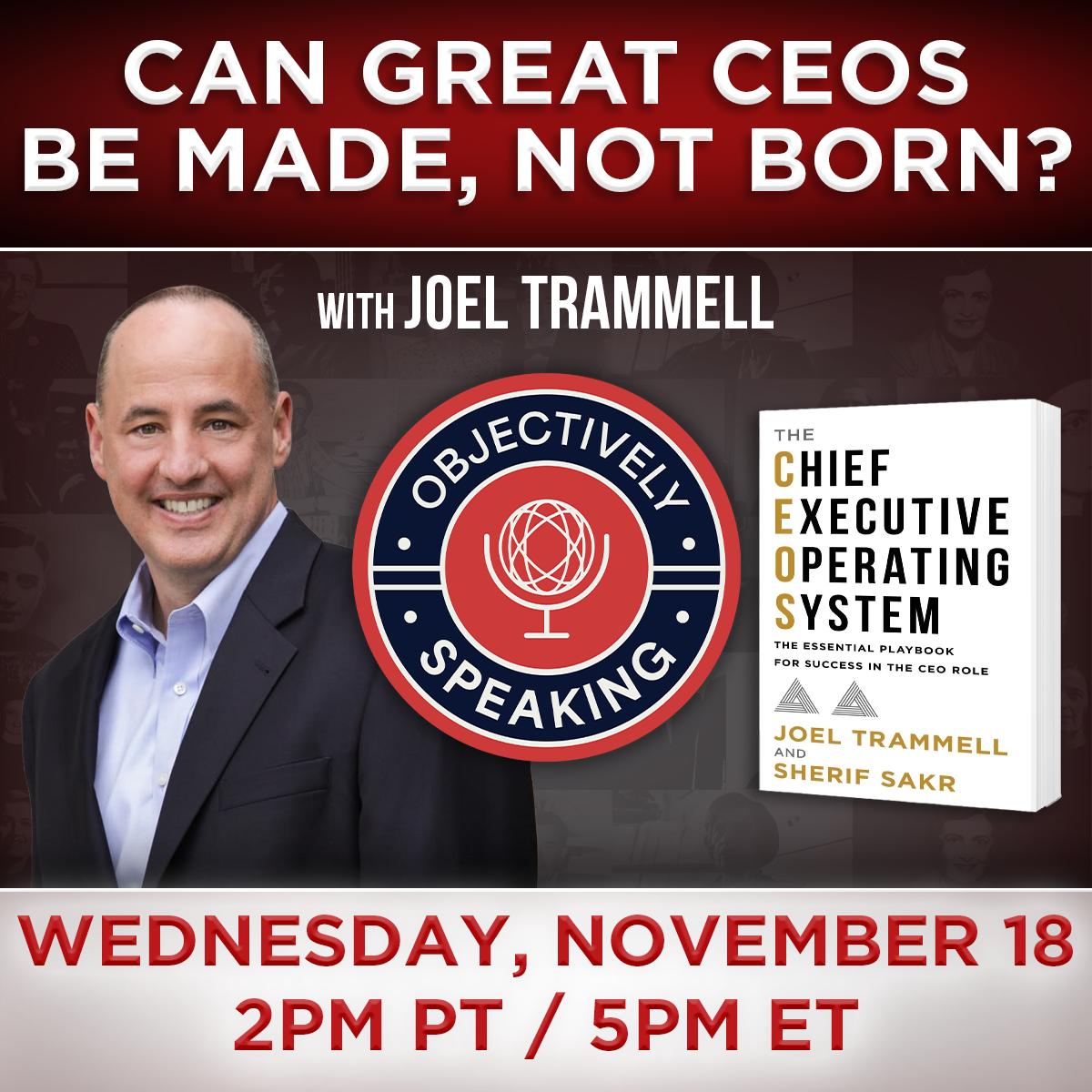
[00:00:00] Speaker A: Everyone, welcome to the 328th episode of objectively speaking. I'm Jag CEO of the Atlas Society. I'm very excited to be joined by Joel Trammell to talk about his book, the Chief Executive Operating System, the Essential Playbook for Success in the CEO Role, which I have read and I have listened to and I have learned from. So, Joel, thank you for joining us,
[00:00:26] Speaker B: and great to be with you today.
[00:00:29] Speaker A: So, in doing some research about you, I learned that after graduating from Louisiana Tech with an engineering degree, you spent several years as a instructor.
Naval nuclear instructor. Did that experience help you develop skills to teach CEOs?
[00:00:52] Speaker B: Well, it certainly helped. You know, I spent over $1,000 in the classroom, and so from a training perspective, but kind of the big insight that I had by teaching there was. It was the first time in my life I had been surrounded by a bunch of people who were smarter than I was.
And I kind of thought if you had all the smart people, the organization should work really well. And I found out that just putting a bunch of smart people together doesn't by itself make the organization run well. And. And that's the problem. That kind of started my direction of wanting to be CEO and wanting to learn how to be CEO and run an organization, and Then now teach CEOs how to run their organizations.
[00:01:32] Speaker A: So I also learned of your competitive tennis background. Are you still competing? And what can competitive sports teach leaders about the mindset they need to bring to their executive roles?
[00:01:44] Speaker B: Well, tennis is one of those sports that's individual. You're out there by yourself. And in my career, there was never coaching allowed on the court during the match. And so you have to figure everything out by yourself. Unlike other sports, team sports, you can call timeout and the coach can substitute and all those things. Tennis didn't allow for that. And I think that is good training for the CEO position. I think it's. It's relevant. I spent probably 50 years playing competitive tennis. I've now transitioned to the hot sport of pickleball. The old ladies work a little better on the pickleball court than they do on the tennis court.
[00:02:23] Speaker A: So during our lunch in Austin this past summer, you mentioned an early interest in philosophy, but you couldn't see how to make money with it. How did the transition from studying and teaching to actually starting companies and getting them off the ground?
[00:02:42] Speaker B: Well, as I said that, you know, I kind of had this interest in how to run an organization, and I thought about getting an mba, but at the time, the University of Central Florida, that was near the base wanted me to take 60 hours of undergraduate business before they would allow me into their MBA program. And as an arrogant engineer, I wasn't going to do that.
And so the only way at that time, you know, this is pre Internet days, you could go to the library and try to find a book on how to run a business, but, you know, that didn't really exist. So the only thing I could think of to do was to start a business and try to figure it out
[00:03:19] Speaker A: along the way. And you've done that, repeated that process several, several times.
So turning now to your book, in it, you suggest that becoming citizen CEO is more like arriving at basecamp rather than reaching the summit. Can you unpack that for us?
[00:03:37] Speaker B: Yeah. I mean, there are two major career changes where it's really a change in the nature of the job that can happen for people. And the first is if you're an individual contributor and you get your first management position, you know, that's really a change in the nature of the job. And you really have to start from scratch somewhat and learn how to be a manager and develop those experiences and skills. And the same thing's true from the CEO position. A lot of people think, oh, if I've been the VP of sales or the VP of marketing or a chief financial officer, that CEOs just the next step up the ladder. And I would say it's, it's not, it's a very different job. I mean, I've been CEO of various organizations for the past 30 years, but I'm not qualified to be CFO or VP of Sales or marketing person. Those are very different jobs and they need to be approached very differently. And so that's a big thing that a lot of people find out when they get into the CEO role, that it's very different in the nature of the job than other executive positions.
[00:04:42] Speaker A: Since you have been involved with various nonprofits on their boards, you mentioned you're in Dallas now and going to an event that YAL is hosting. What are some of the biggest differences between being a nonprofit CEO and running an actual for profit company?
[00:05:01] Speaker B: You know, I think a lot of people think those are extremely different. And I would say they're, they're actually very similar and they're just a few, you know, differences. Typically in a for profit business, your customers are the ones who provide most of the resources to run the business by you selling something and, and you get direct feedback from who you're delivering the product or service to, how well you're doing. You know, if they buy more. And if they like your product, that you get very direct feedback. A lot of times in the nonprofit sector, you're delivering a product or service, but they're not actually funding the organization. Some independent third party is funding the organization. And so there's not as close tie between what you're delivering and whether you're being successful.
And so that makes it a little bit more challenging. But you're still in both cases trying to organize a bunch of people to provide some sort of product or service to a market.
And that is a challenging job to do, regardless of whether you're doing it in the for profit world or the nonprofit world.
[00:06:08] Speaker A: Yeah, you know, when I was appointed CEO of the Atlas Society, I wanted to transition it from what I called a symphony model to a soup kitchen model. And the symphony model is where the people that are writing the checks are also consuming the products and services.
The people that are writing a check to a soup kitchen aren't necessarily eating at the soup kitchen. Same with running a, you know, a nonprofit that's focused on organizing student activists or teaching kids about philosophy and having conferences and schools all around the world.
So I think one of the, the jobs of any nonprofit is to make sure that you're communicating directly.
What is the singular benefit that you're providing that they can't necessarily get from other alternatives? So, so you've built technology startups that achieved nine figure exits. You've also run a publicly traded company. How different is being an entrepreneurial founder from being a corporate CEO?
[00:07:22] Speaker B: Yeah, those are two very different jobs. I mean, I divide the CEO job kind of into three phases based on complexity of the organization. And complexity of the organization is really dependent on the number of people. People, you know, employed by the organization is the primary thing. A lot of people think it might be revenue or other things, but really it's the number of people you have to organize that determines the complexity.
And it gets very complex very fast. A lot of people don't realize how quickly that happens. And so I talk about the first phase, the entrepreneurial phase, before you have product market fit. You know, this is typically from one employee to maybe 20, 25 employees.
I call that a project manager CEO, because yeah, you're the CEO, but you're also probably effectively the executive of most of all the other functions as well. You're making all the decisions, you know, what everyone is doing in each job.
Communication is pretty easy. You can fit everybody in one room, you can talk to everybody.
And then there's a transition that has to occur because complexity at 25 is a lot more than it is at 10 people. And I always point out that at 10 people, there are 45 different conversations, unique conversations that can happen among 10 people. But as you transition from 10 to, let's say, a hundred, there become almost 5,000 independent conversations that can be had. And so the complexity of organizing 100 people is not 10 times greater than organizing 10 people. It's 100 times greater than organizing 10 people. And so during that transition, then the CEO needs to find executives that can run all the functional areas of the business. And then as you get to 100 or 150 or more employees, there becomes a full time CEO job. Now, the interesting thing related to your question about public company versus private. I've run a private company that was 270 people running a public company that was 4,000 employees.
Those two jobs didn't feel dramatically different to me because in both cases I had eight to 10 executives that were working for me. I had a board that I reported to, I had two or three individual contributors that were important, I dealt with regularly. And then whether there were two or three levels below me or four or five levels below me didn't impact day to day how I did the job. But the difference between running the 275 person company and a 20 person company is very dramatic. And that transition is where a lot of founders really struggle.
[00:09:54] Speaker A: So in your book, you identify five responsibilities a CEO cannot delegate. Setting the vision, providing resources, building culture, developing organizational decision making, and delivering performance. Which of these do you think most commonly executives neglect?
[00:10:16] Speaker B: Well, it's probably the first one of owning the vision.
I mean, I think everybody knows the CEO. They're responsible for performance.
They're usually okay, they want to make decisions. They don't necessarily teach the organization to make good decisions, but they make decisions. They know they got to supply the people and the capital, but they don't really own the vision and communicate that vision clearly and get everyone in the organization aligned. Often they think people know what the vision is. They've told the story once, they've talked about it, but they don't take all the steps necessary to really align a large group of people around the common mission, vision and values.
[00:10:58] Speaker A: So you describe what you call triangles of tension between different parts of a business, including sales, marketing and product development, as well as customers, staffers, employees and shareholders.
Could you give an example of how a CEO should be navigating those competing interests when there's no solution that immediately satisfies everyone?
[00:11:28] Speaker B: Yeah, I've Developed what I call the first law of business, which in my experience, the only way to build a successful, thriving business is to consistently provide value to customers, consistently provide value to employees, consistently provide value to shareholders. Now the problem with that is those three are in tension with each other. Because if I just cut the price for the customer, that's a resource that money could have gone to employees could have gone to shareholders. And so that's a zero sum game.
So what real, the real art of business is being able to arbitrage value.
Know your customers so well, know your employees so well, know your shareholders so well, and be creative enough to figure out things that you can deliver to each of those groups that they value more than it costs you to provide them. Right? It turns out customers might spend more money on quality and they might pay you more than it costs you to provide that additional quality or great customer service. Employees might prefer great working conditions or good management or just good peers to work with a good culture, and they might value that more than the money it costs you to provide. And so that's where profit comes from and long term success comes from, is consistently providing value to each of those groups. And therefore, again, because those resources could be used by any of the groups, there's a tension there. And so you're balancing and optimizing along three variables instead of just one. Many people think of business and CEOs just around building profitability, but you can't optimize profit without providing value to customers, employees and shareholders. And then you mentioned the other kind of internal triangle of tension I talk about, which is between sales, which wants to sell everything they can, and the product and service or service delivery team that has to deliver what sales sells, and the marketing team that's out there trying to raise awareness and make customers aware of your products. And so there's a natural tension that occurs there. And those six functions really are the core functions of a business. I talk about them like they're the electrons, protons and neutrons, you know, of an atom. They're, they're just fundamental components.
And it, it has a lot of implications for the CEO and how they run the business. And their real job is to manage the tensions between all of those groups and referee and make a decision to, to balance the interests the best they can of all those groups. But the tendency, of course, is to get overly focused on one.
You know, you can be overly focused on the employees and not provide value to the customers or shareholders. You can get overly focused on the customer and not provide value to shareholders or employees. You can get overly focused on the shareholders as well and not provide value to the customers or employees. So it's a constant balancing act. Which is the reason my first book I wrote about the CEO job was called the CEO Tightrope.
[00:14:30] Speaker A: Well, tell us about that. What is the CEO type rule?
[00:14:32] Speaker B: Well, so it's just the idea that, you know, you have to constantly be moving forward, but you have to balance between these competing interests. And you can't lose your focus and understanding that there are competing interests. And you can't just optimize along one variable. And you inevitably see when a company fails, it's typically because they optimized, tried to optimize around one variable. I mean, example I often use is Boeing ran into significant trouble when their CEO got overly focused on shareholder value and earnings per share and they took shortcuts in their design of the newest 737. And that caused the plane to have, you know, structural and, and safety issues. And of course that, you know, didn't provide value to customers. And then they couldn't make enough of them because they had to solve that problem to satisfy Southwest Airlines. So their biggest customer was upset and then they didn't treat the employees very well. So the union went on strike and, and so they just lost focus.
That there's a constant balancing act that you have to pull off.
[00:15:40] Speaker A: That's a great but somewhat harrowing example of somebody focusing too much on one thing and not walking the tightrope and having the balancing act on the other side. What are some either historic or current CEOs that you do feel have a grip on balancing these competing interests?
[00:16:01] Speaker B: Yeah, and it's sometimes hard being on the outside to evaluate CEOs, but certainly Satya Nadella at Microsoft, I think has shown over the years to be a great technology CEO of one of the big tech companies. And running in an environment where the market is constantly changing, technology is constantly evolving, trying to keep up with all those changes while again keeping the workforce happy and the customers relatively happy. I think he's done a great job at that.
[00:16:34] Speaker A: Okay, well, we are more than a little more than about quarter way through the interview. And it's about this time that I like to turn to our audience questions. So the conversation, it doesn't get too far ahead of what they have been curious about. And we have Alan Turner. He is asking what is the single biggest mistake you see first time, first time CEOs make, aside from suddenly thinking they have all the power,
[00:17:01] Speaker B: the biggest mistake that CEOs make is getting.
They don't know exactly what to do in the CEO job because they've never had it before.
And so they just take whatever problem comes to their desk and I call it the firefighter CEO. They go, you know, they go in in the morning and, yeah, there are going to be 10 emails there, and somebody's got a problem. And if you go solve that problem, then somebody else can have another problem. There are three people standing outside your door, and suddenly you're not doing the important strategic things that the CEO job requires. You're spending all your time on a bunch of seemingly urgent things, but not necessarily important things.
And you don't have the confidence often of the team or yourself to let those decisions be made at a lower level. And so you get into this constant firefighting mode, and you just can't ever get out of it.
[00:17:55] Speaker A: All right, we got some love from Anna on X. It's great to see you here.
And another question from my modern gift. Is there a particular leadership lesson that you, Joel, learned the hard way?
[00:18:12] Speaker B: Well, I mean, the biggest transition, I would say, is, you know, when I graduated college, as a thought, I was a pretty smart engineer. I just said, you know, the only thing that's important in people that work for you, are they smart and can they get things done? And after 35 years of running businesses, yes, it's good to have smart people. Yes, it's good to have people that get things done. But the most important thing in the hiring is can they identify with the mission, vision, and values of the organization? Because if they buy into the mission, they're going to try to constantly move that mission forward, they're going to try to constantly improve, they're going to build a career.
If they don't buy into the mission, they're just taking a job. And if somebody else comes along with a slightly better job, they're going to take that job. And you're really not going to get the value from those people that you get from the people who bought into your mission.
[00:19:07] Speaker A: I couldn't agree more.
I'll take one more. Lock stock barrel asks, how can a CEO build a culture of meritocracy without creating toxic internal competition?
[00:19:22] Speaker B: Yeah, well, you have to have a consistent measurement and management of performance in the organization. And, you know, if you want the details, you can look at my book, the Chief Executive Operating System. It gives great detail about how to build out a performance management system that is consistent across the organization. That's fair that everybody knows what they're responsible for and how they're going to be evaluated and it's really having the discipline and the consistency to do it. And I find that's the hardest part. Nothing I talk about in the book is complex in the sense of it's complex to execute.
But a lot of people don't have the discipline to stay with it and be consistent in the way they evaluate and manage performance across the organization. If you don't do that, you're going to struggle building a meritocracy and it's always going to look like you're doing special favors for this one and you're reacting instead of being proactive.
[00:20:23] Speaker A: So you devote an entire section of your book to the CEO as an individual, including self awareness and mindfulness. Is there a characteristic that you found repeatedly separates excellent CEOs from merely competent ones? Perhaps intellectual humility, emotional resilience, or the ability to change their minds?
[00:20:46] Speaker B: Yeah. So, you know, all the character traits are valuable. Good character traits are valuable in the CEO.
But I think uniquely the CEO job rewards, curiosity, open mindedness, things that, you know, most people don't think of when they think of CEOs, but the great ones, I think have that they're interested in all aspects of the business. And you know, people ask me, you know, would you be a good CEO of this company? And I say, well, to be a good CEO of a particular company, I have to be interested in in the product, how the product's made, who it's sold to. There are a lot of businesses that I would not be a good CEO of because I'm just not curious. I'm not interested in that market or that product or that thing. And I think that's really critical that the CEO be interested in kind of all aspects of the business. You can't just be a salesperson or just be a finance person and think that's the only part of the business that matters. All six functional areas matter. And I often when I'm teaching my class, I talk about those six functional areas. The customers, employees, shareholders and sales, marketing and product areas as six wheels on a vehicle. And the question I'm asking as CEO every quarter is which which of those wheels is turning the slowest? And then I want to, you know, try to address that and come up with a plan and hopefully speed that wheel up. And then of course, the next quarter a different wheel may be turning slower. And so I'm always addressing that and thinking about it in those terms. And so you've got to look at the business as a whole. You got to consider all the functional areas and not just be focused on the sexy thing, selling or whatever you, whatever expertise you brought to the job.
[00:22:29] Speaker A: So you have spent decades working with CEOs and studying their performance.
Are great CEOs primarily born with certain qualities? Or can someone with average natural leadership abilities become an exceptional CEO by learning the right skills and methods? I guess I'm asking, are there limits to what training can accomplish?
[00:22:54] Speaker B: I mean, you know, talent matters in, in everything. But in this case, you know, I think it's certainly knowledge and experience and training can, can have a dramatic impact.
You know, most people, especially if they're hired, at least if they're hired from the outside, you know, have the requisite skills, the requisite talent there. They must have been pretty smart, they must have been pretty successful, they must have been pretty disciplined, they must have been pretty hard working or you don't get considered for somebody to hire you as CEO of their organization. So those skills are generally consistent across it. And the CEOs that fail don't fail because they're not smart. They don't fail because they're not hardworking. They typically fail because they don't have the knowledge about what to do in the job.
And of course, you're not given a lot of time for success. It's kind of like head football coaches. You know, you have a couple of losing seasons and the team's ready to move on. You know, you don't get five or ten years to figure it out. And there's no junior CEO job in a company. Right. Whereas most of us, if you built a career in a company, you know, you started out as the junior person and nothing was much was expected of you. And then you showed some promise and you became a little more senior and got promoted into management and then hired higher and higher levels of responsibility and you had a little bit of time to learn each job. And all the jobs were within a functional area. Problem is, when I give you the CEO job, you don't have time to learn it. You're responsible for the results from day one. You take the job and you know, it's a lonely position. There's nobody to ask, what do I do within the company? You can't tell your board, I don't know what I'm doing. And so it's very important to me that those CEOs seek outside help from people who've been there and done that.
[00:24:42] Speaker A: Well, I suppose that the courses that you teach are a way for them to do that. Can you tell us a little bit more about These courses, how long have you been doing them? How many people in a. How do they find you?
How many people do you teach at a time?
[00:24:58] Speaker B: Yeah, so this came about about almost 20 years ago. I was chairman of what they call the Austin Technology Council, which is the consortium of tech companies in the Austin market. Like all areas, we wanted to grow and be a better Silicon Valley or whatever, be a better Silicon Hills, as they refer to Austin. And, and so we did a study and we decided we need more venture capital, attracted to the Austin market for our entrepreneurs. And then we also decided, though, if we brought them more money, we need to CEOs that need knew what to do with the money. And so I'd had a couple of successful entrepreneurial ventures at that time. And then I had the teaching background and, and so I volunteered and said, hey, I think I can put together a course around being a CEO. And so that was again almost 20 years ago. And so when you teach something, as Richard Feynman was famous for saying, if you want to learn something, you know, go try to explain it to an 8th grader and then refine because you learn so much when you teach about, you know, you may see a problem one way, but then the student asks you a question about it and you go, boy, I never thought of it that way. And so it really refines your thoughts. And so what I bring to CEOs is about 20 years of experience of teaching the job. And we do that is our flagship offering is a three day master class that we have at my ranch that's about 30 minutes east of the Austin airport. We bring 8 to 10, 12 CEOs at the max in, we bring in a chef. And so you stay on premise. You work eight hours a day and then you sit by the campfire and tell stories about being CEO and ask questions. And you know, that experience for a lot of people has been game changing in their CEO career.
[00:26:38] Speaker A: Interesting. All right, as we were speaking, a couple of more questions came in that I thought are worth asking. Flying Custard asks what is more dangerous, excessive confidence or excessive caution?
[00:26:52] Speaker B: Yeah, now you know, that's. That might just be a personality quiz, but you have to understand business is a competitive environment and if you stay the same, somebody else is passing you. And so I think excessive caution is always the thing you have to guard against.
When you have some success, the tendency is to get conservative and say, let's not change anything, let's not worry about anything but that, you know, professional sports is a great example where, you know, the team that won the super bowl last year is not the team that's winning all the games this year because everybody else went out and got better and they didn't manage to get, you know, that much better. And so I'm, as a CEO, I'm always pushing the organization and thinking about how we can be better. And sometimes that involves taking some risk and throwing caution to the wind a little bit. Now, they've got to be appropriate risk, but I think you can get into more trouble by being too cautious.
[00:27:50] Speaker A: You know, we were talking before about these music videos that the Atlas Society is coming out with and including one in which we had Jensen Huang as one of the tech leaders that were, you know, rallying to Ayn Rand's side. And if I had had, you know, if it had come out maybe a week later, we would have made other artistic choices.
But yeah, just any perspective that you have on that particular unique situation in terms of obviously gross errors and judgment that he made, but also, you know, your perspective as, as an outsider on, on how it might have been handled differently.
[00:28:40] Speaker B: Yeah, so, I mean, I think the challenge here, a lot of people don't understand the, you know, with restrictions challenges of a public company environment.
So, you know, my first complaint is, to me, the board was completely incompetent in allowing a situation to occur where if anything happened to Jensen, he gets hit by the proverbial bus.
They did clearly did not have a backup plan. They allowed him to run the business having 60 direct reports, which is just unheard of.
And obviously, if you have 60 direct reports, no one else is positioned to see much at all of what's going on across the whole business or in position to step into the, to the role. So first of all, I fought the board greatly for not having a succession plan in place. Every public company, you know, that's just table stakes to have a secession plan clearly in place and, and have something.
Second, if I'm on that board, my primary responsibility is to the shareholders. And so I would have probably been in that board meeting saying, yes, we can firing. But I'm not sure that's in the best interest of the shareholders. And reality is you're going to get sued either way. If you fire him, you're going to get sued by the people who didn't want him fired. If you don't fire him, you're going to get sued by the people who wanted him fired. And so my first thought goes to, okay, I'm going to be on the witness stand and I can hear the question now, you know, Mr. Trama, was a member of the Nvidia board. When you voted to fire Jensen Wong, did you believe that was in the best interests of shareholders?
And, you know, I.
That's a hard question to answer yes to, I think. And so I'd have probably been saying, hey, can we do something? Can we fire we? Can we find him? Can we suspend him? Can we take away his pay? Can we, you know, do something?
Because at this point, you don't have a backup plan, and it's probably not in the best interest of shareholders. Now, I understand the. You know, and if there were. If there were laws broken, that's a whole different case. And I get it. But. But, you know, that apparently has not been established as fact. The board did not establish any of those facts before they made the decision.
[00:30:52] Speaker A: All right, Valiant Mike asks, Are CEOs generally overpaid or does the market underestimate how difficult their jobs actually are? So, yes, just in general, you know, within the context of this debate, right, that like,
[00:31:08] Speaker B: right.
[00:31:09] Speaker A: The rich are getting richer and they're making, you know, however many times more than the average worker. How do you tend to think about CEO compensation?
[00:31:20] Speaker B: Well, there are several pieces of that. And of course, most people only see the CEO compensation of the, you know, top 10 or 20 public companies. And we see these pay packages. And like many things, the way the media reports the pay package is not in a way that people understand, they misinterpret. So they'll say, you know, signed $100 million package. Well, that probably means $1 million in cash salary and stock options that may in the Future be worth $100 million.
Those options may in the future be worth $0, too.
And so, and this came about because the government basically limited the tax deductibility of salaries over a million dollars because they thought CEOs were making too much money. And of course, the market has to compensate for that. And so we end up with these large stock option grants that could be valuable, but you don't know what they're going to be worth because they're in the future. They're based on what the stock price might be in the future.
And so that causes a whole complaint. Complaint. The one area where I think CEOs and, and a few other professions, like college football coaches are overpaid is if they fail. I mean, I hate seeing large parachute packages for people who failed in the job, you know, and these buyouts and stuff that, you know, hey, 50 million, so you don't be CEO.
That does offend my senses. And if you, you know, if I was king, I would actually. I think CEOs should be paid at the end of every quarter. Basically, the board should vote to affirmatively pay the CEO because the CEO has done the job. And if they haven't, the board should vote not to pay the CEO. And if the CEO doesn't want to work there anymore, okay, fine. But you don't get some big pay package because you failed in the job.
[00:33:13] Speaker A: Right. So more skin in the game, so to speak, and getting incentives aligned. So, given your background in technology, I'd love your perspective on AI. In a recent article, you challenged the assumption that because AI has become so effective at programming, it will soon replace nearly every other profession. What do you think the technologists misunderstand about what kinds of work AI can and cannot perform?
[00:33:46] Speaker B: Yeah, so the first thing that, you know, I kind of observed is, of course, you know, I was, I was one of them. I was an arrogant engineer too. And, you know, how did you prove how smart you were? You were really good at math, you were really good at programming. These are things that we associated with intelligence, and it's certainly a type of intelligence, and we valued that type of intelligence.
And it turns out that that type of intelligence is hard for humans. The average human is not great at math, is not programming, and so it distinguished these people.
But it turns out the average AI is actually pretty good at math and pretty good at programming, actually in some cases, really good at those things.
And so I think there's been an assumption because those, the AI is good at things that are hard for humans, it will be good at everything. And, and that is not the case because there are many things that humans do that are more driven by emotion than, and relationship than they are by, you know, factual data and logic and the things that are rewarded in math and computer science. I tell my CEOs they should think of an AI system as no different than the smartest college grad that just graduated from whatever you think is the best university in the country. And not only did they get a degree in business or finance or whatever, they got a degree in everything that university offers.
But you should imagine that kid's been raised on Mars and so has no context of what's going on. And if I gave you access to 10 of these new college graduates, maybe I, I interviewed every college grad this year coming out, and I was able to provide you with the 10 smartest ones in your business.
How effective would they be day one?
And the answer is, of course, they wouldn't know what to do day one. They wouldn't be effective at all. They might be super smart, but they would have to figure out a bunch of things about your business. They'd have to be tr. They'd have to understand the strategy and the mission, vision, values. We talked about all these things before they could be successful. So you know, I had an exec the other day asked me, you know, what's your AI strategy? And I said, what's your people strategy? It's no different because AI should be thought of as intelligence. And the only other way we've had access to intelligence is people. And if you're not good at taking smart people and making them productive in your organization, you're certainly not going to be good at taking AI and making it effective in your organization. And of course, the more AI, the more automation we see, the more humans will value human connection and human contact. And so I was just talking to a CEO today who places people in the retail segment and you know, the trend there is to put more workers in place. You know, Walmart tried, you know, self checkout and no workers and they decided that didn't work very well. Right. And you know, Chick Fil A's made a great business out of, you know, customer service at the drive in window where you would think, oh well, I could replace that. I could put a robot there to hand me my food. Yes you could.
But people would probably not like that as much as a strong customer service person. So I have a lot of thoughts on AI, but that's where I start.
[00:37:02] Speaker A: Okay, well I'll throw another question AI question at you. You've cautioned corporate boards against treating AI simply as an opportunity to reduce headcount and increase margins. How should CEOs think about distributing the productivity gains from AI across the company?
[00:37:21] Speaker B: Yeah, well, so you, you could, the only way you could think about it as oh, I can reduce headcount is if you had invented AI and you could keep it to yourself, well then you would have a productivity gain. But as I mentioned earlier, business is competitive and everybody has access to this AI. So it's how you balance the value you're going to accrue to customers, balance the value you're going to accrue to employees, and balance the value you're going to accrue to shareholders. If you say we're going to take all this value that AI creates and there is productivity gains and value it creates and apply it to shareholders, somebody, one of your competitors is going to say, well, I'M not going to put it all to shareholders. I'm going to give it some to the customers and some to the employees and suddenly they're going to out compete you in the marketplace. And so you can't, you know, that, that, that sounds great. We're going to implement AI and we're going to reduce headcount and save the shareholders a bunch of money. But that's again, optimizing along one dimension and not being balanced.
[00:38:27] Speaker A: Right.
Well, what are, what, in all of your years of teaching, what do you find are some of the common threads? We're talking about questions about AI, but what are some of the common threads that CEOs come to you with?
[00:38:42] Speaker B: Yes, most CEOs until they're in the job, don't realize the weight of responsibility, the loneliness in the job. Because in every other job you, you've had, you've probably had peers, friends, people in the organization you could build relationships with, talk to, share your problems.
We're all in this together.
But the CEO job is, is very personal.
Everyone in the company's watching you, but you can't really share your innermost thoughts with anyone. And so that is a, you know, psychological burden and if anything goes wrong, it's your fault. And so these are, you know, stress that, you know, wears on people and some people are better able to handle it, of course. And, and that's why we talk about things like self awareness and meditation and, you know, staying in good physical shape. All these things are, are Critically important for CEOs to perform at their highest level.
I remember it was a five or 10 years ago, I'd stepped out of the public company I was running. And previous to that I had been running private companies, but I'd always had investors and other people's money involved in. And so it's the first time in about 20 years that I hadn't been responsible for other people's money. And I remember just feeling the weight lifted off my shoulders because I don't know about you, but I treat other people's money a lot more valuably than I treat my own. I have no problem if I lose my own money. I mean, yes, that's not good, but, but I can live with that. But losing other people's money was always, you know, really burdensome to me and a responsibility and not having that burden on my shoulders.
I remember the relief I felt. And so I think people don't understand that until you've been in the job, the responsibility and the burden and loneliness that comes with it.
[00:40:35] Speaker A: So you have been highly critical about incentive pay structures and pay for performance schemes.
What do such incentives get wrong?
[00:40:46] Speaker B: Yeah, I think they have a misunderstanding of the nature of the work that most people are doing in organizations.
Pay for performance kind of implies that if people just work harder, try harder, they will be more productive.
And you know, that's true if you're maybe mining coal or doing some physical labor, at least up to a point they, you know, they can try a little harder.
But most jobs in modern day corporate America are not try harder jobs. There be more creative jobs. That's what is rewarded their knowledge, work type jobs.
And so incentive pay actually usually works to your detriment. And then of course the human animal tries to figure out ways to game it and it gets all messed up. And so I have a whole, you know, I can spend an hour talking about how, how the challenges of incentive pay and setting up objective pay structures. But in my organization it's always, I've always found that the best way to do it is figure, try to figure out market value for a person for a job they're doing and pay them some percentage. You can pay, you know, may pay them at 75th percentile of whatever market value is. So I'm not saying you pay them average. You might pay them more or less depending on your business, but then being consistent across the board with everybody in the organization and if two people are sitting next to each other and have the same qualifications and are doing the same job, they should be making the same amount of money. And in too many organizations we make special deals. We, you know, that person threatens to quit, so we give them a $5,000 raise and they're making more than somebody else or they negotiate harder than somebody else. And that inevitably causes problems.
And when you do things that people consider unfair around pay, it really upsets them and is not a good work environment.
[00:42:50] Speaker A: Well, along those lines, CEOs and founders often talk about employees as a family.
Why is that the wrong model?
[00:43:01] Speaker B: Yeah, well, family, you know, there are people in my family that, you know, I can't get rid of whether I want to or not.
And you know, a family, you're always blood and company is really more, I think a community. I think the CEO is the, you know, kind of mayor and the sheriff of the community.
And you know, my job as CEO is to make it an attractive community, make it a community that people want to participate in, but also eliminate people from the community that aren't good fits and aren't beneficial to the community as a Whole. And so I think family, you know, family implies you're never going to eliminate anybody. You're always there for them, no matter what. And community, to me, know, I'm going to try to build a great community that everybody wants to be a part of, but then I'm going to be selective about who gets to participate in that community based on what's in the best interests of the community.
[00:44:00] Speaker A: So objectivism emphasizes the importance of facing reality even when the facts are unpleasant.
Your book stresses transparency and objective decision making. What practices help CEOs ensure that important decisions are based on accurate information and that potential problems are identified before they become crises?
[00:44:25] Speaker B: Yeah. I often describe a business really as a search for truth. Right. You're trying to find out what's true about the market, the customer, what's true about the employees, what's true about the shareholders. And a lot of times, CEOs don't want to admit that things are not good and not going the way they wanted them to go. And so that's a real challenge. And so I've tried in my businesses to be transparent with employees. I mean, I remember running a business where I would give. We would have a board meeting in the morning, and I have the deck of slides for the board. We'd go out to lunch with the board, then I'd walk in after lunch to a room full of people and give the exact same presentation I had just given the board. And unless there was personal issues about the performance or health of a given individual, it was the exact same deck that I just discussed with the board.
And so I think that is critically important that everybody understands that the CEO is giving them the truth the best they can. And then if you're transparent with everybody, you're much more likely to get information fed up to you. There's a famous meme or poem about, you know, how it starts out as dung at the bottom of the organization, and by the time it gets to the CEO, the message is, it's fertilizer that helps things grow. And while both have some truth to them, they're not, you know, that's not accurate.
And there's a lot, I find a lot of that. And it's a failure mode of CEOs often always saying, everything's great, everything's great, everything's great. And then, oh, no, we got to lay off 30% of the people Friday.
Well, wait a minute. You know, you lose credibility very quickly with your team because you've been telling them everything's fine. And then all of a Sudden there's some big event like that.
[00:46:11] Speaker A: As Ayn Rand said, you can evade reality, but you can't evade the consequences of evading reality.
[00:46:18] Speaker B: Yes, that's one of my favorite quotes.
[00:46:22] Speaker A: So one of your other entrepreneurial exploits, you developed Chat CEO, an AI tool specifically designed around CEO's responsibilities. At the same time, you've warned that generic AI can reinforce a user's existing beliefs and provide overly agreeable answers. How do you design an AI advisor that genuinely challenges CEOs assumptions rather than simply affirms them?
[00:46:56] Speaker B: Well, you know, generic AI, if you use a cloud or a chat GPT in whatever format was kind of trained on, as I said, I think of it as a university student that took all the classes at the university, but no university I know has CEO class.
You know, that is a role.
The CEO is a role that's performed, it's not a task. And so AI tends to be very good at task intelligence. Create a spreadsheet, create a model, analyze this, create a PowerPoint. Those are task based things.
The role of the CEO, balancing shareholders, employees and customers, not well understood.
Not something that AI knows how to do. So first of all, you've got to build a model and a system which I built in the chief executive operating system, and obviously teach AI those how to be a CEO effectively. And then not only can we take what I've done and feed all that in and use that to train the model, but we can talk many of the great thinkers of the past that have a lot of publicly available information, interviews, texts, whatever.
And so in our system you can ask what Deming or Drucker or one of the great business minds would have fought and how they would have handled the situation you're in. And you can get four or five different opinions and you can have them debate each other if you want. And you know, it gives CEOs somebody to talk to that has, you know, real world advice that's been there, done that, and it gives it to them 24 by 7, 365 days a year. And you know, that capability is just mind blowing to me. And, and you know, it kind of resembles. I remember when I was a kid, we had the World Book Encyclopedias and I thought I was so lucky because most kids didn't have a copy of the World Book Encyclopedias. And I thought, boy, if, you know, if everybody had access to all this information I have, everybody would be smart. And you know, 50 years later, people have access to all the world's information on their phone and they're not any smarter.
So, you know, it's important that CEOs take advantage of this capability that they can have access to knowledge about how to be CEO, because even 10 years ago this knowledge was only locked up in books and, and you know, wasn't available very easily. And now it's available at the touch of the fingers anytime you want it.
[00:49:20] Speaker A: All right, couple more audience questions. My modern Gault asks, what sampling separates a successful founder from a successful CEO?
[00:49:31] Speaker B: So the skills that are rewarded when you're founding a company are the ability to do things in the business, you know, typically build the product, you know, sell the product.
Those are skills that are, you know, highly rewarded in the early stages of a business. When you get to the CEO, full time CEO job at 150, of course you're no longer, that's not scalable. You're no longer the one selling the product. You're no longer the one building the product.
And so the skills that are required there are finding people who are experts in those areas and identifying them and providing management leadership and coaching of those people so that you can scale the size and operation of the business. And a lot of times founders aren't willing to do that, aren't willing to turn those things over. So it causes the business to stagnate because a given founder can only sell so much or build so much or deliver so much.
And in most businesses that just doesn't scale.
[00:50:38] Speaker A: All right, Iliacin asks, what is one piece of CEO advice with which you strongly disagree?
[00:50:51] Speaker B: Yeah, so one thing that comes to mind that you hear is there's often books written and ideas guide that there's a certain style of leadership that is the right style of leadership. And for example, servant leadership title that goes around and people say, yeah, you know, you need to be a servant leader.
And the answer, and the truth is you need to be a servant leader sometimes.
But there are also other types of leadership. Sometimes you do need to take command and make decisions quickly and kind of, you know, bark orders and lead the troops forward. Sometimes you need to serve them. Sometimes you need to be compassionate and rigorous. Sometimes you need to have fun. And so the dimensions of leadership are often not understood. Everybody's looking for the one silver bullet. And the truth is you're leading a group of people who are all unique individuals with their own unique strengths, behaviors and emotions. And you've got to respond to that group as best you can and meet their needs as they come. And, and that requires a very open approach and a very, you got to identify the situation and choose the right approach for the situation.
[00:52:09] Speaker A: You know, both you and I have our fingers in politics and professionally and in various ways.
Wondering if you have any thoughts on whether any of these CEO operating procedures, how they map into the political space if there are things that say a governor or a president could learn from the kinds of principles that you are teaching?
[00:52:40] Speaker B: Yeah, absolutely. I mean, you know, there are certainly executive jobs now, you know, Congress and Senator. Those are not executive jobs. So those are different type of job. But certainly the presidency and governors and other executive positions, cabinet people running departments and stuff, that is a very similar job to the chief executive job in a company. And I've written some pieces on how I would be president, approach the presidency, how I would do the job differently. Not policy per se, but, you know, I mean, things like, you know, I think the president, the day he's elected, should say, I renounce my party affiliation because I'm the president of everybody. And so for the eight years or four years or whatever, I'm in office, I'm not a Republican or a Democrat.
I'm the American president. And, you know, that's a, you know, starting point. And then, you know, one of the things I would do is I'd load up Air Force One every weekend on Friday or whatever and fly to a state and bring all the congressmen and senators that'll fit on the plane with me. And we'd have an event in, you know, a state and we'd meet with the state legislature there and, you know, maybe have a barbecue or let them talk to me and hear their concerns and hear what's going on.
I think, you know, the president tends to get very isolated, talk to very few people. And the people he does talk to don't tell him what's really going on. Back to our search for truth. Right. And so it's very easy to get disconnected from the customer in the presidency. And so there are a lot of things like that that I think would benefit presidents and governors. Thinking about that, most of them don't come prepared to the office. We haven't had a true, you know, person who's been chief executive in a while and understood the nature of the job before they took it.
And, you know, every senator thinks they're qualified to be president and senators. Probably the worst training job for the presidency.
[00:54:45] Speaker A: Yeah. All right. This is a great question from Robert Begley. How does a great job CEO distinguish between taking responsibility for failures and taking credit for successes?
[00:54:58] Speaker B: Well, that's one of the unique natures of the job is that everything's your fault and everything's the team's success.
And you have to be comfortable with that.
And your ego has to be able to handle that.
And really, I think you have to get joy from that, that it was the team success. Because, you know, if you're CEO of a large organization, you didn't build anything, you didn't sell anything, you didn't servicing, you know, now does the CEO have a huge impact? And, and is it the most important job in a company? Absolutely.
But, you know, if I don't have all those people, I can't have any success. And so it's the team. It's always the team success.
But it is my failure if we're not successful.
[00:55:49] Speaker A: All right. Well, as we are now coming up on the top of the hour, I'm wondering if there's any question that I should have asked you that you'd like to answer or any other final thoughts with which you'd like to leave our audience.
[00:56:03] Speaker B: Well, I, you know, I love having conversations about CEOs. I love helping CEOs. My mission for the rest of my life is to try to keep CEOs from failing. Because when the CEO fails, not only do they fail personally, but organizations fail. People lose jobs, money's lost, and a lot of times it would have been easily preventable if they just reached out and seek help. So I'm always interested in talking to people. I can be found on LinkedIn. I write a substack called Managing the Future, or I am CEO of Expert Loop, spelled X, P, E, R, T, L, O, P.
And again, love to talk to CEOs and try to help them with their problems.
[00:56:46] Speaker A: Well, fantastic. Well, I learned a lot both reading and listening to your book and through this interview, so thank you, Joel.
[00:56:54] Speaker B: Great to be with you.
[00:56:55] Speaker A: Thanks, everybody, for pitching in with the great questions. Be sure to join us. Next week. I will be off, but Atlas Society senior scholar Stephen Hicks will host a speaker special webinar talking about the enlightenment and what its detractors get wrong. We'll see you then.