Episode Transcript
[00:00:00] Speaker A: Hi, everyone.
[00:00:00] Speaker B: Welcome to the 283rd episode of objectively Speaking. I'm Rob Drzynski, senior fellow at the Atlas Society.
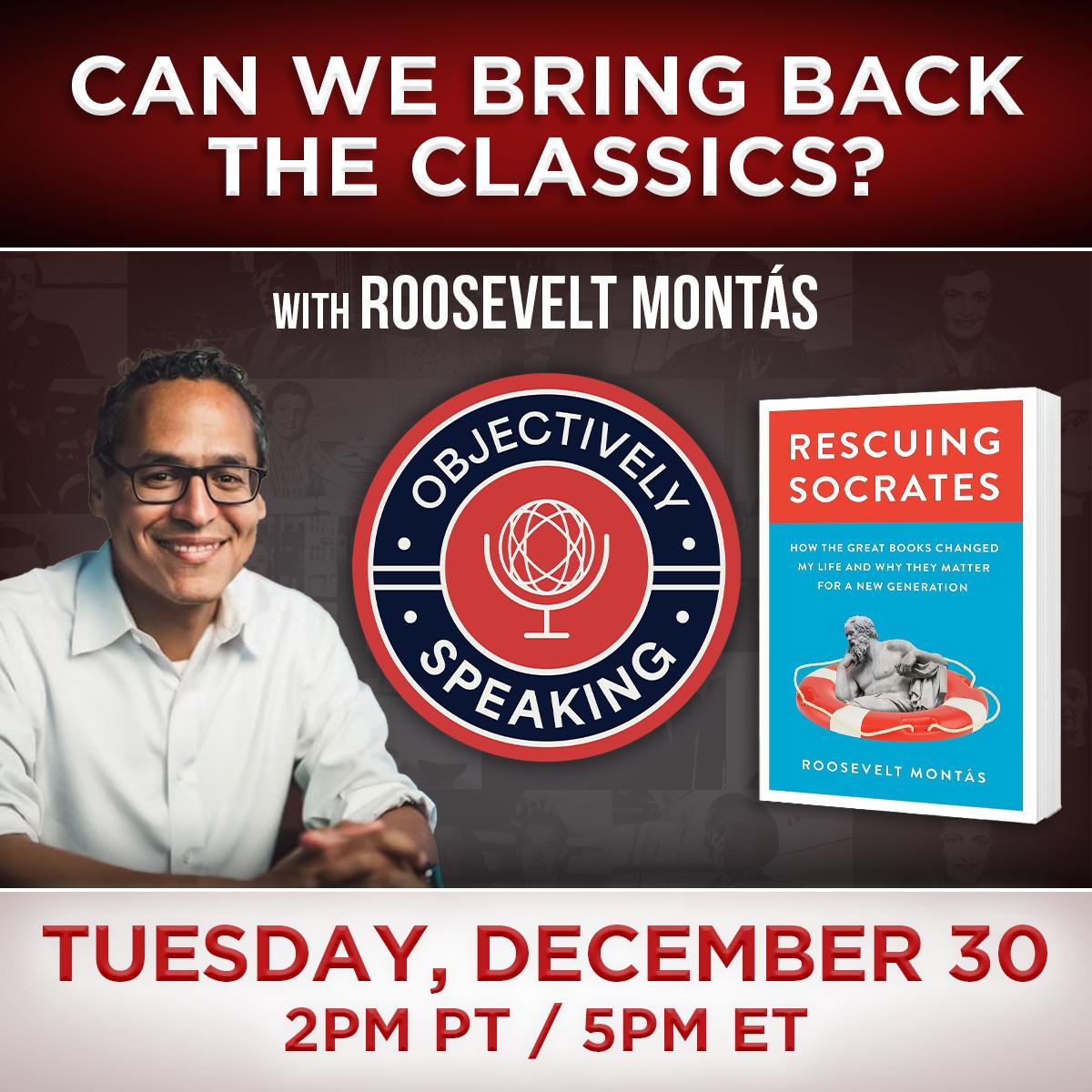
Our guest today is Roosevelt Montas, joining us to talk about his book Rescuing how the Great Books Changed My Life and why they Matter for New Generations. So, Roosevelt, thanks for joining us.
[00:00:18] Speaker A: Thank you, Rob. It's a pleasure to be here.
[00:00:21] Speaker B: So this is a subject very near and dear to my heart as a liberal arts guy, product of, well, a somewhat different program than yours, the Great Books Program at the University of Chicago, but very similar. So I want to, first, I want to talk about you. You have a sort of, people have this view of these sort of great books programs and liberal education as being this very sort of WASPy kind of thing. And you have a very different background. So I want you to start by talking about that being from the Dominican Republic.
[00:00:49] Speaker A: Yeah, great.
Indeed, there is, there is a sort of aroma of elitism, particularly cultural elitism, about the Great Books or a liberal education in general. And that's historically accurate because a liberal education and the Great Books were the province and the education of a cultural elite for a long time.
And with the sort of democratization of higher education that begins in earnest after the Second World War, then that no longer was the case, though it still retains sort of that, that, that aspect, that aspect of it being an education for a cultural elite and in the United States, meaning sort of an act. The shorthand of WASP Turner does not apply to me. I, as you said, I was born in the Dominican Republic, so I'm an immigrant to the United States.
Not only that, I was born extremely poor in the Dominican Republic and very much outside the mainstream of modernization and industrialization. I was born in a little town in the mountains in the Dominican Republic, very rural, a place that felt much more like the 19th century than the 20th century.
And then I immigrated to the United States just before my 12th birthday to New York City and attended public schools in New York, like many other immigrant Dominican immigrants in New York City, landed here with a lot of disadvantages, with very little resources or know how, and sort of made my way through the public school system from seventh grade on, ended up at Columbia University, where I encountered the Great Books and really had this ridiculous, extraordinary privilege of getting a truly elite education, really a world class undergraduate education. And that has been a decisive force in the way that my life has turned out.
[00:03:06] Speaker B: So, so I want to talk about what are the liberal arts? How do we define what the liberal arts is? The history of this, which you mentioned yeah, is always been an elite thing. I mean, it was literally in ancient Greece. You know, I love Greeks, but they practiced slavery. And it was like, you know, if you were the first sort of, you had to be an elite, you had to be sort of the one of the leading families to be able to have the luxury and the leisure of having this, this kind of liberal education.
So what, what, what is it that defines liberal education? And especially in a more modern context?
[00:03:41] Speaker A: Yeah, so there is a bit of conceptual confusion between the liberal arts, which are a set of disciplines that are studied and around which there is scholarship and which you can major.
And the liberal arts disciplines typically include the humanities, literature and art and music and philosophy, history, et cetera.
That liberal arts discipline is quite different, though related than a liberal art. A liberal education.
A liberal education is a form of education that is not in preparation for a craft or a profession. A liberal education refers to the kind of education that prepares an individual for the full flowering and flourishing of their life as a free individual. Right. And that's what liberal means in liberal education. It means the kind of education that is appropriate for a free person.
And as you pointed out, its origins go back to ancient Greece in which there was a very clear distinction between the free person and the not free person, the slave.
The free citizen of Athens, where it was first theorized the free citizen of Athens was involved in matters of governance. Athens was a direct democracy. So if you were Athenian citizen, you participated in decision making, in proposing and voting on laws and deciding on foreign policy, you held political office, you had the duties and responsibilities of self governance.
And a liberal education was the kind of education that would equip you to fulfill this responsibility, this task.
Now, when you translate that into a democratic society, liberal education is a form of education that is aimed not at preparing you for a career, but are preparing you for the full life of citizenship in a community, in a democratic community that is for the task of self governance. Now, there are two aspects of that. One is sort of this collective civic aspect of democratic self governance. But there's an individual aspect to that because we have a commitment to a form of society that values individual freedom, that values and protects and promotes individual freedom. Well, what are you going to do with that freedom? How are you going to organize the complicated economy of psychic and social and historical forces that feed into, into you? How are you going to organize that? In a way that truly maximizes your liberty, In a way that truly facilitates, promotes your full flowering, your full coming into being? And that's what A liberal education is there to do, to equip you as an individual and as a member of a community to maximally exercise the condition of freedom in which we find ourselves.
[00:06:51] Speaker B: Right. So the, the.
In Athenian society or ancient Greek society, it wasn't just the differentiation between free men and slaves. It was also that a very small number of people in that society were citizens who were capable of participating in government in the way. Yeah, it was a direct democracy, but it was not widely spread out.
But in a modern society where we have an even more white. We have a much more widely spread out democracy where, you know, everyone's a citizen essentially, and almost everyone's a citizen, you have the. It seems to be even more vital that we have this kind of education prepares people for making those deliberations and decisions. So, you know, I have a degree in philosophy and, and uh, you know, there's all these sort of. And people ask me, why did you go into writing about politics and current events? I said, well, you know, there's all these great giant big questions about philosophy that turn out to be, you know, tremendously relevant to everything that's happening, you know, in the news. Like questions as simple as what is truth? You know, what is truth? And how do you tell what's true? You could see that, you know, as a, as a. Is a vital, important central issue in today's politics where you have all these debates over what's true and how do you tell.
[00:08:05] Speaker A: Yeah, I mean, that's exactly right. In a democratic society.
In fact, I would put it this way. The possibility of democracy depends on the widespread, as close to universal as possible practice of liberal education.
You need, in a democratic society, a population that is equipped with the tools of deliberation, of political deliberation. When that means debate, that means conversation, that means being able to understand somebody else's point of view, being able to articulate your own views in a way that is persuasive to somebody else.
And that's the promise of the universal democracy that we have. It's a promise that depends on a population that is equipped with these capacities.
As you said in Athens, it was a small number of people. And for a long time democracy was thought to be only possible in a small republic with a small number of people that participated directly.
Historically, every democracy was that possibility of self governance by a small group of elite who were equal among themselves, were sustained by a large, enforced, coerced labor force, slavery. Even our own republican experiment began with a large coerced population of enslaved people and the promise of America. And the idea of America was of a full democracy, of a universal democracy. And we have been making not linear and not uninterrupted progress, but we have been moving in that direction towards a greater realization of the democratic ideal. But as I said, that ideal depends on a population that is educated, equipped to perform those tasks. And they are complex tasks. They are probably the most complex of objects of understanding available to us. That is the complexity of politics, the complexity of self governance.
[00:10:28] Speaker B: Yeah. I'm struck by some years ago I read the memoirs of Albert Speer, who's this architect who became a key figure in the Nazi regime. And he's sort of reflecting afterwards and he's not always the most accurate source about himself. Himself. He has a lot of. He has a lot of things to be guilty for. But he does talk about how in his education, this sort of very Germanic, Germanic education that he had, that there was this sense of you focus on the narrow technical things, you focus on your narrow technical skills that you're learning and you assume that the authorities are taking care of all the big questions of state and all the big decisions. And he talks about that being a factor in his.
In his basically being willing to sign up for the. For the Nazi cause is this idea that there are. The authorities will decide everything. Those questions aren't for you to think about.
And you focus. And I want to focus specifically about liberal arts versus the sort of the technical education, because I think that's all very live issue today.
[00:11:27] Speaker A: Yeah, this is why it's so important that we distinguish a liberal arts major or going to college to study in one of the liberal arts than going to college and getting a liberal education.
Because if you major, say in English or as you did, you major in philosophy, you are pursuing one particular field of inquiry with an almost professional focus. I mean, the way that the undergraduate curriculum is organized in the United States is to, if you major in philosophy or major in English, the preparation, the curriculum is meant to prepare you for graduate studies in that. So there is a kind of vocational aspect to the major.
So this is why it's important that we distinguish a liberal education from a liberal arts major.
You may major in the liberal arts, as I did. As you did, but it should not be the only way to get a liberal education. The lawyer, the physician, the architect, the entrepreneur, the computer scientist, all should get a liberal education. It should not be a function of majoring in the liberal arts. We need to make liberal education the foundation of every sort of specialization in higher education. I mean, this is this is very much what my.
What the book is about, rescuing Socrates. And very much what my sort of activity in higher education is focused on is on making.
Promoting liberal education as the universal education of every person that goes to college, not just as the, as the field of those quirky people who don't care that much about having practical skills coming out and choose to major in the liberal arts.
[00:13:22] Speaker B: So I want to talk about the get into the book is kind of a love letter to the course core program at Columbia University that you went through and ended up running later, later on. So you talk about what does that look like? I'm familiar with. There's a version of that that we did at the University of Chicago called the Common Core where everyone, regardless of your major, everyone has a certain number of classes they have to go through that cover this range of topics.
And I know at the U of C it was the, that if you were a liberal arts major you saw science courses you had to take, and if you were a science major, you had the liberal arts courses you had to take.
So what does that look like at Columbia? And talk about your experience encountering that great.
[00:14:05] Speaker A: So to put it in the larger frame, every undergraduate degree, every bachelor's degree in the United States has a number of courses that kind of lane in the curriculum that is blandedly called general education.
Those are courses that you take that are not in your major and that everybody, regardless of their major, takes.
That idea captures what is left of the notion that every college education should be liberal, that is that every college education should contain a portion of it that is not professional, that is not specialized. Columbia, which was a pioneer in crafting general education as a, as a liberal education in great books, maintains to this day this thing that is just called the core curriculum and it consists of this. Every student, every undergraduate at Columbia in their first year takes a year long course in a small group of about 20 students in which they read, roughly speaking, masterpieces of Western literature, beginning with Homer's Iliad and Odyssey and moving chronologically through the Greek playwrights and historians into the biblical text, into the medieval epics, into the Renaissance, all the way to the 20th century. Over the course of a year, same group of students, same faculty member, reading about a book a week.
In their second year, students do a similar thing with, roughly speaking, philosophical texts, beginning with Plato's Republic, Aristotle's ethics and Politics, and moving on chronologically through ancient, through antiquity, Middle ages, Renaissance, enlightenment, etc. All the way to the 20th century. In addition to those two year long, roughly speaking, Great books courses. Students take a one semester course in music which does a similar thing looking at sort of masterpieces and major composers in the western tradition. A one semester course in art, doing the same thing, beginning with the Parthenon, looking at major works of art and a course in science called Frontiers of Science in which students are exposed to scientific habits of mind.
These courses together make up the core curriculum. And they have a few characteristics that are pretty unique in American higher education and that are not found in any other major research universities general education curriculum. One is that those courses are common. Every student takes those courses, reads the same books at the same time in the first two years of college. So this, this commonality of intellectual experience, which means that the faculty has agreed to teach a common curriculum.
Second is that these are discussion based classes. There are no lectures. You sit in a room with 20 students around a table. You read a difficult text, you try to make sense of it.
Third characteristic is that it is non disciplinary. It's not an English class, a philosophy course, a literature class. And it has faculty from, from all of the.
All of the departments teaching. And the last thing which I really mentioned is that, is that it is a great books course. That is that it represents an aversion, an idea, a consensus among the faculty of what are works of major cultural significance that every student ought to have some familiarity with.
These four characteristics of the core curriculum, as I said, are pretty unique among research universities. There are many other non major, non R1 universities that have versions of this and smaller programs.
But it used to be quite common and many universities had programs like this. Over the last 40, 30 years those programs were dismantled.
Over the last few years there's been an effort to recover and revitalize and reinstitute some of these programs. Stanford University, Vanderbilt University, Purdue University. There have been a significant re engagement with this notion, with this approach to general education. And may that renewed interest thrive and prosper.
[00:18:30] Speaker B: So I want to talk a little bit about the decline of this and maybe the rebirth of it, which would be nice. But I also want to go specifically into.
In your book, you focus on four thinkers that impacted you. Now to go through the just briefly in turn.
So Socrates is entitled the book, but the first thinker is actually Plato. So I wanted, you know. And those are very closely related.
I want to talk about what impact Plato had on you.
[00:18:59] Speaker A: I encountered Plato accidentally and my.
That encounter with Plato is the source of the title of the book Rescuing Socrates.
When I was a sophomore in high school, living in Queens with my English now being just beginning to be good enough to read grown up books on my own. That was my fourth year in the United States.
Some neighbors in Queens threw away a bunch of books. There was just a big pile of books lying there and I went outside and checked them out. Some of the books were quite beautiful, sort of leather bound editions, fancy, very fancy looking. And I grabbed, I grabbed two.
One was a collection of Shakespeare's plays. I knew that name, Shakespeare. The other one was a collection of Plato's dialogues. I didn't quite know that name, maybe sounded familiar, but I started reading those dialogues. The first dialogue in that collection was the Apology of Socrates. And Socrates immediately gripped me. The apology, as some of your listeners and viewers know, is Socrates defense before an Athenian jury against charges of corrupting the youth, of introducing new gods to the city. The real charge is his practice of philosophy, the way he goes around asking questions and not settling for simple official answers, but keeping inquiring and in the, in that process demonstrating that many of the people reputed for wisdom in his society in fact had none.
So he gets into trouble for that. He is tried.
[00:20:50] Speaker B: That'll make you some enemies real fast.
[00:20:52] Speaker A: That'll make you some enemies. And it did. And it, and I point something about philosophy, that philosophy from the very beginning has had a very uncomfortable relationship with official domain, with power.
And that's why the universities are always. And intellectual life in general are one of the first targets of any authoritarian regime.
So Socrates is found guilty of the charges and he's executed.
And that story and sort of what Socrates represented and this idea of a life that was dedicated to inquiry, to rational pursuit of truth at whatever cost absolutely gripped me.
And you know, I tell the story in the book of becoming very close around that with a teacher in my high school who saw me reading this, this book.
Mr. Philippides, Greek immigrant who had studied, sort of had had a classical education at Princeton and became my most important mentor.
That I continued to read Plato in college, continued afterwards to teach Plato.
And Plato was really my introduction to the great books, but really to a traditional thought, inquiry and debate that sometimes is called the Western tradition that has been utterly central to my intellectual formation and to my personal development.
[00:22:22] Speaker B: Now let's talk a little bit about the other one that I think was an early influence which was encountering Augustine. This is the early Christian philosopher from the late Roman world.
[00:22:34] Speaker A: So I encountered Augustine's book the Confessions in my first year of college at Columbia.
It's one of the earliest books in the spring semester. So you spend the fall semester mainly in the ancient Greeks. And early on in the spring, you encounter this Christian thinker and this book, the Confessions. The Confessions is an autobiography. It is often thought of as the first autobiography. It's an exploration by St. Augustine of his own life and the path that led him to Christianity. From his childhood, his adolescence, his professional life as a teacher of rhetoric, as a prominent sort of philosopher, his inquiry, his quest for truth, for knowledge, his experimentation with various religions, his ultimate embrace of Christianity.
That book came into my life at a moment when I was grappling with many of the questions that Augustino had been grappling with, about the nature of nature, of reality, of my own experience, of what it meant to know myself, of religion, God, history, philosophy of interiority. Augustine is a great delver into the inner resources of his own mind.
And to me, that gave me a key, gave me a vocabulary, gave me a sort of vision of what it meant to examine yourself, to explore yourself, to understand yourself and to position yourself rationally before the great dilemmas of human existence. That the mind, reason, rationality, was a useful and legitimate tool with which to approach the great questions of human existence.
So Augustine, paradoxically, for me, gave me a way out of a form of Christianity that I had fallen into. Late in high school, I had a kind of powerful religious conversion to evangelical Christianity. And my last years of high school and my early college was. Was very devoted, but it was not satisfying.
It was not ultimately the philosophy of life that I found satisfying and convincing and meaningful. And Augustine, who tells the story of his conversion to Christianity, gave me a green light and showed the path for me to sort of construct a different non. Something that I wouldn't call Christian or religious in any conventional sense, approach to life, to thinking, to the life of the mind, to the. To the social life and the great. The great questions of human existence.
[00:25:24] Speaker B: Yeah, so it's interesting, the thing about Socrates, now you talk about Plato and Socrates, They're. We kind of talk about them together because Plato is our main source of information. Socrates never wrote anything.
Plato wrote a whole bunch of things in which Socrates is the main character. Now he's oftentimes Plato's putting his own philosophy into Socrates's mouth, but what he captures is the way Socrates talked and the way. The kind of inquiry that he opened up, and that's really the significance of Socrates is he had this way of, as you put it, of asking questions and not settling for the usual pat answers and then probing the answers and finding the weak spots and. And trying to get to a deeper understanding of these things, which is highly radical. And I think you make a comment in your book, I believe, about how the difference in the Plato sort of begins this process of let's ask these big important questions and let's probe them more deeply and not, you know, know, not accept the conventional answers. Whereas Augustine does something that I think most of the other ancients don't do, which is he is more introspective, he's more looking into, into your own mind and questioning what, what's going on in your own mind. And maybe that's a good, that maybe that's good transition to what you talk about when, when writing about Freud.
Yeah, Sigmund Freud, not my favorite guy, but. Because there's a lot of things wrong with his psychology that you pulled out of that.
[00:26:54] Speaker A: Yeah, I mean, one can say of Plato and Augustine as well that there's a lot that we disagree with, a lot that we don't accept. In fact, what Augustine is trying to do is to convert you to Christianity just like he was converted to Christianity. But you don't need to buy that to get a tremendous benefit and meaning from, from Augustine's thinking. And that's always the case with great books. Great books usually have an agenda, but the point that makes them great is not that their agenda, that you adopt their agenda, that you're, that you're convinced or persuaded, is that they stimulate a form of reflection, a kind of inquiry that ends up to be that you can own yourself, that you can yourself internalize and put to work in your own pursuit of truth and your own.
[00:27:45] Speaker B: Let me ask you, I was meaning to get to this, which, but I think we're going into it already now, so I want to expand on that, which is, you know, for example, I, I, Some of the thinkers you're citing here are not my favorite people. I, I prefer, I prefer Aristotle to Plato. Right. But, but there I want to talk about the value of reading authors you disagree with. You know, that you have this whole writing great book. Some of them are, some of them are ones I love and I feel like, yes, you know, I really feel some patico. With some of them. Some of them I really enjoy reading and others, you know, I feel like this guy got everything wrong. What is the value of reading? I want to talk a little bit about the value of reading books that you disagree with.
[00:28:26] Speaker A: You know, Socrates is really an archetype of this Socrates.
Maybe the most famous line in his apology, his defense is when he says that the unexamined Life is not worth living.
This life of constant examination.
And the thing that makes a life worth living, examining it, right? It doesn't. It's not that you get the answers and that makes your life worth living, but that you are engaged in this process of inquiry, this process of examination and that the process of examination of inquiry makes it worthwhile living.
And Socrates used to, you know, go around saying, I don't really know anything, all I'm doing is trying to figure stuff out, trying to ask questions.
That openness, that open ended inquiry is really a kind of model, a kind of paradigm for the life of the mind. And that means the life of the mind, that life of inquiry that you're always looking to understand the ways in which you are wrong, the ways in which your vision is limited. You're always pushing at the edges of your frame.
And there is a tremendous sort of thrill in discovering that you had it wrong all along and that you need to reconstruct your understanding. And how do you do that? You do that by encountering ideas that you disagree with, by encountering challenges to your position. That is the thrill of the life of inquiry. That is the thrill of the examined life is constantly putting yourself in at the edge of what you know and challenging it. That is the way of intellectual growth.
That is the difference between the life of the mind and the life of intellectual docility, of the life of acceptance of other people's truths.
So what makes a book great? And I think this, this, this characterizes all of the so called great books. Is there a capacity to expand your mind? Is the capacity to engage you in questioning fundamental issues, in empowering you to pursue this project of examining your life more deeply.
So it seems embedded, it seems to be a constituent feature of the lives of the life of the mind, to be constantly looking for ways in which your current understanding is lacking, in which you, in which your current understanding is limited, in which you can change your mind?
And that of course means encountering things you disagree with initially.
[00:31:15] Speaker B: Yeah, and the phrase that sticks in my mind is from John Stuart Mill who says he who understands only his own side of the argument understands little of that.
That's oftentimes, you know, even if you, if you encounter idea and that you disagree with, and even if you decide at the end you still disagree with it in encountering it, you all sorts of questions and objections and new facts are brought up and new arguments are brought up that you would not have considered even if your view is correct, you would not have considered it and understood it with Anywhere near the death if you hadn't encountered some, somebody who, who has a very different view. Viewpoint.
[00:31:50] Speaker A: Exactly.
And that's what an education should be. An education should put before you different kinds of ideas, should put in the form of text, but also in the form of people.
An education should expose you to a wide range of different points of view by people who believe them.
And that's how you build up your own, your own sense, your own point of view.
[00:32:17] Speaker B: So, so we talked a little bit about Freud because, you know, I think, I think my, my take on Freud in this context is, you know, Augustine looked very, was very introspective as I look into your own mind and examine your own mind. And Freud kind of in a way had this idea, well, telling you that, well, you might be an unreliable narrator about what's going on in your own mind, that there might be unconscious or subconscious forces that influences on you that, that you. That are not apparent to immediate introspection. Is it.
[00:32:46] Speaker A: Would that be. And that.
I think that's right. That is the big breakthrough insight that Freud has.
And now you can see sort of glimpses of it. You can see it's not like Freud entirely original with Freud, but what Freud did was systematically investigate and probe the consequences and the extent, the consequences of what he called the unconscious and the extent to which unconscious processes in fact significantly dominate and drive our conscious life.
That is, Freud demonstrates that a lot of our mental activity goes under the radar and that a lot of the activity that's above the radar is motivated and driven by stuff that we don't see.
Freud demonstrates and establishes that we are a mystery unto ourselves.
And he comes up with a lot of really fascinating ways to probe and understand and bring into consciousness parts of your mind that are otherwise inaccessible.
Things like the interpretation of dreams, things like Freudian slips, things like analysis of your childhood experiences, ways in which you can illuminate aspects of yourself that are otherwise hidden, that are otherwise inaccessible. Now, Freud came up with lots of theories and lots of hypotheses that he often expressed as facts and as objective, incontrovertible truths that, that he was wrong about. And that's why Freud today doesn't have much of a, of a reputation in clinical practice.
[00:34:41] Speaker B: We've decided we don't all have Oedipus complexes.
[00:34:44] Speaker A: Well, we, we have not decided that.
[00:34:50] Speaker B: Maybe some people do.
[00:34:52] Speaker A: Yeah, I mean, just, just.
Freud's key insight in the Oedipal complex is that when we grow from childhood, from early childhood to a more mature childhood, we find that Our primary relationships to our caretaker need to be fundamentally revised. That is that we can't have, we can't possess them, we have to share them with other people. And that brings feelings of jealousy, feelings of rivalry that we have to negotiate as part of our development. We have to get past that stage at some point, and we all do. And how you negotiate those psychic conflicts that a normal childhood developmental process implies, how you negotiate that has long term implications for your personality and how you, how you are.
That's the basic insight of Freudian, Freudian, Oedipus complex. Freud, Freud, in his way of overstating and dramatizing everything, comes up with this very, you know, eye catching. Every, every boy wants to sleep with his mother and murder his father.
But there is, there is a deep insight there that I think has been very valuable in, in how we understand human development and human psychology.
[00:36:10] Speaker B: Right, right. And then the last thinker that you talked about engaging with is Gandhi.
[00:36:15] Speaker A: And I think it's interesting that, you.
[00:36:16] Speaker B: Know, so we talk about, there's been a, I want to go into this a little bit more in detail later, but there's been a sort of backlash in the last few decades, probably 50, 60 years against this idea of a great books education. And a lot of it has to do with the contentious question of what is a great book? Right. Who decides what books are great and what books are not? And part of that has to do with people have said, well, how come we started to say all these Western thinkers, all these ancient Greeks and Europeans, and we don't study people outside of that. So I think the conclusion of Gandhi in there is an interesting example of how you, you know, you can have a great books curriculum that expands somewhat the, the, the scope of who's considered a great thinker.
[00:36:59] Speaker A: Yeah, The Great Books were sort of four formulated as an educational project in the United states in the 20s and 30s by a group of thinkers, many of whom were at Columbia, but not exclusively, and they were looking at the sources of contemporary civilization.
How is it that, that we think the way that we do, that we organize the way we do, that we have the understandings that we do? What are the influences that have shaped our society and what can the textual tradition that lies behind our institutions, our sensibilities, our language, our ways of seeing, our ways of relating? What can the textual tradition teach us about who we are and where we are?
So that meant immediately a, an exploration and examination of that textual tradition which we, roughly speaking, called Western.
There is a conversation centered around texts that's Geographically located in the, roughly speaking, the Mediterranean basis, both the South, North Africa, the East, the Middle East.
[00:38:19] Speaker B: Augustine. Augustine was in North Africa.
[00:38:21] Speaker A: Augustine was North African himself. The philosophical tradition or the religious tradition he takes up is born in Palestine.
So there is a textual tradition there that informed what the great books were. And sort of all the early lists and conceptions of the great books were pretty much exclusively Western tradition.
Yet you know what a great book is. The features that you find in those great books of the Western tradition you can also find in books of different traditions.
The west doesn't have a monopoly on great books.
Now it makes sense if you live in a Western society, as we do in the United States, that that tradition that produced the norms and institutions and categories in which transact your social life, that you study that history. So that means the Western tradition deserves a privileged place in the education of a Western person.
But that does not exclude the value.
And in fact, it's extraordinary value that looking at texts that deal at the same level of sort of radical, fundamental engagement with basic human questions from a different tradition, extraordinarily valuable. And in fact it casts, you understand the Western tradition with the depth and richness when you also have an understanding of a non Western tradition, entirely different way.
So there's tremendous value in incorporating into a great books education, books that speak and emerge from a different sort of civilizational trajectory, philosophical, ethical, religious, social trajectory.
Gandhi is sort of a perfect instance of a thinker that is rooted in this non Western tradition, but who also is entirely conversant and in some significant ways shaped by the Western tradition. He has a traditional Western education.
So for me, Gandhi became an entry point into a whole different way of looking at things, using a set of references in a way that gave me, because I share that education too, that, that philosophical, historical, Western education, giving me an entry point into something entirely different.
Gandhi is a really, really extraordinary figure in so many ways. And this, this is one of the ways in which he is that he is like this bridge figure between two ancient and profound with different, different traditions.
[00:41:23] Speaker B: Yeah, it's sort of interesting that you talk about figures, things that are outside of the Western tradition, and how we understand the differences and things encountering ideas that are alien. But I've also found that, you know, as much as we say, oh, our civilization is based on the achievements of the ancient Greeks, there are a lot of ways also in which, when you read the ancient Greeks, they are very alien to the modern world, right? They had very different ways of looking at things and accounting these sort of alien perspectives, things that are not part of your immediate environment is a lot, lot of the value of this.
But also, you know, we talk about questioning the Western tradition. There's nothing more Western. There's no greater Western tradition than questioning the Western tradition in a way that you amongst. Amongst the great thinkers of the. And I think what. That's what makes the Western tradition Western. I use in quotes because I think it's no longer, you know, the geographic or it has a geographic origin. It's no longer at all limited to that. I mean, you know, as you point out, Gandhi had a Western quote, unquote education. He was.
He had a British education. But the. What, what make. You know, somebody once argued that the most important.
Somebody wrote a book about Anaximander. And Anaximander was. Thales was like the very. Considered the very first Greek philosopher. And Anaximander was a student. Is that an axiom? And his most important guy because he's the first student who disagreed with his master.
Yeah. He studied under things and then he comes up with different theories. And that really sets us home. I think what is really distinctive about that Western tradition is this sense that you're always disagreeing with what came before. You're always questioning the tradition. You know, you're not accepting that tradition. I think this is in contrast to some of today's conservatives who like to use the Western tradition.
But you know, the Western tradition has never been about following it just because of tradition. It's always been about questioning that tradition.
[00:43:20] Speaker A: That's right, yeah.
If I may just pick up on some of those points.
One is that the Western tradition, we use it as a shorthand. It's really, you know, the closer you look at it, you realize it's kind of a porous in Kuwait.
Not. You can't give us a strict sort of visis. It. It's got influences from the very beginning. It's got influences that we would call non Western.
It doesn't emerge in a vacuum.
So that's one thing that we have to clarify that when we say the Western tradition, we're really speaking of something very loose. And it's a useful term. It does describe a real thing. But we need to be cautious not to like essentialize and think of this as a kind of uniform, sealed off, homogeneous thing. One of the ways in which it's not homogeneous is exactly what you point out, that it is a tradition of debate. It is a traditional disagreement of contention.
Anaximander disagrees with Thales, Aristotle, who studied under Plato for 20 years disagrees with Plato. The reason we read Aristotle is not because he promotes and extends and popularizes Plato. The reason we read Aristotle is because he so fundamentally disagrees with Plato. And that's the way you get into the tradition. That's the way you get into the conversation. That's the way you become a great book in the Western tradition is not by regurgitating and exalting and honoring the previous thinkers, but it's by undermining them. It's by overturning them. And that happens over and over again that every thinker, every. Every new important voice in the tradition has a contentious and, one might say, Oedipal relationship to their, to the predecessors.
They are there because they have something new and different to say. And as you point out, there are. There are many other traditions, learning and scholarship, where that's not the norm. Where the norm is that you revere and maybe revise, but really in a way that extends and reaffirms the superiority and higher wisdom of the past.
That's not a characteristic of the Western tradition. Western tradition is a tradition of overturning the past. It's a dispute, a traditional disputation and debate, which is, you know, why. It's not like a monolithic tradition. It's not. There isn't a doctrinal coherence. It's not like if you get an education in the Western tradition, you have gotten an education in a particular set of doctrines, in a particular point of view that's going to organize. No, it's going to challenge you and leave you probably more confused about what the tradition is trying to tell you than otherwise. It is not a tradition of orthodoxy. It is a tradition of heterodoxy.
[00:46:27] Speaker B: Okay, and that brings us into some of the. You talked about. There's, there's, you know, been some of these attacks or attempts to down the liberal education in American education specifically over the, over the last 50, 60 years. And one of those is now there's an attack from the, from the right that we'll get to in a moment. But one of them is an attack from the left, which is this idea that, well, this is Western. It's privileging Western ideas, therefore it's, you know, colonialism, or it's, you know, it's somehow narrow and therefore it has to be broken down precisely because it elevates one group of people over another.
Let's talk about where that came from and how the impact that that's had. And, and I think we've talked about some of the reasons that are wrong with that.
[00:47:14] Speaker A: Right, right. I mean, you can see where the criticism comes from. There is. There is certainly a legitimate critique to be made of the ways in which the so called Western tradition, including that very name, just calling it the Western tradition, has been used in a sort of chauvinistic, imperialistic way. A way of saying we are better, we are superior, and that superiority gives us the right to master and you.
[00:47:39] Speaker B: Know, at the time, dominate. Yeah. In 1900, 1910, early 20th century, when a lot of these ideas are being developed, there was a lot of casual acceptance of a kind of a racial archetype.
[00:47:51] Speaker A: Exactly.
[00:47:51] Speaker B: Well, there's the Western man versus Eastern and there these are different archetypes and these, you know, they believed very much these races were very separate and different.
[00:47:59] Speaker A: Exactly. So you can see that that's there.
What a lot of the sort of that critique has become is, I don't know, to put it in plain terms is like throwing out the baby with the bathwater.
Because this tradition has. This has been implicated in some of these colonial, racist, imperialist projects. We're going to get rid of the tradition, we're going to not read those books. But I always say, you don't have to throw the baby with the bathwater. You can throw out the bath water and keep the baby.
That is, this is a tradition of debate, as we have said, that has shaped our world today.
That confronts us with some of the most important ideas that have shaped our world. That confronts us with fundamental questions about what it means to be human. That gives us tools with which to think about those questions, that helps us understand why the world is the way it is, why the institutions we have, the norms we have, the conventions we have, the unspoken understandings that we have, the injustices, the triumphs that we grapple with. All of those have a history. And that history is encoded in this tradition. And you cannot understand that history without grappling with those texts. Again, we don't do them because we agree with them. We don't do them because we want to turn everybody into Platonists or into Augustinians or into Heideggerians or whatever. That's not the project. It's not a project of indoctrination, it's a project of inquiry.
But this sort of narrow minded ideological purity that we're not going to read Aristotle because Aristotle supports slavery, that we're not going to read Plato because Plato thinks that the Greeks are superior or whatever. We can find ideological objections to pretty much anybody in antiquity and anybody Even in the present.
That's not the filter through which we approach them. That's not the key to their value. That's not what determines their value.
And in fact, you know, if we chose only to read books that were ideologically consonant with our positions, we would do precisely the opposite of intellectual growth. We would become simply, as you quoted Mel before, we would become simply machines of reproducing what we take to be the answers to the big questions.
But in fact those big questions, nobody has the final ultimate answer. That's the difference between education and indoctrination. Education equips you for inquiry and indoctrination purports to give you the answers to the big questions.
[00:50:56] Speaker B: Now the other thing I've seen as I think is in a way a practical enemy of, of liberal education is.
Well, frankly, I think it's, there's an economics to it that as education has become more expensive and you have kids going, you know, in getting student loans and going into debt to get through college, there has been this emphasis of oh well, you have to have, you have to be getting a degree in something that you have to spend all your time focused on getting a degree in something that has practical value, something that's going to get you good income, you know, coming out of college because you've gone into debt, you've spent this tremendous amount of money.
You know, I really think the economic pressure, in addition to the, some of the ideological critiques, the economic pressure pressure is part of this that absolutely much it becomes a luxury again, you know, that, that, yeah, liberal education once again becomes a luxury of the elite.
I was struck by this when my wife was in graduate school is how, how many now she was in graduate school in architectural history, which as you'd imagine is something doesn't have a lot of practical applications. So I was struck by how many of the other graduate students there were actually from pretty well off families. They, they had some sort of economic background that was fairly elite because that's who can afford to do this. And I think that's one of the unfortunate things we've had happening in the last 50 years. As tuition goes, you know, goes up and student loans and all that, it gets driven, the economics drive it back into becoming an elite phenomenon.
[00:52:24] Speaker A: Yeah, I think you're right. I mean there's a Marxist insight that says when you see an ideological configuration, ideological phenomena look for an economic underlying reality. And that, that turns out to be quite a powerful insight. It's often, it's often the case and you can Often understand the idea, the ideology, by sort of ignoring what it says about itself and looking at the underlying economic reality.
The price of colleges is scandalous.
The fact that it has become such an economic burden to a family, particularly a middle class family, you know, if you're super wealthy, whatever, you can afford it. If you're very poor, often you can get financial aid like I did at Columbia, that makes my education essentially free. If you're middle class, then you have to pay for it. And for most families that means significant student debt and which makes it a financial transaction, makes it an investment. If you are going to get into this kind of debt or invest, you know, your family's resources in this way, it better have an economic payoff, otherwise you won't do it.
And you know, the reasons why tuition has become what it is are complicated. A big part of the story is public divestment from higher education, where the state universities no longer rely primarily on public support, but have to make their finances work by other means. And the primary means, tuition raising tuition for students and the private sector. There are a whole other set of factors, including the fact that universities have become this kind of all around service providers of technology and mental health and physical health and accommodations, sort of this extraordinary administrative apparatus to create a certain kind of undergraduate experience of which actual education is only a small fraction.
So there are a lot of things going on, but there is no question that this financial model of higher education is broken and that it is one of the sources of pressure against true liberal learning, against the idea of education as human cultivation, against the idea that you should pursue an education that is independent of its financial reward, that has a kind of reward that is intrinsic to the process itself.
It also suggests to me one of the reasons why it's so important that we reform general education to make liberal education available to everybody. Because the way that things are now, most people who major in liberal arts are people who, for whom making a living is not a big worry, that the low income students has an incentive to, not a very powerful incentive to not study the liberal arts. So we must embed liberal education in the general curriculum. That is, we must eliminate the opportunity costs of getting a liberal education. Because maintaining a liberal education as the thing that only elites and the already privileged access is a way of reinforcing the kind of inequality that used to be the norm and which very sadly becoming again the norm where the privilege have access and the underprivileged, the unprivileged to not.
[00:56:13] Speaker B: Well, I also think that, you know, we could talk about this as being okay, we have this great privilege of having liberal education.
But in a way, having liberal education available to everyone is not an optional thing in a free society because, you know, the people who are not, do not have the luxury of having a liberal education are still going to be voters, they're still going to be, you know, the broad mass of the public, they're still going to be, you know, there's still constituent elements and citizens in our society and having them be able to, to make those decisions and do that kind of thinking about who they want to be, what they want to do with their lives and also not just the political decision decisions, but all the other decisions about what they want, what they want out of life. That's not a luxury for society.
[00:57:00] Speaker A: Yeah, yeah, that's right. And it speaks. You know something, my work, I'm a college professor and most of my work is in reforming higher education. But it brings up the obvious fact that The K through 12 educational space is the most critical one in our, in our society and is one where students need to have the rudiments of a liberal education.
I think it's an incredible shame that people are not getting it even in college. And I think that to the extent that we make liberal education central to the college experience, it has downstream effects to the curriculum. But there is no question that the brunt of the game in nourishing a democratic society is in the universal K12 educational space.
[00:57:48] Speaker B: You've also done some work in that instruments of teaching at lower high school.
[00:57:53] Speaker A: Yes, yes, I certainly have. And it's, I have put a lot of work and thought into introducing students in their high school years to the kind of education that I was fortunate enough to bump into and have seen it again and again have the same kind of transformative impact on them that it had on me.
[00:58:14] Speaker B: Well, I think that at that age they're, they're totally ready and open and already grappling with those issues without necessarily knowing what they are exactly.
[00:58:23] Speaker A: And in a way that is not marked or constrained by class privilege.
That is, you can get the low income first gen to college student and put these ideas, these texts, these questions in front of them and you get the exact same kind of enlivened, intense, genuine engagement and an insightful engagement that you get from students who come from the greatest kinds of educational privilege.
[00:58:50] Speaker B: Yeah, yeah.
Well, I think we're up against our time, but I've been a great conversation and I'm hoping that we have a revival of some of this liberal education as we can solve some of these challenges to it.
[00:59:05] Speaker A: I join you in that aspiration, and thank you for this great conversation. Really enjoyed it.