Episode Transcript
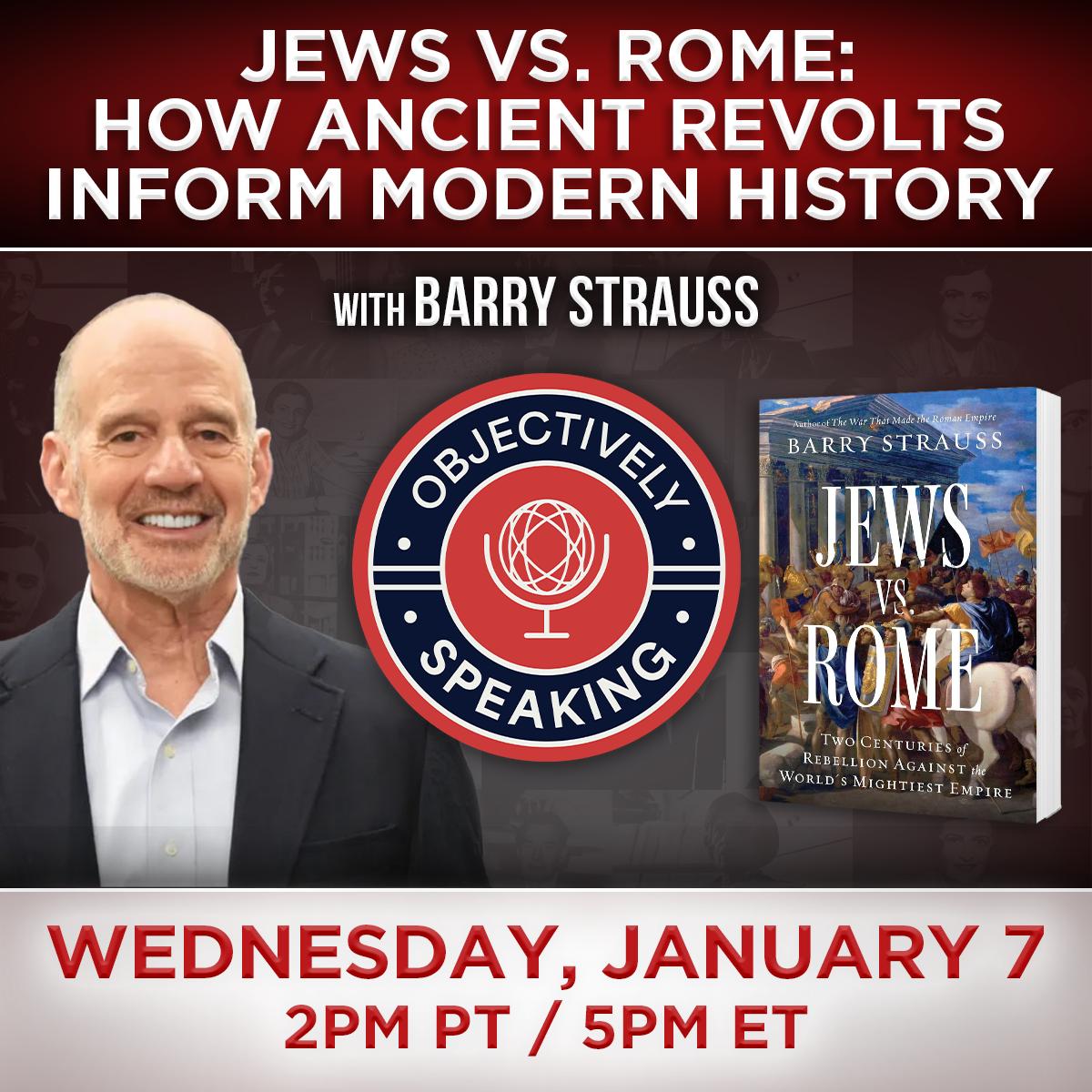
[00:00:01] Speaker A: Everyone, welcome to the 240th episode of the objectively speaking, I'm Jag CEO of the Atlas Society. I'm very excited to have Barry Strauss on to join us to talk about his book Jews vs.
Two Centuries of Rebellion against the World's Mightiest Empire. Professor Strauss, thank you for joining us.
[00:00:24] Speaker B: Thank you. It's a pleasure to be here.
[00:00:27] Speaker A: So, before we went live, we were chatting a bit. Always nice to have a guest in my same time zone, in fact, at the Hoover Institute over at Stanford. And I was asking you if you had any Ayn Rand story. I have to say, you probably one of the better read guests in terms of what you've read from Ayn Rand. Of course you read it early on and then even interested your daughter in reading Ayn Randall.
Looking back, maybe what do you find is the most relevant today? Or what characters, if any, have stuck with you?
[00:01:03] Speaker B: Well, I mean, I think Ayn Rand is relevant as a defender of freedom and as a witness to totalitarianism and what it can do.
I enjoyed all of her books.
I hate to say it, but one of the characters who stuck with me the most is Ellsworth Tuohy as a villain.
I, I think it's just really funny and ultra reminiscent of some of the people that, that one encounters. So he certainly stuck with me.
Daphne Taggart also has, has stuck with me. And how could you forget Howard Roark and, and the immortal opening lines of, of the Fountainhead? So all those characters have stuck with me.
Also in Atlas Shrugged, the. The who is John Galt as a slogan. That's absolutely brilliant. Really brilliant.
[00:02:00] Speaker A: Yeah.
Well, I like to say we all have a John Galt inside of us. If we only try to set him free and to set boundaries and to maintain integrity and to follow our vision without compromise. So now I was really fascinated. I, I also mentioned I was reading your book and then rereading it this past week as I was journeying in Egypt with my mother. And I'm seeing these monuments and the Ptolemaic rule and the different pharaohs saying that they crushed the tribe of Israel. And so it was quite fascinating and a, a backdrop for what I was reading. Now I how you have written multiple bestsellers on ancient Greece and ancient Rome. I'm curious if you ever going to do ancient Egypt, but also what in particular drew you to explore Jewish rebellions against Roman rule?
[00:02:59] Speaker B: Well, I thought it was a fascinating topic.
There's been a lot that's been written about it, and I'm deeply indebted to the work of. Of other scholars.
But I thought there were some areas that hadn't been explored as much as they might have been.
One of them was the geopolitics of the situation.
It seems to me that although the book is called Jews versus Rome, there's a third player in this story, and that's ancient Iran, which is known as Parthia. In this period, the Parthians were the Iranian people who provided the ruling dynasty, and they were very important allies and friends of Jews, but also enemies of the Romans. When the Romans thought about their relations with ancient Israel, Judea, as it was called at the time, they're always looking over their shoulders or looking over the horizon at Parthia and how that played in. And indeed it did play in the Parthians were observers, participants, threats to the Romans throughout this period, and often allies or friends, at any rate, or prospective friends of the Jews. So that was one thing that I wanted to bring in. The other thing is there were. There are some people, individuals who I felt had not been brought into the story as much as they needed to be brought into the story. And so that was the second thing that I wanted to do in the book.
And the third thing was to see the revolts in the perspective not just as one revolt, but rather as 3. How they're connected to each other, what ways they're similar, what ways they're different.
And of course, anyone who studies this wants to try to answer the question, why?
Why did the Jews revolt as often as they did?
Why did it all go wrong? So those are the things that motivated me.
[00:05:03] Speaker A: Well, and there were a couple of characters, too, in particular that stood out for me that you really brought to life. And we're going to get to that. But I want to provide some context first. You know, at the time, Rome defeated and subjugated many, many peoples across three continents governing, I think as many as 50 million people had its peak. Why was the Jewish Roman conflict so unusually intense and prolonged?
[00:05:30] Speaker B: Right.
So great question. So, first of all, there were many rebellions against Rome throughout the empire, and the Jews are not unusual in doing that, but they are unusual, as you said. First of all, that this was such an intense conflict and such a prolonged conflict that that. That makes it unusual. And I think there are several reasons for that.
First, the. The Jews, like all the nations, or almost all the nations who the Romans subjugated, didn't really enjoy being ruled by the Romans. They wanted their freedom.
So that's one thing that doesn't make them different from others. But what does make them different is their history and their religion.
The fact that about a hundred years before the Romans invaded Judea, they actually were invited in by members of the ruling dynasty who are having a factional dispute with each other. They never thought that Rome would take over in the way that it did.
But what makes about 100 years before then, the Jews of Judea had revolted, this time against a different imperial overlord, against the Syrian Greeks, the Seleucid Empire. And this is well known today as the Maccabean Revolt, the Revolt of the Maccabees. And it was successful. It gave Judea, ancient Israel, its independence for the first time in centuries. And I think it was an especially bitter blow that for Judea, have to have lost this revolt, lost its independence at the time that it did.
Second thing is the existence of the Torah, the Jewish holy book, and the additions to it, the Tanakh, I should say, the Hebrew Bible. And the theme of freedom is such an important theme, such a major theme in this writing that it's constantly in people's minds.
Third thing I would say is Parthia. So unlike some people who revolted against the Romans, the Jews had the prospect of outside help from Parthia. And they had it in three different ways.
For one thing, there is a very large Jewish community living in the Parthian Empire, mostly in what nowadays is Iraq and mostly in southern Iraq. This is a big part of the Diaspora. And there are close connections between the Jews in Parthia and the Jews in Judea. People constantly going back and forth. Secondly, they're helping to get help from the Parthian king, who was a rival and often an enemy of the Romans. And third, one of the vassal dynasties of the Roman Empire, the kings and queens of a place called Adiabeen, essentially what is today Iraqi Kurdistan.
They converted to Judaism, and so rebels were hoping to get help from them as well.
But none of this would have mattered if the Romans hadn't misbehave, if the Romans hadn't mismanaged Judea, if the Romans hadn't pushed things to the point where the rebels who had been there for over a century but were never the majority and were always squelched by the Romans, if the rebels hadn't been given the incentive to push the revolt further than anyone had before, and if then they hadn't had the sudden, shocking, surprise victory over the Romans, that pushed things even further. So a variety of causes.
[00:09:11] Speaker A: So your book covers two centuries of conflict, focusing on key revolts like the great revolt of 66 to 70 CE, the Ketos War and the Bar Kochba revolt. Why these specific uprisings and what were the similarities and differences between between them?
[00:09:30] Speaker B: These were the three major uprisings of the Jews against the Romans. There's at least one other significant one, and that's what's sometimes referred to as the Varus War.
It takes place in the year 4 BCE when King Herod dies. He's a whole other story.
That one is squelched very quickly by the Roman governor of the neighboring province of Syria. There's also a revolt in the year 6 CE AD attacks revolt which also the Romans put down very quickly. These three revolts are different, so they're on a much bigger scale. It takes the Romans a lot longer to put them down. They are major headaches or challenges for the Romans, more than a headache in some cases, so that they have that in common as well. And in all three of them, the Parthians play a role.
So I think those are the things that had them in common. And together the three of them ruin the Jewish people in most of Judea. The first revolt, well, we can talk about the consequences, but the consequences of the three revolts in general are disastrous to the point where it wasn't clear that the Jews as a nation would continue to exist after, after these two revolts.
[00:11:00] Speaker A: Again, as I mentioned, I had been in Egypt when I was reading your book and so I was curious, how did the Jews fare under the previous Ptolemaic rule and even before then compared to Roman rule? Were there two times when they had enjoyed long periods of independence and what perhaps were some of the biggest changes when the Romans took over? And how long did it take to get pretty bad?
[00:11:29] Speaker B: Right. Well, the Jews weren't independent in Egypt or also in what's now northeastern Libya, which was ruled by the Ptolemies as well.
But they were treated pretty well.
They were relatively free, particularly in the city of Alexandria where there were Jews as small scale manufacturers and traders.
They were concentrated in one quarter of the city, although they spread out to other parts of the city as well. There were three main populations in Alexandria. Jews, Greeks who had greatly outnumbered them and Egyptians who also outnumbered. Outnumbered them.
Jews also served as soldiers in the Ptolemaic army and they were settled in military colonies up and down the Nile Valley and also in, also in Libya.
So they did pretty well, although they were never, they never had the status of the Greeks who were full citizens.
When the Romans came in, the Jews continued to do all right, but there was more ethnic tension and more turf rivalry between Greeks And Jews, either the Romans tolerated it or the Romans even encouraged it.
Because the Romans did not mind following a divide and conquer policy. Like most imperial overlords, they followed such a, such a policy.
So ultimately in the year 38 CE there are anti Jewish riots that really get out of hand.
The Jews respond and there's a great deal of violence.
They send a delegation to the emperor at the time who was, I only have to mention his name, Caligula. And we can all guess that the results weren't great for the Jewish community.
But the Caligula was assassinated, the riots died down.
There were other flare ups against the Jews in the 60s CE and, and there was more violence and more deaths in the Jewish communities in Alexandria. Nonetheless, the Jews on the whole continued to prosper in Egypt until the second of these revolts in the second century ce and then things changed drastically.
[00:14:08] Speaker A: Well, as you've described, the Rome's response to Jewish rebellions was overwhelming. Temple destruction, mass killing, exile. Was this typical Roman counterinsurgency or was it something harsher there?
[00:14:24] Speaker B: It wasn't typical. Well you know, it depends. It depends how much effort the Romans had to go to, to put down a revolt and depends how much resistance there was.
So the harsh policy against the Jews was not. There was precedent for the harsh policies against the Jews. Again and again in Roman history. We see this. For instance, as early as the 4th century BCE Rome defeated and destroyed a neighboring Italian city called Vei, not very far away from Rome. Later on, famously, the Romans destroyed Carthage. They destroyed the city, they killed many of the inhabitants in the siege of Carthage and enslaved, enslaved the others. Likewise, the Romans were extremely brutal in their treatment of the city of Corinth in Greece. So ironically, in the same year they Destroyed Carthage in 146 BCE they also destroyed Corinth as punishment for a rebellion against the Romans. So there was precedent.
And the rebellion by the Jews cost the Romans a great deal of trouble. The Romans were also very angry because most of these rebellions took places in newly conquered areas.
Wasn't all that long after the Romans had taken over a place typically where there was a rebellion in Judea.
Judea had been in one way or another under Rome's thumb for over a century.
And the Romans felt that this was massive ingratitude on the part of the rebels. To have betrayed the Romans, to have stabbed them in the back in this way, the Romans might have said so their anger was all the greater.
In addition, the Romans were concerned about the Parthian connection and they had reason to be concerned about that.
They wanted to make a point to the Parthians that the Romans were not going to be trifled with on the edge of their empire close to the Parthian realm.
In addition, Jerusalem refused to surrender. The siege went on for five months, and the cost in blood and treasure for the Romans was very high.
We don't know how many Roman soldiers were killed, but the fact that our sources don't tell us is in and of itself a suggestion that they didn't want to tell us because the picture wasn't pretty. And what they do tell us about the fighting that went on tells us there had to have been a lot of Romans killed in the fighting. So the Romans were up for blood.
The fact that they destroyed Jerusalem as a result of the siege, not surprising given the way that ancient wars went.
[00:17:19] Speaker A: All right, we're not quite 20 minutes in, but I am going to turn to a few audience questions because I sometimes find that, you know, I wait till the second half of the show and the topic that we've been talking about, we've already moved on. So let's see here. We have got. Hey, everybody, thanks for holding the fort for me when I wasn't here last week. Jackson Sinclair asking, I think we may have covered this.
Was religious belief the central issue for resistance versus political or economic grievances?
You know, I think you wrote about times when the Roman emperors or people that were the representatives ruling over the region insisted on, for example, having statues to either the emperors or to Roman gods within the temple. That certainly would have been a religious objection. And I'd add a question to that.
Cultural differences and cultural offense. You know, for example, you tell the story of one of the emperors and the love that he had for this teenage male youth who died and how he, you know, dedicate cities to him. I mean, Greece and Rome were, you know, unique in kind of this institutionalized pederasty and practice. And, you know, I don't want to necessarily judge it from the current perspective, but at least at the time, it was very different from. From Jew religious law and practice.
[00:19:01] Speaker B: It's true, and I guess I see things somewhat differently. I think it's important to say that there's. There's only a fine line separating religion and politics in this period.
And in many ways, from the Jewish perspective, there is no difference, really.
They're all the same. So a, a religious Jew would have said that, you know, Judea, Israel was the Holy Land and that had to be held sacred and that its center was the house of God, the temple, the, the holy house on, on the Temple Mount.
So I don't know, I don't think that, you know, the Romans under some, a lot of Romans understood this. They thought the Jews were kind of weird in that they didn't have any images of their God and weird. They only recognized one God. And some, some Romans would have called the Jews atheists because they didn't believe in the Roman gods.
But I don't think that was necessarily a problem as long as the two sides could work out a modus vivendi, a way of getting along.
And for most of this period they had worked at a modus vivendi. The Roman governor sat in the city of Caesarea by the sea, Caesarea Maritima, located on the coast, so north of what's today Tel Aviv.
Whereas the Jewish capital was Jerusalem, which was located inland in the hill country. And actually there's remarkable geographical differences, diversity in Israel between the coast and the hill country. They seem like two different worlds in a way.
As long as the Romans kept to their sphere and the Jews didn't, weren't too boisterous or rambunctious in their sphere, everything was okay. It was on an easy peace.
And yes, when Caligula, Caligula again demanded that the Jews put up a statue of the emperor in the temple. And the reason he did that was that some Jews had overturned an altar in a Greek speaking city on the plain and complained to the Emperor when he made that demand. That could have led to a revolt then and there.
Fortunately, the governor of Syria and Judea came under the purview of Syria. The governor of Syria understood just how toxic this could be, so how inflammatory it could be. And he made sure that he refused to follow the Emperor's orders. He would not put up the statue in the temple. The Emperor was going to order his death. But unfortunately for him, Caligula was assassinated. So it didn't happen.
When the revolt did come, the rebels were angry because the Roman governor had tolerated murderous anti Jewish riots in Caesarea and because the governor had extorted a lot of money from the Jews of Caesarea and then helped himself to some of the treasures in the temple. And then when they protested peacefully, he sent in the troops to massacre Jewish civilians in Jerusalem. Supposedly, if we can trust the sources, which I'm not sure we can, 3500 people were killed.
I think those were the things that inflamed the revolt more than the fact that these two cultures, two religions just couldn't get along all right.
[00:22:47] Speaker A: Iliation asks how does geography influence the conflict and politics in general in the ancient world? I know we just talked about Parthia and its proximity and concerns about threats posed by them, but perhaps also, you know, some of the farther flung regions where the Romans ruled, like Scotland or France or the UK today.
[00:23:13] Speaker B: Yeah. So, I mean, geography is all important. And today geography is immensely important. And in antiquity it was immensely important.
So in the Eastern Empire, I think that many of us look at a map of the Roman Empire and we see the border and we think, oh, the story stops there. But the story didn't stop there.
Jerusalem was about as distant from the Parthian Empire in Mesopotamia and Iraq as it was from Rome.
So it's situated between the two of them. Likewise, in the other parts of the empire, geography is immensely important. So Scotland, which you mentioned, the Romans tried several times to conquer Scotland and failed. And Scotland has the advantage of being very rugged terrain and not very hospitable terrain and being located, as it were, at the end of the world.
So it's difficult for the Romans to conquer. And the Romans have to really push themselves out beyond their comfort zone if they want to conquer Scotland. Germany, on the other hand, Germany stretches eastward quite far from the Rhine. And the Germans were able to call on help from a large area when they rebelled against the Romans and when they continued their struggles against the Romans. So geography very important in Gaul, ancient Gaul, as France was called in ancient time.
There the geography is not as challenging as in some other places. I think there more of a factor is the political divisions among the peoples of Gaul and the Romans ability to take advantage of those divisions. It's a classic case of divide and conquer.
[00:25:12] Speaker A: So we touched on this earlier, but given the overwhelming superiority of military resources that Rome had at its disposal, what were, if any, rational grounds for the Jews to believe they could possibly succeed in their recurring rebellions? For example, did the example of the Maccabean Revolt or other successful revolts throughout the empire give them hope?
[00:25:44] Speaker B: Yeah, well, certainly the Maccabean Revolt was the.
The great predecessor that the rebels looked to. And they thought if the Maccabees could do it, we can do it.
Of course, bit of a false hope because the Seleucid Empire against which the Maccabees rebelled was in decline. It was decadent, it was past its prime, whereas the Roman Empire looked very strong.
I think other rat. But there were some rational grounds for thinking that they could win in the Great Revolt. First of all, the Roman emperor at the time was Nero.
Nero had Just faced and had to put down a domestic conspiracy, a rebellion against him. So there was domestic opposition to the emperor. And under Nero, three years before the outbreak of the revolt in 66, there, the Romans had suffered a significant strategic defeat on the eastern frontier, where they were forced to admit allow the Parthian dynasty to put a junior member of the royal family on the throne of Armenia. Armenia was a bigger country in ancient times than it is today. It was very important geopolitically.
So when they looked around, they could see that there are reasons why Rome was weaker than it had seemed.
They also knew that their cities, particularly Jerusalem, were very well fortified and they thought they could withstand a siege. I think finally, and probably most importantly, they thought they could get help from Parthia. I would compare it to the American Revolution, where from the word go, the rebels hope was to get help from the king of France.
It took a while because the rebellion was defeated in New York in 1776.
And the king of France, despite initial enthusiasm, had second thoughts when he saw that happen. But then came the victory at Saratoga.
And for the French, that was the signal to go and to help the rebels in a big way, I think. Likewise, the Judean rebels were hoping to get help from Parthia. And if Parthia had intervened, that would have been, as they say, a game changer.
[00:28:05] Speaker A: Now, did divisions within the Jewish rebels themselves undermine whatever slim chances of success they may have had?
[00:28:16] Speaker B: Yes, divisions among the rebels was.
Division among the rebels was a major problem. Maybe the major problem. You can't conduct a war successfully when you're at the same time you're having a civil war and fighting each other. And that's exactly what happened to the rebels. They spent as much attention fighting each other in.
In Judea, in Jerusalem, as they did fighting the Romans even more for a long period.
And because it was a civil war, they weren't concentrating on victory. And they killed each other, quite literally. And the worst thing that happened was that they burned the grain supply of Jerusalem.
Once they did that, they're not going to be able to survive under siege for very long without having a major famine, which is exactly what happened. If they still had that grain supply because Jerusalem has its own source of water, if they kept that grain supply, they could have held down in the siege for a lot longer than they did, and maybe they would have gotten the Romans to negotiate a peace with them.
[00:29:24] Speaker A: Well, we talked about what you hope to achieve with this book that was different from maybe some of the preceding publications and coverage. And one of them was wanting to bring some of these colorful characters to life. And perhaps the most colorful of all was Josephus, from whose prolific writing we gain much of our understanding about this ancient conflict. Who was he? Why was he important? And perhaps some of the more unbelievable highlights from his very adventurous life.
[00:30:02] Speaker B: Yeah, so Josephus is very important for, for us historians today because he wrote the best, most detailed surviving history of the Great revolt against Rome, which is generally called the Jewish War.
He was a participant in this revolt. And after the revolt ended in the year 70, it's around the year 75 when he wrote his book. He then goes on about 20 years later to write an even bigger book, a much bigger book, which today we call the Antiquities of the Jews or the Jewish Antiquities. It claims to be a history of the world from creation to the eve of the Great Revolt.
He also wrote another book called Against Appion, which is a reply to an ancient anti Semite in Egypt.
And finally a brief book called the Life, in which he chronicles his own life.
So very, very important historical source, but he is also a character from a picaresque novel. So he's born in Jerusalem, he comes from a family of priests and in the temple in Jerusalem, and on his mother's side, he's descended from the kings.
And early in his life, in his 20s, he is known as a guy who can serve as a go between with the Romans. The priests tend to be conservative and they tend to be in favor of collaborating with the Romans. And he is actually sent to Rome on a mission to negotiate the release of several Jewish prisoners there. On the way to Rome, his ship has a shipwreck in the Adriatic Sea and he has to swim all night for his life in order to survive this until another ship picks him up.
The man must have known how to swim. Not everybody on the ship, I think most of them did not survive. So that sounds like an awful experience. And he went to Rome, he did negotiate the release of these prisoners. He met Nero's wife, who's well known for being friendly to Jews and to Judaism. He went back to Judea and then just a few short years later, the great revolt breaks out. He's now around the age of 30 and he is appointed governor of Galilee, or we might say as the military commander of the Galilee district. And it's his job to organize the rebels against the Romans. He tells different stories in his different writings and he's not always a reliable historian, unfortunately, but one way to interpret what he was doing was that he was really trying to hedge his bets on the one hand, organize resistance and an army, on the other hand, prepare the possibility for negotiating a peace with the Romans and having the rebels put their weapons down. Because after all, if the Parthians didn't come in, their chances for victory weren't all that great.
But interestingly enough, so in the summer of the year 67, he ends up at the comma as the commander of a small city in the Galilee, not all that far from Nazareth, which is the center of the revolt at this point against the Romans. It is a city called Jotapata, and for about six or seven weeks in the brutally hot summer sunshine, this city holds out against a Roman siege.
And Josephus goes through the ways in which he and others fought back against the Romans and gave the Romans a hard time, until finally the Romans took the town.
Now, Josephus was in a hideout with 40 other rebels and he wanted them to negotiate a surrender to the Romans. But the others said, nothing. Do it doing we want to heroically commit suicide. Let us draw lots and kill each other until the last man kills himself. And they did this until there are only two men left, Josephus and one other. And at this point, Josephus is able to convince the other guy, look, this is crazy. Let's go on living, let's surrender. Which is what happens. And he's brought in chains before the Roman commander, a man named Vespasian.
And Josephus says, I'm a priest, you know, I have a direct line to divinity, and I wanted, I can prophesy, and I want to tell you that you are going to be the emperor.
And this is treasonous for him to say, Nero is the emperor. Vespasian knows this, but he's intrigued.
And he decides that instead of sending Josephus back to Rome, where he'll no doubt be condemned, tortured and executed by Nero, he'll keep him in chains in his army, which he does.
And then two years later, there's a civil war in Rome. Nero is forced to commit suicide. There are several pretenders to the throne until the armies of the east recognize Vespasian and they claim him as emperor. And at this point, Vespasian frees Josephus from his chains and now has him become an advisor to the Roman army as to how to put down the revolt in Jerusalem. Revolt in Judea, which he does. Vespasian leaves to make his way to Rome. He puts the army in command of his son Titus, and Josephus is an advisor, a go between, someone who's trying to negotiate with the rebels and get them to surrender. They almost kill him As a, as a result.
But the Romans win. He survives the war and at the end of the war, he goes back to Rome where he's now a client of the emperor Vespasian. He's supported by Vespasian and he goes on to write his history book. Books.
[00:36:06] Speaker A: Spectacular. There should be a movie about, about this guy and his many.
Not just nine lives, maybe 90 lives, and also a lot of wives, as we, as we found out in your book.
Another character who really stood out for me was Queen Helena of Adia Bean, who converted to Judaism and at least for a time, moved to Jerusalem and carried out a lot of good works there.
What should we know about her? And also how common was conversion at this time in the world?
[00:36:44] Speaker B: Yeah, so as you say, she really is a fascinating character.
And in addition to whatever her sincere religious convictions were in converting to Judaism, she's also a geopolitical player.
And her kingdom is a vassal kingdom, a client state of the Parthian king.
And the degree to which she can prove herself valuable to the Parthian king and also the degree to which she can make friends with the Romans, that's gonna help her and help her dynasty. So she goes to Jerusalem and she builds a house for herself there. She builds herself a palace in the city of David, which is the oldest part of Jerusalem. And she studies Judaism and she makes connections. Her sons convert to Judaism as well, and they sit on the throne after her.
And she is buried in a tomb in Jerusalem. The tomb still exists today. It can be visited in East Jerusalem. Her two of her sons are buried there as well. And her sons send their sons to Jerusalem to be educated. And they build more palaces there, two more palaces, there are three of them at the time of the great revolt.
And her grandsons participate in the great revolt on the part of the rebels. So I think it shows us how powerful the connections between east and west were. Again, her kingdom is located in what is now Iraqi Kurdistan and it has this close connection with what is now Israel.
Again, the geographical connections across borders and in places we might not ordinarily looking. More important, I don't think conversion was all that common in the ancient world. What we do find more often is the phenomenon of the so called God fearers. The God fearers are non Jews who are attracted to aspects of Judaism.
They're attracted to the Jewish ethos of being law abiding, of being moral, of being good, of giving charity, of helping their neighbors, of having one day, a week devoted to a day of rest which doesn't exist in the pagan world. And these God fearers would go to synagogues around the Greco Roman world or the Parthian world and they would hear sections of the Hebrew Bible being read, but they would not go all the way. They would not consider themselves Jews, which to them would have been entering a foreign nation.
But they're on the boundaries of Judaism, so we see a lot of that. What Helena and her dynasty does is a step further and very much impressive.
[00:39:39] Speaker A: All right, we're going to take another question from Kingfisher who asks, you mentioned the issue of reliability when it comes to primary sources for these revolts. What about issues with modern interpretations?
Do people try to distort this history? And I'd add an addendum to that also. What happens at certain archaeological projects.
You mentioned in the book how nationalist perspectives often intrude in terms of how they interpret their findings or at least want to have them be interpreted.
[00:40:20] Speaker B: Yeah, so great question. So in terms of the first one, I think that every historian has his or her perspective on what they're doing. And we all, as historians are influenced by the times in which we live.
So I, for instance, I think one of the reasons I got interested in the Parthian connection was because of the current, the attitude of the current regime in Iran, the Islamic Republic and its, you know, extraordinary hostility to the Jewish state, which it wants to destroy. And I was struck by how different things were in antiquity when Iranian empires were friends of the Jewish people and friends of the, the Jewish state.
Archaeology, yes, archaeology is a nationalist project almost everywhere and often an imperialist project. So, for instance, in the 19th century, when the European powers got permission to excavate in different places in Greece, it was partly to demonstrate their own cultural superiority and their own achievements, and they were looking for roots. So when they excavated in Greece and Italy, they're looking for the roots of their own societies and they want to give them a classic called pedigree. When Kaiser Wilhelm II becomes the emperor of Germany, he's very concerned about what he might have called the archaeology gap. The fact that Germany does not have sites to equal the ones that the French and British do in Eastern Mediterranean. And he makes sure to build up just these sites. So Troy in Turkey in the Ottoman Empire then is one such example in Israel. Archaeology is a national pastime and sometimes an obsession. And certainly one of the things that Israelis want to do when they excavate is they're looking for their history, they're looking for their heritage, and they're looking for proof that the Jewish connection to Israel goes back Millennia, which, which it does. So it wasn't hard to find this proof. Sometimes I think on the whole they're very scientific, but sometimes they make mistakes. For instance, the excavations of masada in the mid-1960s were a little bit over enthusiastic and thinking they could find evidence of the rebellion against the Romans in the year 74, they did find some, but not in the ways they had thought. They didn't find the corpses of the rebels, although they thought they might have found skeletons of rebels. So archaeology tremendously important, but like all study of the past, influenced by the time and day in which it is carried out.
[00:43:20] Speaker A: Well, that tees up Masada, of course, one of the most famous and tragic stories of a Jewish resistance to Roman rule.
Again, the account that we have is from Josephus, who wasn't even there, who gets it second hand.
And even that account is not based on what actually happened, but supposedly the story of these couple of women and children that may have survived. So how do you interpret all of that? And what is, what is believable? What do you think we can at least take to the bank? And then what do we have? Kind of have, as you know, more of a myth.
[00:44:02] Speaker B: So according to Josephus, So the story in Josephus is that there were rebels in Masada. So the Romans put down the revolt in the year 70. They destroyed Jerusalem, the revolt is over, but there are still some pockets of resistance, three in Judea and also one in Egypt. And so the Romans are eager to get rid of the particular one in Egypt, which they think is still smoldering. They take their time in putting down these other pockets of resistance, but they do put them down as well. And the final one is at Masada, where probably in the year 74, though possibly in the year 73, the Romans liquidate the remnants of the revolt they're under, according to Josephus. And Josephus really is our only source for this, although we do get a glimmer of information from some archaeological evidence and inscriptional evidence.
According to Josephus, there are about a third thousand men, women and children on top of Masada, which is a table top plateau, a mesa high above the Judean desert on the edge of the Dead Sea on one side and a mountainous wilderness on the other.
Herod King Herod the Great, who was a tyrant, had built palaces there and a getaway in case of a revolt.
And it is hard to get up to the top of Masada without being ambushed. So they felt this was a good place for them to be protected. But the Romans are determined to Snuff out this resistance, as was the case for other revolts. This is not the only one. And so they surround Masada with a ring of forts and they build a ramp to go up to the top of Masada so they can take the place by force. We might guess that they asked the rebels to surrender first because that's what the Romans did, invariably did. If so, the rebels refused. And Josephus's story is that when the Romans got to the top, they discovered to their shock that no one was alive. That I think the number is something like 975 rebels had killed each other and then committed suicide. The last few had committed suicide. Men killing their women and children killing their families and their relatives. And only a few, a handful of survivors, had hid in drain pipes and. And live to tell the tale.
So did it really happen?
We know that there were really were rebels at Masada because we have found some artifacts from them and some documents that refer to it. But was there this mass suicide? Some scholars are skeptical because they say, come on, it's too good a story. Josephus is our only source. He chooses to end his book with this story, which he really didn't have to tell, or certainly not in any detail, but he tells it in great detail. And he gives the purported speeches of the leader of the rebellion. These are undoubtedly speeches that almost entirely were made up by Josephus. They might be based on some information that he got from the survivors, but that information would be pretty scanty. It wouldn't be enough to give him 10 pages or so of speeches.
What's interesting about these speeches is that they are among the most moving defenses of freedom that we have in ancient Greek literature. Josephus wrote in Greek and really extraordinary the degree to which they give such a powerful and in some ways unparalleled defense of freedom.
There are a number of examples of ancient mass suicides and executions for people who preferred to die as free men and women rather than be enslaved and raped, tortured, which the Jews knew was well awaited them.
And in at least one of those cases, we know that the numbers are exaggerated, that there were survivors, and perhaps that's the case here. But unlike some scholars, I tend to take Josephus at his word and think that there was this mass killing on top of Masada instead of a surrender to the Romans, because we know that's just what the Romans would have found. Impressive that people would do this. They'd rather die than surrender. And it's what had happened at earlier in the war at Jodapada of Course, Masada has become a great symbol of Zionism. One of the early Zionists wrote a poem and then about a century ago, which contains the famous line, masada shall not fall again, which has been a rallying cry.
And there are members of the idf, the Israeli Air Force were sworn in on top of Masada. So a very powerful nationalist symbol.
[00:49:14] Speaker A: So you mentioned King Herod.
I'm wondering what were the challenges of Jewish kings under Roman rule? How well or how poorly did they meet them? And did there come a point where the Romans said, enough of this, this is not working. No more Jewish kings, no more monarchy, we're going to do this another.
[00:49:37] Speaker B: So the challenges were great. I mean, and Herod is really the only one who navigates them successfully. Well, his grandson did all right as well. But in a brief reign he murdered.
[00:49:49] Speaker A: A lot of his relatives too, right?
[00:49:52] Speaker B: Yes. So Herod's problem is he has to keep everybody happy. He has to keep the Jews in Judea happy, who want Judea to be the Holy Land sacred to the God of Israel and no one, nowhere else. He has to keep the Romans happy, who want to make sure that Judea is a loyal ally to Rome and none of this messing around with Parthia stuff. But he also has to keep the minorities in Judea happy. So there's a large Greek speaking pagan population.
There's also a large Samaritan population. So the Samaritans, who live where else? In Samaria, So it is now in the northern West Bank.
They believe in the first five books of the Hebrew Bible, the Torah, the five books of Moses, and they believe in the God of Israel, but otherwise they do not recognize the temple in Jerusalem, they do not recognize the priesthood. They have their own temple near the modern city of Nablus, and they are at odds with the Jews. They often serve in Roman auxiliary forces as kind of local policemen to keep the Jews in line and then some.
There are two small groups of Arabs living in the north and the south of the country.
And there's also a people called the Idumeans, who live in what is now central and southern Israel. They originally came from the east side of the Dead Sea in what's now Jordan. They had migrated to Judea centuries earlier.
They were Pagans until the 2nd century BCE when they converted en masse to Judaism. So they were now Jews. They had a separate identity, a group identity and ethnicity, but they were also Jews. So these are competing and often conflicting groups, particularly the Samaritans and the Greeks were competing with rivals against the Jews. And vice versa. So Herod has to keep all of these people happy. It's a juggling act. And as you hinted, one of the ways that he succeeds is by being a tyrant, by just killing a lot of people.
And that is immensely helpful for Herod and makes him successful, but it also makes him horrible. I mean, he's murderous. He executes several of his sons, he executes his most beloved wife, he executes young fervent Judeans who are opposed to him putting an eagle on the gate of the temple, an eagle which seems to represent the.
The Romans. And at the end of his life, he supposedly had his last will and testament was basically kill all the leaders of this country after I'm gone. But fortunately his. His sister, I believe it was his sister, or it might have been his surviving wife, who was his executor, as it were, decided not to carry this out. But he did keep the peace and he did demonstrate one way of squaring the circle and giving something to the Jews as well as to the Romans. I should say that he's most famous.
Well, one of the things that he's most famous for is build rebuilding the temple in Jerusalem, expanding the size of the Temple Mount, rebuilding the temple surrounding it with porticos and shops and offices and study halls, and making it one of the grandest, if not the grandest shrine in the entire Greco Roman ancient world. In this period, of course, in the New Testament, he's also infamous for the massacre of the innocents, the slaughter of young innocents in Bethlehem, because he believed that a rival king of Israel had been born. That's our only evidence for it. And most historians would say that this isn't true. But Herod in any case, certainly was a very bloody tyrant.
[00:54:09] Speaker A: All right, well, here is a wonderful question from my modern Gault. I think it's a good one to turn to as we're beginning to wrap things up. And it is. Why do some defeated cultures disappear while others live on?
Your book highlights the resilience of the Jewish people against the world's mightiest empire.
How does this story challenge common perceptions of ancient Jews as passive victims? And what contributed to their resilience?
[00:54:43] Speaker B: Yeah, that's a great question. And I think, I hope that one of the takeaways from this book for readers is that the Jews weren't passive victims, that they were fighters, and in fact they gave the Romans a huge run for their money. We didn't talk about the third revolt, the Bar Kokhba revolt, but that was the most challenging for the Roman Empire of all of the revolts.
And the Romans had to make a major effort to put it down. And the last thing they wanted was to see any additional Jewish faults. There was actually one a few centuries later, and then another Jewish collaboration with the Iranians who invaded the Eastern Roman Empire. Empire.
But yes. So why did the Jews survive in spite of being nearly wiped out in Judea? And I think one answer is the emergence of the Rabbinic movement, this movement by an elite of educated literary men who had decided to collaborate with the Romans. That further armed resistance was utter folly. That they would have to accept the Roman Empire outwardly, but inwardly, spiritually, they would not accept the Romans at all.
They would continue to resist in a spiritual way.
And their writings become the basis first of the Mishnah, which is a codification of Jewish law, and then the great commentaries on the Mishnah, the Talmud. One Talmud in written in the Galilee, the so called Jerusalem Talmud, and the other written in Mesopotamia, the so called Babylonian Talmud. And I should also say that one of the reasons for the survival of the Jews is that Parthia and later the Sassanid, the Sasanian Empire, another Iranian Empire. These are the safety valves.
They're not persecuting the Jews, by and large.
And these are areas where Judaism can thrive and they become the centers of scholarship and study for centuries. So a key part of the story.
[00:56:59] Speaker A: So at the Atlas Society, we are huge fans of the Jack Miller Center.
We've been honored to feature JMC scholars and their work on this podcast. If I understand, they were very supportive with this project of this book.
Maybe just share your perspective on their mission and why it's so critical to solving the nation's crisis of uninformed citizenry.
[00:57:26] Speaker B: Yeah, well, the Jack Miller center has been doing a fantastic job for decades now of helping people in academia tell the story of America and the story of freedom in a way that I think that is fair and quite different than what has often been the dominant narrative in academia during these years.
They gave some support to me in my nascent program at Cornell several decades ago called the Program on Freedom and Free Societies, a program that continues to exist nowadays.
And they have served as a clearinghouse and a center for scholars from diverse disciplines and different institutions all these years who are interested in coming together and supporting, telling the American story, explaining what's different, what is exceptional.
Excuse me, what is exceptional about the United States? Not exceptional, but exceptional and supporting research and teaching in American history and in the history of freedom.
They were quite helpful in getting the word out about the book and very supportive. And I'm on the board of academic advisors for the Jack Miller Center. So I'm a great fan of them and very supportive and appreciative of everything.
[00:58:57] Speaker A: They do, as are we. And if you viewers or listeners have not already checked out their work, I urge you to do that and to support them.
The fight for America academia doesn't have to be over until folks like the JMC say no more. But we're glad they're not shrugging yet. So thank you professor for this wonderful interview and for your work.
[00:59:24] Speaker B: Thank you so much.
[00:59:25] Speaker A: It's a pleasure and thanks everyone for joining today for your questions, for your patience last week. I hope you will join us next week when three time recurring guest Timothy Sandifer joins us to talk about his latest book. I love this title, you don't own Individualism and the Culture of Liberty. We'll see you then.