Episode Transcript
[00:00:01] Speaker A: Hello, everyone.
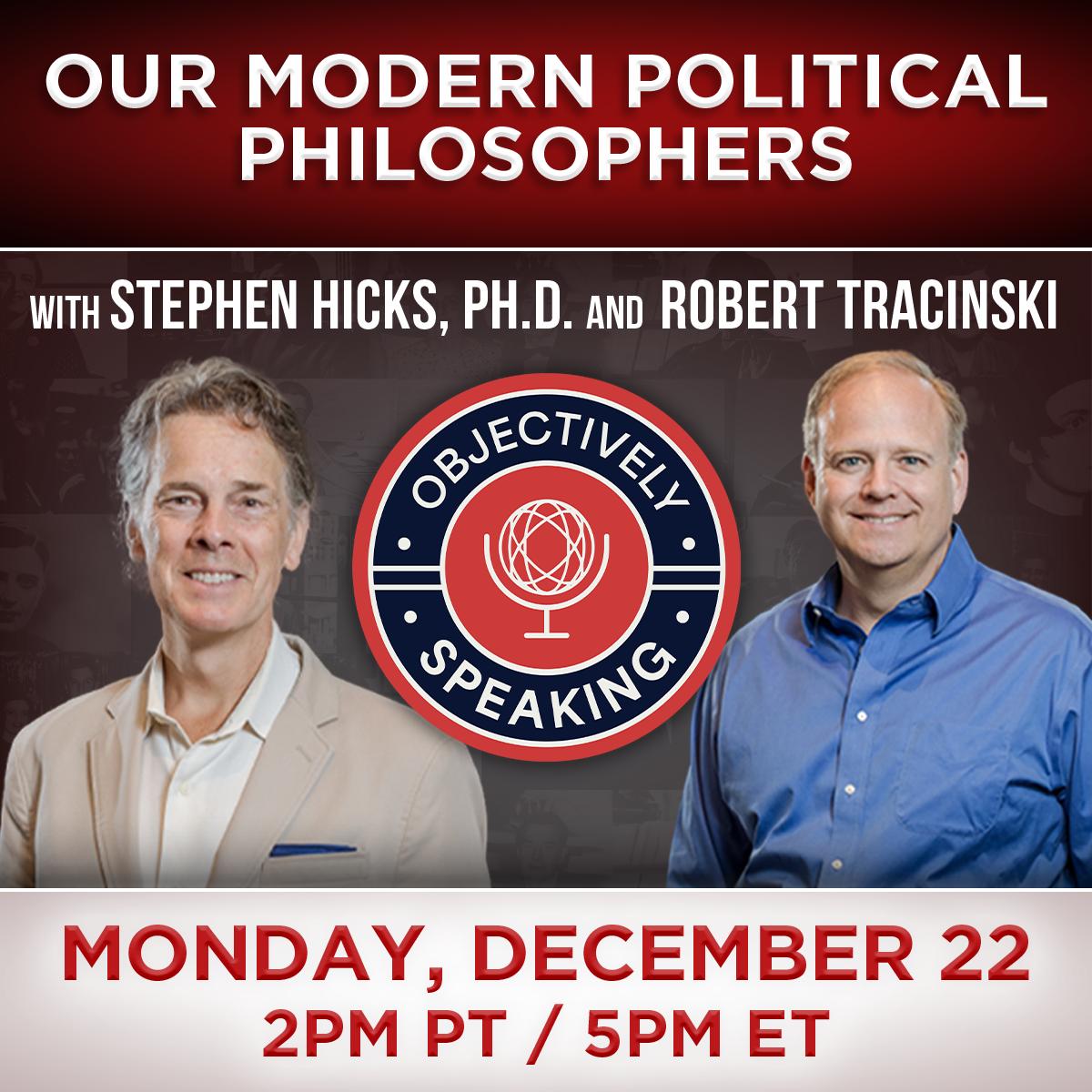
[00:00:01] Speaker B: Welcome to the 282nd episode of objectively Speaking. I'm Lawrence Dilivo, senior project Manager here at the Atlas Society. Jennifer Grossman has the week off, but I am excited to have joining me today, Atlas Society senior scholar Stephen Hicks along with senior fellow Robert Jasinski for a special webinar exploring the emerging trends in conservative political philosophy today.
Now, if you have any questions, please feel free to add them in the questions in the comment section. Whether you're on YouTube, Instagram, LinkedIn. We'll try to get to your questions nearer to the end, but for now I'm going to pass it over to our host for today's session, Stephen Rob. Thank you for joining me.
[00:00:44] Speaker C: Thanks for the intro.
[00:00:46] Speaker B: Thank you.
And with that, I'm going to pass things over to start things off to you, Steven. So I'm going to pull up the PowerPoint and we can get right rolling.
[00:00:54] Speaker C: Okay.
All right. Yeah, let me actually, sorry, there's one more thing I need to do quickly. Sorry. I want to make this dominate slideshow.
There we go.
So I think it's fair to say that conservatism has come out of the shadows, so to speak, of political philosophy and even practical political day to day politics. For much of the 20th century, political philosophy was dominated by the left, in some cases the far left, and their main adversaries were those who were centrist liberals of various sorts.
Conservatism was not widely discussed in the academic world or even among public intellectuals very well, but much. But as we got into the 20th century, conservative practical politics has come to the fore and conservative political philosophy is having its moment, or perhaps decade or generation in the sun. So I'm interested in knowing what is going on among the conservatives.
[00:02:08] Speaker B: Now.
[00:02:08] Speaker C: Conservative, of course, is one of those big tent labels at the level of movement politics, even at the level of political political ideologies and philosophies, it covers a lot of territories and includes a lot of elements, schools, factions, sub movements, however one wants to describe them, that are in some cases in an uneasy alliance or for various conceptual reasons just grouped into the same very broad category. And when we try to sort out what the prominent elements of that big tent are, what those major sub movements are, it's, it's rather complicated. But one striking thing about this generation's conservative big tent is that the main action would be seemingly unrecognizable to the main action a generation or a generation and a half ago. So if we look at what's going on most vigorously inside conservatism now it seems like it would be largely unrecognizable to what was vigorously going on in conservatism in the 1980s and the 1990s, say, going back to when Ronald Reagan and Margaret Thatcher were the big names. So what I'm interested in is what's the most vigorous part of the conservative intellectual movement now. Now I'm a philosopher by training and I'm always especially interested in what the philosophers of various movements or ideologies having to say. And it's important because it's easy to get caught up in day to day practical policy debates and media, social, so on. But long term trends are almost always driven by what the philosophers or the, the big picture strategists for a movement have to say. They are the ones who are trying to give the movement cohesion, sort out what its ultimate values are, what its understanding of reality is, and convincing people that their political program is the most meaningful, true, valuable. And that's the work of philosophers so very interested in, is what the philosophers of this generation's resurgent conservatism have to say. And since I am more of a European philosophy guy than I have been an American philosophy guy, I want to focus on two very recent conservative political philosophers, both of whom are across the pond, so to speak, now to get a start on trying to figure out what conservatism means as a, as a big label obviously has to do something at its root with conserving. So the question is always going to be what is one trying to conserve?
And since we learn largely by compare and contrast, what I want to do is to say that the currently resurgent generations of conservative political philosophy are quite different from the standard or stereotypical understanding of what conservatism is and what has dominated conservatism for generations, perhaps even a millennium. So what I want to do is do a compare and contrast to a certain kind of stereotypical understanding of what conservatism is. Old style conservatism or paleo conservatism. Now to do that, what I want to do is try to define the main features of what goes into any movement. Now the main movements in UX have always been coming out of strong religious traditions. And almost every prominent form of conservatism historically and down to contemporary times has said that religion plays a central role in how one should understand one's place in the universe philosophically in terms of one's moral or orientation, and that good laws and good jurisprudence should be based on ultimately that kind of a framework.
Now sometimes Conservatives will be more or less religions, but the conservatism so that have dominated have largely taken religion and religious philosophy as their, as their touchstone. And so the strongest, most principled, deepest understandings of conservatism then can be defined. What I want to do is then break it down into these six dimensions. So if we then say the strongest stereotypical understanding of what it is to be a conservative would be to be a strongly religious conservative and take religious philosophy as one's metaphysical, epistemological, one's understanding of human nature, one understanding of values, and then to see the political order as the, the place where all of this is going to be realized in the best possible possible way.
So paleo conservatives then will say of religion that religion is absolutely not necessary, not only to living one's own life well, but to doing politics well. And then typically the religious conservatives will say, we can't be loosey goosey about religion. There is one correct, universal, true religion, and to be it's the one that I have subscribed to. And so the important thing is to get people to believe, not only in religion in general, that is necessary, but this particular religion is the correct religion.
Most of these religions are universalistic. There is one God. God spoke to human beings. And so the message of my religion is for all human beings.
And these principles that have come from God are absolutes. God is a perfect being. He speaks truth. He speaks for all time.
And so the principles that we are using in our religious philosophy are absolutes. There are say, 10 commandments. They're not 10 rules of thumb to be applied in various loosey goosey ways. And said, these are absolute principles. And so the law and our political principles should be seen as absolutes. Now all of this has been defined in the past, sometimes in the distant past, and it's been recorded and commented on. And so the traditions that have come down to us, constitutional traditions, scriptural traditions, are things that we should revere. It's not up to us to question, to argue too much with them, but rather to accept them and then to apply them to our current circumstances. And then typically, then that gives the name conservatism some bite. Rather than saying we're open to change, we're open to evolution. Instead we are to particularly interested in conserving the true understanding of philosophy, the true understanding of religion, the proper way of doing things, as is coming down to us, and to the extent that we have evolved away from that, changed too many things, we should resist those current liberalizings, those evolutionary trains or even those revolutionary changes, and try to get back to this true absolutist understanding of the way the world really should be governed. Now that is a dirty understanding of what I'm going to use as my foil, paleoconservatism, to contrast what I see as the prominent resurgent versions of conservatism which philosophically reject pretty much everything on this tradition. Now the two people I want to emphasize to concretize this point first is Dr. James Orr, who is a professor at the University of Cambridge in England and he is a big gun in contemporary conservatism. He is the UK Chairman of National Conservatism. They put on major conferences in the UK drawing together major European intellectuals and bringing them to England, major British intellectuals, in some kinds cases bringing people over from America or up from Australia.
So he is kind of an intellectual, thought leader and organizer of these major movements to make a connection across the, across the pond to the Americas. He is sometimes described as J.D. vance, who's the current Vice President of the United States, as his philosopher king, the person who is the big brain, so to speak, behind not only the strategy but the philosophy that J.D. vance subscribes to. So with all due respect to some journalistic hyperbole, there is some prominence there. Now, I had a formal debate in London, England with Professor Orr a couple of years ago. We then had a formal three part written debate that was published in the journal Recent Papers earlier this year. So if one is interested in the deeper dive, I recommend go to Recent Papers and you can see how that debate folded out. But what I so with that to say that James Orr is a one of the major conservative philosopher voices about contemporary conservatism with that way of interaction. Let me give you a few quotations to indicate what OR's conservative stands for. Now if we think of Paleo or traditional conservatism, most conservatives are very comfortable with saying there are absolutes, there are truths, we know what they are, and this is what our conservatism stands for. One of the things that is interesting about OR's conservatism is a resistance to the idea that we can define in terms of necessary and sufficient conditions or even have a pretty clear list of what the principles of conservatism are.
So this is why I'm sometimes comfortable with labeling this approach to conservatism as a much more pragmatic approach, that is to say, a philosophically pragmatic approach. We're backing away from the idea of truths that are absolute, that are known, that we can define exactly what we are talking about.
So he goes on to then argue as a philosopher that there's something wrong with approaches that try to define their terms very carefully and to make very clear what their principles are. So here's a quotation from Professor Orr, a crisply distilled ideological schema that purports to be applicable to all people at all times and in all places. That is to say, universalism disturbs the conservative's instinct for the particular over the universal, the empirical over the rational, the concrete over the abstract, the pragmatic over the ideal. So that then is to say, from this understanding of conservatism, we're not going to be trying to be too rational about this. Instead, the concept here is an instinct as a matter of a conservative instinct that we are trying to express perhaps, but not in terms of crisply to skilled ideological schemas. We're not too interested in the abstract principles. We're not too interested in ideals.
We're not interested in broad generalities. We're interested in more narrow. We're in this circumstance right now. These are the things that we are aware of these concrete realities, and we're interested in what's going to work in this here and now and backing away from the. What conservatism traditionally has been understanding to be this more universalistic absolutist. So this is a very different philosophical approach to conservatism.
And then another quotation from Professor Orr that to emphasize how much this is not about rationalism, this is not about being able to state explicitly in clear definitions and words, there are certain habits of thought and guiding impulses that distinguishes the conservative temperament from its rivals. So, so far then, what we have is conservatism is backing away from definition, backing away from clear formulation. We're speaking now the language of instinct, habit, impulses, a kind of temperament. And that is going to be what conservatism is all about.
Now, that's vague and it's an explicit backing away from vagueness and backing away from rational definition. But if we push, and of course, as an intellectual intellectuals get pushy, so, or will then say, this is what we mean if we, you. You push us to say what exactly this conservative impulse is, is. Well, if one were to isolate a single organizing idea behind conservatism, one might well point to the notion of order.
On this view, the real view of conservatism is neither the liberal nor the socialist. I'll pause there for a moment. By liberal, he means someone like John Rawls if that name connotes some sort of centrist liberal welfare state liberal, some freedom mixed with some egalitarian, totalitarian, semi collectivist welfare state, that kind of liberalism, that's not the deepest foe of conservatism, nor is the socialist the deepest foe of conservative, but rather the anarchist and the libertarian. So it's the anarchist who is opposed to order, or at least political order, existing political order that's going to be imposed on people, and the libertarians who emphasize freedom of the individual to do whatever he or she wants. The strongest contrast then is between the conservative conception of order and then at the other farthest end of the political spectrum is the anarchist and the libertarians. And that's very interesting because then we are here we have a prominent conservative saying that conservatism has a lot more in common and is closer to welfare state liberalism and socialism than it is to anarchism and libertarianism.
So a re understanding of how the political alignments are going to work out at the more practical, at the more practical level. Now that's Professor Orr, who's now mid career at Cambridge. I want to supplement Orr's remarks with Roger Scruton, who's perhaps the most famous conservative political philosopher, PhD and philosopher of the past generation and perhaps even the past century.
And very sharp mind, very sharp as a critic. And then a couple of years before he died, just a couple of years ago, he published the third edition of his classic work, the Meaning of Conservatism. And since Scruton is so influential on this generation of conservatives and died relatively young, I want to, and he's such a prominent philosopher and deep in his philosophy, give you a little bit of flavor of what this brand of conservatism is about.
Similar to Professor Orr, Professor Scruton argues in this quotation here what conservatism is about. Well, it is not about freedom, it is about authority.
And this then is something that Professor Scruton emphasizes quite frequently, this idea that somehow conservatives and libertarians or objectivists, or people on the so called right, we all really believe in freedom and we're against all the authoritarians. Professor Scruton is deeply interested to make and emphasizing the point that conservatism is not about freedom at all. It is fundamentally about authority, higher authority to which one is beholden. Now, what is this higher authority to which one is beholden? Now we know traditional Paleo conservatives will talk about God, religion, the institutions of the church, and Scrutin does not go there. Instead, the authority that one is beholden to is One's social community, the political order and the social order into which one is born. And the way he puts it this way is, and this is a strongly philosophical statement, Conservatism, as I describe it, involves the attempt to perpetuate a social organism. And this language, as used by a philosopher of an organism, this is not just a loose metaphor.
You are born into a society, and that society is a living thing that has its own life, its own vitality, its own organizing principle, its own mode of being. You are born into that organism as a cell or as a component of it. It's not that you have your own independent existence. Rather, you have a function to play inside this social organism. And the job of conservatism as a movement is to say there is this social organism, there is this way of living, right, my community, my nation, whatever it is, and our job is to conserve it and pass and keep it intact onto the next generation. And my role as an individual is, do we understand, within that role.
Now this is then to have a more organic, collectivized understanding of what it is to be a human being. But Professor Scruton, as a philosopher, also then is concerned to say we are not going to be able to define this very well in terms of explicit principles and necessary and sufficient conditions.
So just as Professor Orr does, he wants to to back away from this language of rationality and definition and to talk about traditions and feelings and impulses and habits that are inculcated in one. So conservatism then may rarely announce itself in maxims, formula, or aims. Its essence is in articulate. So we can't in principle do so. And then if you try to force us to do so, we're going to say we cannot do it. It's expression, when compelled is skeptical. So it's again, it's not that we are defining that we know what we are talking about, that we have knowledge and truths. And that's what conservatism is about. It's more about feelings, it's about habits that have been inculcated into. And I just feel a certain identity, a certain commitment to my set of traditions that I have been born into. And I'm going to resist any attempt to skeptically to try to put things into conceptual definitional boxes. And then, once again, a very strong claim about what philosophically conservative stands for in terms of the major alternatives. And this is after Scruton has spent some time harshly criticizing socialism, harshly criticizing Marxist versions of communism and so forth, and various centrist versions of welfare statism and so on. And he announces quite forthrightly who the worst enemy of conservatives are. And this is this quotation here I shall characterize in this book, this book being the meaning of conservatives, the principal enemy of conservatism, the philosophy of liberalism. And notice it's the philosophy of liberalism. And he goes on to say what he means by the philosophy of liberalism, it's attendant trappings of individual autonomy and the natural rights of man. That then is to say, if you are a conservative, you do not believe in individuals, you do not believe in individual autonomy, you do not believe in natural rights of man, all of those things that liberals believe, fundamental liberals, that we are individuals with our own autonomy, that we have universal human rights, and we should be striving for all of those.
Conservatism of the scrutiny attempt rejects that fundamentally right, you have no natural rights. You instead have whatever permissions, whatever allowances are afforded.
So have a.
[00:23:55] Speaker A: Chart here.
[00:24:00] Speaker C: Talk to each other.
This.
For sure, that religion that it is, and it's important as one's cultural framework if one happens to have been born into that particular cultural framework. But we very much recognize different religious frameworks. There's lots of different social organisms out there, their own belief systems and ways of doing things. So, you know, we can't say that ours is truer and better and more universal. And so we are pushed into a kind of. Of relativism. What we're interested in is not absolutes, but what seems to help us pragmatically perpetuate our way of life into the next generation. We might find traditions from the past a useful starting point, and we should honor those. And we are open, of course, to change as long as those changes are slow. And then just to wrap things up, to say what we then have is if these are six kind of defining features of a political ideology, philosophically, these two gentlemen I've been speaking of, James or and Roger Scruton, are very much not the traditional paleo religious conservatism.
They are something philosophically very different. And so conservatism of this generation is moving in much different philosophical waters. And that is going to have big differences when we think about movement strategy and debates over particular policies. So I will pause there and turn things over to Rob for his supplementary hopefully remarks.
[00:26:05] Speaker A: Well, so. So the first thing I have as a sort of question for Steve, which is basically, are these just sort of rehashed old Hegelians?
And so for those who don't know the old Hegelian, the George William Friedrich Hegel was a early 19th century German philosopher who proposed a lot of this stuff, the idea of sort of society as a superorganism that shapes the individual and the individual being, you know, having his duties within that social structure. And the young Hegelians were people like Marx who were these sort of. They went in a radical, in a radical direction and came up with radical new theories of collectivism. The old Hegelians or right Hegelians were the sort of the conservatives who had this very authoritarian social system that they wanted to, to you to justify with that philosophy. And I'm seeing there's almost like a certain. This is almost like a revival of the old aliens in some respects.
[00:26:57] Speaker C: Yeah, I, I want to say yes and no. I, I take what you're saying, but the, the no part. I just said that yes to what you would have said in terms of description. But the no part is that the, the old right Hegelianism is still progressive. It says that, yes, we are in relative moments and there are all these different organisms and everything is very authoritarian, but nonetheless, the world as a whole is evolving through and there is still one true necessary eventual outcome of all, of all of this dialectical evolutionary process. And this generation of conservatives, Lisa or and Scruton, would reject entirely that. So I think the better label would be to say that if they are reviving anything, it's going to be something closer to a Burke conservatism, Edmund Burke conservatism, a generation prior to Hegel, actually an older contemporary of Hegel's, but another British political philosopher. But let's set aside that historical remark for now. But yes, they're drawing on some Hegel. They're drawing on, I think, more strongly some Burke. But yes, so you are hearing some historical echo.
[00:28:09] Speaker A: So the interesting thing is when you talk about, because you're my British and European philosophers here, and we took it to the American context, this question about, you know, what does conservatism even mean and the fact that it contains these different things. I think that's especially so in an American context. So recently I was reading a book, a very influential book called the Ideological Origins of the American Revolution by a guy named Bernard.
He's a historian. He, he passed away a few years ago. That I was, I was very happy to see this new Ken Burns documentary on the American Revolution, and it features a whole bunch of clips from Bernard Bailyn because he was still alive until about 2020. So I'm assuming either these are old clips that Ken Burns dug up or he did some new interviews with him you know, before he passed away. But Bernard Bailyn, the reason I mentioned this book is it's actually really crucial to understanding the conservatism of the 80s that you were talking about.
Because in 1967, Bernard Bailyn writes this book, the Ideological Origins of the American Revolution.
And it was him going back through the, the pamphlets and the, the writings and the newspaper debates that happened during the American Revolution and finding out the main themes and talking about what the political philosophy was that was behind the American Revolution. And this was hugely influential at the time that it sort of led to a revival, particularly among conservatives and people, quote unquote, on the right, which has a very even broader and more vague designation. So among libertarians, among objectivists, had a huge impact that there was this tremendous sort of rebirth of scholarship about the Founding Fathers.
And that explains why 40 years ago your average quote unquote conservative, if you ask what is he conserving? It would have been, well, he's conserving the philosophy of the Founding Fathers, right? Because this huge amount of study and scholarship and really new appreciation and going more deeply into the detail of what the founders stood for and what were their intellectual influences were.
But what it meant is that we were conserving a liberal philosophy in the broader sense of things. The broader sense liberalism is means the philosophy of individual rights and of government as a protector of individual rights. And you know that this sort of Enlightenment philosophy from coming from John Locke and embodied in Thomas Jefferson and the other American founders and by the way, that included the view of religion. I'm going to drop into the, into the chat here if I can.
How do I add something new there?
I was going to drop in there if I can.
A.
I can't figure out how to add. I could see what everybody else is posting. I can't figure out how to add something new.
Share it with me in the private.
[00:30:55] Speaker B: Chat and I can post it.
[00:30:57] Speaker A: I'll see what I can do. I'll just.
Anyway, just mention there's a, a review I did years ago of a book by a friend of mine called on on about the the life of Jonathan Mayhew. And he was sort of one of the Founding Fathers or a proto founder. He died before the Revolution, but he was hugely influential on people like John Adams in Massachusetts. And he was a New England preacher, he was a theologian. But the theology that he taught, the Christian, the version of Christianity he thought was basically totally infused with Enlightenment ideas about reason and about individualism and about pursuit of happiness as the goal of individual happiness. As the goal of life.
So it shows that, you know, that even the version of religion that was prominent in America was one that was connected to these Enlightenment ideas. And the thing about these Enlightenment ideas is these are, these are.
Thank you for that.
Lawrence seems to have found it. Yes. Making the miracle, Jonathan Mayhew and the Enlightenment in America. All right, so that's a good one to follow to look at that. So it's how you have these conservatives who are going back to the past, but the past they're going back to, to a large extent is the ideas of the Enlightenment, which are very forward looking, very progressive, very rational and individualistic view of the world. Right. So what's happening now? The thing is that, that the more you bring that from the Founders, that Enlightenment outlook, the more it contradicts what the essence of conservatism as a philosophy really is. Because if you want to go back to the past, if you think the past was better.
Well, what you're adopting though is an Enlightenment philosophy that is very future oriented. That's very much about rejecting the, the previous past traditions that came before it. And I think that's, you know, the other thing too is we think of, oh, the Enlightenment was this thing that happened in the 18th century, it happened in the 1700s is stuff, you know, John Locke was doing it in the 16, sort of kicked off the enlightenment in 1689 or 1687, depending on the date you take. And this is the thing that happened in the 1700s. It influenced the founders, but it's this tradition that's 200 years old. But I think that to a large extent, what we don't, what we tend to not appreciate is that the, the Enlightenment is something that has only, that has taken a long time to filter down from sort of the high ideals of the philosophy of the philosophes in, in 1790, from those ideas down to actual concrete reality of everyday life for the average person. And I think it's really in the last 50 to 70 years in some respects that that has actually happened, that the idea of you are an individual using reason to, to, to direct your own life, to be autonomous and to come up with your own ideas as to what the meaning and direction of your life would be.
That is not, that was a reality that came down to practical meaning for the average person in a, in a more recent timescale in some very important ways.
And I think that's particularly why conservative, the paleo conservatives are reaction against that. There are reactions. So if you think about like the sexual Revolution coming and the arriving in this in sometime in the 60s and 70s and the idea of the tremendous amount of personal freedom have, that people have, that they don't have preset roles as men and women or as, you know, how you're going to live your life is not a preset role that everybody's given. It's something you are deciding for yourself. That you have this tremendous individual autonomy over directing your own life as a cultural phenomenon is actually much more recent than the Enlightenment. It's like a long after effect of the Enlightenment finally coming to fruition. And I think that's what a lot of the, the, these sort of new conservatives are reacting against.
So I would.
Somebody says can a society based on Enlightenment principles sustain shared social norms? I think that's, it's surprisingly, it's surprising the extent to which that actually does happen.
But somebody says this appears to be the sticking point among these younger conservatives. And yes, I think that is actually it. So there's another piece I wrote. I'm going to try to find it. It's called the Dilemma of Choice, something I wrote a couple years ago.
But it was this idea of if you have all these choices in life, if you have this tremendous amount of autonomy, it is, on the one hand you can experience it as very liberating.
On the other hand, you can experience it as absolutely terrifying because suddenly you don't have something that's automatically telling you who you are and what you're going to do and what your role is in life.
You don't have an autumn, you don't have a role. Thanks. Thanks, Lawrence, against for finding that you don't have a role in society that you can automatically walk into. And you can see this reflected, I see this reflected online in the, in the sort of the memes being used by a lot of these, these young conservatives that are being influenced by these ideas that they'll post things about, you know, they post this very idyllic view of the 1950s where you know, you have the, and some of those memes are this, this length that, that, that Lawrence just put up there where you have like, you know, there once was a time when you could, you know, support a family and send kids to college and have a nice life all on one income. And they have these old illustrations from old ads from the 1950s, right, of the sort of Leave it to beaver idyllic 1950s lifestyle. And the complaint seems to be there was this lifestyle that was set out for us that we could just sort of naturally walk into and that has. It's not that you can't live, by the way, it's not that you can't live that lifestyle anymore, because you can if you want to, but it's that it's not automatic. It's not considered the norm. It's not something that you just automatically walk into. And this is. They have this idea. This is somehow. So they're there, handed to you as an automatic thing. That's not the case anymore. You have this tremendous autonomy, and they're rebelling against that idea of autonomy.
And, and that's why they have. That's why they love this.
[00:37:17] Speaker C: These.
[00:37:17] Speaker A: The trick construct. These ideas of, well, your actual role in life and your outlook and everything about your life should be. Should be constructed for you by the society in which you are. In which you are born.
And, you know, the. The social organism basically decides all these things for you.
And I see that as a rebellion not just against, you know, the liberalism of the 20th century.
It's not just against the counterculture or the sexual revolution. It's really a. Like a delayed reaction, a delayed response reaction against the Enlightenment itself, against the modern world, against modernity and modernity in the philosopher's sense. So when philosophers talk about something to be modern, they don't mean something that's made today, or they don't mean something from the 20th century when you had modernist movements with a philosopher's use of her modern, you know, modern means to us, basically, after the Middle Ages, it means the Renaissance coming forward. And I think this is really a rebellion against modernity in that philosophical sense, a rebellion against the idea of a society in which. Which you are autonomous and you, using your reason autonomously, make decisions about your own life as opposed to things being sort of developed by society and imposed down upon you.
And like I said, I think that this, you know, that idea of the autonomous individual using reason to guide his life was an idea that sort of developed through the. Through the Renaissance, reached its expression, its first expression in the Enlightenment, and has been sort of working its way down as an aspect of everyday life for 200 years since then. And they are reacting against that. So one thing I just want to toss in as a. I think I'm going to go back to Stephen in a moment. But one thing I would toss in as a. I think something that sets off a lot of this conservative philosophy now, it doesn't, you know, the conservative philosophers are saying a lot of these things beforehand. But what gives it urgency and what gives it a lot of momentum in today's world, especially in America, is.
I've been fascinated recently looking at some polls that people have been doing on religious belief in America. So I want to give a recommendation. I follow a substack newsletter called Graphs About Religion. And it's exactly what the name says. It's graphs about religion.
Basically somebody who goes through all these poll public opinion surveys and facts and figures that people gather about the. What's going on in religion, particularly in America. And the big story it tells is in the last 30 to 40 years, you've seen all their apps go like this. There's just a collapse, a collapse in organized religious belief in America.
And it's, you know, the, the nothing, the people who believe in nothing in particular. Now these aren't all just atheists or agnostics like us. These are people who are maybe still believe in God, but they have no particular theological beliefs. They don't go to church, they don't have a denomination or a particular doctrine or dogma that they believe in. So they believe in nothing in particular.
That has become by some counts the largest denomination now in America. It's bigger than the Catholics, it's bigger than the evangelicals and all the other religious movements. Denominations in America are sort of in a low, somewhat a steep decline and some in a slow and steady decline, whereas the nothing in particulars are on the rise. And I think that's what's caused the real sort of conservatives in America sometimes look, they're actually losing their minds and going crazy. And I think this is why they see that and they think this is the apocalypse. The thing that we thought was the essential that was holding all society together, traditional religious belief is disappearing. We are, they're not a minority yet, but they can see in the future, maybe 30 years from now, we, we are becoming a minority. And they're terrified of that and they're reacting against it. But what they're really reacting against, I think is, is at a long delay, they're reacting against the ideas of the enlightened.
But I'm going to go back to Stephen for more comments on that.
[00:41:21] Speaker C: Yeah, I think that's, that's fascinating.
So this is too quick, but a short form would be to say that the Paleo conservatives are reacting against the rejection of official religion as the organizing philosophy.
And then as you say, that comes with a packaged understanding of what one's meaning of life is, what the rules are, one's place in society.
But then as we become more secular, more naturalistic in the modern world, that does put a lot more weight on individuals to think for themselves.
And those who are not up to the task for whatever reasons are going to then be in a bind. They're going to not be able to believe in the old time religion in any sort of simple minded faith way as it's true, it's absolute.
But at the same time they're not willing to or are wanting to or able to take up this very robust self responsibility of defining one's own meaning of life.
So they're going to look for a substitute. And the substitute in that case might be then something like society.
[00:42:46] Speaker B: Right.
[00:42:46] Speaker C: That rather than God providing my meaning, I'm born into a certain society and it's already got its ways of doing things and I can just merge myself into a certain role in society. So it then becomes a halfway house that way. And then what we would be looking for is those who are the representatives of society, the politicians to have a more robust role in defining what my life is. So I want a pre existing social order undergirded by or overwritten by or backed up by a certain political order where I know what I'm supposed to do and what the rules are and I will follow along. Okay, that's an interesting hypothesis.
[00:43:31] Speaker A: Let me just throw one more element to it. If you. Unless you have someplace else you wanted to go first.
[00:43:36] Speaker C: Yeah.
[00:43:36] Speaker A: Which is if you think of what a pre modern now modern in this philosophical sense, like a pre enlightenment going back to the middle ages, what a pre modern social system looks like. What you'll see is a lot of elements that people are trying to rebuild. So like for example, how would you know what's true? Well there'd be two sources, there'd be the authority of the church.
But also on a more day to day level it's like how do you know what's true about what's going on in politics? Or how do you know what's true about how you, how you, how you build something or how you cure disease, for example.
You would go by rumor and there'd be, there's like you'd be a sort of a rumor mill and, and there wouldn't be systems that are in place for systematically studying idea. Something that you know you wouldn't have. For example. So I want to recommend a book by Jonathan Rauch called the Constitution of.
I think it's Constitution of Knowledge where he talks about the idea in a positive way. Talking about the idea that, you know, one of the things we implemented in the last couple hundred years is whole systems for trying to put to to test knowledge and, and, and, and produce knowledge in a way that's systematic and will tend to produce a more reliable result. And so for example, you know, the press has certain rules about, well here's how you cite your sources, here's how you show that what you, you know, if you report something here so that the rules you have to follow to make sure that what you're reporting is reliable.
Whereas in a pre modern system you didn't have any of that. You had rumor and innuendo and you had, you know, you had just sort of things that you heard through the grapevine. And I almost like I see that online in, in social media and on YouTube, I see that being reconstructed, especially when it comes to the sort of the wellness movement and medicine and health, that this idea of, well, here are these things that people are saying on YouTube and that you have this like rumor mill and the idea that any of this would be scientifically tested or rigorously, you know, there'd be rigorous data behind it instead of going out the window. So you see the like elements of a pre modern society being reconstructed in a way in the current world or you know, how would power be be?
Who decides who's in power? How is power decided? Well, you have hierarchy and authority and you have the sort of the big man of the village who has the dominant power and everybody has to come to him and ask for favors. And you see the people trying to sort of reconstitute that in our politics of this sort of hierarchical authority based system. So I see that what I see it is so like there's almost like this attempt to say let's, let's make them have this idealized vision of medieval life, sort of a Renaissance fair idealized version of medieval life, and try to reconstruct that in contemporary society and getting rid of the elements that the institutions that have been put on top of it as a consequence of the Enlightenment.
[00:46:31] Speaker C: This is partly a more sociological than a philosophical one. But the status of temporary education, especially in America and many of the developed countries around the world, the conservative complaints, a lot of them well grounded, are going to not simply be about the content that 90 plus percent of all kids say go to public schools and there's official church state separation. So religion is not taught in the schools. So it's that we have a whole generation of kids who grow up without the proper religious understanding.
So there's a kind of absence there. But then at the same time their criticism is that the positive content of what kids are taught is going to be secular, it's going to be leftist, it's going to be liberal, it's going to be perhaps woke. And so their complaint is that kids are learning the wrong stuff to the extent that they are learning any content at all.
But I wonder if part of it is feeding into the supply of new conservatives. So if we have a modern Enlightenment world that requires a lot of individual autonomy and developing your capacity for rationality and logic, we have this very scientific and technological world that the Enlightenment has created, but at the same time we have now a couple of generations of young people who are largely mathematically illiterate, scientifically illiterate, and in terms of technologically technological systems and illiterate and enumerate and, and so forth. So cognitively, by the time they graduate and they go out into the world, it's not that they don't have the right religious framework content, they have a lot of false beliefs. This is again from the conservative perspective that they've been fed a lot, but they don't have even the capacity for autonomous, cognitive, rational, self directed governance of their own lives. So they do feel at sea. And so what are they going to be looking for? They're going to be looking for some sort of answers from someone to give them guidance, to give them meaning, to give them a purpose to their lives and even more specifically to give them a job, to give them specific roles to fulfill out. And so that is going to be a, a natural or sorry, not a natural, a homegrown audience for demand for a new kind of conservative politics that's going to try to provide that rule in this long tail of the Enlightenment world that you're describing.
[00:49:15] Speaker A: Yeah, I've heard some people describe contemporary conservatism as postmodern conservatism because in a sense it accepts the post, the subjectivism of postmodern, this idea that everything is socially constructed and everything that, that, that, that everything is just narratives. You know, there are no sort of unavoidable facts or realities behind everything. Everything is just a narrative. It's a story that you, you are told or that you tell yourself. And those stories are constructed by the society around you and then imbued into you. And you know, if you. Now the thing is if, if, if you accept that and then say, well, I'd like a better story, I'd like a, I'd like the older stories is essentially if everything's just a story, I like the old stories. They're more comforting to me, they give me more of a sense that I have A place in life and a role that I don't have to think about. But I think you're absolutely right that the greater degree of autonomy. So one of the things that I fight against when I talk to conservatism is they have this idea individual autonomy is anarchy. It's subjectivism, it's just doing whatever you feel like.
But even the word autonomy, it means self from auto, self and nomos which means law or order or rule. So it's really, it's self autonomy is self rule, it's self control.
It's, it's, it's not, you know, just simply subjectivism. It's coming up with rules on your own by your own choice, by your own reasoning and using those rules or knowledge or you know, the law, orderly sense of the world to guide yourself.
And now the difference between, you know, autonomy. So it's individual autonomy isn't just anarchy or subjectivism.
It's an order or law or rule. It's self control guided by something that you chose or understood for yourself individually.
And I will say, you know, the other aspect I would throw into that is autonomy is not optional, right? It's not something you could decide I'm going to be autonomous. You are autonomous. And that's, that's kind of that. One of the contradictions I see in the arguments of the, the anti liberal or anti autonomy philosophers is they're very trying very hard to convince you in your own brain to choose by your own choice. Their philosophy, which itself implies and recognizes that you are autonomous.
I brought this up because there's a, one of the illiberals in America is a guy named Saurabh Amari who's been making this, these, all these are sort of bringing these arguments down and popularizing them. And he's, he's Iranian, he, he grew up in an Islamic society, rejected that become Marxist, rejected Marxism to become like a neoconservative and then rejected neoconservatism to become a Catholic integralist, you know, arguing for lack of separation between church and state. Here's a guy who's continually reinvented himself by his own choice, making these arguments about how we shouldn't be autonomous. Well, you know, he is autonomy personified in that respect and that he has chosen by himself all the series of different ideologies over the years.
And it's, it shows how unavoidable it is that everybody does in fact have to choose their own way. We are autonomous by our nature.
And so the, there's a sort of a, an illusion the idea that you can somehow give up autonomy and all rules, all, you know, that the social organism will decide your role and your values for you is an illusion. And it's one that, like I said, you know, in the factory fact that they're trying to argue us into this. They have philosophers trying to argue us into this. They are recognizing that we do have this autonomy that is, that is unavoidable.
[00:52:59] Speaker C: Yeah.
[00:53:01] Speaker A: And I really like your point though, that if we have this autonomy, then our education should be around how do you develop the mental tools and capacities and habits to use that to be able to make those choices and to be able to understand what's true, rather than having everything be described as, as just subjective.
[00:53:19] Speaker C: Yeah, I think that's. That's well said. I know we only have a few minutes left and I was scanning through the, the comments and questions here. I wanted to take one that was posted by Kingfisher.
That thing is interesting. Why are so many conservatives suddenly criticizing liberalism instead of the left? And I think that's an indication of where we are in the recent cultural and political shifts, that the left to a large extent dominated thinking and many of the institutions in the 20th century, although liberalism did fight back and quite successfully. But there has been a perception that in the last 10 postmodern. The postmodern left wokeism. The various forms of, of the left, including the Marxist far left and critical theory, have had their moment, that they are now in a decline phase. So that is to say the fighting back against them has been successful. Now there's still a cultural force, there's a lot of them that are tenured or running various institutions and so on. So the battle has to.
Has to carry on. But I think from the conservative perspective, they are rightly noticing that if the far left goes, who their serious enemy is going to be is going to be some sort of liberalism. And that liberalism, best in the modern world, using modern world, the way Rob described it philosophically, is that the trajectory of Renaissance and Enlightenment philosophy that I think still is largely the working machinery of our culture, that's the big enemy, left standing. So we're not going to go with left authoritarianism. We really are going to take freedom and individualism seriously. And for significant movements within conservatism, that is the current enemy. So they are changing the focus of their strategy.
[00:55:11] Speaker A: So yes, I would add one thing to that too, which is from my experience, whereas a working writer with a lot of conservative colleagues, the thing that 10 years or so ago that I really started to hear and I think this is about the time of the Obergefell decision with the, the, the Supreme Court decision on gay marriage. Because that was like a watershed moment, a really bitter moment for them because it was where they felt like traditional Christianity, a traditionalist view of Christianity was being, was, was totally losing its grip. And so they had this very bitter sense that look, you, you free marketers, you know, the right, the sort of center right liberals in the sense of being the people who are for freedom, the people for free markets, you free marketers, you got what you wanted out of Reaganism and you got what you wanted out of, out of the conservative, old conservative politics. But what did we religious people got? We got nothing. We lost every, we're losing everything.
And that's, that goes along with all those poll numbers showing the collapse of traditional religious belief. So they have this up apocalyptic view of the world which is if you think your traditional religious belief is the most important thing to hold society together, it would be an apocalypse if that were actually true. Right now you have, you know, Europe as an example of an orderly, peaceful, well developed society that has its problems but still, still holds itself together without, without a strong, you know, also being a very highly secular society or Canada even, you could probably put in the same boat. But so you have some examples of you don't need religion to hold a society together, but if you really believed you did, that would be an apocalypse. And so I think they have a feeling like we're against the liberals because. And by liberals they mean not the far left, but the sort of center left, center right, pro freedom Reaganites even. We're against them because they got their way and religious belief is declining and that means collapse.
[00:57:09] Speaker C: Yeah, so like a variation on that, and this is a, tied into the reshift of focus is if that is correct, the old style religion is true and we can prove that it's true or we're going to get enough people to accept on faith that it is true. If that is by the. By then the next backstop position is going to be a kind of cultural argument for religion. Maybe we're not going to try to prove that religion is true and absolute, but nonetheless that it's still necessary because people need some sort of moral framework, they need some sort of sense of meaning and only religion can provide that. If it's true, we don't know, but nonetheless we can show that it works for in people's lives. And so that's what we will be pushing for.
And what we then don't want is Too many autonomous people using their reason, attacking that notion. So again, for more cognitive reasons, the autonomy of liberalism and the Enlightenment is going to be the enemy, and we have to attack that.
[00:58:15] Speaker A: I also think that, you know, 30, 40 years ago, during the culture wars of the 80s, they thought, we will revive religious belief. You know, there's going to be a revival of traditional religious belief. Just give us the freedom to speak and to advocate for it, and it will come back. And then it's more selling to the day. It's not going to come back on its own. And I think that's what tempts them to the idea of we need to then impose it coercively on people.
[00:58:39] Speaker C: Yeah, the integralists. Yeah, definitely are going that direction. Yes.
And, yeah, I think that's part and parcel with the, you know, the philosophical skepticism or the failures of the education system, because if you're going to try to argue people into the truth of a religion, you're going to presuppose that people are cognitively developed enough to be able to do so. If that's not the case, then you are going to need coercion to get them there.
[00:59:06] Speaker A: Yeah.
[00:59:08] Speaker B: All right, perfect. We are at time, but that was a great back and forth between you two. And thank you everyone in the audience for your comments. I know we touched on some. Some weren't gotten to, but we appreciate your comments all the same. So again, Rob, Steven, thank you so much for today.
[00:59:24] Speaker C: Thanks for hosting. Lawrence, thanks for.
[00:59:26] Speaker A: Thanks for listening, everyone.
[00:59:28] Speaker B: Of course. Thank you. And then again, for those of you, be sure to join us next week when JAG will be back, Jennifer Grossman will be back, and we will be having a new guest, Roosevelt Montaz, who has a new book out. They're going to be discussing his book, Rescuing Socrates. How the Great Books Changed My Life, why they Matter for a New Generation. So we'll see you all again next week. Take care, everyone.