Episode Transcript
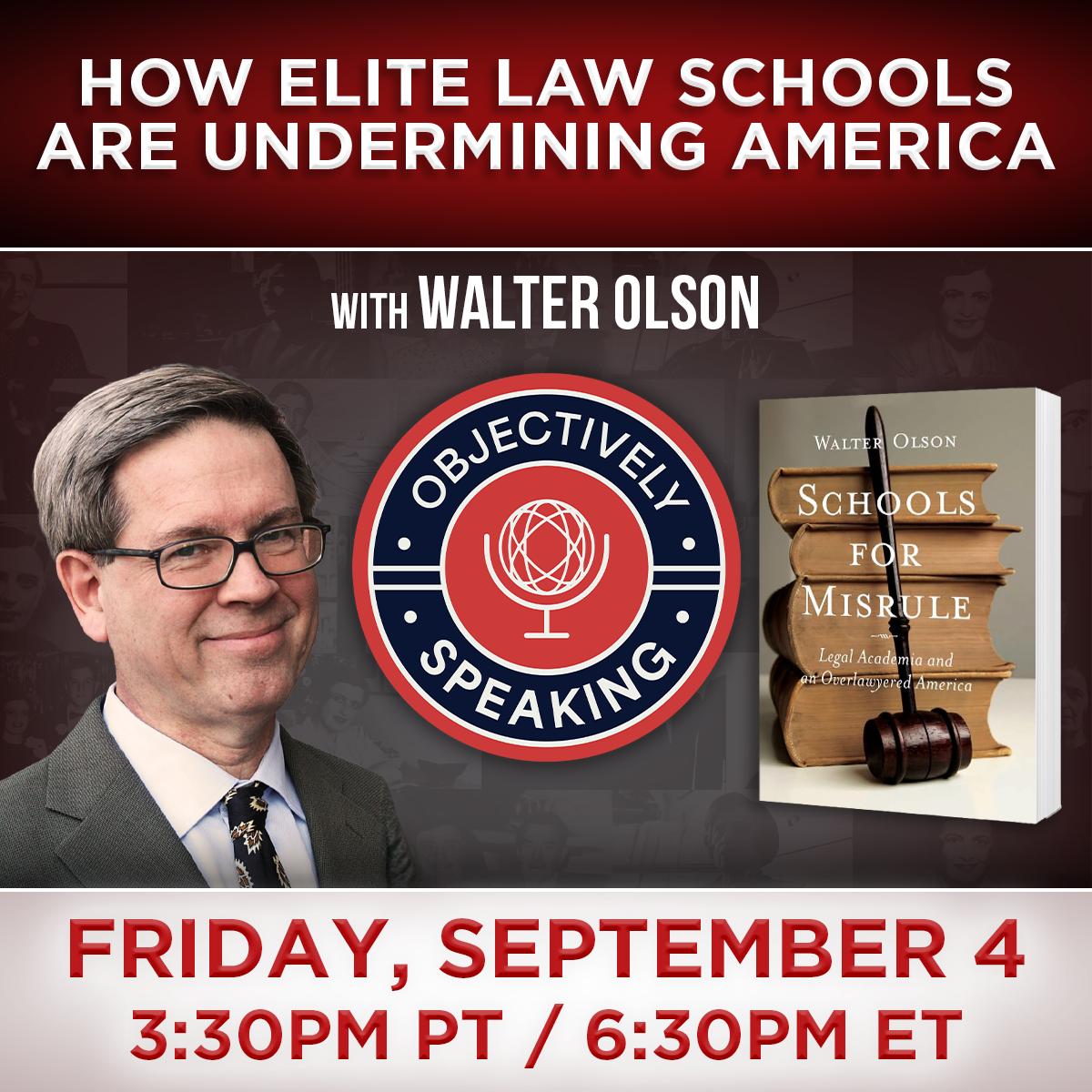
[00:00:00] Speaker A: Everyone, welcome to the 317th episode of objectively speaking. I'm Jag CEO of the Atlas Society. I am very excited to We've been saving the best for last. Walter Olson is the final guest on our series of episodes to talk about tort reform. And in particular we're going to talk about his book Schools for Misrule, Legal Academia and an over Lawyered America. Walter, thanks for joining us.
[00:00:34] Speaker B: Thanks for having me on.
[00:00:36] Speaker A: So we were chatting just a few minutes before we went live and I was asking you for an Ayn Rand story and you had a bit of one that was a little anti climatic. But you have thought a lot about Ayn Rand objectivism and the intersection with justice and law. So maybe give us a little background.
[00:00:59] Speaker B: I sure will.
Over the years, as I have talked with people, many of them very familiar with Round's work, many of them influenced by it, there's several points that may at first seem odd looking in retrospect to the period, maybe the early 60s when she was at her peak of writing about public policy, the specific applications to what the government was doing. And she concentrated on issues that might seem strangely assorted, things like broadcast regulation and antitrust.
And she would get into quite a bit of detail about them.
But why those issues? Why not other ones that were bigger in the newspapers at that time?
So a couple of things that joins the areas that she wrote about. One of them is that those two areas and others that she wrote about were the subject later of major, major influx by intellectuals doing work generally on the right side with broadcast regulation. The central issue which she spotted is that the government could revoke the license of a business enterprise that had invested hundreds of millions of dollars in creating a productive broadcasting enterprise. And it could vaporize that by revoking the license. And something was very bad and dangerous when licensing could do that. So you saw the growth among economists and lawyers of attempts to develop theories of spectrum ownership in which spectrum would not be revocable, it would be instead freely traded and would become a kind of property together regulatory changes that would tie the hands of the Federal Communications Commission so that it couldn't do that. And you notice that this issue is still in the news.
It's hard to win these battles permanently when there are people in government who have so much to gain by rolling back our progress. But on antitrust, you know, after she wrote, there came the wave of interest for economists and lawyers, correctly perceiving that antitrust law in America was very difficult to predict in its operation was potentially restraining some of the nation's most productive enterprises. And in came the so called consumer theory of antitrust, which said if you have one of these antitrust doctrines that Washington is so enthusiastic about enforcing and economists show that consumers are actually being made worse off, if you enforce it, then maybe get rid of that. Now, this was not a perfect reform.
More thoroughgoing repeal would have been better, but it nonetheless defanged a lot of the worst operations. So again, so point number one is that she was very predictive. The things that she wrote about, and you could add military conscription to that, the things that she wrote about tended to be the subject of a lot of very intelligent people's analysis and reform in the years after that. But also uniting the broadcast regulation with the antitrust and, and with some other areas that she wrote about is that they come down to the rule of law. They come down to the fact that what you do, if you are running a business or maintaining property that you own, should not be subject to the whim of some enforcer who may switch around the rule as it operated last year and the rule of law, and we'll get into this in the show, because of course it's important in tort law too. But the rule of law starts out with a number of very basic premises.
Rules must be announced. You have to be able to find out what they are that the law is expecting you to do. They must be pre announced. It's not enough to find out after you act, you have to be able to get it pre announced by the authorities.
It can't be contradictory setting you up so that whichever way you decide on some issue, you're going to break some, some law, one law or the other, and there are other components to it too. But she saw that basic issue of someone who is trying to carry out a productive enterprise and finds themselves short on rule of law. They can't know what the rule is by which they're supposed to act.
They find themselves deliriously exposed to a different rule than the one they told was probably applying.
And they find themselves in these whipsaws in which they were told that they had to avoid breaking one law and that set them up for being accused of breaking another one. So, you know, this testifies, I think, to the fact that even though she was not trained in law, even though this was not her big area, it wasn't even one of her three or four biggest areas.
She saw the uniting philosophical background of these, which is the country and businesses specifically need rule of law.
And if some sector of law is badly, badly failing at providing it. We need to do something.
[00:06:15] Speaker A: Well, that is so interesting because again, I have not spent a lot of time on this intersection and clearly you have, even though, as you say, it was not among the big three or four topics that she covered. So no one's done a book on this.
Maybe we will get one from you.
Anyway, I also just want to say to our audience how great you are making me feel because we rescheduled this at least once because yesterday I returned from Burning Man, Black Rock Desert in Nevada, and tomorrow I'm headed off to Portugal because we've got our European student conference. And so to see so many familiar handles here and all of the praise that you've got for our guest is terrific. And I will be getting to those questions. But first, as you might imagine, I have a few of my own. I do want to get to your book, Walter In Schools for Misrule. You make the case that many of the legal ideas that eventually transform American public policy begin years earlier at elite law schools. Can you walk us through that pipeline? How does an idea go from, say, a law school seminar to something businesses and individuals are eventually forced to contend with?
[00:07:40] Speaker B: There are a bunch of different routes, and I trace in the book about a dozen areas in which this happened, in which the ideas bounced around in law schools, wound up creating massive litigation or massive changes in law that produced these compliance problems. But basically sometime by the 30s or 40s, although it started as early as the founding of Harvard Law School's new approach, where they tried to bring on philosophically oriented professors, but leadership of practical law began moving to law schools. The people consulted them and it varied from one area of law to the next. In torts, which I write about, there was one particular professor who was hailed as the most influential tort professor. Well, it turns out he was close friends with one of the justices on the California Supreme Court, and they would whisper and confer. And then when an issue came up through the California courts where the law could be changed in a more liberal direction along for more recovery and more litigation, that justice led the way and was promptly celebrated and written up by Professor Prosser, the academic. So sometimes you've got that direct relationship with the judge. Many other times the legal movement in a law school will have backing from, let's say, big foundations will know a lot of people in the press will be able to get attention for what they're trying to do. I trace through areas like class actions were very clever lawyers. Law professors laid out the idea that class action should be much more available for many more types of litigation than otherwise. It extends into areas like sexual harassment law, where, if it were not for one particular University of Michigan professor, Katharine MacKinnon, we would probably have something that allowed some litigation, but it would look very different, different from what we have now and on through Indian land claims reparations, international human rights, as a imposition on locally what laws will be upheld or struck down, and somewhat different methods. One of the things that underlies it as a constant is where do judges get their clerks? And their clerks, of course, have just come out from an atmosphere steeped in whatever the most current fashion in law schools is.
I will not claim that most judges turn their opinions over to their clerks. That would be wrong. But on the other hand, this is the bunch of people who they see every day as they turn over in their mind, what is the proper resolution of this? And if all the students are saying, hey, have you heard that? Maybe we should use this to socialize the risk, or whatever, some judges will listen.
[00:10:41] Speaker A: All right, I usually wait a little bit longer, but we have so many great questions that are. Are bubbling up here. Let's get to a few of them.
Kingfisher asks whether, Mr. Olson, you know, if Ayn Rand had anything to say about voting laws.
I don't know the answer to that. And if we, if we don't have an answer to that, then he would like. He or she would like to know. Do you think voting laws are stronger or weaker than in the past?
[00:11:12] Speaker B: Okay.
Election law is a current specialty of mine. Unfortunately, I don't remember what Ayn Rand might have written about it or whether she did write anything about it.
Whether the law is stronger or weaker isn't the question I would ask because the laws are mostly the same as they were before.
The processes and the protocols are different in part because technology has come in with both different voter preferences on things like mail voting, which used to be relatively rare and is now the rule in a dozen states and very popular out west especially.
But also the one thing that people I hope will find encouraging is that the combination of audits and ways of analyzing election data in order to catch the. The possibility of fraud or imposture have gotten much better.
We can much more quickly spot the types of things. I'm old enough to remember when the Chicago machine, for example, and the Philadelphia machine and some others got away with some things that would curl our hair now. And fortunately, detection improved in part because it was helped by the mechanization of some of the things and the ability to apply security to things like the register of votes piling up on a voting machine in part through other advances. And so that led to prosecutions in Chicago and elsewhere and Philadelphia and elsewhere.
It hasn't stamped out voter fraud. There are still bits of it. There was prosecution in Bridgeport, Connecticut, but it now means that mostly voter fraud is accomplished in the dozens of votes rather than the thousands of votes. And that, of course, is directly relevant to whether or not it's likely to change the outcome in any big races.
[00:13:15] Speaker A: All right, Iliation asks, given that America just celebrated its 250th birthday, what philosophical advances or regressions do you think have occurred in the practice of law today?
[00:13:30] Speaker B: Big, big question. And I love the history of law because it often shows us that the things we took for granted, we don't necessarily have to take for granted. Let me start with law schools themselves, because it's widely remembered that Lincoln trained for the bar through effectively an apprenticeship method. But that was actually the predominant way in which people trained for the bar was by studying alongside and helping experienced lawyers. And academia came in, and I have to say, academia had sharp elbows because they used accreditation and they used state laws to require people to go their way route.
Fairly long ago, they cut through things so that only about two states still allowed the apprenticeship route. So that's one area where the restriction of competition in the interest of the academic class was successful, but I think possibly harmful to a lot of people who make good lawyers, but could have come up through the other method and saved enormous debt that they currently owe. So that's one thing about the training. If you look at areas like legal ethics, and this is the subject of some of my earlier writing before this book, but if you look at legal ethics, there were a lot of things that came under pressure from progressive movements and that were dismissed as medieval. You're not supposed to take an interest in litigation that doesn't pertain to your financial interest. I mean, and you're not supposed to stir up litigation with someone else because you might be able to make fees at it.
A lot of that got down to the idea that lawyers were officers of the court. Now, that sounds kind of collectivist, but if you look past the verbiage, lawyers obligations as officers of the court often had to do with not bringing dishonesty to the court. A lawyer who allowed a client or witness to perjure himself or herself had betrayed the interests of justice, and it was couched as basically betraying the court, as if it were somehow insulting the judge. But it was getting at a very important element of professionalism and ethics. And again, there was a bit of a big wave in the 60s and 70s to toss out a lot of old legal ethics rules as just, you know, a meaningless inheritance. I think that the many, many ethical fiascos that we've had since in which lawyers have made themselves vast sums of money by techniques like teaming up with the attorney general of a state to represent the state, except that they collect a contingency fee from it.
You know that right there through most of American history, they would have said, no, you can't represent a public entity like a state on contingency fee because it ain't poor in the first place. That was supposed to be the use of contingency fees was for people who couldn't afford ordinary legal issues, but also because you are behind the scenes harnessing together someone who's getting rich and someone who has a great deal of government power and that has now been abused so terribly. There is some backlash, but there needs to be much more examination of what we got into when we allowed private lawyers to team up with government lawyers that way.
[00:16:59] Speaker A: All right, you have argued that legal academic academia tends to generate ideas that expand the scope of law and the power of lawyers. Is there something structural about law schools that create that bias, even apart from their often progressive politics?
[00:17:19] Speaker B: Yeah, I think there is. And I could compare it.
Part of it is going to happen with any specialized body of professionals. If you turn to medical school, if you research at a medical school indicates that doctors probably can't be of some use on a condition. It tends to kind of sag as they turn to things where maybe they can be useful and a bunch of people they train can become cutting edge practitioners. So in that sense, it's a version of what can be innocent in many other professions. However, as I keep coming back to argue, when law expands, as opposed to when medical therapy expands, someone didn't consent to be part of it is at the other end of the new kind of lawsuit you've invented. Someone is at the business end of the new type of prosecution over something that used to be legal. And on down the lines, law being adversarial.
New activity for law means new bids to take away the rights, the property rights or the freedom of action of some group that is targeted by the law. And that's why ultimately I don't think it's like medicine that way.
[00:18:34] Speaker A: All right, my modern G, nice to see you here has a question. Is there a meaningful difference between rule of law and simply having a large number of laws and regulations.
[00:18:49] Speaker B: There is a connection between those two issues, even though I see them as different issues. One of them is that if law proliferates to the point where you have too many laws to keep track of, of even too many laws that are relevant to your own line of business, then you have lost an important part of the rule of law, because part of the rule of law is supposed to be. And this traces back to the bad Roman emperor who put new laws up at the top of an obelisk where the print was too fine for people to tell what was the new thing being forbidden. Now, you can tell that that's tyrannical from the fact that it's an anecdote that has survived to this day. But on the other hand, when the Federal Register prints 20,000 new pages having to do with construction or whatever, the intent may not even be there to make it uncompliable to be in that area of enterprise. But the effect can be there even if the intent wasn't there.
So the generation of lots of new law can, on a practical level, make it closer to being uncompliable. It also multiplies the chances of conflicting obligations regulations that I mentioned earlier.
I can't hear you. You're.
[00:20:05] Speaker A: There we go. Box Doc and Barrel asks what studies have there been on the regulatory state? Is there a good way to measure the cost of regulations that discourage activities or businesses that never come into existence in the first place?
[00:20:23] Speaker B: It's such an important issue, and it is a hard one to measure.
The regulatory reform movement has gone through various phases of trying to become more sophisticated from numbers of regulations. Not a very good guide, because there can be tiny ones and there can be huge ones.
Actually, one of the better ones is pages in the Federal Register, even though sometimes there's 500 pages on something that only affects neighbors of one dam out West. Nonetheless, it tends to correlate with the expansion of regulatory law through the Office of Information and Regulatory affairs, part of the omb. In the executive branch, they brought to bear economists and others who, once a regulation is proposed on the table, can provide some pretty good analysis of how burdensome it is.
It's certainly much better to have their input than it was back in the days when no one had to try to do an economic calculus. But we are left with very imperfect information, not necessarily because it would be easy to get perfect information, but because it's so amorphous. The ways in which they discourage activity, the hidden compliance costs that may not even be on the regulated party themselves.
[00:21:39] Speaker A: All right. Tort law traditionally asks whether a particular defendant actually caused a particular person's injury. How much of modern litigation has moved away from that model towards suing an entire industry because it is associated with a social problem?
[00:22:00] Speaker B: I'm happy to promote another of my books called the Rule of Lawyers, which is all about industry wide litigation. It's all about the attempts to replicate what was done with tobacco, which itself gets a chapter, and what was done with asbestos.
Replicate it for cheeseburgers, replicated for unsecured lending, replicated these days for social media operations that allegedly should have completely overhauled their activities 15 years ago to make sure that kids never tuned into things that would cause them to be depressed and self destructive.
To me, let's just talk about the social media one, because it leads directly to possible restrictions, not just possible, to likely restrictions on the freedom of expression.
To the extent of that, Facebook and the others begin imposing controls, not just age controls, but also anti anonymity controls, controls requiring you to regularly send your picture to them. If that's part of the, you know, as it often is with these skins, they introduce privacy dangers, they introduce things that make people involved in tough areas simply more likely to climb up and not participate in debates.
And again, to get back to the rule of law issue, what has happened with social media is a perfect example of how if those companies went to their lawyers, as indeed they did go to their Lawyers in year 2000, year 2005, year 2010 and said, is it okay for us to allow parents to be the main regulators of when kids get on and to allow, you know, 16 year olds into discussions where the talk might turn to drugs or suicide or whatever their lawyers would have said, looked at all the different state laws, there is nothing that is against tort law or anything else. Now they find, as so many other industries have found, that it can be retroactively made illegal even after the lawyers were telling them that it was legal at the time. Something very wrong when the law can change retroactively on you.
[00:24:29] Speaker A: So you've referenced a couple of your previous books and we have some who are watching us today remarking on your prolific and very productive career. I wonder if we could almost zoom out a little bit and tell us how did you originally get interested in law? Did you grow up in a family of lawyers and how you got interested in legal abuses and legal reform and how those interests have evolved over the decades?
[00:24:59] Speaker B: Certainly my background is in economics and so little did I know when I began trying to find that Right job writing in a popular vein about the economic analysis of especially areas like regulation and business practice. Always of interest to me from the very youngest exposure to sources that we talked about a few minutes ago.
So I worked for five years for Regulation magazine, which is currently at Cato, where I am, but at that time was at American Enterprise Institute. And Regulation had a wonderful formula. It wanted to provide scholarly analysis of the immensely growing regulatory state. It was the Carter administration. And although there were some good trends, there were also a lot of new regulations coming out. So we had a magazine that depended on contributions from law professors, often dissident law professors, who didn't like the continual progressive trends, from economists, who very often recognized the cost of these things, and also from political scientists, a group that I had not had much, much exposure to. And we published the very best that we could find. And also we had two incredible personalities that I was, I benefited enormously for working with. One was our managing editor, Ann Brunsdale, who went on to chair the International Trade Commission and is probably the most important mentor that I've had if. And the other one was Ananya and Scalia, who of course went on to. To serve on the Supreme Court. And I can tell you, not only was his sense for writing style phenomenal, you know, just amazing to work with him for the sheer language craft of it, but also he quickly, quickly knocked out of me a lot of dumb ideas I had about the law. As someone who had not been trained in the law, I brought a lot of novice ideas about, well, shouldn't the, you know, shouldn't this side win? Because there shouldn't be any law in this area at all, and therefore the person who has violated the law should be set free. And he said, well, think of what you're doing on that.
The are, if you are willing to say, if the juries can just do anything, are you equally content when the law allowed the business to do it and the jury steps in and says, no, we're going to, you know, find them $10 million anyway? I said, well, no, of course not. That would be, you know, the jury would be ignoring the law. And he said, we said the problem anyway. So he brought me around to appreciating what lawyers know, which is different from what economists know. And I never looked back because after that point, all of my books have been about law. I like to think that I still bring the economic way of thinking, which is so tremendously valuable, but the things the lawyers knew, and in particular about the rule of law issues, economists sometimes do and sometimes don't see that about the role of fraud and imposture and perjury.
Very important in actual litigation and often ignored by economists because they are themselves very honest people who would not think of perjuring themselves and therefore don't realize that a great deal of law makes sense only because of centuries of attempts to control Burgery. That's why a lot of rules are there.
Ayn Rand herself, by the way, in one of her passages about law, cautions her readers, saying that jurisprudence is an extraordinarily complex field which must not be confused with our recommendations on what should be legal and what is not legal. Now, there was a tremendous amount of wisdom packed into just a throwaway sentence or two there because jurisprudence is its own different area and sometimes you don't get to adopt the right rule because it allows too much perjury to be gotten away with and you have to fall back on a second best rule role.
[00:29:02] Speaker A: Well, even though not having the training in law, perhaps you had some deficits that your mentor needed to correct. But by the same token, I think it was Richard Branson, the reason that he called his various companies Virgin, because he had a management philosophy that, you know, he wanted to bring somebody that. Not that had been running rail airlines all of their career, but somebody from a different industry to provide that fresh perspective. And so perhaps,
[00:29:38] Speaker B: and I certainly recognize that, and indeed I've so often been asked, you know, you didn't go to law school. Why are you proud of a career writing about law when you didn't go to law school? And the fact is they might have beaten it out of me if I had actually, not only would I have all that debt, but would I or would I have not have withstood the pressure, the peer pressure and other.
Being an outsider I think has been very helpful approaching it, having been trained in a different area allowed me to ask. In some ways this sounds self serving, but ask more fundamental questions that had already been kind of ruled out as answered by the people who were, you know, fully in line with the mood of the top law schools.
[00:30:31] Speaker A: So getting back to the abuse of the tort system and the need for reforms, we often hear in these conversations about so called frivolous lawsuits. But in reality, aren't many good lawyers able to craft them just to be plausible enough to survive dismissal?
Allowing discovery costs and the threat of runaway verdict to pressure defendants into settling?
[00:30:58] Speaker B: Yeah, I try not to use the word frivolous occasionally, there's no other word. But usually exactly as you say, the problem is not that it is over some very ill defined line of frivolity, but that it is a lawsuit locking in general merit which the lawyer filing it could tell perfectly well was unlikely to win if it reached final adjudication before a judge. But its value in obtaining a settlement is other than its likelihood of winning the eventual court ruling. Its value stems instead, as you say, from the imposition value of the discovery alone may cost you a million dollars. How about forking over 500,000 dol and you won't have to do the discovery. There was a or the reputation value the terrible lawyer Roy Cohn, who's just the subject of a new biography, but he's one that I discuss in my books because he's such a disaster area for legal ethics. But one of he brought a lawsuit to a very large household name successful American manufacturing company and said my client is going to claim that your product did this.
Now you know what that's going to do for weeks and weeks of publicity. And the company said, you know, we know we can, we've already studied this. It doesn't do that. The product does not cost that. And he said, well that's all very well. You want all that publicity. And of course they've handed him over a very large chunk of money. Now Roy con was an extreme instance, but less extreme instances unfortunately are much more common.
[00:32:42] Speaker A: So here we are 15 years after schools for misrule.
What predictions in retrospect do you think that have been most clearly vindicated? And what if anything, would you add if you were to reissue the book today?
[00:32:58] Speaker B: Well, the mood changed and enough of that had already happened when I wrote the book that I have various passages about. By the way, things have been getting better because now there's a scholarly pushback where a number of professors hazards have emerged who have the right critique of this. So I put some of that in, but that continued.
A lot of the ideas that I criticized have become unfashionable since then and I hope that I did something or other to help make them less fashionable by pointing out how badly they threatened to rights and how badly they threatened to malfunction. But the fact is many things were peaking around the time I wrote the book that have now declined.
And that's for the good.
I failed to predict one of the most important ways in which the system was resilient against what I warned against and that is through arbitration. If you enter into contracts over consumer products, over so called shrink wrap, the stuff that you accept, except when you open new software or over many Employment situations and so forth. You find that you are agreeing to arbitration. Well, that's tremendously effective at channeling disputes into not an area where the consumer never wins. Because studies of arbitration indicate that consumers often do win.
Companies are content to run to be part of arbitration systems in which there is relief for the more meritorious cases. Partly because they know how much cheaper that is than the litigation circus and craziness, partly because when they can make amends, when their product really did fail on someone, they are buying goodwill that helps cement the loyalty of their consumer base. So arbitration does provide real remedies in a lot of cases. What it does not do is get caught up in, in all the stuff I write about, sometimes I have lawyers come to me and just refer in a hand waving way, you know, Walter, all the stuff that you write about. And I do know because I got to be known.
So when you hear attacks on arbitration, which is of course a matter of contract, it is a matter of minds meeting, even if very briefly.
And it's a matter of contract that you can avoid if word gets out out that one company is doing bad and extreme versions of it.
But it's also in the target the crosshairs of a lot of progressives who so want to overthrow arbitration and push all that stuff back into the legal system. But at the moment, the current US Supreme Court has valiantly defended arbitration. I have to give them that they have. In fact, many of the things that I have argued about and warned of in my books, I will give Credit to the U.S. supreme Court for having turned the tide on a lot of them. I argued in my first book, among other things, that the way lawsuits were started then, where you didn't have to explain what you thought the defendant had done wrong until perhaps months into the case. This was fundamentally an attack on human rights. Really to drag someone into compulsory process without telling what they had done wrong and let that wait was terrible. And so the US Supreme Court re bolstered the pleading stages of lawsuits in order to require plaintiffs to cough up more information. Not an imposition on most plaintiffs that have good conditions cases, as many plaintiffs do. A terrible imposition on someone who's doing a fishing expedition hoping that something will turn up. And most states have followed that. Likewise, again, the Supreme Court and the federal courts is not where most tort litigation happens, but it is influential in the way that states arrange theirs. So states followed that rule and that improved the atmosphere tremendously. One other area, expert testimony and the reception of science in the court courts at the time That I started writing it was a mess and a damaging, unprincipled mess because the progressive position was let it all in. Let someone come in who was willing to, you know, as a spellbinding orator, say that strawberry jam causes cancer and then, you know, drag in the jam company and make them, you know, bet the company on whether or not the jury believes this silver tongued person. Well, this was a bad rule and very different from the way most countries do it and different from the way the US used to do it. So in a case called Dobera vs Merrell Dao, a lot of these cases come from the drug and pharmaceutical and medical device area.
The US Supreme Court said, no, this is not the way to run a fair and objective legal system because some scientific views in fact have standing with, you know, know, scientists and some of them don't. And it is part of court's duty to be gatekeepers. They're not to be perfect gatekeepers, but better to do some gatekeeping function on who can spin their theories to a jury. Well, it revolutionized things.
It helped all by itself. That one decision helped pull back from the brink a lot of Americans, medicine and medical device and pharmaceutical and vaccine and other areas where the litigation pressure was just tremendous because they couldn't bring in people who said that a particular form of contraception, for example, if you look at studies, actually does not cause whatever. And now they could, and now they could get the cases thrown out of court through pre examination of the plausibility or validity of the scientific testimony. So most states adopted that too. And it's made just a tremendous difference. So as I say on this issue, although there is much that troubles me about the trends, I want to caution people that a lot of trends, people do eventually learn, you know, in the meantime, some vaccines were driven off the market, some good drugs were driven off the market.
You know, lots of bad things happened, but the scientific community kind of rallied because they were just as upset as anyone else. And the scientific community made its voice known that they didn't want any more valuable medical devices to be needlessly lost just because juries could be misled.
[00:39:56] Speaker A: So you've written about plaintiffs attorneys functioning almost like, like entrepreneurs who discover new theories of liability. Markets normally reward entrepreneurship because entrepreneurs create value. What goes wrong when that entrepreneurial energy is instead directed towards creating new causes, grounds for lawsuits.
[00:40:21] Speaker B: Well, I'll go back to the point I made a little while ago about how innovation is law. Is innovation in ways to impose obligations, obligations to respond, obligations to spend Perhaps two or three years of your life in court, the chance of having your money redistributed, the chance of losing your liberty in some instances. And so innovation in that is different from innovation in most areas of life where people only get the product if they have chosen to take it on. This is an involuntary consumption. And the catchphrase that I came up with, and I actually did originate it, and it's been picked up by some people that I love and respect. But it was the invisible fist theory.
The idea was, we knew from Adam Smith, that in the voluntary market in which people are choosing to buy products, that the stuff that is profitable to introduce over the long term is profitable because it serves the willing needs of some of the people who are buying it. Now, in the invisible tist theory, some of the academics that I criticized took the view that the more litigation went on, the more perfect justice would be. There would be a correct attribution of social cost, quote unquote, to the businesses that were being sued. And the idea was not only fit, they would sue auto companies for every injury in a car because if they, because they were the least cost of order. That was the jargon.
Auto designers were better positioned, or sometimes highway guardrail designers, or sometimes bridge abutment designers, but someone with deep pockets was better positioned. So the idea was that you would get more safety by a tribune, the cost of accidents to deep pockets.
But the invisible fist theory was refuted by events. I like to say the uncertainty as to who was going to pay, since there were so often more than one deep pocket on the sand, led often to extremely costly litigation between the deep pocket businesses trying to shift the liability to each other, it was read as a very poor and misleading safety signal. Obviously, in some extreme instances in which a product blows up and it wasn't supposed to blow up, you do get a safety signal of okay, don't market that product. You would get that even from traditional pre modern law in torts and contracts though, because your contract may have been broken if the lawnmower or blows up on you.
So again, the parts of the system that do work decently in sending safety signals were often the parts that were there all along, or at least widely accepted.
The stuff that is new, the stuff having to do with problems that are caused by hundreds or thousands of different emitters, whether it be emitters of carbon dioxide or emitters of calories into your diet, Are intrinsically very not well suited for resolution by a process that eats up a lot of the money in the process itself before it ever gets redistributed to anyone. And where the.
The old rule of the old law of you need for your particular defendant to be more likely than not to be the source of your actual injury, that's manageable more often than not means that if you get fat and you blame it on someone, and I'll get in a moment to why that's a bad suit anyway, but assuming it was a good suit, you'd have to be getting more than half your calories from one particular ice cream maker before the law would have let you over that particular threshold. Well, the progressive idea was ideas like market share liability. You know, first you establish that the food industry is making us too happy by sending us high calorie food. And then you assess, you know, 1% of the billion dollar verdict to this company and 1/2 of a percent to that company. It's crazy, it can't possibly work. And if it could work, it would have to be done through taxation to make any sense. I'm against that too, but at least, least there's some show of rationality to do it through attacks. But I promised one other angle, which is that those suits about obesity would have been thrown out in the first place because of a grand old principle that was called assumption of risk. And assumption of risk, and the classic instance is skiers and that sort of thing. Assumption of risk says someone who knew the risk or had every reason to know the risk of something, even if they are injured by the thing cannot come around and say this is unconscionable and throw out the contract in which I signed waivers and things.
Professor Prosser, who I referred to earlier, really couldn't stand assumption of risk because it was such a powerful and such an intuitively just and fair way of throwing a lot of litigation out of court before it could ever get there. That for torts to turn into social insurance, you had to get rid of it. You had to say no, you know, it's unjust to let companies get out of it just by saying that you knew perfectly well their activity was risky. We're not going to get social insurance. And social insurance is what we want. If so many people have to be injured and not get any recommendations through torts, at least. And so his writings were very influential and most courts, to one extent or another, either throughout assumption of risk entirely or very sharply limited it so that maybe the ski resort could get out and maybe not, but that a lot of others could not argue that. So again, they had to change about 100 different things in order to get a creation like the modern torts system. We've only had a chance to talk about six or eight of them. But you know, take my word, there were a lot of other things going on, almost all in the same direction.
[00:47:05] Speaker A: All right, well we've got maybe 12 more minutes of time till the top of to the end of this podcast, so we'll try to kind of make the the rest of these almost more kind of rapid fire.
Have a question from Valiant Mike.
What really is a jury of your peers today? When people, people can barely agree on concepts like what is a woman? So any usually jury selection doesn't come up when we're having conversations about tort reform. Do you have any thoughts there? Otherwise we'll move on
[00:47:39] Speaker B: the jury as an institution.
I still think the best case for it is that it is an obstacle to tyranny if the government begins going around and either whether through criminal indictments or through misuse of civil law, begins to persecute its enemy.
I want, and we should all want a jury to be there of one's peers is a tough phrase.
There have always been challenges to kick people off juries.
This is actually something I have written about a lot because that part of the process went badly wrong in some states.
But again then the, you know, juries are, I say that they make often an irreplaceable break, but a terrible accelerator. You don't want juries to hand out a billion dollars because a lawyer made them mad enough at some defendant.
But in terms of looking at, is someone lying in terms of looking at did the complainant behave as a normal person would? Yeah, juries can be pretty good.
We still face the problem that in industry wide litigation they can sue over the drug 10 times and win nine times. The drug maker can win nine times before juries and then the 10th one has punitive damages that capsize the whole thing. That's a problem that judges should try to solve.
[00:49:05] Speaker A: So you've spent much of your career arguing for rules rather than discretion. Why is discretionary legal power particularly dangerous to economic liberty?
[00:49:19] Speaker B: It is one of the dimensions of the rule of law issue because if the actor who decides, and this will sometimes be a judge, sometimes be a jury with no guidance as to how to analyze the case, sometimes will be an administrative judge.
If they don't have objective and knowable rules by which to decide whether you violate a the law or not, then their discretion becomes potential tyranny. Even if they are a good person, even if they are not trying to abuse the power. The fact is that discretion means that you've lost the benefit of a predictable rule. You have set up a situation in which the next person accused of doing the same thing may get a very very different result.
And that is it defines the so called horizontal justice which is which is whether like cases are treated like so watch out for that discretion.
It is I hardly need to add that during the progressive period in law schools that I criticize, they fell in love with discretion and they really disliked clear rules. And they brought up all of the genuine critique of clear rules which is that people can take advantage and skirt around them and find loopholes. And those are real problems with clear objective rules is that they may not foresee every situation but better thought and that set of problems than to jump into discussion.
[00:50:47] Speaker A: Looking back over the last 35 years, which tort reforms have most clearly worked? I know you talked about some Supreme Court decisions. I don't know if there are any other legislative changes that you feel have made a difference in real cause.
[00:51:04] Speaker B: Tim One of the curious things is that almost nothing that the federal Congress has done has been of any use and I don't know whether I would have predicted that at the time. And part of it is the political power of the trial lawyers has generally, except in a few extreme instances where the small plane industry was going to close down, has kept Congress from acting at the state level. Most states have enacted sumtor reform and and people who deal with state tort law day to day tell me that limits on non economic damages, that is where you're not asking for your medical bills to be paid, where you're not asking for your lost ability to work to be compensated, but where you're asking for the things you went through psychologically or even for pain. The limits on that have been practically one of the most important, if not the most important thing in calming down the tort atmosphere. One of the things that I like to do is to look around at other countries and also look at and I hope this is not too far fetched but I look at what rules would we want if somehow we could contract with each other? That other driver on the road we can't contract with because we don't share an insurance company, we don't share any way of negotiating. But if somehow we could get together with that other driver and come up with rules, what would they say to minimize the needless cost?
They would probably resemble some of the things that work as tort reform. They would probably include reasonably full recovery of the doctor costs and lost wages and probably not unlimited, you know, pain and suffering and likewise for a bunch of other issues. So thinking through, you know, if I love contract, contract is the consent oriented, the voluntary oriented part of law.
I have been fighting for contract, at least not to be shrunk. But I love to daydream about what if contract played an even bigger role than we let it play.
[00:53:15] Speaker A: Well, I would love to know in these last few minutes if there's anything that I, I haven't asked you that I should have asked you, or any other thoughts you'd like to leave the audience with.
[00:53:28] Speaker B: Well, we have really traversed an awful lot of what my career has been about. We have hit an awful lot of issues. One issue that I get asked about, this total switch of mood. But I've had people come up to me and say that they avoided going to law school because they read my and also people say that they went to law school only because they read my work. Not sure quite what to conclude from that, except that law is an honorable profession if you do it right.
But you also want to be sure the right people go into it. Because it includes big sectors of contentious litigation, even the justified kind, where it takes a certain personality not to get worn down by that constant conflict. It includes other areas, such as the drafting of documents, which are extraordinarily valuable contributions to the business world, but which, let's face it, can be very boring for a lot of people. Although if you've got the right personality, then improving contract drafting might be just your cup of tea. So think through some of these things, because those who have fulfilling careers as lawyers where they believe they're making a difference are often the people who spotted the area that suited their personality.
[00:54:49] Speaker A: I'm wondering for some of the young people that are in our audience, the students that come to our Galt Gulch and other conferences that are thinking about going to law school, what advice do you have for them? Are there some law schools out there that are a lot better than than others and wants to avoid?
[00:55:13] Speaker B: It depends on whether you plan to go into an intellectual field related to law or whether you are trying to get training to be a good lawyer in a field. And those are two different paths.
The expense is different because if you want to become a legal intellectual, you have to look at the top law schools, vastly expensive that they are, because that side of the law is dominated by prestige ladders. On the other hand, if what you are looking at is to become a valuable business lawyer or family lawyer or many other types of things, perhaps serving a community or serving a particular group of people that you love, you can become a very, very good lawyer at doing that with some much less expensive options.
You know, look at things like bar passage rates, which, you know, we, we laugh sometimes that some of the most prestigious law schools don't necessarily have the best bar passage rates because they haven't been teaching them how to practice as lawyers. But, but again, there are a lot of options for a good legal education if that's the kind of lawyer you want to be. So try to think that through.
[00:56:28] Speaker A: A so what is next for you, Walter, and what's the best way for us to follow your work?
[00:56:35] Speaker B: Well, if you go to cato.org there'll be a long list of the senior Fellows and click on my page. You will soon find more to read than you could possibly want.
Most of it lately on election law. But if you search on terms of interest, you'll also find a lot of older writings on almost every topic that we've, we've talked about and on social media. I'm on Bluesky.
Not too many others these days, but the, you know, again, do the Google search, you know, follow up on whatever issue you wish I had talked about because if I didn't talk about it in the past hour, I may well have written about it anyway.
[00:57:23] Speaker A: All right, well, thank you, Walter. This has been just very illuminating and I really appreciate not just your time with us today, but also your flexibility with our many rescheduling. So thank you.
[00:57:35] Speaker B: Glad I could. And thank you so much for having
[00:57:37] Speaker A: me on and thanks to everybody. Appreciate all of your great questions and comments. We really are building a community here at Objectively Speaking.
Now make sure to join us next week. I will be, as I mentioned, in Portugal, but Atlas Society senior scholar Richard Salzman will host an episode with returning guest Robert Zubrin to talk about his books the Case for Nukes and the New World on Mars. So see you then. Thanks.