Episode Transcript
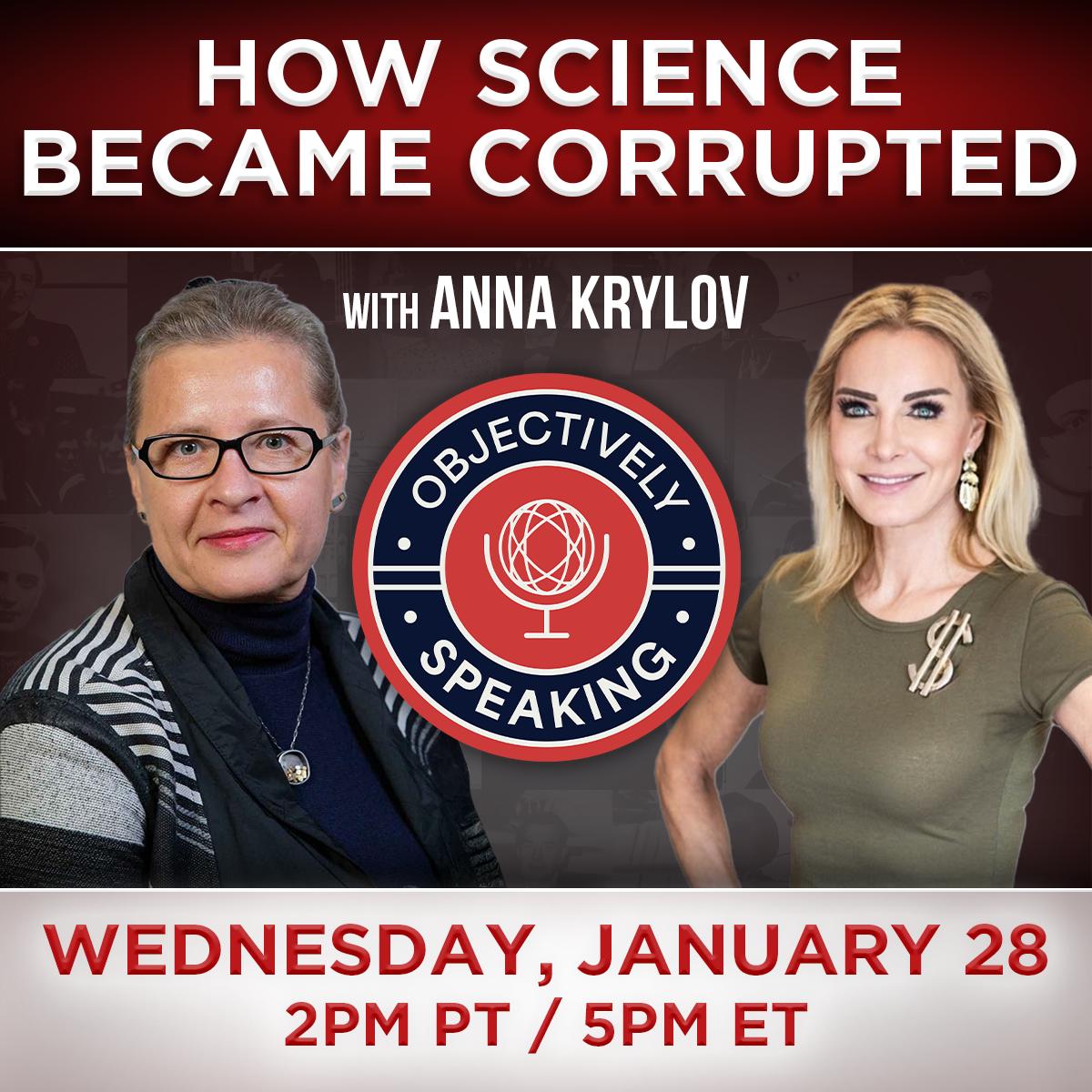
[00:00:00] Speaker A: Hi everyone and welcome to the 287th episode of objectively speaking. I'm Jag CEO of the Atlas Society. I am very excited to have Professor Anna Krylov join us to discuss how scientific institutions dedicated supposedly to truth seeking began to prioritize ideology over scientific rigor. Anna, thank you so much for joining us.
[00:00:27] Speaker B: I'm very honored to be on your podcast. Thank you.
[00:00:30] Speaker A: And a special thank you because Anna just returned from some of that crazy weather and is herself under the weather. So we're going to have to be a little patient and gracious. So let's start if we will, with your origin story. You were born in Donetsk, Ukraine, which obviously is in the news. You were in college in Moscow when the Berlin Wall fell. What was it like growing up under communism?
[00:01:05] Speaker B: Well, it was really very different from what you might have experienced growing up.
So the standard of living was very, very different. So everything was in short supply. And we weren't exactly starving, but we were spending, spending time standing in endless lines to get some basic stuff like groceries, butter, eggs, meat.
The first time I saw banana was I think in eighth grade.
And then of course procuring things like new pants or new boots. That was a whole project and undertaking.
So, so we were living also in pretty cramped quarters. So having things like your own bedroom that you do not share with anyone else was an idea out of this world, out of our world.
But poverty, of course, that's the most important aspect of life.
You do not need bananas or closet full of clothes to be happy. And I do have happy memories from my childhood.
So it's not that it was all negative, but maybe more important thing that really permeated our lives was ideology.
A Marxist Leninist ideology.
So from very early age, from kindergarten, once you go into the world, it was clear we knew that we are not just living our lives, we, we are advancing the world revolution. We are fighting to liberate masses from the oppressors. We are in war with the west and existential war for that matter.
And everything and everyone was scrutinized through the lens of Marxist Leninist ideology. So literally everything. I mean it like books, literature, music, chemistry even.
And as part of, was also very clear for anyone like as you grow up, that all non conforming ideas and actions were punished.
So they knew that even if you yourself didn't get in trouble, they knew that you can get in jail for reading a wrong book or get into mental hospital for writing her own book.
So and what is also I think very what I remember very vividly is that not speaking.
Not speaking was not enough. You cannot just keep your head low and mind your own business.
One had enthusiastically engaged and literally from the kindergarten I remember slogan at first grade. Who is not with us is against us, and God help those who are against us.
So as part of it, you had to be a member of communist organization appropriate for your age, also starting from the first grade.
And then as part of it, you had to actively participate in various events, like May and November demonstrations, some political rallies where we would condemn the west and require some political actions, like free Angela Davis.
Frequent events like brainwashing sessions where they would talk about current events from the lens of Marxist Leninism.
And maybe the last one I want to mention, because it came, I was recently vividly reminded of this, the warmth of collectivism, the collective. The collective was there to watch over you and to enforce compliance.
Another banner I remember from school in a classroom, in Russian, it goes like that, which means, if you can't, we will teach you. If you don't want to, we will make you.
And the collective, I think, was more effective than organs, than kgb, because it was always with you, and it was deployed on minute indiscretions to put people in line, and it was always there.
[00:05:57] Speaker A: You must have had some shivers then going down your spine when you heard our mayor in New York calling to replace the frigidity of rugged individualism with the warmth of collectivism.
And you know what you're describing. So right before the show, Anna and I were talking and didn't want to put her on the spot on the show, so I said, well, you know, have you read Ayn Rand? And she said, well, it definitely wasn't on the reading list when I was at the university in the Soviet Union, and. And she just recently discovered it and read the Fountainhead. And I look forward to her going through the rest of Rand's ovra. And at some point, Anna, you'll have to read. I can't say it's my favorite because it doesn't quite have the same sense of life, but without any spoilers. She wrote we the Living, which was her most autobiographical novel. And it was about a young scientist, a young engineer female, growing up under Soviet tyranny. And so be interesting. Interested to see how much you find there that reminds you of your experience. So tell us a little bit about your education, how you came to be a professor of chemistry at the University of Southern California.
[00:07:30] Speaker B: Yeah, my education in school in Donetsk and environs.
So my formal schooling was, I think, at the best mediocre. So the school was not very high quality.
But from early on I was Russia's reader. I would read everything that I can get hands on. And in my home we had a lot of books.
And you know, in school I would read textbooks on all subjects for the entire year in a week. You know, once we get them, I would read them and that would be enough for me. And I would be reading popular books like science and science magazines. Popular magazines, which usually were way above my head, but I would read them anyway.
And socially that wasn't, you know, a ticket for success and acceptance. So I was not very.
I was quite isolated in school.
But then I started participating in student Olympiads. That was Russian tradition, a USSR tradition, when students would be sent to compete in different disciplinary competitions.
And I was thrilled by that. So I was attending like all of them, mostly frequently chemistry, physics, math.
And the reasons I liked it because first I was getting kicks out of adrenaline. So I was showing signs of becoming of being adrenaline junkie.
And the second reason is that it was the first time when I was around kids and especially boys who. With whom I could talk about academic science. And that was okay and, you know, it wasn't so. And then the thing that really got me into chemistry was when I get my hands on chemistry, actual chemistry. And it also didn't happen in school.
I think it was sixth grade when I cajoled my mother to buy me chemistry set. And at this time they still had chemicals in it. So I was very happy to set my chemistry lab.
So I ran through the official recommended activities very quickly. And then I started to acquire chemicals and they get pretty decent inventory with strong acids, with permanganate, with all this stuff. And then I went on my own. And it was not always safe. Well, often it wasn't safe, but it was a thrill. So that's how I got into chemistry.
And then I went to study in Moscow State again, despite my family wishes, because my family strongly discouraged me from that line of career.
And so I studied in Moscow State. So it was very good education.
You know, we had our share of political brainwashing that was also kind of required part. But overall education was great.
And in Moscow State that when I first got exposed to mathematical foundation, to quantum mechanics, and that really again changed my direction because that was the first time I realized that we can use. We can predict chemical events and properties and not just memorize, you know, what molecules are doing. And that changed my career direction.
[00:11:07] Speaker A: Yeah. So you describe yourself as a quantum cheminis can you give us a layperson's take on how quantum applies to chemistry? What is the main focus of your research and what problems do you work on now?
[00:11:22] Speaker B: So chemistry is concerned with how molecules interact with each other, with environment, with light, and quantum mechanics as a part of physics. Quantum mechanics has, in principle, answers to any possible question a chemist can ask. Because the Schrodinger equation that describes atoms and electrons, I.e. molecules, has all the answers, like, literally answer to any possible question.
But there is a catch, and the catch is that to solve this equation by brute force, we cannot, except for some trivial cases.
And I think about quantum mechanics, it's like a treasure chest. It's a treasure chest with all the, you know, goods we want to get our hands on, but it's locked by this intimidating clock of complexity of solving the Schrodinger equation and what quantum chemistry is. Quantum chemistry provides the key to unlock this treasure chest and the way does it. We develop smart, physically motivated approximations to the stern German equation. We use mathematical manipulation and computer algorithms to make solving this equation tractable.
So ultimately, we write software, computer software, and that's what I do for a living. You know, that's. Quantum mechanics is the foundation. Quantum chemist is the practical way to take advantage of it.
So that's. That's. That's what I am.
[00:13:02] Speaker A: You. You describe failures as instrumental to success, and that's definitely something that I emphasize here at the Atlas Society.
I, of course, I want us to try to avoid unnecessary mistakes, but my philosophy is, if you're not failing, you're not learning, and you're probably not risking enough. So what is a key failure from your early career that ultimately led to a breakthrough in your work?
[00:13:30] Speaker B: Yeah, failures are important. You know, I used to be a rock climber, so. And the mantra that if you are not falling, if you are not failing, it means you are not trying hard enough. So that's very true. But in chemistry, I think it wasn't a monumental failure, but it came at a very critical time when I just started my independent career at UC and as an assistant professor, you know, tenure clock is ticking, and you are under very strong pressure to make your mark so you can be considered for tenure. And at that time, I had this idea, which I thought was brilliant, of a new approach to solve Schoenker equations. So I thought it would really revolutionize how we tackle it.
And I spent, I think, two full years developing it, developing equations and implementing it in a computer code, because that's a hard work, and it takes Long time to do it right.
And I made big plans around it. I thought, you know, I will do this and this and that. Basically that was a supposed to be foundation for my future research for quite some time. And then it didn't work.
You know, it just didn't work.
So I, I was devastated and frankly I was scared because I thought, well, I do not know, I have three more years left and I do not have to show anything for two years that already passed.
But then it turns out, as I realized soon, luckily, that this foundation that I created working on a failed idea, it helped me very soon and it was invaluable because at some point I got a new idea of the spin flip method that ultimately worked very well. And then because I had all this foundation, all these building blocks, I was able to implement and test it very quickly and publish it and all this platform, all these things, all these two years of work, they weren't really wasted, even though they didn't lead to the successful idea.
So that was very important lesson for me that there is no such thing as complete failure. So what you.
[00:15:58] Speaker A: Yeah, and I think it's an important also lesson for young people, you know, who are so often coddled or overprotected from going out, getting a skinned knee, making some mistakes and without that process, you don't gain the confidence and the resilience, you know, to take bigger, bigger risks and know that, you know, yes, you've made a mistake, yes, it's disappointing, but you've got the self esteem to be able to continue to persevere and try something new. Now you have served on the editorial boards of numerous peer review journals. Did that insider's role give you more of a front row seat, so to speak, at how decisions about who or what to publish were being made?
[00:16:46] Speaker B: Yeah, I served on advisory boards for a number of journals and more importantly as the editor of two chemistry journals.
And what can I tell? So it's not really secret. There are no like behind the scene things in chemistry publishing, at least in stem.
But it does help to see how the sausage is made. So you understand better how a peer review process is executed. You understand better what difficulties, what challenges editors face when they have to do their work and sometimes when they have to make difficult decisions. So yeah, it was useful experience. And maybe one important lesson is that no one is perfect.
Editors are not perfect, reviewers are not perfect, many papers are. Well, most papers are not perfect.
But overall the system works pretty well. It, it's robust, it's resilient, and when it's functioned correctly. It achieves its goal, it achieves its purpose of an epistemic funnel. So a lot of things go in, but what comes on the other end, that's validated knowledge, not always correct. Sometimes we have to go back and revise, but it's effective.
[00:18:09] Speaker A: All right, now, you came to my attention because as viewers know, I'm an avid fan of the free press, and there you wrote a piece why I cut ties with science's top publisher and the associated heterodox piece. You cite examples in 2019, 2022, October 2025.
Was this a progression for you coming to question them over time?
[00:18:40] Speaker B: Well, maybe not necessarily a logical progression, because I was concerned about all these issues since 2021, probably.
But what the three milestones, the three examples illustrate. They illustrate three distinct ways in which ideology can subvert mission of a publisher. And these three distinct ways are injecting ideology, which most often comes under the name of diversity, equity and inclusion, DEI in the form of social engineering in the editorial process.
The second example, the second way in which the subversion happens is ideologically motivated institutionalized censorship, suppression of the knowledge and ideas.
And the third, the most perhaps concerning one, is when ideology is directly injected in the published content in the published papers.
So the three examples kind of illustrate these three aspects. One was this diversity commitment when they openly say that we will use diversity when we look for reviewers and solicit content from authors. The second one, censorship manifesto, of course. And the third one is how editors now encourage authors to write inclusively and to exercise things like citation justice and so on.
[00:20:22] Speaker A: Yeah, well, that caught my eye.
What is citation justice? And was that kind of the straw that led to your decision to publish against their pattern of sacrificing scientific rigor?
[00:20:37] Speaker B: Sometimes it's even difficult to explain with a straight face because it sounds like something like a hoax rather than something that can be happening in serious institutions.
So citation justice is one of the examples of application of critical theories to the field of publishing. And the premise, as with all critical, you know, analysis, critical, race theory, critical, this critical, that is, that there is inherent struggle and power imbalance and that there are oppressors and oppressed. And if some demographics is not represented equally, it's because of deliberate oppression. So citation justice says that again, axiomatically claims that authors from preferred identity groups, from the oppressed, from women, racial minorities, and what's not that they are under cited, so their work is just completely, not completely, but overlooked. And then to do justice, what do you do? Well, you have to cite them to correct for this, regardless whether their work actually merit citation in a particular paper. So the citation justice, it's a way to treat bibliography in published papers as a spoil system which you use to, you know, to undo past purported injustices.
[00:22:09] Speaker A: So, you know, a lot of the guests that we've had on the show would make the argument that we have reached and we have passed peak woke even with this administration's anti DEI mandates as evidence of that. But you seem to push back against that.
What's your take?
[00:22:31] Speaker B: Yeah, so we do have some changes of overtone windows, so to say.
And with, well, actually not with administration, but actually the result of the past election signals that many people kind of understand the pernicious nature of this ideology.
Maybe not necessarily in publishing, not many people care about chemistry publishing, but in other domains of life. So, yes, we have new administration.
What has changed is that government mandated DEI practices such as loyalty oath that people had to write to get a job or to get funding, so these things now are not mandated and even declared undesirable by the government. So this is good.
Now people are more willing to speak and less scared. So this is also good.
But all in all, I can only describe what is happening as slowing on the momentum. You know, I cannot say that pendulum has come back and why I'm saying that. Well, we see at many institutions, universities, most of all professional societies, publishers, you see strong resistance to change.
Sometimes it's subversive. Like universities are playing the shell game. And you know, now when Trump said that you will lose federal funding if you engage in discriminatory DI activities, well, they rename them, they try to hide them, they give them different names and all that. Now in professional organizations, in honor societies, in publishing, we see that they actually doubling down on di, like the nature example illustrates.
And that's very concerning because it shows that this idea, this rot, is very deep and that this subversion, ideological subversion of our institutions, it's not going away on its own and that we should find a way to reform it, to get rid of it from the bottom, not rely on administration solving this problem for us.
[00:25:07] Speaker A: So we've got a very lively conversation going on in the chat. And here's a great question from aliation. Is there evidence that people will become more skeptical or resistance resistant to even good science because they believe academic institutions are compromised?
[00:25:28] Speaker B: Oh, that's actually excellent point. And I can, you know, talk for hours about it because one of these really big implications of this political subversion of institutions that are supposed to produce knowledge is growing mistrust in science and in academia. And there are surveys that show that Americans losing their trust in large numbers. For example, 2/3 of Americans now on both political ends think that universities are going in the wrong direction.
And also mistrusting some science may be not as high, but it's growing, which is very concerning because, you know, there are many negative consequences of that. Now some people actually study this phenomenon, why people trust or mistrust science for a living. And they came across research by Professor Kahan who ask this question, what makes people trust or mistrust scientific facts that are presented to them?
And one of the kind of common hypothesis and thinking was, well, people are not very well educated, you know, unwashed masses. They cannot judge. And that's why they do not trust evidence when it's presented to them.
And it turns out that's wrong. And so that's what his research shows and what he found out, that the biggest, the most significant determinant is when people perceive whether particular topic is politicized. So if.
And if they see this topic as an issue on which we have partisan dividend, you know, if you are good Democrat, you believe that planet is burning. If you are a good Republican, you believe that climate change is a hoax. And then people start making decisions not based on the facts that are presented to them, but on their group identity, that's extremely dangerous. But then, of course, you know, this politicization of science, that's what drives it. Because. Because if people, you know, if people see that scientists are not empirical, objective experts, but they are playing the partisan game, then of course, why should we trust them? Right. So they're just trying to get, you know, score points for their party.
[00:28:09] Speaker A: Yeah, that is a. Definitely a disturbing trend. Another good question here from Alan Turner, Anna. Do you think this is purely ideologically driven or is there a financial incentive among these publishers?
[00:28:29] Speaker B: I think it's purely ideological. Now, of course, publishers are commercially motivated, financially motivated, and they're trying to, you know, I sat on many board meetings when they would be discussing how to increase ratings of their publication and what they can do to increase their portfolio and all that. So they are motivated by money. But this thing comes, I think, in a way, especially now, when we see how many people now recognize this politicization as a negative thing, they still cannot drop it, because even if it leads to financial losses, So I think it's a pure ideology. And ideology at this level, when it becomes faith, you know, when it's not grounded in reality and People would just do it till they completely destroy their institutions.
[00:29:33] Speaker A: So talking about restoring scientific rigor to these institutions, how would you define scientific rigor and what core principles distinguish it from, say, other forms of inquiry?
[00:29:47] Speaker B: Yeah, that's a good question. So I'm a practicing science, so I learned what scientists do by doing it and by example. And only later I started to. To think and, you know, from where these principles and techniques coming and was, you know, it's very interesting to see and to understand the foundation behind modern science.
So I think the most important aspect of it, of science and of scientific rigor by extension, is that it's based on reality, on the objective reality.
And our axiom that is foundational to everything is that objective reality exists and it can be understood.
So that's something that postmodernists reject, actually.
So scientific rigor, that's how we go about it. How do we understand objective reality, how we find the truth?
And I think it has two components and more important one is that it's more about discipline of the mind.
There are, of course, specific protocols. They're important, but that's, I think, secondary.
And the key components of this discipline of the mind is that it's empirically grounded, which means it's based on facts. So we build theories that.
Aiming to explain how the world operates. But theories are needed. They need to be tested against reality at each step and discard it or modify it if they contradict the observations.
So logical coherence and aesthetical beauty of your theory is important, but it's not sufficient.
[00:31:40] Speaker A: Well, and I think you are an objectivist without necessarily even knowing it yet. So I'm excited for you to continue your Ayn Rand journey.
Can you Talk about the 2022 Nature Human Behavior example which you described as a censorship manifesto?
[00:32:03] Speaker B: Yeah, that was one perhaps of the biggest, most concerning things that happened at this time. So, you know, censorship in principle is antithetical to knowledge production because if we hide and suppress knowledge, well, we obviously harm knowledge production.
And publishers who play this critical role in this process, they are supposed to be the stewards of knowledge production and the defenders of it. And then Nature Human Behavior publishes this unsigned editorial, which I think is just manifesto. So they say that, right. You know, with no atheism, that they will not publish valid research, research that, you know, doesn't have flaws in data interpretation and collection, if they consider this research harmful to groups, which is, of course, very subjective criteria.
So I want to quote from it because it's just their language is, you know, sends the Chills down my spine every time I read it. So that's how it goes. They say, although academic freedom is fundamental, it's not unbounded, so you can see where it's going. And then they say, advancing knowledge and understanding is a fundamental public good.
So we all agree with that. But then they say, in some cases, however, potential harms to the population studied may outweigh the benefit of publication.
And by potential harms, they do not mean that, you know, some subjects, research subjects, have been given some unverified treatments and drugs or anything. They say in the future is if findings of research can in some very subjective, undefined way harm these groups, then we will just suppress the research and will not publish it.
So that's, you know, you cannot think about more unscientific act than this manifesto. And the fact that it was published in this flagship publishing house is, Is really disturbing.
[00:34:38] Speaker A: So many scientists, I think, agree with you, perhaps privately, but, but they stay silent. What do you think keeps so many highly intelligent people from defending scientific rigor and defending merit openly?
[00:34:55] Speaker B: Yeah, well, then, you know, when you talk to people in private, they will tell you exactly why, so you do not need to guess.
So most common fear, complicity and conformity. So, and people go, you know, explain their silence.
They would say that, you know, they would. Motivated by their commitment to science. They say, I am. So I'm, I'm a scientist and I do not want to be the distracted from my primary role. And if I speak out, it will be distraction and it may even harm my research, my students, my postdocs. Therefore, I will stay silent. So very old set of arguments that we heard in historically, in totalitarian societies from people that choose to say silent when things will dice in. So now we hear also a new. There is a new tune to it.
So now I see that quite a few people prefer not to speak up.
They are motivated by political and partisan concerns. They say, well, yes, we do have problems in academia, we do have problems in our institutions, but what about Trump?
The only thing that matters is stopping Trump.
And they say, well, if we criticize, you know, abc, it will play in the wrong hands, and we do not want to give them ammunition because they will use it to nefarious purposes. And that's a very common, that's very common now, unfortunately, and it really doesn't make any sense to me because regardless of what you think about your political opponents and adversaries, it never serves a good purpose to hide and to, you know, overlook problems in your own home.
[00:37:01] Speaker A: Yes, well, as Ayn Rand reminds us, you can evade reality, but you cannot evade the consequences of evading reality.
So Anna, how do current DEI initiatives in science affect, say, grant review processes and publication standards?
[00:37:20] Speaker B: So again, I will be talking mostly about American reality because it's different now from European.
So Biden administration very heavy handedly injected DI and funding process.
So I wrote the whole paper about it, long boring paper with a lot of exhibits.
So they dedicated, they diverted large resources, by some estimates from 10 to 30% of National Science foundation funding to pure DI projects such as discriminatory projects when money are given based on identity, or to some loony projects when people would study racist mathematics, how racist mathematics is, or, or how to weave indigenous knowledge in chemistry and things of that nature.
So now that was one problem. The second problem was also under Biden administration, that technical grants required DEI plans. So with each technical grant, no matter what you write for DOAE or other funding agencies NASA, you would have to pledge your commitment, make axiomatic statements about systemic racism and systemic barriers for women and what's not, and put up a plan how, in addition to your technical work, or through your technical work, how you will advance goals of dei. So now what that means is that at best the selection of technical grants was not based purely of scientific merit.
Now on top of it, there could have been social engineering behind the scenes.
And that's hard to quantify. We do not have data for it. But I suspect that things were happening because I know from private conversations that programs at different agencies were relentlessly criticized for the lack of equity, for the lack of proportional representation. You know, that quantum chemistry program doesn't have 50% of women and things of that nature.
So now this is now reversed largely by executive orders and by change of leadership. That's good.
[00:39:44] Speaker A: Now.
[00:39:47] Speaker B: Is there still something going on behind scenes? I do not know, so I do not want to speculate.
So I think funding currently is okay.
Publishing is another matter, because publishing houses, they have no, they do not answer to the government and that's a good thing. So they are completely independent and based on what we see on this manifestos and their public claims of that they have their commitment to DEI above all.
So I would suspect that yes there is, that it does impact what is published and has impact on quality. Again, it's very hard to quantify because, you know, I do not know whether we have some not high quality paper being given preferential treatment because, you know, demographics of the authors or not so hard to measure.
[00:40:54] Speaker A: We got a question here from Lock Stock barrel. He wants to know, are there any scientific journals you see as models for how things should be done? And you also mentioned previously sort of the difference between American European journals. Is there less of this going on in other places around the world?
[00:41:16] Speaker B: Well, there is more of this going on in other places because in Europe just recently I saw announcement on the mail list about new professorship in physics, experimental physics, open for women professors. So that's your first qualifying requirement to be a woman.
So in Europe DI is still, you know, officially an official politics. So there are positions for women only or minorities or sexual minorities.
Funding agencies doing it quite heavy handedly. So that's all there.
Now with publishing I would.
My feeling is that there is not much difference between American publishers and European. Like you know, we talked about Nature and they just get triggered by them.
But our own flagship publisher, Science magazine, well they didn't go as far as Nature, but they also have, you know, a number of ideological actions of similar level. So now a good model? Well, I do not know good model. But you know, like I have now by now like three papers published in the Journal of Controversial Ideas. Believe it or not, there is such a journal and that's a new initiative.
And the journal was established by couple of.
By several moral philosophers, which is not my field of study. Right. But I will tell you how I get to know them by Peter Singer and a few others.
And the reason they found it is because they realized that the ideological corruption of some standard journals is so high that people just cannot publish certain work. It's very a taboo topic Now I got into this journal because in 2023, I think I co authored the paper with this really boring and mundane title.
It's called In Defense of Merit in Science where we tried to document the what is happening now, the attacks on merit that we see in publishing, in hiring in different agencies and appeal to common sense and you know, warn the community and try to speak up against it. So we couldn't publish this paper anywhere. We tried several outlets and we were turned down. And then I learned that there is this journal of the controversial ideas.
So I sent draft to them and sent to them correspondence with some other publishers to justify that. Merit is in fact now a controversial idea.
And after peer review they were published in this journal.
So that's one of the examples how people try to respond to this. But it's very difficult to, you know, to build these new journals from scratch. And it's very difficult to. To do it in chemistry, for example, when we have lot of a Lot of existing publications and it's, you know, with budgets, with their money. So it's very hard to just build the parallels.
[00:45:00] Speaker A: So we are talking about scientific journals, we're talking about chemistry. My modern Galt asks do you think this problem is happening more in some disciplines than others? Let's say sociology journals or political science journals or philosophy?
[00:45:19] Speaker B: Surely, yeah, yeah, it surely does. So you know, through my speaking out and I get to know people from the way outside from my field.
And the answer, the short answer is yes. So I can tell you we had now one of the examples of this ideological subversion of the field is when they start sensor particular research, when there are taboo topics, taboo findings.
And if you. Last year In French in January 2025, I co organized a conference titled Censorship in the Sciences Interdisciplinary Perspective.
And we invited it to a three day conference and we had people from very different fields, from social science, from sector psychology, from political science, from stem, quite a few people from stem.
And these three days were filled with talks that documented ideologically motivated censorship in different disciplines.
And what emerges from that?
Anthropology, sociology, psychology, really far gone. Its ideological capture is incredible.
In STEM situation is not that bad. But there are subfields which are captured and, or you know, like scrutinized by ideology.
So examples we had at the conference, you know, if you are doing research in life sciences or medicine on anything related to gender and sex, very hard, a lot of censorship, a lot of ideological control and pseudoscience. If in other fields that we heard, you know, at the conference, that is captured not completely, but you know, in significant extent it's climate research where there is again preferred narrative and people that you know the information, the publications are kind of heavy handedly channeled in one particular direction.
So I think the correlation would be fields that are more rigorous or less captured, it's more quantitative, but I wouldn't think that there is a single field. It is not captured at all.
[00:48:13] Speaker A: So you mentioned before this idea of postmodernism, that objective reality doesn't exist. Of course, that kind of ideology has permeated both schools and universities. So I'm wondering, are you seeing any kind of generational shift in how young scientists that you come across view scientific objectivity versus social values.
[00:48:41] Speaker B: Yeah, it's. Unfortunately we do see that younger generation is quite receptive to these ideas, which in part may be just because young people are usually more open to radical ideas. You know, the same saying, if you're young and conservative you have no heart, but if you are old and liberal you have no brain. So there is something to that.
I think also what we see is that younger generation was really brainwashed intensely from school years in this ideas and they are coming to university already imbued with these ideas.
And in part I think it's our fault because not enough people openly spoke against this nonsense. You know, they think that this barrage of op eds and the statements by our professional societies, by publishers, by universities about virtues of, of dei, about systemic racism, about colonialism and decolonization of science, that was not opposed strongly enough. And then, you know, people get captured by this. Now the good thing is though, I think it's not.
Yeah, we do see more young people that come taken by these ideas. But at the same time, surveys illustrate that there is a little bit, you know, shift in the views of Gen Z and that Gen Z now according to surveys is kind of moving away from the wok ideology and in contrast to previous generations. So I think there is a hope, but there is a problem definitely that young people have these attitudes.
[00:50:55] Speaker A: Yeah.
So we have like eight minutes left and I didn't get to all of the questions that I wanted to ask, but I'm wondering, are there any reforms, any solutions that might help to restore scientific rigor at these journals and funding agencies?
[00:51:18] Speaker B: Yeah, I mean reforms I think is pretty simple. What in my opinion, what needs to be done. I think, and it applies to every possible agency, to professional societies, to universities, to publishers.
The reform should be that they should recommit to their original mission. You know, for universities it's research and education, period. No social justice, no changing the world. Research and education for publishers is publishing scientific research and exercising peer review process, editorial process, and that's it. Nothing else. Not advancing diversity, not, you know, doing citation justice and what's not.
Same for professional societies. Chemical societies should be doing what their charter says, supporting chemical profession.
So and it's not that they need to do much. They should stop doing what they are doing. They should jettison all these, you know, activities that they get engaged that subvert their mission. They should of course fire and stop all this, you know, this DEI bureaucracies that should be gone because that's for where this is coming and that's it. Just get back to what they were supposed to be doing. That's a reform.
[00:52:47] Speaker A: So for young people that might be considering a education in STEM or career, what kind of advice would you give them during, you know, early stage research? Say to avoid the politicized.
[00:53:06] Speaker B: Fight, fight now, don't delay it because it's their future and you know, Understandably, young people sometimes concerned about their career progression, they say, well, you know, I cannot say anything now because I have to first get my job and all that. But if, you know, old people will be retired and gone in pretty short time, and if they do not fight for their own future to secure, you know, health of the field, there will be no field left. There will be nothing to live for. So I think it's incredibly important that they show integrity and they do not be complicit and do not. This is capture.
[00:53:59] Speaker A: Yes. And my other piece of advice would be to read Ayn Rand and to realize that a is a. That there is an objective reality, and to be inspired by her vision of man's heroic potential. Maybe we can end with this. Anna, since you've just started discovering and reading Ayn Rand, any takeaways from her literature or ways in which they made you think about your experience a little differently?
[00:54:29] Speaker B: Yeah, well, so I was really taken by Fountainhead, because what resonated with me is the struggle of individual, of a person with a talent, with a vision, with this passion to create in his field, a struggle against this collective, against the establishment, against mediocrity, because mediocrity is always, by definition, present in large numbers. And mediocrity. And that's something that antithetical to creativity and progress.
And so, you know, the thoughts that this book kind of inspired in me is that it's hard for.
I mean, for people who are creative and capable, it's always hard to move along their life. It's much easier to be, you know, complicit, mediocre person.
But there is no.
There is no. You know, you have to be true to your calling. And in some sense, there is no choice. If you just betray your calling and betray your vision, that's the end of you as a person. And that's a very important lesson.
[00:55:59] Speaker A: Yes, well, as Ayn Rand said, I cannot be a coward. I see the consequences all too clearly. So, Anna, no one's going to accuse you of cowardice. Thank you so much for joining us today. Thank you for the great scientific contributions, and thank you for standing up for reality. Really appreciate you.
[00:56:22] Speaker B: It was a pleasure. Thank you.
[00:56:24] Speaker A: And who knows? Perhaps we'll somehow lure you to come and join us at Galt's Gulch in San Diego, June 4 through 6. I think you'd find a lot of like minds there. So thanks, everybody, for joining us. Thanks for your lively conversation. Thanks for the great questions.
Next week, I'm going to be joined by my boss, I'm going to have Atlas Society Chairman of the board. Also chairman of the board of the Cato Institute, Jay lepair, join us to discuss his work with the Free Society. So we'll see you then. Thanks.