Episode Transcript
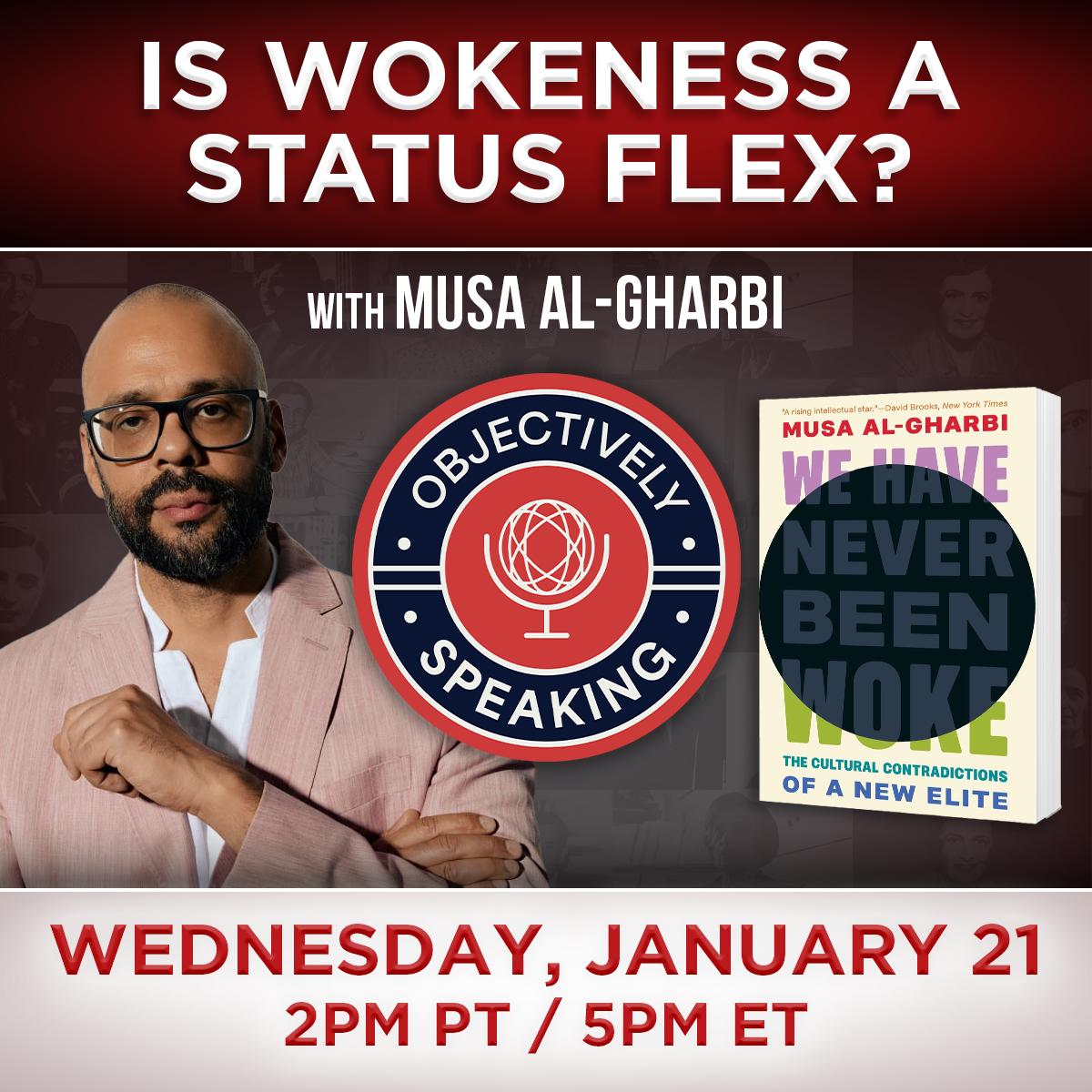
[00:00:03] Speaker A: Hi, everyone, and welcome to the 286th episode of objectively speaking. I'm Jag, CEO of the Atlas Society. I'm very excited to have associate professor at Stony Brook University Musa Al Gharbi join us to talk about his book, we have Never Been the Cultural Contradictions of a New Elite. Musa, thank you for joining us.
[00:00:27] Speaker B: It's good to be here. Thanks for having me.
[00:00:29] Speaker A: So, in reading up about you, I learned that you come from a military family going back generations, yet instead of following in your father and grandfather's footsteps, you aspired early on to become a Catholic priest. Tell us the process that took you from that early aspiration to eventually converting to Islam.
[00:00:53] Speaker B: Yeah, yeah. So, as you said, like, military. In my family, on all sides of my family, going back generation, my mother, my father, my stepdad, my twin brother, a lot of my half brothers, my cousins, everyone was kind of army, army, army.
And I guess part of what drew me to the religious vocation was that I was kind of a nerd in the sense that, like, I was really interested in these questions about the nature of reality and the meaning of life. And I was also very focused on. On these questions about.
Yeah. And on religious, you know.
Anyway, so my initial plan for life was, you know, there's kind of a narrow range of things that were viewed as being, like, really acceptable or valuable careers.
And if, you know, in my family, if you. If you weren't going to do the army thing, you should do something else that's, like, worthwhile and beneficial to society. And being a priest seemed like one of those things to me as well. I had this problem, though, where.
[00:02:08] Speaker A: You.
[00:02:08] Speaker B: Know, I had, as I.
[00:02:11] Speaker A: Crisis of faith as I read about it.
[00:02:14] Speaker B: Yeah, I had a crisis of faith that made it impossible to. I mean, basically, the short version is through my kind of. Through my deeper understanding of the Scriptures, I came to the conclusion that Jesus probably didn't understand himself to be God and didn't.
And this was a big problem because I was. As a Catholic, this is a big problem. In the early Church, there was a lot of dispute about who Jesus was, about, you know, whether he was divine, about in what sense he was divine. But those have been resolved.
So if you're a Catholic. If you're a Catholic, the lack of. If you don't believe in Jesus's divinity in this way, it changes the meaning of key sacraments, like communion, for instance. It changes just a whole bunch of stuff. And so I couldn't, in good faith, go on into the priesthood if I didn't embrace this court, this like fundamental core tenet of about the nature of God as.
[00:03:15] Speaker A: Did you kind of go religion shopping? Did you start exploring Buddhism, Judaism, Islam, just different, different faiths? Or was there something in particular Islam that.
[00:03:28] Speaker B: Yeah, I mean, I did some shopping eventually. In the early stage though, I just went from, I just went straight from a aspiring priest to kind of militant atheist.
And so, you know, I had, from my current vantage point, I would say in the immediate aftermath of, you know, stepping back from my first life plan, I kind of overcorrected.
Rather than thinking, oh, is there some other. If Catholicism just isn't going to. Worked for me, is there some other faith tradition that's a good fit? Or rather than doing that, I just became a, a pretty radical militant atheist. I mean, but then I have this problem there too, where, namely I had convinced myself rationally that there was no God and that religion was a joke. Like, if you wanted me to come up with arguments, I could come up with lots of arguments for it. Problem was I couldn't make myself like feel that way. So I could, I had a good intellectual conviction about it, but I couldn't make myself feel that way in my heart. And so I was left in this dilemma. I could just ignore that feeling, which would make me kind of a bad faith atheist, which is like a really sad state of affairs.
[00:04:43] Speaker A: We had only gotten our hands on you because you and I, of course, objectivism is thoroughly secular and we might have been able to persuade you to come over to our side, perhaps militantly, but we could debate this for the rest of the time and I could talk about your background for the rest of the time. But I did want to just hit on one incident that I thought was really interesting. You had an experience when Fox News misleadingly characterized you as a radical Islamist after your conversion because of a paper you published in an academic journal which was critical of aspects of US Foreign policy. So what was the immediate aftermath at your university? I think you were in Arizona at the time.
And what crucial piece of advice from an advisor ending you to fail upwards academically, essentially turn lemons into lemonade.
[00:05:48] Speaker B: Yeah. So in the immediate aftermath of this scandal, you know, the University of Arizona was like, well, we here at University of Arizona, we deplore Professor Al Garvey's reported purported remarks, but we believe in academic freedom. Now, this was bad for two reasons. First, they kind of just.
I didn't actually make the remarks that I was.
They were mischaracterizing what I said. So to have your own university Condemn you based on a law of misrepresentation of what is really distressing. But then second, they said that they support academic freedom, but they didn't renew my teaching contract. So I was teaching political science, I was teaching classes on national security and foreign policy.
And yeah, I was teaching core classes, I was publishing in good journals and all of this kind of stuff. But yeah, they didn't renew my teaching contract. And then when I applied to PhD programs and at the University of Arizona, I got rejected from all of them. Even though I had taken graduate courses in all the departments I applied to, I had letters of recommendation from sitting faculty. I was just blackballed at the University of Arizona.
And in a way that ended up working to my advantage, I was also managing this academic consortium that brought together soldiers and people from more affected regions to study conflict together.
And so that ended up getting shut down.
Just.
[00:07:23] Speaker A: So you were canceled? Yeah. You mean you were essentially canceled and probably about to give up. Then you spoke with the professor and advisor. What did she tell you?
[00:07:32] Speaker B: Yeah, so what she told me is because I was like, well, look, I tried this nerd stuff. It didn't work out. And then even at the shoe store that I was working at, as I talk about the intro to my book, I. I applied to be a manager and they wouldn't take me because I was overqualified. So I was like, look, I guess I tried all these non army routes. It's not working for me. I'm just going to enroll in the military as an officer. This was my.
Yeah, my advisor was like, look, here's the thing. If you really want to join the army, who am I to stand in your way? But I think you have a lot of potential as a scholar.
The thing is, you're someone who's weird on paper. Your work is really interdisciplinary.
You seem risky and so on and so forth and for a lot of departments. So when you apply to grad school, you applied to University of Arizona and other safe schools. Those schools are actually not safe for someone like you because most schools, what they're looking for is someone who's going to fit into a particular box, someone who's going to play to the department strength, someone who they have a very clear vision of exactly what they're going to be doing five years from now. You're not that person. You're never going to be that person.
So she said, what I should do is I should try one more round and actually just apply to the top schools. They have a higher aversion, a higher Appetite for risk.
They can afford to do that because they have large endowments and so on, and they're looking for the next big thing. So even if they think there's a chance that you could be a big deal or that you could kind of be a train wreck, they're willing to roll the dice in order to get the next big deal. And they can, like I said, they have the capacity to do that. So the next round, I took her advice. I tried one more round before I was going to join the military, so I only applied to the very top schools. And then I got in basically everywhere I applied. I got into Yale, I got into Columbia, and so on. It just pretty much everywhere I applied, I got into. So it was life changing advice.
Yeah. And that's how I became an Ivy League intellectual before.
[00:09:30] Speaker A: Amazing.
[00:09:31] Speaker B: Yeah.
[00:09:33] Speaker A: More of us should try to get. Get canceled. We should just have to think back from like, all right, I want. This is my next job. What's going to be appealing to them who are the right enemies to have? And so.
All right, well, like I said, we could spend the whole hour talking about this fascinating background of yours, but then we wouldn't get to your equally fascinating book, we have Never Been Woke. Curious about the title. Was it a nod to Bruno Latour's book, We have Never Been Modern? And. And also in your title, who is the we?
What do you mean by we Pale face? And what does it mean to never have been woke?
[00:10:14] Speaker B: Yeah, so you're absolutely right. The title is a nod to Bruno Latour. So we have never been honored.
What Latour argued in that book was that the stories that we moderns tell ourselves about what separates us from other people, these stories that we tell, while comforting, are importantly false. What they do, they end up kind of obscuring the nature of the modern world and they make it difficult for us to understand the problems of modernity. And so in the same way, what I argue is that the stories that knowledge economy professionals tell ourselves about how we're on the right side of history, how we're champions for the marginalized and the disadvantaged, these stories feel good, but they're ultimately false and they actually obscure how and why. Oh, a lot of social problems come about, why they persist, who benefits from them and how.
And yeah, so that's, you know, because I'm making. The structure of my argument is in a deep way similar to the structure of Latour's argument. The book is kind of a play on that title.
So, yeah, the main character, in a way, the we and we have never been woke is this constellation of elites that I call symbolic capitalists. They've been called by other things, they've been called the creative class, professional, managerial class. It's kind of a tangent. Why? I don't really like class language to refer to this constellation of folks. But basically, symbolic capitalists are people who make a living based on what they know, who they know and how they're known. So they cultivate and they leverage what sociologists call symbolic capital on behalf of themselves and other people. So think about people who manipulate symbols and data instead of providing physical goods and services to people. People who work in fields like media, academia, consulting, finance, law.
These are all examples of symbolic capitalists.
[00:12:11] Speaker A: All right, well, who was the audience, the intended audience for this book? And do you feel that your positioning yourself as an African American Muslim will help you to reach your intended audience?
Yeah.
[00:12:30] Speaker B: So the main audience for the book is.
So it's a book by a symbolic capitalist for symbolic capitalists and about symbolic capitalists. So the main audience for my book, it's a crossover text, so it's by an academic press, but it's also received a lot of coverage in mainstream media outlets. And a lot of people who are not academic academics have been picking it up and reading and engaging with it, which is great. That was the intent.
But almost everyone who reads the book, whether they're an academic or not, is almost certainly going to be people who are tied to the symbolic professions.
One of the things that's interesting about symbolic capitalists as a group is we tend to be left leaning culturally in cultural terms. So we're the Americans. If you look at who in America is most likely to self identify as an environmentalist, as an anti racist, as a feminist, as an ally to LGBTQ people, and so on, it's us.
We overwhelmingly self identify as liberal or progressive or left or something that indicates not right wing.
And politically, we're overwhelmingly and increasingly aligned with the Democratic Party.
So this matters.
Well, for one, this fact about us sets up one of the core questions that the book wants to answer, which is given how we understand ourselves, how we describe our moral and political commitments, what we say we're up to.
What you might expect is that as symbolic capitalists and our professions and so on gained more power, more status, more influence over society, you might expect to see inequality shrinking, you might expect to see long standing social problems getting fixed, you might expect to see growing trust in institutions because of all the good work that we're doing, and so on. That's not what you see.
Over the last 50 years, symbolic capitalists have gained a lot more power and influence over society. But over that same course of time, we've seen growing inequalities, increasing institutional dysfunction and mistrust and so on. And so one of the core puzzles the book is trying to wrestle with is like, why is that now?
The fact that symbolic capitalists are wrongly on the left is part of the reason why I structure the argument of the book in the way I do. Because you have to talk to people in terms of. In the language that they'll understand.
Talk to people in a way that will be persuasive and compelling to them. This is a big thing that I harp on all the time. People, if you want to persuade someone of something, you have to talk to people who don't already agree with you. One, you have to talk to them in a way that they will find compelling, not in a way that's kind of most resonant to you and most satisfying to you, but in a way that they will find compelling and persuasive. And you have to go where the fish are. So you have to go into the forums where the people who don't already agree with you are and talk to them in ways that they will find persuasive. So that's what I did here.
So in the book, you know, one of the interesting contradictions of the book is that the book itself is almost a physical embodiment of a lot of the trends that it critiques.
So one of the things the book critiques is the use of credentials, especially elite credentials from schools like Columbia and Harvard, to decide who is worth listening to, whose perspective matters, who should be taken seriously.
But it's also the case that I published this book with Princeton University Press, and I targeted that press in part because I knew that the book, coming from an academic press, especially an elite academic press, would change the way that it's received. It would be taken more seriously. And they were interested in me in turn, in part because at the time I was at Columbia University, I had sent them the same manuscript as a grad student at University of North Dakota. It probably wouldn't have gotten the same hearing. Likewise, chapter five of the book spends a lot of time criticizing the tendency of many in these professions to make arguments from their race. Like to say, like, because I'm black, to presume that I can speak on behalf of black people, or that my. My own desires and interests and and so on should carry more weight than someone else's, because I belong to a marginalized or disadvantaged group. So chapter five of the book criticizes that tendency at great length, explaining why that's kind of a terrible way to approach understanding the social world. But it's also the case that part of the reason why this book was published and was published in the form it is, is because I'm a black Muslim dude who writes for the Guardian. Like, if I had sent in the same manuscript as a cisgender heterosexual white male, and especially if I had, God forbid, any hint of conservatism or evangelical Christianity or something like that about me, the book probably wouldn't have been published. Even if it was the exact same manuscript, it probably wouldn't have been published.
Or if it was published, it probably would have had sensitivity readers, much more aggressive editing. Like, part of the reason why I'm able to just go pew, pew, pew and say what I actually think about stuff and just call things as I see it, ironically, is because is because I'm a black Muslim scholar from a non traditional academic background.
And so the book criticizes giving people more credence or freedom on the basis of identifying themselves in these ways. And it shows how the tendency of these professions to give additional credence and incentives and so on to people who identify in these ways leads people to misrepresent their actual background and life experiences and so on creates perverse incentive structures.
Yeah, but I criticize those things.
But the book is itself a product of them. And so rather than ignoring that, I.
[00:19:07] Speaker A: Thought that was very refreshing. You kind of put it right out there on, on the table.
You know, also your subtitle, you talk about these cultural contradictions of a new elite. And in Objectivism, identifying and avoiding contradiction is central to pursuing reason and happiness.
Most explicitly articulated by John Galt in Atlas Shrugged when he says all the secret evil you dread to face within you and all the pain you have ever endured came from your own attempt to evade the fact that A is a. So you talked just now about this contradiction of these are the articulated priorities of the symbolic capitalists. And yet, given the power that they wield and their ubiquity within these institutions, you might have expected to see progress. Instead, you've seen growing inequality and growing marginalization, to use again their terminology. What are some of the consequences both for those engaging in these contradictions in terms of internally, and then also what are the consequences for those the symbolic capitalists claim to care most about?
[00:20:31] Speaker B: Yeah, so I mean, the kind of core cultural contradiction that informs a lot of the other ones Is that, on the one hand, symbolic capitalists. Again, we're kind of overwhelmingly think of ourselves in egalitarian terms. So a lot of our professions are, like, literally defined in terms of altruism and the common good. So as an academic, I'm supposed to follow the truth wherever it leads and to tell the truth without regards to anyone else's political or economic interests. So I'm just supposed to be an altruistic agent serving the common good in society.
Journalists likewise, are supposed to speak truth to power, to be a voice for the voiceless. Again, they're not supposed to be looking out for their own good. So almost all of our professions define themselves in kind of altruistic common good sort of terms.
And it's not that we don't actually, you know, want or believe in a lot of these social justice claims we make. So when we. When people say that they want people at the margins of society to live lives of dignity and inclusion, it's not that they're lying per se.
When we say that we want people who are poor and impoverished to be uplifted, like, we're not being cynical.
When people were crying after George Floyd was killed, like, that was a performance, but it wasn't just a performance. They were actually troubled by having watched the video and so on.
But the problem is this set of egalitarian commitments that we have, while sincere, is not our only set of sincere commitments. We're also symbolic capitalists are also overwhelmingly committed to being elites, by which I mean we think that our perspectives and our priorities should carry a lot more weight than the people checking us out at the grocery store.
What we want should count for more. We think that we should have a significantly higher standard of living than the people delivering the packages to our doorsteps every day. And we want our children to reproduce our own social position or to do even better than us. And this set of commitments is also very sincere. And the problem is these two sets of sincere commitments are in a fundamental tension. You can't actually be an egalitarian social climber. Like, what would that even mean?
What I argue in the book is that when these two sets of sincere commitments come into conflict, as they often do, it's this desire to be an elite that often ends up winning out and transforming how we pursue the social justice goals. So we mostly end up trying to pursue a lot of these political objectives in ways that don't cost anything for us, risk anything for us, require us to change anything about our own lifestyles and aspirations. Our kind of fantasy is if we just tax Elon Musk and Jeff Bezos hard enough, we can solve all the world's problems.
And as I show in the book, well, there's a lot of problems with that mode of thinking, but basically, it's just not plausible to achieve the social outcomes we say we want without changing, sacrificing, entailing any risk ourselves.
[00:23:49] Speaker A: Yeah, that really also showed up quite a bit in Covid and the COVID interventions we care about about blacks, we care about the inner city, we care about those at the bottom of the income scale, but yet, you know, we care a lot more about, you know, having our groceries delivered and, you know, not having to worry about our kids going to school and that kind of thing. All right, well, we are just going along at a quick pace, and I didn't want to skip over some good questions that are coming in.
Question from Ilishin asks, would you argue that media incentives, okay, talking about symbolic capitalism, especially social media, amplify the most performative versions of moral discourse?
[00:24:50] Speaker B: Yeah, I mean, I think so. One thing to bear in mind about us as a group, when you look at the way we engage in politics, when you look at the ways we think about morality, we're kind of funky. We're kind of funky compared to ordinary people, even in regular times.
But then the gap between us and a lot of other people during these periods of awokening, especially the gap between us and other people, grows rapidly.
Now, one of the ways in which we're unusual is because our lives and our livelihoods are oriented around symbols and rhetoric and managing social impressions. We care about those things a lot. It's like, literally, what puts the food on our table is how other people perceive us, is whether or not people defer to us.
And because we manipulate symbols, we also think symbols are very. We take them very seriously. So we think that there's a lot at stake in whether you name a school this or that or whether you use this kind of language versus this kind of language.
Because we make our lives and livelihoods are oriented around these symbols. We just take them very seriously in a way that is very different from how other people think about and approach the social world.
So part of this kind of emphasis on symbols and performance and stuff is an enduring feature of the symbolic professions that goes back a century, and that has consistently made us very different from other people. But there are some ways in which the kind of information environment that we're in now does change things. So if you're in a situation where everyone can surveil Everyone all the time for their public statements and like, easily pull up anything that you said publicly over the last 30 years or something like that, then that certainly kind of raises the stakes and changes the way that a lot of social interactions play out as compared to a world where, you know, you might say something to someone, but only the people in the room hear.
[00:27:05] Speaker A: Now, I. I hear that the question from lock, stock, barrel is the moral signaling that you talk about among symbolic capitalists, is that different or the same as when we talk about virtue signaling?
[00:27:20] Speaker B: Yeah, it's kind of the same.
Like, if, again, if you look at like.
I guess one thing that's worth noting is just, again, like, the ways that we do virtue signaling are very different from or kind of unique and idiosyncratic. But yeah, so symbolic capitalists do engage in a lot of virtue signaling. And we do it again in part because while everyone engages in virtue signaling to some degree, you want to signal that you're a good, trustworthy, reliable person that would be good to have a relationship with, that would be good to go to business with, and so on. So we all try to emphasize our positive attributes so that we seem like a good person who's worth investing in socially. But again, one thing that's unique about us is that we don't just one is kind of the scale at which we do virtue signaling. So it's not just the case that we're trying to show other people in our community that we're. We're a reliable person that that's worth doing business with through conspicuous displays of, like, our virtues.
We're often putting on a performance for, like, huge swaths of, like, in very public ways, including for people that we've never known, will never meet kind of at this kind of.
And in part because. And we do this in part because the perceptions of a lot of other people who we don't know and will never meet again are actually substantively important for our lives and our livelihoods in some senses, like as a tenure, like, if you're a professor and you're going up for tenure, or if you're a professor and you're trying to get an article published or a grant approved, it's often dependent on the perceptions of your peers.
Your peers will decide whether or not your grant gets approved. Your peers will decide whether or not your IRB gets approved. Your peers will decide when they sent out external letters whether you're approved for tenure or not. And so the perceptions of a lot of totally random people who you will never. Who you may never meet in real life are actually important.
[00:29:28] Speaker A: Yeah, means. Means something tangible for your career. So your title is we have never been woke. Wokeness is one of those terms that can mean a lot of different things to a lot of different people. So for your purposes, how do you define it and how are you using it in the book?
[00:29:46] Speaker B: Yeah, well, I don't.
I don't define it. I don't define it in the book because I think that people sometimes overestimate, for one especially overestimate the value of crisp analytic definition. So one of the things I do in my class when I teach interpersonal communication, when we get to the unit on language, I'll have the students, I'll tell the students, define apple for me, give me the necessary and sufficient conditions that include 100% of apples and exclude everything else, and I'll be sitting here at an R1 research university with 30 very bright young people, all of whom speak English, and it'll turn out that after a half hour of talking, they can't define apple.
Now, this doesn't mean that they don't know what apples are, such that if I say, hey, grab me an apple, they're going to come back with a fish or a chair.
It's just not the case that you need crisp analytic definitions in order to understand what something means, in order to use a term in such a way that they understand what it means. So I think people kind of put. Put too much weight in definitions. And often what ends up happening, especially over highly contested terms like wokeness, is that most of the discussion ends up being quibbling about the definition, whether or not that was the right definition.
And so you never actually get to the substance because you just kind of quibbling over.
So what I do in the book is I look at the history of the term woke. I look at the ways different stakeholders talk about wokeness and what it means. I look at other terms that have served a similar function. I do this kind of stuff, which I think provides a much richer context on what different stakeholders mean by woke, than if I were to provide some kind of pithy definition, one way that.
[00:31:46] Speaker A: We might get a sense of how you are at least using it. If in a broader sense, as you talk about these various great awakenings or great awakenings throughout history. I'm just wondering if you could provide a little bit of context for that. What, what is a great awakening or awokening, and what are the key similarities and differences between the various ones that, that you cover?
[00:32:14] Speaker B: Yeah, and I'll say so. Even though People argue about wokeness. There are some things that people, there is kind of a space of agreement that people have. So for instance, take trans inclusive feminism.
So if you're someone who rejects feminism, you're definitely not woke. Everyone agrees with people on the left, people on the right, they'll all say, if you think feminism sucks, you're not woke.
If you subscribe to, if you self identify as a feminist, you subscribe to an understanding of feminism that excludes trans women as women, you're also, everyone will understand you're not woke. J.K. rowling, for instance, self defines as a feminist, but as a trans exclusionary feminist. And no one thinks J.K. rowling is woke.
Not on the left, not on the right. And so there are a whole bunch of these kinds of things where you can see now, again, I think they don't add up to a definition. I don't think a definition is necessary, but there are, there is actually a lot of, if you look at the different stakeholders and what they're arguing about, you can see patterns that repeat over time. You can see this kind of broad zone of things that they're talking about and what it is that people are talking about when they talk about wokeness. At bottom are the unique ways of talking and thinking about politics that symbolic capitalists tend to. These kind of culturally left symbol heavy ways of talking and thinking about politics and morality that are unique to us. One of the things I show in the book, as you said, is that this period of rapid change and how people talk and think about social justice that we started seeing after 2010 and that seems to have peaked around 2021, this period of rapid change is actually a case of something. So using a lot of the same kinds of empirical measures that I use in the book to show that, to measure the current great awakening, I show that there were three previous episodes of awakening. And you can compare and contrast them and get leverage on like, well, why do these awakenings happen? Do they change anything? Why don't they go on forever?
Okay, so the three awakenings previous to this one, there were. There was one in the 1920s to the early 30s, one in the mid-60s through the early 70s, one one in the late 80s to early 90s. That was the last time we had blow ups around political correctness, they called it at the time, Wokeness, we call it today. And then the most recent one that started after 2010, 2011. Things they have in common, they almost all of them really focus heavily on race, gender, sexuality, these kinds of culturally left things. This is true even during the first awakening in the 1920s.
The first awakening in the 1920s had some of the first.
The first wave of anti racism, some of the first gay rights organization, the first wave of feminism.
A lot of, as I showed on my substack in this review of George Orwell's book the Road to Eigan Pier, even things like intersectionality and so on were pronounced.
These have been elements of. Of the way that these movements play out for 100 years. Things like cancellation also have been a core element of each of these periods of awokening. Now, sometimes the cancellation went by different names. In the 60s, for instance, they called it trashing.
But as I show in the book, the dynamics of cancellation are very similar. So Joe Freeman has this essay on trashing that she wrote in the 70s where she talking about how, like, it's not just the case that you said or did something that you can apologize for and just kind of acknowledge your error. No, no, no. Your whole existence comes to be seen as inimical to the movement. And the only solution is for you to just disappear. And everyone around you stops having associations with you because you're viewed as being corrupt.
They don't want to be socially polluted.
And so these Dynamics go back 100 years.
Some things that are different real quick.
One thing that's changed over these different episodes is that is the composition of the symbolic profession. So earlier, most of these professions were sinecures for white Anglo Saxon Protestants, especially men.
The composition in terms of ethnicity and gender of the symbolic professions has changed over time. And this has given the different awokenings a different flavor. And in the past, another thing that's changed, it's just the percentage of workers in the United States who are symbolic capitalists and how they're dispersed across society. So in the 1920s, awakening, symbolic capitalists were about 3% of workers.
They were broadly distributed across the country. So for instance, for journalists, there were local news organizations all over the place. For universities, there were lots of colleges all around the country. What you've seen over time is the share of workers who are symbolic capitalists has gone up a lot. So today, symbolic capitalists are about a third of workers, 10 times as many.
But even though we've become a larger share of the workforce, we're increasingly consolidated in a smaller and smaller number of cities. And these really interconnected institutions, like nonprofits, academia, journalism, that are kind of intertwined with each other in a way that was less true in the past. And this matters because if you have a highly destabilizing event that involves 3% of workers broadly distributed across the country.
That hits very different than if you have the same kind of highly destabilizing event that involves one third of the workforce that's really tightly concentrated in this small set of interconnected hubs and cities. Right.
[00:38:17] Speaker A: And so the impact is a lot more concentrated.
And then also just kind of the network effects of people feeding off of each other's energy. And now also with technology being instantaneous. Okay, great question. Very interesting question from Caballero Ridare.
He is asking you, professor, have you read any works of Carl Jung?
Jung explains why we strive toward a futile utopia, which would kind of explain these. These woke social justice activists.
[00:38:56] Speaker B: Yeah, yeah, yeah, I read.
I think I've read a lot of Young. Yeah, it's behind me here, actually, on the shot.
Yeah. You know, one of the things.
Part of the reason why symbolic capitalists strive in this way, they'll all say, is because we do have these kind of claims towards altruism in the common good, these claims towards improving society.
They're part of why we're able to live the lives that, that we live. So if you look at symbolic capitalists, compared to most other workers, we get paid a lot more than most of the workers. We have a lot more prestige, we have a lot more autonomy.
So there's not a boss looking down our neck, looking at what we're doing every day. We have a lot more freedom in terms of how we structure our time.
The kind of social contract that was created at the beginning of our professions, basically, that the reason you should give us these things, the reason we need this autonomy, the reason we need this comfortable lives and so on, isn't for our own sake. It's because if you give us these things, it will better empower us to help everyone in society, including and especially the least among us. And so from the beginning of our professions, our claims for more power and autonomy and resources were bound up with these claims towards supporting the common good and helping the disadvantaged in society. This has always been from the beginning of our professions. These claims towards helping others has also been a key part of our legitimation for our claims for power and status and resources.
And so that's an important element, I think, in the book as well, for kind of why we both.
That shapes who comes into these professions in the first place. And then when you become folded into these professions, how you start thinking about yourself, how you start justifying. I mean, one of the things that's interesting is that almost everything that we do almost any claim that we make symbolic capitalists, we tend to frame it in terms of altruism and the common good. So think about student loan forgiveness. Student loan forgiveness is something that would overwhelmingly benefit people like us.
It would not benefit the, you know, only one third of Americans have college degrees and they tend to be the more affluent, the most affluent slice of America. For the other 2/3 of people who don't, student loan forgiveness wouldn't impact them as much as it impacts us.
[00:41:35] Speaker A: Right.
[00:41:35] Speaker B: But if you look at the narratives we make symbolic capitalists tend to make for student loan forgiveness, we say the reason you should do student loan forgiveness is not because I took out these loans and it's really inconvenient to pay them back and it would make my life so much better if I didn't have to pay the loans. What we say is the reason you should forgive student loans is because there's all these black people. If you look, black people have higher, higher ratios of student loan debt than white people. And black people are more likely to go to unaccredited, for profit schools. Now of course, we could just forgive the loans of people who went to like unaccredited or poorly accredited for profit schools. But notice that's not what they're essay.
[00:42:19] Speaker A: We definitely have to also forgive the loans for Harvard and for Yale and for the, for the Ivy League.
[00:42:28] Speaker B: So it's really. Yeah, this is actually one of the. I'll just say real quick, this is one of the big problems of the ways that, because you asked before, how does this, these contradictions distort?
So one of the big ways in which these kind of contradictions I talked about really distort the way we do politics and just go through our lives in general is that it's really hard for us in many cases to be honest about what it is we're actually doing and why, why it is we're actually.
And on the one hand, what it is we actually want out of life, what it is we actually value because you can see what people actually value, what people actually want through their actions.
And so you can see that there is this kind of wide gap.
[00:43:18] Speaker A: And I think that that also probably just undermines, you know, credibility and legitimacy. Those that are hearing these arguments can kind of say, well, wait a minute, you know, this also seems like a pretty self serving argument coming from you. And in talking about these symbolic capitalists, there seems to be divide among people who believe that, you know, these symbolic capitalists are true believers. These are people that would make this argument would be Barry Weiss or Jonathan Haidt, Rob Henderson. And then there's those who'd argue that these elites are rather adopting these stances as self serving social tools. People like Wilfred Riley, John McWhorter, Matt Taibbi.
I understand there's not, you know, we've talked about this, a bright line dividing these camps. But is it said that you lean more towards the latter or can both be true?
[00:44:17] Speaker B: Yeah, I mean, one of the big things I try to argue in the book is that like one of my goals is actually to synthesize these two, these two counts. But one of the things I get frustrated by is that in the discourse there's often this tension, this tendency where the idea is either you believe something sincerely or you're using it for self serving, instrumental ways. And so there's this whole line of work that's especially popular in the left that if you can show that someone has an interest in believing something, you go, ha, ha ha, you've been exposed, therefore you must be cynical.
I think that's a terrible way to think about thinking.
There's a whole bunch of work in the cognitive and behavioral sciences that shows that how people think about the world, how they perceive the world, even just at a very fundamental level, is deeply shaped by what it is that we want to be true, what it is we expect to be true, what would be in our interest. If we take that work seriously, and we should, because there's, it's just a really robust line of work, then we can see there's actually not a deep contradiction there. Like if you have an interest in believing something, you would actually be more likely to believe it sincerely, to believe it passionately, to try to get other people to believe it too.
And so, yeah, again, what I argue in the book, the problem isn't that symbolic capitalists are cynical and insincere.
The problem is that they have these wide range of sincere commitments that are in a fundamental tension with each other.
Both of these things are absolutely true.
It's absolutely the case that symbolic capitalists often leverage these social justice claims and their struggles over power and resources and opportunities. In fact, one of the big values of branding other people as racist, sexist, authoritarian, and so on is that it's a way of saying that these people are not worth listening to or taking seriously. I mean, one of the things I show in the book is that if you look at who, at the popular, at the slices of society that have been on kind of the losing end of a lot of these transitions towards the Symbolic industries, the communities that aren't doing as well, the stakeholders within different communities that aren't doing as well, and so on.
Those are the folks.
Those tend to be the same stakeholders.
They've been gravitating more towards the political right even as symbolic capitalists have been aligning more firmly with the Democratic Party.
We have these narratives about how people who are in this coalition that's opposite to ours must be motivated by racism, sexism, authoritarianism, and so on. What's convenient about that is it allows us to not feel any responsibility towards those people if they're racist, if they feel marginalized in society and they're racist. Sounds good. They should deserve to be marginalized if they feel like they don't have a voice or representation in different institutions. But they're sexist, why we need sexist to be represented in our institutions.
So these narratives that we tell about other people and what they're motivated by actually justify inequality. They justify why we deserve the social position that we hold, why those people deserve to be marginalized and excluded, and why we don't have to be concerned about these other people and their problems.
And so this is kind of one of the cultural contradictions that you see in the book, is that these social justice narratives are often mobilized in practice to justify inequalities.
But again, that doesn't mean that they're not sincere.
[00:48:21] Speaker A: Yeah, I see. I can see that now. So we have about 10 minutes left, so I'm going to do a little bit of a lightning round with you because I have so many questions about other arguments that you make in the book. And along those lines, I saw a story last week that caught my eye, and it was 40% of Stanford undergrads are claiming some kind of disability.
And you talked about symbolic capitalists wanting to leverage some claims of. Of disability. So what's going on here? Are we having a health epidemic or are there some other incentives at play?
[00:49:01] Speaker B: Yeah, so actually, this is a great example of the interplay between people's kind of sincere commitments on the one hand and incentive structures on the other.
So, yeah, one of the things that you've seen in recent decades, especially since.
Since 2010, during this period of when the kind of cultural tensions were more pronounced, as you saw a lot of people who didn't previously identify as gender and sexual minorities or as being disabled suddenly start doing so.
And kind of the more elite you go, the more pronounced this tendency becomes. So, as you said at Stanford, 40% of undergrads identify as disabled. That's not the case if you go to Cochise Community College, the university that, I mean, the community college that I started at in Sierra Vista, Arizona.
And what's ironic about that or what's is that kind of the more elite you go in the social structure, the more likely it is that these people are going to be, that the people in those institutions are going to be physically fit and cognitively sophisticated. So these are some of the people who perform the highest on tests of intellectual acumen. They're the people who are going to be most likely to have peloton bodies and so on.
But they're also especially likely they're going to be able to run a mile. Much more likely than just a random person from Cochise College.
But they're also especially likely to define themselves as disabled. And the thing about it is what you see in a lot of these cases of disability, a ton of these disabilities, are people self identifying as and being identified as autistic, neurodivergent, adhd, these kind of psychological things.
You see kind of two things that are happening at once. On the one hand, people have interests. They do have an interest in identifying this way. If you are identified as having various strains of neurodivergence and so on in highly competitive environments, you get advantages for things like tests and in your classes.
When you are at work, you can get all sorts of accommodations.
It can be tougher to fire you sometimes. There's preferential admissions and hiring things. There are special scholarships and stuff that are available to people who identify with various forms of disability.
So there's incentives. Right, but there's also, it's. But that doesn't mean that the people who are, who are identifying this way don't think that they have.
And in fact, one of the things that's really interesting that you can see over time is that there's been this kind of growth of people who are kind of self diagnosing as autistic and so on in a way that's increasingly out of step with the clinical criteria for meeting autism. Amit, you see people who look at what those clinical criteria are and then start behaving in a way that more closely matches the clinical criteria as well. On the practitioner side, what you often see is people diagnosis shopping if they have convinced themselves or become persuaded by others that they must have ADHD or some other form of neurodivergence and they go to a psychologist and the psychologist says, I don't see it, what they'll have to do rather than going, oh, okay, maybe I was wrong. So just get a second opinion or a third opinion until they get the diagnosis they want. And often on the practitioner side, practitioners can see that this is a person who seems to be diagnosis shopping, that the symptoms that they're describing are pretty much exactly verbatim what you would see if you googled this disorder on WebMD.
And they can sometimes know from the records that this is someone who's been to plenty of other people and didn't get this diagnosis from them. But they often. But sometimes even when they know that someone is diagnosed as shopping, they'll just give them the diagnosis they want, both because they have a financial interest in doing so, they get a new patient and so on, but then also because they actually feel like they're doing something good for this person. This person wants this thing. If I give them this diagnosis, it unlocks all this stuff for them. It will make them happy. So I'm just gonna. So it's not something that they think they're doing that is incompatible with their goal of trying to help this patient.
[00:54:01] Speaker A: Yeah. I can see, though, however, how thinking of yourself as having some kind of disability that, you know, that is, could be, perhaps on one level it gives you status, it gets you these perks, but on another level, I think that it might be limiting. And you also wrote about how in this altruistic culture, we look at people who are victims or who can claim some kind of victimhood status, and we confer on them this. This idea that they must be somehow morally more pure, that their motives are more pure.
But the research shows that that isn't necessarily the case. If you think of yourself as a victim, how might you, according to research, be more likely to treat others?
[00:54:54] Speaker B: Yeah. So what the research shows is, yeah, people who see themselves as victims, and especially if other people kind of validate or recognize their victimhood, they actually become more likely to behave in immoral ways. They become more sel. Selfish, they become less concerned with other people. They become more, like, likely to wrong other people who wronged, who didn't do any wrong to them, and to feel entitled to this kind of moral exception, to act in ways that they would never tolerate in others in virtue of their victimhood. And so that's one way in which people become different when they understand and think of themselves as victims another way. But even this is kind of convenient, right? In the sense that it allows you to. To kind of do things that you would never tolerate in other people and that would not be tolerated if other people were doing it. But that you have the ability to do, but it does make you behave worse and in more immoral ways. Typically another way in which it's another adverse consequence, though that actually often harms the individual.
So I have this piece that I did in American affairs on how political ideology relates to subjective well being. And one of the things I show in that piece is that when people start thinking of them of themselves as a victim, when they think they're surrounded by people who harbor deep animus towards them, when they start blaming external factors like the fact society is fundamentally racist for the reasons why they don't succeed in life, there's actually a lot of research that shows this isn't good for your well being. In fact, you become more likely to not be able to form or sustain relationships with other people, especially across lines of difference, if you really internalize these narratives about how everyone around you harbor secret hatreds to you.
And then second, even if it's the case, sociologists often do a lot of work on how these big macro factors shape people's life chances and opportunities. That can be true, but one of the things that you see in the research is that the more people believe that their life outcomes are as a result of their own actions, the more that they have a strong feeling of control, locus of control, and so on. The more likely they actually are to achieve positive outcomes, the more likely they're they're going to be able to control the things that are within their control and improve their lives. The more that people internalize the narrative that their life outcomes are the result of these external factors, they become less likely to try to change anything about their lives and actually do worse as a result. And so there are some ways in which really internalizing these victimhood narratives are bad for people.
And there are other ways where even if it's not bad for you, you it's bad for society.
Namely, justifying these kind of pathological behaviors towards other people. Yeah.
[00:57:51] Speaker A: Wow. Well, especially when we're talking about these other people.
You've got a book coming out by also Princeton University Press, those people. Care to give us a 42nd, 32nd preview?
[00:58:07] Speaker B: Sure. Well, so mostly what those people is about is the kind of causes and the consequences of the growing distance between people who work in the knowledge professions and the rest of society. It'll look at how this distance interferes with our ability to understand other people and what they're motivated by, and also to an extent, leads other people to misunderstand us and how our institutions and communities actually work as well. So it'll be about the kind of causes and the consequences of this growing distance between us and the rest of society.
[00:58:41] Speaker A: Well, I'm looking forward to that. Perhaps we'll have you back on the show. So thank you, Moussa, so much for joining us today.
[00:58:47] Speaker B: It was a lot of fun. Thanks for having me.
[00:58:50] Speaker A: And thanks to everybody else who joined us, asked your great questions. Sorry I couldn't get to all of them. Be sure to join us next week when theoretical chemist and professor Anna Kryloff will join us to discuss how scientific institutions and publications once dedicated to truth seeking began to prioritize ideology over scientific rigor. See you then.