Episode Transcript
[00:00:00] Speaker A: I don't know if many of you watching or listening know, but Natalie did us the honor of serving as our mistress of ceremonies at the Atlas Society's sixth, sixth annual gala four years ago here in Malibu. She was recommended by our honoree that year, Michael Saylor. And I remember being curious, maybe a little nervous, wondering, how much does this woman know about Ayn Rand and Objectivism? And I ended up, frankly being blown away by your knowledge and the way you grasped and articulated the philosophy in its essential. So tell us, if you will, about your Ayn Rand origin story.
[00:00:45] Speaker B: Sure. Well, I came to Rand the way a lot of people do, I think through frustration. I had already started learning about Bitcoin and I was connecting the dots. And, and I think also a point in my life made a huge impression on me, which was my family surviving the great financial crisis. And by surviving, I actually mean they lost everything and had to build back. And I watched during that time all the banks getting bailed out. And I saw regular people like my family lose their home and their life savings. And so for a long time I had been asking, why is no one being held accountable and how did this happen? And a friend of mine handed me Atlas Shrugged and said, just read it. And I remember staying up so, so late. I probably stayed up until 2 o' clock in the morning. I couldn't put it down. And I thought, you know, she wrote this in 1957, I think. And she's just literally describing the moment we're in today and how productive people are being punished and the parasitic organizations and entities, they're being rewarded and the bureaucrats are multiplying. And it wasn't just a novel to me. It was such a diagnosis. And once you see it, you really can't unsee it. So I think Ayn Rand really gave me more vocabulary to be able to articulate something that I had felt for a long time, but I really couldn't name or articulate, and the importance of bringing back the individual to the forefront and the moral case for capitalism. And so I think that it's just one of the greatest books that I've read. I think Ayn Rand in general is just someone to really admire and to study. And that's what I tried to carry into the gala. So I'm very grateful I was a part of it.
[00:02:27] Speaker A: So looking back at that gala, Michael Saylor had a line that really stuck with me. He said, quote, both John Galt and Satoshi are heroic figures who said, you're in a no win situation. As Long as you stay in a corrupt system, one of them gives a solution of Galt's Gulch and. And the other one gives a solution of shifting your money to cyberspace. That's the end of the quote. So why do you think there's so much overlap between Ayn Rand fans and bitcoin proponents?
[00:03:01] Speaker B: Well, I think Michael Saylor nailed it. Both John Gauld and Satoshi looked at this corrupt system and said, I'm not going to fix this system. I'm going to opt out. I'm going to build something better. And bitcoin really is this financial exit door to a much better system, a much more fair system that rewards the individual and rewards value.
And I think both are really built on the same premise, which is that you can't negotiate with a system that is so structurally designed to exploit all of us and exploit our productivity. So I think, you know, Rand's heroes understood that the currency that we exchange in, whether that's money or energy or talent or time, it belongs to the person who actually created it. And I think bitcoin makes that very literal. It's money that no one can print, no one can confiscate, no one can debase.
And, you know, for all the objectivists out there, it's not just an investment thesis. It's. It's really a moral statement as well.
[00:03:58] Speaker A: So you and Ayn Rand have something in common. You were both born behind. Well, she wasn't born, but she lived behind the Iron Curtain. She was lived through the Bolshevik Revolution. You were actually born in communist Poland. You were quite young, if I remember, when your parents brought you here to the United States. But I'm wondering whether there were any memories or experiences passed on from your parents that inform your perspective today.
[00:04:30] Speaker B: Absolutely, yes. So I was very young when we left, so my own memories of living in Poland are kind of hazy, but my parents passed on very visceral memories. Like my mom would describe standing in lines for basic necessities, and sometimes she would get to the front of the line and everything was gone.
So, you know, something like that is something no one in America has really ever experienced. And my father talked about, like, the powerlessness of watching the state making every decision that affects every aspect of your life. And there's no recourse, there's no social mobility, there's no economic hope, there's no exit, there's no voice. And so I think that that gave me this, like, bone deep understanding that the things that Americans really take for granted, like property rights and freedom of speech and the ability to build something and keep it. Those are not defaults. And billions of people around the world still live in authoritarian regimes like my parents grew up under. And these were really, these American ideals were really achievements, and they can be lost. Like, our freedoms are very fragile. And so when I look at what's happening to our monetary system today, I really see echoes of what they described.
And the pattern is becoming so familiar. And like, one of the reasons I do what I do and I educate and I create content is to prevent us from going down that path where we allow ourselves to walk through the door of people actually taking our freedoms away from us, because it's very, very difficult to get them back.
[00:06:02] Speaker A: So we're going to get to your book in a moment, but you mentioned Atlas Shrugged. I'm wondering if you've ever read we the Living by Ayn Rand.
[00:06:10] Speaker B: I haven't, no. I should add that to my list.
[00:06:13] Speaker A: I would. Just because of what you were saying and your parents experience.
It's known as the most autobiographical of all of Ayn Rand's fictional works. And that title, we the Living, and what you're describing, what you describe in your book, is just the impossibility of, of living and being productive and acting rationally when you're in the grips of. Of an irrational, irrational system. And that's what your book is taking on. So it. Your book opens with the idea that one of our one problem lies at the. At the root of all others.
Our money is broken. So we walk us through your 2008 wake up call and how it led very successful mainstream journalists such as yourself, to become one of Bitcoin's most passionate educators.
[00:07:13] Speaker B: Yeah. So the great financial crisis, again, it really left such an impression on me, and it planted a seed that didn't blossom until I really started doing the work, studying the monetary system, studying the works of Ayn Rand, learning about what capitalism really is, and really studying Bitcoin. But now I look back and I see it so much more clearly.
You know, the banks that, that caused this crisis, I was so frustrated, frustrated at the time, like millions of other people that they got rescued. And the people who played by the rules, like my family, they got wiped out. And so that part for me is just something that's almost unforgivable. Right. And we have to find a solution for it. And the Fed responded by doing something that had really never been done at the scale that it was before. They created trillions of dollars. And I didn. How. But literally it was electronically like that out of thin air, out of nothing. And when you start pulling on these threads and asking how does the system really work and who benefits from this system and what does it do to the value of what I work so hard for, you really can't stop going down that rabbit hole. And then bitcoin found me right at the moment of just maximum curiosity, I think, because I had been reporting on so many people who were struggling with the same, same crisis that we hear about every day. It's like affordability getting worse, the cost of living rising and the average income not keeping up, even though people are taking on side hustles and, you know, working much harder than previous generations. And so when I understood what Satoshi had actually built, which is this fixed supply, decentralized, permissionless monetary network all of us can opt into peacefully, I thought this is really something everyone has to study. And I wanted to contribute to that.
[00:08:57] Speaker A: So your book contained a statistic that frankly shocked me, and that was that 40% of all money in circulation today was created since 2020. How could that possibly be true? And how did, how did it come to pass?
[00:09:14] Speaker B: Well, yeah, and now, I mean, look at the cost of everything else, right? If we start to connect the dots between how much money is created and how prices are going up, we see a connection there. And Covid, I think, gave governments this political cover to basically do whatever they want and spend without limit. And we're now seeing the consequences. And the mechanism which I try to explain in the book is sort of this elegant deception. The treasury issues bonds which are IOUs, and then the Federal Reserve buys those bonds by creating new dollars electronically, again out of thin air. You didn't offer permission for that. It's not created in my account, my savings account, there's no productivity, no, no labor, no factory, no real wealth creation. They just, you know, hit a few keystrokes. And so in the US the money supply ballooned. It went up trillions of dollars. And that was supposed to be, you know, stimulus, but it's actually, it's dilution is what it really is. Every dollar that existed before became worth less and less and the cost of things like homes and other assets. We saw the stock market hit all, all time highs. I mean, this is where you're exacerbating the divide between the wealthy and, and the middle class and the poor because most people don't own those assets. And so the people who do have a greater advantage and it creates a greater chasm. And the people who are wage earners, who are the Savers, they live on paychecks or fixed incomes, they're having their wealth destroyed and again they don't realize what's happening. So I wanted everyone to really understand that because it matters.
[00:10:46] Speaker A: Well, we have some interesting questions and comments here that are coming through the chat. I want to get to them before we get too far along because when I procrastinate we usually moved on to a different topic. So seeing regulars and a few new faces too, my modern Gault asks Natalie, what mistakes do you see beginners make when they first enter the bitcoin space?
[00:11:11] Speaker B: You know it can be overwhelming because I remember when I started in Bitcoin in 2017, you know there, there are so many technical components to wrap your head around because that we've never had digital scarcity before and a digital bearer asset that you can actually self custody. And so that can feel overwhelming for people especially like me who were non technical, who didn't have their MBA and thought, you know, what is this? Can I really trust it? And then of course you get confused by so many of the other crypto tokens that are out there that are very, very different. And I try to make it a point in my education to distinguish that there's bitcoin and then there's sort of everything else. So my recommendation is always just take it slow, take it easy, don't stick your whole life savings into it. Start small, learn what you can. There are so many free resources out there. Whether you choose books or podcasts or videos. There's so much information. But I urge people take it seriously because it is so transformative and it's not just about number go up and in your portfolio increasing in value, which obviously is important, but it's so much more as a freedom technology. It's something I wish my parents had when they were fleeing communism.
[00:12:21] Speaker A: Valiant Mike asks, what do you think about the IRS trying to track any use of cryptocurrencies?
[00:12:28] Speaker B: Yeah, I think that this is evolving. I hope that the latest proposals are not going to be put into action. I think there's always going to be friction between what I consider the forces of control being the government and the forces of freedom, which is the individuals, us. And we need to protect our freedoms. We need to elect people and educate them on why we need to protect the right to self custody and privacy. And I think those are going to be some of the key battles going forward because bitcoin really has been legitimized. I mean we have now a bitcoin president and a strategic Bitcoin reserve.
But we need to fight the battles of maintaining privacy and being able to self custody this so that we protect people's property rights. And I think that there are going to be a lot of questions, but I'm very positive about the developments going forward.
[00:13:15] Speaker A: You mentioned we have the first bitcoin president. We now have a bitcoin reserve.
That wasn't something that Trump was talking a lot about during his first term. What do you think has shifted and who do you think has helped to open his eyes on this issue?
[00:13:32] Speaker B: Yeah, I think the voices of the bitcoin community are loud and they matter. And now there are political dollars behind them. So I think it's important that we advance advocacy and education at the policy maker level. So many of the members of Congress and the folks that work for them, they are, they, they are not educated on bitcoin. And we need to do our service, we need to do our part, we need to make sure that, that education is accessible and it's neutral because we do not want this to become bipartisan. But how exciting is it that we did have someone elected into office, the highest office in our country, who embraced this asset, who saw that it has value, who saw that it has strategic importance for the United States to represent excellence and innovation and, and set a standard for the world. And I think we're going to see a lot of bitcoin presidents from here, no matter which political party is in office.
[00:14:24] Speaker A: Let's go back to some of what's broken with the current system. Talk a bit about quantitative easing. I think a lot of people really don't understand what it is, why it occurs and what are the impacts.
[00:14:38] Speaker B: Yeah, it's a great question. I try to break it down simply in my book because I wish I had learned this in school. QE is a fancy word for aggressive money printing.
It's really the Fed's way of injecting money into the financial system. Again, printed out of thin air. And they do it by purchasing assets, typically government bonds or mortgage backed securities, and they purchase them from banks. But again they're doing this by creating new dollars that didn't exist before electronically. And theory behind it is that by doing this, you lower interest rates, you spur growth, you encourage borrowing, you're trying to stimulate the economy. That's the whole pitch. Right? But the reality is much more complic.
When the Fed buys those assets, it again, it credits the banks with new reserves and those reserves end up inflating financial asset prices. They tend to go to asset prices first. So Stocks go up, real estate, bonds. So the first order effect of QE is just asset inflation.
And maybe that sounds great to you, but again, who owns assets? Not everybody in the country, certainly not the majority of the middle class. It's mostly wealthy people, very well connected people, and not the single mother working two jobs whose wages are no longer keeping pace with the cost of living. So QE has made everything more expensive. But where the money flows first is what goes up in price first. And there are definitely people who benefit from that. And so QE becomes this very regressive wealth transfer that's dressed up in academic language. And I think that there are a lot of dangers to it. And the Fed has gone a little bit extreme with QE in the last decade or so, including in response to the pandemic.
[00:16:20] Speaker A: So is that what you mean when you talk about the impacts of currency expansion not being distributed evenly?
[00:16:27] Speaker B: Yes, exactly. So I try to teach people about the effects of the Cantillon effect, and that's one of the most important concepts in the book and that nobody really talks about that. When this new money is printed out of thin air, again, it dilutes all of the other units in the system and it enters in and doesn't land evenly like rain. It just, it lands first on whoever is closest to the source. And so I, I visualize it as sort of like a mountain in the book. But the closest sources to the money printer are the big banks, Wall street, the financial institutions, the government contractors, and the, you know, the too big to fail entities, the really massive corporations who can get low lines of credit and they get to spend it at the current prices before all that inflation starts to ripple out. And by the time the new money reaches the average person, the average worker prices have adjusted upwards. And so the rich basically got a head start and the poor are paying the bill. And I think that that's one of the cruelest parts because it's so invisible, none of us get a say in it. Nobody sends you a letter saying, hey, we just taxed your savings by 8%. And I say that because that's literally around the average that the money supply exceeds, expands every year. It's somewhere between 7 and 8% per year while most people are struggling to get like a 2% raise. And the CPI is quote 2%. So it happens really slowly. And then all of a sudden, you know, here we are today, people are putting groceries on payment plans and can barely afford rent and kids can't, you know, afford anything when they graduate from college with Expensive degrees. And I think that the result of that is people start to blame the wrong things and we have the political division that. That results.
[00:18:09] Speaker A: All right, we have a really interesting question here from Ilyishin, asking Natalie, do you see Bitcoin primarily as a technological innovation, an economic revolution, or a philosophical shift towards individualism?
[00:18:24] Speaker B: I think it's all three. I truly do. I think it's a technological breakthrough. I think Satoshi is one of the most brilliant minds that has walked the earth and I can't believe that someone was able to think of it. And almost the timing is so serendipitous because we really have been reaching this inflection point of excess. And where do we go from here with this chasm between the rich and the poor? So on a technical level, it's like it came to us at this perfect time to create a door, an escape hatch for us to peacefully start to opt into. That doesn't disrupt the current system and create the need for this massive, you know, depression and destruction, but really like allows us to grow at a grassroots level from the bottom up and not something that's imposed on us. And that's what I love. So it touch touches all three of those points because Bitcoin really intersects with so many different schools of thought and different industries and money, at the end of the day, it's like the bloodstream of the economy. It's the thing that connects all of us and it allows us to price things and measure value. And everything has been distorted because of a system of excess money printing and artificially low interest rates for a long time that they're trying to kind of correct now, but they have a difficult time doing that with the, with the debt load that we have. So I think it touches all of those.
[00:19:46] Speaker A: All right, we've got a question from LinkedIn asking, Is Bitcoin a currency or an investment asset?
[00:19:54] Speaker B: It's both. So the great thing about Bitcoin is that it serves many functions and it serves the functions that make good money. So it's a fantastic store of value. It might be volatile in the short term, yes, but when you zoom out, it has outperformed almost every other asset class. But it is also an open and permissionless monetary network that allows for the peer to peer exchange of value anywhere around the world. You can't do that with a bar of gold.
I can't take my shares of Nvidia stock and self custody them and then transfer them to someone on another continent. I mean, it truly just allows you to do so much with your money, in addition to the fact that now you can self custody it, you can be your own bank, you can opt into this network where there are no middlemen, there is no entity that can dilute the supply and dilute the value of what you're earning. And I think eventually it will be used more as a currency, but that will be because of the incentive of people wanting to accumulate Bitcoin, including businesses. So right now we have merchants around the world actually who do accept Bitcoin. But we're going to see more and more because more and more companies and business owners are going to say, hey, if you're going to buy my service or good, I want you to pay me in bitcoin, maybe I'll offer you a discount for it, or maybe I'll only accept bitcoin as payment. So I think in the process of monetization of any type of asset, including gold and other forms of money, in the past it starts as a store of value first before it moves to medium of exchange and then finally unit of account where maybe someday everything will be priced in satoshis.
[00:21:30] Speaker A: All right, Candace Morena asks, is there any overlap or conflict between cryptocurrency and AI?
She says, I know a bunch of companies are switching over from mining Bitcoin to AI development. So how do you see the relationship there?
[00:21:48] Speaker B: Well, I'm not an expert on the mining companies that are pivoting to AI. I know that has a lot to do with just energy and data center costs.
But from just more of a general perspective, I mean, we are moving into the age of digital intelligence. I think right now we're just starting to see the impacts of it that will ripple through everything from the job market to just our day to day lives. And how we incorporate these technologies, just like we did with the Internet, it's going to create the destruction of some jobs. It's going to create the creation of a lot of new wealth and new jobs and new ways of that we're going to be doing business and communication.
I always try to take the positive view on new technologies because I do think that ultimately they, they drive us toward more productivity and more abundance. But there are of course a lot of risks. And when it comes to the financial component, well, these AIs are going to be paying each other eventually, especially autonomous ones. And they need a form of money that is digitally native, that is 24, 7 and that is secure. And so that's why I think Bitcoin really has a spotlight on it because out of all the other cryptocurrencies out there, it stands out as the one that is truly decentralized, truly distributed enough to be called decentralized as an asset with no issuer, a true commodity, one that has the security, it's backed by energy, and one that is finite. So again, it doesn't dilute the purchasing power.
And So I think AIs, even when you ask any of the large language learning models, like which which form of money would you prefer to use or hold or transfer, they say one of two things. They say Bitcoin or they say stable coins. But when it comes to actual like holding, which one they would want is a savings account, they say Bitcoin. So I think, I think they speak for themselves.
[00:23:42] Speaker A: All right, Kingfisher asks, what mistakes do you see governments making when they try to adopt Bitcoin?
[00:23:50] Speaker B: That's a great question. I mean, I obviously come from the perspective of being skeptical of government, especially big government.
So I'm always worried about overreach. I'm worried about governments having policymakers come in and wanting to go too far in the name of protection. Right, we're here to protect you. We're here to save you. And that infringing on people's rights, right to property, right to self custody, and a right to privacy. And this is where I think we need to critical attention to building tools so that we retain our freedoms, especially in a world where these technologies empower things like mass surveillance and things move at the speed of light with artificial intelligence. So we need to do our best to educate those going into office and make sure to be active so that the policymakers that we do elect know that this is really important to us and this is something that they need to prioritize.
[00:24:45] Speaker A: So getting back to your book, you had a phrase in there that really intrigued me. You wrote that the abundance of money creates scarcity everywhere else. Could you help unpack that concept for us?
[00:24:58] Speaker B: Yes, I love that. I actually borrowed that from Jeff Booth. So I have to give credit where credit's due.
And it sounds kind of paradoxical, but it's really straightforward. I think money is really supposed to be a measuring stick, a store of value that allows you to compare the worth and the value of different things and then you can exchange them efficiently. But when you flood the system with all of this new money, you can't just create out of thin air new services, new goods, new houses, new food.
You can't like, will these things into existence the way you can print money. And so you have more units chasing the same amount of stuff. And of course prices rise as a result. And I think the things that people need the most, which are housing and healthcare and education, they become harder to access because even though your bank balance might look the same or it might go up a little bit, the abundance in dollars creates the scarcity of the real things.
And Bitcoin addresses this because again, it has a hard cap of 21 million coins that can never be diluted. And you can't manufacture more of it, you can't print more of it, because there is no central authority and there's no group of people that can just decide to print more when it's convenient. So that scarcity is really important. It's built.
And that's why I think it's the most honest measuring stick as a form of money. But I also use a comparison in the book to our Monopoly game. But yeah, I mean, it's a true statement.
[00:26:26] Speaker A: So talk a bit about the drag in terms of time and fees and lack of transparency with the current payments infrastructure. And how might Bitcoin provide a better alternative?
Sure.
[00:26:39] Speaker B: Well, I think we just take for granted how many frictions exist along the way when we send money digitally. We don't think about it behind the scenes when we pay for like a coffee, for example. But there's settlement that happens, there's middlemen taking a tiny cut along the way. And think about what happens when you wire money internationally. Like it could take three or five days, there are correspondent banks involved and everyone takes a cut. And sometimes these fees can be so significant. Like I've looked at remittances fees and sometimes they could be 5, 6, 7%. And so for billions of people that are sending money back to families, let's say in developing countries, those kinds of fees are not rounding errors. That could be a week, a week's worth of groceries. And so that the system, the current traditional financial system is very opaque and it has a lot of different intermediaries and you don't actually know where your money is at any given moment. And so Bitcoin, and especially Bitcoin on the Lightning network, it can settle transactions anywhere in the world in the matter of seconds for fractions of a penny with full transparency, 24 hours a day, seven days a week, working all the holidays, no banks required, no permission required. And think about what that means for the unbanked or for immigrants again, or for people sending money cross border. And for small businesses, that's not just an incremental advantage, it's a massive improvement in A different world that bitcoin offers.
[00:28:07] Speaker A: You talk about Satoshi creating this, bringing this into the world. How the timing was very fortuitous.
So take us back to the very beginning. How was it created? What has been its evolution since then?
[00:28:22] Speaker B: Yeah. So the concept for bitcoin was released in 2008. And again, that timing is not a coincidence. We're reaching that inflection point and we were just about to have the great financial crisis.
And there was this anonymous person or group, or I say pseudonymous, their name was Satoshi Nakamoto. And he or she or they published a nine page white paper titled bitcoin a peer to peer electronic cash system. And it really provided a way to send value digitally without a trusted third party. So no bank, no PayPal, no government.
And the key innovation was this blockchain with a difficulty adjustment.
And it's just a distributed ledger maintained by this decentralized network of computers, making it impossible to counterfeit any of those tokens or double spend them. And the first block was mined in January 2029. And there was an embedded headline from the Times, which is a British newspaper, that said, chancellor on brink of second bailout for banks. And that was a huge message. Again, that was a statement from Satoshi. Because bitcoin went from being this cypherpunk experiment of creating peer to peer money to solving one of the biggest problems, which is that our money is constantly diluted by these institutions that we have no say in. And all the power is held by these sovereign nations and major corporations and the wealthy. And now it's becoming distributed. It is the money for the people and it's the people's money. And I think that it's just such an incredible invention. And I wish I could have sat for a dinner with Satoshi, whoever they may be.
[00:30:08] Speaker A: So bitcoin's adoption has often been compared to the rate at which the Internet was adopted by users, businesses and investors. Do you believe that has either slowed down or is no longer true?
[00:30:23] Speaker B: No, actually, I think it's tracking faster in some dimensions. I actually have to pull up some of these charts just to check. But the Internet, I think, took about a decade to reach 100 million users. And bitcoin got there in roughly the same time, but from a much higher base of global connectivity. And so what's changed really now is this institutional layer, and when I first started covering bitcoin, the question was, is this real? Are people going to allocate? But now today it's like, no, everyone's going to allocate it's just a question of how much. And we have the ETF and the government has this bitcoin reserve. So these are not milestones for some fringe asset anymore. These are milestones of a massive monetary infrastructure that's being built in real time. And the retail wave, again, it came first, it was built bottom up, but now the institutions are recognizing it. And I think eventually nation states are going to be racing to accumulate or mine as much as they can. That'll be the sovereign wave. And each wave is like bigger than the last. So if you actually track it, I think it's moving faster than the Internet adoption. And how much did that transform all of our lives?
[00:31:33] Speaker A: So critics, and our own community contains some of them still hit Bitcoin with the usual objections. Energy use, volatility. It's not backed by anything. How do you respond to those objections?
[00:31:50] Speaker B: Well, if I would sum it up, the energy use is a feature, not a bug. I would rather have an asset that's volatile to the upside over time rather than stable and then being worth less and less on the volatility. And our dollars are just backed by promises really at this point. But let's unpack those a little more.
Bitcoin does use a lot of energy, but so do a ton of industries. First of all that I cover in Bitcoin is for everyone, including the global banking system. You have to think of the data centers, I mean AI, my gosh, like a tremendous amount of energy that's going to be poured into AI, but also, you know, banking branch offices, armored cars, ATM networks. So I've actually read studies that say the legacy financial system uses more energy than Bitcoin. Bitcoin uses I think less than 1/10 of 1% of all the energy in the world. And bitcoin also increasingly runs on stranded or wasted or renewable energy sources because miners are always following the cheapest power and their location agnostic. So it's really the only industry that has this really massive financial incentive to seek out energy that would otherwise just go to waste.
And as for the volatility, again, Bitcoin's volatile because it's really still in price discovery. It's so new. It is a 16, I think year old or 17 year old asset class being adopted globally and valued differently by different actors at different stages. And it's just such a small market cap. We're less than $2 trillion competing against, against asset classes like equities and housing and bonds that are worth hundreds of trillions. And I would say that I was I mean, I obviously wasn't there when gold was monetizing, but I'm sure it was very, very volatile before it became a reserve asset. So I think volatility and utility are not mutually exclusive, and it's just a feature of early adoption and then not backed by anything. I mean, this one is something I love because you could apply this actually to the dollar. I mean, the dollar is not backed by gold anymore.
It's backed by our trust in the U.S. government.
And we see that they're just going to print, they're just going to dilute us out of our savings. Bitcoin, what it's really backed by is mathematics and thermodynamics and a global decentralized network of participants who have all agreed on the same rules. And I think that that is far more durable as a foundation than any political promises is.
[00:34:16] Speaker A: So one of our viewers had asked about mistakes that governments sometimes make when getting into bitcoin. I don't know much about El Salvador's experiment with bitcoin. I'm wondering if you do and if you could help explain what went right and what didn't go as planned.
[00:34:34] Speaker B: Sure. So I actually had the chance to sit down with President Naib Bukele, who was the first president of a sovereign nation that chose to adopt Bitcoin as legal tender. And the government has been stacking Bitcoin. I think that this was a very progressive move. President Bukele has always been someone who not just embraces bitcoin from a sovereign level, but encourages the individuals of his country to accumulate it, to use it in business. So one, one thing that was great is when I visited, I got to see these circular economies that are actually using Bitcoin day to day as a transaction, as a medium of exchange tool, and so you can purchase the pupusas or whatever you need via bitcoin. It's offering opportunities to people who have never had the chance to become business owners because now they can earn in this globally accessible monetary network. And I saw entrepreneurs, I saw just a massive amount of building at the ground level in a country that had lost a lot of hope in a country that had dealt with massive financial crises. And I think it was again, very progressive for President Bukele to say, I'm going to go in a different direction and I'm going to allow my citizens to decide if they want to use this as money. Let them, let them. And let them, you know, self custody, protect it. And he's accumulating. I think that will pay off for that Central American nation.
[00:36:00] Speaker A: So you mentioned that bitcoin's spread has been at pace or even faster than that of the Internet yet. But at the same time, after 16, 17 years, it's still less than 3% of the global money supply. I'm wondering what concrete milestones or timelines would convince a skeptical objectivist that we're actually on the path to bitcoin displacing fiat rather than just coexisting as a speculative asset class.
[00:36:34] Speaker B: Well, it's a great question, and again, and I love to look at that big picture of just the amount of money that exists in the world and the asset classes it's denominated in because the other pools of capital are so massive.
We are competing against bonds that are worth hundreds of trillions, against equities that are worth hundreds of trillions, and real estate, gold, art collectibles. And so bitcoin is just kind of making its way slow and steady. But a remarkable. I mean, to reach $2 trillion at its peak in just 16 years, I would say is pretty remarkable. And so we are going to be watching for milestones. And that includes more businesses accepting bitcoin, governments allowing for you to pay your taxes in bitcoin, wage contracts denominated in bitcoin. We've actually seen some of the major athletes out there accepting their salaries in bitcoin. Those are the moments where I think it advances to not just a speculative asset, but like a unit of account and something that you're earning and you're pricing things in bitcoin and it is more of a medium of exchange. I think we're going to see more central banks adding bitcoin to reserves alongside gold. We just had a headline about that with Kazakhstan.
I think the ratio of bitcoin's market cap to gold is going to eventually close. Right now, gold is like speeding ahead, but I think that that's actually a marker and a signal that bitcoin's going to follow very soon. And I think that bitcoin will try to catch up as gold's market cap continues to grow, because people are recognizing the debasement that's going to come.
So I think there are going to be a lot of different milestones. And we also have to be very aware that we're going to see major sovereign debt crises. And they might not be crises in the.
In the real sense, in the nominal sense, but they will be when they print their way out of it and everyone's savings gets destroyed because a lot of governments, including the U.S. they face massive debt spiral risks and they're going to try to inflate their way out. And so that's going to put a huge spotlight on bitcoin as this alternative that you have to eventually opt into because you're not going to want to save in anything else.
[00:38:51] Speaker A: All right, interesting question from Jackson Sinclair asking if bitcoin were to be adopted on a mass scale, what entrenched institutions stand to lose the most?
[00:39:05] Speaker B: Well, I mean, no one, no one can change or influence the rules. And I think that that's the beauty of bitcoin right now in the fiat world. Again, wealth tends to concentrate. And when wealth concentrates, political power concentrates. And so what I think is most necessary in order to create a more abundant world that has more opportunity and more value and quality is competition.
They're going to have to actually compete for our money. You're not going to want to part with your bitcoin that's going up in value unless you see true value out there. And so that's what I'd actually love to see happen, is more competition as opposed to the incumbent who are just sitting close to that money spigot and get to grow larger and merge and acquire other entities. So there is no biodiversity in the economy at large. We just see mass everything.
Big food, big pharma, big tech. I think on a bitcoin standard it would empower again the individuals and the smaller actors to grow by providing value and to be measured in a system that no one has a special advantage in, where we all sit and play by the same rules. And that analogy, like the rules and a fair versus unfair game is, I think, a really powerful one. Because if life is a game, you don't really feel excited for or happy for the winners when the rules are rigged.
That's why I think we see such resentment right now towards those who own capital, the wealthy. It's because a lot of people feel they didn't earn it and they feel like they're struggling, they're working so hard and where's, you know, where's my reward for it? And so if we level the playing field by saying, hey, this is, these are the set of rules everyone has to play at and let's see who wins.
That's where I feel like real value is going to show and people are going to be much more happy for those who are successful in the system because it will be won based on merit.
[00:41:04] Speaker A: I love it. Bitcoin as an anti envy technology, that would be truly fantastic. So we've talked A lot about the economics of the fiat system, the economics of bitcoin as an alternative.
Talk a little bit about the technology and what maybe people misunderstand or what things people need to understand better or put a different way. Like, as you went along, your education and your journey, what were some of those aha moments or biggest reveals as you began to learn more about bitcoin as a technology?
[00:41:42] Speaker B: Yeah, I mean, so I.
It's funny, I divided my book into really two parts. The first, let's say seven chapters or so, aren't even about bitcoin at all. They really get you to understand what is money and where does it come from, who issues it, and why does the supply of the money matter and impact our purchasing power? And then I finally pivot, when you're kind of primed for it, to bitcoin, and I focus on these unique properties and how brilliant the technology is. And my message is that I feel like so many of us, we use our cell phones every day, but we don't really know how it works. Right.
Again, we use it, it has value to us. So we don't really know how the chips work and the silicon and how all these components come together. But when you study those components of bitcoin, like bitcoin mining, or the difficulty adjustments and the consensus mechanism, the blockchain, not only is it not too hard, like the average person can really understand it, and I try to convey it in a way that has simple analogies, but it is fascinating. It gets you so excited that this was even made possible because Satoshi didn't operate in a vacuum. He or she or they built on top of decades of research and development within the computer programming world, the computer science world, and they were able to achieve this, this breakthrough of digital scarcity.
And it's so exciting when you study it and when you really understand how does mining work, how does this network that's globally distributed reach consensus about every 10 minutes and secure and guarantee that 21 million finite cap?
And why is it backed by energy? How does bitcoin use energy? Those are the things that you can't explain in a sound bite, but once you dig into the book. I had so many aha moments myself through my reading journey of just like, like, wow, this is an incredible invention and one that stands to serve the globe in such a positive way.
[00:43:36] Speaker A: So I do remember also Michael Saylor comparing bitcoin to Reardon Metal as an innovation that people were afraid of, didn't understand, but that it was stronger, faster, safer than ordinary steel. And of course in, in the Francisco's famous money speech, he talks about these worthless pieces of paper that should have been backed by gold.
And with regard to gold, we have seen in recent months the price of gold and silver has gone through the roof, seemingly because of fears of inflation, war, economic worries. Why do you think Bitcoin is failing to capture the upside that precious metals have? Especially when it's supposed to be considered an asset to that, to hedge against these fears?
[00:44:26] Speaker B: Sure, absolutely. I'm actually following this macro story very closely because I think a few things are happening simultaneously. And it's, it's fascinating to me because we are almost taking a step back toward gold, the gold standard. And then I think eventually bitcoin will catch up. But gold right now is really benefiting from central bank buying. And we have seen that at a very high level with China, also with Russia and emerging market central banks. And they are deliberately de dollarizing. And we did that right when we broke the promise and showed that we're just going to print our way out of every crisis. We disincentivized other nations from holding Treasuries as their primary reserve asset. So I believe that actually recently for the first time in decades, gold surpassed US Treasuries as the primary reserve asset. Now this doesn't mean US Treasuries are going away or we're suddenly, you know, the dollar's gone. No, it's, it's a, it's a massive unwinding and now gold is taking a primary position again that it hasn't had in a very long time.
And I think that gold has just, it has this 5,000 year track record that makes it easier for people to sign on to. And yet we've seen all this central bank buying, but at an, at an institutional level, like wealth advisors, clients have almost no exposure to gold. I think it's at like a 3% range at the most. So I think actually gold still has a huge amount of upside, but bitcoin has even more. And it stands to capture this asymmetric opportunity because it's such a small asset class that a huge amount of money will balloon it. And bitcoin's just very new. So a lot of these, like compliance departments, for example, with RIAs, wealth advisors, they are not ready to allocate. They actually are not able to allocate. A lot of pools of capital, have mandates that say they cannot buy Bitcoin. And that's changing. And that changed in part with the ETFs, but there are still some Regulatory and some just loopholes and compliance issues that companies and firms and institutions and pension funds have to go through. So I think we're going to see more allocation to bitcoin. But right now, gold is definitely, you know, the, the familiar safe haven asset that people have come to. And I think we're just going to see this cycle play out and bitcoin will eventually catch up and maybe start to close that gap. But I am someone who, personally, even though I'm a bitcoiner, I believe gold has a long way to go. I think we're eventually going to see gold in like, the 10 to $15,000 per ounce range.
I think that we might even revalue the gold that's on our, our nation's balance sheet in order to address our mountain of debt. And that's going to have implications again for everything from the dollar to assets like bitcoin. We just have to see how this plays out.
[00:47:21] Speaker A: Well, I do agree with you there. Although as someone who lives in Southern California and has seen her house and her fireproof safe with gold in it just vaporize, I. Yeah. Still have worries about, you know, some of the limitations of. Of gold. It's not something that you can put in a indestructible place, but.
[00:47:46] Speaker B: Right.
[00:47:46] Speaker A: I. I agree. We, we still need alternatives to, to the destructive situation that we find ourselves in right now.
[00:47:53] Speaker B: I'm glad you mentioned that, because again, bitcoin is superior as a technology to gold. It is harder to produce, it's easier to verify, it's easier to transfer, transport, it cannot be confiscated or, you know, suddenly disappear because it was in a vault. It's in cyberspace. Right. So that. That has not been priced in yet.
[00:48:15] Speaker A: All right, well, you, you talked a little bit before about some of these aha moments in terms of unlocks and learning about the technology.
I guess I want to ask you what surprised you most over the course of researching and writing your book? Charles Murray is known for giving young writers the advice that if you didn't change your mind on a few things, then perhaps you were doing it wrong. So were there things that gave you pause, changed your mind, or just really surprised you in bringing this book to life?
[00:48:48] Speaker B: Yeah, that's a great question. I think what surprised me the most is just how old the pattern is.
I feel like I thought I was writing about a modern problem. Right. I'm like the product of the great financial crisis, and it's like central banking and fiat. But if you dig deeper, you find that pretty much every civilization that debased its currency, eventually paid the price Rome did with the coins. Weimar Germany did it with the printing press.
So the mechanisms might change, but the outcome really doesn't. And I think that that becomes really humbling. And that, again, points you to who's creating the money, who benefits from it, and what does that supply do to the value of what we work so hard for, the value of our time and energy.
And so I think it just, like, deepened my appreciation for the human experience and human incentives and how they drive outcomes.
And I went about the book as a journalist, you know, I really was curious, and I wanted it to feel like something that anyone could pick up, no matter what their background is.
I wanted it to feel approachable and warm and give people a sense of hope and economic empowerment. Because before Bitcoin, I had lost so much of my hope. I looked out at the future, thinking, how will I ever afford a family? And the American dream and the things that I once thought were within reach. And now, if we change our perspective, if we take agency again as individuals and we embrace something like digital property and bitcoin, and this open, permissionless monetary network can build such a better future, one of hope and abundance. That is more fair without anyone having to go in with some DEI program. It's going to be more fair because the average person has a seat at the table and plays by the same rules as the billionaires. And I think that that's going to be an amazing world to create.
[00:50:47] Speaker A: Well, as Ayn Rand said of Atlas Shrugged, it is not a prophecy of unavoidable destruction, but a testament to man's power to avoid it if he chooses to change course. So that's what we must do today in many, many aspects of our lives and our economy.
So we really appreciate you, Natalie, and we. I hope you've given us some inspiration to. To make the better choice.
Now you're traveling, you're sitting down with heads of state. Tell us where we can keep track of you and. And follow your work.
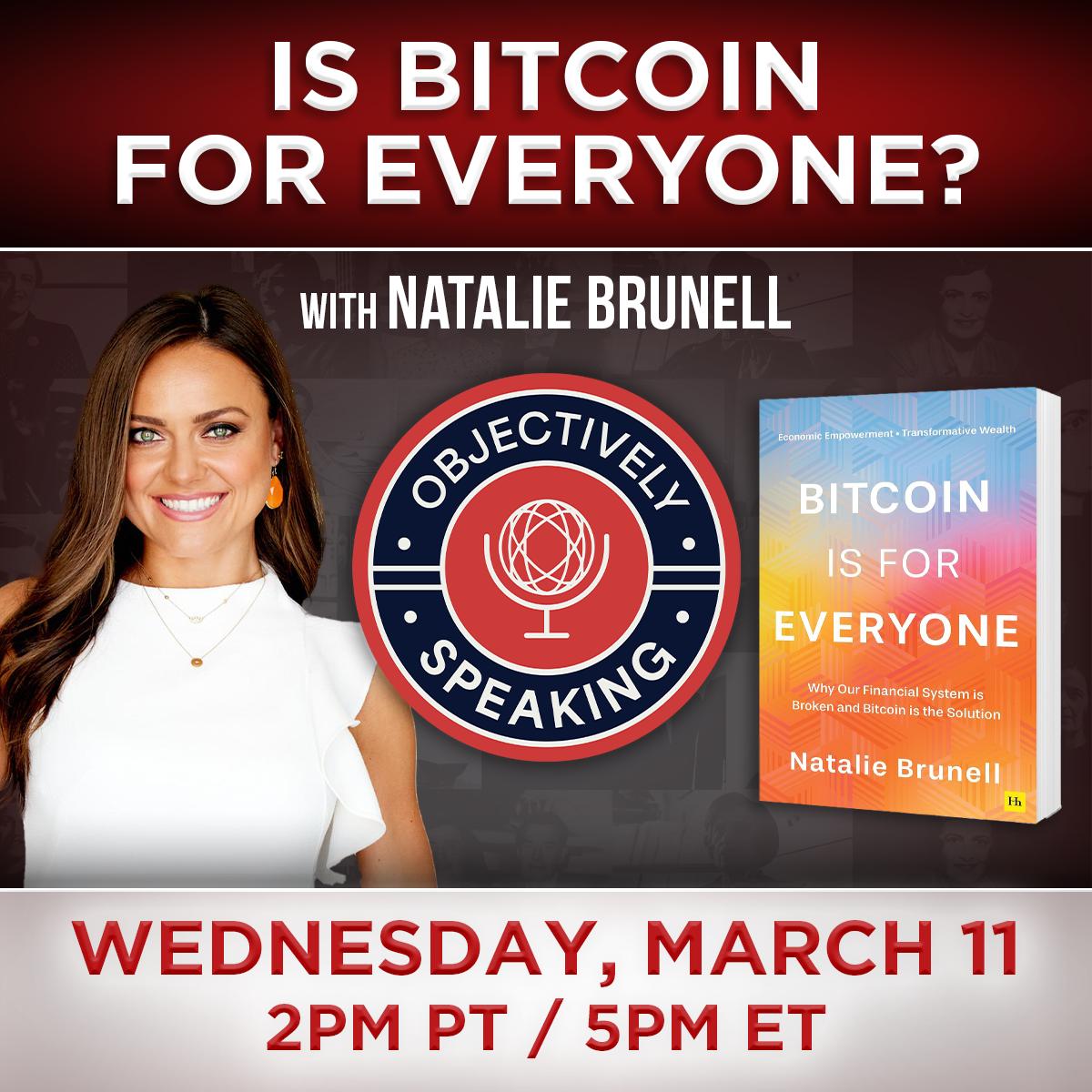
[00:51:24] Speaker B: Work well. First of all, thank you so much for having me. I truly appreciate it. I love what your organization is doing. I think education is the key to solving so many of these problems. I hope more people embrace taking financial literacy seriously. I hope they study bitcoin with me. I have a weekly podcast. It's called Coin Stories. I just wrote bitcoin is for everyone, and I'm very active on Twitter and Instagram. So please follow me and join in the conversation and. And start stacking. It's not too late. We're all very early.
[00:51:55] Speaker A: All right. Well, thank you, Natalie, and thanks to everybody who joined in, asked great questions. Be sure to join us next week. I will be off, but Atlas Society senior scholar Richard Salzman will host a special current events webinar exploring what it means to have an America first foreign policy and the current conflict, conflict with Iran. So that should be interesting. See you then.