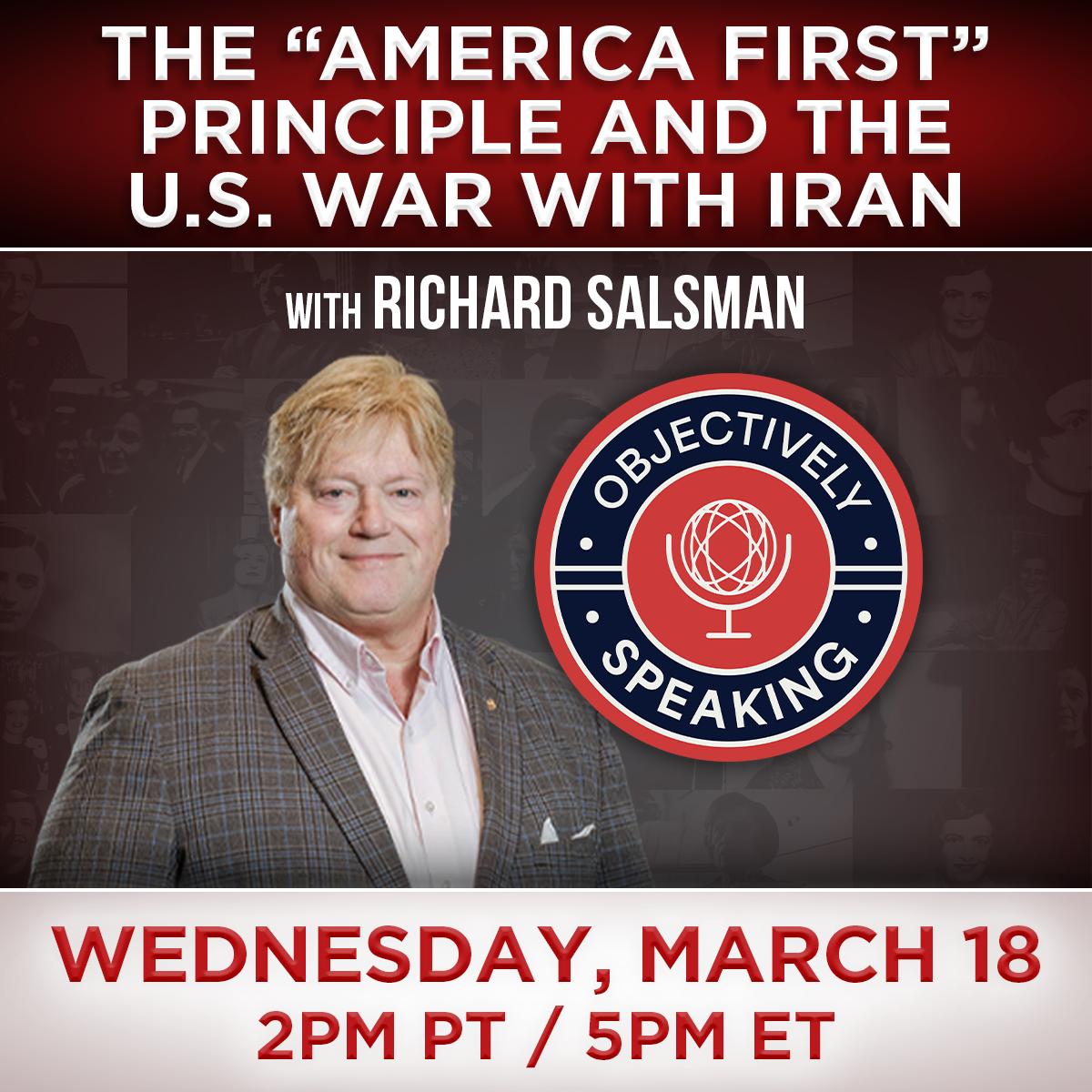
[00:00:00] Speaker A: Hello everyone. Welcome to the 294th episode of objectively Speaking. I'm Lawrence Olivo, senior Project Manager here at the Atlas Society. Jennifer Grossman has the week off, but I'm excited because this week we have Atlas Society senior scholar Richard Salzman here to join us for a discussion on the topic of what an America first foreign policy looks like and how it should be operated in regards to current conflict between the United States and Iran. As always, Richard will do his discussion first and then there'll be time at the end for questions. So Whether you're on YouTube, Instagram x, put your questions in the comment section and we'll try to get to as many as we can near the end of the show. Richard, thank you so much for joining me.
[00:00:45] Speaker B: Lawrence, thank you so much and welcome everybody. I'm going to vote to devote roughly 35, 40 minutes to my assessment of the philosophy of war, the strategy of war, the application of these principles to the war in Iran which began three weeks ago. This is roughly what is it, March 18th today for those looking later and seeing we are now roughly three weeks into the war with Iran.
So I'm leveraging off of and Lawrence will have some links to this if you want them. I'm leveraging off of some work I've already done on the meaning of an egoistic or self interested foreign policy and the relevant events we had prior America first foreign policy as an egoistic foreign policy from 2022. So you'll get links to those. Why 2022 was in April or so, right after the war that began with the US and Ukraine versus Russia. So I thought it was important then to bring out these principles. You can go back and look at those. I, I will summarize and give the essentials of the basic principles there. But today what I wanted to do is just one reintroduce those principles but then get more into not so much the philosophy of what that means, although it's important and crucial and primary. But then talk about what does that mean for actual strategy. And if you want to get even more granular, you can call it tactics having to do with weaponry and things like that. I'm no specialist on those kind of things, but I have studied it fairly closely and I think the integration of these three, this is hard to find that someone would understand both the philosophy of it and the strategy of war and then the tactics of war and then on top of that to be able to say what is a truly self interested approach, because that is not actually been the main approach for America, unfortunately, since World War II.
And we've had, I don't know, I think eight or nine conflicts since they're starting with the Korean War, that were not primarily in America's national self interest, national security. So those wars fail.
It hurts Americans reputation and their fiscal situation, a whole bunch of things because it's selfless, because what the international community calls it's humanitarian. So I'll talk about that and then we'll be ready to talk about the strategy and the specifics of Iran, which by the way, let me just say up front, I support entirely with some reservations on tactics that the US go to war with Iran. I don't even look at it as going to war, but finally joining a 47 year war that Iran has been waging against the United States. So we had seven presidents prior to Trump not going to Iran and responding to the war. They began in 79 and have continued for 47 years. But I'll return to that. I just wanted to put that up front to give you some, some provocative pushbacks because there's differences, as you know, the left mostly opposes this, but there's differences within the right.
MAGA and others, conservatives versus others, Christians versus Jews. There's all sorts of splits, as you know, within the right as to whether this is right now, the, the fundamental essay always to look at here in the case of an objectivist perspective, as Ayn Rand's essay in capitalism, the unknown ideal called the Roots of War. I won't rehash the themes there, but it's some of what I was saying here, namely you have to have a rational sel interest in being at war and we'll say what that is about America soon. But she wrote that in the middle of the Vietnam War, which she opposed, but she did so in the mid-60s when Kennedy and LBJ were doing it, not when Nixon was doing it again on the idea that it was selfless, not that she was pro communist, the communists were taking over southern Vietnam, but that it wasn't in America's rational self interest, national security either. There is a theory, long standing, of the idea of total war, that once you understand and, and understand objective, and it's a proper objective, the idea of pulling punches, the idea of tying hands behind your back, those kind of things are also selfless. So even if you're in a proper war, we've had people opposing the idea of total war. That means that going all out and as fast as possible and as quickly as possible and as harshly as possible, getting your victory, not Long drawn out, what they call forever wars that would just bleed you to death.
And so that, that was Curtis LeMay, that was the theory, that was George S. Patton of World War II, but it's been really denounced since then in favor of what's called the just war theory.
And just war theory isn't really just at all. It's social justice applied to war, which is that you shouldn't target civilians, you should, I'll pull your punches, you should be fair, you shouldn't use unfair weapons, things like that. They tend to be the kind of rules of Eng that make those who should be victors ultimate losers. One other principle or kind of philosophy of this that's worth mentioning, but it's also kind of a, it's also verges on the, on the strategic part of this is you're hearing this a lot today. That attack was not imminent from Iran, therefore this is wrong.
Well, the very fact that you say there's 47 years of a track record of them doing something, suppose they didn't do anything in the 47th year, the argument here would be forget what happened, happened over 46 years, we don't see anything imminent. That's one argument that I'll refute soon. But the other argument is this is a war. Did you ever hear this one before? This is a war of choice, not of necessity.
So allegedly the idea of war of choice is supposed to be wrong.
You're supposed to be a war of necessity. You see the idea of you're a total victim, there's nothing else you can do, you must necessarily go to war.
You know, if you ever actually choose to go to war, war and on rational grounds, on self interested ground, that's considered terrible. And so beware of that language. You see today the idea of a war of choice, especially for a moral country like the United States, we're not talking about dictatorships who choose to go to war, but if it's a proper war, and then the US decides when and how and of course this should not be telegraphed, this should not be broadcasted, or the enemy succeeds, the enemy wins. So even the claims of now having started the war, you're not giving us the full battle plans, you're changing week to week or month to month, which of course happens not only in sports strategy, as the game goes on, but in war as well. There is a mission here, we'll see it soon. There is a specifically stated, rationally self interested mission that the Trump administration has in Iran, which is very good, it's very good. Because it's all those things that checks off all those boxes. But this idea of you only have wars of necessity and those are the only legitimate ones is an illegitimate argument. It comes from Richard Haas, by the way, H A S of Council on Foreign Relations.
Now, what does America first mean? I mean, if I said in your personal life that it's you first, that you should take care of yourself first, that you should be the primary beneficiary of your own actions, this doesn't mean that you're living on a deserted island. It doesn't mean you're alone and a hermit. It means an issue of ordinal ranking first, not only, but first. And who comes second? The significant others, loved ones. In foreign policy we call these allies. And of course they are of selfish interest to you. So America first, you know, whether it's in foreign policy or in other things, I, I eschew the idea, by the way, that it means nationalism, that it must mean protectionism, that it must mean isolationism. All these isms, you hear those I believe are caricatures of the America first or any national interest first policy in order to, you know, create a strong man, you know, who would be for.
Who would be for isolation. That's crazy. Well, yes, we don't have to be for isolation without saying America first.
It means also America not on a par with other countries. That's the UN view. Let's all join the UN regardless of what type of countries we are, and we're all equal, all going to be treated with equal dignity and equal respect.
That's not legitimate either. But that wouldn't be legitimate in your own personal relationships either. We make differences and distinctions between people based on their character, based on their track record, based on what they say, based on what they do.
So there. Because in philosophy generally there is an animus toward or a suspicion of self interest.
You can imagine that there would be in, say, business manifestations of self interest, like the profit motive. Yes, the profit motive is distrusted. Or in foreign policy, if you say America first, why is it distrusted? Because to the philosophers, including the philosophers of war, it sounds immoral.
It sounds like you are a. Well, what do they say in your personal life? If you're selfish, you're going to be a monster. You're going, going to be an imperialistic monster who invades other countries just as the selfish person would, you know, rape, rob and pillage other people. That's a straw man. Rational self interest does not justify any of that kind of behavior. Now, the essence of America when people say America first, well, who is America and why? And what is in America's national interest? Is there such a thing? Because it kind of sounds collectivist, doesn't it, if I have a personal self interest.
But what does it mean to have a national self interest? Here you have to identify the essence of America, even if it's been transformed to the bad in the last hundred years, which I would say it is, has been. But here's the essence of it, and almost no one would disagree. It is the country of liberty, it is the country of freedom, it is the country of prosperity. You can call it capitalism, although it's been again, diluted over the years. That's what it's known for, that's what its founding documents and principles lay out. It's not a democracy, it's a republic, a constitutionally limited republic focused on protecting individual rights, including property rights. So that's important to know because the essence of the country is what its national interest should reflect. It should reflect those things.
And when others threaten it, when others threaten America, you have to think of it as they're threatening our life, liberty, property, pursuit of happiness.
And if it's existential, of course that's even worse. Existential threats means they're trying to wipe us out of existence. Who has acted that way in the last hundred years? I would say the Soviet Union definitely had that view.
So the ending of the Cold War was really important. I mean, they had the view that we would be, should be vanquished. And Islamic political Islam has the same.
They don't have as much power as the Soviet Union. They're trying to get nuclear weapons, but it's the only other case. I wouldn't even include Hitler in this because he wasn't capable of really vanquishing the United States. But obviously existential threats are important. But even things short of existential threats, hurting American security, hurting American lives, hurting American liberty, hurting American prosperity. And by the way, this should be the guide also for those waging war.
Those waging war, the President, Congress, the War Department, they also must be, as they go to war, as they go to a proper war, conscious of not submerging those things, not fiscally bankrupting the country, not throwing arm, not throwing soldiers in, into the fray, you know, like fodder, mistreating the soldiers. You got to be respectful of them. You got to try to minimize the damage. So all that is relevant. No notice, very philosophical aspect of this. One more thing before I go on to the politics and then the strategy.
Another key thing here and again, you could personalize this. You have rational self interest guiding your personal life. And you also have, as I said before, significant others. Why are they significant? Who should be significant others? Is it only family? Is it friends? Is it colleagues? Is it allies? Who are your foes? Who are your enemies? Who should you avoid? Who should you fight? Who should you take to court this on a foreign level, the same thing has to happen. The State Department, usually of a country has to engage in decisions about who are the friends and foes of this country.
And again, you identify that by the principle of what is the essence of America, what is the country and foes of it would be those who are opposed to the essence of America. And friends and allies would be those obviously who support that.
But again, you don't sacrifice yourself for the benefit of others who are tangential to your self interest. That's important on foreign policy as well.
So that's important to keep in mind. People are asking about Israel, people are asking, you know, would ask about what about the allies during World War II. So the idea of allies and identifying foes is very important. And doing this in advance and then also realizing that as other regimes change, your alliances might change.
Washington and Hamilton famously in the first farewell address talked about no entangling alliances on foreign affairs. Well, the argument there was not that you shouldn't have alliances notice, no entangling alliances that last so long that things can change. Like in the case of France, France originally helped us with the revolution to defeat Britain. And then France had a revolution and went tyrannical, you know, and had Napoleon. So the argument and Washington and Hamilton lived through that. Right. So their view was why should we still be allies with France? It's a different France now.
So that's important to keep in mind. Now, a couple things about just the politics of it moving away from the philosophy, but the politics of a specifically unique to America. Is this constitutional?
What about the powers and how they're laid out in the US Constitution? Is this a constitutional act by Trump? Now, the first thing to notice is there's two main provisions. I'll be, I'll be brief on these in the Constitution. Article 1 covers Congress and Congress has the right to declare war. So it's the only place that war is actually mentioned specifically that the declaration of war has to come from Congress. There has been no declaration of war in the United States since World War II. And there's been seven or eight, maybe even more wars and conflicts starting with Korea. So the precedent is important to name here. This doesn't justify having yet another war without a declaration. But just to know that this is not unprecedented. And I think what's more important in this context is whether this is an actual foe of the United States, which I think it is, and a dangerous foe. Yes, I think it is. But something like Kosovo, which Clinton went into in the 90s, would not be considered that. I wouldn't even consider Vietnam in the way Ayn Rand it. So there's only five times US declared war, the War of 1812, 1848 versus Mexico, 1898 versus Spain, and then World War I and 2. I think I got all five of them. So now the other power in the Constitution is the president is a commander in chief. So it is a split power. And if you look at the constitutional convention of 1787, the framers, we're speaking about the idea of not depositing power for war in one branch or another, it's definitely split. Now the Supreme Court, by the way, has not ruled. There is no famous Supreme Court case about war powers. I, I would say mostly probably because you need standing like you need someone to sue the federal government for the wars it does. And that's, that's not going to be a domestic, is not going to have standing as much as the one being attacked.
Now the other relevant, it's not really an act, it's a resolution. The war Powers Act 1973, that was an attempt by Congress to limit the long Vietnam War at that point. It was almost over by then, but by then it was like 11 years old and Nixon was still in power and they had forgotten this was JFK and LBJ's war. And they said it was Nixon's war. That's just a resolution. Now what about that? It's not an act, it's a resolution resolved.
And it basically has to do with informing Congress.
So it's not really a declaration of war. It's Congress saying within 48 hours of you engaging the troops, notice it's not Pre approval. Within 48 hours, you have to report to us what you're doing. Well, Trump in this case actually reported to the Gang of Eight in Congress before February 28th. That's the day the US launched this mission. And certainly within 48 hours that fully informed them. So they're following the War powers Resolution of 1973 in that regard. And then the other thing is Congress has to authorize a use of force. It's called AUF, authorized use of force. And that's for 60 to 90 days.
What's 60 to 90 days from now, then that brings us into the summer, I suppose. So I imagine Congress is in the process of doing that. So notice it's not really a declaration of war, but there is still. This is not completely unilateral. This is not the executive branch unilaterally going to war without any consultation with Congress. And I expect that authorization of the use of force to occur. And if they renew it, they can renew it every 60 days. That tended to happen in the Iraq war.
So that's an issue. Now. One more thing. I should go back to the Constitution. The Constitution, interestingly, says when Congress funds a war, it can only do so for two years.
So, interestingly, there is a limit kind of implied in the US Constitution that war should not be forever.
That if Congress wants to go beyond the two years, it'd have to renew it again. But notice it would have to go through a process of debating it and renewing it again. So I think that's very interesting. Although many US wars have gone beyond two years.
Okay, now a couple of things on now. I'm going to shift now to issues of strategy and tactics. In war, you do not have to wait for someone to smash you in the face for you to preemptively act. I mean, just in regular criminal law, you know, there's a difference between assault and battery.
A battery is actually hitting someone. People forget this. Assault is threatening to hit someone.
And you can definitely be arrested for assault. You can definitely be arrested, convicted, and jailed for attempted murder.
So this idea that people are floating that or claiming that, you know, unless somebody smashed you in the face, unless Iran actually attacks us, unless we actually have a Pearl harbor, we can do nothing. That's not true.
Now, that doesn't mean it's Deuce is wild. Back to the original point. You do have to be able to objectively identify friends and foes.
And then what in the interest in the case of foes, what the foes are actually doing?
Are they preparing to go to war against you? Are they saying they'll go to war against you? Are they saying you're the Satan of the world? Are they saying death to America? Not just once, but, you know, every spring when they bring out their weapons?
Is their philosophy such that they find themselves incompatible with the West? All these answers on Islam, of course, are true. True, true, true, true. Is there a long list of atrocities committed by this regime in Tehran against the U.S. yes. Against U.S. interest? Yes. Against U.S. citizens? Yes.
So none of those are really actually denied by people. What they're trying to deny is that you could do anything unless there's an imminent threat. I guess a bomb literally, you know, three inches from your head, landing on your head. That's not true. Let's not fall for that. You can preemptively act, but some rational principles are definitely required for that.
Couple of other things, I won't say much about this, but another strategic tactical issue is whether you use conventional weapons or nuclear weapons. Now, in this case, I want to bring this up because one of the main arguments and one of the good arguments used by Trump, and it's a definitely self interested argument, he is not saying, I'm trying to free the Iranian people.
He's not even saying I want peace in the Middle East. Notice that was the George W. Bush approach, you know, or that was the Wilson FDR approach. Democracy all over the world, make the world safe for democracy. You know, notice it's not America first, it's everybody else. We're going to fight for everybody else. Not in the Constitution. Of course, that's not Trump's justification. It is, Iran is dangerous.
And having these nuclear weapons makes them even more dangerous.
And he points out, quite rightly, by the way, seven presidents prior to him all claimed or all said Iran should not have a nuclear weapon. And some of them did act to preempt that, usually with Israel. So for years Israel has been going in there and killing scientists and killing, you know, blowing up nuclear labs, you know, selectively not completely wiping them out.
But the point here is important that if you said, I don't want this other country to have a nuclear weapon, I don't think they should. What are you really saying? Because the UK has a nuclear weapon, Russia has a nuclear weapon.
I don't know, 10 other countries. I think Pakistan has it. Why aren't we attacking all these other countries? So the essence of saying the problem is they have a nuclear weapon. The essence is not that they have a nuclear weapon. The essence is that they're a vicious, nasty, anti American Islamic regime that would kill us if they had a nuclear weapon or Israel.
So that has to be distinguished to make sure you don't fall for this idea that, you know, whether they have a nuclear weapon. They might have a nuclear weapon. That's not the issue. And by the way, you can go the other way as well. It's not just that they're Muslim because Indonesia is largely Muslim, other countries are Muslim, but they're not joining faith and force. They're not a theocracy which is also trying to get weapons of mass destruction.
So that distinction is important in many ways. You should commend Trump for having the integrity of realizing that. The reason I'm saying they shouldn't have a nuclear weapon. And by the way, the negotiations in January made it pretty clear that they were never going to promise, as if you can trust them anyway not to pursue nuclear weapons.
So that alone was a necessary trigger or a legitimate trigger, I think, for going in there. But he has more integrity, you could say, than prior presidents who didn't really go the full route and say, well, I'm telling you why they shouldn't have a nuclear weapon. Well, why would you pass them on to the next administration and keep Americans at risk for 47 years? The weather presidents, by the way, there's a parallel here for seven presidents prior to Reagan, just like the seven presidents prior to Trump on Iran. All appeased the Soviet Union, all said that they should be detente or coexistence with the Soviet Union.
Reagan was the first one to say, no, I don't want coexistence with the Soviet Union. I want to get rid of the Soviet Union. I want us to win and them to lose.
And it isn't surprising, I think in retrospect to see that the end of the Cold War was made possible by very bold moves opposed by many on the right at the time, by the way of Reagan negotiating with Gorbachev and in some cases threatening Gorbachev and ending the Cold War.
So this can be done with people who are principled. And I don't think Trump or Reagan, I don't think they get enough credit for that.
The issue of boots on the ground, okay, now we're notice we're into strategy or tactics. Why would he not want boots on the ground? Well, the first self interested argument would be is we don't want to use soldiers as cannon fodder or in this case as sacrificial animals. I mean if you look at the landing at Omaha beach and elsewhere, Normandy and what FDR did, just throwing soldiers into a slaughterhouse, I mean, everyone thinks that's heroic, but you could say that's horrific that he would do such a thing.
Here's another way of looking at it.
Trump goes in and decapitates the leaders of this vicious regime.
That's amazing and proper. And the good the start, the smart way to start it, the I don't think they're done yet. They should go further. But notice if the US had gone in and tried to kill the Nazi regime first, you know, instead of the last thing that happened was Hitler killed himself. We didn't even kill him.
So Trump has inverted the whole order of things that are typically done in war, I think, in a good way, when here you go after the actual tyrants and your focus really isn't on the people. I mean, maybe the people like these tyrants.
I'm not even convinced that the Iranian people don't want these tyrants or that they're not Muslims. That's not the point. The point is the ones who are attacking us and the ones who are threatening us are these imams. And he's only got 40 or 50 of them so far. But that's a proper thing to do as well.
But, no, it is almost impossible to win a war totally from the air.
But again, in this case, there's still victories going on, because if the goal and Trump has set it, Hagseth has said it, Vance has said it, we're not here for a forever war.
We're here to destroy their military, to destroy their navy, their air force, as many of their missiles as we can, as many of their drones as we can, you see. So, and notice they're not targeting and this isn't out of any altruistic or humanitarian aim. They're not destroying oil infrastructure or economic infrastructure or utilities or desalination plants or, or the things that in peacetime and post war would enable that country to function as an economy. So I think that's very interesting. It's not that you shouldn't go after those things at some point, if necessary. That was done during World War II. And of course, Nagasaki and Hiroshima were cases of the atomic bond just destroying everything because they would not give up. I mean, they didn't even give up in Japan after the first bomb. And there's a parallel here, because Iranian philosophy, the, the Muslims, the particular version of Islam there, Shia, they will not quit. They, they would rather die to the last than surrender. So if any, anyone in the Trump administration or in the War Department believes that they're going to get what Trump called like an unconditional surrender and a laying down of arms and a peaceful trend, that ain't even going to happen.
So at some point, the US Is just going to have to say, we've destroyed enough things, we've neutered them enough.
Maybe the locals will come in and change the regime and make it less irrational, but you're not going to get a Philadelphia Constitutional Convention going on in Tehran anytime soon. And that's just the realist approach to it. Still, American self interest is advanced by Doing what they're doing, destroying as much of the military capacity of Iran as possible.
Now, I want to say something about regime change, although also a tactical thing. But regime means two things which are often collapsed together, which I think can be very helpful.
Think of it first, in the US Case, one way of looking at the regime in the United States is the constitutional regime, the system of three branches and federalism and elections and. Right. That's a certain structure, a regime, if you will. But another way of looking at a regime is the current occupants of the office.
We call those, interestingly, administrations, the Trump administration, the Nixon administration, the FDR's administration. Why? I mean, it is a particular regime, Right. And some are good and some aren't so good, but they're operating within a particular structure. Right. So when you speak of regime change, and I hope they're aware of this at the Pentagon and the State Department, it's in two senses. The fundamental problem in Iran is it's a theocracy. It's an Islamic vicious theocracy. It's a unity of state and force. There's a million man army, by the way, out of 92 million people, they have a million man army, which I think relative to the US population is four times as big an army relative to the population. And within that, a quarter of a million.
It might be in addition to that, irgc, the Islamic Republican Guard Corps, who are totally committed to the religion of it, but they're also vicious. These people are not going to lay down their arms, as Trump said, you're just going to have to mass kill them selectively, surgically if necessary, if you can find them.
But that's important to know that the regime change. For example, in Venezuela, when he says out with Maduro, in with, I forget who she was that replaced him. Notice that socialist regime has not changed. The structure of socialism in Venezuela hasn't changed, but the people occupying the offices have changed. Now that might make Venezuela, you know, less vicious than it was previously. But people have to think about whether that's the issue in Iran or not. The fundamental benefit to the United States would be if Iran was not an Islamic theocracy anymore, actually not a theocracy at all.
But you're not going to convert all the Muslims in that country to Western either religion or Western enlightenment ideas.
And the idea of just deposing the existing occupants, which in effect we've done with the first layer, you can see that that will not be enough because there's just another set of people ready to come in and wield the same ridiculous vicious power as the other. So that distinction is important to make as to you shouldn't necessarily be against regime change, but if you wait around for that to happen and they have longer time to wait than us, you're going to lose the war. So at some point you just need to cut off and say, well, they're not going to change their regime, but they're not as dangerous, they're not nearly as dangerous to us as they used to be. So we're out of here.
Nation building. Another phrase you'll hear. Nation building is going in after the fact and rebuilding the country you destroyed.
The US should never do that.
These countries after their vanquish should just fix their own. You can trade with them if you want, but the idea of the US not only devoting material soldiers wealth to destroying a foe and then afterwards spending material and labor and wealth rebuilding that foe is totally altruistic, is totally self sacrificial and I certainly hope that. But that's what was done in Iraq, that was done in Afghanistan was done. It was done actually with the Marshall Plan after World War II, which I don't think it should have been done. But they could have recovered anyway on their own if they just adopted freedom. But nation building shouldn't, is not in the self interest I think of the United States and, and the Trump people to their credit. Trump, I'm talking Trump, Vance, Rubio, Hegseth, they are saying they won't do that. Although Trump did say let's make them Iran great again. Any talk like that is going to be a sure loser if they keep pursuing it. I've already, I already talked about targeting the idea of what you target, I've already mentioned, I think the targeting here has been very rational. Namely you target the leadership first, you target the military prowess first or second, you know, and you leave the economic infrastructure for later if they don't quit. So that's all good. You know, the US still wants to trade in the Middle east with oil and other things. So the extent that Iran is not an enormous part of oil, people overestimate how much Iran is part of the oil infrastructure and the oil shipping, the oil producing and the oil refining in that region. It's perfectly fine within the United States self interest to say we also care about oil, we rely on oil, we would like to be able to import oil.
That's okay. It's okay to devote your navy and your merchant marines and other things to, and your air force to preserving international trade and navigational waters. And things like that. There's a debate about the straight of Hormuz now that's going on we can talk about in the Q and A. But that's perfectly within self interest. Many presidents have been reluctant. Trump is not reluctant. Many presidents, as you know, have been reluctant to say we're going to war over oil. You shouldn't be apologetic about that at all. You should be able to trade with others for their oil. And not to mention the history of this is the regimes, the sheikhs in the Middle east stole the oil, the oil fields and the oil equipment that British, French and American companies built in the first place.
So you don't have to go there now. But Trump is very aware of that. Trump is unapologetic about this because he knows that history.
He knows, as they said in Venezuela, as he said in Venezuela, you stole all that oil equipment that we in the west help you develop oil in Venezuela. So that's an act of restitution and justice. I think not, not a, not a selfless act.
One or two more things, then I'll open it to questions. I'm at the, I think a 35 minute mark Lawrence backing up to the philosophy of it and the importance that when an ideology that's totally anti American is totally anti capitalist, then in many ways is completely barbaric and uncivilized. As I would include Marxism to be when joined with state power, as it was in the Soviet Union and its 14 or 15 Warsaw Pact satellites.
That is an existential threat to the United States.
And the equivalent here is at a very irrational, very anti American, very anti Western, very anti capitalist ideology called Islam.
And it's even more primitive than Marxism. But here's another way of looking at it. Ayn Rand once said, and I agree with this, she said religion is better than. I'm paraphrasing a little bit and I'm adding a little bit religion is better than nothing religion because nothing is just nihilism, right? Nothing is. You don't believe in anything in religion. You do believe in things and you believe in this code of it could be commandments. They all have their texts, they all have their prophets, they have their leaders.
It gives you a view of existence. I mean it's highly superstitious, not rational. But here's the sequence to understand here, religion is a primitive form of philosophy.
But then Islam among the religions is a primitive form of religion. You see the problem here. You have a primitivism squared. You have primitivism, intensified exponential primitivism. And when that's joined with state power. It's very vicious and very dangerous, as we've seen for 46 years, and could be more so the more power they get.
So I wanted to leave with that because I started with philosophy, did a little politics and the right to go to war or not, the strategy of war, the tactics, some of the specifics associated with Iran in the Q and A. We could talk more about what I think should happen or will likely happen here. But, but that background you should understand, which I don't think is discussed at all. It was understood, I think, at the end of the World War II.
At the end of World War II, the idea of de Nazifying Germany, the idea of having the Nuremberg Trials and really investigating motives and philosophy and the, the utter inhumanity of the philosophy. Nobody does that with Islam.
Nobody does it like they did with fascism. And I would. And something like that has to be done. There has to be a war of argument of persuasion, of vitriol against Islam, but, but specifically against, you could call it political Islam because there are some peaceful Muslims, obviously, and they exist in the US but notice the sleeper cells awakening and coming alive in America. There's a, there's an attack almost every week now, overt, specific, Islamic motivated.
I mean, they write it on their T shirts as they're blowing up things and Allah Akbar on the way into blowing up things. And that's also totally Iran. That, that is them just triggering these things.
And, and so it exists. And, and the com, the complicity, I would say also of so called moderate Muslims who do not denounce aggressive and terroristic Islam in the United States and elsewhere.
That's a sanctioning and a, and a aiding and abetting, if you will, which is disgusting. It's totally disgusting. It goes on a lot undercover of. I'm just a moderate Muslim. I didn't blow anything up. Yes, but you know who did, or you know what mosque it came from, or you know what mosque or the, you know, in Dearborn, Michigan or elsewhere. And, and sadly, the American approach, not in the Trump administration, the, the typical Democrat, I would say mostly Democrat approach is to apologize, to accuse everyone who's critical of Islam of being an Islamophobe.
An irrational fear. That's what a phobia is, an irrational fear of Islam. I don't have an irrational fear of Indonesians who are Muslims. Why? Because nobody ever hears of them killing people.
So it's, no, it's a rational fear of people who actually kill people for Islamic reasons. So that should be kept in Mind also, as we, as we get sometimes in the weeds of looking at actual things being blown up and which leaders are doing this and which Secretary of state or war is saying this or that. What's the latest tweet to get the bigger picture and open the aperture and realize there's a clash of civilizations going on here?
And the sooner the west realizes this is an argument that you're dealing with medievalism, you're dealing with medievalism backed by nuclear weapons, which the west created is, is a dangerous thing. And there has to be a philosophic war, so to speak, going on where the west and the Enlightenment emboldened to defend themselves, say, as I've said, not only is religion dangerous, not only does religion kill, but the ones, the ones who really didn't go through enlightenment are, are the most killing and the most vicious. So that's what we're dealing with here. I'm glad Trump has done this. There are other Arab slash Islamic countries, if you know, in the region who are becoming more secular.
I mean, they're not pro capitalist yet, but UAE and Qatar and elsewhere, they're still obviously very mixed, but over the last decades. And the Abraham Accords brought this out as well. When Trump tried to negotiate, which he successfully did, certain deals between Arab countries and Israel, there are positive signs going on in that, quote, neighborhood.
But it's not going to get better and it could get worse unless he does what he's doing to Iran, which I hope means the eradication of that regime and the eradication of it as a threat. One last thing. Notice for decades, if you're as old as I, the phrase peace in the Middle east or the lack of peace in the Middle east, it's just a phrase that just rolls off people's tongue, but not, oh, can we ever have peace in South America?
When are we ever going to have peace, you know, in the Nordic countries, peace in Asia, I mean, apart from World War II, 80 years of. Every region of the world is generally peaceful except the Middle East.
Why?
Because it's very religious.
It's a very religious place.
And religion is irrational. And it's not just that it's a very religious place, it's a very Islamic religious place. Back to my point about it's a primitive form of philosophy. So another, another reminder that there's a bigger battle here and it's intellectual that Islam has to be fought. All right, I'll stop there.
[00:42:19] Speaker A: Okay, thank you, Richard. I have seen a number of questions come in, so we will see. We can get to here next 15 minutes or so. But I do want to jump in just on the point that you just made and see if you could help clarify something for us. Because in the description that we had for today's episode, you mentioned how one of the goals for the war is a Middle east without dominance by theocratic Islamists. And what you just mentioned now reshaping the sort of the political and the religious character of a region seems similar to what nation building would be defined as or at least a part of the goal. Can you maybe clarify, maybe see where is that line between the two and how should we understand that from that philosophical perspective?
[00:43:02] Speaker B: Yeah, I, I agree with you that there's a certain maybe ambiguity there. I would put it this way, that they know what we consider they our enemies, the Islamic regimes and the people in those countries too.
It's not as if they're, It's a mystery what the west is, not that it's a mystery of what the US Is. You know, so, like, in terms of nation building, I'll often, I'll often jokingly say to people, here's the nation building we'll. We're doing. We will send you the Declaration of Independence and the Constitution of the United States.
There's our recipe. Go do what you can. If you can't do it, if you don't want to do it, fine. But it's not as if it hasn't been done before. So my answer to your question would be yes, to rid ourselves of that. If on the first level, it's just they're a danger and you just destroy these regimes and really, I mean, really neuter them. This was done actually with Libya under Gaddafi when Reagan did it. I don't mean what Obama did. And so what you're saying is we will not allow that kind of regime in the area.
Does that mean we go in there and start doing, you know, Philadelphia, 1787? No. If they can do that, fine. They're not actually likely to do it. I don't even think they're likely to do it. But that's okay. It's enough for. It'll be the same thing. Like if we went in and say we're not really sure the Germans will have, you know, free government and representative government after Hitler.
They may not.
We're not going to help them do it. We're just going to kill Hitler and the Nazis and they're not going to be a risk to us anymore.
It sends obviously a clear message that you can try this kind of government in Europe, but It's not gonna, it's not gonna pass muster with the United States. So that's really all I'm saying. And maybe that's not a very clear answer, Lawrence, but that, that's really all I'm saying here, that the US does have to, especially in the case of Iran, I'm not even sure I would name any other Arab slash Islamic country in that area that's a threat, danger to us, you know, say Egypt or Saudi Arabia. I mean they're not free countries, but they're not a direct threat to the United States. And they have not had a long history of being so, at least in the sense of Iran. So sometimes you just say, I am, we are, we are electing to destroy this type of government.
And the one in Iran is so not just actual, but symbolically that, that when it goes down, others will notice. They'll be definitely, obviously reactions going on. This is a kind of philosophy, there's a kind of a religion where they will not go down quietly. They're, they're almost like that part of Imperial Japan which was kamikaze, where they have a self sacrificing aspect to what they're doing and they don't care whether they're, you know, whether millions of themselves are slaughtered to defy the United States.
The great, what they call the Great Satan. They literally think of it as fighting the Great Satan. So no, I think destruction of regimes as crude as it sounds sometimes can be enough, believe it or not, to change ideas locally about what to try next. Shall we try this again? You can. I think actually they would on the grounds that Trump won't be there anymore.
One of the defects of America having this turnover of one regime after another is the policies change so wildly. You have Trump and Biden, I mean, excuse me, Obama and Biden subsidizing Iran, basically allowing them to have the weapons that they're now firing at us.
So Iran, you know, in that regard was emboldened and bolstered by the prior American administration and now this one's fighting those.
[00:46:45] Speaker A: Okay, thank you. There is a question I wanted to ask about that, but I'm gonna step aside and let some of the audience answers questions. There's two here from my modern gulp that I'm gonna package together because I think they're hit at the same point. He asked first, can capitalism survive a lot? Can capitalism survive long term during a period when a country conducts a war or says they are in a war and then he says, follow up. If the goal is to defend capitalism and liberty. How do you justify war's tendency to expand state power?
[00:47:17] Speaker B: That's a really good question and the history is definitely that.
I think it was Randolph Bourne B O U R N E who said war is the health of the state.
Yes, the state amasses power during war. It's hard to ratchet back down that power or that spending power afterwards. And it is a definite danger and a risk to a capitalist, otherwise capitalist or even semi capitalist country.
That's why the wars have to be rare, rational, quick, quick, no long, drawn out and winnable, which has not been the pattern in the US in the last few decades.
So, but that's not war in my mind. That is not war fought in a capitalist way. So I don't want to portray, I don't think we should have to portray capitalism as an isolationist system that, you know, can't defend itself.
The basic functions of government for a minarchist. We're not talking about anarchy here is defense. Courts and police, national defense, true national defense, say, not offense, not imperialism. The US in many ways. I know I'll sound like a Marxist here for a second. The US in many ways is an imperialist empire right now with colonies. I mean the whole NATO set up is a bunch of colonies. We provide military cover for 32 other countries which are basically dependent on us. It's ridiculous. It's bankrupting us and it's making them not defend themselves. So we're constantly in war. I've over the years become much more sympathetic to the argument that there is a military industrial complex where there's a motive to stay in wars and start wars and prolong wars. But I don't think it's due to munition makers wanting to make money.
I think it's due to these false war philosophies of why the US should go to war. You know, to make the world safe for democracy and peace in the Middle east and all these other altruistic arguments in the bet in the bad sense of self sacrifice. So it's a, it's a good question. The other good example of this is Leviathan Crisis and leviathan by Higgs 1987, a very good book about when there's financial economic crises and war, the power of the state goes up and then after the crisis pass, that power doesn't really go back. The power and the spending doesn't go back to prior levels.
So to me it's not an argument for pacifism or isolationism. It's an argument for being much more meticulous and careful and scrupulous about what kind of capitalist wars we fight.
[00:50:05] Speaker A: I think it is interesting especially because as I've posted in the chat, so if you look at the links, you can take a look at that. In a previous conversation that you and I had about this in a clubhouse, you'd mentioned how the U.S. left about $83 billion in war material in Afghanistan. Right. So I. It definitely seems like there appears to be some sort of argument for this financial incentive, but the prevailing ideological pushes seem to be mainly leading the charge there as well.
[00:50:35] Speaker B: Exactly. And if you go, if you dismantle like the munitions, you don't want the government like nationalizing munitions. So it should be private companies. That's why the quality of the material we're using is so high, because it's built by Raytheon and General Dynamics and others who are profit making, you know, rational companies.
But, but you got to be careful about the tail wagging the dog. You know that you don't want them telling the Pentagon to stay in war so they can keep making munitions. Usually it goes the other way. I worry more about Pentagon officials who won't end wars. I mean, Trump, for example, is campaigned on the idea he's for against forever wars. He's against the Iraq war, especially against wars that we lose. You know, that there's no nothing we're gaining out of it. Right. And yet when he was president the first time, he could not end the involvement in Afghanistan.
Why? Remember the exit was by Biden and it was terrible and everyone complained about it, but nobody complained that Trump didn't get out of it himself in the first administration. So they were already 16 years into it when he showed up. By the time Biden finished, they were 20 years into it. 20 years. Not only in Afghanistan, which is a place of basically dire poverty and caves and people with no munitions. And 20 years later, the Taliban is still there. That's amazing. To spend trillions of dollars and lose 3000 guys in Afghanistan and not have anything to show for it at the end is an example of a totally altruistic policy. But the same thing in Iraq. Iraq turned in, went from a military Islam to a more Shia, Iran oriented Islam.
Libya has gone that way, Egypt has gone that way. Every time the US has invaded these places on the grounds that we're going to improve the regime, it doesn't because they're not aware of the local philosophies are important. When the local philosophies don't change, you're not going to change. The regime, people will just turn around and vote for the same type of tyrants that they had previously. That happened during the, what was it called, The Arab Spring 2012, when there were a bunch of elections and they just elected tyrants.
[00:52:52] Speaker A: A question here From Kingfisher on YouTube is asking what are the most common misconceptions people have when they hear the phrase America first? We've talked about nationalism, you talked about isolationism. Are there any other terms that you think people get misconstrued when we talk about America first or at least specifically in regards to foreign policy?
[00:53:12] Speaker B: Yeah, well the, if you go from the left, the left will say that sounds like you're going to be a monster, you know, astride the entire planet, you're going to be imperialistic. And if, remember that is part of the argument of Marxism, the argument that after capitalists have exploited labor and the third world, they go hunting to exploit others, so they invade other countries in order to take our products, that kind of thing. So, so anyone leaning left or having the Marxist model in their brains will think of America first as capitalism running roughshod over others. So they'll think of the US as imperialistic and. But on the right, yes, now America first. The ones who are criticizing it, I would say if I'm suppose I'm on the right and I'm criticizing this, I'm criticizing not the idea that America is great, it should be for liberty, capitalism and all those good things, but that it's defined America first in these anti capitalist ways, frankly, to be nationalistic, you know, to put the nation above the individual. That's collectivism. To have protectionism, to prevent trade, which is Trump. I mean this is a bad part of Trump. He's impeding trade, voluntary trade among countries and with Americans and then claiming he's not taxing Americans or the anti immigration, you know, I'm for managed immigration, not for illegal. But many on the right really just don't want any immigration at all. So yeah, if those are seen as America first, you could see why people would be suspicious of the America first argument. I think one way of putting this would be I'm trying to clean up myself almost single handedly with others the meaning of this and trying to revive it as a good thing and then reminding people what it shouldn't be. These other bad things that you're throwing in with it. I just think it's so worth defending this on the grounds of rational self interest. And that is unique to the objectivist philosophy. We are the only philosophy out there that has a principled, deeply, metaphysically, epistemologically based argument for being rationally egoistic, which means neither sacrificing others to yourself or yourself to others. And that definitely should be applied in national affairs and it should definitely be applied in international affairs.
And it isn't. But this is a, this is close to it being applied, so we should defend it and make these distinctions and urge on, you know, more pure versions of this, if you will.
[00:55:48] Speaker A: Okay, thank you, Richard. So we've got about four minutes left. Not a lot of time to go into anything in great detail, but I figure it's good to sort of close off with this question since it's topical to what's exactly happening in everyone's mind. The straight of Hormuts.
[00:56:02] Speaker B: Yeah, closed. Yeah.
[00:56:03] Speaker A: Direct result of that conduct 20 of global energy supply is basically crippled and everyone's starting to feel it, especially at the pump, but most likely other areas as well. So if we look at Rand's argument saying that free trade is the essence of capitalist foreign policy.
[00:56:19] Speaker B: Yeah.
[00:56:20] Speaker A: This conflict now has directly resulted in the impediment of free trade through the region and this sort of cascading issue.
So seems like it'd just be a natural cause of any war. But maybe you can talk about how can we coincide those two issues there of free trade being such an important thing to upheld, but war causing Friche to fall.
[00:56:42] Speaker B: I see what you're saying. Well, I mean, one approach would be to say too bad, now we'll just trade with who we can X that 20% energy.
In this case, I would say this is part of the war.
Taking out an Iran that can not only harm American interests, but do things like block an entire strait which other ships go through. It's not just Iranian ships. So I think the US military should work to open the Strait of Hormuz. I don't think they're actually ready to do so now, which is a little troubling. I don't know whether it's because they don't have enough assets or they have not actually taken out all the missiles and drones that Iran can use. So they're worried that if they bring either oil ships or navy ships into there that they'll be sunk. And so they have more work to do, if you will. On that side, there'd be what, the western side of Iran near the straight of Hormuz to take out those so they can open up trade again. But it's, but it's actually not where the US gets most of its oil. But Even so, I don't think it's a humanitarian act. I think the US should do it on the grounds of we get to trade with other people and maybe we don't trade with Iran. Iran's oil goes through there as well.
I think they ship half their oil out and I think it's been proper, by the way, to take, well, not, they haven't taken it yet, but the Kharg island, which is off the coast of Iran, right in the middle of the Gulf, that's where all of Iran's refining is. That's where they send their oil to be refined, to be shipped down the Gulf out through the Strait of Hormuz. Trump has already destroyed the military assets on Carg island, but not the oil producing and refining assets on cargo oil.
If you closed or quarantined cargo oil, and again, you don't, you don't have to do that with troops, that would totally put an end to any energy in Iran.
They wouldn't know what to do with it. That's the only place they refine it. So there are, I think there are still steps to take without boots on the ground and without this taking forever, that if the U.S. army is, if the U.S. military is capable of it would open the Strait of Hormuz and take over if necessary, or at least squeeze Iran on Carg Island. Not take over Carg island, but use it because it's so critical to Iran surviving on oil. And that's all they survive on. They don't export anything else.
So I don't think these, again, I'm not a military guy. I don't think these don't seem strategically impossible to do. But if Lawrence, your question is how do you get free trade flowing again? In this case, I would use military assets to get the free trade flowing again.
[00:59:21] Speaker A: Okay, thank you, Richard. I have a lot more I could ask. I know the audience could as well, but we are at time. So I do want to thank you for spending this hour with us to go over this topic and sort of break it down in more detail.
[00:59:33] Speaker B: Great, thanks. Love doing it, of course.
[00:59:37] Speaker A: And then for all of you who are watching us, if you like what you saw, of course, leave a, like, if you want to keep supporting what the Atlas Society is doing, be sure to join us in providing a tax deductible
[email protected] donate and be sure to join us. Next.
Jennifer Grossman will be back and she'll be with returning guest Michael Shermer. He has a new book out called Conspiracy why the rational, believe the irrational. So we'll see you again next week. Thanks, everyone.
[01:00:05] Speaker B: Thanks, Lawrence.