Episode Transcript
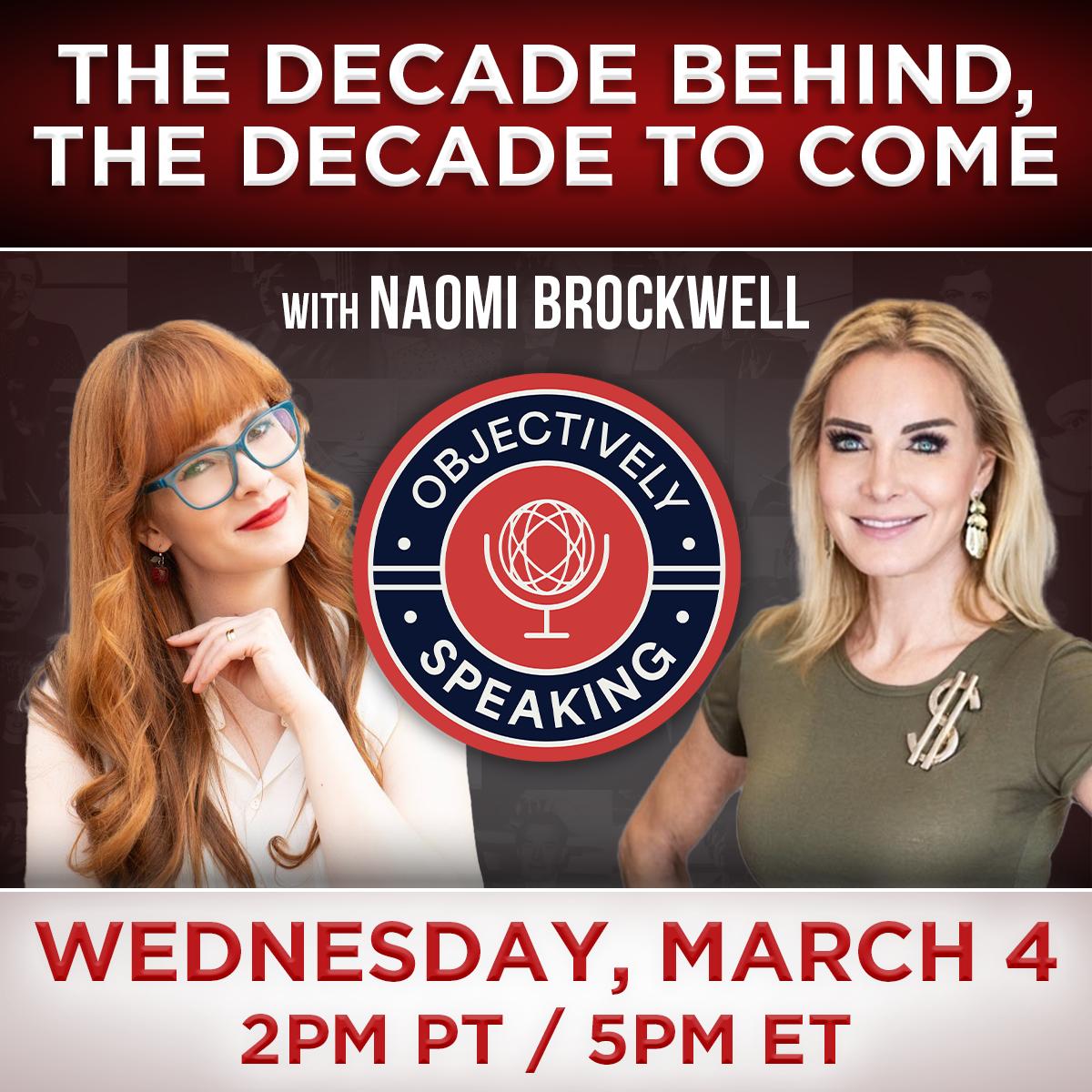
[00:00:00] Speaker A: Hi, everyone, and welcome to the 292nd episode of objectively speaking. My name is Naomi Brockwell and I am delighted to be joining you here today on this chat and to be talking with Jennifer Grossman. This is a very special anniversary webinar today and we'll be looking back at the past 10 years of Atlas Society and we'll be talking about what the next 10 years has in store. So, Jag, it is so nice to have you here. Welcome.
[00:00:29] Speaker B: Well, thank you. And you know, as I was saying right before we went live, I'm so grateful to you for doing this. And I go back with you not just to the very first Atlas Society gala where you were mistress of ceremonies and all of the things that you've done with us since then as your career has skyrocketed, but even before that, even before I was offered the job, years before, I was trying to get this various libertarian venture off the ground. And you are always there. So you're a true friend and I really appreciate you.
[00:01:01] Speaker A: I have been delighted to know you for such a long time and watch you as well. And I am, I'm very excited that now I get to ask you questions about.
Yeah, I get to share with the audience about all of the amazing things that you have done. And just watching, oh my goodness, watching what you have done at Atlas Society has been incredible. So let's go get started and let's just go back 10 years. Right. That was when you first started working for Atlas Society. So how, how did you land at Atlas Society? How did that happen?
[00:01:33] Speaker B: Well, all right, so let's see this week, Monday, this past Monday was my first day, March 1, 2016.
And it was interesting because, you know, I spent a long time in, in Washington D.C. in a prior life. I was a, a researcher and then a speechwriter for, for President Bush 41. I was a director of education policy at the Cato Institute. But I left all that behind and I came out to Malibu, California and I worked in the corporate world at Dole Food Company.
And then after that chapter ended, I was just kind of doing various things and a really close friend of mine, another girlfriend, the girls mafia here, reached out and said, you know, I heard about this opening. She knew David Kelly and knew that they were looking to hire new CEO. And she said, you know, there's this crazy Ayn Rand obsessed lady living on a cliff in Malibu and maybe you should talk to her.
And, and that was kind of the beginning of it. Little funny side note to that was I was kind of down in the dumps at the time because a guy that I was seeing had been, had broken up with me because of a, an article that I wrote called Dately Atlas, not the Shrug. And, and it was kind of looking at sort of old fashioned approach to dating and combining it with kind of principles of Objectivism. And he thought, oh, you're manipulating me. Broke up with me, broke my heart. But it was that article that then David Kelly saw and said, wow, okay, she's a good writer and she knows a little bit of something and she doesn't take herself too seriously. So it all worked out in the end.
[00:03:22] Speaker A: Oh my gosh, I want to read that article. Can you send that to me?
[00:03:27] Speaker B: It's on the website. Maybe our gremlins can drop it into the chats. Called Date the Atlas, not the Shrug.
[00:03:34] Speaker A: I want to read that. And also, his loss. I mean, goodness, he doesn't know what he gave up. That, what an idiot. Good riddance to that person.
So let's talk. I mean, I would love to know, like after David Kelly reached out to you, how did the interview process go? What was that like?
[00:03:52] Speaker B: Well, it was a little eye openening. Okay. Because I have had White House positions, I have had State Department positions, I have been researched for top secret security clearances. And I'll say I never got a more thorough vetting than I had at the Atlas Society with, with these trustees. And I was like, whoa, these guys take this like, really, really seriously. And they did background checks and, and they, I think I had at least one kind of, you know, conference call interview and then two in person interviews with the entire board of trustees. And I do remember at one point, you know, they're like, okay, you check this box off, check that box off. But, and yeah, we, we, we get that you've, you know, read everything that Ayn Rand has ever written, but we, we don't really know if you're like steeped in Objectivism enough, if you're enough of an Objectivist. And I said, you know guys, if that is what your, your criteria is for finding an executive who can help turn this organization around and grow revenues and, you know, or organize staff and, you know, have a plan for growth, I'm not sure I bought this job because, you know, I, I, yes, obviously I need to understand Objectivism, but in terms of people having, you know, deep philosophical conversations, I hire those people. We have a faculty of Atlas Society scholars who are professors and, and, and they are the true experts on objectivism.
[00:05:39] Speaker A: I love that. And I love that this doesn't you know, disappear into dogma. This is about, like, interesting con, exploring ideas and in particular, what Atlas Society has done an amazing job at is getting people to talk about things that seem to be so taboo in society. You know, and I love that, that exploration of ideas, that it's okay to discuss things. And you do so much discussion. I love that.
So we are getting some questions coming through in the chat, which is great. Thank you to everyone who is watching. It is lovely to see you there. So I might just throw to one of these questions first and then I want to circle back and, and talk about some of the other things you're doing in the early days. But I have a question here from my modern gold who says what, what books, besides those of Rand, have shaped your thinking the most during your time as CEO? Are there any of those books that you picked up for these live streams?
I'm not sure about the second part. What, what they mean about are there any books you picked up for the live streams, but are there any other books that have shaped your, your thinking the most?
[00:06:44] Speaker B: Yeah, I would definitely say Man's Search for Meaning by Viktor Frankl is a book that I've returned to many times.
I think that gratitude is a theme that's important for us here at the Atlas Society. And I always say that in order to be objective, you need to have perspective. And reading about somebody who maintained a relatively positive mindset and chose his attitude even while living in a concentration camp really helps. Whatever you know, you're going through, whether it's a tragedy or your house burns down or you lose your job or you lose an important relationship, just, just remembering to put it into context and, and, and think about gratitude not just as a, you know, Hallmark card slogan, but as a way of, again, making sure that you're being objective. We always have a tendency, right from evolutionary biology to look out for problems, to look out for threats, but then that can maybe exaggerate them in terms of their actual importance. And we tend to discount all of the things that we've got going for us, and we need to take stock of those as well because that gives us ballast to continue and to persevere.
So, wow. In terms of the books for this podcast, there's, there's been so many that I'll have to actually come up with the list. Thanks for that idea. I'm going to come up with my 10 years 10 best books that authors we've had on.
[00:08:31] Speaker A: Objectively speaking, selfishly, I cannot wait for that list. And I'm going to work my way through them. I have read the Victor Frankl book, and I absolutely adored it as well. So that would be another recommendation for me. Also, I want to go to a question like, it's a. It's a personal question.
I would love to know how you discovered Ayn Rand in the first place.
[00:08:54] Speaker B: Well, as with so many of my stories, it's a little embarrassing because I. I didn't discover her until actually relatively later in life. I grew up in Newton, Massachusetts. I never met Republican or a conservative or an objectivist or a libertarian. Went to Harvard.
Never even heard of the books, although it was interesting to later learn that my parents had read both the Fountainhead and Atlas Shrugged. I was at the Cato Institute, and a colleague of mine there, Jose Pinera, we were working on some pension reform policy, and I think that I heard somebody say, who is John Gallery? And I said, yeah, you know, who is John Gal? And first they laughed and thought I was joking, and then they realized I really didn't. At least he did. He pulled me aside, he said, grossman, I don't know how you got in here and gave me the book. And I read it, you know, fair. I was one of those people that, you know, read it in, in a few days, just kind of, you know, cover to cover, and then went on to read everything else. And it resonated with me on so many different levels.
And one personal one was that I had had these experiences with envy when I was in the third grade, when I was in the fourth grade. And actually my, my Draw My Life video, which was like the beta, the like, test version that we did before we started cranking those out at scale, recounts how I was being bullied, not for like, a lisp or a disability or what have you, but for my strengths and how I, early on tried to appease these, these girls that were doing this. And I said, what can I do to make you stop? And they said, well, you can kill yourself. And I said, well, that's not going to happen.
And. And then I realized that, you know, envy is. Well, I'm not sure if I realized then, but I started to have enter my consciousness this idea that, that envy is irrational and that it. That it is an unappeasable hatred.
And then, you know, finding out shrugged and the Fountainhead and the, the virtue of selfishness gave me a much better understanding of that. And I, you know, truly believe that it's not just a lack of proper education that is driving the, the popularity of socialism. It really is an Epidemic of bad values. And I believe that Ayn Rand's literature can really inoculate young minds against these mind viruses of envy, resentment and victimhood and entitlement. And now we have the challenge. Of course, young people used to read in my day, 70%, we were, you know, reading fiction every day for fun. That's probably around 10% today.
So that is reality. A is a.
You can't turn away from it in some kind of guilty, foggy hope that it doesn't matter. But you have to find other ways to engage young people with these ideas. And that involves going on a sociological experiment of really studying what kinds of content they are consuming and engaging with and where, and then finding ways to bring these ideas into that kind of content. And, and so far it's working pretty well.
[00:12:31] Speaker A: I, I just finished reading we the Living again. The last time I read it was maybe 15 years ago. And gosh, it's like a gut punch when you're talking about how like society, we really need to shift culture and it's just bad values. Gosh, just reading an entire book of just a society built on those bad values, it like, oh, it was so heartbreaking. She's such a, a powerful writer. Candice Morena says envy is evil.
So I thought I would just interject that.
So we've got another question in the group here. When you were talking about hiring and the questions David Kelly gave to you and your response and saying, you know, would you rather have someone who can hire these people and, and, and lead them and all of that. So Richard Salzman asks, is it more difficult to recruit staff or intellectuals? And why?
[00:13:28] Speaker B: Well, it depends on the, the role. I, I think that it's challenging to recruit intellectuals in part because we have a very different, very unique brand of objectivism, of open objectivism.
We agree with Ayn Rand when she said a few years before her death that she has, she has a complete philosophical system, but the job of elaborating a system is one that no philosopher can complete in his lifetime. There's still a lot of work to be done, so there's that, but there's also really the, the kind of spirit that we bring to our work, which is non dogmatic and being entrepreneurial and benevolent and being on the lookout for people that we might be able to work with in some ways and not being afraid to talk to groups where, you know, we might have even some serious disagreements on some, some very fundamental issues. So, you know, I think that I've been disappointed to see how persistent this you know, I almost call it the narcissism of small differences that those who have a different view of Objectivism wouldn't want to, to, to work with us. And you know, I've tried many, many times to invite certain other Objectivist thought leaders to come on this show. And it's like not, you know, can't sanction your, you know, fraudulent activities or what have you, but I think it's also challenging because, you know, there's not a lot of Objectivism within academia. And so one of the components of the ten year strategic plan that I have is a program of advanced intellectual engagement that would be geared towards refreshing the pipeline of scholarly academic talent.
[00:15:38] Speaker A: So there are a couple of questions that I want to roll into one, and it's on the point of, during your process running Atlas Society, talking about your biggest challenges, biggest opportunities, so a coup. A couple of questions which are in that vein that I want to bring up, which may, you know, influence your, your answers. So Richard Salzman says Rand's books are fabulous but lengthy. How do you meet the challenge of youth reading less in recent years or less deeply? So that's on the challenger side, maybe one challenge to think about. And on the success side, we have Robert Begley, who'd like to know what has been the biggest breakthrough in reaching a new generation of independent thinkers. So some of the, the challenges, some of the successes that you've had.
[00:16:22] Speaker B: Well, one way to do it that while, you know, reading of fiction among our key demographic is gone, you know, way down, unfortunately, there's another category which actually has defied that trend and actually increased, and that's graphic novels. If you go into any high school library or any public library, you'll see kind of wall to wall graphic novels. So early on I agreed with Ayn Rand that art is the indispensable medium for the communication of a moral ideal. And we decided to lean into graphic novels. And again, not just, you know, hiring any graphic artist or illustrator, but finding one who already has a well established following. And so we were able to do that with Dan Parsons and we did our graphic novel of Anthem and followed that up with Red Pawn and then took notes for a screenplay Ayn Rand was working on about the development of the atom bomb and how that could only happen in a country where free minds are able to operate freely. That's our third. Now we are just actually, I would say close to finishing up our graphic novel of the Fountainhead. Of course, that won't be able to be published for, for many years, but it certainly has been very exciting on, on my end. And then, you know, I think one of the things that everybody always runs up against is people don't think about distribution, right? So they're like, oh, we've got these great courses. Oh, we've got this great video. Oh, we've got this great publication. Where are you going to distribute it? And so that's when we happened upon this novel distribution strategy of taking of leveraging these comic Cons, which are a cultural phenomenon that coast to coast, bringing Dan Parsons to their, sponsoring them. And that's become one of the biggest avenues of people getting introduced to Ayn Rand, not knowing who Ayn Rand was, not knowing how to pronounce Ayn Rand.
So yeah, so that has been one of the ways. Then another way that we did it was from day one, I wanted to do a video book trailer of Atlas Shrugged. You know, some of you may be familiar with the book trailers that bestselling authors like Jack Carr or Greg Hurwitz do when they have a new release, but Ayn Rand really never had a book trailer. So it took a long time. But in the past couple of years, we were able to create an AI model to turn live action into anime.
And we did a book trailer of Atlas shrugged. It got 12 million views and it doubled sales of the novel months. And then we followed up that up with the Fountain Head and with several similar treatments of Anthem. And happy to say that not only are these moving the needle in terms of book sales, but they've also allowed us to attract funding for a full length feature film of Anthem. And I think this is very important because again, going back to the role of art and how powerful it is, not just with its potential to shift individual consciousness, but to shift the, the values of a, of a culture. And in Ayn Rand's day, that a novel had the ability, a blockbuster novel had the ability to, to have that kind of mass impact. Today, I'm afraid that only film has, has that potential. So I'm really excited to, to get that underway.
[00:20:15] Speaker A: That's incredible. And I mean, I'm constantly in awe of you because you're this amazing mix of someone who understands the issue and has the, you know, the, the strength to actually pursue a difficult mission. But you're very strategic. You're actually finding clever ways to get there. And I love going to Comic Con, of all places, to distribute this. Most people would be like, go to the liberty focused conferences or, you know, something else. And you were like, no, let's go completely out of the box. These are ideas that anyone could resonate with if you, you know, put them in the right format. And so you put it in a format that these people really resonated with, you know, this comic book format at Comic Con. And I just love how, how you're moving the needle. It's incredible.
Now you were talking earlier about how you have this nuanced or very specific brand of objectivism that Atlas Society embraces. So on that note, I have a question here. Where is it? So, lock, stock and barrel asks what has surprised you the most about the response to your viewpoint on objectivist ideas over the past decade?
[00:21:29] Speaker B: Well, I think one of the things that, that surprised me, I hadn't quite been prepared for the tribalism. You know, we talked about strategy. But for me, part of strategy is constant experimentation and risk taking.
And you can only do that if you have a certain amount of self esteem confidence that you can fall flat on your face and learn something from it and continue.
And to me, that is something that this open objectivist attitude gives you. Because if you're subscribing to a more dogmatic approach, you're really constantly afraid of making a mistake or being judged or what have you. And that means that you're going to be paralyzed in terms of making moves.
And so, you know, all progress comes from risk taking and creativity. And I feel that, that, that this approach to Objectivism allows us to be more creative and allows us to take more risks and, and fall on my face many, many times. And so again, one of my friends said, so the very first video that we did at the Atlas Society after the beta one that was about me was again, I saw that Draw My Life videos were very popular among young people. And they were being done by, you know, celebrities like Jenna Marbles, kind of on a whiteboard, stick figures. I was born here.
This was my mom, this was my dad. And that gets speed ramped with a narration. So I said, well, we should do a draw My Life of Ayn Rand. But you know, we had two pennies to rub together. So I said, okay, well I'm gonna have to write it and I'm going to have to draw the storyboards and I'm going to have to, I'm going to have to do the narration and I'm going to have to do the art. And so but I thought like, well, I don't sound anything like Ayn Rand.
So I neighbor of mine is a very famous speech coach to Hollywood actors with a specialty in accents. You know, I worked with Hugh, Jackson, Jackman and all of these people and having. Having different kinds of accents for their role. So I trained with him to get a Russian accent. And I.
That in. In that video.
And because the video is going to be seeing part of me, I put a wig on and, you know, I had a dress and dollar sign and all of that. And so another mentor of mine, Jim Pinkerton, said, well, you should take that on the road. You know, do a chautauqua. And it was, of course, very terrifying to do that because again, I was at the beginning. I think I actually would be more comfortable doing it now because I was still learning. Right. I was. I was really still learning and was. Was even more of a novice student of. Of objectivism in those days.
But I. I remember doing an early one with Jeffrey Tucker, and he was in white tails, and I was dressed up as Ayn Rand. And we've been going through. And I just remember somebody saw that early video and they're like, that was the most horrible, horrific, terrible, frightening thing I've ever seen. And I'm like, God, we've been under a rock. I mean, getting the head choppers are, you know, busy in the Middle east. And. And this is like the most horrible thing that you see.
Anyway, it was just a little bit. That was eye opening.
But. But again, you know, I think that what objectivism gives you is. You're like, so you know what? I don't care.
You don't have a lot of people. You don't care a lot about what people think of you if. If you don't actually respect them that much in. In the first place.
[00:25:21] Speaker A: Yeah, I hate is gonna hate. So, but on that, I mean, you mentioned that sometimes falling flat on your face. I don't believe that for a second, actually.
[00:25:30] Speaker B: Yeah.
[00:25:30] Speaker A: But I would. I mean, I would be very curious to learn what were some of your earliest successes and earliest failures, because I'm sure there are lots of budding CEOs out there who want to learn from experiences. So I would be very interested.
Some stories to share.
[00:25:46] Speaker B: Sure. Well, let's start with the failures and get them out of the way.
I think wouldn't count that one as a. A failure, actually. Did we go a bit off the air? Oh, there we are. I'm back. We're back. Okay.
I thought again, I. I wanted to take this in an artistic direction. I thought that this was a space that nobody else was really owning in the liberty world. And so. But I think I took it a little bit too literally at the beginning and I wasn't thinking, you know, I wanted to have an art contest, right? I wanted to have artists submit works that would somehow, you know, express a, a sense of life. You know, a kind of Ayn Rand sense of life. And we really struggled to get entries. And again, it was probably too early to do something like this. I mean, you know, we didn't even have much of a platform to promote a contest. I mean, I remember when I first started, our entire social media digital audience was 40,000, and today it's almost 3.3 million. I mean, this is like a 20,000% increase. That's incredible. You know, if we were to do something like that today, I'm sure we would get more, more takers. So I think sometimes being a little bit too literal, I also made many, you know, bad hires and it really did take a while to, to get to the team that we have now. And I really feel that we've got a, an A team and people who work together very well. And I, I just want to make sure that we, we keep them on board, we keep, keep providing them value and, and provide them a, a path for, for growth and long term stability.
[00:27:50] Speaker A: Yeah, that's incredible. And a lot of people don't realize that, you know, you could have a noble mission and you could even have a good pathway for getting there. But ultimately it's about the team. You know, is it a good leader? Is there like a good group that is, you know, or participating in this? And I think you've identified some amazing people. I'm just judging from the results that you're getting. So whatever you're doing, you seem to have some sort of a secret recipe there. So huge congratulations for the tremendous success that you've been having.
So we've got some more questions in the chat here, and one of them is from Valiant Mike. Valiant Mike asks which Atlas Society project of the last 10 years excited you the most?
Valiant Mike's favorite was the animated book trailers you already talked about, about, you know, a bunch of them. But do you have a favorite out of any of these projects that you've launched?
[00:28:43] Speaker B: Well, Valiant Mike, I'm probably with you there.
This was a kind of a minor project, but along those same lines again, strategically seeing that so many searches now take place, you know, not on some, you know, Google or what have you, but they're actually taking place on YouTube. So I wanted to find out what were the, the top Ayn Rand and Objectivist related search terms. Search searches and, and what videos were they pointing to? And I Saw that, you know, it was all over the place and that it was. One was going to reason and one was going to, you know, Stossel and what have you. So we created search videos, well basically videos to cater to those top searches. So who is Ayn Rand? Who is John Gault? How to pronounce Ayn Rand? What is objectiv? Why is Ayn Rand so controversial? And then, you know, because of the quality and also because of the latency that those now have the top spot on all of those searches. And that's really led to a noticeable bump in the quality of subscribers that we have on the YouTube channel. I'd also say that something I'm really the most excited about was what was the merger that took place early last year, in January of last year.
I had had my eye on this group called the Ayn Rand Center Europe for many, many years. I was a great admirer of their leadership and also of their model. Again, lots of people have online courses, but this group had the statistics to, to and the KPIs to show that, that, that people were, it wasn't just courses out there. People were taking the courses, doing the homework, passing the exams, writing the essays and, and then bring a conference, a European conference that they had for alumni. Well, they approached me, asked if I might be able to raise the money to acquire them to essentially affect a merger.
And I was able to raise quite a good chunk, not quite the former budget that they had. But again with any merger you've got some synergies and so we've made it work. And again I've been working on this 10 year strategic plan and I believe that this is the area where we have the, the biggest opportunity to scale right now. Well, last year we had 20 John Galt schools. These are eight week courses introduced introductory courses on Objectivism for about 20 or 25 in each cohort. And these are pretty rigorously selected. Sometimes we'll get 100, 150 applications for any John Galt school. So these are really the best of the best.
I would like to scale so 20 schools last year, 22 schools this year. I'd like to scale that the number of John galt schools to 100 by 2036.
Currently have a European conference in addition to our Galt's Gulch US Conference.
And I plan to again not only increase the size of the European conference, but start to introduce regional conferences in Africa and Latin America and Asia. Because the demand for objectivism and for, for a new kind of lens to understand oneself one's place in the world. And the world around us is just really rocketing in places like the Middle East, Africa, India.
So I'm, I'm very excited about that,
[00:32:28] Speaker A: that I feel like I could take a master class from you. If you ever start offering classes in leadership and being a CEO, like, I, I'm the first person to sign up because I, I just, I love listening to your strategies. Here we have another question from lock, stock and barrel asking, has anything changed in how you understand leadership since you first stepped into the CEO role? And I'm very interested in that too.
[00:32:55] Speaker B: Yeah, I mean, I, I wouldn't say much has changed. I think I have been, I've become more comfortable with, with imperfection.
You know, I think if I look at some of my previous, you know, op EDS in the Wall Street Journal, New York Times, Washington Post, I have them all here on the roll. I mean, God, I would just agonize over things like that.
But I think this heavy emphasis on reaching young people online and just the more ephemeral nature of social media has just been like, it does the job. Okay. It doesn't have to be perfect. I don't need, you know, 12 takes to answer this Instagram question.
But then also just continuing to learn to delegate more and to find other people to take on best use roles. Right. Again, like my doing everything in that, that first video. Right. And so, you know, how do I continue to delegate, continue to groom personnel and others to take on these roles so I can. Because in that 10 year plan, okay, so when I took over, we had less than a million in revenues. We closed out 2025 with over 4 million in revenues, aiming for 5 million this year. And I'm aiming for 10 million by 2036. I believe it is eminently doable. But yeah, that's gonna be a lot more traveling for, for me. And so I, you know, finding somebody to eventually take over, objectively speaking, and, and take over more of our video content is part of the plan.
Yeah.
[00:34:36] Speaker A: I've got a fun comment here from Chuckle Coffee. Megs was a real jerk. Just thought I would share that with you all. I think we all agree.
So we've got from Andrew, Andrew Esquivel. I hope I pronounced that correctly.
Andrew asks, what is your elevator pitch for why someone should explore objectivism?
[00:35:00] Speaker B: I would say that if you want a world of more liberty, you don't have to be an objectivist to understand Ayn Rand's historic role as the all time greatest recruiter for the liberty movement.
Young people are not reading any anymore. Today. And so we have to meet them where we are. The Atlas Society is doing that. We have a larger digital audience than, you know, certainly all other objectivist groups combined, but as well as many libertarian groups. And we are finding young people meeting them where they are and then creating content for skimmers, swimmers and deep divers and upselling them opportunities for deeper engagement. So.
[00:35:48] Speaker A: And we've got a question. You were talking before about your merger, and so I think this relates to that somewhat. My Modern Gold asks, is the international audience more receptive versus people in the US I am very curious about that also.
[00:36:03] Speaker B: Totally, totally. Yeah.
[00:36:05] Speaker A: And it's not because, like, the US has, I mean, when I, it's so funny. I have a, a fun anecdote. When I first moved to the U.S.
i, I took Russian lessons for a few years and in my Russian class, you know how you always have to do, like, small talk? Like, my name is Naomi, I have two sisters. You know, you learn all these things. So we start talking about, okay, what's my favorite book? And all this stuff. So I'm like, oh, Atlas Shrugged. And the room basically gasps. And like, she said, atlas Dog. And I was like, what had I, oh, have you heard of it? Like, no one in Australia had heard of it. You know, I, I kind of felt like I had discovered this amazing gold nugget and no one knew what I was talking about. So when I said it, I didn't expect anyone to know of it. And instead, everyone knew about it. No one had read it, but they all had opinions on it, and I found that so fascinating. So I would love your take about that difference culturally.
[00:36:57] Speaker B: Yeah, well, you're not alone in having that kind of experience.
Chip Wilson is the founder of Lululemon and was one of our honorees at an earlier gala, had a similar experience. You know, he, he was so inspired by Atlas Shrugged that he used Dagny as a model for his Lululemon woman. Right? A modern woman who's looking for comfortable athletic clothing that she can work out in, but also just live her life in. And so at his Lululemon's Taurus, he had a, the famous Lululemon bag and he printed on one. Who is John Galt? He's from Canada. Okay. He didn't realize that this is like this radioactive toxic thing. And, you know, he basically sparked a, a revolt at his own company and a backlash against him from, from us, US consumers and customers. So, yeah, I, I, it's partially that America is very polarized, and I think that the, the left recognizes that Ayn Rand has been again, the most effective all time recruiter for the liberty movement in in particular her moral defense of capitalism and her not being willing to exceed. Oh, their morals are, their motivations are okay.
Saying no, actually their motivations aren't okay. They are not, you know, inspired by compassion. They're, they're inspired by envy and by hatred of the good and by entitlement and by greed, properly understood as the desire for the unearned. So I think that that is why she has been so demonized here in the United States. It's a tribute to her effectiveness and that's just simply not a factor overseas. So I, you know, just instinctively push where I can see, you know, that there's a lot of give and there's a lot of opportunity to, to grow. And I, you know, we, we did that in Venezuela.
We had a, after the, the early protests against Maduro, we had a video about Venezuela. We pushed it into Venezuela with a few hundred bucks. It went viral. I raised 30,000, I put it back into Venezuela. We ended up with 230,000 Venezuelan subscribers from within Venezuela. And then we kept on feeding them more Spanish content and more Ayn Rand content and more Objectivist content. And that number of Venezuelans within Venezuela grew to 400,000. That kind of makes a difference, I believe. You know, we have the whole operation or we had it teed up to do the same thing in Iran.
The Iranian part of it using VPN destinations to, to get this English language asset into Iran has been stymied for the moment because of what's happening. But, but we also wanted to disrupt Iranian propaganda in the Middle east. And so we, we did an Arabic asset and put it into Arabic speaking countries. And again, again, it's over. You know, 250,000 YouTube subscribers from the Middle East. I think there's just a lot of people around the world that are tired of these old isms, in this case Pan Arabism, Arab nationalism, Islamism, socialism, and they're looking for a new way of understanding the world. And I think that we really have an opportunity to make some, some material difference in, in some of these formerly and currently very, very oppressed authoritarian regions of the world.
[00:40:57] Speaker A: I wish you all the best of luck that it's so tremendously important for the people there. They need a lot of help right now. So thank you for everything that, that you're doing.
I have a question from Chuckle before I want to get to, you know, talking about the future, which I want to make sure that we, we, we cover in this video. But before we get there, a question from Chuckle Chuckle wants to know who is Dagney patterned after?
I am curious about that. Do you have any insight? Like, I know that some of the other main protagonists across the novels have been patterned against, you know, famous people of the era. Is Dag, you know, patterned against anyone that you know of?
[00:41:37] Speaker B: Not that I know of. I, I know that I'm. And I, I've, you know, interviewed Jennifer Burns and, and Ann Heller, two of Rand's biographers.
On, objectively speaking, I didn't ask that specific question, but I also didn't pick it up in those biographies, which I've, which I've read several times.
I, I know that she talks about Dominique, who I don't like very much, don't relate to very much as, as Ayn Rand on a bad day. Right.
And of course that Kira and We the Living is the most autobiographical of her, her novels, but I'm not sure about that. I'll do some research.
[00:42:22] Speaker A: Yeah, I'd be very, very curious. Maybe it could just be an ideal that she was, she was painting. So I want to move on to questions about the future and I want to know what you have in store for 2026.
[00:42:35] Speaker B: Well, okay. So hopefully at some point we'll be able to continue this operation in Iran. The next big thing that we have on tap is Gulf Skullch in San Diego.
We decided this year, actually we've been doing annual galas. We've moved to every other year. So no gala this year. So while this is largely still a kind of student and young adult environment, I wanted to bring more donors in. So we're going to be doing a donor dinner cruise.
You can go to the Atlas Society website, apply for a scholarship if you're 35 and under. Otherwise buy a ticket and come and meet me there.
So that is a big deal. As I mentioned, we're increasing our, our Galt's Gulch, our John galt schools from 20 to 22 this year. We've got our European conference coming up in, in Porto in, in September. So I'm excited about that. We are very close. We've already signed this, this new talent. Her name is Maggie Anders. She was formerly with Fee and I think she's just a tremendously bright and charismatic young woman. And we have signed her on to do long form content every other, every other week. And it's going to include also her documenting her Ayn Rand journey because she's read the Fountainhead, but she's going to be Reading the rest of the books and Rands oeuvre, but you know, just doing content that's more like, you know, is Scandinavia socialist not so vast because, you know, we have, we have big goals of, of how we're going to be growing our social media audience, including to at least you know, 3 million YouTube subscribers this year, if not more. And so we need more content. It can't just be that. And then of course the big piece de resistance, which is the production of our full length anthem feature. And that is, that's going to be exciting. We're going to be doing a lot of that work in Colombia and Latin America.
So. Yeah. And then also this is a little bit random, but we're doing a tort reform series initiative campaign and that's going to include for all of you guys who, who know the novel Judge Naren Gansett presiding over a, a frivolous case and, and walking the audience through how a piece of lawsuit abuse can lead to squelching, you know, innovation and higher costs. So, so that's, that's going to be fun.
[00:45:26] Speaker A: I love that. I can't wait for all of that. And I am particularly excited about the, the feature that's, that's gonna be incredible. I would love to know if anyone who is watching has already bought tickets for Gold's Gulch 2026 in San Diego. I saw a preview of it when I was at, at the, the Chicago gala this year for Atlas Society. It looks incredible. So I am, yeah, I'm curious to see if anyone has already bought tickets there.
So another question, I would love to know if you have any advice to other nonprofit leaders, people who are hoping to, you know, set their organization on a similar path of exponential growth that you have created. Because honestly, the job that you have done is incredible. The growth that, that I've been watching just from the, the, you know, as a bystander is absolutely amazing. So, you know, hats off to you, huge congratulations. And I would just love, you know, for all the people out there who are curious for tips, what is some advice that you would give them?
[00:46:28] Speaker B: Yeah, I mean, I think the thing I would look to do first is what is the one thing that no one is doing or no one is doing? Well.
And I remember even when I was working at Dole Food Company, all of, of this new technology, we're having a revolution in communication technology and social media and video content. And I was looking at my old friends at Cato and I was looking at other Liberty groups and I was like, why isn't anybody taking advantage of this. If you're in the business of transacting ideas, technology has now demonetized, dematerialized and democratized how ideas are translated. So I remember urging somebody at Cato to do it. They didn't do it. And so when I came back, I'm like, still, nobody's doing it or not, not, you know, anybody's doing it all that well.
So that, that very small $900,000 budget that I started with, I took a third of it and I invested it in digital media and digital content.
So I would, I would see what, what people aren't doing. I would also just see what, where there's a need. You know, I, I think that we have a need to bring more young women, find ways to, to reach more young women. Right. You've got 12th grade boys trending kind of conservative, that 12th grade girls, you know, really were losing them. And so finding ways to, to, to reach those audiences, I think is, is really important. And then, and finally, what is it that you love to do and you're going to do anyway even if nobody's going to pay you? What are you really passionate about? And so, you know, for me, I'm passionate about artistic content, I'm passionate about Ayn Rand, I'm passionate about technological innovation, and I'm passionate about young people and repaying this debt that I feel like I owe to Ayn Rand by continuing to spread her message. So those are probably the best, best two pieces of advice. But then the other one would be you better lean in to being savvy on AI while listening to Naomi and not compromising your, you know, your digital privacy. But I really think that there's going to be two kinds of, of non profits by the end of the next five years. And there's going to be those who have become fully fluent in and able to leverage AI to increase productivity and efficiency and output, and those who are no longer with us. And I know which one the Atlas Society is going to be in. Yeah, I think video content, like I was talking about before, I think this is another opportunity for newcomers to, to take advantage of that because I think these older legacy organizations sometimes have a harder time turning, turning the ship and, and being entrepreneurial. So I think this is an opportunity.
[00:49:35] Speaker A: Yeah, I, I completely agree. And there have been some comments in the chat as well about AI, some people saying that, you know, they're excited when it comes to animation and what we can do with that, to see some of these, this work that Atlas Society is putting out, maybe we can actually use AI to turn this into full length features or create even more content, which is really exciting.
And I, I agree that, you know, all of this tech, it's, it's really just another tool in our toolbox. You mentioned the privacy side for me, for me it's about, you know, there's a spectrum of tools that you can use and as technology grows, the answer is not to, you know, shut it out. I, I agree with you completely when you say that people will be left behind. It's about looking at technology and figuring, can I make this work for me? How do I make sure that this tech, you know, advances me and it progresses me forward. How does it help me rather than hurt me? Some of the worries I think people have and why a lot of people hate AI is because a lot of it's used for surveillance. And I say, okay, well you're empowered. Write a better future. Use it for privacy, use it for empowerment, use it to help people.
The future isn't pre written. So I love that you're encouraging people to, to really explore new tech. I, I definitely agree that it's the way forward. We probably have time for like another real quick question. So just to kind of, you know, summarize here.
You, you've talked about the milestones and, and things you want to achieve in 2026 and you also talk throughout our talk today about, you know, by 2036 you want this and, and I, I'm very interested in your 10 year trajectory and like what you think the world will look like in, if you've succeeded in what you want to achieve with Atlas Society.
[00:51:20] Speaker B: Well, so the Anthem full length feature, to me that's just the very beginning and I think it's something that eventually culminates in a, a full length feature film of Atlas Shrugged.
But you know, so I do see a progression of Anthem, then Anthem prequel, then Anthem sequel, and then moving on to, you know, we the Living and the Fountainhead and others as those rights become available one way or another.
And again, I think that, you know, if people are watching these, these are gaining a big following.
I think that you really will have that gateway for people to go back and engage with reading again and really begin to internalize these values and live them.
But again, I also just see a huge opportun abroad, particularly Venezuela, Iran, Cuba, you're next.
And the entire Middle East, Africa.
I, I just think that, you know, it's one really interesting data point that, that stuck with me from one of the interviews that I did. On, on this podcast was a researcher who created this social envy coefficient in which he would measure levels of envy country by country and also generation by generation. Right. And he could do that with questions like, you know, how do you feel about somebody who's, you know, rich and are they a better person or worse person or whatever?
And one of the things that he found is that in the United States, the social envy of the older generations was a lot lower than the social envy of the younger generations. Okay, but that again, it's not the reason why I'm so excited about this international expansion that completely flips overseas in, in Europe, in, in other areas that it's the older people, people, right, the older socialist generation that are a lot envier. That have a lot more animus towards the successful than the younger people who are like, oh, entrepreneur, technology, world's changing opportunity.
So, so again, I, I think that there's an opportunity to, to tap into that. And you know, as, as we continue to move along, I think that with this explosive technological change that we're experiencing, there's going to be a lot more opportunities to engage with people from around the world. And the travel isn't going to be quite the same barrier. The technology isn't going to be quite the same barrier. The language isn't going to be quite the same barrier. And so I think that even while we're going to grow our Galt Sculpt student conference to at a minimum 500, 500 to a thousand students by the end of the decade, I think we, we have an opportunity to, to really have a global renaissance in objectivism over the next few years, not just the decade to come.
[00:54:40] Speaker A: Gosh, I'm so excited about that. And if anyone can pull it off, it is you. So huge thank you to everything that you have done and I'm glad that you exist. And I think that what makes you powerful is that you're, you're just inspiring so many other people to action. You know, you yourself are an inspiration just in what you've achieved, but you're then creating new leaders in the world who are then going on to inspire others. So I just think that that network effect that you're creating is incredible and I can't wait to see where you are in 10 years time. Let's make sure that we meet back here. We have another one of these chats. You walk me through it all because I am so eager to watch your growth over this next decade. Decade.
[00:55:19] Speaker B: Well, thank you and I absolutely adore you. Everybody go out and check out what Naomi is doing at the Ludlow Institute. And again, most of you in the audience will know who it's named after.
So a perfect name for a perfectly glamorous objectivist and very, very dear friend. So I love you, my dear.
[00:55:40] Speaker A: Oh, I love you, too. And thank you for having me onto this very special episode. Thank you to everyone who's been watching and tuning in, sending your questions. It's wonderful to have you guys here.
So, so next week, make sure that you tune in because on this show we have the author, Natalie Brunel, who's going to be talking with JAG about her new book, Bitcoin Is For Everyone, why Our Financial System is broken and Bitcoin is the Solution. So I really hope that you will all be there for that. And thank you so much for tuning in today. It's been just a wonderful conversation. We'll see you all next week.