Episode Transcript
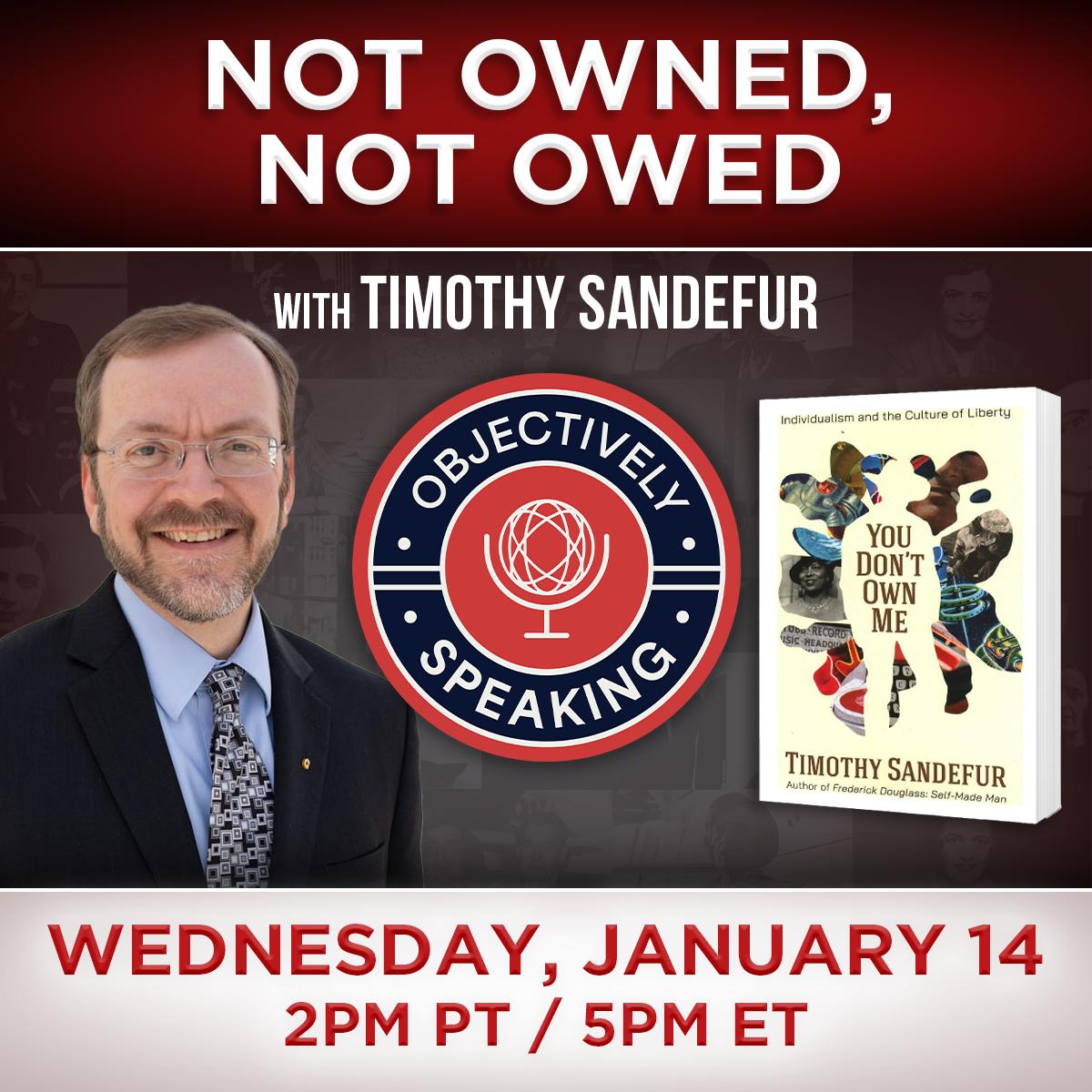
[00:00:01] Speaker A: Everyone, and welcome to the 285th episode of objectively speaking. I'm Jag CEO of the Atlas Society. I'm very excited to have three time returning guest Tim Sandiford join us to talk about his new book, you Don't Own Individualism and the Culture of Liberty. As you guys can see from my much bookmarked copy here, I enjoyed it immensely and so this is going to be a real treat. Tim, thanks for joining us.
[00:00:32] Speaker B: Thanks for having me back.
[00:00:35] Speaker A: So first, I love your book's title taken from Leslie Gore's 1964 hit song, but I had not realized that it was part of a series that began with it's my party and I'll cry if I want to and then Judy's turn to cry. How did the song you Don't Own Me fit into the kind of growing feminist consciousness at the time asserting female autonomy and independence?
[00:01:03] Speaker B: Yeah, that's, that's great because I. I can't definitively prove that the three songs were intentionally designed to, to go together, but they definitely make a series that starts with this.
A song that's basically like, you know, Leslie singing about how she wants to be the ideal girlfriend, and it sort of has this docile tone of resignation and she's so thrilled that she's been approved of by a man and so forth. And then the next song, Judy's turn to cry is in that song. She's kind of jealous. She's proven herself by making Judy jealous that Bobby's come back to her. And it's this sort of.
It's not a bad thing. It's not demeaning or anything, but it is definitely a portrayal of femininity as a sort of a secondary status, that she has no personal goals or identity of herself. She just wants to be featured with some guy and she sees her value in his eyes. And then the third song comes along, you Don't Own Me, and it's completely different. In that song, Leslie is singing that she stands for herself. She belongs to herself as a free, independent person, and she doesn't expect to be bossed around and controlled by her boyfriend. And when you put the three together, it's almost like it's the evolution of a literary character from one position to another. They fit together as almost like a story. Again, I can't prove that they were intended that way, but they definitely come off that way. And of course, you Don't Own Me became kind of an anthem in the early 60s as the feminist movement was really gaining momentum at the time.
[00:02:41] Speaker A: So how does this contrast with other literary and artistic treatments of women not as autonomous beings, but as property, such as Nabokov's Lolita and Shakespeare's Taming of the Shrew.
[00:02:55] Speaker B: Yeah, so Lolita is, I, I. Lolita is a little bit different because in Lolita, of course the book is narrated by this satanic evil character. So it's not a novel that's trying to spread the word that women are property. On the Quite the contrary. Instead, what happens is Lolita is, is treated as a figment, as a, as a piece of property by Humbert Humbert, who is this satanic character. I think the Shakespeare play is a little bit more ambiguous. It's really not clear whether Shakespeare meant or didn't mean that women should be in this subordinate situation. At the end of the Taming of the Shrew we have this bizarre scene where women are told directly to the audience is instructed that women should be secondary and subordinate to their husbands. And yet in the original play it's actually told in sort of what they call a frame story where the characters exist within a play. Right. It's a play within a play.
And we're told that the story that you've just seen has been presented to somebody as a story. So it's kind of ambiguous in that sense. But laying those things aside, it is definitely true that women throughout much of history were regarded as secondary and as essentially the, the belongings of men, or at least as secondary in terms of God. Right. And the relation to creation. I'm thinking of Milton in Paradise Lost who says that Adam was made for God alone and Eve was made for God in him, that is in Adam. So that she's sort of a secondary being in the order of creation.
Contrast that with the image in you Don't Owe me that says I'm a self reliant, self sufficient human being. I set my own destiny and I'm responsible for myself.
[00:04:49] Speaker A: So historically, conceptions of individuals as children or property has been used to justify everything from monarchical rule to slavery and Jim Crow laws. How does this fundamentally diverge from the sensibility that developed in the Enlightenment as articulated by John Locke?
[00:05:13] Speaker B: Yeah, it is true that Lincoln has this great line where he says the, the kings in the old world never rode the backs of the people because they wanted to. Of course, they always rode the backs of the people because it was better for the people the, that they be ridden. Right. And that's sort of the attitude that you find in monarchical and tyrannical government, that the people don't really know what's best for them and therefore they need to be controlled for their own welfare. And, and so people were so often treated as functionaries of the state or the nation or the race or the collective of whatever that sort might be.
Whereas in the Enlightenment you had this real discovery you rediscovery. But, but it was. Had been so long that you could call it a brand new discovery that people are self sufficient in the sense that they have rights and they are autonomous beings capable of making their, their own decisions and with a moral right to make their own decisions, a moral dignity to themselves and that they come together to create the state as opposed to the state creating them or vesting them with their rights or their personality or their autonomy.
And that was a real transition in political philosophy. James Madison even has an essay where he comments on this. He says that in Europe he says charters of liberty were granted by power, and in America charters of power have been granted by liberty. What he means is contrast the Declaration of Independence with Magna Carta. Magna Carta says, I, King John, hereby give the following liberties. And it's important that he that the plural word is used there liberties, because it's a finite list of liberties that are being given to the people by the king, because apparently the king owns all of these liberties and can decide who gets them.
And the reverse of that in the Declaration of Independence where it says people are fundamentally free. They, they own themselves by nature and then they come together and create the state by, by a charter. Right. So that's a real reversal of the way that politics had been imagined before then. And that's reflected in popular culture, as you said, with this sort of shift from especially women, but other minority groups too, being treated as they were secondary and they only had the rights that the majority gave to them and transitions into a world where everybody is inherently free. And then they get to choose or to decide whether to create a state or society or whatever.
[00:07:42] Speaker A: Yeah. It's not just secondary, but specifically seen as children. Right.
And that somehow slave owners or the state is benevolently patriarchal and is going to take care of people who cannot take care of themselves. And in your book you give some examples of how in the oratory of Martin Luther King Jr. This concept of adulthood also manifested itself.
[00:08:11] Speaker B: Yeah. Yes. In his I have a Dream speech, King goes out of his way to use the term adulthood.
And the reason why is because, you know, throughout American history, black Americans were very often treated as if they were children. The very long tradition, for example, of referring to black people by their first names and white people by their last names, which culturally. What that led to is that in the late 19th and early 20th century after. After the Civil War, a lot of black lawyers, but also other writers and artists, would often use only their first initials. They would go as JM Smith in order to make it impossible for white people to call them by their first names. It became such a tradition in the south, especially, but throughout the country to refer to black people by their first names as if they were subordinate. Incidentally, there's kind of a funny story, and I don't mention this in the book, but maybe the word funny isn't appropriate, but you'll get what I mean. In the 1960s, there was a case where a black woman was called as a witness and the lawyer asking her questions. This is in a Southern state courtroom. The lawyer asking her questions kept calling her by her first name, and she refused to answer unless he referred to her as Mrs. So and so. And she was held in contempt of court and that. That. She appealed that, and that got appealed to the U. S. Supreme court. And the U.S. supreme Court reversed the contempt contempt order without an opinion and.
[00:09:40] Speaker A: Or.
[00:09:40] Speaker B: And reverse that and sent that back to the trial court. I take that to mean that you have a constitutional right to be referred to you by your last name in the United States of America. And it's a small thing, but it indicates dignity. Right. It indicates respect and personhood and not treating you as if you're some sort of child who needs a paternalistic state to guide you or, you know, a strong man to defend you or whatever.
[00:10:05] Speaker A: Well, of course, we previously had you on the show to talk about your masterpiece of a biography of Frederick Douglass, Self Made Man. So I'd love to put that link in the chat as well. If you haven't read that, folks, I highly recommend it. So no surprise that you have a chapter on Frederick Douglass which you're quite passionately making the case against this kind of growing cynical abandonment, hopelessness, helplessness, dreamlessness.
What are some examples of that today on both the left and the right?
[00:10:45] Speaker B: Yeah, what I was trying to talk about there is this cultural sense, this cultural attitude of nihilism that has become very popular in our culture in the past, I would say, 20 years or so. And it's reflected in everything from television shows to the nonfiction writings of popular intellectuals today.
My particular target in the chapter that you're talking about is Ta Nehisi Coates, who wrote a book called between the World and Me several years ago, which is just A monster piece, you might say, of nihilism, of a total refusal to believe in the possibility of ideals. Not just to doubt the possibility of freedom and justice, but to deny that such things have any meaning at all is really the message that Ta Nehisi Coates teaches. And gotta hand it to him, he is entirely consistent about this. He believes that ideals are meaningless and are created as a tool to fool you into accepting the chains of your own slavery.
On the right, we also see this too in the form of power politics, especially nowadays, where the idea that notions such as justice and equal rights are really just. That's just political rhetoric. And that when it comes down to it, it's all about power and who can make things happen.
What happens is when a culture has that, it tends to start to lust for the strong man and desire for some leader on a white horse to come in and just impose his will. And let's get rid of all this fussy lawyer talk about due process of law. That's one, by the way, that you see a lot on the right is the denial that due process of law has any real meaning, when that is in fact the oldest and most important of all of our constitutional rights.
And of course, ideals, including that one, have meaning.
Some time ago, you know, I shouldn't be doing this, but I. Sometimes I get into little arguments on Twitter, but sometimes ago I saw somebody on Twitter arguing that there. That law doesn't actually exist. There is no such thing as law until the Supreme Court tells you what the law is. The constitutionality of a law doesn't exist or. Or not exist until the court says something. Right. So you have a law. Is it constitutional or not? There is no answer to that question until the Supreme Court answers it. Right. Well, that's nonsense, because that assumes that the Supreme Court creates the law and imposes its will. And that's not the way law works. Law is a process of reason and deliberation and discussion over meaningful principles. But on the right and on the left, you have this denial that ideals or principles have any meaning.
And it's, I think, deadly to our culture. It stands very opposed to everything Frederick Douglass stood for in his life. He very much believed that ideals are real things. Yes. Maybe they are out of reach at any particular moment. Maybe they're very demanding. Maybe we fall short of them, but that hardly means that they're not real.
[00:13:45] Speaker A: Right. Well, and I think it just underlies the importance of art, whether it's music or literature or. Or film or architecture in concretizing these Ideals, Yes.
[00:13:58] Speaker B: In fact, there's a great line. There's a philosopher named Iris Murdoch who has a great line where she says man is the only animal that creates a picture and then tries to be like the picture. And I think that's a beautiful encapsulation of the way ideals work. We imagine a better self or a better nation or a better world, and then we work our way toward that thing. It's a really special thing that only human beings are capable of doing.
And that's why art is so crucial, is it's one of the ways that we depict or picture to ourselves what a better world is like. Or, you know, in the reverse, if something like Dostoevsky picture to ourselves what a worse world would be like and how to avoid it.
[00:14:41] Speaker A: Right, right. As Ayn Rand said of Atlas Shrugged, it's not a prophecy of our unavoidable destruction, but a testament to man's power to avoid it if he chooses to change course.
So, of course, my absolute favorite chapter in your book was Navigating by Fixed the Moral Trajectory of Star Trek. And since it is my impression that objectivists significantly over index with Star Trek fans, I. I hope you won't mind if we spend a bit of time there. So how does the evolution of the franchise's tone provide a vantage on the evolution of liberalism since the John F. Kennedy era?
[00:15:25] Speaker B: Yeah, actually this, you know, that plays in really well with what I was just saying, because the recent efforts by the Star Trek franchise, shows like Discovery, for example, are riddled with this cynicism, if not nihilism, that I was just talking about. And compare that with the high idealism of the original 1960s Star Trek or Star Trek the Next Generation, which, you know, they. They had their flaws, but they all had at their core this belief in a better world or better galaxy.
And today's Star Trek has fallen off the rails because it doesn't believe in that ever since J.J. abrams took over the franchise and influenced it in such a terrible direction. Because of this denial of the meaning of idealism, I think it's really gone downhill. Now in my essay. What I talk about in that chapter is that you can use the evolution of the Star Trek franchise to sort of chart how liberalism has transformed from 1966 to the present day.
And that is during the original series. The original series was written and produced and acted by a lot of World War II veterans. Gene Roddenberry, who created Star Trek, was a World War II veteran. Jimmy Doohan, who played Scotty, lost a finger fighting in the war.
So these were guys who had faced real evil. They knew that evil really existed and more, they knew that the idea that it's none of my business if oppression is going on over there is a falsehood. And that's important because in the Star Trek world there's this thing called the Prime Directive that says you should never interfere with how a planet is, is evolving. Right? And you should hands this hands off attitude. Well, the reason that this Prime Directive idea was introduced into the franchise is because it is a bad thing. Star Trek, the original series preaches against the Prime Directive. It says, of course it is my business if somebody else is being enslaved. But then you fast forward past the Vietnam era to the Next Generation and that has changed everything. The Vietnam experience changes America a great deal.
And by the time Next Generation comes along, people have embraced this idea of it's none of my business if somebody else is being enslaved. Who are we to judge? Moral relativism, cultural relativism. And they gradually seep into the Next Generation's episodes to the point where Captain Picard spends a lot of his time trying to figure out how not to exercise moral judgment. Very much the opposite of the original Star Trek. I should add a footnote and say I'm not, don't mean this to disappoint Next Generation. There are some really good episodes of it. I enjoy it, I enjoy watching it. But there are, you can find these, this gradual arc where this, the show becomes more and more relativistic over time and ends up not being able to even defend itself. For example, in the episode of Next Generation when they decide that warp speed is a bad thing because it pollutes the galaxy. I'm not making this up. And you know, well, how do you have Star Trek without warp speed, right? So it ends up being very self destructive because it loses track of its original enlightenment influenced ideals.
[00:18:33] Speaker A: So those familiar with Ayn Rand know that she reserved some of her sharpest criticism for the culture in the counterculture in general and hippies in particular, calling the hippie movement, quote, an anti conceptual, anti rational, anti life phenomenon, end quote. And she complained that hippies are people who preach the renunciation of values, yet demand to be supported by the values they denounce. It seems that Star Trek, both the original series and later iterations also offered a kind of cultural commentary on space age hippies or those seeking to reject technology in favor of, of a more primitive lifestyle.
[00:19:20] Speaker B: Yep, yep, that's true. There's an episode called the Way to Eden of the original series. In the 1960s, that specifically is a commentary on hippies. This group of futuristic space hippies, like steal a spaceship and Captain Kirk tracks them down. And the reason why is because they're trying to find a mystical planet called Eden where everything is perfect. And they do eventually find the planet. And spoiler alert, it turns out that it's not Eden. In fact, it is the opposite. Everything on the planet is poisonous poison. And the hippies all die from this poison. It's kind of a, kind of a spooky prediction of things like the Jonestown Massacre, honestly. And.
[00:19:57] Speaker A: Right.
[00:19:57] Speaker B: The message it's trying to teach is that the anti civilization, anti technology, anti rationality element of the hippie movement, which does not encompass the entire hippie movement by any means, but was a major part of it, that that element of it is very dangerous and in fact is kind of a throwback to the fascist movements of the 1920s and 30s, which was anti liberal, anti civilization.
Right. The, the Germans in the 1920s liked to contrast civilization on one hand and culture on the other. Civilization was artificial, man made liberal based on things like constitutions and laws and contracts and chemicals, capitalism. Whereas culture was an instinctual thing. It was a rational, it was about the spirit, the folk geist, they said, the spirit of the people.
And it was a deeper way of knowing a more profound thing. And it created this spirit of the race in which you participated or should be made, should be forced to participate as a good German.
And that sort of attitude, that anti civilization attitude was detected by a lot of people, not just Rand, but also another philosopher I really admire named Jacob Bernofsky, who criticized this at the same time for the same reason that this anti civilization, anti rationality element that as you said, is often called the counterculture, that that was really a throwback to an anti civilization movement that was essentially self destructive. And now what's interesting to me about this about Star Trek is the first episode that I mentioned that the Way to Eden with the space hippies, it's a little ambiguous about the space hippies. It's not a direct criticism of them. In fact, Spock, who is so logical, right, he actually kind of sympathizes with them and he says he hopes that they'll find their Eden someday. And I think that indicates that the older school liberals, The World War II generation liberals, who of course were the parents at the time that this episode aired, some of them sympathized, part of them sympathized with what the hippies were trying to do.
And that's understandable because the hippie movement was a complicated movement. It wasn't a single thing. And, and we, we, I think we run the risk of caricaturing it, which is not a good idea in some ways. The hippies were very independent and self reliant. The hippies revived things like blacksmithing, for example, because they were interested in hand making things and in, and in going out there and, and getting back to the land and building from the soil and the ground up. That's a very independent Thoreauvian notion of individualism. Now you and I might have our problems with that, but it's still an individualism of a kind.
So I don't mean to paint with a broad brush here, but in any case, you fast forward to the Next Generation. By the Next Generation, the hippie stereotype has taken hold. And by the end of the whole Next Generation franchise you have the show actually pretty praising anti technology, anti civilization attitudes and even utopian attitudes. Now the one thing Star Trek always was was anti utopia. The message of the original Star Trek is all utopias are dystopias, period.
Next Generation is a little more sympathetic to utopias. And in some of the films we have Star Trek kind of saying, eh, you know, hippie utopias might be a good thing and maybe we shouldn't be exploring and maybe we shouldn't be developing new technologies and maybe we should just sit on our hands and, you know, till the soil with, with horses. And you know, it was a complete reversal from the way Star Trek said, optimistically that technology and civilization and advancing knowledge can improve the world for all mankind.
[00:23:44] Speaker A: So despite all this, I still found much to enjoy in the Next Generation and later theories such as Voyager. But there's one depiction that always troubled me and that was of Quark and the Ferengi in general as cartoonishly greedy capitalists.
Any thoughts on that and what it says about where the mindset of the franchise was evolving?
[00:24:14] Speaker B: Yeah, and you know, it's funny, I actually think that the franchise gradually evolved in a healthy direction in this respect. So the Frengi are introduced basically as this group of very greedy, sort of selfish, in a bad way, kind of accumulative, unprincipled, stab people in the back kind of characters. And I think what you see over the course, especially Deep Space Nine, is they added a degree of depth to Quark and to the Ferengi. In fact, there's one episode off the top of my head I can't remember, but there's an episode where Quark actually stands up and defends himself and he says, look, you may hate the Ferengi but we don't go to war with other races. We, we deal with people. We provide value for value. And you may not like us, but at least we aren't. We're not the Klingons, we're not the Romulans, we're not there out there massacring whole civilizations. And he's absolutely right. Right.
Unfortunately, there are even episodes of or moments in the Next Generation where the Ferengi are even, even border on an anti Semitic caricatures. I think that's particularly true in the movie Star Insurrection, which ends with a scene which, if I remember right, it was cut from the final movie, but it ends with a scene where Quark is fantasizing about building a bunch of luxury condominiums on this planet and Picard says, well, we're gonna make sure that we protect this planet from people like you.
What do you mean by people like you, Captain Picard? You know, it's a very disturbing moment. I'm kind of. I'm really glad that it got cut out of the show.
But in any event, my point is that the Frendy start out as this nasty caricature and I think that's largely Gene Roddenberry's doing because he was a member of this 60s liberal generation that had a lot of qualms about capitalism. But I think eventually it evolved into a more individualistic and more friendly attitude toward the Ferni in my estimation.
[00:26:09] Speaker A: All right, well, I was moving on beyond Star Trek as much as I.
[00:26:15] Speaker B: Oh, I could spend all day talking about Star Trek. I'm sure you could too.
[00:26:19] Speaker A: I was unfamiliar with another artist that you describe in your book, the Texas Texan novelist Elmer Kelton, who was named apparently the best western author of all time by Western Writers of America a couple of decades ago.
How do themes of self reliance and integrity manifest in his work?
[00:26:46] Speaker B: Yes, Elmer Kelton is the greatest writer you've never heard of. And for all of you who might be listening and watching us, I urge you to go out and get some of Kelton's novels and read them. He wrote about six masterpieces. He wrote a lot of books and some of them aren't that good. But he wrote six great masterpieces.
The Day the Cowboys Quit, the Time It Never Rained, Stand Proud Trying to Remember the Good Old Boys, which is the only one of his works that's ever been made into a movie.
In any case, they're just marvelous books and they have a real respect for the integrity and virtue that was necessary to settle the Western frontier. And Kelton was very conscious of this fact. He gave a speech where he talked about the Western and he. He said it was really unfortunate that the, the east coast community, the literary community of America, won't really pay any attention to a Western unless it either is anti the values of civilization. For example, Cormac McCarthy, who is one of the nihilists I mentioned before, who thinks that all ideals are meaningless, that in fact he even thought that storytelling was essentially a meaningless idea. So his stories don't actually add up to a climax or anything.
Horrible writer. One of my least favorite writers of all time. I know that's very unpopular thing to say, but McCarthy is awful.
Or Larry McMurtry, who does admire these virtues, the, the western frontier virtues of individualism, self reliance, but regards them as passe, as doomed. Right. As a thing that we can admire, but only in retrospect. And Kelton rejected that. And he. He very much believed in these virtues. Now, his books are not political.
There's maybe a little bit of a political element to them, but what I love about is they're not political propaganda by any means. The Day the Cowboys Quit, for example, is a novel based on a true story of the only time cowboys ever went on strike in the United States.
There was an effort by ranchers to prevent cowboys from keeping the. The unbranded calves that they found, which they had previously been allowed to keep. And they then could develop their own herd and become cattle barons themselves.
And the Caliberans tried to stop this, and so the cowboys went on strike. And the novel is about a character who starts out opposed to the strike and then gradually comes to sympathize with the strikers and why that is and what it means to have principles and stand for them when everybody's against you. And it's just a marvelous novel and I recommend it very highly to all of you.
[00:29:20] Speaker A: So I mentioned the first time you were on the show was to talk about your book Self Made man, about Frederick Douglass. And the last time you were talking about your magnificent book, Freedom's Furies.
And of course, it explored the relationships between and the times in which Ayn Rand, Isabel Patterson and Rose Wilder Lane lived. Any similarities between those authors and some of the authors that you explore in your book?
[00:29:53] Speaker B: Yeah, so I don't think that any of them were familiar with Kelton, who comes a little bit later than Patterson or Lane, but was around at the same time as Ayn Rand.
And I think that's unfortunate because although Rand knew a little bit about the Western, and so did Lane.
They didn't pay that much attention to them. Now, I should say Rose Wilder Lane, who was the daughter of Laura Ingalls Wilder and the secret co author of the Little House on the Prairie books, was in some ways a precursor to the Western as we know it. The history of the Western as we know it begins with Owen Wister's novel the Virginian in the 1910s, but it sort of changes after that.
And the kind of Western that you and I are most familiar with dates mostly to the 50s and 60s, when it was really. Or the post World War II era, when it was really the most popular form, the genre of entertainment in America for a long time. And one which philosophical ideas could really be explored in depth. And I'm thinking about the great Westerns like the Oxbow Incident or the man who Shot Liberty Valance. These are stories that tell a deep philosophical story in an integrated way, which of course is something that Rand would have sympathized with a great deal. And my theory is that the Western in that form evolved out of the prairie novels like the ones that Rose Wilder Lane and Laura Ingalls Wilder were writing in the 30s. I can't prove that, but I suspect it.
The commonality between them, of course, is this, in this strong emphasis on individualism, self reliance, independence, and the ability of the human being to go out there and with his rational efforts to build a better future for himself or herself.
[00:31:45] Speaker A: Because another writer you include as someone championing independence and integrity is Zora Neale Hurston. And as with Ayn Rand's fiction, the author dramatizes recurring themes of envy and individualism. What are some examples of that in her writing?
[00:32:06] Speaker B: Oh, yes. Hurston, of course, is best known for her novel Their Eyes Were Watching God. She wrote four novels or published four novels in her lifetime, and they're marvelous, just really magnificent works of art. The Rise is certainly her best novel, but she also wrote a lesser known novel called the Seraph of the Swanee.
And what's unusual about it is that the characters are all white characters and Hurston was black. And there are very few, perhaps no black novelists at that time who were writing novels with white main characters.
And this novel, Seraph of the Swanee, is about a character named Arve who goes through a transition from a sense of bitter entitlement and jealousy to a sense of individualism and self reliance and how that transition takes place.
It's a complicated story and it's one that is quite beautifully told, of course, in. In the novel, the, the climactic moment comes when Arve decides that, realizes that she's become a better person than she was before and she can let go of the pain of her childhood. And she burns down her parents, her mother's house.
And she says to a friend, while they're, while the flames are launching, she says to somebody, slums. She's a. Places are not slums. People are slums if they allow themselves to become slums. And she's decided not to become like that anymore. And this novel was based on Hurston's own life, on her own experiences, because she had been in a, in a very heart wrenching romantic relationship with a man who had this sense of resentment and envy toward her and to reward her writing career.
And it really, it caused a great deal of heartache in her life. She ended up. They ended up separating because he couldn't stand her career. And so the novel is a reflection on how it is that people allow what you and I would call envy to eat themselves up. And it's not just jealousy, like, I wish I had that thing.
Maybe it starts that way, but it gradually it rots the person into hating somebody for their accomplishments and being bitter toward them just because of who they are. To me, the acid test of this is, is a person happy for another person's achievements. If I hear somebody has accomplished something great, do I think bastard, or do I think, yeah, great, good for you. Right, That's. There's a world of difference between those two spirits and you can cross from one into the other, and that's what the novel is about. So again, strongly recommend, great novel.
[00:34:53] Speaker A: Any similarities between that novel and the character of Arve and Dominique in Ayn Rand's Fountainhead?
[00:35:01] Speaker B: Yeah, I think there, I think there are. I think that Dominique in the Fountainhead is a misunderstood character. Dominique Rand used to say that Dominique is herself in a bad mood, but that's, that is actually understating it. Dominique is the character who has given up on idealism, who fights down her own idealism, tries to rip out her idealism, tries to become a nihilist because she's been so disappointed so often that she just can't stand the pain anymore. So in. There's a famous line in the book where she says, freedom to want nothing, to depend on nothing. Right. That's not an ideal for Rand. That's not what Rand is preaching in favor of. That's the situation that Dominique has to outgrow and arve in. Seraph of the Swanee is a little Bit different, but because she's not really a nihilist, she's just bitterly resentful.
But what both of these characters do is they discover that ideals are possible if only you will open yourself to them. Which sounds like an easy thing, but often is not an easy thing. Often it's very hard to, to let go of bitterness. The reason why is I think, and I think this goes back to what we're talking at the beginning about the culture of cynicism is it's very easy to be a cynic. It's very easy to be a cynic. All you have to do is go around and say, nah, that's silly, that, that ideal is meaningless. Let's be hard headed realists.
And hard headed realism doesn't have any room for idealism, right? And then you look like the smart, clever guy, whereas the foolhardy idealist is out there pursuing the, you know, building castles in the sky. It's a lot harder to be a realistic idealist and say, here there is something, the world can be better and it can be accomplished and this is how we're going to do it. And even if I fail, at least I've tried. That's a lot harder.
And there's a line, I'm thinking of a line in Edmond Rostand's play Chanticleer, which is a story about a rooster who thinks that his crowing causes the sun to rise in the morning. It's sort of a comedy. And some of the other barnyard animals gang up on him because they think he's a fool and, and they reveal to him that actually his crowing does not cause the sun to rise in the morning.
And so it's a question about how he deals with that disappointed idealism. And later on in the play he says, the reason I knew that my crowing caused the sun to rise was because the forces of darkness rejoiced at my silence.
And that's idealism.
When you silence yourself, when you allow yourself to not believe in the possibility of good anymore, and you say, well, it's all about power.
It doesn't. All this due process or justice, those are just pretty sounding words that then the forces of darkness rejoice. And so what these books teach is don't let the forces of darkness rejoice at your silence.
[00:37:53] Speaker A: Well, our viewers are not silent. We've got quite a few questions and compliments from one person here, Elmo. Tim is a great intellectual we agree with.
So I am going to get to a few of these. Lock, stock, Barrel asks The big question, do the arts tend to lead cultural change or reflect changes that have already occurred?
[00:38:19] Speaker B: I think they do both. They reflect them and then help change them. That way, they're like a mirror, and you look into them, and then you can primp yourself and make yourself look better. Right. The arts are a way of expressing ideals, and then they're also a way of teaching ideals, ideas. I think one of the most important roles that arts play in terms of idealism is, as I mentioned, they allow you to project a better self or a better world or a better whatever, and then work toward that thing. And I actually think that this is. This isn't just a question about art. This is a question about what philosophers call meta ethics. How do you go about deciding to become a better person? Why should you do that? And I think ultimately, it is an aesthetic. Aesthetic choice where you say, I want to be that kind of person.
And that begins with art. A lot of the time, if not all the time. I think when. The reason why kids are drawn to great heroes. Even though when you and I look at the show, we might think it's silly. Right. When I was a kid, I used to watch Knight Rider. When I was a kid. I love Knight Rider. And, oh, now that I watch it, I'm like, how did my parents put up with this show? It's so silly. And. And yet the reason why is because as a. As a kid, you're looking for what is the best kind of person, what kind of good person could I aspire to be? And you look up at heroism, and looking up at heroism, of course, is one of the great things, if not the greatest thing that human beings do.
So the arts do both. They reflect the times, and then they pass on, ideally, the best of those times to the next generation.
[00:39:53] Speaker A: Yeah. Speaking of heroism, I'm reminded of Ayn Rand's praise of, I think the very first James Bond that came out, in which she talked about that Bond vanquishing his villains, told the average viewer that it can be done, that he also can overcome the obstacles in his life. Okay, my modern Galt has a question. Do you think the dilution of individualist ideas in more modern media is due to creators trying to appeal to a global audience rather than an American audience? I'll let you answer that, but I will throw in my two cents, which is, you know, we are trying to appeal to universal themes and virtues, which I don't think are culturally specific. We have a huge segment of our YouTube audiences from within Venezuela, in. In the Middle east. In India. So. But. But do you think that is possibly at. At play?
[00:40:59] Speaker B: Yeah, I. I agree with you, of course. But at the same time, I do think it's true that there is also a large cadre of people out there who try to teach that values like individualism and. And self reliance and integrity and justice. And so that those values are, you know, Western values or. Or even white supremacist values. That's a popular thing to say nowadays. And unfortunately, I think Hollywood does often listen to people like that.
So I'll give you an example. I don't mention this in the book, but this is one of my favorite examples. So the. The movie Moana, the Disney movie Moana, which is one of my favorites. Love. Love. This movie is actually one of the most subversive movies in our. In recent years. And I don't think even. I don't think people have noticed it. And that just proves how subversive it is.
The story is about Moana living on this island where she's taught that everything we. We have everything we need here, you shouldn't go out exploring because we're happy where we are. And the. The symbol of this in the story is the coconut, right? Dad sings this song about, consider the coconut. It has everything we need. Why should you bother exploring?
Later on, there was a scene that was sketched out that ended up being cut from the movie, where Moana is by herself on a beach and she's using a stick to whack coconuts out at. Out towards the ocean. She's taking like a baseball bat whack and knocking them off into the sea, and she's cursing about how much she hates coconuts.
And the cultural sensitivity committee that Pixar and Disney had hired objected to this and made them take that out. And instead, in the final movie, she's just sitting there throwing sticks into the sand while she curses to herself and doesn't say how much she hates coconuts. Later on in the movie, we see Moana encounter the kakamora. Those are the little monsters that are shaped like coconuts. And she says, coconuts. And she whacks them with her orange. She fights against them, right?
The reason she says, ah, coconuts. I know what to do with these guys is because of that earlier scene about hating coconuts. But that got taken out of the movie.
And the reason that that's significant is because the coconut symbolizes, stay on your island. Don't go exploring.
And so what Moana is actually learning in the course of the movie is to reject the values of her society and to instead embrace exploration, adventure, individualism, which of course are the values of what her society used to embrace but has forgotten.
Unfortunately, that message gets diluted because the political correctness committee ordered them to take that scene out. I think it's a terrible shame.
[00:43:25] Speaker A: So in your chapter on the blues impresario Albert King, you observe that a, quote, sense of defiant competence, end quote, makes the blues so distinctly American. How is that musical genre a celebration of individualism?
[00:43:44] Speaker B: Yeah, I love the blues. Of all the music that I listen to, the blues is my favorite genre of music. And Albert King is my very favorite blues musician.
The blues has this reputation being sad, right? The blues, a sad song. Oh, I lost my, I lost my wife and, and my girls left me and all, blah, blah, blah. But if you actually listen to the music, it's not actually sad. One reason why is because virtually no blues songs are performed in minor keys. A minor key is. This is the longing sound that is used in truly sad music.
And the lyrics are very often either silly or raunchy or defiant and are songs about how I'm gonna overcome the hardships of my life.
Who was it? I think it was Wynton Marsalis once gave an interview where he said that the blues is like. Listening to the blues is like taking a vaccination. It's a little bit of the smallpox to keep you from getting the smallpox. Right. And so the blues has developed into this genre of defying suffering and that. Well, I shouldn't say developed. It started out as a way of defying suffering. Right. It started out in black American culture, especially in the time immediately after the Civil War when Jim Crow was being put into place and so forth. And this music started up and it's all about, you know, oh, I've got all these bad things going on and yet the ultimate message is, but I'm gonna overcome it anyway. Even if those words don't actually occur in the song, ultimately that's what they're really about.
[00:45:13] Speaker A: So switching now to architecture. Your chapter on Louis Sullivan, the father of the skyscraper, was both inspiring and a little depressing given his demise at the age of 67, alone, bankrupt, living in essentially tricked out broom closet.
Now, given his mentorship of Frank Lloyd Wright and Rand's study of Wright, among other mold breaking architects in her research for the Fountainhead, I can't help wondering whether Sullivan was a model for Henry Cameron.
[00:45:45] Speaker B: Yes, oh yes, he certainly was. And in fact, the philosophy that Rourke ARG articulates in the book has very little to do with Frank Lloyd Wright's own philosophical views, which were kind of a mishmash of Transcendentalism and are much more in common with Louis Sullivan. While I'm recommending books here, I will urge viewers to get a copy of Louis Sullivan's memoir, which is called Autobiography of an Idea. Rand actually mentions it by name, if I remember right. It's in the preface to we the Livings, so we know that she read it.
Autobiography of an Idea is Louis Sullivan's memoir from his birth until about 1893. Now, he didn't die until after World War or around World War I, so there's a lot left out, but it's written in this incredibly beautiful prose that is very, very individualistic. Sullivan was kind of a poet also. He was an amateur poet, and his favorite poet was Walt Whitman. And so Sullivan had this very high individualistic idealism about individualism and democracy, just like Whitman did.
And he wrote. Remember, he wrote four books. He wrote a book called Kindergarten Chats, which is written in the form of, like, platonic dialogues between a teacher and a student. The student, in many cases is obviously Frank Lloyd Wright.
He also wrote a book that was just about how to do designs. And then he wrote a book called Democracy, which he just. He never finished. He sort of scribbled at it for a long time, and it's really unreadable. It's just. It's so long, it never got edited down. So get a copy of Autobiography of an Idea and you will see this amazing optimistic, individualistic attitude that Sullivan had in the late 19th century about the possibilities that capitalism was opening up to the world and especially to the refugees of the old world who had arrived in America.
[00:47:42] Speaker A: So Ayn Rand also admired American author O. Henry for his, quote, benevolent, almost childlike sense of wonder.
So for his sense of life. Contrast for us the themes and values we see in O. Henry's stories with those of the revolt from. From the Village literary movement, which I first learned about in Freedom's Furies.
[00:48:07] Speaker B: Yeah, the Revolt in the Village was this movement that began in the early 20s, when America was going through a real cultural transition from a largely agricultural society to a largely urban society. And new technologies like the automobile and the radio and the telephone were transforming American culture totally. And the younger generation, it was. It was the first generation gap in American history. The younger generation had very different attitudes about what life should be than their parents did. Their parents had grown up on the farm, and they wanted to go and listen to jazz in the cities to drive their model T's to the Cities and listen to jazz on the radio. You know, it was a very different culture that the young grew up in between, say, 19, 1905 and 1925, let's say, say. And so the Revolt from the Village is this literary movement that reflects that. The most famous of the. Of these novels would be Main street by Sinclair Lewis, which exerted a huge influence on Ayn Rand, as I. As I discuss in Freedom's Furies.
Well, O. Henry was a writer in the very early 20th century, about 1900, 1910.
His career spanned only a decade, and he died right at the end of that. So it was like he became a colossally famous writer and then vanished within a span of 10 years.
And he was probably the most important writer immediately after Mark Twain's death. Well, actually, I guess. I guess Twain was still alive during this time, but immediately at the end of Twain's career.
O. Henry is best known for these short stories that have this really sort of optimistic attitude toward life. A very romantic, spiritually uplifting life affirming is the term that people use nowadays.
And I use that term because not. They're not always happy stories. Some of them are tragedies, and yet they still have this uplifting quality to them.
One that comes to mind is there's a story where this girl is trying to choose between two boyfriends and one of them works in this little cigarette stand on a sidewalk, and the other is this really rich guy, and he has the penthouse at the top of one of these new skyscrapers. And so he takes her up to the top of the, to the penthouse to look, look out at the, from the skyscraper. And he looks down on all the people of New York City and he's like, oh, they look like ants from here. And she gets really upset and she, she says no to him and she says yes to the other guy. And she says because she would rather be at the cigarette stand looking up at what is great than to be up there looking down on everybody as if they're tiny and small and insignificant. And that's sort of the spirit of O. Henry. Right. And that's very different from what you see in the, in the Revolt from the Village stories, where the, the rural communities in small America, small town America are treated with contempt and the. As incredibly boring. Right. The whole point of Main street is that American bourgeois life is boring and pointless and ultimately destroys your idealism. I. I don't mean that it's a bad novel, but on the contrary, it's one of the most Important American novels, and you all should read it. But it's about, it's really has this almost hatred of what America is at that time compared to O. Henry, who for all of his frustrations, deeply loves America and what it stands for.
[00:51:22] Speaker A: Well, your book, you Don't Own Me. And this interview could not be more timely because we have in New York City a newly inaugurated mayor who has called on replacing the rigidity of rugged individualism with the warmth of collectivism. And so as you kind of survey the popular culture of today, the kinds of books and movies and music that you are. People are consuming, do you feel that they are helpful or are they paving the way for people to turn away from independence and individualism?
[00:52:09] Speaker B: You know, I kind of go back and forth on that myself.
I, I have the feeling that we're on the cusp right now of a real shift in the culture. I think for the past 20 years we've had a very nihilistic culture, very cynical culture. This is reflected in TV shows like the, the Battlestar Galactica reboot or, or Breaking Bad and things like that. And I think people are fed up with that and I think people are desperate for a new idealism. Unfortunately, socialism and communism have always cashed in on that because they pretend to be idealistic and they're very good at it. And so people fall for socialism and communism because they're longing for something that's idealistic.
Rand herself writes about this almost a century ago now.
So it's a very common phenomenon. I, I think, however, that politics that we had the question earlier about whether culture follows the world or whether it leads it. I think politics actually follows culture. And I think the culture right now is at a point where we want something better and we're, I think we're gonna find something better.
It'll be a while before that ripple effect is felt in the political world.
I hope, I hope that it is felt. I hope it doesn't just, you know, go off the edge.
[00:53:31] Speaker A: Well, at the Atlas Society, we are not just waiting for it, we are creating it.
We are beginning the process of a full length feature film of Anthem. I know you discuss Orwell's 1984 in your book, but Anthem is the kind of quintessential encapsulation of, of what happens when you lose the, not only the word, but you, you lose the sense of ego, of individualism. So we're hoping and we're planning to provide an artistic means of helping people envision what, what happens when you replace the frigidity of rugged individualism with the warmth of collection collectivism and encourages them to to change course. Now, Tim, you are already working on your next book. Tell us about that. Hopefully you'll come back to talk about it with us and I. We can follow you on on X. Where else can we follow your work?
[00:54:35] Speaker B: That's right. You can find me online. I have a substack and I'm on Twitter and so forth. My next book will be out in April. It's about the Declaration of Independence. In time for the 250th anniversary, I wanted to go through the Declaration and explore each of the grievances that's listed in it because we often people aren't taught what they're referring to, what each of the things that is listed in there as a complaint, what they mean. And so I start from the beginning of the origins of the tensions between Britain and america in the 17th century, 100 years before the revolution, that people don't know about those kinds of arguments that were going on. And then I lead up to discussing, item by item, what the Declaration is talking about in hopes of giving everybody an idea of its true meaning. And I tell this in a narrative style in the lives of Thomas Jefferson and John Adams as they were writing the Declaration.
[00:55:25] Speaker A: Well, we're looking forward to it, so thank you again, Tim, and please say hello. Give our regards to Christina.
We really enjoyed having you with us today.
[00:55:35] Speaker B: Thank you.
[00:55:36] Speaker A: Thanks everyone who joined us. Make sure to join us next week when author and associate professor Musa Al Gharbi joins us to talk about his book. We have never been woke. The cultural contradictions of a new elite. See you then.