Episode Transcript
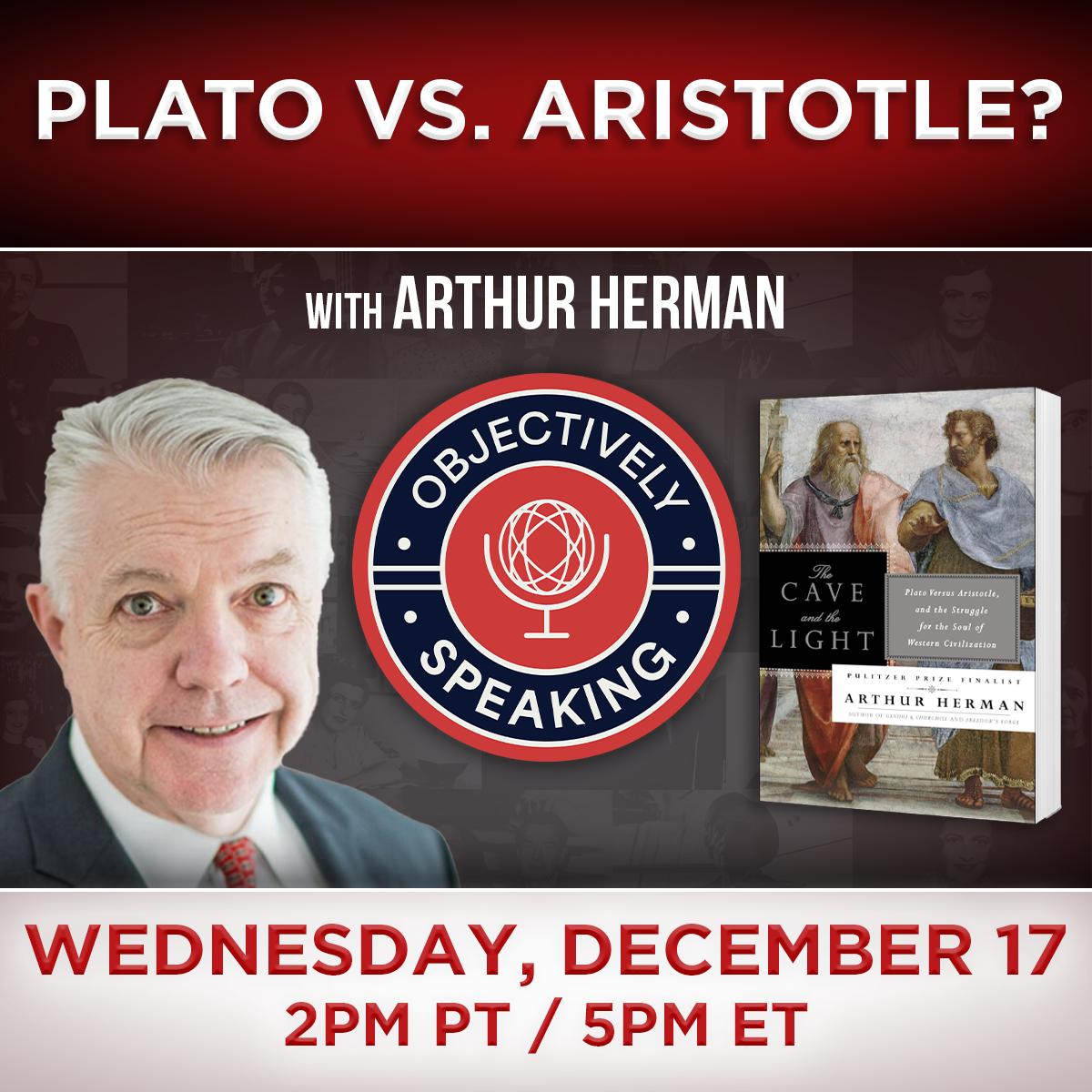
[00:00:02] Speaker A: Hi, everyone. Welcome to the 281st episode of objectively speaking. I'm Jag, CEO of the Atlas Society. I'm very excited to have Dr. Arthur Herman join us to talk about his book the Cave and the Light, Plato versus Aristotle and the Struggle for the Soul of Western Civilization.
Arthur, thank you so much for joining us.
[00:00:27] Speaker B: Oh, it's a great pleasure to be here.
Happy to join you.
[00:00:31] Speaker A: Well, even before we get started, I want to talk about Ayn Rand, because we were talking right before we went live and you shared why you felt it was important to include her in this book and what your takeaways as a non objectivist were from her essays.
[00:00:49] Speaker B: Yeah, and I want to.
The place of ayn Rand In 20th century American philosophy, and I think in philosophy, has been sadly overlooked by sort of the mainstream consensus views about who's an important philosophic figure and shaping the way we come to understand not just a theory of knowledge, not just epistemology, of which of course AM Rand has a. As an important contribution that she made in that area, but also our understanding about economy, understanding about society and politics.
And although, as you point out, I am not, I don't think of myself as being an objectivist per se, at the same time, I do recognize, particularly in her essays, that there are some really profound insights about how the 20th century went wrong and off track in terms of the protection of individual liberty and of freedom and also ways in which to get people and get societies back on track.
And one of the things that I thought would be a way to include her in this book would be the fact that she was a great admirer of Aristotle and understood how important Aristotle's philosophy and thought and influence was in leading and pushing forward ideas about human freedom, ideas about self government, about the rule of law, and also in science and technology, that this was an influence not to be overlooked and in fact to be stressed and emphasized if we were going to understand where we come from as part of Western society and Western civilization, but also about where we need to go forward.
And for those reasons, I really believe that including her in this book would help to eliminate not just that aspect of Ayn Rand's philosophy, but also it help us to understand better the, the influence and legacy that Aristotle has left over 2000 years of thought.
[00:03:14] Speaker A: Well, and that is, it's pretty remarkable. The ground that you cover in this book, you chose as the image for your cover.
And you also begin your book with a discussion of Raphael's painting of the School of Athens, which perhaps we can show us a screenshot of how did it illustrate the philosophical tension that played out over the centuries. You describe.
[00:03:41] Speaker B: Well, by looking at the text you see right away is that what Raphael has done is give you an Austrian text of the ancient philosophers.
And some of the figures that we would recognize right away in terms of names, names like, like Euclid and like Protagoras.
And a whole range of all the different schools of philosophy that the Renaissance had come to recognize were foundational for understanding the world, understanding society and understanding the cosmos.
At the same, at the center of this representation is all star cast are the two heaviest hitters of all, Plato and Aristotle. And the contrasting pose that they strike.
Plato with one hand raised upward, heavenward, pointing to transcendent, transcendent reality, the world of the transcendent of ideas and of ideal view and vision. And then Aristotle next to him with hand held in a moderating gesture, bringing us back down to earth, bringing us back to reality if you like, as we experience it, as we know it in this world. And those two views of how human beings should come to understand their place in the world, but also the very nature of the world are reflected in those two gestures. On the one hand, looking towards a transcendent vision, an all encompassing vision that includes an all encompassing and all powerful God. And the influence of Plato on Christianity which I talk about in the book, is enormous.
And then Aristotle on the other hand, reminding us that whatever our aspirations to reach towards heaven, towards the transcendent, that there's whole other level of reality with which we have to deal and make, and make ourselves familiar and create an order, a rational order for understanding. And that's Aristotle's great contribution over the centuries.
[00:06:01] Speaker A: You describe the trial and death of Socrates, who famously said true philosophers make dying their profession. What did he mean by that? And how did this teaching influence his disciple Plato?
[00:06:16] Speaker B: Well, Plato.
Socrates is Plato's great teacher, his mentor, and he is the central character in all of the dialogues that Plato wrote.
Even though they are. The dialogues are a reflection of an exposition of Plato's own philosophy and thought on just about everything from politics and society and ethics to, to theories of knowledge to the very nature of the cosmos in, in the great and highly influential dialogue called the Timaeus, which really gives us Plato's vision of how the cosmos itself, the universe itself has, was created and came into form. But the person who speaks for Plato throughout the dialogues is the figure of Socrates, his revered teacher.
Revered teacher by the way, by many of the young men living in Athens at The time in the fifth century.
And the fact that Socrates is questioning, relentless questioning of conventional ideas about democracy, about the moral life, his relentless pursuit of truth in an absolute, unquestionable sense, that eventually led him into conflict with the political authorities and eventually to his execution, left a deep imprint on Plato. And what particularly shook Plato in all of the figures when you read the dialogue in which he describes it, is that Socrates, far from being horrified or fearful of death as his punishment for his unconventional and outspoken views, that he in fact, through the process of understanding the world, had come to a reconciliation with death. And that what would happen in Socrates view, as reflected in the dialogue, is that he then will pass on from this life into the next life, in which all of the universal truths, all the profound understanding of the world, of everything, will finally be revealed to him. The realm of the forms, as Plato calls it here. And so death, far from being the end of things, Jack, it's the beginning of things from the Socratic point of view. And for Plato, that idea of pushing forward into the transcendent, to go beyond our mundane world here into another level of reality, another level of truth, would always be a driving force in his thought and ideas and an enduring part of his legacy all through Western thought and Western culture.
[00:09:06] Speaker A: So speaking of throughout Western culture, Ayn Rand observed, Aristotle may be regarded as the cultural barometer of Western history. Whenever his influence dominated the scene, it paved the way for one of history's brilliant eras. Whenever it fell, so did mankind. Does your reading of history agree with that assessment?
[00:09:29] Speaker B: In many ways it does. And I think that she's got her finger on an important part of the ups and downs, if you like, of the reputation of both of these philosophers, both of Plato and also of Aristotle, which I chronicle and describe here in the book Cave and the Light, that there are certain times in history in which Plato is the dominant figure. And the ideas of Plato particularly, again, that idea of that, that our lives and our. The most deepest meaning is to be pursued by our pursuit of the, of transcendent truths, including, of course, our understanding of God, or on Plato, on Aristotle's side. No, what we really need to do before we get involved with all that is to figure out how the world works around us, the reality, the reality of other people, the society we live in, if nature and that understanding, that rational order and bringing and understanding an organization for it is the first step towards an ascent towards higher and higher truth and higher, higher understanding. And so in, in the early part of the Middle Ages, you have this enormous Interest, this enormous interest in Plato because of his, because of his consistency with and sympathetic views with those of Christianity. And he becomes a major figure in helping to shape and direct Christianity into the mainstream of Western culture, Western civilization.
Then you have Aristotle and his interest in logic and in science and the writings that he leaves will then have another layer of influence on Western culture and Western civilization.
And in what I point out in the book is that at certain key turning points in history, as for example, in the Renaissance and also later on in the, in the 19th century, that what we see is the confluence of both of these influences coming together here, in which in each age comes to recognize that each philosopher in their approach and understanding of philosophy and our place in the world, that each of them have a validity, each of them sheds an important light on our experience and on our world.
But that there is always this constant dynamic tension between the two, that the Platonist and the Aristotelian will never quite agree on everything but that when that dynamic tension is part of the dynamic that drives and pushes the progress and the developments that we see as being so essential to the development of Western civilization.
[00:12:29] Speaker A: Ayn Rand also said that, quote, aristotle is the father of individualism. Is that because he was the first thinker to make the individual human being his reason, his life, his flourishing, the starting point of his philosophy?
[00:12:44] Speaker B: Well, you could say that about Plato too. I mean, Plato, after all, is thinking about us as individuals and how we come to understand the world around us. The difference is in Plato's case is that his pursuit is the realm. The realm of truth is always transcendent, it's always lies beyond us.
And therefore all of our social and political organizations need to reflect that pursuit of transcendental truth, which is one that goes beyond simply the individual's wants or desires. Because after all, as an individual's wants and desires, we're just a puny part of the overall cosmos.
Our lives are tiny reflection of this larger truth and larger reality that is the one that the realm of the forms and the realm that we pursue in order to understand and grasp ultimate truth.
Aristotle, on the other hand, says the individual is your starting point.
And how it is that individuals react with one another and how they see themselves and see their actions as moral or immoral in their interactions with others. That's the real starting point of how we come to understand truth and how we come to understand our world. And so his works like the ethics, his works like the politics, which is about the individual citizen.
What's my role as a citizen? How is it that I can be a good citizen and contribute to the commonwealth, to the freedom and the rule of law that we all want to belong to and be involved in? Here the focus is always on the individual's obligations, the individual's choices, the individual's destiny in ways that in Plato's philosophy tends to fall to the background. It's the big ideas, it's the big institutions, it's the big truths that we pursue and that we go forward with. For Aristotle, what's your place in the world? How do you see it? And how do we make sure that you're acting in the best possible way according to the moral standards of your society and also the standards that govern, that govern all of human existence and human truth?
[00:15:17] Speaker A: All right, we've got a bit of a fan base of yours professor, here, including King Fisher, saying, a great historian with several excellent books on my shelf.
And then we have a question from my modern Galt. He asks, you frame Western civilization as a long struggle between Platonic idealism and Aristotelian realism. Do you think that is still true today? We seem to be in an age of pure irrationality.
[00:15:51] Speaker B: Well, yeah. And one of the themes of the latter part of the book is the rise of that irrationality as I talk about it and the way it reflects the understanding of human character and human behavior in politics.
Before Plato and Aristotle appear on the scene, really, the influence of the pre Socratic philosophers. I talk about this with regard to Friedrich Nietzsche, for example, who is an admirer of neither Plato or Aristotle.
The influence on philosophers like Georges Sorel.
The growth of the interest in the irrational, which sets aside the Plato and Aristotle and sets aside therefore that dynamic tension right, between the two different ways of thinking about the world on a rational basis and acting in the world on that basis. If you shove those kinds of things aside, well, then you are going to end up in a realm which is governed by instinct, governed by pure emotion.
Right? If it feels good, go ahead and do it. If it feels bad, then go ahead and shoot somebody who's made you unhappy or made you feel threatened, has offended you in some kind of way.
If that's the moral realm, the ethical realm in which you occupy here, then you are moving way outside of the bounds that both Plato and Aristotle set for and their influence has set for thousands of years on how our civilization carries itself forward and how our society and individuals in that society need to act. And from that point of view, the question that you've just raised is, yeah, in many ways. And you Read my book. There's aspects of Plato's philosophy which are not particularly good, particularly in the political realm, and Ayn Rand recognized that. And there are aspects of Aristotle's philosophy, but again, particularly in the political realm, that are to be celebrated and embraced, and Ayn Rand did that. But at the same time, both of them are a lot better choices than the demons and the kind of creatures that surge out of that embrace and celebration of the irrational, which has become an important part. An important part of the philosophical discourse in the latter part of the 20th century. People like Michel Foucault, for example, who I talk about in the book, but who've become, I think, misguided. Misguided our future and misguided the way in which we think about the world and think about our own history and think about the nature of civilization.
[00:18:49] Speaker A: You write that quote. At one level, we are all become Platonists when we are conscious of our own shortcomings. What did you mean by that?
[00:19:02] Speaker B: I guess what I was saying there is that Plato is always aware of our own inadequacies as human beings. That's one of the things that leads us to. It makes us yearn for those transcendent truths, to find a means by which we can be better than our current self. You know, the one that sits around in our pajamas and is on social media all day.
That's not who you want to be. That's not who you are destined to become.
You're destined to be better than that. You're destined to achieve something more, to have a destiny that points you towards not only acting as a moral being, but understanding the world in ways that give you a confidence and allow you to act with confidence and with a sense of purpose in the world. And in Plato's case, the way in which to pursue that was to look to those transcendent truths.
Just as we would say in the Christian tradition. We look for that guide to better action in the Ten Commandments, in the dictates of Jesus as Christ's savior, that the larger truths make our lives meaningful and allow us to act morally, exist outside of ourselves and above ourselves. And we want to push ourselves forward here because we yearn for. The plaintiff's point is we yearn for those truths.
Even the drug addict knows that the time that he or she spends with the needle, with the syringe is wasted time, is a wasted life. And they understand that. They want to reach for something bigger and better, even if they don't have the inner strength to do it.
Aristotle wouldn't disagree. Aristotle wouldn't disagree, but what he would say is. What he would say is, if you look at yourself as you are, even you sitting in your pajamas in front of your computer screen, going, digging around in social media, there's a lot of that good person already there.
There's already someone there who understands the world in a rational way and who knows the difference between, you know, posts which are really malicious and ugly and mean, versus the posts that are. Can be inspiring and encouraging here as well. So Plato is one who are always dissatisfied with where we are and where we sit in the scheme of things and want to push forward to something new, to something better. Aristotle says, yeah, that's true, but don't discount where you are right now and the people around you. This society here works pretty well and we can find our place and find our home here, even if we put off our pursuit of those transcendent truths for next week.
[00:21:55] Speaker A: Right.
So, and forgive me in advance, I may interrupt you a bit because we have so much ground to cover and I want to, you know, I really do want to understand and see how these, this tension plays out and has played out throughout Western civilization.
And you just described this kind of tension between pushing forward, pushing towards the transcendent, or, you know, also not losing sight of where we are.
[00:22:25] Speaker B: That's a great way to put it. That's a beautiful way to put it. Put you just describe it exactly.
[00:22:29] Speaker A: But you also describe one of the crucial, most crucial differences between Plato and Aristotle. As Plato looking backward to what we were or what we've lost, or to the originals of which were only pale copies, where as Aristotle looks resolutely forward to what we can be. Using that one crucial distinction, can you provide some examples of which of the ensuing ages were characteristically more Plato, you know, looking back or a stately and looking forward?
Sure.
[00:23:06] Speaker B: I mean, a good example of this is for, take the Renaissance, for example, in which the. When you look at the thinkers and the movements that were heavily influenced by Plato, they're looking back to the lost world of the ancients, looking back to the lost world of Greece and Rome and that great sense that they had, that the Greeks and the Romans had achieved the highest level of aesthetic expression in sculpture, in architecture and even in painting, with the discovery of the first antique paintings in ruins in Italy, in places like herculaneum and Pompeii, etc.
The ancients had established a level of a standard of excellence to which the modern world could only imitate and could only achieve, really sort of pale imitations, of the lost glories and directions that come with it.
The Renaissance has a heavy levy load of that kind of Platonist view of the world and of our place in it. Now contrast that with the Enlightenment.
The Enlightenment which, as I describe in the book, all the major Enlightenment thinkers in France, in Scotland, like Adam Smith, in America, like Thomas Jefferson, all of them took a very dim view of Plato. They all thought that his philosophy was one of a pursuit of these sort of, what should I say, these kinds of mirages, these transcendent truths, this realm of the forms. Great waste of time, great waste of intellectual effort.
Their man is Aristotle. And what they love about Aristotle is his stress on knowledge as a knowledge of things, a knowledge of nature and of science, guiding us into what it is that we can achieve and develop in the future and move forward towards it.
Aristotle's philosophy is always about a development, an evolution, if you like.
And I describe in the book, for example, the way in which his view of form compared to Plato, that you know, that we have, that nothing starts from a level of perfection. Everything grows, everything, everything moves organically. The puppy grows into a full grown dog.
The baby grows into a child and then grows into an adult.
The tree grows from a sapling into a large spreading oak tree.
This process of change, of evolution, is a means by which we come to understand our purpose in the world.
And so the way I would frame it is in Plato's case, the world of change is one of a falling away from a standard of perfection that the more stable, the more fixed in place for eternity.
That's where truth lies.
For Aristotle, everything is about change.
We can't escape it. But what we find in change is not always a falling away and a decline and a collapse of standards. What we do find is new standards, a new way of moving forward. And that includes developments in science, developments in technology. Aristotle is the great prophet of the importance of technology and the shaping of human society and human economy here. And so what we really have is two different views of change. Either changes of falling away, a decline if you were, versus a more optimistic, a more progressive view, a theory of decline versus a theory of progress. Plato versus Aristotle. It's a fundamental theme in their philosophy, but I would say also in their.
[00:27:18] Speaker A: Influence in the west when it comes to politics. Aristotle looked to Athens as his basic political model, Plato to totalitarian and authoritarian Sparta. What does that tell you about the ethics of both philosophers? And is there a through line with the ideologies that seem more collectivist and seek More control and intrusion into human affairs.
[00:27:45] Speaker B: Now, if Plato were sitting here with us as part of our discussion, what he would say is, I think you've got Sparta told it wrong.
Sparta is not a totalitarian society in any kind of way. It's a free Greek state. It's freedom, it's the life of the citizens. But the life of the citizen in a free society is one that needs to uphold those values and needs to be fixed on what it is that makes our society free and strong. And he admired the Spartans because they had eliminated from every other aspect of life those characteristics that detracted from the defense and protection of the freedom of Sparta.
Now, from our point of view, we would call that.
It certainly isn't a pluralistic view, right? All citizens must see the world and see their city state the same way and serve it in the same way in battle as the Spartan males would do, or supporting the warriors in battle as Spartan women were expected to do. But for Plato, this was a form of freedom. This is the highest form of freedom, because those truths that underlie the Spartan model are the truths which are true for all time and that give Sparta its freedom. In this regard here, Aristotle takes a more pluralistic point of view. He says, no, the great thing about Athens is he, you've got rich and poor, you've got people pursuing different ends in life. Some are shopkeepers, some are landowners, some are working as mechanics and doing technical kinds of work. Some are studying philosophy. But all of them come together to make decisions in unison in the political realm, however different their lives are outside of politics. Politics right now, that's a much closer to our modern idea of democracy than Plato's idea, which is that politics, the, in the support for the highest vision of politics must govern everything that we do and every, everything that we come to understand.
And that model for understanding politics becomes a very powerful and even rather dangerous one when it becomes linked to the power of the modern state and modern science.
This is why the identification which Ayn Rand would do very clearly between the Platonic view of how politics is to function, in which all the citizens are unified together in their purpose and in their meaning and in their actions together, and the way in which we see citizens in Soviet Union, in Nazi Germany, in the Islamic Republic of Iran, as being therefore a pathway to tyranny, and another very important philosopher this last century who I got to meet actually when I was studying at the University of London, Karl Popper has very powerful books, two volume work on Plato's baleful influence on Political thought in the 20th century. I talk about that in the course of the book. And again, the battle lines between Aristotle's view of democracy and Plato's view of how democracy should function are important break lines, important differences in their influence and in their thought.
[00:31:21] Speaker A: Was Plato's Republic the first communist state?
[00:31:26] Speaker B: In some ways, I think that that's probably true, at least in writing. You could argue that the Plato's Republic is in the sense of its view of how society should function in which everybody in that has their place, has their view as guardians, as workers, as philosopher kings, and that all things then issues like private property and so on fall away and drop away because all things are being held in common. His real model again, though, however, was Sparta, which was not in a. In a technical sense or the modern sense, communist. But the influence of the republic as a model for how to organize our political, political systems and build them, I think is one that has a lot of affinities with. With the development of communism in the 19th and then in the 20th centuries, no doubt about that.
[00:32:32] Speaker A: Anne has a question for you. Did some Protestants turn on Aristotle when he was used to invoke orthodoxy, Falling bodies falling at different rates, which people like Galileo challenge? You write, you know quite a bit about Plato and the early influence that he had. And then of course, Aristotle with the more scholastic influence. And then. So maybe talk a little bit about the Martin Luther and the Reformation and how that fit into this.
This ongoing.
[00:33:05] Speaker B: It's a very good question to raise because with the. In what the. The. A large part of the Reformation movement was a rejection of the influence of Aristotle as it was embodied in medieval Scholasticism.
The way in which Aristotle's philosophy, or I should say particularly certain texts of his philosophy, like the physics, for example, and his work on heavenly bodies, a range of other works, logic, et cetera, had become so embodied and ossified as a part of the medieval scholastic curriculum that for those who wanted to break free from the restraints of that very rigid orthodox approach to education and to understanding religion as well, since Aristotle was really. Aristotle's philosophy was seen as the. As the groundwork from which the future understanding and understanding of the nature of God, the nature of nature and the nature of the universe were to proceed, that in order to break free from Aristotle would open up new worlds, open up a new understanding, for example, of Christianity and the relationship between the individual Christian and God, but that you had to sort of clear away, clear away what had been built up over centuries through the medieval universities and the influence the dead Hand influence, I would say of Aristotle on that understanding.
And so as I called talk about it in the book, the revolt against the orthodox Catholic Church against the Catholic Church also becomes a revolt against Aristotle and his influence, his influence on education in particular and on his view of, of the workings of the universe.
[00:35:09] Speaker A: And.
[00:35:09] Speaker B: And what philosopher will people turn to then to sort of say, if Aristotle's understanding of the universe and the cosmos and nature is incomplete and insufficient, who can provide us with some clues as to where to look for a better view and a more. In a more a sounder view of that. Who else to turn to but Plato in particular? Plato's influence and importance of number and of geometry. And I talk about how important the Platonist view, the. Plato's view of the. Of number and the geometry is the language of nature had on Galileo and the whole scientific revolution is it plays out, plays out after the Reformation Here.
[00:35:55] Speaker A: Speaking of number from I like numbers question, did Plato invent modern utopianism?
[00:36:03] Speaker B: I think, I think that sums it up perfectly. And that's what republic is. Republic is not a descriptive work, it's a prescriptive work. And it's a view of what the perfect political and social system would look like. And from that point of view, yes, it is a utopian, Utopian view. Although he doesn't use the word, it's Sir Thomas More who takes it and use it to apply to his ideal Commonwealth in the 16th century.
But it is a. The idea of it is. Is that by our understanding of what would be the ideal political system, we gain insights on how to reform and how to shape existing political systems.
Aristotle would say the other way around that in fact, by understanding how our own political system, our own social system work today in reality, we can begin to understand what are the fundamental truths and principles that underlie not just our political system, but all political systems, particularly those that support and encourage the role of the individual as a free agent in the world, free to pursue our own desires, our own goals and our own destinies. That's Aristotle in action.
[00:37:24] Speaker A: Schiff asks, does Aristotle's integrated view of soul and body better anticipate modern neuroscience?
[00:37:33] Speaker B: I think it does. That's an interesting point.
And I think in many ways his Plato's soul is entirely transcendent. It's entirely cut loose from reality. And in fact, as in the case of Socrates where we were talking about that before, it actually wants to free itself from material reality in order to return to the realm of the forms, this transcendent, transcendent world universe that exists above and apart from the reality that we see today. That's Plato's dualism, right? There's two realities. There's the one we experience here and then there's the higher one, the realm of the forms, the realm of God, which is higher and which contains the real truths we just occupy.
We just operate in a world of sort of dim reflections of those truths. Aristotle, the other hand, sees mind and body as being deeply connected, profoundly connected. And although I think there would be aspects of the current neuroscience that would baffle him from that point of view, because his understanding of how the human body worked was all based ultimately on theories of humors, which we've moved far beyond where the ancient Greeks were. I think he would also be fascinated and want to learn more about just exactly how the. How the nerve, the nerve system, the nervous system within the human body operates in relationship to the brain and helps to shape our view and understanding of the world. He'll be fascinated by that.
[00:39:15] Speaker A: So now Stoicism is in vogue. It's enjoying tremendous popularity of late.
Would you posit Plato or Aristotle as the progenitors of that later school of thought?
[00:39:29] Speaker B: I have a chapter on the philosophers, the Greek philosophers, Plato and Aristotle. And I talk about Stoicism in particular. And I think we see almost all of these philosophies that came after, whether you're talking about Stoicism, Epicureanism, skepticism, all of them are amalgams.
Take bits and pieces of Plato on one side, bits and pieces of Aristotle on the other.
And in the case of Stoicism, we can see very much it's Platonic side, which is that the moral individual is someone who rises above mundane reality. The circumstances in which we live, in which we aspire to a. A soul who is unaffected by the slings and arrows of outrageous fortune, to borrow Shakespeare's phrase.
I mean, Socrates is a great hero to the Stoics, right, who comes to embrace death as being an acceptable, acceptable fate in this kind of way, and not dealing, not confronting it with fear or with foreboding, foreboding, but simply as part of. Part of existence to be embraced in this way. But also there's an Aristotelian side as well in Stoicism, with its emphasis on the way in which human beings form social bonds and the way in which we operate in a world in which by our cooperation together and by our sharing of the social values, particularly those of the bond of gratitude, exchange of gratitude. Here that society is built around certain moral values, on cooperation that bring us together, that's an important part of ancient Stoicism as well.
[00:41:30] Speaker A: So perhaps the most colorful character we encounter in your book is the French philosopher Peter Abelard. How did his assignment as a tutor end up in a torrid love affair and his own ultimate mutilation.
[00:41:50] Speaker B: He's a figure out of the 12th century. 12th century, before there's University of Paris. It is a major center for the study, particularly the study of Aristotle and most specifically in the application of Aristotle's rules of logic to theology, to understanding the larger truths of theology and of divine knowledge. And Abelard is the great unsurpassed master of Aristotle's logic and using it both to build up an understanding of God and an understanding of Christianity, theology and doctrine, but also tearing down those structures within theological orthodoxy which don't have strong or secure logical foundations and that turn out to be pretty much based on fallacies or pretty much based on misperceptions and misapplications of logic here. And the result was, is that he became a, a magnet for students in 12th century Paris who couldn't clamor to get into his. Into his classes and clamored to sit in his spellbind. He must have been a spellbinding lecturer. Quite apart from the intellectual rigor of what he was doing and what he was engaged in. Breaking everything down in its logical formula like this.
But at the same time too, he was a man. He was a superstar, but he was also a man. And one of his most important students and favorite students, Abelard, a bright young girl full of energy and enthusiasm, and Eloise.
And so they have a. Have a love affair.
And they have a love affair. Torre, we would say love affair. And when her uncle finds out that, that Abelard, Peter Labelard, has defiled his maiden niece in these kinds of circumstances, he loses it and flies off the handle and he has Abelard kidnapped and then castrated as punishment, as punishment for his. For his dalliance with, with Abelard.
And it is of course, one of the great torrid love stories of many of medieval history and medieval literature. In many ways. Eloise and Abelard, that love, hate relationship that develops within them and that ultimately costs Peter Abelard not only his, not only his manhood, but also his reputation at the same time as he withdraws into a monastery and becomes in a sense, a shadow of his former self.
It's a devastating end to a brilliant, spectacular career, but it also, at the same time, and this is the thing I want to stress, Jack, what it also does is illustrate the degree to which the Thirst for knowledge in a city like Paris in the 12th century, for ways to understand that the world, ways to understand even theological truths of Christianity itself. They were opened up by bringing the logical rules and understanding that Aristotle had created in his works more than a thousand years before of just how important, how influential that was, that such a person as Peter Abelard could become the great superstar of 12th century Paris.
[00:45:37] Speaker A: A rock star. Philosophical rock star. And speaking of another philosophical rock star, we recently interviewed Johan Norberg about his book Peak Human, which covered the rise and fall of various golden ages throughout history, including the Islamic Golden Age as manifested in the Abbasid caliphate of the 12th century. One key figure during that time was Averroes. What do we know about him and his role in trying to reconcile Aristotle's teaching with Islamic thought?
[00:46:13] Speaker B: I'm not someone who's going to be able to speak very much about Avery's influence in Islamic thought. That's not my sort of my what the book is about or touch I can really talk about with any great authority. What I can mention is Arvay's enormous influence on Western thought because he is one of the key conduits for the Middle Ages coming. To understand the thought of Aristotle, we have to understand that in the Dark Ages, the understanding of Greek and Greek texts in the west had virtually disappeared.
And it was only through the translations of Greek works by Arab commentators like Our Voice, which were then translated into Latin and became disseminated in the. Within the Christian intellectual frame, that it's only in there in the 12th and in the 13th centuries that these Aristotle's ideas and many of the Plato's dialogues were known at all in the West.
And so our Voice becomes the great champion of so many of the key ideas of Aristotle, including Aristotle's logic, which has an enormous influence, enormous influence in not just on a figure like Peter Abelard, but also culminating in a great synthesizing thinker like Thomas Aquinas and Thomas Aquinas ability and agility in being able to bring Christian and Plato and Aristotelian thought together into a magnificent synthesis. It makes it one of the great. His Summa Theologica, one of the great masterpieces of Western thought, I would even say of Western art in many ways because of the architecture, the magnificent intellectual architecture that underpins it and that develops it with it.
[00:48:19] Speaker A: Here.
[00:48:21] Speaker B: Aquinas occupies a very interesting place in all this because he was in many ways an important starting point for me in writing this book. And we haven't really had a chance to talk about how did you end up writing a book like this and that's striking.
[00:48:38] Speaker A: It was quite the undertaking. So I am curious and I'd like to hear what was the impetus.
[00:48:43] Speaker B: Well, I'll tell you what, I'm going to be straightforward and honored with you and your audience about all of this. I got interested in writing this book as a way to refute the thought of a 20th century philosopher whom I particularly dislike, whose name is Leo Strauss.
And Leo Strauss and his disciples are always ones who insist upon how much superior ancient thought, particularly ancient Greek thought is and was to modern political thought and understanding.
The Straussian approach, Leo Strauss approach is always emphasizing the wisdom of the Greeks. The Greeks have this great understanding of politics and society and ethics here that answered all the fundamental questions. They're all contained in the wisdom of the Greeks and the works of Plato and Aristotle. And they all the Greeks all sort of come together as this, sort of this great mass of all wise, all seeing, all understanding philosophers here. And for Leo Strauss, for Leo Strauss, all of that great understanding all culminates with Thomas Aquinas. And all the thought that comes after Thomas Aquinas is all downhill.
And the philosopher particularly detests Machiavelli is from his point of view just a signal of just how the west and Western thought had fallen away from the wisdom of the Greeks.
Now to me, yeah, the Greeks are great, but they didn't know everything.
They didn't understand everything.
And far from being united in their understanding of the world and their understanding of politics and of ourselves as ethical beings, they were sharply divided, particularly Plato and Aristotle. Their philosophies are incompatible and they see the world in totally different and opposite ways.
And that it is that ability of Western thought to take these two incompatible views of the world, of man, of our place in the world, including politics, to take these two incompatible worlds and to find some kind of way to jam them together, to bring them together in this uneasy dynamic tension that is a key driving force of Western thought and Western civilization here. That and although when you read my book, perhaps especially the later chapters now, Plato comes across as the, as, as a kind of the bad guy in the overall story and Aristotle as the good guy, as, as was the case with Ayn Rand. And I understand and sympathize very much with review of those two philosophers in that kind of way. The real person who I see is the, is the one I was trying to, trying to refute the real bad guy in the history of understanding of Western thought, Western civilization, although I don't mention him in the book, his name doesn't appear in the index, but this book was a step by step, chapter by chapter way to refute the Leo Strauss approach to understanding Western thought, and particularly the thought of the ancient Greeks, that I wanted a book that would do a completely different view of what we've inherited from the ancient world, from ancient thought and Greek thought in particular, and how important the modern contribution has been after Thomas Aquinas and thinkers like Machiavelli and Martin Luther and Erasmus and Galileo and the Enlightenment figures, the Adam Smiths and the Montesquieu, all the way down to the Karl Poppers and the Ayn Rands, that they all deserve their place in the history of Western thought as contributions, key contributions to shaping who we are and who we can be and who our society, where our society can go from here. And I wanted this book to do that in ways that would be both readable but also would be historically accurate, but also philosophically compelling in terms of understanding Plato and Aristotle. They're at opposite poles, baby, and you bring them together at your own risk. But it's that risk of putting, trying to find a balance between the two that makes Western civilization so dynamic and so forward motion.
[00:53:33] Speaker A: Well, as we are all looking forward to the 250th birthday of America, we've been spending a lot of time on this podcast talking about the founding era, the founding principles, the founding players.
And a lot of them had, you know, fierce debates, fierce disagreements, and hash things out. Do you see Platonic and Aristotelian influences in any particular founding figure?
[00:54:00] Speaker B: I do. And, you know, the new book which I'm. Which will be coming out, in fact, in April, the book that I've just finished, which will be published in April, called founders fire from 1776 to the age of Trump, is about the evolution of and the importance of that founder culture of the founder drive, energy, vision, risk taking that we see in our founding fathers from the very first moment in which the Declaration of Independence took shape and then in the Constitution, all the way down to today, all the way down to the age of Elon Musk and the founders of AI and the founders of Silicon Valley and beyond.
What I came to realize in working on that book was that much of the foundation of that founder culture that. That if you look at those individuals which you see is that they are openly or closet Platonists.
You know, in this book, the craven light, Plato comes across in increasingly bad light, as it would be for an iron Rand here. But you can't neglect the Fact that it is that Platonic urge to break free from conventional thought, to reach out towards a bigger and greater vision, that is one of the driving forces behind what every founder, every great founder wants to achieve. And that it's fundamental in American culture and American history that I think it's one of the things that makes American exceptionalism is that drive to make something new, to push out, push the envelope, to venture forth into. The influence does come from that inner Platonist push to break free, that there has to be something bigger and better than just what we've got here right now.
At the end of this book, I talk about the weaknesses, the dangers of too much Aristotle or too much Plato. Too much Plato, we know, and Ayn Rand understood that. Too much Plato. And you move towards that kind of totalitarian model that you and I were just talking about, in which human freedom becomes extinguished and is squelched in pursuit of some great absolute vision of perfection, some great absolute vision of uniformity in society. But there's also dangers with too much Aristotle.
And what happens there is we become so fixed on how well things are working for us now in our current situation that we shy away from taking the risks of trying to do something different and moving in a different direction here, that the Aristotelian will tend to sort of say, you know what? Don't rock the boat. You know, okay, things could be better, but could also could get worse.
Don't take those kinds of risks here. Stick to your knitting stick. Stay in your lane.
The people around you seem to understand, even much better than you do, how things really work, and you should follow their lead in that direction.
That's the kind of impulse towards a complacency, towards inertia.
It's one that becomes embedded JAG in bureaucracies, whether it's governments or corporations or institutions like universities.
Whereas the founder impulse to break free, to move forward in direction. That's the kind of thing which I think represents a very different view of the world, which is you have to be willing to take risks. You have to be willing to break, to break free from the conventional attitudes. And so Plato, I don't talk about him, particularly in my new book, Founders Fire, but I've come jag through writing that book with a deeper appreciation of some of the virtues that Plato brings to the cultural and intellectual table.
[00:58:18] Speaker A: All right, well, on that note, last question. Will you come back and talk about your new book, Founders Fire, next spring?
[00:58:25] Speaker B: I'd be honored to do so.
[00:58:27] Speaker A: Wonderful. Well, it's been fantastic speaking with you I want to recommend your book. It also has a wonderful audible version and I always appreciate that as somebody who has to get through at least a couple of books a week. So really appreciate your time and this magnificent achievement. So thank you.
[00:58:47] Speaker B: It's been a great time.
[00:58:48] Speaker A: I'm enjoying the frameworks and want to thank everybody. Thanks for your great questions. I hope you will join us next week when I will be off. I will be going to Egypt, but please join us when Atlas Society Senior Scholar Stephen Hicks and Senior Fellow Robert Tracynski will discuss emerging trends in conservative political philosophy. We'll see you then.