Episode Transcript
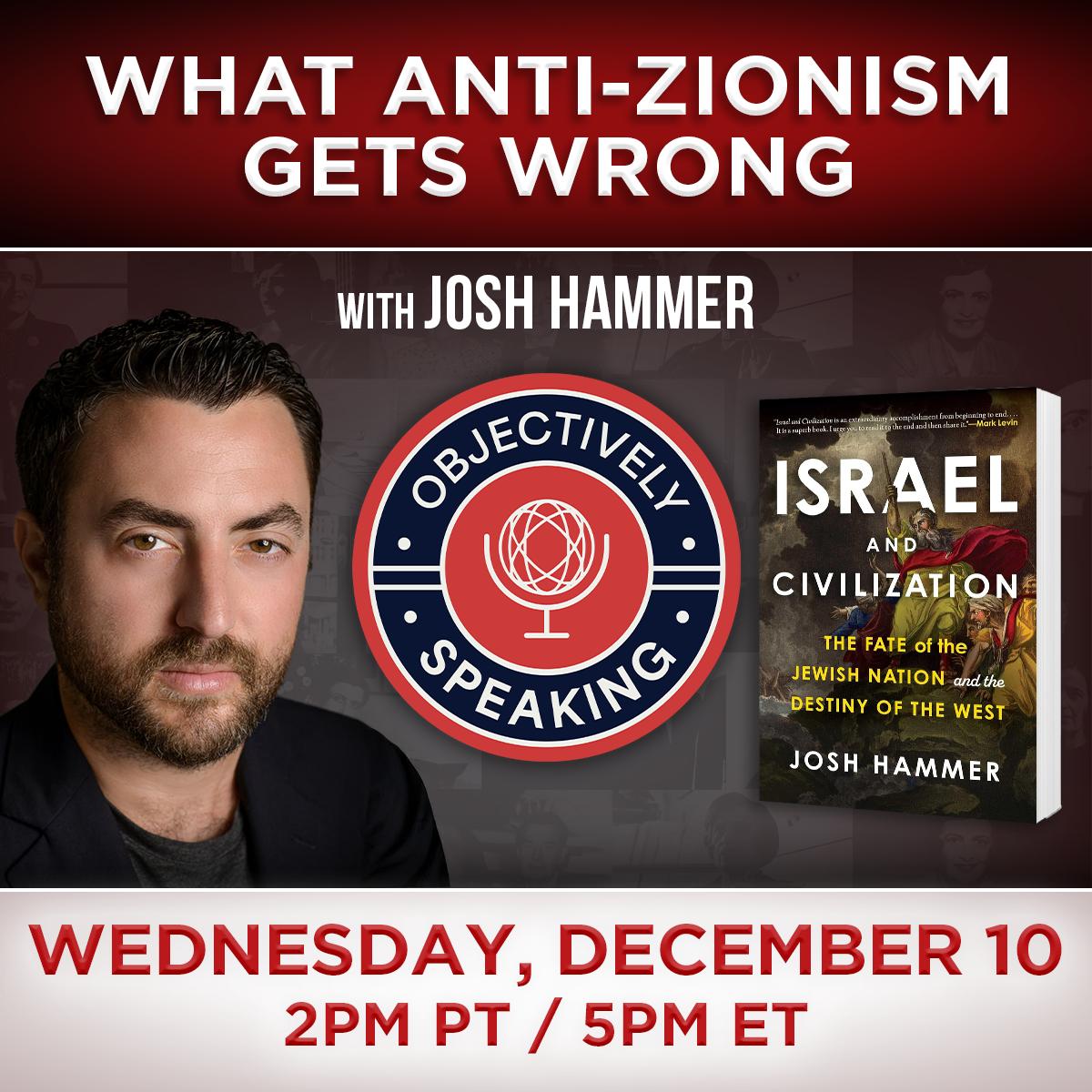
[00:00:00] Speaker A: Hey everyone, and welcome to the 280th episode of objectively speaking. I'm Jag CEO of the Atlas Society. I'm very excited to have Josh Hammer join us to talk about his book Israel and Civilization, the Fate of the Jewish Nation and the Destiny of the West. Josh, thank you for joining us.
[00:00:21] Speaker B: It's my pleasure. I really appreciate you having me on.
[00:00:24] Speaker A: So I first, I enjoyed how you wove your own personal story into your manifesto about the state of Israel and the fate of Western civilization. How did events in your childhood like 911 shape your political trajectory and how did that trajectory influence your relationship with Judaism?
[00:00:50] Speaker B: Sure, so lots went back there. So I grew up in a very assimilated Jewish household. We were aware that we were Jews. We would do some basic rituals, like we would light the Hanukkah menorah and wrap presents and we would go to kind of an abridged Passover Seder and then maybe eat a slice of pizza after the Passover Seder, which is of course a big, a big no, no. But I, I really was, I, I don't think I knew what the Jewish Sabbath, what Shabbat was until I was in my teenage years. I, I, a lot of people say like how can that really be true? I'm telling you what, it actually was true.
I don't think I had, I genuinely just think I ever experienced it, honestly. So having said that, I unlike people in deeply assimilated settings like that, my politics were never of the left. My politics had been of the right really since my very first political thoughts. So I grew up in Westchester County, New York, about 25 miles north of the city, right out right on the Hudson river in a town called Sleepy Hollow, New York, in know home of the Headless Horseman. For those of you who have were familiar with the old ghost tale and all that to say that on 9 11, on September 11, 2001 when I was in seventh grade, I was 12 and a half years old, you could see the smoke from the Twin Towers because it was right there up the Hudson River. And at the age of 12, I think I was able to morally intuit, even if I couldn't quite phrase it as such, that this is an act of profound evil. And it stands to reason that if there's evil in this world, then there's also good in this world because it just, it beggars belief that the world would be created and that creation would possibly exist solely for the perpetuation of evil. So if evil exists, then good must exist. And You've, you're, you're essentially already a conservative. When you've arrived at that conclusion, you, you've removed yourself from kind of the, the, the John Lennon imagine utopian, the utopianism that has really defined left wing movements for hundreds and hundreds of years, ever since Robespierre and the Jacobins and the French Revolution and so forth there. So I, I really kind of was that guy, so to speak. So I, I kind of came of political age, middle school and high school, Germany, Bush administration.
So I was that guy back in high school who was defending, for instance, Guantanamo era waterboarding policies against 25 liberal classmates. Now, you know, my own foreign policy views are a little more nuanced today than they were back when I was in high school. But I guess we'll hold that aside just for now. So I guess the next step then in my journey was at some point towards the end of college, maybe in my early 20s, I started giving a little more thought to what it actually meant to be a conservative, what it actually meant to be on the right. This around the time that I was graduating college, moving to Washington D.C. kind of surrounded by the political milieu there in Washington D.C. and for the first time I kind of did somewhat of a deep dive. I kind of did the reading, so to speak. And I consistently came across thinkers, writers over the past two, two and a half centuries who have said over and over again who have exalted the importance of tradition and, and how it is a core conservative tenet to pass one's own tradition down from one generation to the next. This is a theme of thinkers like Edmund Burke, Roger Scruton, Michael Oakeshott. I mean, there's more. Russell Kirk, famously in the United States, there's too many examples possibly to count. So as an intellectually curious young Jewish man, I think you have to start asking yourself if this makes sense and if I believe this intellectually, then what is my own tradition? Well, actually I'm a Jew. I come from an unbroken chain of tradition going literally all the way back to Mount Sinai. I mean, frankly, actually even further back than that, all the way to Abraham the patriarch. So that's actually kind of very slowly how it began. Jennifer. Actually, I was profiled in a recent profile in Mishpacha magazine, which is a Haredi, an Orthodox Jewish magazine. It's a long six and a half, 7,000 word profile, a very, very good job, written by my dear friend Ellie Steinberg. And in the article he says that Josh Hammer found Orthodox Judaism from Edmund Burke, which is a very Funny way to phrase it. I wouldn't necessarily have. Have phrased it that way myself, but it kind of actually is. Right. So that, that's. And to be clear, the religious journey didn't happen overnight. It wasn't kind of like a wow, like, this makes sense, I'm going to actually do it. No, it took years and years and years and years. I mean, the journey never ends, right? I mean, I think any religious person says that you're on a lifelong journey and it never ends. So I'm very much still on this journey. But that's, that's more or less kind of the, the Cliff Notes version of the answer there.
[00:05:11] Speaker A: I'm curious about your process in writing this book. How long did it take you? I'm asking that because it came out just this past spring, yet it's very up to date with some of the concerning trends we are seeing on the political right.
[00:05:27] Speaker B: Yeah. So, you know, you know, I, I'm a syndicated opinion columnist. My opinion column runs in a bunch of newspapers and websites. I'm a lawyer by background, so I published law review articles. I've written for lay journals, academic journals. I basically had done everything you can do in writing other than write a book. So I knew that the time in my career was such two and a half, three years ago that it was really time to start thinking about what a book should be. And when I started really diving in a little more earnest in the spring of 2023, I guess would be. So two and a half years ago, I initially planned for something totally different, kind of like more of like a standard. I'm a conservative pundit. Here's my manifesto for the future. You know, that kind of thing. You know, I'm being a little tongue in cheek here. I'm sure it would have been better, better than that description, but something along those lines. And then October 7, 2023 happened. And a friend of mine, a couple of weeks after the pogrom, suggested to me that maybe you ought to write about this. And it immediately clicked. And specifically, the reason that it immediately clicks is not necessarily for the pogrom itself. To be clear, the Hamas slaughter on that horrific day was unspeakably, unconscionably awful. I've been to those places. That's how I begin, actually. Chapter one, the book describing my visit to those places, it indeed was unconscionably awful. But the mere fact that the Jewish people had a pogrom is not necessarily itself reason to write a book. After all, the Jews tragically have been the subject of countless such slaughters over the thousands of years of their history. The reason that I wrote the book is because of the reaction to the pogrom that the world had a brief window where it could have been morally clear, it could have been absolutely crystal clear as to who it will stand for between this free and flourishing people, this free and flourishing nation, the birthplace, the origins of the Bible, and therefore Western civilization on the one hand. And on the other hand, you look at this 7th century aspiring SHRI, a supremacist jihadist death culture, and the world could have said, okay, this is actually not a very difficult decision. I side with the former, not the latter. But the fact that it actually was a difficult decision. The fact that 30 plus Harvard University student groups affixed their name to some letter saying that the Jews of Israel were themselves wholly morally culpable and responsible for their own wanton slaughter, the fact there were statements and statements like that over and over and over again, that really is ultimately what galvanized me to write the book. So when I actually started getting pen to paper was probably around March or April of 2024. So about a year and a half ago, I guess, give or take a handful of months after the pogrom. I kept on updating it over the course of the manuscript. So there were various things that happened. For instance, there was Israel's aggressive war against Hezbollah in Lebanon, culminating in the assassination of Hassan Nasrallah, the chief jihadist of Lebanon, in Beirut last September.
And I think the final addition I made right before it went physically to the press was after Bashar Al Assad was toppled. I think I actually, I actually can't quite remember if that made into the book. That might have been, that might have been right around the time that the absolute final edits were made. I submitted the final version of the manuscript probably around mid, mid October, with some absolute final tweaks. Very, very minor stuff throughout November, maybe into early early December. So the whole writing process more or less took, I would say, six to seven months at the most, give or take.
[00:08:43] Speaker A: That's pretty impressive. So in the book again, you're weaving some personal narratives with the topics that you' covering and you recount being heckled on campus by pro Hamas mobs when giving speeches, often on topics having absolutely nothing to do with Israel. And I can relate since in the spring of 2024 I was assaulted by a pro Hamas protester while speaking at Mercer University again about Atlas Shrugged and capitalism having nothing to do with Israel. So I'm curious, on a personal note, how would you advise speakers to handle such disruptions, especially now with political violence seemingly on the rise?
[00:09:29] Speaker B: Well, it's a, it's a good question. So the first thing that I hate to say, but you're totally right that political violence is, is on the rise. And we have to just, just state that, observe that it kind of just is what it is. I mean, Charlie Kirk was a, was a personal friend of mine.
I mean, we talked almost every day over the final year, year and a half, his life. And it's just been absolutely unconscionable. It's been appalling, it's been horrific. Charlie's assassination was the culmination thus far of America's descent into the chaos of political violence.
Primarily, if not exclusively left wing political violence, I might say. But it's bad. And I think that anyone who is venturing to speak on a university campus, who is not crossing all the T's and dotting all the eyes about campus security, you're not doing your job, you're not doing your due diligence. You absolutely have to make sure that security measures are currently there in place when it comes to things like armed security, when it comes to metal detectors and all the various other basic things that you ought to do to make sure that you protect yourself.
I've done any number of campus events, both undergraduate and law school can be my local legal training.
And I am cutting down on them now. I'm not going to give it up. I actually just did an event at Florida Atlantic University here in South Florida, where I live, about a month ago or so. So I'm not, I'm not giving it up. But you do have to be a little more selective and make sure that security protocols are in, are in place. At the same time, I do think it is imperative that you, that you not just, just give them the heckler's veto or as the case may be tragically, the assassin's veto. You can't, you can't give them that. You cannot give the, the forces of civilizational arson, of wokeism and so forth there. You cannot give them the satisfaction of thinking that they have actually successfully booted you out of the arena. So, you know, two things can be true at once here. One is that you have to take all those precautions. Two is that you, you do have to, makes, make an effort. Still, still to show up. Now, as far as the attitude that a speaker should have when you're, when, when you're looking at very angry people, look, it's not fun. I've Done it any number of times, speaking on any number of different topics there.
[00:11:38] Speaker B: This is where conviction, I mean, this is where core conviction, if you are genuinely confident in what you are saying and you believe it not merely to be true, but also to be actually important, and not merely important for you or your friends, but actually important for your community, for the country, for the world, etc. There, then I think that conviction will get you through situations like this.
[00:11:58] Speaker A: So you write that the pro Hamas campus insanity of 2023 and 2024, which we both experienced, can be understood as, quote, the chickens of a uniquely toxic stew finally coming home to roost. End quote. Can you elaborate?
[00:12:15] Speaker B: Well, I think when you look at the rise of what is often described as intersectionalism, intersectionality, really modern wokeism, and this has been a very, very slow march through left wing circles, it started in many ways, as it often does in the academy. There's been a lot of great essays and books written on this. My friend Chris Ruffo of the Manhattan Institute had a great book on this a couple years ago talking about the rise of the Frankfurt School back in the 1960s with Marcus and Adorno and various other neo Marxist thinkers and how their ideas start to proliferate in the academy as far back as 1960s. And then you look at some recent elected officials. I look at Barack Obama as the first true elected official who is himself a product of the post Frankfurt School, post cultural Marxism academy. Barack Obama's entire worldview was shaped by the cultural revolution of the 1960s, 1970s. So what began at one point in the academy is no longer confined there. It very much is now trickling out after all the university students and so forth of 50, 60 years ago. They are the societal elite state. They are the ones who are in control of all of the organizations who are getting elected to public, to public service, who are serving in corporations, who are serving in Hollywood, Silicon Valley, et cetera, et cetera, et cetera. So from that perspective, this is in some ways the chickens coming home to roost. But even from a specific Jewish perspective, I mean, that's kind of the broader kind of cultural Marxism paradigm here. And to be clear, to kind of give like a very brief synopsis of wokeism, which I more or less use as synonymous with cultural Marxism.
[00:13:57] Speaker B: I view it as essentially being the old Marxist paradigm where you have this two tier oppressor, oppressed matrix. But instead of being oppressor or oppressed based on economic status, the patricians versus the plebeians and all that there. Now nowadays the woke cultural Marxist claim is that there are two tiers and the oppressor, oppressed matrix is based off of certain traits such as skin color or religion or gender or sexual orientation, et cetera, et cetera, et cetera. So in that way the reaction to the pogrom is the broader cultural Marxist chickens coming home to roost. But there's also a specific Jewish element here as well. So the timing is interesting because around the time that the Frankfurt School was really taking off in the academy in the late 1960s, that was Israel's second existential war. So the first would be the Independence war back in 48 to 49 after the modern state was founded. And then they essentially did all over again in 1967 in the Six Day War, which easily could have eradicated the modern Jewish state. Only 19 years into this experiment and miraculously, Israel won. They prevailed over the invading Arab armies on all sides. And I think it was around that time that this is really when the modern left started to very slowly turn on Israel because they immediately then saw Israel as not the David, but as the Goliath in the region. And they saw these quote, unquote, poor, quote unquote oppressed, quote unquote brown skinned Arabs as the actual little guy, as the David. I mean, let's hold aside some obvious facts here as to how there's dozens of Arab states, way more Muslim majority states. They are tiny little Israel the size of New Jersey. Let's hold some basic facts aside.
That's how the left's narrative from an intersectional lens started really to kick in. So with that premise, going back at this point almost 60 years to the late 1960s there, I think it's a pretty easy stretch then to get from that to some of the horrific things that were being said after the Hamas pogrom, that this was a liberation movement there, that the oppressed, quote, unquote, brown skinned Arabs did against the oppressors, that there's no such thing as a form of resistance that can be condemned, et cetera, et cetera, et cetera.
[00:16:05] Speaker A: So that is a perfect segue if you would talk about the emergence of the Palestinian cause in the mid 20th century and was there a role of the Soviet Union?
[00:16:19] Speaker B: So the, the modern Palestinian Arab cause does originate with the founding of the PLO with, with the Asser Arafat who was essentially brought out, out of, out of Tunisia to come back to the Holy Land to find this movement there, found this movement there. And it absolutely was egged on all along by the Soviet Union. So in many ways, the entire recruitment of the Asser Arafat out of Tunisian exile back to the land of Israel, to the Holy Land, this was, whether explicitly or implicitly, depending on the exact circumstances of the exact moment we're talking about there, the Soviets absolutely did play, play a role. And essentially what the Soviets were trying to do, this was the height of the Cold War, the 1960s. It's literally just a year or two after the Cuban Missile Crisis. Things are really, really, really tense. And every single region, every theater of the world has its own proxy wars, has its own proxy conflicts and things like that there. And they saw that the United States was behind Israel, not that the United States was exactly a robust supporter of Israel in those early years. By the way, Harry Truman did famously become the first president or the first world leader, I should say, to recognize Israel just 11 minutes after their declaration of independence in May of 1948. But frankly, you know, the rest of the Truman presidency, and especially the Eisenhower presidency were somewhat mixed.
So it wasn't like America was a great supporter of Israel, but they were broadly seen or perceived as being on the side of Israel. So naturally, the Soviets chose the exact other side. And they saw all along that if you can fabricate, and yes, it is fabricating this cause of a rival nationalist movement within this tiny, tiny sliver of land, they understood that this would not just be a discrediting of the biblical inheritance which the inherently atheist Soviet Union very much wanted to do, but frankly, more important for their purposes, they also saw that it would be a total rebuke of the United States and a rebuke of American geopolitical clout and power in the region. So if you look back at some of the quotes that some of the founders of the PLO actually said, Yasser Arafat says this once. There's a guy in the 1970s, I'm blanking on his name. It's in my book, Zuhir Mudin, I think was his name there.
They say pretty explicitly that there's no such thing as Palestinians, that this is a pure fabrication, that the Arabs of quote, unquote, Palestine are indistinguishable from the Arabs of Jordan, Syria, Lebanon, et cetera, and. And how all of this is ultimately just an information and geopolitical warfare operation. But the intended effect of trying to eradicate the state of Israel just kind of made this a little more personal for you. I think it's important for folks to realize that prior to 1948.
[00:19:06] Speaker B: The plot of land, the land of Israel between the river and the sea, as the jihadists call it, what was for a time called quote unquote Palestine. And this goes back actually to Roman times. So after the burning of the second temple in the year 70, the Romans tried to de Judaize the region by stripping the original name of Judea from the Bible and then renaming it as Palestine, which is kind of an old play on the old Philistine civilization there. But they gave it a Roman name trying to Romanize it. Then after World War I and the Sykes Picot Treaty and when the European powers start to carve out the Middle east, that's when Britain acquires control over a lot of territories, but among them the Holy Land, among them the land of Israel. And at the time it was referred to as Mandatory Palestine because it was the British mandate for Palestine. So from roughly 1920 until 1948, that plot of land was, was called Palestine. That doesn't mean the Jews didn't live there. Of course they did. In fact, I would encourage the viewers when you, when you have a moment, go on Google and Google Palestinian soccer team, 1930s, you will literally see a bunch of Stars of David, gold Stars of David on blue uniforms. And, and you'll see that the players names are not Ahmed and Muhammad. They're like, you know, Shlomo and Cohen and Goldbaum, et cetera there. So that was the quote unquote Palestinian soccer team. My wife's late grandmother was born in, I believe, I think 1941 or 40, right around then in the Land of Israel, before the state of Israel came into being. So she was a Jew who had a quote unquote Palestinian passport.
So none of this exists. Okay? It is a. It is all fake. Jews and Arabs lived in this part of the world continuously for millennia, even even after the destruction of the second temple in the year 70. There was always some Jewish presence there in the Holy Land. Always, always, always. Maimonides, one of the great medieval Jewish sages, famously describes his visit to Jerusalem, his visit to spot in northern Israel. There were always Jews there. It was called the issue Jews actually living in the Holy Land all throughout the 2,000 years of the Diaspora. But again, this notion of a specifically Palestinian Arab nationalist cause, it is utterly without precedent at all, frankly. Arab society is not particularly nationalist in general. It's much more of a tribal structure. When you think about how Arab society is actually governed really to this day. Actually when you look at Palestinian Arab clans in Judea and Samaria, the. They're mostly clannish or tribal, local sheikhs, local warlords. They're really not big on kind of the Westphalian notion of a modern European, North American nation state. So it's all a ruse. And it was all done for the express purpose of trying to eradicate Israel and thereby for the Soviets try to undermine their great geopolitical power, the United States of America.
[00:22:01] Speaker A: So as an objectivist, I expect that you and I would find little agreement when it comes to, to many aspects of the philosophy, certainly when it comes to the virtue of reason, which Ayn Rand called man's only means of gaining knowledge. But where we would find common ground is the role of private property rights, without which Rand says no other rights are possible. So tell us a bit about how private property has been viewed in the Jewish religious tradition and how that should inform Jewish views on socialism and Marxism.
[00:22:36] Speaker B: Look, anyone who calls themselves Jewish and a socialist or a Marxist, it's, it's, it's, it's totally incompatible. I mean, just a very basic rudimentary level. I, it's not intellectually feasible. You cannot, that's, that is a circle that cannot be squared. I, I mean literally, in the Ten Commandments itself, there are at least two commandments, I would argue, that violate the core tenets of socialism or Marxism. Thou shalt not steal and thou shalt not covet.
Literally, at least two of the Ten Commandments flatly fly in the face of, of socialist dogma. There's all throughout the Torah, the five books of Moses, all throughout the Hebrew Bible, there are repeated descriptions of what happens when one violates your private property. There are entitled, there are entire tractates of the Talmud, the Talmud being the compendium, the final version of the Oral Torah. Initially it was just given orally, passed down generation to generation. After the destruction of the second Temple, it was decreed that it had to be actually written out. That's the Talmud. There are entire tractates, entire treatises that go on for hundreds and hundreds of pages in the Talmud describing the most intricate details of private property, how you sell private property, how do you acquire private property? What about inheritance rights?
Can someone who has inherited from their father when, when is the age of eligibility or the age of maturity where he can sell his property to someone else? This notion of buying and selling property, of private real estate transactions, I mean, it is, it is completely ubiquitous. So again, I just don't understand how anyone can possibly take the, the opposite approach. And private property is a, is a, is a, is a core, absolute, core tenant. Now here's where it gets a little more interesting, is that private property is, is unambiguously there in the Torah, unambiguously there in the Talmud. I think what's more interesting would be kind of the three cheers for capitalism mentality, which I personally most associate with objectivists and with Ayn Rand's teaching and thought with kind of a. More let's call it Irving Kristol, who famously coined the term two cheers for capitalism. So in my book, in one of my earlier chapters, I think it's chapter three, I talk a little bit about the political economy of.
Of the Hebrew scriptures. And I argue that the political economy, notwithstanding its staunch support for private property rights, is a little closer to the. To the two cheers camp, where there are such things as tithing to the poor, such things as leaving the corners of your field to not pick up the grapes that fall from the tree to allow poor people to pick them up there. There's a huge emphasis on private charity and just communal obligations more generally there. So that might be something of a bit of more tension, I think, between the most traditional biblical worldview and objectivism. But certainly when it comes to private property rights, there is essentially no daylight that I can discern.
[00:25:29] Speaker A: So, Josh, you were born on Abraham Lincoln's birthday, and he remains for you a lifelong hero between the many Lincoln historians we've had on the show. In my recent interview with historian Wilfred Maclay, author of the Jewish Roots of Liberty, I thought I was pretty up to speed on Lincoln lore, which was why I was delighted to discover two more nuggets in your book. Would you tell us a bit about specific actions that Lincoln took during the Civil War which helped to illustrate his relationship with the Jewish people?
[00:26:04] Speaker B: Sure. So there's, there's a lot to be said about Abraham Lincoln, right? I mean, he's. In my estimation, he's.
I mean, he and George Washington are the two greatest leaders in history. I've always been partial to Lincoln. You know, it's funny, my childhood best friend was actually born on Washington's birthday. I was born on Lincoln's birthday. So we would have these arguments, you know, who was the greatest president? So I've always been a Lincoln, a Lincoln guy, really kind of through and through. So, I mean, there's many examples here, right? I mean, Lincoln famously gives this speech on the precipice of the Civil War in Trenton, New Jersey, In February of 1861, just about two months, give or take, prior to the opening shots behind fired at Fort Sumter in South Carolina.
And he refers to Americans as being part of an almost chosen people, deliberately evoking this language from the Hebrew Bible, from the Old Testament. And he did this over and over and over again. In fact, people who have studied Lincoln's speeches carefully note that he quoted the Hebrew Bible, what Christians call the Old Testament, much, much, much more frequently than the New Testament, which is actually fascinating. And I mean there's again a lot of examples here, but one that really kind of stands out is very close to his untimely death. He gave his second inaugural address in March of 1865.
Very terse speech about an op ed in length, 700ish words.
One of the, I would say, most outstanding bits of rhetoric and oration that he probably ever delivered. This is the speech that famously ends with the line, with malice for none, with charity for all, let us bind.
Bind the nation's wounds. Well that, that notion of bind the nation's wounds is a direct reference to, to Psalms, to the book of Psalms, chapter 147. In fact, Orthodox Jews, we say that psalm literally every single morning in synagogue actually. So that's actually what Lincoln is getting out there in his, in his famous stirring words, concluding one of his most famous speeches. One of my, one of my favorite anecdotes is as follows. So USS Grant, who was of course the general of the Union army, he issued an unfortunate anti Semitic edict at some point over the course of the war effort where he kicked the Jewish soldiers out of regiments out in a midwestern state. I can't quite recall if it was Illinois, Indiana, but somewhere around there. And this is the time, I guess, where you could get on your horse and buggy or on a train as the case may be, given the then new technology and you could find yourself in Washington D.C. and get a face to face sit down with the President of the United States. So sure enough, There are roughly 10 Jewish soldiers who were excommunicated who were unceremoniously booted from Grant's regiment there in the Midwest. And they find themselves with Honest Abe with Abraham Lincoln in Washington D.C. and the alleged conversation, which some historians doubt, but there's a lot of evidence that this actually happened. The alleged interaction goes as follows.
Abraham Lincoln says, and so the children of Israel were driven from the happy land of Canaan. And a Jewish soldier named Kaskal, who was kind of the spokesman of the group, says yes, and that is why we have come unto Father Abraham's bosom seeking protection. And Lincoln says, and this protection they shall have at once. And he immediately goes ahead and he countermands, he rescinds Grant's anti Semitic edict don't be too harsh on Grant. He actually formally apologizes, says this is wrong, I never should have done it there. So, you know, he's not the villain of the story, but Lincoln is very much the hero. Just one other quick other example. Lincoln was a, was a famously private person. He really did not particularly enjoy talking about his private life at all really for the most part there. And he was also not known to have a ton of social friends of like close personal friends. And in fact what historians say is that the only person that he ever identified in his entire life as being a quote, close friend that he ever, literally ever used that language for was another lawyer from his town of Springfield, Illinois who happened to be a Jewish lawyer named Jonas. This man named Jonas was the only man who Lincoln was ever known to describe as a close personal friend. So you know, for all these reasons, you know, he was not just an incredible leader, but he was also just an incredible friend of the Jewish people as well.
[00:30:19] Speaker A: What were some other instances of founding era leaders admiration of the Hebraic tradition, including some that you mentioned in the book, proposals to actually make Hebrew the official language of the fledgling republic.
[00:30:33] Speaker B: So this, this was actually the Hebrew language tidbit here actually initially dates back even further than the founding. So we can go back actually literally as far as the sailing of the Mayflower itself.
So William Bradford, who was on the Mayflower and ends up becoming I believe the second governor of Plymouth Colony after the boat land successfully in Massachusetts.
Bradford, going back to late 16th century England was a student of a well known Christian Hebraist in England by the name of Henry Ainsworth. Hebraism is kind of an outdated term. You don't really hear it bandied about very much these days. But it essentially refers to someone who was a scholar of the Hebrew scripture, of the Hebrew culture, of Hebrew language and so forth. So Bradford himself, who was the captain of the Mayflower, spoke about a thousand words, give or take, of Hebrew. And there actually was some chatter on, on the Mayflower about whether or not once they arrived, God willing in the New World to just ditch the English language and had this clean start and speak the language of the Hebrew Bible. After all, they saw, they saw themselves conscientiously as new Israelites, as fleeing their version of Pharaoh's oppression in Egypt and then crossing their version of the Red Sea. Now they didn't do it, they didn't ultimately do it, of course, that's why we speak English today in America and not Hebrew. But there actually was some, some initial chatter in Fact, Bradford actually described Hebrew as, quote, that most ancient language and holy tongue in which the law and oracles of God were written. In fact, after his death, actually, this is, this fascinating me. After his death, William Bradford, the captain of the Mayflower, believed that he would speak that most ancient language, Hebrew, with God and the angels in the world to come. So he was a genuine admirer actually of the Hebrew language. And it is true that there was some chatter at least about adopting the Hebrew language. It's not necessarily something that ever came particularly close to passing. But there was a French general who served alongside George Washington during the Revolutionary War. His name was Marquis de Chastelou. And he famously said that Americans, quote, have seriously proposed to introduce a new language and some for the public convenience, would have the Hebrew substituted to the English taught in the schools and used in all public acts. So it was. There's a man who literally fought alongside Washington.
They were genuine admirers. George Washington himself famously was a great admirer of the Jewish people. He has this incredible letter that is often quoted that he wrote to what was then the fledgling republic's largest Jewish community, the community in Newport, Rhode Island.
And Washington famously writes to the Jews of Newport, Rhode island in 1790. He says, quote, the children of the stock of Abraham who dwell in this land shall sit in safety under his own vine and fig tree, and there shall be none to make him afraid. In fact, if you look on the back of the $1 bill, you will also see that in the national Seal, by the way, Benjamin Franklin won the national seal to be Benjamin Franklin to be Moses crossing the Red Sea with the Israelites. So they also won that as a national seal ends up being rejected. We chose something else which is still new today. If you look carefully in the back of the national seal, you will actually see a small Magen David, a small Star of David. And although this is a point that is disputed among the historians, there are a lot of historians who say that that was George Washington's way of thanking his good friend Haim Solomon, who was a Polish born Jewish merchant, very prominent Jew during the time of the Revolution, a great financier of the Continental Congress and the colonist cause in the revolution itself. So a lot of folks say that that Star of David that's in the national seal to this day. A lot of historians say that that was Washington's way of kind of giving a head nodded of thanking Haim Solomon. There's too many other examples to count there. I guess I would just give one more. There's an Amazing quote from John Adams, who was probably one of the most pious, religiously devout Christians of all the American founders.
He has this incredible 1809 letter that he wrote to someone named Francois Adrian Vanderkemp, and he says the following. He says, well, I will insist that the Hebrews have done more to civilize men than any other nation. If I were an atheist and believed in blind, eternal fate, I did still believe that fate had ordained the Jews to be the most essential instruments for civilizing the nations. If I were an atheist of the other sect who believe or pretend to believe that all is ordered by chance, I should believe that chance had ordered the Jews to preserve and propagate to all mankind the doctrine of a supreme, intelligent, wise, almighty sovereign of the universe, which I believe to be the great essential principle of all morality and consequence of all civilization. I mean, that is extraordinarily powerful stuff, right? I mean, there's, there's a lot more that came from Hamilton himself was a huge, huge, huge friend of the Jews. But, you know, for now, I think that kind of paints at least somewhat of a picture.
[00:35:19] Speaker A: All right, we're going to dive into some audience questions here, including my modern Gault. Always great to see you. No, actually, Kingfisher. Sorry, Josh. Is there a specific thinker, ancient or modern, who most shaped your worldview?
[00:35:37] Speaker B: That's a very good question.
In my worldview has at times fluctuated. Again, I've been on the right my entire life, so I, I, I, I, I, I fluctuated at times within, within the right.
I, I. Look, I mean, this is kind of a, kind of a cliche answer, but I mean, if I won't shock the audience, given what I just said, I, I, I think that Moses, based on what you see, the actual character of Moses, how he acts and leads from the book of Exodus through the book of Deuteronomy.
I've tried at times really to really try to learn as much I possibly can from that. I mean, that would kind of be the ancient example of someone who I've just been very influenced by as far as later Jewish thinkers, I think, who have really kind of deeply influenced my way of thinking about Judaism and the Bible and how it interacts with the modern world. I'm a big fan of. I mentioned him earlier, actually briefly of Maimonides, which we refer to as the Rambam, who was living and writing around the 12th century, give or take. They're oftentimes referred to as the Jewish Aquinas.
[00:36:41] Speaker B: That description works to an extent. But they were thinking and Writing more or less around the same time, grappling with a lot of the same questions. I'm a huge fan, certainly of the Rambam. I really enjoyed visiting his tomb, actually, in Israel. That was about three years ago or so. That was a very cool experience for me in the city of Tiberias. I. As far as modern leaders, I mentioned Lincoln. Lincoln is kind of my. It's kind of my lodestar when it comes to what it means to be a leader there. So those are kind of just some examples I could give some more modern book authors and essayists and so forth, too. But as far as historical leaders, I would say those three. Winston Churchill, maybe, if you want to name a 20th century figure there. Those are some of kind of my historical lodestars right there.
[00:37:26] Speaker A: All right, here's the question from my modern Gault. He says it's commonly accepted that cultural Marxism came out of the universities, but how did it get inserted into our education system in the first place?
[00:37:39] Speaker B: So slightly outside my realm. Expertise of them. Just being very candid with you. I, you know, I would, I would encourage you to check out Chris Ruffo's book, who does a much deeper dive on this, frankly, than, than I could ever do Justice. The short answer is that a lot of these folks moved to America and found people at that time who were already. Who were already itching to upend the status quo, and they managed to insinuate themselves into positions of power. You know, let's not forget that when William F. Buckley wrote God a Man at Yale, that was the early 1950s. I mean, Buckley was in his 20s when he wrote that, if not mistaken, I mean, this was 1951, 52. That was a very, very long time ago. And he was decrying the communism and the militant secularism and the hostility to Western civilization and Yale. So that was called 10, 15, 20 years, depending on where you want to market, before the real ascent of the cultural Marxists and the Frankfurt School into the American Academy. So the seeds were absolutely already there. I think all you had to do was find yourself in America, get immigration paperwork one way or the other. You. And then find some already sympathetic people there who are already deeply unhappy with, with Western civilization, with freedom, capitalism and so forth there. Find folks there who would be willing to kind of give you a position where you could then preach and kind of indoctrinate a whole new generation. So that, that's kind of my basic reading the history. But, you know, I think Chris Rufo's book two years ago probably would do a much richer job of that.
[00:39:09] Speaker A: All right, so the protesters that you and I have both encountered on campus have as their rallying cry, as you've mentioned, from the river to the Sea, which essentially would entail the removal of all Jews living in Israel by one means or another. Doesn't that just suggest that anti Zionism is really a fig leaf for a genocidal hatred of the Jewish people?
[00:39:33] Speaker B: Yes, the short, the short answer is yes. Look, prior to the founding of the state of 1948, the Zionism debate was an interesting intellectual question, right? I mean, this, this ancient civilization that goes back thousands and thousands of years.
And by the way, the Jewish people never, never cease longing to return to Zion, to the, to the, to the Holy Land. You know, Judaism is, is quite different in some ways than Christianity. We share a ton in common. You know, roughly 75% of the Christian Bible is the Hebrew Bible.
And there's, there's a ton in common. And I, and I, and I emphasize those points of commonality all throughout the book. But one way in which Judaism is a little different is that this notion of the English word faith, which a lot of people use to describe Christianity. I don't think Judaism is really a faith. Judaism to me is an ancient nation. It's the Hebrew nation, the Israelite nation, which for the past 2000 years has oftentimes had a large diaspora component. But part of being a nation is that you are attached to a certain part of land.
I mean, I sometimes joke that the first Zionist document ever produced is the Torah is the literal word of God itself. Large parts of this book are about the children of Israel, of the Jews finding their way back to the Holy Land. I mean, this is a huge part of that particular book. But nonetheless, prior to the founding of the state in 1948, there was an interesting intellectual debate as to whether or not the state should be reconstituted now, whether it should wait until the coming of the Jewish Messiah. So there were a lot of Haredi Jews which the media referred to as, somewhat tangentially as so called ultra Orthodox Jews. A lot of Haredi Jews objected intellectually and philosophically to Zionism because they said that we can't actually bring all the Jews back to the Holy Land until the Messiah is here.
That argument ultimately did not carry water. There are still nonetheless plenty of Haredi Jews who are philosophically anti Zionist today. The key point though is philosophically, it's somewhat of an interesting academic discussion without much of a practical difference. So for instance, you know, before we went live here. You and I were kind of having an informal back and forth about Chabad. Chabad is a Hasidic Haredi movement. Chabad is intellectually, philosophically anti Zionist for the reason that I just said you will never see a State of Israel flag in a Chabad synagogue, because as a theological and philosophical matter, they would have preferred that the Jews not come home until the Messiah is here. Nonetheless, in practical terms, if you ever talk to any Chabad rabbi, they have virtually indistinguishable views on any of these issues than me or any prominent right wing members of the Israeli government.
So a lot of this ends up being a philosophical distinction without any kind of a practical public policy difference that is totally, totally different than the keffiyeh clad crazies.
You know, whether it's them or whether it's the, you know, the awful Nick Fuentes, Candace Owens people and the quote, unquote, right, the folks were actually calling for Israel's destruction. If you are calling for Israel's destruction, then one of two things can be true. You know, here is the only way that I will say that you are not necessarily anti Semitic if you are calling for the end of Israel. If you are such a committed George Soros style globalist that you actually intellectually oppose the very existence of the nation state, and you oppose with equal ferocity the end of Israel, much as you oppose the end of Italy, France, Germany, Brazil, Paraguay, Japan, India, the United States, Canada, wherever, Fine. I'm not going to call you anti Semitic for holding Israel to the same standard that you apply to the rest of the world. But if you are so focused and if you are disproportionately dedicating your time to calling for the eradication of war, one tiny state, and you're doing so with this genocidal rhetoric of from the river to the Sea, which says that all the Arabs should be in control. We know from thousands of years of history what Arab control of lands where Jews and Christians live, what that means for the Jews and Christians. It frankly means nothing good.
So that, that's very different than taking the, the intellectually consistent kind of hardcore Soros global position that there's no such thing as an agent there. So if you are, if you're calling for the end of Israel, and that is really the only issue that tends to preoccupy your mind, then by definition you are advancing an anti Semitic policy, whether you realize it or not.
[00:44:06] Speaker A: All right, we have, I think 14 minutes left and I want to leave enough time to talk in a Little bit more depth about the rise of antisemitism on the right. So maybe a quick answer to this.
Despite ongoing challenges, you cite the 2024 Happiness Report, which found that Israelis were the fifth happiest people in the world and the most happy non Nordic people. What accounts for this.
[00:44:33] Speaker B: As far as happiness levels? Look, I mean, Israel is a happy society on most metrics. I'll try to get my answer brief because they have a sense of purpose. When you have purpose, that is really when, when you are able to, to have children and have a view of the future. You know, there's been all sorts of interesting public policy debates here in the United States, definitely in Europe when it comes to trying to boost our sagging fertility rates. And there's been all sorts of ideas about how to structure the tax code and then this and that there. And I'm sympathetic to some of these proposals, but there's really no better medicine for trying to make people date and get married and have children again than just just, just giving them hope and a sense of optimism and purpose for the future. And Israelis, whether they are religious or even quote, unquote, secular, by the way, a lot of more quote, unquote secular Israelis actually are oftentimes much more traditional than the word secular here in America would, would imply.
So they have a sense of purpose. They know what their civilization is. They know what they're doing in the year 2025 in this plot of land, in the same land that Abraham, Isaac and Jacob and Moses and. Well, actually not Moses. That's kind of the whole point. But a lot of the other biblical figures stood. They know that they have a sense of purpose and that they, that they are trying to pursue that purpose there. So I think a sense of purpose really is probably the number one thing overall that can guide people and try to instill them instead of trying to form families and have children.
[00:45:54] Speaker A: All right, so I wanted to talk about aipac. I wanted to talk about the Abraham Accords, and maybe we'll be able to squeeze that in, but we are running out of time. So I really want to focus on the rise of antisemitism on the right. Previously, the only personal experiences I had with antisemitism came from exchanges with individuals on the left. Well, not anymore. Where did this surge of anti Semitism on the right come from?
[00:46:23] Speaker B: So to an extent, it was there, lurking in the background, to an extent.
Now, I say that because I, I do remember the 2016 presidential election cycle. And this is when I first heard of Nick Fuentes. When I first blocked Nick Fuentes on social media and there were, I. I remember there was this one morning in August 2016, right before the presidential election, where I turned on my phone and I saw that there were just like a ton of just, just horrible gas chamber memes. Memes and all sorts of other disgusting Nazi stuff in my mention. So there was a little bit of this lurking the background all along. It obviously is in a totally different place today than it was then. And there, there are a few, a few things that I can point to. One is that there's been something of a ferocious overreaction in the opposite direction when it comes to foreign policy and for American engagement on the world stage. So the neoconservative boondoggles of the Bush era and so forth, their rock boondoggle, Afghanistan, there, a lot of folks who are younger have reacted without any kind of nuance. But just by saying that, okay, that didn't work. I'm not going to do the exact opposite.
When you start to go to the exact opposite of just hardline, Charles Lindbergh esque isolationism, it's not necessarily going, you know, it's not going to, it's not a shock anyone, that Israel will be one of the first casualties of, of your worldview.
The good news that there is such thing as nuance. I mean, there is such thing as, as having a nuanced position. In fact, President Trump has actually a very nuanced stance on foreign policy. He is a realist and nationalist and that's, that's basically what my foreign policy is. Well, but nonetheless, I think that that kind of equal and opposite reaction when it comes to foreign policy is part of it. There are a few other things going on as well. I think the number one reason, if I had to boil it down to the number one reason, there have been a lot of things that have happened ever since 2016 that I think have caused the American people to lose profound trust in elites, in narratives, institutions, and really just kind of cause them to question their basic sense of the ability to discern and distinguish right from wrong, up from down, fact from fiction, truth from lies, et cetera. And this information operation on the American people, this gaslighting of American people, if you want to call it that, in my telling of the story, goes back really all the way to the Russiagate's collusion hoax of 2016, this notion that Donald Trump is a Russian agent, this gobbled up two and a half years of the Trump presidency. Then you had 2020, which is a particularly chaotic Year when it came to the COVID 19 lockdowns and all the elites telling us that if you were a Black Lives Matter protester, you had a public health exception, but if you were not, then you had no public health exception there. Then we had the Biden presidency and they essentially decided to try to hide a mental patient for multiple years from the American people. We had the prosecution of a former President of the United States, trying to throw him in jail and incarcerate him and bankrupt him for every penny that he has raised. So a lot of things have happened to cause American people, I think, to question their basic ability to separate right from wrong. And when you lose your ability to separate right from wrong and to question objective morality in general and to lose sight of objective morality, well, there's actually historically been one group of people who have been most often the brunt of a society failing to grasp what is right and what is wrong. And that is the original Tory force bearers of objective morality, of monotheism, that is a Jewish people.
[00:49:59] Speaker A: All right. Now, even when you are not being heckled by specifically hostile activists, you recount that you often get the question from skeptical students who are some kind of variation of this. It's clear why the small nation of Israel might benefit from an alliance with the US but what does America get in get from the bargain? It's, it's more than a fair question. So you want to address that head on?
[00:50:26] Speaker B: Yeah, it's, it's a, it's a very, very fair question. Look, I mean, frankly, it's not just a fair question. It's a good question. We should, we should, America should ask this about, about every single country on the world stage. You know, I was meeting with the U.S. senator in D.C. i won't name his name because it was a private, off record conversation back, back in September. So just about three months ago.
And the Senator, who himself is pro Israel and is struggling with the current climate on the right when it comes to increased skepticism.
The Senator asked me how he could go about better trying to persuade his colleagues that Israel is an ally. And I said, senator, I will give you a clean and concise definition of what an ally is. An ally is a country that when the ally acts in its own national interest to further its own national interests, that America then benefits as a secondary or tertiary proposition. And I would speak to you, that test meets Israel extremely well. When you look at the terrorist organizations that Israel is at war with on a seemingly daily basis. When it comes to Hamas, when it comes to Hezbollah, when It comes to the Islamic Revolutionary Guard Corps in Iran when it comes to Kataib, Hezbollah, the Houthis, the Muslim Brotherhood, and on and on and on.
These are virtually all U.S. state Department recognized foreign terrorist organizations. So in the most simple manner possible, when Israel goes to battle against a jihadist, it's not just Israel that benefits is very much also the United States and Western civilizations.
I think to illustrate this in the most concrete terms possible, I like to use the following example. So last summer in 2024, Israel went on this Michael Corleone Godfather esque revenge killing spree trying to exact revenge on its enemies. And a lot of it was was centered around Hezbollah. This was the Beeper operation in Lebanon. And before they got Hassan Nasrallah, the long standing head of the Hezbollah Jihadist organization, they knocked off various other top rungs of the Hezbollah organizational hierarchy. Two of these upper echelon jihadis at the time were men by the name of Fouad Shakur and Ibrahim Akhil. Now Fuad Shakur and Ibrahim Akhil are the masterminds respectively of the 1983 US Marine barracks bombing that slaughtered 241 US Marines in Beirut, Lebanon. That was Shakur Akhil was mastermind of the bombing of the U.S. embassy in Beirut, Lebanon that very same year. These two men had U.S. state barn bounties, State Department bounties on their head of five and $7 million respectively for over four decades. And literally nothing happened until Israel killed them. So people say what does America get from this alliance? I think that is the most concrete possible way to show exactly what America gets out of this lines. There are any number of other side things there when it comes to technology. The cell phone, like the cell phone is really technology. A shockingly high percentage of the tech companies listed on the NASDAQ stock chains are actually based in Israel. So you get that. You get all sorts of intelligence sharing. There's a lot of other ways to answer this question, Jennifer, but I think kind of that Fuachakurt Ibrahim Occulexam really kind of brings home just the very clear unambiguous benefit that America gets from this alliance.
[00:53:44] Speaker A: All right, well, let's end on a positive note. A lot of what you recount in your book is really alarming and rightly so. But we should also take stock of positive developments, including the transformative Abraham Accords, some of the practical consequences of which you experienced when you and your wife traveled to the United Arab Emirates. There's a chabad in Dubai.
Hard to believe.
[00:54:11] Speaker B: Yeah, it's actually Multiple synagogues in Dubai and multiple synagogues in the UAE in general. And, in fact, it's actually amazing. So we flew after we got engaged. We got engaged about three years ago, married about two years ago. We flew from Israel to Dubai taking that Abraham Accords flight.
And I think I had tweeted or something that I was going to.
To the Emirates. And a rabbi, I don't. I can't remember if he's Chabad or some other Orthodox organization.
DM me. Message me on Twitter and said, what hotel are you staying at? I'll make sure that you have a Shabbat package waiting for you when you get there. And amazingly, we got to our hotel in Dubai and it was there. There's like, a little Shabbat package in her hotel room with. With a little. A little fake candle, like. Like an electric candle, a little. A little thing of grape juice, a little bread, a challah bread.
Amazing stuff. So, yeah, there are multiple synagogues. There's actually a small kosher supermarket in Dubai, and there's all sorts of kosher restaurants. There's an upscale kosher steakhouse, actually on one of the ground floors of the Burj Khalifa, the most famous building in all of Dubai, is also the tallest building in the world. It's, like, almost 3,000ft tall. There was a prominent upscale kosher steakhouse literally in the country's most iconic building. So, look, the Abraham Accords were an amazing generational breakthrough. If the Nobel committee were not just horrifically biased, Donald Trump would have gotten a slam dunk, no questions asked peace prize at that time. And it's a testament to the Accords that they've stuck through. You know, if they had been a flimsy agreement, then the October 7th jihad and the war that followed easily could have severed these ties.
If there were not strong, durable connections here, it's very easy to see a world in which the UAE and Bahrain could have said, you know, what? That was lasted, but screw you, Israel. You know, we're with Hamas. They didn't do that. Now, did they say all the right things? No. I mean, there were some statements from the Emirati government that kind of had me wincing. That's kind of just how it is. That's kind of how it is in the Arab world. The key things that the Abraham Accords are here to stay, and God willing, there'll be more peace where they came from soon. Rather something later.
[00:56:18] Speaker A: What is next for you, Josh? And where can we follow your work.
[00:56:22] Speaker B: So you can follow me all over? I'm on X Josh Underscore Hammer Instagram, Josh B. Hammer. My show, the Josh Hammer show is available via Newsweek's YouTube page, also over at the Salem News Channel or everywhere where you get your your podcast. I I'm a syndicated opinion columnist. My column comes up every Friday in a Newsweek, Los Angeles Times, Real Clear Politics, Daily Signal, New York Sun, Daily Caller and elsewhere. And as far as what actually comes next for me, I guess we'll see. But it's probably probably sooner rather than later, probably time to get cracking on that next book proposal. So we'll see what happens.
[00:56:56] Speaker A: All right. Well, thank you so much and thanks everyone else, almost everyone else joining us today. Please be sure to join us next week when Arthur Herman joins us to talk about his book the Cave and the Light, Plato versus Aristotle and the struggle for the soul of Western Civilization. We'll see you then.