Episode Transcript
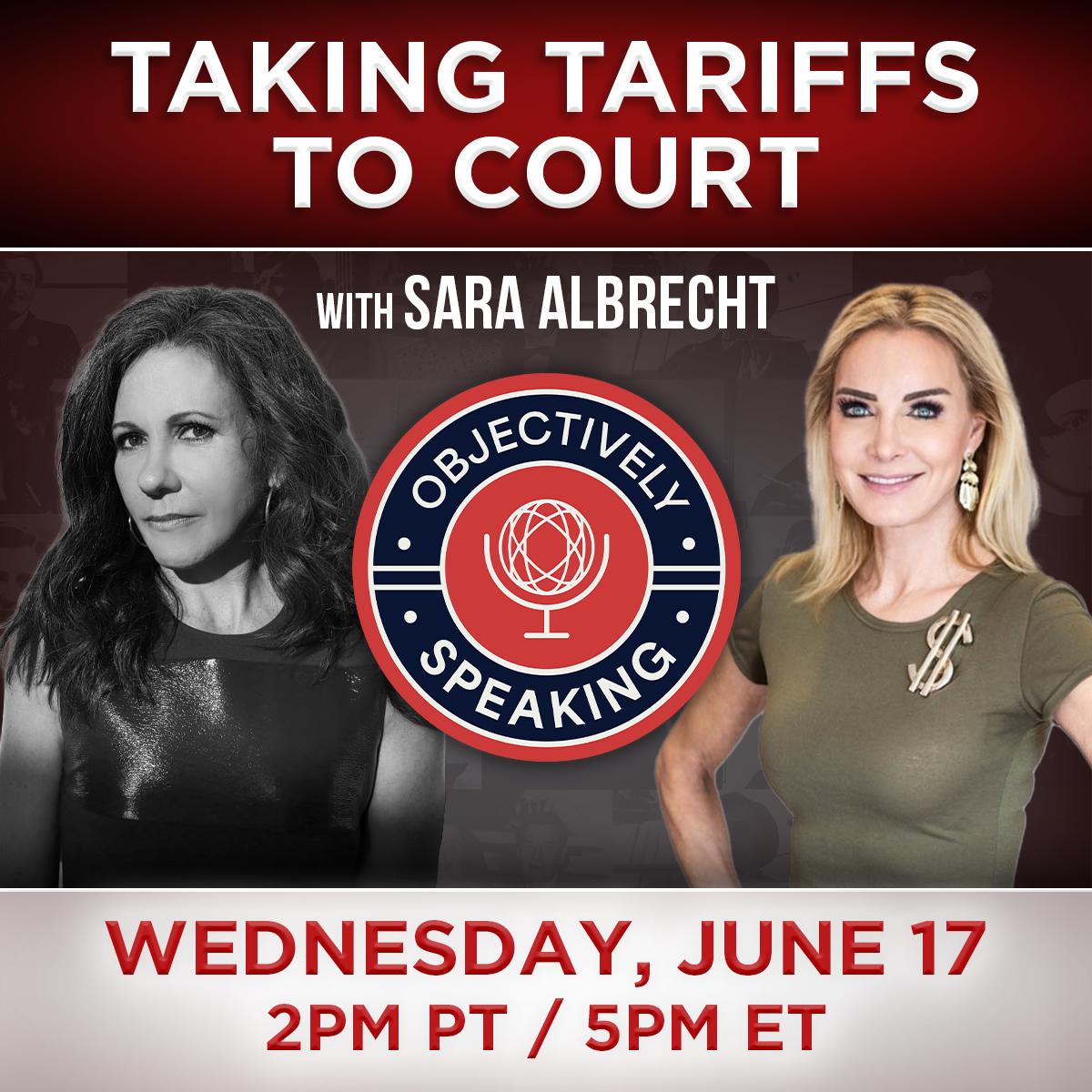
[00:00:00] Speaker A: Hi everyone. Welcome to the 307th episode of objectively speaking. I'm Jag, CEO of the Atlas Society. I am so excited to have Sarah Albrecht join us to talk about the Liberty justice center and its landmark Supreme Court victory that struck down President Trump's tariffs. Sarah, thank you so much for joining us.
[00:00:25] Speaker B: Thank you, jag. I am so excited to be here
[00:00:28] Speaker A: and congratulations again folks. If you haven't seen it, there was some really important coverage of Sarah and what it means for a small non profit like hers to go up against the establishment. So we'll get that link for you. But I know her phone has been ringing off the hook and in a good way. So.
So, Sarah, our audience is always curious about our guests backgrounds. Where did you grow up? I know you mentioned you were just running a hard copy of the Wall Street Journal over to your mom. Any early influences that shaped your career in business and in policy?
[00:01:09] Speaker B: Yeah, I grew up in Iowa on a farm, kind of like straight out of Central casting, the family farm that my mother grew up on. So it was just we all did what we needed to do to kind of get things done.
And that has really kind of stuck with me. And you know, you learn that, you know, actions have consequences and work matters and reality doesn't negotiate with you. Like the weather is doing something, then that affects your, your crops, something breaks, you fix it. So it was just kind of bad. Those values that I think have stuck with me through various careers. I moved to Chicago and put myself through college and then got an investment job and then taught. Hardest job I'll ever have is teaching. And then I ran a small retail business, which my work with the tariffs, I really reflected back on how hard it is to run a small business in the best of times, let alone when you have constantly changing tariff rates and expenses being thrown at you every morning that you wake up. So it really had a special place for me.
Just thinking back to people I'd worked with and struggles that friends of mine had had in small businesses. And so it was important and very special case.
[00:02:38] Speaker A: Yeah, I mean, trying to run a small business and dealing with the uncertainty and not being able to plan right proper, I can see that that really hit home with you.
The Liberty justice center filed suit just 12 days after liberation Day. Within days of the announcement, you'd already concluded the tariffs were unlawful. Walk us through that decision. What made you move so fast when most organizations were still trying to figure out what had happened?
[00:03:10] Speaker B: Right. Well, we knew that they were coming. So when the President started talking about the tariffs, we're like, okay, that doesn't sound exactly right. But, you know, keeping in mind, we're not trade attorneys, we're constitutional attorneys.
And some of us thought, like, well, this is never going to happen. He's just using it as a negotiating tactic, like throwing something at the wall, seeing what will stick, and then by the time Liberation Day rolls around, he will have moved on. So we kind of had it in the back of our minds, and then it was clear that it wasn't going to move on.
So one of the things that sets us apart from other organizations, because there are a number of organizations similar to ours, most of them are significantly larger, like 10x our size or even larger than that.
So we have to be nimble and quick and efficient with our resources.
So that's why we were able to move so quickly. That's kind of what we try and do.
We were actually in the middle of a strategic planning session.
And so on our way out to the conference center where we were all meeting, we were talking about this case in the car and started dialing small businesses that we knew that were either donors or just friends, saying, hey, these tariffs are happening. Is it going to affect your business?
And how is it going to affect your business? And, oh, by the way, would you like to be a plaintiff in a lawsuit that's going to sue President Trump? That's usually when the hung up on us, but it just, you know, we were out there and it was April 2nd when Liberation Day hit, and all of a sudden it became real. And I'm like, all right, guys, if we're going to do this, we're going to need to be first, we're going to need to be right, we're going to need to be good, and we're going to need to find the best plaintiff possible.
So all those things had to, like, come together in a really short amount of time. I remember one night I was at a theater engagement to go to, because I'm on the board of a theater, and the team was writing the brief, and we were trying to, like, nail down the last, you know, engagement letters with clients, and there were all these. I kept having to run out of the theater to take the call, and they didn't have an elevator. So I was running up the stairs to go outside so I could take the call and running back in. And at one point, I'm like, what is going on? Like, I have this, you know, theater life and other, you know. And then now we're going to sue the president and I didn't really have time to think about what that meant.
Yeah, I think maybe if we had all sat down and thought about what was about to happen, we might have taken a moment, but I don't think any of us would have changed or done anything differently. And we're, you know, just so proud of the fact that we were first. There are a lot of other organizations out there that filed after us and filed in different courts. That's something that was also important. We chose the right court to file in initially, and other people filed in different courts because it wasn't really clear where the jurisdiction was going to lay. So a lot of moving parts and it worked out. And, yeah, it's been a wild ride indeed.
[00:06:31] Speaker A: So the case itself rests on the argument that the President invoked the International Emergency Economic Powers act to justify the tariffs, but that a trade deficit is neither an emergency nor an unusual and extraordinary threat. End quote. So for listeners who aren't lawyers, why does that distinction matter so much? Constitutionally?
[00:07:00] Speaker B: Yeah. So I'll back up and explain a little bit about iipa, which is what you just described. And it's a lot easier to say IIPA than the whole name a statute that was passed in 1977. So you have to kind of think back to 1977. And yes, I can remember 1977, and we were coming off the gold standard, and there were a lot of stresses in the world and pressure points. And so this was an act that was passed kind of in response to some of those issues that were going on at the time.
And the act has nine different things that the President can do and use to, quote, regulate trade.
And so we're like, okay, fine, regulate trade. You can put fees, you can have quotas, you can have sanctions.
Not one of those nine things that you can do is tariff. The word tariff doesn't appear in the statute.
It just didn't come up. And so one of the arguments is if Congress really wanted this statute to allow the President to use tariffs, they would have spoken clearly and said tariff was one of the nine things that you could do or made it the 10th thing.
So it didn't say that. So for us, that was, first, red flag. Secondly, of those things and the way that it was invoked, there were no guardrails, there was no time limit, there was no amount limit. It was any amount, for any amount of time on any country, for any reason.
And when you start to look at a statute that has no guardrails, no boundaries, it also sends up a red flag because Congress would Not delegate power that is just open ended and just could be used for anything to the President. And they would speak clearly and they would say, nope, you can use it for 100 days if this happens, and only up to this amount and only on countries that do this.
So none of those conditions were present. So that was another red flag.
And then you look at our constitution and Article 1 says Congress has the ability to tax and tariff, like that's in their bucket of things that they are allowed to do.
So Congress is also allowed to delegate that power to the President. But when they do that, they do it with very specific guardrails and reasons and parameters and very narrowly tailored, as people like to say. So that wasn't present here. So it seemed. And nobody had ever tried to use IIPA for tear ups before. So I like to say he went into the dormant statute drawer and pulled out IEEPA and said, oh, let's use this for tariffs.
And we just felt that the risk was too great that this power and precedent would stand, not just for this president, but for any president of any party who could use this just broad expansive power on any one of a number of things. So it wasn't about the President, it was about the Presidency. It was about the separation of powers and it was about, at the end of the day, the Constitution and what our country was founded on.
[00:10:40] Speaker A: Right, because you voted for Trump. This was certainly not personal. This was about principle.
[00:10:46] Speaker B: Yeah, I voted for Trump three times. And I think it's important to say that because I hope that by talking about that publicly, people realize you can have a difference of opinion with the President.
It's not an all or nothing proposition. I like to say I like President Trump a la carte. Some things I like, some things I don't. I think we all need to step back and realize we're going to have differences of opinion with our leaders.
No one's perfect.
This wasn't about him.
We've sued President Biden a number of times also. I imagine we'll probably sue the next President if he does something that we feel is outside of the constitutional boundaries.
I hope that one of the things is people can step back and go, oh, I get it. Constitution matters. It's our 20th, 250th anniversary year. We should all be talking about the Constitution and what it means.
[00:11:48] Speaker A: Right. Well, I can see that our comment section is just going off the hook in a good way with a lot of questions. I want to get some of them because otherwise, you know, I have so many questions. For you. And we've got a lot to cover. So we'll be like, halfway through the interview and we'll have gone beyond these.
And these guys make my job earlier easier as well. Jackson Sinclair asks Sarah, do you think small businesses might have been falsely bullish for tariffs due to how the Trump administration marketed them?
[00:12:21] Speaker B: 100%, I think the country, and we talked about my mother before.
I think every time I talk to her, she said something about foreign countries paying the tariffs. And I'm like, nope, that is not who pays the tariffs. And so, you know, President Trump was brilliant in marketing this and, you know, explained to people that foreign countries were paying these tariffs. Well, anybody out there who has a small business knows that foreign countries did not pay these tariffs. American businesses, dead. American entrepreneurs, dead. American consumers ultimately paid the tariffs because the costs were passed on. Not always, but in a lot of cases, they had to be passed on.
So, you know, I understand we all want the deficit to be paid down, and we all want fair trade, and we all would like to, you know, have money from other countries coming back into our country, and we would all like manufacturing here. But the fact is, it's not a broad stroke of like, all these countries are going to be punished and all these industries. So our lead plaintiff, Victor, was a wine importer. Well, how do you manufacture Spanish wine in the United States?
You cannot.
We have a toy importer. Well, unfortunately, 90% of toys are manufactured overseas because there just isn't the infrastructure and cost structure that can support it in the United States.
So instead of the tariffs, I wish we could have a conversation about why manufacturing has left the United States and how do we change the regulations so that it can be feasible for some manufacturing to come back and be based in the United States, not all manufacturing. We shouldn't be, you know, we shouldn't have to manufacture everything here. But it should be the start of a discussion. And that's where I hope we get with some of, you know, the tariff misinformation out there. Because the one good thing also is now people are talking about tariffs and talking about trade and maybe starting to think, well, how are we going to change this going forward? And what really is the best way?
[00:14:41] Speaker A: Well, you talked about how your mother thinks or thought that tariffs work from a small business person's perspective. Let's say that wine importer break it down very simply, how a tariff affects his business.
[00:14:55] Speaker B: Yes. So small businesses, in this case, it was a 10% tariffs. Those are paid up front.
So your shipping container lands at the port you get 10% added onto your bill.
So while you, you know, ordered your merchandise and, you know, we're negotiating with your supplier, when it was loaded onto the ship, when it got off the ship, all of a sudden you had more expense. So your working capital was now going out the door, like, immediately without any planning. So in our wine importer's case, he had his shipments landed, he paid his tariff fees. The catch was, as a wine importer in the state of New York, he has to post his prices 30 days in advance.
So before the wine was loaded on, he posted his prices. When the wine arrived, his cost structure was completely different. And that ate up most of his margin. And a number of businesses experienced the same thing because orders had been placed months in advance. And by the time they got around to manufacturing and bringing those goods into the country, all of a sudden what you'd committed to sell a good for to, let's say a department store now was not the price that it was actually costing you. And department stores and larger businesses had all the leverage and said, sorry, we only are going to pay this, so you can either sell it to us at this price or we're going to cancel our order.
So all these things were going on.
The opportunity cost that was lost by businesses in this is just, you know, will never be able to be repaid back by refunds.
You know, if you have customers that are expecting this is what this good costs normally, and all of a sudden they come in the store and they're like, wait a minute, why is this so expensive now?
And if you want that customer to stay, you either have to eat some of that expense or they're going to leave and hope you can get them back later. So it was existential for small businesses when this happened. And the fact that, you know, then the rates kept changing and so you never knew. Like, I feel like there was a movie where the prices on the tote board kept changing. Well, this is kind of that same situation. And they had to keep, you know, there's only so many costs you can absorb in the supply chain. And that's kind of what was happening.
[00:17:29] Speaker A: All right, I like numbers. Asks whether losing on tariffs possibly led to a pivot by the administration to more military pressure. Like you saw with Venezuela and Iran. I don't necessarily see the connection, but
[00:17:46] Speaker B: I don't think so. I mean, they did pivot to different tariffs. So we won the case on February 20th at about 10:30 in the morning.
And by 2:00 clock that afternoon, he'd already announced A new tariff scheme using another tariff statute that had never been used, called section 122.
So he'd pretty much been telegraphing if he loses. I mean, I don't think he ever said if he loses, but, like, you know, we could always use section 122. And even in court, when the justices question that, they said, well, what about section 122, government?
Why don't you use that? And they said, oh, well, that's not applicable. That doesn't, you know, fit. We can't use that until they lost. And then they said, oh, by the way, that's what we're going to use. So I think it wasn't really a pivot to military. I think it was a pivot just to, you know, plan B and plan
[00:18:43] Speaker A: C.
All right, so a panel of judges issued a unanimous decision in May that the tariffs were illegal. And then the Court of Appeal for the Federal Circuit upheld that decision 7 to 4.
When you got that second ruling, what went through your mind?
[00:19:05] Speaker B: I thought, that's great, because I only had six judges in my scorecard that were on our side. So I kind of also felt like, okay, the dog that caught the car, like, now what? Now we're really going to the show. To use a baseball analogy and the Supreme Court and the pressure that this is really getting real and, you know, worldwide stage, certainly it was real before that, but it was.
We also knew we were going to be on an expedited path, like the fact that we filed April 14, and we were at the Supreme Court on November 5.
I know for businesses that were paying these tariffs and waiting for a verdict, it was an eternity. But in the legal space, it was lightning speed.
So, yeah, we didn't get a chance to enjoy the victory, and we just kind of launched straight into the next phase and started working on that. We'd had everything kind of like phased out from the beginning because we knew that ultimately this was such a huge decision and issue and constitutional issue that it would most likely end up at the Supreme Court.
So we were ready. But when it's all happening and there's 5 million other things going on around, plus the fact that we have an entire firm and 30 other cases that we were working on. So it was a lot. So I didn't really get a chance to think about seven, four, or whatever, I'm like, okay, we won.
[00:20:42] Speaker A: Now what next?
[00:20:44] Speaker B: Boom, boom, boom.
[00:20:45] Speaker A: Well, one question I have about next is, okay, the Supreme Court validated your approach, and now an estimated 166 billion in tariff payments plus interest are supposed to be refunded to American importers.
What's. How does that happen? I mean, are they actually going to see that money?
[00:21:08] Speaker B: Yes, they have been starting to see the money.
So what happened was.
And try not to bore you with all the legalese, but. So we went at the Supreme Court and you think, okay, great, they'll just start paying back the tariffs, right? No, we had to first of all kind of wait for them to issue an executive order to stop the tariffs. The tariffs weren't actually stopped until February 24th.
And then we had to go back to the Federal Circuit and say, okay, we won. And now we need you to rule on this injunction that you had set aside, meaning stopping the tariffs and refunding them. And so they did that. Then we had to go back down to the Court of International Trade, which is where we started, and say, okay, we need you to, like, implement the refund process and work with cbp, Customs and Border Protection, who controls the tariffs.
So that was a little bit of a delay. So by, you know, the beginning of March, we were back at CBP and working with a judge who had been assigned to all these cases because while we were working our way through the court system up to the Supreme Court, other companies had been filing to kind of preserve their rights to a refund. And so the CIT, which normally hears 70 or 80 cases a year, now is sitting there with a docket of about 3,000 cases in front of them, all of which they stayed, meaning they just said, hold on until we get a Supreme Court decision, because we can't really do anything until then.
So they were also overwhelmed. So the $166 billion, you know, the largest tariff refund in the history of the world.
Now, the CBP has always had a mechanism to issue refunds, so they knew how to issue refunds.
But at this scale, it was going to be monumental. So they built an entirely new system and they call it the CAPE system.
And so the judge said, okay, we're going to have like weekly reports.
So we all go into a closed conference room and have like a settlement discussion is what the judge calls it, and talk about the mechanics of this system and how it's going to work and, you know, who's going to be eligible in like the first tranche and, you know, just the time frame. And the judge was very like, you need to do this now because companies are suffering.
So they had a 45 day time period. By April 20, CBP had built out this whole new system. They'd made it, in my opinion, very simple and very easy for small businesses to understand and file for themselves. Like, if you can file, you know, some of your taxes, you can file this. They could have made it a lot more difficult. I really commend them for the work they did to make it functional.
So April 20, the system opens.
Everybody starts filing for their refunds. Of course, the system, you know, blows up and is offline for 18 minutes, but it gets back online and it's working.
So then the next part is, okay, well, how. When is the money actually going to flow? Well, May 11, the first refund check went out. And by check, I mean it was a direct deposit because they don't issue checks anymore. So money's flowing, and then we're like, okay, well, when is it all going to be out? So right now, by the end of June, they are estimating that $40 billion of the 166 will be at the Treasury Department and in people's accounts, or actually the 40 billion will be in people's accounts. There is another 55 billion that will be waiting. That has been approved and just has to go through, like, the final process and get transmitted to treasury and then that will get sent to people's accounts.
That's all in phase one. Now, there's also a phase two, which, if you had what they call reconciliation on your entries, that goes into phase two because it needs a little bit more information and a little bit different way to process it. That will be the next group of refunds, and that will be about $28 billion that will be dealt with.
And then phase three is this thing called final liquidation, meaning if you paid.
It's basically the people that paid the tariffs first when they were first put on the fentanyl tariffs in February of 2025.
So those entries have kind of what they call liquidated, and they need a little bit extra time to account for the fact that they were paid so long ago.
[00:26:03] Speaker A: They're.
[00:26:04] Speaker B: The government's not arguing about the money going back to the people. They're just now trying to figure out how to get that last tranche of refunds out the door.
[00:26:14] Speaker A: Yeah, you know, I'm not. I hate to be. I mean, I'm thrilled that this managed to happen in an expedited way, which is unusual for government.
But, you know, especially with so many cases of fraud and Medicaid fraud and all. All of these different.
I. I just. I can't help but worry that they're going to be. Oh, yes, I'm an Importer and the. This is my fake website and this is, this is my fake receipt. And you need to send me, you know, $10 million.
[00:26:48] Speaker B: I don't think there's going to be as much of that here. I know a lot of that went on during COVID and that's certainly a concern. But just the way that cbp, I mean, they, they know everything that comes through the ports because, you know, it's also security for the country and they have to track everything and that has to match up to then what gets, you know, applied for for the refunds. I think the bigger issue here is, and those are probably going to get me into trouble, attorneys that are taking fees and making promises that they can't, attorneys can't speed up the process. You can take a fee and you can pay an attorney, but you're all going to end up in the same queue and you're just going to be wasting money if somebody's out there making promises that you're going to get your money faster or more money or whatever. So that's what I'm more concerned about. And also, you know, these brokers that pop up overnight to say, oh, we'll do all your filing for you and then take a fee. So I think some of them are great and will do a good job. And I think there are some people that, you know, have never done this. They have no expertise. The same people that popped up to file, you know, PPP refunds during COVID So that's where I think more of the fraud.
Right.
And I Businesses need every dollar back. Like.
[00:28:21] Speaker A: Yeah, well, we've been doing a whole series on tort reform, so don't get me started.
Well, actually, I'd like to do one more. So maybe if you're interested in talking about that, we'll have to have you back to do another show on that.
But sticking to this case right now, it was the Supreme Court, it was a 6:3 ruling, but not every justice in the majority reasoned the same way.
Can you talk a little bit about that and perhaps you know, which of the arguments in your favor most resonated and most matched where you were coming from?
[00:29:02] Speaker B: Well, of course, I like Chief Justice Roberts opinion because it was very clean, it was very simple, it was very straightforward.
You know, one of the things with the case was we did lay out about six different ways that this was wrong.
And so kind of, you know, I think lawyers like to give. Well, it's illegal because of this.
But if you don't believe that, then this.
But if you don't believe that. Then there's also this. So, you know, kind of going down the list of reasons, because everybody, you know, has a different. All the justices have different, you know, ways they come at problems.
And certainly we just made the arguments and we tried to prepare for questions that they would have.
But, yeah, I think my favorite, and I think everybody should read this is Justice Gorsuch's opinion, where he basically just calls out all of his colleagues and says, okay, yeah, you agreed in the majority, but you did it for the wrong reason or you didn't agree with us, but it's the same set of facts from this other case that you did agree with.
So, you know, like, what's the deal?
And then his final two paragraphs of the opinion, maybe three paragraphs or something that I think everybody should read. I normally have it on my desk somewhere because I like to recite it anyway. Maybe Jen, or you can post it somewhere because it really does summarize what the case is all about and that you might not understand it or you might not agree that tariffs are bad right now, but someday, right, we will come to see the bulwark of liberty that this opinion is, and that the separation of powers is.
[00:30:54] Speaker A: So getting to that, that point that you made, that what was really chiefly concerning you was.
Was the precedent.
So one of the people with whom Gorsuch disagreed was Justice Kavanaugh.
His dissent argued, in effect, that if the President can block imports under ipa, it is strange to say that he cannot impose a lesser tariff. So what is your answer to that?
[00:31:20] Speaker B: Well, blocking imports is not collecting money, and the statute didn't say that. So he was kind of saying, well, you know, yeah, he could do this so it would make sense. But the fact is the statute didn't say that, so it shouldn't matter.
And you can't really make those assumptions. And he was also talking about foreign policy. Well, this wasn't a foreign policy. It wasn't a national security type of issue.
It was really, does the President have the power to regulate trade? And does regulate in this case mean tariff?
And our argument was regulate meant nine different things.
And if you imply that regulate automatically means tariff, think about all the other statutes where regulate is in them. And so does that mean you can start using those statutes to assign taxes randomly on things?
So it's.
I understood where he was coming from. He likes to defer to presidential authority.
I get that.
And there's a time and a place for that. But I think deferring to the Constitution is maybe A better approach in this case.
[00:32:40] Speaker A: All right, got another question here from Jackson Sinclair asking, Sarah, why did Congress not try to stop the tariffs when Trump first implemented them? Was it a politics thing or could something like this only be stopped via a lawsuit?
[00:32:57] Speaker B: Congress could have stopped it. That is exactly the question. We're like, okay, any day now, would any of you like to step up?
Senator Paul and Senator Kaine from Virginia were very vocal about these tariffs and how they were affecting the country and that Congress should do something. And they tried numerous times to try and put a stop to them. They were unsuccessful. Again, I completely understand why, because the President is very retaliatory and I think people weighed the consequences with midterms or other bills they were trying to pass. And they're like, well, you know, we're just going to, this is so important to him. We're going to keep our heads down and not do anything. Well, the problem is we don't elect Congress to keep their heads down and not do anything. We elect them as one of the branches that is supposed to be a check on another one of the branches and they just have failed epically.
Probably shouldn't say that, but.
[00:34:07] Speaker A: Well, speaking of retaliatory, was there ever any concerns that the administration was going to pressure your non profit or were there any whatever you might feel comfortable sharing, even again, if it was just a concern that, that you weighed and decided to go ahead anyway?
[00:34:32] Speaker B: Yeah. So again, we were moving at such lightning speed at the beginning. I'm not sure if we really fully appreciated the wrath that was about to happen. And not just from the administration, but a lot from his supporters. Like, we got very violent emails and threats to the point where I had to turn off my team's email. Like you couldn't email them through the website anymore because it was getting a little scary.
[00:35:05] Speaker A: Can you give me some examples of that?
[00:35:08] Speaker B: You should die, you foreign loving American. Oh, I wrote down a list of them. There's all these evil American hating people. You're an enemy of the state. You're just scum.
[00:35:21] Speaker A: What else?
[00:35:23] Speaker B: Oh, these are just things that Trump said. Dark and sinister forces.
But a lot of people just wanted us to die.
You know, I hope you get in a car wreck today. Like, okay, you also just emailed me this from your email. I know where you live or people would call and say these things. I'm like, we have caller id, I know who you are. So, I mean, on that level, I didn't think it was, you know, they were just venting and our country has become, you know, we just lead with violence. And, you know, I didn't really think there was anything that was going to be actionable. Although we do have a big file of everybody who ever emailed us or called or sent us weird things in the mail, which also happened.
So, yeah, so we just.
We were careful.
We had to do. We. We weren't going to stop. And, you know, the administration so far has not shut us down, I don't think. I mean, that would be really bad. So
[00:36:38] Speaker A: now, you know, do you sometimes feel with the administration, because he's pretty intent on tariffs, that you're playing whack a mole? So if AIPA didn't work, then he's going to, you know, as you say, pull out something else from his drawer and file under a different statute.
[00:36:54] Speaker B: Yeah, which is exactly what he did with section122. So we were kind of ready for that. And I. I said, okay, we've won. Aipa, like, this is the biggest case we'll ever have.
[00:37:04] Speaker A: We're not.
[00:37:04] Speaker B: Not gonna get involved. Somebody else can now pick up the, you know, the mantle here and file against 122. There's enough people out there that now kind of know the whole argument.
Well, we also stepped back and thought, okay, this is our battle. This is our fight. We started it.
He announced 122, you know, five hours after we won.
So we kind of felt like we needed to finish this.
And so we took a couple days to decompress. And I'm like, okay, if we're going to do this, we're going to do this. And I picked up the phone, I called a couple businesses and said, hey, would you like to be a plaintiff? And this time around, people knew enough about what to expect, and people had been following the IPA case that I think we made three calls, and two of them said yes and very enthusiastically said yes.
So that was refreshing. But it's like, okay, here we go again. A little bit of a different circumstance and a different. Little different legal argument and a different set of, you know, boundaries with the statutes. Like, it is actually a tariff statute. It just has never been used. Because when we came off the gold standard, you know, this is going to get really incredibly economic.
101 and econ. 101 and boring. But when we came off the gold standard and moved to a floating rate, exchange rate system, we would never have a fixed payments crisis, fixed balance of payments crisis, because the market would adjust for that. And this statute was written to address that. At the time when we were coming off the gold standard. We weren't sure if we were going to be all the way off or it would be some hybrid or we just didn't know. In the 70s when they were talking about this, this was 73, 74.
So they passed it. It was never used. In 1984, somebody tried to use it. And the, if you read the legislative record, they're like, no, this is just.
[00:39:15] Speaker A: You can't. This doesn't exist.
[00:39:17] Speaker B: We're like, okay, exhibit A right there.
[00:39:20] Speaker A: So they're using that.
You filed. Where did you file? Where does it stand right now?
[00:39:26] Speaker B: Right. So we filed back at the Court of International Trade.
That court is a very specialized court that deals with trade issues. And so that's the right place to file, which is where we filed the first time.
It's a lovely little court in New York.
And we had two plaintiffs. This time we had a different panel of three judges.
And we argued that we filed March 9th and we had our hearing on April 10th.
Fun fact, April 10th, 1973, was the day that Section 122 was announced by President Nixon.
Other fun fact, April 10th, 1606 was the day that the Virginia Trading Company was. Was issued its trading charter to be the first trading company company in the new world and what ultimately became the state of Virginia. So I felt like we were at the right court on the right date with the right argument and, you know, everything was coming together.
We had an epically long argument. Normally we would have expected maybe an hour, hour and a half. It was over three hours long. We were grilled by the judges who clearly knew what they were talking about. They'd done their homework. You know, they were around in the 70s when this, you know, was being passed. And so it was fascinating to hear them and their perspective.
So it was a really interesting day.
A little bit different than how the first argument went. The first argument was more of just constitutional type of issues. This was actually nuts and bolts of economic policy and legislative history.
We got our decision on May 7th and that was a two to one decision.
And we also received an injunction to stop the tariffs just for our two clients.
So we won. Unfortunately, on this case, we're not on an expedited path, so it's going to take a little bit longer. We are now at the Federal Circuit. The government appealed, of course. We're at the Federal Circuit. We haven't received our panel yet or our court date.
So we're waiting for that. And kind of that's where we are right now. A little bit of a holding pattern, waiting for a hearing date.
[00:41:53] Speaker A: So as I mentioned at the outset, you had a piece come out in the Wall Street Journal yesterday which talked about the experience for you and for your nonprofit in terms of taking on this case and knowing that you would probably receive some backlash in it. I don't think I realized before that you lost 30% of your donors by people that had been supporting your other work but were not happy about what you were doing.
Were you surprised at that? Did you attract other donors?
What did it mean for the Liberty Justice Center?
[00:42:41] Speaker B: Yeah, I guess I was surprised because I felt so passionate and committed and kind of excited to be able to argue something this important in a non political way. I think for us, you know, where I think prior cases maybe would put us in a right of center organization. Clearly I voted for President Trump. I don't know who my team voted for, but we're probably more on the conservative side than the liberal side or at least moderate that. I was excited that we could do this. And I also felt it was important for us to message it because we wouldn't make it about attacking the president. We would make it about defending the Constitution and not the noise that usually surrounds cases like this because we weren't political.
So I thought that alone would make us kind of stand up and people would, you know, say, oh, yes, we agree, somebody needs to do this. You're going to do it in the right way, you're going to do it respectfully and not make it personal.
That didn't happen.
But donors, it's their money, they can do what they want with it. And if they want to support the president blindly, I get it, that's fine, it's their choice. I was disappointed, but it just means we have to find different donors. And I never thought for once that, oh, gosh, I wish we hadn't have done this case because I don't want to be in a position where we're being directed by political kind of arguments. We want to be directed by constitutional arguments. So we did lose some donors, but we got some new donors who were very happy with our work.
So
[00:44:37] Speaker A: the challenge I think will be to retain them.
[00:44:40] Speaker B: So always the challenge, like you know that.
[00:44:44] Speaker A: But, you know, I mean, they came, they came on board because of the work. It sounds like what you were doing with the tariffs. And like you said, that's not generally what you do. You're focusing on constitutional law.
The article also seemed to suggest that there are donors that looked at this case either through a pro Trump or an Anti Trump lens. While again, LJ viewed it as a constitutional limits case. How hard is it to keep people focused on principles rather than personalities?
[00:45:21] Speaker B: It's really hard. And not only that, you also have to remember this wasn't really a case about tariffs per se. It was a case about the separation of powers and who gets to do what things in government.
And we should all be really excited about how it worked. I know there's a lot of noise about, you know, the end of democracy and, you know, the countries falling apart. Well, you know, the Constitution was written exactly for times like this and when there is, you know, disruption and stress in the system.
And in this case, there was all of that.
And the executive tried to do one thing. The legislative branch didn't do anything that they were supposed to do, and the judicial branch came in and said, no, you can't do that. So it all worked exactly how it was supposed to. And small businessmen and small nonprofit could stand up to the executive and say, hey, we think you're wrong.
Here's why.
Let's talk about it. Let's argue it out and see who's right.
So that's what I wish people focus on because I think, you know, the end of the tariffs do serve a purpose in certain cases.
So kind of explaining that this wasn't about tariffs. It wasn't about, you know, economic policy, it wasn't about foreign policy. It was about reaffirming the things that people had fought for 250 years ago and people are still fighting for today. And I think it's also very fitting in this 250th year anniversary that our country was founded by small businessmen and farmers and tradesmen. And now we look to the small businessmen and tradesmen and small nonprofits to again, stand up and say, no, this is not, you know, a monarchy. We have a separation of powers. We all have lanes that we need to stay in, and let's stay in them and go for another 250 years. So beauty. The patriotic music, that's my Constitution.
[00:47:36] Speaker A: In the hopes of helping you find some additional donors to, to replace some of those that you lost.
Sarah, maybe you could talk a little bit about the Liberty justice center, how it started and how you came to represent Illinois State employee Mark Janis in support of supreme court case Janice vs. AFSCME. That one's not quite as you know, but that of course ended up being a landmark decision for, for free speech. So talk a little bit about the center and the kind of work that it does.
[00:48:11] Speaker B: Sure. We were Founded. We applied for our tax status in 2011. So we're kind of going into our 15th year mainly to work just in Illinois. For those of you in Illinois, you know, we have a lot of work that needs to be done here. I'm based in Illinois, and one of the things was dealing with public sector unions and letting people out of public sector unions if they didn't want to join a union, as the public sector unions have increasingly gotten very political with their speech.
So we found Mark Janis. He was social worker in the public school system in Springfield, Illinois, in 2015.
We brought this case saying, you know, I want to opt out of the union. You need to let me stop paying union dues, but you still need to represent me.
So we worked that through the system.
And in 2018, we argued the case in February, and we had our decision in June of that year.
And the decision was written by Justice Alito, who, you know, ironically, was against us in the tariff case and was just a very important decision for free speech, basically saying public sector union employees should not be compelled to join a union as a condition of their employment because they don't want to have to have the same speech that the union is saying. And by paying dues, they are affirmatively, you know, being forced into the speech of the union. So what that did was allow public sector employees to opt out of the union and stop paying dues and put them money back in their pocket.
Well, unions have gone on to, you know, lie to their employees. And we're still. We fight those battles every day.
But it was a really big step, and it was a really big step for free speech in general. So the Janus decision has been cited hundreds of times. It's actually cited once in a brief for the tariff case.
So that was important. So we do that. I like to say we only do landmark cases, but we know there's a lot of other cases in between there. But that really launched us onto the national stage. So while we were working just in Illinois up until that point, at 2019, we started branching out. I now have cases in 36 states and Puerto Rico.
You know, we kind of go to where the constitutional issues take us. We don't do social issues. We do free speech, workers rights, meaning helping employees get out of unions. Because FDR back in the 30s said public employees should never be in a union because you're on the same side. You're negotiating kind of with yourself. If you're a public employee and you're negotiating with public officials, then how is that Fair. And everything's, you know, working conditions are pretty much set for public employees. So we've got a few tricks up our sleeve to deal with union power going forward. If that's of interest to anybody, let me know.
And then free speech, you know, that's the amendment that keeps on giving.
We had a great case in North Carolina. A student, a 10th grade boy said in English class, he asked a question, as 10th grade boys are known to do, kind of a smart ass question, and said, oh, do you mean illegal aliens or space aliens?
And that innocent question got him suspended from school for three days and branded a racist.
Yeah, it's shocking, right?
So we went in. Not only did we litigate that case, we also helped pass a law in North Carolina that said if you're suspended for three days or more, you don't have to file a lawsuit. You can challenge that because prior to that bill being passed, it was 10 days you had to be suspended for. So I mean, that was a pretty extreme case. I'm proud of that. And then we also, in taking this case and working with the community, we, you know, had enough information on like, why this was happening and how it can happen and how it could probably happen to a lot of people that the community did turn over the school board during that upcoming election season. So it was kind of like we like to go into something and leave it better than we found it. And I think in that case, we absolutely left the community and the state better than we found it with the law and the new school board and having the school realize what they've done. So cases kind of like, that's one of my favorite cases.
[00:53:02] Speaker A: These cases find you, or do you find the cases?
Is it people reach out to you or you get a headline, you say, no, no, no.
[00:53:12] Speaker B: Yeah, it's a little of both.
For that case, I read the headlines because it was making like international news.
And so I was trying to find this family because it was just. It like sometimes cases just really hit you. Like, this is so wrong.
So I looked on social media, they weren't there. I started calling everybody I knew in the state of North Carolina, which got me to one of the state senators that I called, which then got me to a pastor in their church who I called. I just left messages saying, hey, if they want help, because I know a lot of things are getting thrown at them, like, we'll be happy to help them. And all of our services are free.
And sure enough, the pastor called me back and set up a meeting. And I still talk to that family every week just because they're amazing people, people. So things like that. Sometimes we read about it on social media. Sometimes people on social media reach out to us. That's probably the easiest way to get our attention.
You know, there's just a lot of different ways.
[00:54:16] Speaker A: Do you, in terms of arguing these cases and mounting them, do you have primarily an internal team of like full time lawyers? Do you also work with outside counsel that maybe, you know, are supporting what you're doing and want to work on a pro bono basis?
[00:54:37] Speaker B: A little of both. We have 12 attorneys that work for us full time. This is their only job.
And then we sometimes work with local council if we need someone just to help with local rules and regulations and filing things like that. In the tariff case, I did hire outside, you know, big gun attorneys to help us argue at the Supreme Court. Our team is great, but we just needed a little bit more experience for that type of case.
So it's a little both. We have a pro bono network that you can sign up for on our website. So if you are an attorney, but you love what we do, but you don't want to give up your day job, we are happy to find, you know, a case for you to work on with us. We would love that. We always have different things that come up, so it's kind of a mixture of all of those. But primarily it's our core team that does the heavy lifting, that writes the briefs, that finds the cases, we do the handholding with the plaintiffs and the clients and.
But we're happy to have help.
[00:55:47] Speaker A: All right, well, in the four minutes or so that we have left, is there anything that we haven't covered, Any question you wish I had asked you or anything that you'd like to leave this audience with?
[00:55:58] Speaker B: I think it's, you know, one non profits. We do this for free. People would the case in North Carolina, they would never be able to afford a case like this. A case like that, his would probably have cost them, you know, $250,000.
Not worth it. Tariff case. Millions of dollars were poured into that.
So it's important to understand that in order to have a voice, you need to have organizations like ours. So you should support organizations like ours, you know, in any way that you can. And also it is important if you have a problem to say something because we're not just arguing for that one case. We're trying to set precedent and set law that will affect the most people.
Yes, the case in North Carolina, it affected Christian and his record, but it also now paves the way for students in the future that have an issue they won't have to file this lawsuit.
We're not a legal clinic where we're going to write a contract for you or get you out of a parking ticket. We're going to set a new law so that other people that come after you don't have to do that. And then that takes very brave people to be willing to stand up and stick with a case. Which cases can go 3, 4, 5. I have one case right now that's on its seventh year.
So it's a big commitment. And yeah, it's just there's so many people behind the scenes that do this work, work. If you know a public policy lawyer, go give him a hug or, you know, just say thank you because sometimes it's a thankless job.
[00:57:49] Speaker A: Well, on that note, I will say thank you, Sarah, not just for this wonderful interview, but for all of the work that you do and the courage that you're giving us as an example. It's truly encourages others like me to keep going, even in the face of great odds. So thank you so much.
[00:58:09] Speaker B: Thanks for having me.
It was great to get to know you and hopefully get to know your audience and if they have any further questions, they can reach us on social media.
[00:58:19] Speaker A: All right. Thanks, everyone. Thanks for your great questions, your great comments.
Be sure to join us next week when returning guest Bhatia Angar Sargon joins us to talk about her new book, the Jews and the Left. We'll see you then.