Episode Transcript
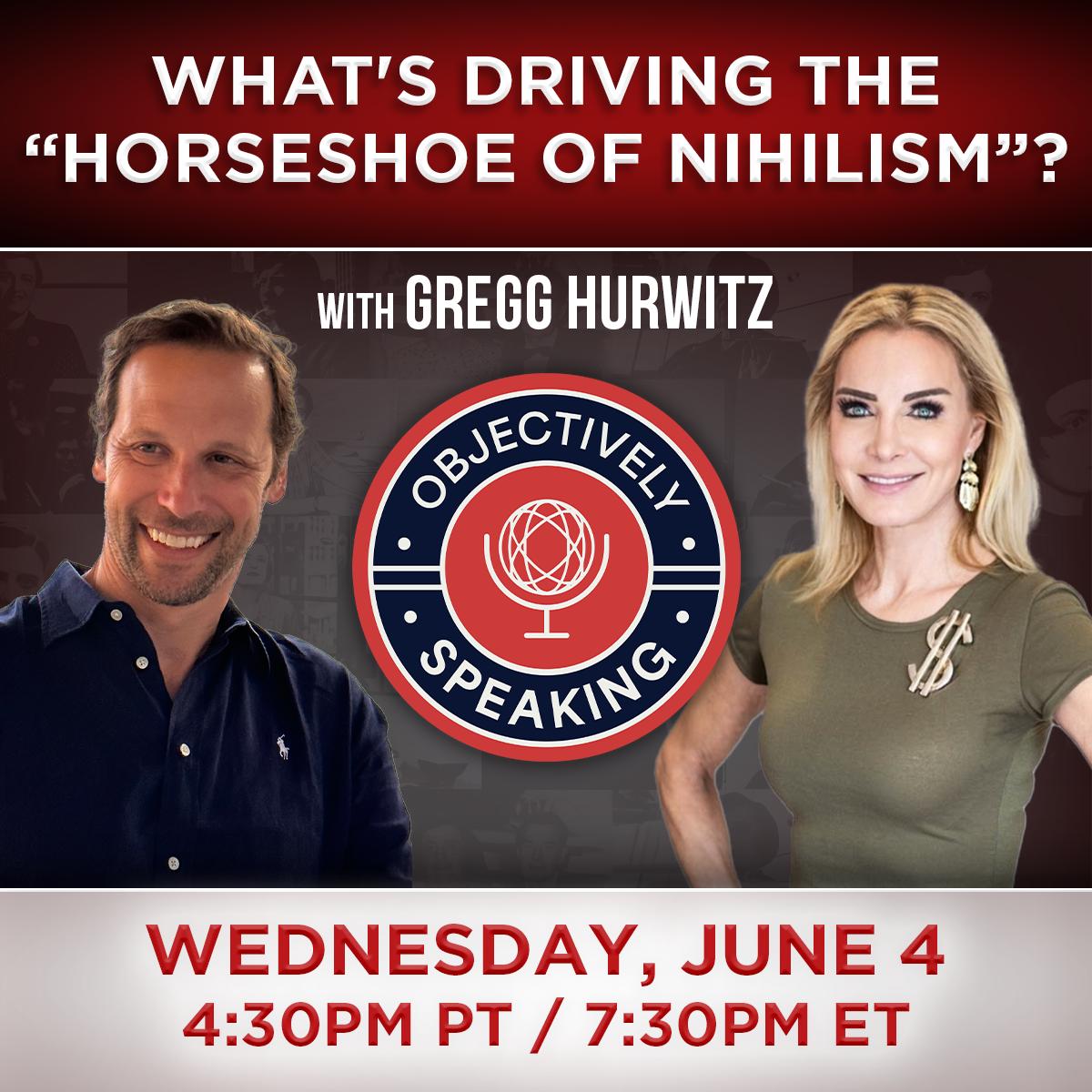
[00:00:00] Speaker A: Hi everyone. Welcome to the 306th episode of objectively speaking. I'm Jag, CEO of the Atlas Society. I am so, so excited to have author Greg Hurwitz join us today. Greg is the New York Times number one internationally best selling author of 27 thrillers, including my favorite, the Orphan X series. His novels have won two numerous literary awards and have been published in 33 languages. He's currently serving as the co president of International Thriller Writers. Additionally, he's written screenplays and television scripts for many of the major studios and networks, poetry, and is an award winning documentary producer. Lately he's been turning his attention to the real, real world. Rise of political violence, radicalization, or what he calls the horseshoe of nihilism. And I'm very proud to say that he recently joined us to do, to give the keynote speech at our GALT conference in San Diego. So Greg, the only thing that came to mind when we were having that talk was like 20 minutes is totally not enough time. So I really appreciate your joining us here today.
[00:01:20] Speaker B: Well, I'm glad to have some more time to talk with you too. Thanks for having me.
[00:01:24] Speaker A: So as I said at the conference, I am such a huge fan of your fiction. Having read just pretty much everything that you've ever written, you decided that you wanted to become a novelist in third grade.
Tell us about that decision.
[00:01:43] Speaker B: It's funny, it's younger, yet I never. Was it really a conscious decision. When I was growing up, I was never allowed to watch television.
There was a big book from that era called the Plug In Drug and my parents were convinced of the nefarious effects of screens.
And so I wasn't allowed to watch television. And so what I did instead is I went to the library two, three times a week. I used to go out with a stack of books, I'd have them stacked up to my chin and I basically read everything. By fifth grade, I'd read my way all the way through Stephen King. And the only thing I can remember ever wanting to do is to be a writer. It's, it's, it precedes memory almost for me.
[00:02:21] Speaker A: Wow.
And at some point Shakespeare became a, an influence or you studied Shakespeare almost as a backup.
How did, how did that influence your work?
[00:02:36] Speaker B: It's funny you say as a backup. I, I did. I so I love Shakespeare. I love the, the tragedies in particular.
And When I was 19, I started my first book. I was still an undergraduate and it was nearing graduation and I realized that I had to do something the following year. And a lot of my college roommates were going off and, you know, going into I banking or becoming doctors, lawyers. And I thought, all I want to do is finish this novel. So I applied for fellowships to England, and I won a Knox Fellow, and I went to Oxford, and I got a master's in Shakespearean tragedy.
Now, while you mentioned that that was my backup plan, you know, I always say that facetiously because it's like, you know, in the event that my. My primary mission of becoming a novelist didn't pan out, at least would have people kicking down my door to hire the guy with the Shakespearean tragedy degree.
But it was during that time that I finished this rough draft of the first novel, and I managed to get an agent, and, you know, shortly after, I managed to sell it. I was. I was incredibly fortunate.
And so that was. That was the start of the adventure of professional writing for me.
[00:03:45] Speaker A: So, as we discovered at Gulf's Gulch, we have fathers who are doctors, who are, of course, big fans of yours, but also avid fly fishermen.
You come from a family of doctors. Was it hard for your parents to see you strike out in this new direction, or were they like, we knew it from the beginning. This guy's gone.
[00:04:08] Speaker B: I do think it was unusual. It's funny. So. So your father's an expert fly fisherman. Mine is a. Is a pretty brilliant lake fisherman. He likes trolling, and he likes a different variety, but he's very much from New England medicine, and I'm from a long line of doctors and lawyers. There's really nobody who's done anything in the creative arts in my family. So I think it was unusual. It was hard for them, but I was so on a mission to do it that, you know, and I. And I managed to strike some success young that I don't think there was too much prolonged torment. I mean, and I also wasn't asking to, like, live in their basement and eat snack cakes. And so I had that advantage going for me also, and I just kind of struck out and did it.
But it was a bit of a correction. You know, my. My older sister is a clinical professor of pediatric gastroenterology, so I'm always appreciative for her for picking up the slack and the family where the, you know, medical tradition needed to be continued.
[00:05:07] Speaker A: So turning now to our theme, you spent years researching radicalization, troll farms, cult indoctrination, the psychology of extremism for your novels. At what point did this stop feeling like research for a thriller and start feeling like a civic emergency for you?
[00:05:28] Speaker B: Well, I Noticed the first tremors in about 2015. I was starting to notice some of the language constriction and play that was happening on the left.
You know, what words people are allowed to use, what arguments are now acceptable, which discussions are off limits. And there was a really snarky, controlling aspect to it that rhymed with. It was like a distant rhyme of totalitarianism.
And I just remember when it was happening, I thought, there is going to be a backlash to this, that, that people like the predominant academic, mainstream elite, all these words have almost lost meaning in all the mudsling that we've engaged in. But let's just say the mainstream, acceptable, you know, educated perspective, once it was starting to police language, I had a realization that this was going to give rise to a backlash of resentful populism on the right. You know, first and initially unlike what anybody could reckon with. I mean, I was trying to kind of go around and have conversations and blow the whistle on this or raise some concern among people that liberalism was starting to morph into illiberalism.
And then I certainly had another level of alarm with Trump's arrival on the stage and some of the ways he was addressing the media and sort of inoculating people against information for the media.
I was also aware that some of what he was doing in his criticism was valid, that there were in fact valid corruptions with gatekeepers to our prevailing narratives. And then I watched in sort of slow motion dismay as I feel, as I felt like the media itself and the news organizations were, were stepping on rake after rake after rake after rake to prove every single thing that he was saying that they were corrupt about in rapid succession, without any process of, of or with limited process of self exploration and correction. And it was like watching this terrible cycle start to strike up.
And I got fairly heavily involved, you know, through 2017, 2018 through 2020, really trying to pull the Democrats back from the far left.
And I would say since 2020, I've been very much in the center, trying to pull connections across different places, across the aisle, from different stretches in the ecosystem, to alert people to the fact that, that right now one of the things that was slowly becoming evident was the role of these hostile foreign regimes in our messaging apparatus, talking to us through social media, driving the algorithms. And, you know, we, we. It's been a sort of slow dawning realization that we're at war. We're at a full fledged war. This is what war looks like now. It's digital, it is largely persuasion based. And now it is Accelerated algorithmically at a speed we can scarcely comprehend. And so the accelerating disintegration that we're seeing in a lot of ways does in fact have causes to it. And those causes can be explored and discussed if we're willing to explore and discuss them rather than pull the ideological hood over our heads.
[00:08:44] Speaker A: Well, that's one of the reasons I think this conversation is so important, because this is objectively speaking, this is the Atlas Society we're trying to promote Objectivism, which is based on the premise that there is a reality and that reason can be used to discover it. And the fact that there are these very disturbing forces that are negating, saying, you know, everything is a conspiracy not to, not that there aren't some conspiracies and just making an appeal to tribalism, to, to resentment, to envy. And I, and I feel like that is happened for a long time on, on the left, maybe longer back on the right, but increasingly happening on the right and we need to guard against it. And so that, that striking image that you use this of a horseshoe, the, the far left and the far right bending toward each other and meeting at a point of shared nihilism.
What you called the no Lives Matter zone. Could you walk us through that?
[00:09:52] Speaker B: Yeah, well, I spent a lot of time deep in there. My, my latest book is called Antihero. It's an Orphan X book, but at the center of it is this pack of nihilistic young men who've been radicalized online. And, and that is the societal ill and the violent force up against Orphan X has to go in this book. So I've just been buried in it. And one of the things I've started to realize, and you'll know and you'll, you'll understand some of this if, if, if you don't know this already, listeners out there, if they step back and look at it, but the drive that if, if you are Russia, if you're China, if you're the Islamic regime in Iran, if you're trying to sort of push negative, radicalizing content at young Americans, it doesn't ultimately matter if you're pushing people further right or further left. And we forget that the Nazis were the nationalist Socialist party, right, it's when the right and the left meet into something that's totalitarian or fascistic and they meet, tend to meet off a very grievance based cry that the systems are so corrupt that something must be done and yet they're excluded from any responsibility that they would have. Because on the one hand all the systems and Institutions by which they can be judged are corrupted beyond compare, they tell us, but they're also not beholden to any future responsibility for what is to come. And the institutions that are to come. So they float in a very chaotic space.
And if you are, let's just say the Islamic regime in Iran or you're Russia, you don't actually care if you can erode the, let's say, a young man's confidence that institutions matter, that there's meaning, that it's not a world of conspiracies, that they have any agency. When they get around to that horseshoe of nihilism, the next bus that they get on, it could be violent antifa, or it could be violent hard right, nihilistic reers. It can be left or right, it doesn't matter. Because what the effect is is that they are going off and creating chaos from the basis of grievance.
Both sides and both extremes are equally useful in that regard.
And one of the things that they have a lot of Americans who are on boarding towards extremism is through their tacit allowance of it or starting to slowly take on the language of that. And we can see where the marks are being moved and people are being onboarded all the time through regular social media. You know, I did a report with one of my partner groups, the Network Contagion Research Institute, that we saw that the pro Hamas accounts on Tick Tock, for instance, were 69 times higher, outweighing stuff that happened to be pro Israel.
It was wild. And then what we started to notice was that young women in America between the age of 18 and 35 had a 52% higher disdain, dislike, hate for Jews, Israel and America, all three of them.
And then we saw that the correlation was they got their news two standard deviations above the norm from TikTok. So we have a fully foreign regime, you know, regardless of what, of what one thinks of the conflict. We have a. We have a foreign regime that is pushing propaganda that is basically moving the main trendsetters within demographics in certain directions. And in this case it's young women, because young women tend to set a lot of the social and cultural currents they're the most useful to target. And one of the other things that we've seen is that anti Semitism or Jew hate or whatever you want to call it, which was a starting point after some of the analysis from October 7, isn't actually the relevant point. It's not the end point. You know, it's not the final destination by any account. And in fact, at One point when X took some steps to beat back the more egregious versions of anti Semitism, one's actually calling for murder and death and genocide and you know, breaking the law. We're not talking about small free speech incursions, jokes, you know, that, that were more casual.
One of the things that happened the next month was that if the anti Semitism was beaten down, all we saw was a surge in messaging targeting young girls for self harm.
[00:14:06] Speaker A: Wow.
[00:14:07] Speaker B: Because what the hostile foreign regimes want, they don't care about Jew hate or immigration or self harm in girls or transgender rights or whatever the topic is, they want something surging that we are scream, screaming at each other about vehemently that we're polarized about, that we've given up common ground because things are so far lost that some violent, chaotic extrajudicial action has to be taken and they don't care which way that goes. And that realization on the one hand is terrifying, but it's also liberating because at least if we look at this problem and we can understand the scope of it, then we can also start to understand how to counter it in ways where we have, where we have a bit more, where we're more empowered to do so.
[00:14:48] Speaker A: Well, I am taking a peek at the comment section here and you've got a lot of fans who watch this show and some questions coming up, but I'm probably going to take less of them this time guys, because like I have a lot of my own that I want to get to. My modern Gault asks, is the horseshoe a new phenomenon or has it always existed and social media just made it visible?
Greg, I think you addressed that with your comment about national socialism pulling both sides of the ideological divide towards a, towards a nihilistic end. But anything else that you wanted to add to that?
[00:15:30] Speaker B: Well, it's a lot easier to manipulate on social media. We are at digital war. This is what our most of our people and our leaders and our organizations and our charities and our donors don't seem to fully realize. People keep freaking out to say oh my God, it could happen here. Or whatever it is, it is happening here. This is what war looks like. We are at war. We are in a digital war with these countries and the speed and access with which they can reach us is staggering. How quickly it can happen. Keep in mind too, if you go on and scroll tick tock for a minute, it takes 26 different readings of you biometrically. It sees where your eyes dilate, it sees where your thumb snags on a feed.
And so the onboarding, the way that it's reading you, this is backed by, I mean, this is deep machine algorithmic learning backed by teams of addiction specialists trying to get you hooked onto these algorithms that are truly psychopathic. They're driving stickiness for maximum engagement. So let's talk about what that looks like in the real world.
I'm somebody I'm. I'm only mildly ashamed to admit, who likes to see.
Oh, shoot, Hang on one second. I just had a little glitch in the system here.
Okay, sorry, got you back.
[00:16:50] Speaker A: Yeah, well, it was just when you were talking about all of those sophisticated mechanisms that.
[00:16:55] Speaker B: Yeah, so I'm so. Yeah, exactly. So with cease, we got a little. We got a ping from St. Petersburg. But I'm somebody who is. I have a dark fascination with watching like bar fights or street fights. If I was ever out and there was a fight breaking out somewhere, my gaze would go to it. It is a, you know, perhaps it's a. Another one of my great many moral shortcomings. One of the things I've noticed if I'm scrolling and, or it is noticing about me probably is if something's just put in that's a random violent image. It's two guys squaring off in a bar.
Clearly at some point my thumb has snagged on that. Then what I start to get is more and more images of young men fighting.
Then it starts to migrate slowly where it's images of immigrants, right, punching and attacking American citizens. Then all of a sudden it's dark immigrants beating up like attractive helpless blonde girls in Europe.
And so what happens is it's not that these phenomenons aren't things that happen or that they can be explored, but what's happening is there's some glitch in, in my perverse interest, let's say like a weaker part of myself's drawn to something and it figures out really quickly how to onboard that into a direction that's increasingly visual and radicalizing.
I spoke to a friend just before we jumped on who's a brilliant researcher and she did a. But she set up a bunch of fake accounts as 15 year old boys.
And if, if boys have any indication of being slightly left leaning, one of the things that happened was they were served IRGC content, which is the, you know, the militarized group of the Islamic Republic of Iran. Within one hour, if boys had any interest in sort of lifestyle stuff like fishing or other stuff and these fake accounts that she put up with one one hour was being Served far right Nazism.
So they're reading, scraping billions of web pages, analyzing human behavior, seeing what proclivities match for people. Where are these little flares of big five personality trait structures and how do we onboard them as massively as possible to sort of violent ends that will tear America apart and down? Because while we're fighting over all this stuff and free speech and rights and due process, Putin and Xi certainly are not. Nor is the regime in Iran right now.
[00:19:15] Speaker A: Alan Turner asks, is it just foreign powers agents at work or are there more homegrown elements at work as well?
[00:19:23] Speaker B: There are homegrown elements for sure. There's a, there's a sort of unholy trinity. Hostile foreign regimes power it. We have bad faith domestic players and then we have psychopathic algorithms for profit. And the algorithms for profit, we tend to get very snowy headed about this and get lost in eternal tangles of freedom of speech discussions. Freedom of speech does not mean freedom of comprehensive algorithmic explosive reach for profit in an effort to undermine our youth's health and the stability of our nation.
Those are different things and we can separate them and we can make a very good free market argument. Speaking among, you know, a bunch of, of of powerfully minded libertarians here, if you are investing in advertising content, if you are a parent using a site, if you're a consumer using a site, if your children are going on a site, transparency is something that's okay. If I'm going to put a bunch of money into advertising, being aware of how the algorithms move to understand am I actually advertising to real people or to chains of L bots and inauthentic activity? Those are okay things that we can negotiate in a free market through transparency and through access and then we can make our own choices. If some people want to move more in that direction, they can. But we can also have a bunch of people and make clear minded decisions that we want to keep ourselves and our kids and our companies and our interests away from hostile foreign regimes that are driving things through algorithms that are designed to do the, to do their worst.
I do think that a lot of the bad faith domestic players are able to link up much more easily and readily here as a result of the online technologies and social media. And I believe that they're way more susceptible to being targeted by bad faith foreign players and people who thousands and thousands and thousands and thousands of people working in troll farms doing this around the clock.
[00:21:20] Speaker A: Where are these troll farms located? Are they in, in Russia, Eastern Europe, Serbia?
[00:21:29] Speaker B: Yes, yes, yes. The worst the Worst are Russia's unbelievable at it. China's incredible. The Islamic regime is incredible, which might sound puzzling until you remember that the education level in Iran is, is through the roof. They're very effective. There's a lot out of Pakistan, there's a lot of fake accounts through India.
And so there's all sorts of ways to run things in different chains.
I think North Korea is effective, though I don't know as much about them. The big targeted guns at us, seeking to divide and destroy us. And I'm talking about going back decades. This is a generational effort is China and Russia and the Islamic regime.
[00:22:11] Speaker A: Yeah, well, you know, you mentioned the Iranian youth and how highly educated they are.
We have a video, my Name is Iran, which we have promoted to the Arabic speaking world because I think there are some green shoots and some encouraging signs that the youth of the Arabic speaking world are disillusioned with many of the failed isms, the pan Arabism, the Islamism, the socialism, the nationalism. And they're looking for new ways of understanding the world and the role in it.
But we wanted to also push this into Iran, given the firewall. We were going to use an English version of it through VPN destinations. Unfortunately, that's no longer possible because now the blackout is completely.
There's, there's no wiggle room to, to get any kind of messaging unless you're going to use Starlinks. But yeah, I noticed that after Israel, Iran had the second highest English proficiency in the entire Middle East.
[00:23:21] Speaker B: So it's, it's hard to, for me to overstate my admiration for the, the, the courage and toughness and moral clarity of the Iranian people. You know, the diaspora is incredible also. It's amazing to me if you want to think about the success of this operation with the sort of mindless chanting that's gone on, you know, not around a very complicated issue of, of the future for Palestinians, but around pro Hamas and pro Hezbollah and pro Islamic regime. It's absolutely incredible that what is being elevated isn't the Gulf states with which we have, you know, confusing relationships. But uaa, UAE is amazing, right? Saudi, there's a lot of cross investments that happen there. Qatar has certainly put a lot of money into anti American messaging. You know, I think of them a lot as sort of like the hotel from John Wick where everybody kind of comes in, but they're, they're constantly looking and playing different factions against each other. But there's a lot that they are our allies. We do have a base there. It's A more complicated relationship. You know, Lebanon is, is an incredible nation. Jordan for so many reasons has been absolutely spectacular. There's all these movements and all these countries by the way, and none of them are pro Hamas sort of marches and disruptions permitted anywhere. And of all the things that America, Americans have seemed to fasten onto, it is literally the tentacle, the tentacles of the Islamic regime. It's this octopus that is the most misogynistic, anti liberal Jew and Christian hating apparatus that is feeding absolute terrorism. And I'm in conversation after conversation with very polite people who are sort of supporting, coming down in a way that is confusedly sort of pro regime in Iran or pro Hezbollah or excuse making for Hamas.
And all these dinner tables that I'm at, you know, I've said we could be transported right now, you know, into the heart of any number of, of cities in the world. Tel Aviv included a number of different Arab cities as you mentioned, and be welcomed and have, have, have a perfectly good time. If we were transporting in Tehran, anyone who's gay would be swinging from a crane. Marital rape is legal. Women have no rights. There's no due process.
You know, Jews should be immediately killed. It's been vowed upon, there's chance of death to America. It is the weirdest sort of success that of all of the complexity of the world in the Middle east, of the, even, even the, the Muslim faith and the different countries and all the nuances, this most virulent hateful, anti freedom strain is the one that has been elevated here is just a sign of the unbelievable power of this massive psychological operation that's been run on a lot of, a lot of America and a lot of it has been through our youth.
[00:26:15] Speaker A: And it's just a complete moral inversion. It reminds me a bit of what Gad Saad talked about in terms of the suicidal empathy for the grandparents and parents in this audience. What are some signs that your children, particularly your sons and grandsons, might be becoming radicalized?
[00:26:38] Speaker B: Well, I'd also say that there are signs that grant that grandkids need to look for, for their grandparents and parents because so many of them are plugged into just one news source exclusively.
You know, if you're doing nothing but watching Fox News or MSNBC or only reading, you know, one side of events, you're getting a very skewed view of the world right now because we're so atomized. I mean, even things that were conventionally, you know, very well regarded like the New York Times, I mean, of course, you know, I think the people on this podcast know, but, like, I'm in communities still where they believe the New York Times is like, the absolute gold standard of objectivity.
And so there's, you know, so I think all of us run this risk of being sort of radicalized into one viewpoint. The thing I always look for is what's called the friend enemy distinction. Meaning, are you opposed to anything that I say, any action taken by the people who you have deemed being on the wrong side of history. Right. It's. It's left, right in America. Let's just shorthand it and say Democrats and Republicans. Is there anything that a Republican. Is there anything that any member of Trump's administration, any choice, any position, any movement, any negotiation, any statement in any position that they take that you support, are you just radically opposed to all of them? And the same applying to Hakeem Jeffries and, you know, Joe Biden when he was in office and Nancy Pelosi. And if, for you, it's a divided black and white world, then you're no longer thinking. You're making decisions that are only purely reactive.
And we have a moment. I have a good friend who is a 60 gunner in the Seals teams, and he called me laughing at one point, and I said what he said. I never thought that I'd see, like, good old boys in big old Ford F1, F250s out, like, honking to protest against, like, hippie green people who are protesting Elon Musk's electric cars. Right? Like, the whole world just goes upside down. And part of this is, is if you are frozen in a position that anything that Trump does or this administration does in any way is an absolute evil, not only are you. Have you removed yourself from being able to make assessments because America is competing right now on an unbelievably complicated chessboard in the world, but you're also removing yourself from the possibility of ever receiving comfort.
And so that's one of the things that I notice and look for the most. There's people on the left who cannot move an inch on any individual. There's no differentiation among them. It's the same thing. If you are, Josh Hawley is the same as Rubio, is the same as Dr. Oz is the same as RFK, is the same as Jordan is the same, same as Nick Fuentes is the same as Dennis Prager. Everybody is the same. And there's people on the right who hold that view completely, and they don't see any space between, you know, Talib and AOC and Alyssa Sakin or Jake Aenloss of Massachusetts. It's an undifferentiated mass. And that mass codes for one thing, enemy who should be opposed at all costs no matter what.
You can't get any.
[00:29:44] Speaker A: That, yeah, that is a really helpful prism to look at it. And if you are, you find yourself thinking that way or if others in your life, I guess the question becomes how?
Well, how do we as individuals break out of it? What, what can we do for. For others in our circle? You have argued that reconnecting radicalized individuals with former versions of themselves and shared aspirations can create a kind of dissonance that prompts reevaluation. So what does that look like in practice?
[00:30:20] Speaker B: There's big picture down to small picture. Let's take big picture first. In America, I believe we need a three part chiropractic adjustment and the first part is a realization to say this isn't us. This is a lot of this is not organic. It is hostile, foreign regime fueled. America is not inherently anti Semitic. I've been, you know, drowned with images and horrific anti Semitism continuously over the last few years. That's not foundationally America. I mean America, we certainly had issues of anti Semitism. I grew up in like an idol. It was, it was completely irrelevant to me for my whole life until three, four years ago probably.
We are not inherently misogynistic and brutal. We are not inherently corrupt and horrifically awful in ways that everything needs to be be torn down.
It is not organic. America is full of common sense and common decency and you know, we have a template for continuing to move forward towards goodness and law and, and lawfulness.
So number one, this is inorganic. This isn't foundationally America. This, some of this is foreign grown. Number two, this is very important is to say Americans agree on way more than we believe that we do.
A lot of what we're seeing is a kind of magic trick.
First, I'll give you the data because of the name of the podcast and the quality of, of the listenership.
You know, I went out and I wanted to do a bunch of polling that was actually targeted at seeing how much agreement that we could get among Americans. So polling, it's very easy to pull to get any result that you want. Right? Like what do I hate? You know, which of the below do you hate the most about Joe Biden's Marxist government? Right.
It's very easy. If I go and poll and say I believe in climate change, I might get 50, 60% of people vote yes. If I say I think climate change is a hoax, maybe 30, 40% say no. Instead I wrote, I believe in clean fields and streams, which codes red state and skies and seas, which codes blue state. Taking care of the environment is a responsibility for all of us. 94 agreement.
So think how many times with political speeches, with debates, with town halls, with social media, people come into a room and say, I believe in climate change. It's I. You lead with the I. I am the holder of the virtue.
If we reframe and ask these questions, which I did, issue after issue, abortion to freedom of speech, to, you know, equality of opportunity versus outcome to immigration, the most painful issues that we have in America, we got 85 to 100 agreement on across every major issue.
So the first step is this is inorganic. This is foreign grown. Much of this number two is Americans still agree on way more than we think. You know, quick question as a side note, why do we think we don't? Because very loud minority groups online can shriek and cause massive reputational and financial damage and a lot of them are fake. When we see a lot of these characters who are pushing, for instance, I did a lot of analysis of far right bots that are driving characters like Nick Fuentes and Candace Owens. 35% in authentic bots. Normal, normal ranges for political posts might be 5 to 10. It's 35% of a paper tiger effect that is happening funneled through, as the gentleman said, domestic bad faith, domestic players. So what's the third one? The third part of the chiropractic adjustment is we already have a shared set of American values that we agree on. We know what they are. We agree on equality of opportunity, not equality of outcome.
We believe in responsibility over grievance. We believe in having due process of the law. We agree in that free speech should be allowed until it crosses a line where it constitutes real, you know, true life threats to other individuals.
We also have an entire sophisticated language, not just through, of course, the Constitution and the amendments and the whole weighted throne of English common law that rests upon a tradition that goes all the way back to the Greeks and the Romans. But we also have a process for protest and for activism here. And I think we have one of the best ones anywhere in the world, which was the civil rights movement. We had paragons of moral authority who set the template. And the template that they set in the civil rights movement, which was successfully ingested into the moral fiber and arrow of America, was you take on more responsibility when you protest something.
You speak up no matter what the costs are about a law that you think is Unjust because it treats Americans differently on the basis of what should be held by the Constitution and the amendments and your unbroken moral character is sufficient that the law. Enough people watch that law crumble across your unbowed shoulders to vote to change it. That is how we navigate movement of groups from the fringe to the center. And you can't ask for more than every other group already has. You don't get special language and you shouldn't get special rights. You don't get different things. And we have that and we have heroes who have done that. John Lewis did that. When they, before they walked across the Edmund Pettus Bridge.
Those men meditated to imagine the white officers who were going to beat them with truncheons as young men and little kids so that they wouldn't fight back, so that they could hold to the moral core of nonviolent activism. Harvey Milk did this. He had a very virtuous, above board, even joyful at times. Navigation from the fringe to the center. There's a mechanism by which this is what it doesn't look like is making threats and screaming and shutting down college campuses and vandalizing property and shouting down people and protesters and demanding a different set of light rights and demanding a different set of, of. Of legal considerations and screaming and wanting class credit for things and wanting preferential treatment. It is the opposite. It's an inversion of these American principles. And so that those to me are the three.
[00:36:40] Speaker A: You know, this conversation for me is sparking so many connections with some of the other talks that we heard at Galt's Gulch. And one of them was Kaizen Siedu, who talked about the punishments and also the rewards of speaking up and remaining true to your values. And he's, you know, blown up as a huge influencer. I think that Elon Musk has reposted him at least 20 times already this year. And he talked about, you know, the costs, how when he started saying things that kind of went against the general kind of tenor of his tribe here in LA and Hollywood, how, you know, he lost a lot of friends and, and that was painful and people called him things and that hurt too.
But then he also talked about, you know, this lure of, of this, this new tribe and, you know, the lure of being rewarded for providing them, you know, confirmation of their biases and how corrupting that can be and how, you know, he also said that at some point he changed his mind on something and he knew that it was going to really alienate some of, you know, this new audience that now follows him. But he said, at the end of the day, the biggest reward is the award of the self esteem that you earn when you conduct yourself with integrity and when what you are expressing also conforms and is aligned with your internal values. So I wanted to turn a little bit now to maybe be intersex. Go ahead.
[00:38:26] Speaker B: Oh, he. He sounds wonderful. I'm sorry I missed that talk. The one thing I'll add to that, I mean, that just sounds. It's so resonant for a lot of the things that I think about, which is, you know, if you hold on, the truth is you can best understand that and you try to set aside your willful blindness and you don't lie. One of the things that Solza needs and observed in the Gulag Archipelago, which I think we can get to when we talk about the personal steps but people take, is that in a totalitarian society, everyone lies about everything all the time.
And what he's talking about is that if you stop lying, you, you all for all the friends that you lose and probably should lose if they don't understand something or they're unwilling to talk to you and merely want to unfriend you as if the world is digital, you'll gain new people, resist the lure to be pulled all the way across the aisle into a different enemy friend to stand distinction, which is just as arid and lifeless and boring and ideological. But the other thing is, that's true. And I learned this from Jordan Peterson, who's a close friend of mine for decades now and was a professor of yours, too. Professor of mine? Yeah, he was my. He taught me young and he was my thesis advisor when I was an undergraduate. But one of the things he talks about is to say it's not. He says it's not that he is courageous. It's not that I'm courageous, he says, it's that I'm more afraid of what will happen if I lie.
And that to me is. It becomes more apparent every year almost as I'm more and more aware. Oh my gosh, if I detoured and just kind of. And this doesn't mean speaking truth to power and yammering every time you have an opinion on everything, but holding a line where it matters and holding your truth where it matters, every one of those is a path that's taken and a path that's not taken. And you can get further and further off the mark.
And if we start to embrace a lie and we start to vocalize a lie, then we start to live a lie. And where you are, when you're living a lie, is just heading straight down to, to, you know, a horrible place to exist. It just grows and becomes more and more. And so there's a strong motivator too, in avoiding that negative. However painful it is to speak the truth at a key juncture, you're still somebody who spoke the truth. And then the right people will gather around you and the wrong people will throw stones at you, and you'll be moving into more goodness in your ecosystem and in your thinking and in your life, and you'll have that clarity, as painful as it is.
[00:40:47] Speaker A: Well, and I think that is also why in resisting this lure, my hope and my belief is that Ayn Rand's philosophy of objectivism is helpful. And particularly things like not being a secondhander and driving your vision of yourself, your value of yourself, from your, your own beliefs and your own actions, rather than from validation for, from others. And of course, without spoilers for those who have read the Fountainhead and remember where Gail Winan ended up at the end of the novel when he thought he was chasing power by, you know, muckraking and giving his audience at the Banner exactly what they wanted. He found himself at, at the end of it, you know, the loneliest man in, in the world, a man who no longer knew, you know, what he, what he thought. So I wanted to try to get to some of the antidotes. We have a question here from Valiant. Mike. What's the best way to combat this? Is there a single or multiple antidotes that we can implement? And then I also just like to talk about your upcoming novella and maybe some of the ways in which what you're working on with this campaign and trying to, to fight these destructive forces tearing us apart kind of overlaps with some of the things that, well, the
[00:42:18] Speaker B: most valuable thing that we have in the world is our attention and where we choose to put our attention.
So how we combat that is, you know, we all know when we're stuck, you know, whether it's scrolling X or social media or listening to news, that's sort of, you know, the hate, the hate tainment industry, like when we're indulging in things, we have a sense in the back of our head when it's good for us and when it isn't. The best thing that we can do is to put our attention into places that are more considered, that are life affirming, that are providing nuance, providing texture in a, in, in a, in an adventure moving towards truth. It's the Most important thing that we can do.
A lot of that means looking at different kinds of news sources, getting out of your algorithmic feed that's just feeding you calorie less, you know, nonsense to keep you stuck, even if some of it's harmless. And a lot of it too is, you know, I, I think I have a, I have a. The fortune of having an incredibly broad ecosystem. I mean, it's 360 degrees of, of different places and parts of, of America and the world and viewpoints. And it's all. There's something that's incredibly humbling about having friends who are in different fields and different arenas, from different perspectives, from different political minds. Not just sharpening friendships, iron, the way that iron sharpens iron, but also in ways that when you care about somebody, when you really love somebody, or you have a relationship that's a real relationship and you know them to be a good person and they vote in a way that doesn't make sense, or they say something that doesn't make sense to you, or they come up with an argument that doesn't make sense to you and you can't square. You're much less likely to just excise them from your lives.
And it's very important that we keep people around us who at times have viewpoints and positions that might make us uncomfortable.
Because a good friend is like a mirror, something my dad used to say. And they're holding up a mirror. It's not always a flattering mirror. And we're trying to do the same for everybody else who's around us. And the more good people you have in your ecosystem who are driving and striving to get things right and to look at things objectively and to make decisions that are better for the long term health of themselves and their community and their family and the country and the world.
The more that you're going to be inspired to keep sort of raising that up. So take your attention, make sure that you put it on places that are, that are, that are good, that are leading you to good places and make sure you're maintaining a very diverse ecosystem of different minded people.
[00:45:02] Speaker A: Well, on that note, I would love to talk a little bit about your upcoming novella, the Delivery. It's described as a family that has this humanoid, humanoid AI companion, Mr. Man, who's designed to anticipate their needs. And he's like a miracle at first, but then things start to go wrong. So tell us a little bit about that.
[00:45:29] Speaker B: Well, it's my first novella. It comes out in a couple weeks. I'm very excited for it. And as you mentioned it, at the center of the story is a family. Mark and Rebecca Higgins. They have a daughter, Maddie. She's special needs. She's on the spectrum, elementary school girl. And they're exhausted. Rebecca has just had a pretty traumatic miscarriage. They're just trying to put their lives together around all this grief.
And they get a type of invitation that is impossible to say no to. Mark's boss at work, kind of a slick, fast moving guy, has come back from a visionary conference in some valley with a card for new technology. And there's a plus one that you can spend a good chunk of money and you get this thing that will make everything in your life easier, will make everything in your life more frictionless.
And they are sort of heavy with grief and the exhaustion of everyday living and keeping up with the Joneses.
And at some point they just agree.
And the. The novella opens with this casket, like delivery. That's. This casket has showed up on their doorstep and they've opened the door and their daughter is kind of playing behind them. And they're making the. Their decision whether to allow this thing that they're not entirely sure what it is into their house. It needs to plug into an electrical outlet which is in the nursery.
And the end of the opening scene in the book is them stepping back and allowing this new technology into their home where they put it into the nursery and that is the delivery.
[00:47:03] Speaker A: So Mr. Man anticipates unspoken desires. Was that at the heart of the fear that you wanted to explore?
[00:47:11] Speaker B: Well, it's one of them. You know, we, we think about.
Look, and I'm also not, I'm certainly not an anti tech, anti AI figure. You know, I think everything comes down to our moral hierarchies. And are things in the right place?
[00:47:26] Speaker A: Place.
[00:47:26] Speaker B: Do we use AI as a proper tool?
[00:47:28] Speaker A: Right.
[00:47:29] Speaker B: Because we want to be Sorcerer Mickey in Fantasia. We don't want to be the eyeless mops hauling buckets of water around.
But there's a lot of temptations for these things to slip above us as we've seen in this discussion of radicalization where all of a sudden, like, what thoughts are we thinking? Are you thinking your own thoughts? Are you thinking the thoughts of a troll farm in China somewhere?
And so this is about that process of sort of promised luxury and ease that we can come into something. And it always seems too good to be true, right? It always seems like it's Pleasure island in Pinocchio. We get to gamble, we get to smoke cigars and Everything's going to be great. But what it does is it turns you in some ways, beast like, turns you into an ass. It turns you into a donkey. And, you know, we've seen this time and time again and we've seen, I think this is a lot of what has happened in terms of the dislocation sexually and orientation and towards families with young people, with pornography. You know, it's just, it's, it's unthinkable what we've sort of have allowed in slowly and slowly, and it seems like nothing could be better. You have unlimited access. You know, you're 15 years old with an Internet connection. You have access to more sexual imagery than your predecessor is, going back all the way to the beginning of time did all at once in one session. Well, what's happening? Massive suicidality, massive depression, massive anxiety, total fear and inability of talking in or dealing with the opposite sex in the real world in terms of judgment, in terms of socializing, in terms of physical engagement even. It's a total dislocation. And so if we can't get some of these things right and if we can't position them in the right place places as we integrate them into our lives moving forward, there's a non zero risk, you know, that we could turn into those blobs from Wally that are sort of just floating around, being fed everything, fed entertainment and fed all the food that they want and forgetting to use our own legs and our own minds.
[00:49:30] Speaker A: Well, I'm, I'm glad you brought up pornography, because Ayn Rand was very vocal in condemning pornography, not because she was anti sex, but because she saw sex as such a vital and important part of, you know, genuine human relationships, that something so important and so intimate to be kind of trivialized and twisted and commoditized was something that, that when consumed, comes with, with a cost, with, with a psychological and spiritual cost.
So I had another question for you and, and that was, you know, much of your thrill, your thrillers, that Orphan X, he's flying on, you know, the jet provided by his friend down in Mexico, and he's going coast to coast and all around the world.
And then this novella, your first novella, you, you're putting this threat and this tension inside the home, so it feels a bit more psychological rather than, you know, action oriented. Not that Orphan X isn't psychological. And it's been really rewarding to kind of watch his character growth and trajectory, you know, throughout, throughout this, this, these adventures. But is by putting it in the home, did you want us to also Think about what we as individuals and parents are also letting into our homes.
[00:51:07] Speaker B: Of course, yeah, It's. This is a domestic thriller.
And technology like that, you know, it has to be invited in. It's like a vampire.
We have to open the door. We have to let it in.
And, you know, there's so many parents I talk to who have kids who are, you know, little kids completely addicted to screens. Can't sit through one dinner without a screen on the table looking at us.
You know, kids aren't old enough to make those choices. Right. Their prefrontal cortexes aren't even geared for it. We're the ones who let this in. And there's another thing that I was thinking a lot about after our conference this weekend, which was, you know, there's a lot of. Of, I think, justified railing against the shortcomings and corruption of our institutions. And by that, I mean institutions on the left and the right.
You know, we tend to focus a lot on the left, but I think we've also had equal corruption and. And difficulties sort of everywhere. It's hard to think over the last, you know, 20, 30 years, which institutions have continued unscathed.
I think the only one that I can think of is Dolly Parton, who herself is an institution.
But, you know, part of that is. Is we're making the choices ourselves of what we are feeding in every choice that we make all the time. When we watch something one way, it's not like the news exists separately of us and our eyeballs or our feeds. We're active participants who have will in this.
And so I'm not always so, you know, 100% eager to just foist everything off into these massive forces that are out of our control because we're choosing how we parent. We're choosing what we look at. We just, like we choose what we eat. If we put garbage into our body or not, we're choosing that with our minds. And I think that's something that's also worth thinking about. I mentioned Solzhenitsyn earlier.
He's one of my, you know, intellectual and literary heroes.
And one of the things he discovered, you know, he's in. He's in a. In a gulag, dying of cancer.
And the realization that he has is, you know, essentially, what's. Everything that I did that put me here? What's. Every time I could have spoken up and I couldn't. What's. Every time that I should have done something that was different to try and stop at? And if we don't all participate in these myriad millions of small ways, in the continued dissolution of our culture and institutions around us, we're the ones who have to stop.
And so we tend to move. I mean, it's. I would imagine, you know, in particular, we're coming out of Ayn Rand's school of thought of like a great man philosophy of the world. There's another one to me that is equally important, if not more, and that is what Solzhenitsyn said, which is we set everything in order around us. He managed to do that, you know, dying of cancer in a gulag. And he wrote a tome that essentially was the moral argument in combination with the military and the economic argument that was powerful enough to help bring down the Soviet Union. The power that is inherent in that, in the, in from one of the least empowered humans in the world. We as individuals net that tapestry back together also stitch by stitching, or we unravel it stitch by stitch, ourselves. And that, to me, is the part of our needed continued focus.
[00:54:34] Speaker A: Well, I think that is a beautiful place to end.
And I just.
Greg, I can't thank you enough for how generous you've been with us, donating your time and speaking so eloquently at our Galt's Gulch conference, and then again, just being willing to hop on, on with us here at Objectively speaking. And I just want to say to our audience, coming from me, coming from my dad, you know, also coming from millions of readers that have made all of his books bestsellers.
Do yourself a favor, treat yourself and go out and buy Greg's books and listen to them. The audio versions are excellent and you will be thanking me. So. So, Greg, thank you.
[00:55:23] Speaker B: Thank you for having me on. Lovely talking with you.
[00:55:25] Speaker A: Absolutely.
And everyone, be sure to join us next week when Sarah Albrecht, chairman of the Liberty justice center, she will be joining us to talk about the landmark Supreme Court victory that she won in striking down President Trump's tariffs. I look forward to seeing you then.