Episode Transcript
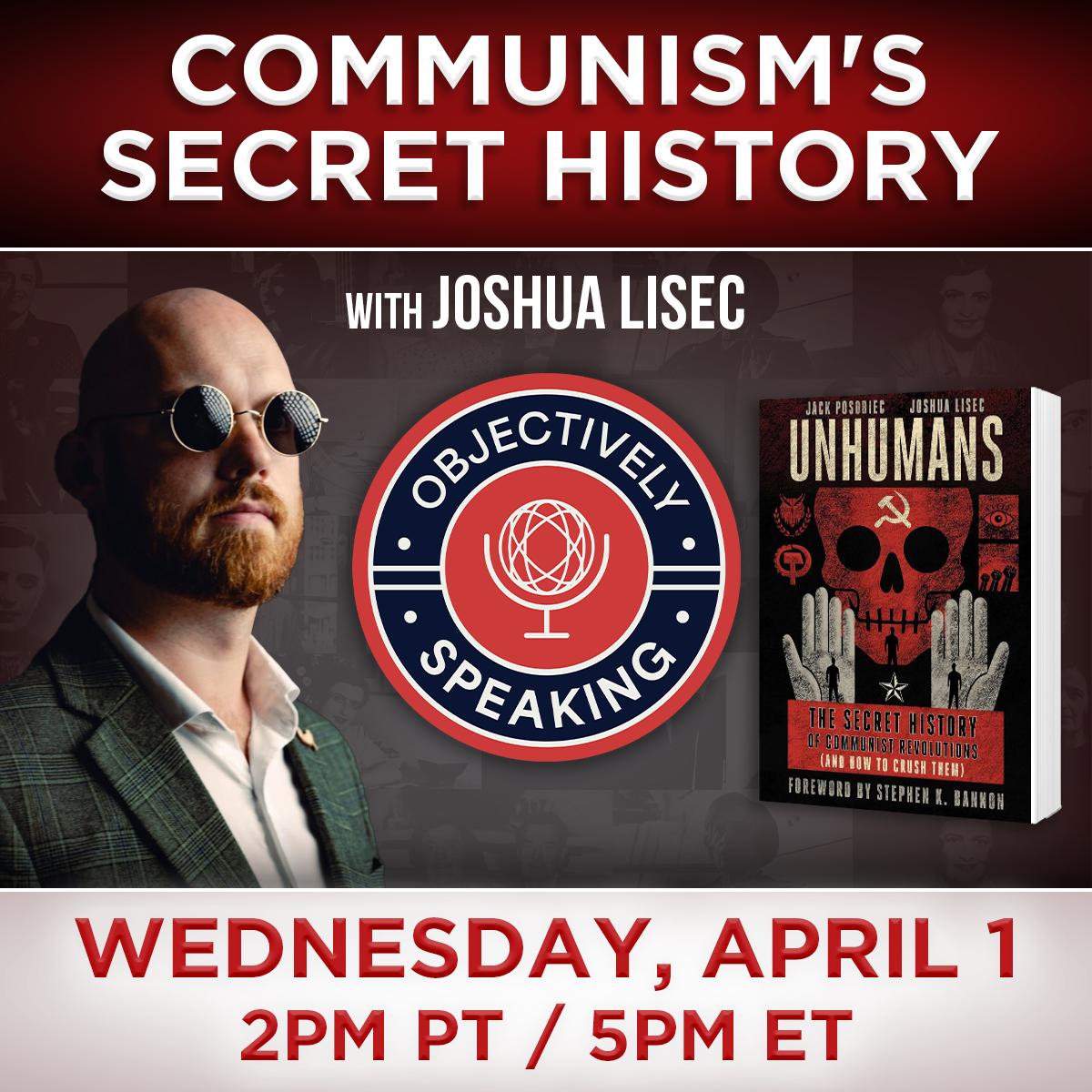
[00:00:00] Speaker A: Hi everyone and welcome to the 296th episode. We're really getting up there of objectively speaking, I'm JAG CEO of the Atlas Society. I am very excited to have best selling author and ghostwriter Joshua Lysik join us today to talk about his co authored book on humans, the secret history of communist revolutions and how to crush them. So. So Joshua, thank you for joining us.
[00:00:30] Speaker B: My pleasure, Jack, thanks for having me on today.
[00:00:33] Speaker A: So, as you can see, I've had quite a few bookmarks in, in this book, so I'm really eager to get to that. But first, as a former speechwriter myself and a ghostwriter, I'm wondering, how did you get into that line of work?
[00:00:53] Speaker B: Well, it was completely by accident actually. My ambition as a youngster was to become a novelist. Right. The great American novel.
And then sequels and spin offs and so on. After that. Something interesting happened though. I had myself a little two book publishing deal for a couple of novels I wrote as a teenager, very early twenties. I was 2021 ish at the time. And as a bit of a youngster, I'm going out there signing copies, taking selfies with my fans. Back in the days when we had the flip phones, you had to turn the phone around until the photo would be off center. I'm doing all those kind of marketing activities. Then something interesting happens. Two of my readers, older individuals, but both of them asked the same thing after reading my novels, which was, Joshua, I've wanted to write a book longer than you've been alive. Can you help me out? Oh, you want to write a novel? I would ask. No, no, no, you don't understand. I, I want to write my memoir, but I want it to read like a novel, not like the Wikipedia story of my life as a boring autobiography even I don't want to read about. But I want it to have dialogue and characters and descriptions. You know, kind of like everything in the novel that you wrote.
Okay. Just, it'll be based on a true story. Yes, exactly. And I said, okay, fine, sure, I'll help you with your book. And I've been saying that ever since. And I'm working on my 115th ghostwritten nonfiction book right now.
[00:02:14] Speaker A: Amazing. So I have to ask, you are the only certified ghostwriter and certified hypnotist on the planet. Does that mean you basically hyp tonight?
Hip, notice your clients into telling you their best stories.
[00:02:29] Speaker B: Yes, exactly. That's exactly it. I like to think of hypnosis, or rather ghost writing as creating long form self hypnosis scripts. Hypnosis is more so rather than some weird stagecraft and there's people falling over or barking like a dog or anything silly like that, randomly falling asleep or waking up, that's more so mentalist or illusion type of work that's performative largely but hypnosis in the clinical context. And I I'm affiliated with the National Guild of Hypnotists. I'm licensed, certified, etc through that organization, California State University, Long beach through for ghostwriting, hypnosis is more so the art of subconscious belief change, behavioral transformation and identity work. Some of the chief reasons people go to a hypnotist actually is to sleep better, stress less, smoke less, lose weight. Just very simple behavioral and habit type of changes. But that skill set can be repurposed for print to well, in the case of ghost writing, pull some of the key stories and memories from my clients and then distribute them throughout the book. But also to write books with embedded suggestions in them so that in the trance like state of being really into reading something, people will more likely more easily adopt the beliefs that I or my clients want readers to adopt.
[00:03:50] Speaker A: Wow, that's fascinating. Maybe I'll hire you someday myself.
So usually I do this podcast. So from my home studio I am on the road and I happen to be staying with some gracious hosts. The former CEO of Dole Food Company and his wife where I worked for over a dozen years. And he came out with kind of a friends and family memoir about his time starting in Latin America in Nicaragua and then rising through the ranks to head up the entire Latin American region. Obviously eventually become CEO of Dole Food Co. And he described a long running Cuban and Soviet infiltration campaign throughout these various Latin American countries to recruit labor organizers and send the best back to Cuba for training and the best of the best back to the ussr. And this helped me gain a better understanding of why various countries there kept voting again and again for communism, even though every time communist policies were implemented the countries were destroyed. I used to think, well, this is just a continental epidemic of political amnesia. But his experience made me see that this was hardly happening organically. What did your research tell you about the particulars of Cuban and Soviet infiltration in that region?
[00:05:35] Speaker B: One of the things that we notice first and foremost is that the Soviet Union attempted to kind of duplicate American foreign policy and influence to be sort of the rival global power. And just as United States democracy building has been a thing for a very long time, investing in various infrastructure places to kind of create your own ally type situation.
Well, the Soviet Bloc plan was to do essentially the same thing. But rather than say here's the promise of capitalism, opportunity, freedom, bringing American, let's say early civil rights mindset to a tropical paradise near you, the plan was more so thoroughly communist from that perspective and then exporting of that worldview and then a re importation into the Soviet Union proper, those individuals from those communities who are aligned with most with that ideology. And what we point out in non humans is that communism, while it can be framed as philosophy, of course we liken it more so to a set of tactics. It's a way to divide or rather partition a society into the privileged and the downtrodden, the haves, the have nots, the bourgeois, the proletariat, let's say, or if you know, kind of the cultural Marxism has, has been crassly termed gay race communism. It's a way of separating demographic groups and maximizing grievance and stoking rage. And when you do that, the population that are now emotionally dysregulated, you can organize them, agitate them, and then unleash them into direction against your enemies. And that's what we've seen time and time again and country after country going back roughly quarter of a millennium now.
[00:07:26] Speaker A: So in this memoir, which again just deeply affected me, my host recalled how at the age of 26 years old, Dole sent him to work in Nicaragua and a few years later he finds himself in the middle of a revolution that he barely escaped with his life. So needless to say, your description of how nicarag was President Somoza tried to show President Carter how Cuba was bringing tens of thousands of African students to Cuba to receive indoctrination and that the only non African students at the time were from Nicaragua. Now it's kind of tempting to think of such operations as a relic from a bygone era, but more recently we've seen stories about leftist activists being brought to Cuba to be schooled in pro regime propaganda against the American embargo.
One of those activists, Kala Walsh, made three such trips over two years. And that was just a stage in her radicalization which led her to become embedded with the Hezbollah in Lebanon, with frequent trips to Iran, where she's become kind of a quasi spokesperson for the regime. I'm wondering whether you followed her story and what it reveals about the kind of tactics as you say, you describe in
[00:08:50] Speaker B: yes, there's a sort of solidarity. We have to pity them, feel bad for them.
In the kind of left wing pop activism, we hear the phrase, I'll Censor myself a little bit here. But it's just be a good effing person guys. Just be a good effing person. Okay, we, we hear that that's the sort of school marming we will often hear from the activist types. And then the sort of activist gateway drug tourism happens. You get radicalized via the immersion into that culture. The same way that you would learn a language. Well, you learn the language of leftism by being surrounded by leftists. Now that person has been brainwashed. They will feel themselves morally superior. Thomas so I think calls this the vision of the anointed where they're a self anointing visionary. They see themselves now as a sort of quasi savior or a sort of Moses for these people. And now you're going to go advocate on behalf of the very regime that's oppressing those people. You're now effectively a propaganda asset on behalf of a non friendly regime and may not even realize it. And this is weirdly kind of the best of both worlds or the worst of both worlds where in the leftist envy and resentment driven, let's say worldview, and then the structures that are built around that worldview, you're able to oppress the people, retain power over them, extract resources from them.
And then of course in that oppressed state, they are not going to be having the best time. But then you say, oh, you know why you're having all those problems? It's their fault, their fault. It's our enemy's fault. It's them, it's them that's with this perpetual, let's say, seizure of their agency. And we see that a similar practice for worse, I think modeled in many, particularly inner city urban areas in the United States since the ethnic cleansing that occurred there in many places in the mid to late 1960s where you now have these Democratic Party super majorities in urban areas where they, they very much have a Soviet style rule, it's anarcho tyranny. There's significant under policing all the things that you could imagine of, of, of a backwards underdeveloped society. You do see to this day in many of these ethnically cleansed American cities. 89% Democrats, 92%. Just, just, just in insane super majorities. And yet life for the citizens and residents there is always getting worse. There's an anecdote I can share from my hometown of Dayton, Ohio. It's been a Democratic stronghold for decades, just absolute decades. And the people continue to elect Democrats as mayors who have credible accusations of corruption. The quality of life for the people continues to get worse. And every single week there's a new social program, an event at the library, a protest about how it's all those racists fault that you're having these troubles. Oh, it's all Trump's fault. We're going to have a protest about it. And so the regime is keeping the people not just in a bind socially, but in a mental prison where the misery that I've put you in is their fault. So keep voting me in office because I say all the right things.
And that's what far leftists do just about everywhere and anytime they can get power.
[00:12:27] Speaker A: Sadly, I was a bit surprised to see no mention of Ayn Rand in your book, particularly given that she was an eyewitness to the Bolshevik revolution and her experience living under the early Soviet Union, as dramatized in her novel we the Living.
Part of what contributed to the left's kind of unhinged and enduring hatred of her is, is her insistence that the socialists aren't motivated by idealism or compassion, but by envy, resentment, victimhood and entitlement. In fact, when Hayek wrote in the Road to Serfdom that the desire for a collectivist system springs from high moral motives, Rand wrote in the margin copy, there is no hope at all so long as would be. Defenders of individualism spout things like that. So in other words, she challenged socialists motivations, their moral high ground. You and your co author seem to take a similar view that the motivation for these various communist revolutions wasn't benevolent but malevolent, nihilistic, vengeful. Is that a fair comparison?
[00:13:44] Speaker B: I think so, yes. Yes.
Myself and my co author Jack Posobic, we did review some of Ayn Rand's materials and writings on the Bolshevik Revolution. The issue that's a little bit of behind the curtain with, with, with book publishing is in many cases there's like a word count maximum. So we, we had to actually, unfortunately, in my opinion, remove a couple of chapters from unhumans the actual book because of the spacing issue, the running out of time issue with, with the deadline. Some stuff that I really wanted to be in there didn't quite make it in there. Same thing with Bulletproof, actually the, the follow up book that's the only independent published investigation to the attempted assassination of President Donald Trump. We had to remove several chapters from that simply because of the, the spacing issue and the time and the printing and whatnot. And so in the process it's like, okay, did we make the point? Okay, move on to the next thing. But you're Correct. Yes, that, that we, we see and I think we'd agree with the Randian position that communism, socialism, any of these left wing isms, they're less philosophies and more so tactics that one engages in when one is triggered to hate one's betters. And it's like well if you have those things and I don't have those things, the only way you could have gotten it is if you cheated me out of them. That's not fair. I should have those too. So I'm going to take them from you. Now here's where it gets to be a bit of an issue.
Had countries like France, China, Russia, Zimbabwe, Nicaragua, South Africa. Had those countries had actual systemic, to use left wing vocabulary, sorry. Had they actually had systematic inequality, had the people actually had grievances?
Well actually yes in many cases they did. Systems of classism, caste like setups where the serfs of the Russian imperial world were effectively worse off than second class citizens. Okay. Many of the Chinese peasantry that Mao would first begin organizing the 1920s, this, this man had a generational run. He was active as a Communist organizer for 50 years approximately Mao Zedong was. But it began with riling up the working poor in rural areas who were basically subsistence farmers hand to mouth and saw themselves as at a disadvantage relative to the landowners and to their, their landlords. And that's what the us versus them position is, is they will, they will many times take let's say true grievances, legitimate grievances that a group of people have and they will basically say the only way you can get what you want justice is to make the person causing you to be unjustly treated. You have to do the same to them. You have to make them suffer the same way that you have.
Featured in the Unhumans book is an account of a Haitian warrior who was part of what we deemed the proto communist revolution there in, in Haiti. This particular individual had formerly a slave and then fought in the uprising again the, the, the genocide of all white Europeans there and many biracial as, as well sort of a racial purification revolution that was also. This particular individual said rather, rather I didn't want my freedom, I wanted to enslave the white woman as well. This particular person said and I think that as an anecdote is exemplary of this position.
I may have been unjustly treated but because of the grievance maxing, let's say that goes into the propagandizing, it's I don't want justice for myself, I want you to suffer. It is a revenge based, dare I say, in many cases bloodlust that is cultivated and that's what unhumans a person.
You no longer see yourself as a person. You see yourself as an agent of destruction. And therefore you unhuman the people who are deemed the targets, your oppressors, even if they had no involvement whatsoever in it. And it wasn't a system of slavery your family had been in for decades, centuries even by the time of the Russian Revolution. The serf system had been abolished for approximately 50 years by that point. But when you can keep the resentment alive and you can organize classes of people and create sort of a coalition of the fringes is what Steve Saylor calls this left wing organizing tactic. You have basically now a mob, an angry mob with nothing left to lose. And they become a clear and present danger to everyone else living in normal, otherwise well adjusted life. Maybe they're lower middle class or working class, but now the mob effectively gets to rule. And mob rule equal democracy.
That's why the socialist radicals and the communists engaging in uprisings will use the language of democracy. Look at us, we represent the people.
We're 3% of the entire population. But we're angry, we're here, we're mad. And now you're afraid and we win.
[00:19:14] Speaker A: Yeah, I mean that language that you were just using from the Haitian Revolution reminds me of something that Ayn Rand said when she described envy as the hatred of the good for being good. And I'll paraphrase, they do not want to succeed. They want you to fail. They do not want to own your fortune, they want you to lose it. They do not want to live, they want you to die. And reading your description of that proto communist revolution in Haiti was actually very personal because on my mother's side, her maiden name was Durand and her mother's maiden name was Bienvenue. They were from Louisiana. And the very first Bienvenue that arrived in Louisiana was a white baby that saved by one of the slaves, taken to New Orleans and, and given to a convent. And the nuns named the baby Bienvenu. Welcome.
Now, in your book you talk about these tactics. You write about how revolutionaries prepare the way for revolution in three stages. The separation stage, the messaging stage, and the infiltration stage. Could you break these down for us and maybe give us some historical examples of these stages in action?
[00:20:45] Speaker B: Yes, I, I describe those as engaging in, we call them operational preparation of the environment. We do use a lot of military style language because revolutions will often be organized and engaged in Often with violence. But they're militaristic in nature. They're, they're not simply just protest, there's going to be violence involved. And so we do talk about, we do use military terminology. Another one would be irregular warfare. Regular warfare is not necessarily battlefields and armies and whatnot, but there's other ways to infiltrate, subvert, attack, isolate and terminate your targets. This is how the great powers of the, of, of, of the world since the Cold War have engaged one another given the threat of a nuclear thermonuclear World War iii. And then everyone loses. So how can we get an edge against our adversary? Well, we engage in irregular warfare against them rather than oceans and battlefields and whatnot.
So we do use language of military conflict in the book because it is relevant. Operational preparation of the environment is where you give yourself the advantage. Going into revolutionary warfare, irregular or otherwise, prior to the actual launch of the uprising, it can take place, place months, years, even decades prior to the actual full scale bloody revolution being pointed out. The separation stage is often there's a. As a charismatic leader with a chip on his or her shoulder. And what they do is they look for where are the natural demarcations between classes, between races, between statuses, between groups. And they will, they will build that coalition of the fringes, so to speak. To quote Steve Saylor, where you look at who, who are all of the haves versus have nots, let's say who are the people likeliest to do my dirty work for me, who are the angriest members who could be the vanguard? As Vladimir Lenin would describe the early Bolsheviks, the people who are willing to dedicate the most to this, risk the most to this because they're the most angry for Mao, 1920s China, that was the land working peasantry class and rural China who believed that they were being unfairly treated by the landowners and landlords. So sort of this separation, it was, it was literally a physical separation. I'm going to meet with you guys privately, come to this event, kind of separation. You're physically separating those you've organized together into your collective. In the Soviet Union that was the Soviet Council, sort of these early labor type of meetings within the community and it was called the Soviet Union because that's kind of how it started, is the Bolshevik energy first appeared amongst the working class, amongst the underclass who were all invited and meeting and they were being propagandized together.
And so when you have a captive audience of those you have separated, so you have to organize them, you separate them and kind of pull them into your coalition. That's when you propagandize them and then you agitate them. You point the blame and you, and you give them the identity of the oppressed.
Things aren't great for you because someone else did that to you, you see.
[00:24:11] Speaker A: All right, well we are about 25 minutes in and I want to dip into the questions because otherwise the conversation moves along and they were asking about something we were discussing, you know, 15 minutes ago. So a few, if we can get pretty quick answers because there are a lot of questions. My modern Galt asks what pattern do you see repeated across different communist movements? And what do you think has changed in recent history?
[00:24:39] Speaker B: What's changed in recent history is actually the, the tactic of revolution. So prior to telecommunications, prior to modern transportation logistics and just sort of the modern world prior to this, revolutionary warfare was more so like that it's police or its national guard type of militia or its literal soldiers firing upon the angry revolutionaries and then the revolutionaries firing back. There's tanks, there's jeeps, there's airplanes, there's boats, there's that, that sort of armed conflict, let's say. But what we've seen in the same way that warfare between the great powers has transitioned to this irregular warfare, also called lower intensity conflict, where it's a bit more targeted. We've seen far left wing radicals groups and movements use irregular warfare style tactics. One of those being we have immense resentment against a certain group of people, a certain race. Let's just enact policies and allow under policing to occur in the area so they all leave. We intentionally ethnically cleanse them without calling it that. And you know what the, the euphemism is for that white flight that refers to the ethnic cleansing in the inner cities. We talk about that in the civil rights era of the unhumans book. So that's a big thing that has changed is the open warfare to the what can we get away with at the time that people won't notice? And infiltration is a key aspect of that. Where you target the choke points in the society or the gatekeeper positions of the institutions and you simply put your people there.
[00:26:21] Speaker A: All right, from elation, how much of these communist movements is political and how much is psychological?
[00:26:30] Speaker B: It first starts as psychological and then it becomes political sort of giving form to the idea or it gives the concrete of the, you know, goes from the abstract to the concrete rather where it's wait a second, I'm being unfairly treated by this system. Well, we should just burn down the system that allows for this. So the political, any political change or otherwise turmoil, crisis happens after. Well, I can't get what I want fairly in the system by following the rules. So it's the rules that are wrong, it's the rules that are corrupt. It's the whole thing itself that's corrupt. Well, you have to come to the point where you believe that, where you will be willing to fight or even have fought again, be fought against within the revolutionary system. And we do still see that to this day, where those who want to burn the system down in one way or another, that activism, as you might call it, that comes after one is thoroughly propagandized and is organized in that own little coalition of the fringes.
[00:27:33] Speaker A: All right, Valiant Mike says, very interesting topic. In your research, was there any historical revolution which you think Americans really do not understand today?
[00:27:48] Speaker B: Eclipsed out for a second. Can you repeat the question please, Jack?
[00:27:50] Speaker A: Yes. Yeah, so we have a question here saying in your research, was there any historical revolution which you think Americans don't really understand today? What comes to mind was you're writing about the Spanish Civil War.
[00:28:07] Speaker B: Yes, the Spanish Civil War is one that basically almost the exact opposite of what happened is what most people think it happened. I think also South Africa, Zimbabwe, Rhodesia. I think that's another candidate of it. The idea is something like there was a Spanish Hitler and he was called Francois or something like that. I don't really care. That's the sort of, I like to call them the NPR Americans. Don't forget the hyphen. The NPR Americans are people who believe the official narrative from the mainstream sources and believe that because they take it, you know, therefore they are educated. But what's closer to the truth about the Spanish Civil War is that there was an anarcho tyranny unleashed by left wing socialist guerrillas, by actual literal communists and then by via, via funding weaponry and so on. The Soviet Union wanting to turn Spain into effectively what Cuba would become like in the 50s and 60s for the Soviet Union. The Soviet Union at first intended on Spain becoming like a Western European Cuba where it was effectively a proxy, an ally of vassal state of the Soviet Union.
And with bloodshed, carnage, property seizure happening all across Spain.
What was the, what was the, what was the recourse? The government was corrupt and capable and would even enable the mass murderous mobs. Well, you had the military and ahead of the military was General Francisco Franco. And Franco being, being a father. This is what I like to say about Franco. A dad's got to do what a Dad's got to do. And every parent who has children understand that completely.
Completely. And that was the energy that he brought. He went, he went dad boat on the communists in Spain. And he remained in place for the subsequent decades. Now, of course, it was the beginning of the 1950s following the brutality of World War II, which he kept his people out of and did not support the fascists. Franco was regularly called a fascist, but they did not support Italy or Germany during the second, during the Second World War, the Spanish miracle occurred under his, under his guidance and under his management and foresight rather during the 60s and into the 70s under, under Franco, where you had kind of a sluggish economy digging itself out of the economic, let's say crater. That was all of Europe, regardless of their military involvement. And then Spain became a shining jewel and had across the world, the only country that had a bigger boom than Spain following the Second World War was Japan under the Marshall Plan, I believe, I believe it was. Or that was. I might be mixing up my European and you know, Douglas MacArthur. Anyway, the point, the point is the story of the Spanish Civil War is, is generally speaking in the population, it's the opposite of what many think it is. Same thing with this Kumbaya. Everyone can get a long story of South Africa and Nelson Mandela, but I think it would be more appropriate in the corner of a word. A word kind of a word word cloud of communist leaders. You've got Ma, you've got Paul Pot, you've got Lenin, of course, Stalin and Nelson Mandela.
[00:31:29] Speaker A: All right, well, I also think can't people changed over time. And don't you think that Mandela's leadership after he was released from jail, after he came to power, he at least made an effort to unify people. Or would you dispute that?
[00:31:48] Speaker B: I think the evidence that we present in unhumans this dispute set record. I think there's also a sort of, let's say post messianic historical revisionism that we in the west want to do where we want to either demonize or sanitize a given figure, much in the same way that Franco has been deemed someone to demonize. I think because he was effective as an anti communist. I, I think we have the same tendency to want to convert Mandela's legacy in South Africa as to be more this, this unifier, this great figure of peace and. And prosperity for, for the, the African National Congress. And now there's all manner of peace and prosperity in Africa. I've had a number of. And I mentioned this in the book. I've had over the years as a ghostwriter, I've had a number of South African entrepreneur and business clients. Many, many of them are older, even senior citizens. And the story of the ANC post apartheid, that. That's literally their autobiography.
And the experiences of those who live through it, who versus our nice, happy Wikipedia history.
Obama's tributes to the Mandelas. Yeah, it's very different, very different experiences. One is sanitized for the Western, you know, Western propaganda. And then the reality situation is, ooh. Oh, dear.
[00:33:09] Speaker A: Yeah, if I understand you correctly, you're saying, you know, that there is a effort or a desire to separate, you know, people, historical leaders, into two clean cut camps. And we're going to demonize one and we're going to sanitize and sort of celebrate the other. And you're not saying, no, we got to flip the ratio. We're going saying, let's present a more objective historical record of both the good and the bad.
[00:33:37] Speaker B: Yes, I think so.
Many will say that Franco was a, was indeed a dictator.
Technically. Yes, that's correct. If you understand the context of that dictatorship, you might understand why that might have been necessary. Okay, so you have communism, mass slaughter. You have churches being ransacked, burned, mass torture of Catholic clergy happening in Spain. You're just gonna, just gonna let that happen? You're just, you're not gonna do anything. You're just, you're just not, you're not gonna. Hands off. Well, why. That wasn't legal. Technically, it wasn't legal to fight back. That's, that's kind of the argument that you, you end up with, you know, and I think the revelation of what else happened in both of those places, Spain, South Africa, and also Rhodesia, which became Zimbabwe, that in both of those cases, very much cleaner cut where. Oh, you only have those things because you're racist. So we get to have them now. They're ours now. And just kill the borer, as they say, and then just take their stuff. It's. It's ours now. You're. You're white, therefore you're bad. It's ours now. And that is the communist mindset once again, as in other places, China, Nicaragua and so forth.
[00:34:54] Speaker A: All right, here's a little palette cleanser comment that I liked from Candice Morena, asking you, joshua, have you ever thought about podcasting or narrating your own books? You've got the voice for it.
[00:35:09] Speaker B: Thank you. I do have a Daily show on YouTube and also on X called Daily Persuasion, and I spend between three and 10 minutes kind of Analyzing the day's news or. Or a subject that's pertinent on people's minds at the moment from kind of a persuasion lens to analyze who's.
[00:35:26] Speaker A: Who's.
[00:35:27] Speaker B: Who's pushing what narrative, what truth can be gleaned from this, versus just saying, here's my commentary on the news from such and such perspective. I try to make the news useful. What can you take away from what's happening in the world right now to better your life, better your career? That's daily persuasion.
The thing about audiobooks is most publishers don't want the author doing it. They have people on staff who narrate their audiobook. So it's very difficult to actually get a publisher to narrate, allow an author to narrate their own book. Very, very few cases where that is allowed.
[00:36:00] Speaker A: Yes. Well, I would say I would agree with them for the most part because most of the author narrated audiobooks that I have heard. I was like, that is.
That is a voice meant for writing rather than radio or what have you. But I would definitely make an exception and agree with Candace in your case. So let's get back to my questions about your book.
Can you tell us a little bit about some of the differences between the Russian Revolution and the Chinese Communist Revolution? For example, you write that quote, to organize peasantry was a Marxist heresy from the Soviet standpoint, preferring to organize leaders from the urban proletariat. Apparently, Mao took a different view.
[00:36:53] Speaker B: Yes, that's right. But it does follow this, this first principle of organizing who are. Who are the people to whom you are the closest that you have the most rapport with, that when they see you, they say, that's our guy. So let's call it like the classical Marxism, which is closer to what the Russian Revolution was.
The concept there was Russia, like other places throughout Europe, had seen kind of the worst of the Industrial revolution. The excesses that many might know. Charles Dickens wrote novels about, you know, and brought into popular consciousness.
The sheer, let's say, I would even admit cruelty, particularly towards women and children, that the Industrial revolution brought basically everybody out of your farms and into the sweatshop and into the mines. Families don't get to see each other, oddly enough. Oddly enough, Karl Marx was right about that. He was wrong on the prescription, but he's correct on the diagnosis. I had at Wright State University as a senior, a class that covered Marxism, and it was taught by one of the only conservative professors on the entire campus at Wright State in Dayton, Ohio. And this professor pointed out that Marx correctly Diagnosed alienation being what was happening in the Industrial revolution where husbands and wives were alienated from one another.
Excuse me. And from the home with where they were going out to work. You'd have like she'd be a seamstress or she would work on the assembly line. Dad goes to the mines or up to the mountain or into the, wherever, you know, factory kids also into the factory. Compulsory schooling is not a thing yet someone's going to watch them. The streets. How about that? So they're alienated one from another. Family's torn apart. The type of work that the men in particular are doing is they're a cog and a machine. They're on the assembly line, they're pulling the one thing and then gripping the other and then sliding the things around and they're tired at the end of the day, at the end of a 12 or 14 hour shift, six, seven days a week. Okay. He's alienated from the fruit of his labor. He's not actually making anything. As opposed to a pre industrial profession like a woodworker, carpenter, a smith of some kind, where your work is actually making something.
And this is something that Karl Marx correctly acknowledged was a problem.
Women's work was alienated from their nurturing instincts.
You're, you're just moving stuff around. You're, you're doing that hard, in many cases dangerous labor also for women.
You're alienated from your children. Just. Yeah, alienation.
[00:39:33] Speaker A: I would push back a little bit on that to the extent that we're talking about, you know, maternal instincts. We also saw that after the Industrial revolution that child mortality started to fall. And you know, perhaps one might have preferred that things be otherwise, but this transition helped to provide more prosperity, lift people just above the subsistence level. And yes, children were working that, you know, may have not been the ideal situation, but it certainly would be preferable to losing, you know, several of your children before maturity. Wouldn't you agree?
[00:40:21] Speaker B: It glitched out there for a second. I think I'm back. You, you're correct that the, it's called the scientific revolution that specifically brought penicillin, I think penicillin and also basic sanitary activities like hand washing. I believe Florence Nightingale was largely responsible for those reforms. And then Louise Pasteur, who, if I'm not mistaken, he had something like, something awful like five children dying from bacteria based diseases prior to a certain, certain young age. That pain was behind his tinkering between his inventions and behind that particular discovery. Ultimately, industrialization would create vehicles for the mass production of sanitary tools. Sanitation, the infrastructure, all these sorts of things. What, what Marx was critiquing was initially the, the kind of the mad rush from one organization of the family and labor to the other.
Now his prescription was so let's burn everything down and kill the masters who own the factories.
[00:41:26] Speaker A: Wrong.
[00:41:27] Speaker B: No, don't, don't do that. There were a number of reforms that happened within the capitalist system that were done by John Patterson also of Dayton, Ohio, and Henry Ford, famously of the foreign company of up on I75 on Detroit. And those two men together, I think are largely credited for preventing the economic and social misery of the working class and the industrializing United States. Preventing a communist revolution. And we talk about John Patterson a lot in the book and some of the reforms that he created which ultimately resulted in happier, more well adjusted and even thriving working class. And when you don't have a grievance, communist propaganda doesn't really work on you.
[00:42:09] Speaker A: So you write that the French Revolution, to go back quite a bit earlier in history, you called it a proto communist revolution. Can you unpack that a bit for us?
[00:42:21] Speaker B: Yes, proto in this case it kind of means it comes before, it occurs prior to before the thing. So technically communism as a, as a pseudo philosophy we're going to call it, we really trace that back largely to Marx, Frederick Engels and contemporaries of theirs and their time and then their place formally creating communism as the radical bloody solution to.
Bad things are happening to the poor workers in these factories. Let's burn the factories down and slaughter that. Okay, that's kind of like the before versus the after. Here's a problem. Here's an even worse problem than that. Which is what? Which is what we also saw in the French Revolution, by the way. There had been absolute power for the monarchy. There had been corruption, effectively multiple levels of justice and righteousness depending on where you fall in society. Society, a strict caste like system was monarchical France.
And so what are the things that can be done to help solve that? So one was the creation of a general assembly. It was the allowance of the people to have their kind of representative voice. Alongside the monarchy there had been a number of social drives that of all people, Marie Antoinette had been around, but we only remember her for saying, let them eat cake. Allegedly never happened. And she and her husband both were compassionate for the poor. The point is the communist doesn't care.
The truth is not helpful in these situations because there was still enough lingering inequality, there was still enough grievance amongst the French peasantry. You can get them all riled up and when you can rile people up, you can control them. And when you can control them, you, you have effectively a volunteer army. And the French Revolution resulted in approximately 30,000 people being, you could say executed, but I think murdered would be more appropriate because it was extrajudicial or it was at the very least, the live action, role play, cosplay of justice before the condemning of, of, of King Louis and Marie and others who were, who were executed. But it was ultimately the execution of, of, of Catholic clergy, nuns in this case, that sort of made it clear to all who were early supporters that the revolution had gone far, so far, way too far. And that was sort of the crest. And then the end of the revolution. And then Napoleon famously said he saw the crown of France lying in the gutter and picked it up with a sword. And then we have Napoleon.
[00:44:59] Speaker A: So, you know, of course in the French Revolution there were many cases of, it's kind of starting, we're going to get rid of this class. And then it devolves. And more people, even many who participated in the original revolution, get swept up into the violence and sacrifice. And it's just one of the many examples that you provide in your book of revolutionaries eating their own. And I'm reminded again of a modern example in Kala Walsh claiming that, that New York City Mayor Zoran Mandani is in fact a Zionist. So what are some historical examples of this phenomenon?
[00:45:42] Speaker B: Yes, we, we use the ancient symbol of the, of the Ouroboros is, is. That's a snake. It eats its own tail. That, that is the left every single time. Another, another expression that's used is called the purity spiral, where things spiral out of control, where it's, I am more dedicated to the cause than you are, and if I'm more dedicated to the cause, then you must be my enemy. We also see this in the, in the meme that Elon Musk first shared maybe five years ago or so, where it shows the person who's like the right winger and then the left winger, and then there's the center, and then the left winger goes so far to the left that the person in the center is now basically on the right. And then the person on the left says, oh, look, you're far right now. Yeah, farther right than you are. And there, there's that sense of injustice that you maximize. And it is based on that envy and, and that resentment, which are not constructive. They are to, to use a, let's say, a biblical reference. They're sort of the spirit of Cain, Cain versus Abel, the one brother sacrifice was pleasing to God, the others was not. Well, he is my better. That's not right. I don't like it. That's not fair. I'm a kill him. And that's the first murder in mythological history or literal history, depending on whether you're a religious person or not. Or see them being deep metaphors that are true myths with a capital M. That's about a five hour conversation. I could get all Jordan Peterson about on that. Coming back to the Ouroboros concept, we do see this again where within Mao's own reign there were other communists. That and also Stalin's, where one at a time those upstarts who were as devoted as communism to they were, but wanted to do things differently or run things differently. There were those during the culture revolution that was part and parcel to the causing of this massive famine in China, this great starvation time, sadly, where they thought maybe this isn't the best way to organize the peasantry. Well, maybe the best way is for you to be disappear. How about that? How about you just disappear? Same thing with, with, with Stalin where all of these leaders are saying, no, you're not doing communism. Right. And that of course is ironically an admission that is revealed by the sort of confession, well, real communism has never been tried.
That is the spirit of the Ouroboros. I should be the one in charge. I should be the one doing it in another way. I guess you can think it's the just come back to the Bible. I'm sure many listeners have at least some religious familiarity.
It's a spirit of sort of Lucifer, the angel of light who believes that I can be equal with God. I should be. There's lots of shoulds. Whenever you talk to a person who has left wing beliefs, they begin to talk this way. They use phrases like should and just as in, well, we should just have equality. Well, we should. We should just make Israel stop. Well, we should just let Iran do what they want. Well, we should just. And then they use the should just. And how do you recommend that happen? And then if you continue talking to them, they end up at something like recommending genocide.
[00:48:57] Speaker A: Yeah, well, so sticking with this Ouroboros theme for a moment, you tell the heartbreaking story of the execution of the royal Romanov family under the direction of a bumbling revolutionary named Yakov Yurowski. How did his fate and that of his family later illustrate that same theme?
[00:49:21] Speaker B: Yes, I, I don't, I don't want to give too much away to a little spoiler Spoiler alert on, on this one. But the, the man who oversaw the execution of the Romanov family, that's the, that's the Russian czar is that ultimately ended their dynasty officially. All of them, including their children were, were basically all shot to death in just the most gruesome circumstances you can imagine. And then they needed to hide the evidence and the, the great attempts, almost unimaginable attempts they went to in order to conceal their corpses is macabre to an extent that's as darkly comedic as the entire scene is grizzly. Where it would be something that you imagine from a comedy slasher flick type of, as you said, bumbling experience.
Of course, ultimately he and his family with that spirit purity spiral went down there. Again, I don't want to give away ultimately their, their fate, but as we say throughout the book, this is what they do every single time.
[00:50:23] Speaker A: So we've been talking about the Ouroboros, about eating one's own, but you provide an example of actual literal cannibalism in the book that did not happen during the Ukraine famine or you know, the starvation that went on, on under, you know, Mao's great agricultural reorganization.
But hundreds of people killed and eaten by Chinese Communists.
Yes, sharing that one with us.
[00:50:58] Speaker B: Yes, that's, that's right. It was in the midst of the Cultural Revolution which was primarily a, a radicalized youth movement where still you have this underdeveloped country isolated from much of the rest of the world. This is before kind of Nixon opening up China period. They were still much lagging behind and even, even sort of as a, a frenemy to the Soviet Union. Again, it's kind of like our version of communism is better than yours. A little bit of that friction there, ironically, but maybe not with the concept of the Ouroboros, but the Cultural Revolution was a way of saying, you know, why things aren't better. Kids, it's your parents fault, it's your grandparents fault, which is radically anti Chinese by the way. Many south and Eastern Asian cultures venerate the ancestors. They, they have a more of a communal set of values. It's rather than guilt, it's more so a shame based morality and value set. Where you think about will this bring honor or dishonor to my ancestors, my parents, my siblings. But that, that, that is more so the way to think. But that was terminated by communism. And this is what we see by a devouring force. It just, it just eats it, it just destroys it.
Yeah, so they had these olds like old culture, old history that were Clean slated by the Cultural Revolution. It was done by the so called Red Guard. These radicalized Mao's youth. Basically students high school age, college age, early 20s ages where the devouring did in fact become literal. And those, those professors of theirs, university professors and teachers otherwise, who were not sufficiently, let's say, zealous for Mao and his new reforms to wipe away all mention and appearance of Chinese culture from public life and kind of do a, a brutalist re architecting of not just the commons but of the culture itself. You know, so the Soviet mindset was using concrete for everything because it's a true equalizer. Yeah. And it looks terrible. And that's the point of it. Coming back to China, many of the zealous youth would confront their professors. These are the accounts we talk about would confront their professors. A shining match would turn violent and then the students would then murder and eat their professor.
I, I don't think we could have picked a better title for the book besides Unhumans. I mean, what are you gonna do with that?
[00:53:32] Speaker A: You know, I, I have to admit at first I saw that title before I began reading the book and before even seeing some of the most recent events in the past few weeks, other stories that we've seen. The title Unhumans made me a little uncomfortable. It almost sounded like we were going to be talking about these people and dehumanizing them and were we just repeating this cycle of demonization by doing that? But you know, in reading some of the absolute unhuman behavior of cannibalism, or just even recently, there was a, an account in the free press about a woman who went undercover in France at some of these kind of pro Hamas rallies and defending rape of innocent people as somehow deserved and justified. So I gave it a second thought and I think it's a good title. Now earlier we touched upon Nicaraguan President Somoza's accounts of these tens of thousands of African students brought to Cuba for indoctrination. What did your research reveal about Soviet and Cuban influence in Africa and their role in, in communist uprisings there?
[00:54:59] Speaker B: Well, we had the, philosophically speaking, the cultural Marxist versus oppressor versus oppressed narrative that was, was truly present there, unfortunately, the story of the decline and fall of South Africa and the transformation, or maybe the devolution of Rhodesia into Zimbabwe.
It was there. And also we didn't talk about it as much in the book. Speaking of things that we had to, we had to remove because we ran out of space. Angola, the, the, the, the, the Soviet infiltration of Angola That's a little bit more of, I think, a more specific one. But that was more of a localized conflict that, that was less of the actual archetypal pattern following of communist revolution, which is closer to what we saw with both Zimbabwe and South Africa. And in both of those cases, unfortunately, it was pressure from Western countries, United States, United Kingdom, European countries, basically meddling and doing a little democracy building in both Zimbabwe, well, what would become Zimbabwe, and also in South Africa, and interestingly enough, also in Nicaragua, via what we would argue was some bumbling from President Jimmy Carter and his administration siding with the wrong people. There's an account of an academic slash journalist who had been a pro Sandinista, let's say mouthpiece in America amongst the intelligentsia, until he actually went there himself and met the people on the ground. And one of his first instances was seeing all of the pro Sandinista, let's say, supporters who were mobbing and putting together this little parade of some sorts. And he spoke with them and they revealed that if they did not show up, they would not be given cards for food and they would not be allowed to eat.
And that was one of his first shocks of oh, wow, okay then. Yes, we're on the wrong side.
[00:57:14] Speaker A: Things are not as they seem. Well, this hour has gone by so quickly. We have just a few minutes left. I want to see that time back to you.
I know I asked many questions about history and yet you say in the book, this is not meant to be a history book. So perhaps if there's anything that you want to touch on that we didn't get to cover in our back and forth.
[00:57:39] Speaker B: Yeah, there's, there's many rabbit holes I think that we've opened that we've begun to dig up. And I think the, the flashlight of reading the book itself, I would encourage those of you who are curious about that, feel free to do so. I think it'll make a lot of connections and you'll see. You know, you mentioned Hamas, Hezbollah and other such extremist groups. There is indeed a, an envy and resentment driven spirit to those movements. And we, we had a chapter on the, they say the, the interrelationship between Islam and communism in the, in, in unhumans the book. But again, run out of space, run out of words. That's just how it goes sadly sometimes because there is very much that spirit there. You have it better than us, therefore you hurt us. And that, that's the story of, of Gaza versus Israel and that conflict. Now you're better off over there. We're worse off over here, therefore it's your fault, so we have to kill you. That is the spirit of Marxism in the vehicle. Even if there are legitimate grievances, by the way, and I'm not even going to say one side's correct one, one side's not, but that's clearly what's happening. The oppressed versus oppressor dynamic. And again, even if there are in fact legitimate grievances, as they were amongst the world Chinese, as there were against the working class Russians, so on and so forth, but it does follow that same pattern there.
So the unhumans hypothesis becomes predictive in that regard where if you want to look at is a left wing uprising, revolution or movement of any kind going to be showing up in a society, city or state near you, look for the ones doing the separation, the demarcation, the us versus them dialogue. Look for them to send their people into institutions, stay on guard for that. Listen to the oppressed versus oppressor type of rhetoric being pumped into the organized coalitions of those fringe groups because suddenly those are the people who are going to be ruling over you and they do not have your best interest in mind.
[00:59:39] Speaker A: Yes, indeed, we tend to forget that the Iranian revolution came to be uniting the Communists and leftists with the Islamists and again with the Ouroboros. Once the regime came to power, they did away with all of the Marxists. So it is definitely a pattern that repeats throughout history. And thank you, Joshua, for helping us make those connections.
[01:00:06] Speaker B: It's my pleasure, Jack. Thanks for having me on today.
[01:00:09] Speaker A: And thanks to everybody who asked wonderful questions. I know I didn't get to them, but don't worry, I didn't get to at least a third of my own questions. Be sure to join us next week when author Priscilla west joins us to talk about her book the New Face of Woke Education.
We'll see you then.