Episode Transcript
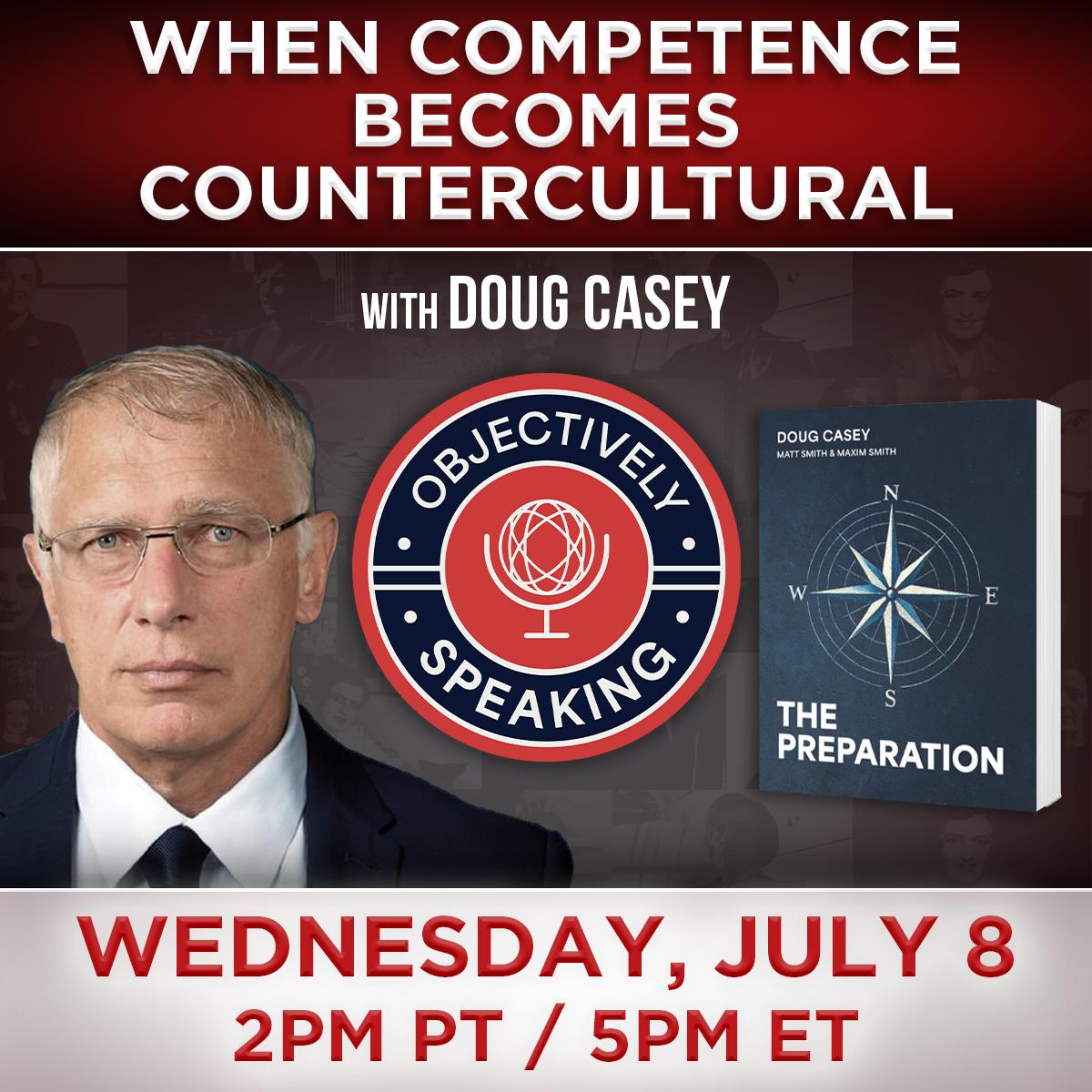
[00:00:00] Speaker A: Hi everyone. Welcome to the 310th episode of objectively speaking. I'm Jag, CEO of the Atlas Society. I'm so excited to welcome back returning guest Doug Casey. He's going to talk about his co authored book, the Preparation how to Become Competent, Confident and Dangerous. Doug, thank you for joining us.
[00:00:25] Speaker B: Well, thanks jag, it's pleasure to be here with you. I enjoy talking to people that are on the same philosophical wavelength that I am, which is only a small portion of the population, I'm sad to say.
[00:00:39] Speaker A: Well, we are working to expand that proportion. So first I have to ask where and how did you celebrate and spend Independence Day? Assuming. Well, no, you were in Virginia.
So wondering, you know, what thoughts were going through your head given that you spend such a large part of your time overseas.
[00:01:03] Speaker B: Yeah, it's true. I live most of the year in either Argentina or Uruguay these days.
I've been to 155 countries, most of them many times lived in 10.
But now I spend most of my time in either Argentina or, or Uruguay.
I spend the northern summer here in Virginia because the weather is good and then I go back south because the weather is good there in the southern summer.
So.
[00:01:36] Speaker A: Yeah, well, so I was really, I was happy to hear that you are in the United States in the month of June. And I just mentioned to our producer, I'm going to send you an invitation to come and speak week at our next Golf Gulch student conference which will be in New Orleans in June, because I just thought your, your book was just fantastic and thank you audience. So I won't put you on the spot, but just heads up, it's coming. And by the way, I have, you know, I just told you I returned from our fishing club and I have already sold two of them, two copies of your books to some of the young men that I've met along the way. So.
But thinking back, the last time you joined this program was in June 2023.
Five months later, Javier Milei was elected President of Argentina. Did you see that coming?
[00:02:37] Speaker B: No, I didn't see it coming. But on the other hand, for years I've been a fan of Argentina not because of what it is, but because of what it was. And by that I mean historically, it's always been the most western oriented, outward looking, free market oriented country with the largest libertarian population in Latin America.
So I was always hopeful that it would return to its roots. And I think it's going to be the same thing here in the US Things have to get bad enough for people to want A radical change. In other words, the Kirchner government had truly run the wheels off the car.
And Milei said very radical things that people would not have countenanced before saying that he wants to abolish the government and get rid of all the agencies and fight hire the employees and get rid of the income tax and get rid of the morass of laws and duties and taxes, everything.
I mean, he was very radical and forthright. Very radical. He's an anarcho capitalist.
Totally ideologically sound. I don't know if that's a proper thing to say to.
To the Atlas Society, because you guys are not anarcho capitalist as I am.
But hey, I started out as an Objectivist. Well, not really, but
[00:04:16] Speaker A: close enough. Let's talk about that for a moment.
Ayn Rand's influence over your worldview. I think I read that you were reading the Virtue of Selfishness, and it. It stopped you in its tracks. So are there any elements or principles from Objectivism that have resonance with the kind of philosophy that you're advancing? Philosophy. But fair to say, you know, largely a practical guide in the preparation.
[00:04:50] Speaker B: Yeah, actually, the Virtue of Selfishness was the first book I read by Rand, and I distinctly remember where I was.
I read the first page of that book and I swear this is the truth. I had to put it down because what Rand said there just on the first page. The whole book was brilliant, of course, but on the first page I knew where it was going and it served to crystallize thoughts which were somewhat inchoate in my head at that time. I was.
What? How would I define where I was at the moment? I guess I was still kind of a conservative because I didn't know better.
So it worked to change my life.
And the values of that book are thoroughly reflected in this book I did with Matt and Maxim.
But we're all anarcho capitalists. What's the difference, you might be asking, between an anarcho capitalist and Objectivist?
Not much.
The difference would be that we don't think that Rand went far enough. Most people thought she went too far. I think she didn't go far enough because she didn't plump for the abolition of the government itself.
[00:06:11] Speaker A: Yes, yes. And we could probably spend this entire session debating anarcho capitalism versus the Objectivist case for a limited government to protect individual rights. But if we did that, then we wouldn't have the chance to talk about this amazing book.
Apparently, your co author, Matt Smith, had spent many years trying to convince you to work on this with him and actually you were the one trying to convince him to work on this book. And it wasn't until his son hit 18 with very little direction that he said, okay, now is the time. So what finally convinced you this was about the right moment and the right co authors for this project?
[00:07:06] Speaker B: Well, I felt that in the past I've written five financially oriented books and well, the International man was my first book, which is not really financially oriented. And novels that I've done with my
[00:07:22] Speaker A: friend John Hunt, which are fabulous by the way.
[00:07:26] Speaker B: Thank you.
[00:07:27] Speaker A: If others haven't read them, maybe we'll put those links in, in the, in the chat so that people can check them out.
[00:07:33] Speaker B: Yeah, they're actually quite good. And we're working on the fourth one now which is called Terrorist.
I have a lot of theories about terrorism as a method of warfare, but I, as time went by, starting with the time when I was in college, I misallocated four years of my time and what was a lot of money at the time, which is peanuts today at Georgetown University, which was also a bad choice. But be that as it may, and since then we've found that even back then when I went to Georgetown, which was in the 60s, relatively few people went to college. Now almost everybody goes to college and the as it's been democratized, if you will, the quality has gone down considerably, dropping considerably from a low level and all, almost all of the professors everywhere, and I speak of somebody who was a trustee of a college for, I don't know, five or six years, that was Washington College, which is the 10th oldest college in the country and was founded by George Washington. Little known fact, but, and I found it there, almost all of the professors and the textbooks, they're all collectivist oriented, Marxist, socialist.
It's a cesspool. The whole system is a totally corrupt, unbelievably overpriced cesspool. And it just made me angry.
And I'm a big fan of Western civilization, which is being actively destroyed by the academic community.
So I just felt that some things had to be said. But it wasn't enough, I thought, to tell people they shouldn't go to college. I mean, that's leaving them with, well, what do I do for those four years? Well, what this book is about is exactly what you should do, I think over those four years.
So that's what it was. And I didn't write it to become rich or famous or anything like that. I just felt that it was a good karma thing, something that needed doing.
[00:09:57] Speaker A: Yes, well also I Think it's in your long term rational self interest, we would all benefit.
And certainly you and I would think that if we had a world filled with more competent, competent, confident and competent people, that would be a better world to live in. So the book lays out for a 4 year 16 cycle program.
Medic, cowboy, pilot, fighter, hacker, maker and more. Each built around a hands on anchor course. So tell us a bit about the structure of the program and how you chose these different cycles.
[00:10:34] Speaker B: Okay, well, I'm a great believer in the concept of a Renaissance man.
And a proper Renaissance man can do anything, go anywhere, knows everything, thinks rationally, logically.
So this, the intent of this book is to, is, is for a young man who goes through the things we recommend in this book to become a modern day Renaissance man that can do all of those things. And in addition, I, I hasten to add, learn everything and more than he would learn by going to a four year college. In other words, because of the Internet, all of the knowledge in the world is online and everything in the Library of Congress and everything else, it's all there.
But to make it easy for people, we've laid out an academic program as well, so that you'll take courses that are on YouTube, but mainly I think, from the Teaching Company.
I'm a big fan of the Teaching Company because what they've done is taken what seem to be the best professors in the world and pay them to give a command performance of lectures.
Because of course when you go to a college, the professor is mediocre in addition to being philosophically unsound and will ramble on, sometimes good, mostly bad.
But the Teaching Company offers courses in all the standard academic disciplines and you can listen to them as many times as you want.
So I found, and I think most of my classmates found, that after a night of partying, you missed the early classes you fell asleep in, the ones you went to, didn't take good notes, couldn't read your notes after you left.
So at most from college, from an academic point of view, you'll learn about history or biology or chemistry or geography, whatever it might be by osmosis. But we lay out a program here where you should learn these things because it's really interesting and take it a second time.
[00:13:16] Speaker A: Right?
So Valiant Mike says a lot of young men seem directionless right now. So it's a good idea for a book like this for people who don't want to fit in the mold. But that kind of leads me to another question, which is what are some of the most common Criticisms of young men today and maybe even critical criticisms they themselves have for their peers. And how would the preparation help them to overcome these shortcomings?
[00:13:45] Speaker B: Well, I think they lack confidence. And the reason they lack confidence is they don't have a philosophical foundation.
They don't believe in anything really. And if they do believe in something, it's going to be a bunch of crappy ideas they've picked up from the environment, from the cesspool that we're all swimming in. But they're especially in a cesspool, swimming in the academic area.
The idea is that by knowing how to do things as well as know things, you'll gain confidence in your ability to deal with life. And that's why we divide the book not just into the 16 quarters, but into an academic area and a practical area.
The academic area is the things that you should learn but probably wouldn't in college and much more. It's academic, but if you learn how to do everything from survive in the wilderness for a month, to shoot properly, shoot a gun properly, to defend yourself with martial arts, to fly a plane, sail a boat, drive heavy machinery, some of the things that you've mentioned, you'll have a lot of confidence in yourself and you'll develop competence as well.
And that puts you head and shoulders, more than head and shoulders above all of your cohorts.
Not only that, but you won't have misallocated four of the most valuable years of your life and you wouldn't have bankrupted yourself because going to college today for most people is only possible with student loans, which can't be dismissed, and a lot of people never pay them off. So it's like an albatross that they've taken on around their necks in order to be corrupted.
[00:15:48] Speaker A: Right?
[00:15:49] Speaker B: It's disgusting.
[00:15:50] Speaker A: It's a terrible deal. And I think in the book you say that the cost of the preparation four years is actually like the cost of one year of tuition at an average school.
But Jackson, that's true.
[00:16:04] Speaker B: And in the case of Maxim Smith, my co author, Matt's partner, after he became an EMT emergency medical technician, that qualified him to get a job as an emt.
So what did he do? He found a job out west fighting fires. And they pay $600 a day net to be an EMT, covering your room and board and food and all this type of thing so that he's been able to finance everything that he's done so far just from working six weeks of the year as a EMT firefighter. So, yeah, it's actually, it's actually better than what you said. It's not just, it'll cost you a quarter.
[00:16:55] Speaker A: Yes, it's a moneymaker. So. But Jackson Sinclair asks, are there still young people who should go to college or do you, Doug, see alternatives for college in most cases?
[00:17:09] Speaker B: Well, I think everybody should do what's recommended in this book, regardless of whether you want to go to college or not. But why would you want to go to college? Well, there are certain areas where it's good to have a formally disciplined environment and there are places where you need lab work. For instance, if you want to take pre med, you want to be a doctor. Well, if you want to be a doctor, you have to go to college because you can do things in a university, learning to be a doctor that you really can't on your own.
A lot of things.
Science, STEM science, technology, engineering, and math.
Those are areas that, yeah, you can learn a lot by yourself, but it's much more effective to have a structured environment and for those things too, and I would add law, you need a piece of paper in order to utilize those skills professionally.
So yeah, of course, in those specialized areas, absolutely. College is okay.
Necessary even.
[00:18:20] Speaker A: Yeah. Candace Morena asks for parents who feel nervous about telling their son to skip college, what evidence should they look for that he is ready for a more independent path? And I guess I'd add to that at some point. Will there be a follow up to the preparation? I think a book with Maxim's, you know, Test case, as well as other young men and testimonials would be really helpful in that regard.
[00:18:49] Speaker B: Yeah, you're absolutely right. JAG and Maxim is trying to put together a network of people that are taking the preparation so that they could communicate with each other and add courses like, well, for instance, the, the Learn to be a Chef course is a professional school in Italy, but there are others, so. But we couldn't kiss all the girls, as it were. So you know, we're doing that to expand it, broaden it and make it more practical.
But are we going to expand on the book?
Well, I'm, I'm so, you know, my regular business is writing an investment newsletter and doing a couple of podcasts of my own a week and three or four of other people's a week and writing a blog and, and I, I do a lot in the markets and that takes time.
And as far as something else, I'm working on the fourth book in the series of novels that I've done with John Hunt. First one was Speculator and we did drug lord, third was assassin, and now we're writing terrorist. So that actually takes a lot of time. So answer your question or Matt and Max may pick up with the ball and run with it from here. But I feel like I've done my good, so maybe not.
[00:20:29] Speaker A: Okay.
[00:20:30] Speaker B: Anyway, I like. I like reading stuff more than I like writing stuff.
[00:20:36] Speaker A: Well, they probably go go hand in hand. So one of the interesting metaphors that you and your co authors employed in the book was, was this idea of weaving a spider webs as opposed to climbing.
Climbing a ladder as a way of measuring your progress towards success. So could you unpack that a little bit for us? Why? The spiderweb metaphor?
[00:21:01] Speaker B: Yeah, that was a concept that, that Matt came up with.
I've never been a believer in climbing a ladder to success, because you climb a ladder, it only goes in one direction. And if you see it as a ladder, you've got people below you
[00:21:21] Speaker A: and
[00:21:22] Speaker B: they're trying to pass you, and people above you that are maybe trying to grease the rungs or step on your fingers. And where are you going? You're going towards one objective, being the top honcho in a corporation. No, it's a bad concept, but most people think about it as climbing a ladder. It's much better to think about your path to success in life as being a spider web. The spider sits at the web which is built, which is woven, and he can go wherever the opportunity is.
And it's like landing off in the corner in the spider's case.
And it's much more survivable, much more stable than a ladder which can be pulled out from under you or tip over. Spider web is very stable.
So it's a much better metaphor for the way that you should advance in life. Thinking of it as a spider web. But it's not a spider web unless you weave it. And that means having loads of experience, practical knowledge, and academic knowledge. All of it build a strong web.
[00:22:33] Speaker A: So I remember the venomous criticism directed towards the young men that Elon Musk had assembled at Doge. And thinking back to the young men among our founders and the great military leaders in history, it seems like we have such low expectations of young men today. How can looking to some of the great feats achieved by young men throughout history help today's young men to elevate their expectations for themselves, themselves.
[00:23:04] Speaker B: Well, look, as you're well aware, Jack, the government, academia, the entertainment industry, Hollywood corporations, in fact, almost all of the important institutions in society have been captured by the left at this point.
So I was going off on a tangent. What was the question again? That's a stupid question for me to ask you, but I will.
[00:23:40] Speaker A: It was. It was about just, you know, we have such low expectations.
[00:23:45] Speaker B: Low expectations.
[00:23:47] Speaker A: And also, you know, the criticism directed towards the young men that Elon Musk had assembled for Doge, but then looked into our founders and other great leaders throughout history, and often they were quite young teenagers or, you know, in their early 20s.
[00:24:05] Speaker B: Right. And that's really not possible in today's leftist captured over regulated society.
The fact, you know, listen, I'm not much of a follower and I'm not much of a leader either. I'm. I'm one of those people that is what I call a gamma rat, okay? You got alpha rats that like to boss the other rats around, and you got beta rats that get bossed around. Well, everybody knew that. But then scientists found that there was such a thing as a gamma rat. They didn't boss around the other rats, but they later took the best territory and mates and all that, just like the alpha rats. And they weren't bossed around like the beta rats. So that's what.
That's the ideal kind of character profile for people that read this book is concerned. But it's very hard for the average guy today because he's used to following the leader and all of our leaders are corrupt. And take Doge, for instance. It was a wonderful idea. But of course, Trump is a pathological, chronic and enthusiastic liar.
I guess Doge, for him was just a marketing scheme. It was a great idea. And I'm a big fan of Elon Musk, I've got to say, too.
But, you know, after the marketing impetus was stolen, was taken from Doge, they abolished it and went back to, you know, doing the same thing. So I guess the answer to the question is, I'm kind of skating around it is that almost all of the influences in society for a young man are negative influences. They want him to be just another cog in the wheel. Okay?
The society is working against entrepreneurs and lone wolves.
You know, you're supposed to get a job, go to your cubicle and do what you're told.
And there are very few influences against that. Well, we're trying to be.
[00:26:22] Speaker A: There is the Fountainhead and there is Howard Rourke. And so I'm happy to report that we are adapting that into a graphic novel. And I think that kind of that lone, you know, creator, producer, independent mind, not willing to create compromise.
[00:26:42] Speaker B: That's very. That's very smart, Jag. But I understand that that Rand or the inheritors of her legacy have made it hard for people that want to do things that are innovative like that. Am I right or have you overcome that hurdle?
[00:26:58] Speaker A: Well, you know, we were able to overcome it with things like the adaptation of Rand's anthem, because that slipped out of copyright in 1960, a very good year.
And then also our graphic novel of Red Pawn, that was a screenplay that was not held by the estate. And you know, at some point those rights are going to be passed on. And if they are passed on into to someone who is interested in the trader principle and would be interested in the trade, then the atlas is society will be there. So.
All right, question here from Alan Turner. He wants to know, Doug, how do you teach judgment and not just skills?
[00:27:47] Speaker B: Well, that's a good question.
I think the basis of judgment is a moral foundation, and you can't make a good decision unless you do the moral thing, the right thing. That ought to come first. This is one of the reasons why Trump is failing so miserably in almost all respects, because he has no moral or ethical or philosophical center. So what he does, his judgment, how he reacts to propositions presented to him, problems that come to him is willy nilly, helter skelter. He has no basis upon which to decide what's right or wrong. He flies by the seat of his pants. So I guess the answer to your question is to develop judgment, you've got to develop a sound, logical, rational moral foundation. And that is something that Ayn Rand really brings to the party, as far as I'm concerned.
[00:28:50] Speaker A: Well, and then we are bringing Ayn Rand to the party. So there you go.
[00:28:55] Speaker B: You know, it's, it's, it's why, it's why the society as a whole, most people, and certainly everybody that writes stuff like in the New York Review of Books, the New York Times and all these things, it's why they hate Rand, they despise Rand. They, you know, they, for just that reason, I think they have no, they have no judgment because they have no moral foundation. Anyway, I'm sorry to cut you off.
[00:29:19] Speaker A: No, that's okay. I mean, I think that part of the reason, I mean, look, you know, in terms of identity politics, an immigrant, she's a woman.
She writes novels with strong female protagonists. She's Jewish. I mean, but of course they hate her. And I have always argued that one of the reasons they do so is because she's so effective. Ed Crane called Rand the all time greatest recruiter for the liberty movement. So.
[00:29:49] Speaker B: And God for. And. And God forbid.
Turns out she's Russian as well, and you're not supposed to be a Russian today.
[00:29:57] Speaker A: All right, so, Doug, the subtitle of your book is Competent, Confident, and Dangerous. The last word is provocative. So what does it mean to be dangerous in the best sense? And why is that a virtue rather than a threat?
[00:30:13] Speaker B: Well, okay, let's look at the word dangerous.
What's the opposite of being dangerous?
See, I don't. I don't have a thesaurus with me, but if you're not, the opposite is being supine or lamb like or.
Things of that nature.
So. And in today's society, somebody that takes charge of his own life and can take charge of a situation is dangerous. It's dangerous to the established order, among other things.
So this whole book emphasizes that in addition to instructing young men to learn overtly dangerous skills like shooting guns, engaging in martial arts, seriously, learning to drive heavy equipment, that's dangerous. Learning to fly a plane, that's dangerous. Learning to pilot an open ocean boat, that's dangerous.
And if you, you know, it's.
Who is it that said you can be feared or loved? It's better to be feared than loved, but it's best to be both.
[00:31:31] Speaker A: That's right.
So, yeah, so I think I understand that better now. So the book promises a, quote, foundational philosophy rooted in stoicism and Renaissance thinking, so that you don't just master tasks, you master yourself.
In your view, how do stoicism and objectivism coexist in your worldview? Are they complementary or are they intention?
[00:31:59] Speaker B: Yeah, well, that is. That actually is a good question.
It's the type of question that I feel more comfortable discussing. I don't debate things with anybody anytime for lots of reasons, but I loved having discussions. And if you and I got together, I would fire up a cigar and offer you one, and we could have a whiskey or brandy and talk it out in detail.
But.
[00:32:30] Speaker A: Well, I just take you up on that at some point.
[00:32:34] Speaker B: Well, I'd like that very much. So you're welcome to come here and visit anytime you want.
But,
[00:32:42] Speaker A: yeah, I mean, I think I would say that there is.
There is complementarity in terms of being rational, not being overly small, swayed by your emotions, remembering that, you know, we have only so much time here on Earth. But I feel like that there is also a tension in terms of. To the extent that stoicism would be repressive or suggest that, you know, you ignore your emotions. I think objectivism would say that emotions are a good signal and you need to. But anyway, again, one of these things that we could spend more than an hour on and I, I don't want to take away from the book. So I had another question.
[00:33:34] Speaker B: Oh, you're right. But it's, it's not just stoicism because I'm very classically classical, classic literature oriented. And you don't want to rule out Epicureanism, which has a bad reputation for some reason because people think of Epicurus as eating too much, drinking too much and being pleasure oriented. And that's really not what it's about.
So.
Everything that Ayn Rand said, almost everything that I can, anything I can think of, I agree with. But as you said, I think that there are insights from ancient authors, both the Stoics and the Epicureans, that complement her thoughts.
Because we're all individ, we're all individuals,
[00:34:27] Speaker A: we all, Well, I think also, you know, young, young men are fascinated by ancient Greece, ancient Rome and I, I could see that that might also be an easier bridge.
But overall people should be reading and gathering sources of, of knowledge.
One of the things in your book that I thought was interesting was its critique of how many young people think about mentors and how, you know, you and your co authors are suggesting a patron formula. What is the difference between a mentor and a patron?
[00:35:08] Speaker B: Once again, big difference from the standard thing. Everybody's looking for a mentor, but what is a mentor? It's somebody that you impose upon or for reasons of his own, decides to take you under his wing.
The question is, wait a minute.
Any good relationship has got to be a two way street.
There's got to be a, okay, I'm getting stuff from this person with more experience, more money, more everything.
What's the exchange? What am I going to give him?
And that's the problem with the patron.
You're looking for somebody to go out of his way to help you. And maybe he will, but it's not a healthy situation or mentor, I should say.
But in the case of a patron, this is going back to ancient Rome.
It's that young men would present themselves to people that were rich, powerful, whatever, and convince them that they could do them good.
And by the fact that the mentee was helping the mentor, the mentor would exchange and help the mentee. It's a two way street.
So the key to this is to associate yourself with different mentors where you bring something to the party. Otherwise you're as rag would say if you're, if you're just a, a moocher, a Mooch. That's exactly the word I was looking for. That's right.
[00:36:55] Speaker A: So the book emphasizes the concept of time preference. What is time preference? And what does the average American's savings and credit card debt say about how most people are approaching time preference?
[00:37:10] Speaker B: Well, it's one of the reasons why I'm pessimistic about the direction that America is going and for that matter, its fate at this point.
It's that all of the debt that we have in society, student loan debt, credit card debt, automobile debt, mortgage debt, and of course the government's debt, which it's going to try to impose on us one way or another, debt is all about I want it now, I don't want to wait for it.
And this is a very destructive influence in society.
So that the time preference is I'm not willing to wait and earn something.
I want to borrow and get it now. In fact, I want it all and I want it now. And about the only way I can do that is by borrowing money, which kind of implies you're never going to pay it back, quite frankly, like the US Government, that it's never going to be paid back. There are bad things that are going to happen in that direction.
So that's why the US is turning into a third world country.
Because in backward primitive countries, their time preferences, right now I got to survive right now, and I got to do whatever I need to to put that meal on the table five hours from now. They can't think long term.
One of the reasons is they never build capital. We don't build capital in this country anymore either. We borrow. So I don't know, I'm hitting on a number of aspects of it, but it's very, very bad.
And you can't think long term in a highly regulated, highly taxed society like this one is where the government can do anything and destroy your plans. Who is it, Hayek, that said, the more the government plans, the more it becomes impossible for anybody else to plan, Right? Yeah. So short term, Short term thinking. You see it with corporations where it's famous that these days, rather than building a dynasty or building an empire the way Ford and Carnegie and Rockefeller, those guys tried to do today, the managers, and they're not entrepreneurs running these countries. The companies they, they, yeah,
[00:39:49] Speaker A: you know, stake in, in the, in the future. So Matt, in the book, he used this program to rack up EMT shifts on Oregon wildfires, as you mentioned, earning $600 a day, fly solo over the Rockies ranch in Uruguay, sale the Strait of Magellan, all before he turned 20. So just curious, what surprised you and Matt most, watching Max execute the program in real time, and what worked better than expected and what didn't?
[00:40:28] Speaker B: I think all of the programs he's been on so far have worked out excellently.
The only one that he stumbled on was when he went to Thailand to live in a martial arts gym for a month or two, and he got sick and couldn't complete it, even though he left Thailand and went to Japan to pick it up again. But he still had a medical problem.
So everything has gone swimmingly except for that.
My question I've got to ask Max about this is that there's a real academic part to the preparation, so that you learn everything you would have learned if you stayed away in class in college. And that's these teaching company videos. And I haven't kept up with whether Max has been taking a couple or three hours a day to study academic courses, but he's doing great in the doing part of this thing.
It's a faultless program, actually. It's. Look, it's all about mensada and corpore sano, which the Romans said, a sound mind and a sound body.
And that's one of the aspects of the preparation as well. You know, I'll give you a model for an individual for the preparation. One is the count of Monte Cristo. Okay, It's a great novel. Everybody should read it, and it kind of lays out what a Renaissance man knows and so forth. But I'll give you a more down to earth one.
During the 50s and early 60s, there was a TV show called have Gone Will Travel. Everybody's heard that phrase, but today, few people have watched the Show. It's on YouTube, where you can buy it all, you know, on streaming or whatever.
And it's a great show about a gunfighter named Paladin, who's not a gunfighter. Well, he is, but he's a problem solver, and he's a Renaissance man. He knows it all. He's done it all. He's been everywhere.
And that's what we're looking for everybody to do by the time they finish the preparation.
We hope that everybody's been to at least a dozen different countries, among other things.
[00:43:02] Speaker A: Well, you have been to countless different countries.
You have lived and invested in Argentina and Uruguay and many other countries.
I can't help but wonder if the preparation is at least implicitly, also a guide for leaving the United States for these young men. Or is it more of a preparation for being a capitalist at large?
[00:43:28] Speaker B: Yeah, Capitalists at large.
Karl Marx would have called us rootless cosmopolitans.
Because part of what this book is about is that, you know, you're born in one place. And I know from my friends that I grew up with years ago, most of them are like potted plants.
They were born one place, they're rooted there, they stay there, don't expand their horizons very much.
I mean, there might be dragons over that hill, thinking like a medieval peasant, perhaps, or, you know, the government tells you, oh, don't go there. It's dangerous. Those people are bad.
So, yeah, one of the sub themes of this book is to broaden your experience. And one of the best ways to broaden your experience is to hit the road and go new and different places and meet new and different people. Now, of course, you can do that in the army, but there you basically meet new, different, interesting people and kill them.
So we want to leave out that last part if possible.
[00:44:45] Speaker A: All right. I know that you and your co authors wrote the preparation for a young male audience with particular needs and a particular sense of alienation in, you know, a culture that treats masculinity as toxic. Now, young women have a different set of problems right now, but it seems to me that they are in some ways even more vulnerable to some of the mind viruses corrupting our culture. Would young women benefit from the same program?
Or have you or your co authors given any thought to creating a similar program for that demographic?
[00:45:25] Speaker B: Yeah, there's no question that young women are in as much trouble as young men today, just in different ways. And I think this book is equally applicable to young women and young men, although following the course we laid out in this book, book, I think would be harder for young women than for young men because a lot of the things that we do here are traditional, traditionally male areas. So I know that, Matt, and the reason we started with men is because it's something we know about firsthand.
I mean, I don't think like a woman, I can say what I think they ought to do, but we thought that we would talk about what we knew about and then maybe later on talk about how this can be applied to young women. It can be.
Actually, I think the ideal young woman is something like Lara Croft, that character in the movies that Angelina Jolie plays. She's kind of a female model, if you would, for this type of thing. But yeah, maybe. Maybe the boys will write it in the future.
[00:46:47] Speaker A: I'll take one more audience question, then I will close up with your final thoughts and any question that I haven't asked you that. Maybe I should have.
Valiant Mike asks, it seems like young men and women are suffering from larger cases of, of anxiety. Do you think this comes from them not being tested in any meaningful way? And so this has kind of been a little bit of an ongoing debate that we've had with some of our guests on this show. There's the whole coddling of the American mind argument that helicopter parents and you know, overprotectiveness have deprived young people of opportunities to gain resilience, to make mistakes, to learn how to overcome them and gain confidence in that way. And then there's the other view, is that, well, we are scaring the wits out of young people. We're telling them that, you know, they live in this very malevolent, maligned country that is racist and is, is greedy and all of this, that the world is going to come to an end, that half of the country is just irredeemable and beyond reproach. So I guess my question to you is where does this sense of anxiety come from? You know, I, I thought a very moving part of the book was when Max was recounting what, you know, he had been suffering with. It's almost crippling anxiety and how the preparation helped him to overcome it, particularly with aspects like public speaking and being, being willing to, you know, gain the sense that your sense of esteem does not rely on others opinions of you.
[00:48:41] Speaker B: Yeah, you're absolutely correct.
And it pervades the society. The things that you mentioned are all true.
And when kids compete with each other, well, they're not supposed to compete with each other because that means there are winners and losers and you can't have that. Everybody's supposed to get a participation trophy and if you go to college, everybody gets an A or sometimes there's no grades and it's. The whole system is totally corrupt and at this point should be washed away. I'm just afraid that when it will be, when it is washed away, it's going to be with a tide of socialism.
I mean, the fact that Zoran Mamdame was elected the mayor of New York running on an overtly socialist platform and he's trying to put his theories into practice.
This is indicative of how bad things are.
And in all the other major cities of the country, it's most of them, it's the same thing. The society is totally corrupted. And I think it's going to get worse.
I'm not trying to be defeatist, incidentally.
Although let's admit it, people that think the way you And I do overtly the way Rand did are a rounding error. And even if we're more than a rounding error, most people have been so intimidated they don't want to say these things out loud because they'll be pooh poohed and they'll be mocked and so forth. I'm not optimistic and I can give you lots of other reasons why I'm not optimistic about the way things are going in the us. It's one reason why I live outside the country half the year and have roots there.
[00:50:41] Speaker A: Yeah, this is all the more reason why we've got to get you to gilch because that conference has tripled in terms of the size of attendees. Started out with 50, we're now over 150.
We're on track for 175 or 200 and we turn away hundreds of applicants for scholarships. And just the enthusiasm, the moral ambition, the authentic intellectual curiosity.
I always leave very, very energized.
And achievements like your book also leave me optimistic. And it looks like from our comment section that you sold a bunch of books already. So I'll just get the last few minutes remaining over to you for anything that I should have asked but maybe haven't or anything you'd like to leave this audience with.
[00:51:35] Speaker B: Well, I want to compliment the people that do buy a copy of the book. I mean, look, I really don't need the money. That's not why I want to sell the books. It's actually a good karma save civilization thing. And from the point of view that read this book, I think they're going to like it because it's not only going to be psychologically reinforcing, but if you're going to do things, you need a It's good to have a plan.
It's laid out. It'll make things easier.
You won't waste as much money, you won't waste as much time if you follow a plan from point A to point Z.
So I would say read the book.
It's actually pretty good.
And one other thing I'd mention, this book is intended for people of college age.
But the fact of the matter is if I'd had this book, and I wish I'd had this book when I was a kid, but if I'd had this book when I was in grade school and I'd been supported by my parents in that direction, which is important at that age, it's important until you're self supporting, quite frankly, which you know, most people under college age aren't.
But if you can get your parents on side with this, which is going to be hard because old people are stuck in their ways and everybody thinks, oh, college is a ticket into the future. All of that idea is being recognized as the stupidity, which it actually is.
But I guess what I'd say is I think kids starting in late, starting in grade school should read the book. And in high school they should actually be you could speed this all up four years and start applying it when you're in high school, although it's tough for a kid that's not mature yet.
Physically.
Yeah. But the earlier the better.
[00:53:38] Speaker A: Sooner the better.
As I said, I got a ride from our fishing club to Reno Airport and gave away another copy of the book to the young man who was the was my driver.
So, anyway, thank you, Doug, for this achievement, for taking time with us today.
Really appreciate you. And perhaps we will meet again if at Galt's Gulch in New Orleans, if not earlier. So thank you.
[00:54:08] Speaker B: Well, I look forward to it, Jag. It's a pleasure talking to you.
[00:54:13] Speaker A: And thanks everybody for all of your great questions, for your enthusiasm for this episode. Sorry if I didn't get to all of them. As you can see, I am not at the studio. I'm here in Las Vegas for Freedom Fest and I've got a panel that I've got to be on in a few minutes. So we're going to be jump. But make sure that you join us next week when returning guest Arthur Herman will join us to talk about his new book, founders fire from 1776 to the age of Trump. So see you then.