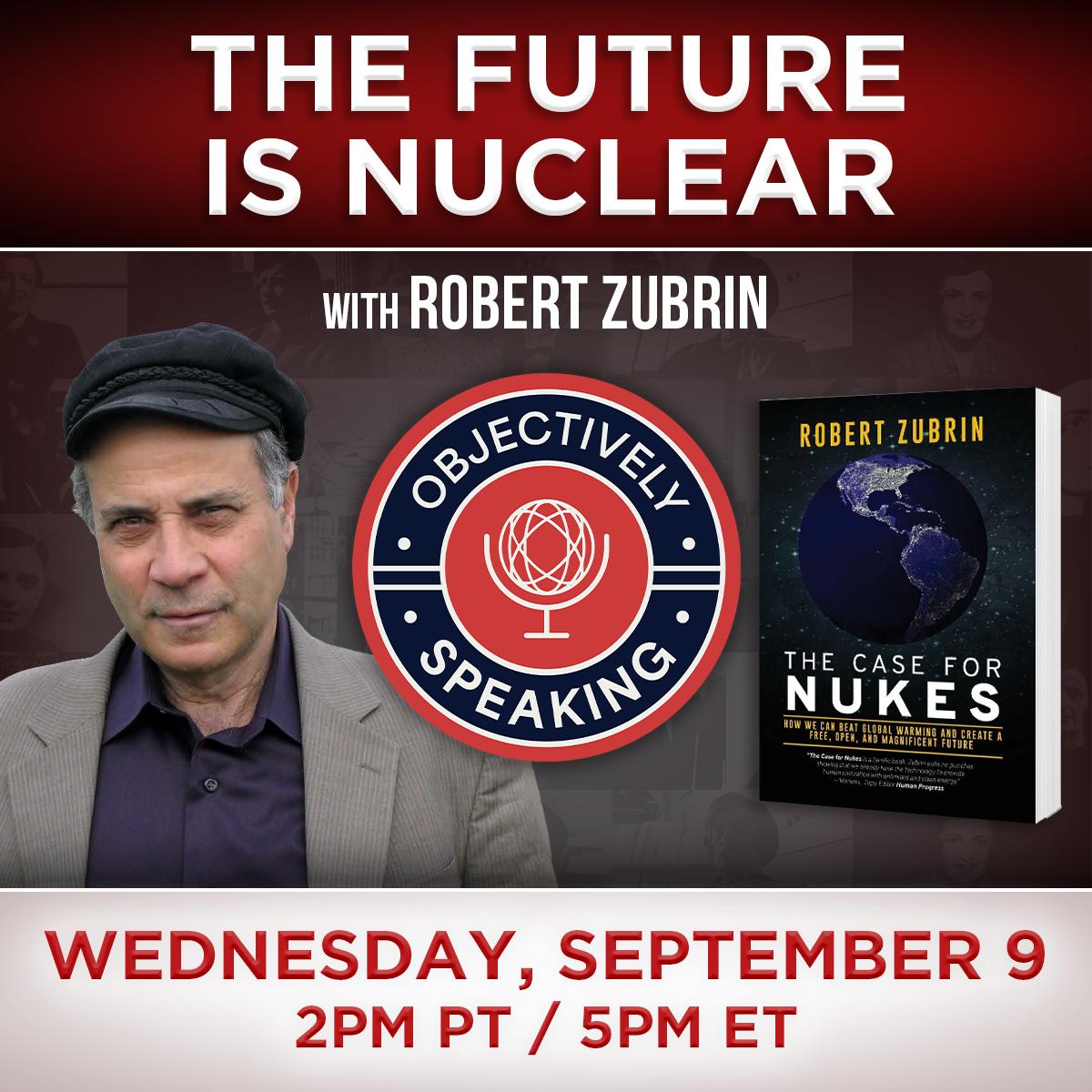
[00:00:00] Speaker A: Okay, we are live. Hello, everyone, and welcome to the 317th episode of objectively Speaking. I'm Lawrence Olivo, senior project manager at, here at the Atlas Society. I'm excited because even though Jennifer Grossman has the week off today, Atlas Society senior scholar Richard Salzman will be reviewing returning guest Robert Zubrin, who has a couple of new books out.
So we are going to go ahead and get this started. I'll pass it over to Richard now, but if you have any questions, please, please don't forget to post them in the comment section. We'll try to get to as many as we can. Richard, take it away.
[00:00:35] Speaker B: Thank you, Lawrence, and welcome. Dr. Zubrin, so wonderful to meet you. I've, I've read some of your books and seen many of your interviews. I'm a fan, a big fan, so this is a delight for me. I'm glad to be able to pinch hit for Jag. I also saw the 2022 interview you had with her.
So I, I know you're an expert in both nuclear and space to put single words on it for those who don't know. By the way, the background, quickly. Dr. Zubrin is a astronautical engineer as well as a nuclear engineer. And for more than four decades he's been a pioneer in advocating an extension of human exploration into space, especially to Mars, but has also been a steadfast defender of all sorts of energy. But in including, including nuclear energy, which, as you know, has been opposed so for so many years. So. So there's two themes I see running through both of these. These are advanced technologies, or if you will want to look at it as advanced human activities and achievement, which face a lot of opposition.
So, but I wanted to start. I'll bring in some of your other books in a moment, but I really wanted to start with an excerpt from the most recent one, the Case for nukes.
Robert, in 2023, you write, the greatest threat facing humanity is now. At this point, most people think
[00:02:00] Speaker A: global
[00:02:01] Speaker B: warming or nuclear war, terrorism and the national debt. But you say instead, the possibility we will turn on each other as we did in the 20th century under the false idea that resources are finite, unquote. You know, it's basically the zero sum game that necessitates antagonism. And you conclude, only in a world of freedom can resources be unlimited. And that's the world we can create, must create. Can you elaborate? That's a great thought.
[00:02:31] Speaker C: Well, yeah, the, the greatest danger to humanity right now is bad ideas.
And in particular, one bad idea which Comes come in a multitude of forms which is that there isn't enough for everyone.
And so we need to kill each other to see who gets what is there.
I mean, this idea is out of the worst of the past 200 years. In particular those the 20th century. You know, I mean, look, in 1914 Europeans were living far better than before in human history.
But in 1912 a intellectual association with the German General Staff von Bernhardi had Germany next war which was a bestseller and international bestseller in fact. And he basically said the following. Look, you know, there's only so much here and who's going to get Eurasia? It's either going to be us Germans or the Russians. We're the only ones that can do it. And so we're gonna have to fight them for it sooner or later. Should it be sooner? Should it be later? Well, let's make it sooner because they haven't industrialized yet and now time when we can take them down.
So two years later the Germans and Austrians to use the pretext of the assassination of the to initiate World War I and to just settle the matter and 20 years or 25 years later Hitler. You know, even more hysterically Germany needs living space unlimited killings the better may live. That's quite now this was all nonsense. Germany did not German. Germany today is significant population actually higher standard. And how was that achieved? It was not achieved because they managed to invade other people's lands exterminate and seize their livestock.
Germany today is much richer than Germany of the 1930s or 40s because of the advance of human technology which has been a global project to which many peoples have contributed including but also many peoples they were trying to exterminate. Had they won and implemented the extermination, they'd be far poorer than they are today. You are today for a fact, because I have spoken to them that there are American national security establishment believe that war with China. Why? Because in the world and driving cars, the billion of them, there's not going to be enough oil for them.
And you can bet your butt there are people in Beijing who are their opposite numbers who think exactly the same kinds from the opposite sides of the chessboard. And if this kind of thinking is allowed to prevail, then we will kill each other. And we'll do a much more thorough job of it than we did in the 20th century. Because our weaponry is a lot better right now.
So this is
[00:06:01] Speaker B: a lot of the themes in your book.
Remind me. In the early 80s, Julian Simon wrote this book called the Ultimate Resource and he Too was pushing back against this idea of finite resources. And his answer was, well, what is the ultimate resource? He went through energy, he went through population fears and things like that. But he basically said what I find you saying very often, reason, science, confidence, optimism, pioneer spirit, however you want to put it, that is the ultimate resource. Is that close to what you're saying, is that.
[00:06:34] Speaker C: Yes, it is. It is exactly what I'm saying.
You know, I read Simon and he had a significant influence on me, although I was already thinking along roughly parallel lines. But I, I absolutely agree he's right.
And this is why as the population of the world has increased the standard up, not down. I mean, look, when I was a boy, there were 2 billion people on this planet.
[00:07:04] Speaker B: Yeah, yeah.
[00:07:07] Speaker C: Now there's eight. And the average. Yeah, exactly.
Okay. You know, population activists or extremists or whatever, alarmists of 1960s, Paul Ehrlich and people like this wrote the Population Bomb. He predicted fairly accurately how the population would increase in the rest of the century.
He, he predicted we reached 3 billion people, I don't know the year 2000. And it was about right. But he got it exactly wrong. How this would affect the, the standard of living. It, it's exactly the reverse of what he said. People today, there's much fewer people as a percentage on Earth that are hungry than was the case in the 1960s.
And this is because of the advance of science and technology. And why is that? Well, the more people, the more inventors and the more inventors, the more inventions. And inventions are cumulative. And not only that, inventions multiply each other. Okay, if you have a motor and a motor and a bicycle, you can make a motorcycle. Okay, so you take two together and now you can and do something that virtually impossible before. And so, but, so this is true is true, resources of the Earth are infinite.
But it appears to be possible to people to see that it's very hard to convince people of that.
For the same, it is very difficult to convince an illiterate person that there's an infinite number of points in a 1 inch line segment.
But anyone could believe there's an infinite number of points in a line that goes in both directions infinitely. Okay, so yes, nuclear power is extremely critical in making it clear that we don't have energy limitations.
But in terms of other kinds of limitations, I think human expansion into space is necessary to make the point clear.
[00:09:29] Speaker B: You've also characterized this, I think rightly, as a political economist, I know this is true as Malthusian. So going all the way back to the late 1790s, Thomas Malthus also feared population, feared that population growth would outstrip food growth.
And Paul Ehrlich, you're right, as late as years, a couple years ago was still saying the same thing. So maybe some of this is some of this pessimism or some of this dog eat dog, zero sum game view could be due to a denigration of reason, just people not being more rational, they're going to be more fearful, more super superstitious.
It also, earlier you wrote a book, you get two books really, on environmentalism and energy and nuclear. The earlier one, interestingly, 2011, which I also read, I think that was the first one I read actually, years ago, and it's called Merchants of Despair.
So this also gets to the issue of, you know, intellectual outlook and confidence or not psychology of it. You referred to radical environmentalists to criminal pseudo scientists. This is in the subtitle the Fatal Cult of Anti Humanism. I like that philosophically. And by the way, listeners, one of the reasons to read Dr. Zubrin's books is he not only knows the technical engineering aspects of these two fields, he is very learned on the history. I've noticed the politics of it. You seem very pro liberty, you seem very pro humanistic. You want a free system.
But I just philosophically, historically, you know, some economics about it. It's this full case, by the way, this full polymath, interdisciplinary case is very, very powerful. But in Merchants of Despair, is that more of like a psychological profile of these environmentalists or they're not all environmentalists? Maybe you say some of them are practical environmentalists, some of them you call ideological, well, mercenary. What about the. How do you see the movement? Is it really anti human? Yeah,
[00:11:34] Speaker C: the term environmentalist adopted by anti humanists is disingenuous. As for instance, we also see the term liberal adopted by socialists.
Okay, so this is a question of manipulation of language.
But it is so accepted, for instance, that you say, well, the Sierra Club is an environmentalist group and certain point, you can't really dispute that. It's just that's what we call an environmentalist group. But are they environmentalists? Is that a correct label? Okay, well, for some of them it is. Okay, there are some people in the Sierra Club who don't like smoke coming out of the smokestacks going into their air and are against people putting toxic waste into the reservoir. And such people do deserve properly the environmentalist as someone who is concerned about a pleasant environment.
But there are other people who are using the pretext of concern about the environment in order to make a case against liberty, okay?
If you say humans are destroyers, humans do bad things to the environment and therefore their numbers, activities and liberties must be severely constrained, okay?
And this is a variant of use the pretext, resources are limited and therefore human numbers, activities and liberty.
And at a certain point you have to say, well, these people who are pushing this stuff, their point is that human activities, numbers and liberties must be constrained, okay?
The pretext is always different.
The solution is always.
And so such people really, I think, should properly be called anti humanists. They are people for constraining humanity, okay? On any pretext.
And you know, of course we do know that in the 70s, for a certain period of time, the environmental panic du jour was global cooling.
And global cooling was supposedly being caused by industrial pollution. And so human numbers, activities and liberties must be constrained. Now it's human warming.
The, the problem's always different. The solution is always the same. And you know, there's a Chinese saying where there's a will to convict, evidence is never lacking. And so, so if your program is to constrain human liberty, you find reasons to do it.
And, but I do in, in some of my books distinguish from such people, practical environmentalists who point of view is to benefit human flourishing and therefore propose measures that would, for instance, reduce noxious pollution. And at one point, for instance, in the. Such people were very enamored of nuclear power because it didn't release noxious thing human environment.
And that should be the position of a practical environment. Okay, but you know, I mean, look, I used to have debates with the Sierra Club and you know, then they were against coal and they were against oil because it makes a lot of smoke and all this and, and we're going to run out of it. And, and this would be very bad. And I said, well, then you should be for nuclear power. It doesn't make any smoke and we're never going to run out. And they would say, but we hate it. And in fact they hate it. Then they hated fossil fuels. And I couldn't understand it until I realized they hated it because it would solve a problem they needed to have.
[00:15:55] Speaker B: Yeah, well put. And they, they basically said, that'll lead to excessive economic growth and population growth. And we don't, we don't need those things, therefore we don't need this. I remember someone at the time saying, we're not looking for safe nuclear energy. We're looking for no nuclear energy. And yes, when you scratch deep and ask why this humanistic side you have by the way is a good distinction because I remember in the 70s they called it ecology, not environmental. It was the ecology movement concern about clean air and clean water, which is humanistic, right. We don't want humans, but when they switch to nature's to be defined intrinsically as intrinsically valuable regardless of any connection to humans. And then isn't it true they often say humans themselves are not natural? So humans are like this invasive force, they're a cancer on the planet. So humans are to be excluded from this calculation.
And that can lead to inhumane policy, can't it?
[00:16:51] Speaker C: Right. And actually it gets even worse than that if you can imagine, because they adopt not just anti, but a fundamentally anti life point of view. You know, recently there were these wonderful mountain goats on the Olympic Peninsula in Washington State. I don't know if you know about this, but these magnificent creatures which somebody had brought over in the 19th century and they had multiplied and prospered there and they were know a thrill for hikers and others to, you know, get a glimpse of these creatures out there. Years ago these self called adopted the position that it was unnatural that these creatures should exist there. They were a quote unquote invasive species. And so they had them killed.
They killed the wonderful mountain goats of the Olympic Peninsula because they were unnatural. Now in fact all species did originate at one particular point and any species has a significant range spread from its point of origin. Okay, yeah.
[00:18:08] Speaker B: And yeah,
[00:18:11] Speaker C: so this is the ultimate extrapolation of this philosopher is not just to eliminate the liberty of humans, it's to liberate animals.
[00:18:26] Speaker B: The supposed concern for greenhouse gases, CO2 in the fossils and the burning of the fossils, I remember years ago, but it had to be at least 50 years ago. The great physicist Peter Beckman wrote a book, the Health Hazards of not Going Nuclear.
[00:18:45] Speaker C: Yes.
[00:18:46] Speaker B: So Peter was beginning to know this is three years before Three Mile Island. And Peter then was beginning to notice the anti nuke movement and he said, okay, but every year you put off nuclear development, you're continuing to rely on these very things you hate, coal, biomass, oil and things like that. So it's that opportunity cost economists call it, right? The foregone problems. And he just literally tallied up the human toll of continuing to come out of coal mines instead of relying more nukes. I think Even today the US only relies something like 20% for its total energy on nuclear France is 70% or so.
I wanted to ask, I wanted to ask you. One of the, one of the most interesting sequences I saw you present is you said, listen what happened from 1945?
Should say 1970. Okay. That's only 25 years. We go from the Manhattan Project with nuclear bomb. Great. But then nuclear energy, a hundred, I counted 100 nuclear energy plants were built in that time.
As you know, they were all decommissioned. They were frozen after 1979, so none since then. But all the other advances you say even the smaller nuclear power of the submarine, the nautilus, I guess 1954. 1954, right. You say we had nuclear empowered submarine. How could this all have gone away?
It can't be just Three Mile Island.
[00:20:16] Speaker C: I mean you've shown before with the Carter administration.
Yeah, the.
Okay, you had this anti human movement started to be promoted in the late 60s by first by Call Ehrlich and then with much greater force by this group called the Club of Rome, which published its report called the Limits to growth in 1972, in which they basically said we're out of everything by the year 2000.
And so human numbers act and liberties must be constrained. And it was actually this report which was celebrated and promoted in many leading times. The Washington Post and you know, only Neanderthals from the Chamber of Commerce who refuse to accept reality because they just want to make money can't accept this fact that we must stop economic and population growth. Actually inspired Simon's first writings was rebuttal to the Club of Rome.
But the Club of Rome was very prestigious and they established national branches including the US Society for the Club of Rome, which staffed much of the Carter administration.
And the Carter administration started instituting a regulatory structure that made building nuclear power plants next week.
So in the early 70s we were getting several orders for nuclear power every month.
And had that been allowed to continue, the United States power grid would be essentially completely decarbonized right now.
But it was stopped by things like the Nuclear Regulatory Commission and its rule structure which make it possible for anybody to stop a nuclear power plant with a spurious lawsuit. And.
And all kinds of crazy things were done. Mario Como, the governor was governor of New York, the father of a recent Como governor.
They built an entire nuclear power plant for over a billion dollars on Long Island. And he wouldn't let them open it because of the danger of the. Of it exploding or something. And the.
So you created a situation where people who might invest billions of dollars to build a nuclear power plant could be told after it was all built, you'd have to write it off as a complete loss because there were politicians who were willing do that to them. And so that is what froze Nuclear power, or in the United States, actually before Three Mile island, and then Three Mile island happened. And even though that's the only mega disaster in human history in which not a single person was hurt, that certainly served to strengthen this blockade against nuclear power. Then, of course, Chernobyl, even though Chernobyl did not occur in the United States, and it was. Was a kind of reactor design that never could have been licensed in the United States under any conditions that also served to undermine any prospects for the nuclear.
[00:24:03] Speaker B: Yeah, and I think you pointed out Fukushima, the same thing. Nobody died with Fukushima, and that was a tsunami, an earthquake in a tsunami. 28,000 people in the city died, but not due to the nuclear plant. Let me ask you, have you noticed? I'm sure you've noticed, but I'm curious whether you think it's significant or not. There does seem to be in the last 20 years, a shift away from anti nuke to more friendliness toward nuke. Now, you and I and Peter Beckman over the years have always. Simon, have already always been that way. But it becomes maybe more significant when people like Shellenberger or the former head of the Sierra Club turn on the movement, see what the inside corruption is, and come out for Nuclear One. Do you think that's happening and are encouraged by it?
But the second part of my question is, even if that's happening, has something been lost? Because we have not been doing nuclear for so long that there's no. There's no state of the art? Like, is there still a state of the art? And is this revisiting of it? Bill Gates, too, right, Said, yeah, maybe we should do nukes, and maybe AI data centers should have nukes powering them. Are you encouraged by any of that? Do you think it's real, lasting?
[00:25:19] Speaker C: It is real. It is not yet sufficient.
Okay, all right. The positive development caused by the fact of the global warming activists overselling their crisis.
[00:25:36] Speaker B: Ah, wow.
Yeah.
[00:25:38] Speaker C: Because what happened was this became such an accepted idea that global warming was going to exterminate us that some people who were not into this as professional activists asked the question, okay, this is an existential crisis.
Why not nuclear power?
And they were not getting sufficiently convincing answers to that question.
So you started getting a pragmatic wing of the Democratic Party in the United States saying, well, gee, you know, I guess we ought to be taking a look at nuclear power here because this global warming is going to kill everyone on the planet. And you're saying we're going to. We shouldn't do it because you don't know how to store the nuclear waste, but there seems to be not really a problem with the nuclear waste at the moment. And doesn't the Navy store their waste someplace? I mean, in other words, the story wasn't adding up, okay? So unless you were a professional activist, in other words, unless you are an actual anti humanist who was looking to say, look, there is no answer. Industrial society must end, okay? And you wanted to.
In other words, if that was your, your position, then sure, you don't want nuclear power. But if you're just a well meaning person who's been convinced that fossil fuels are killing us, and you say, well, I don't want to get killed, we should try something else, well, what about nuclear power? And then the answers are not sufficiently convincing to tell you that in the face of this existential crisis, here's Joe B. Saying this is a global warming existential crisis, that is it threatens the existence of the human race, okay? And yet here we've had, I don't know, over 100 nuclear power plants in the United States since 1954 and they haven't killed anyone. So that seems like that's not an existential crisis, okay? And maybe I'd rather have that than have the world burn up.
So, hey, what, you know, in other words, the story did not add up. So you had a pragmatic wing of the Democrat Party, both informally and actually an organization was set up. And I discuss it a little bit in my book, the case for nukes called the Third Way of Pragmatic Democrats who were reasonably favorably disposed towards nuclear energy.
Now the thing here is this.
It's one thing not to be an anti nuclear cook, okay, that's commendable, but it's another thing to actually be willing to put through the changes that would allow nuclear power to expand.
And not only have we not seen that from these pragmatic Democrats, we haven't even seen that from Trump.
Because there has to be a radical shift in the way nuclear power is regulated in order to make it possible to build nuclear power plants at scale in the United States again.
[00:29:07] Speaker B: Yeah, there are others, like Alex Epstein, who wrote a book called the Moral Case for Fossil Fuels, who, although pro nuke, you know, for years just said, we're never going to get nuke revived, so at least try to defend fossils against renewables, which I, I think you're, you're very right to call, what do you call them, non reliables, unreliables. Solar, Solar, wind and yeah, unreliable. So you agree with Alec, the idea that they're Unreliable. Certainly unreliable.
[00:29:44] Speaker C: Look, let me tell you something.
[00:29:46] Speaker B: It's not like you're making case. You're not making a case against fossil fuels. You're more like all the above. And it's like a litmus. It's almost like a litmus test, isn't it? I. When I talk to students about environmentalism, I say, okay, so you're worried about CO2. Yeah. Okay, how about nuclear?
Well said. Wouldn't that solve it? Well, other than the safety and the waste management, which has been handled. That's not an argument anymore, either of those. They're stuck blubbering about it would. It would supercharge the capitalist system. That's basically what they say.
Which is very revealing because that's kind of anti humanist.
[00:30:26] Speaker C: Well, sure. I mean look, look at the situation in Europe. Okay. France is percent nuclear and 15% hydro, so 90% non carbon electricity. Okay. And they did that actually between the political support came from by port between the Gaul and the labor movement, including the Communist Party of France, which at one point was a significant part of the labor movement there. They all were for nuclear power and they made it happen.
Now in Germany, the ideological reasons spearheaded by the German Green Party.
[00:31:10] Speaker B: Yes.
[00:31:11] Speaker C: Germany not only stopped its nuclear power industry, it actually destroyed the plants that it handled, which is amazing.
And Germany, the oso green Germany, Germans, okay. Have five times the amount of carbon emissions per power generated as the French dollar.
And so this is the result of their deep concern about the environment. You know, and they also burn wood, which. From trees. Even though a lot of these German Greens are like tree worshipers.
Some of the trees are in Germany and others are in places like Vermont or Romania or somewhere where they basically outsource their wood burning to destroy other people's forests. But if you are actually concerned about green nature, the last energy source you would want to use is trees.
[00:32:07] Speaker B: Yeah.
Amazing. And they became more reliant on the Russians natural gas.
[00:32:13] Speaker C: Yes. Well, yeah, there was shortage of Russian funding to encourage them in that direction.
So. Right, yeah. The, the German Green Party and the German anti nuclear movement, anti fracking movement were all heavily subsidized by the Russia.
[00:32:38] Speaker B: A little step back a little bit because people need to know, even if briefly, this origin story.
I've heard you suggest this before, but it's got to be things like you're born 1952, so you're maybe five or six years old. Split Sputnik 1957. The Apollo program is basically the 1960s.
I think I did the numbers, Robert. And when Neil Armstrong walked on the moon.
You were 17 years old and I was 10. And I'm watching it in the living room and I was just dumbstruck. I mean I, I'm like one of those people from the 60s who loves everything space, because that was happening then. But you do recount how it was pretty much given up in the 70s.
I was impressed by the shuttle program of the 80s because one, it seemed like a revival of space, but it wasn't going to planets, it was putting up satellites. And it was. And it would seem to be geared more toward commercial, which as a pro capitalist, I was thinking that's a good trend. There's going to be some Martin Marietta, Lockheed Martin, others Northrop Grumman. They have to be making money doing this.
Is it fair to say that that was the segue? Even though we haven't gone to Mars, even though we haven't gone back to the Moon? Isn't that a segue to what I would call the commercialization of space or shifting out of space away from nuclear that we See now in SpaceX or Blue Origin or Virgin Galactic?
Was that a good.
Did that make possible what we're seeing now or something else entirely? NASA defunding that kind of thing?
[00:34:14] Speaker C: Well, no.
Shuttles a little, but,
[00:34:26] Speaker B: but they had the concept of renewable. Right. The idea that.
[00:34:30] Speaker C: Well, except they did not achieve it.
[00:34:34] Speaker B: Okay.
[00:34:34] Speaker C: Because. Okay, the, the problem was this or reusable.
Apollo.
[00:34:42] Speaker B: Yeah.
[00:34:42] Speaker C: Was a project of the Kennedy Johnson administrations.
[00:34:47] Speaker B: Right.
[00:34:48] Speaker C: Yeah.
Came in with his gang and Apollo was not invented here.
Okay.
And so they killed it. But at that point you couldn't just kill NASA and you couldn't be anti space.
And so what they said was, okay, where are the practical people? Apollo going to the moon, that's in Mars, that's the dreams of youth. We, we're going to have a practical space program and we're going to have a reusable launch vehicle which they called the shuttle for that reason.
And it's going to be able to launch satellites and do other useful things like that, much more challenging cheaply than you can with expendable launch vehicles and, and so forth. So, and, but furthermore, you see, this was a government program and it was explicitly designed to be able to retain and employ a significant fraction of the team that did Apollo.
Okay. So by definition it could not be changed. Cheap.
[00:35:57] Speaker B: Yes.
[00:35:59] Speaker C: All right. Okay. So you might say that it was a requirement of, of the shuttle program that it.
Billion dollars a year.
[00:36:09] Speaker A: Wow.
[00:36:10] Speaker B: So you don't think. Yeah.
[00:36:11] Speaker C: So you go, so the, the the so the shuttle could never. Now aside from their technical issues with how the shuttle works was designed that guaranteed that it would be inefficient. But, but the larger reason why is that this was going to be a shuttle program that had to fill the time cards of 20,000 people.
Right. And so that's not how you create a cheap orbit system. Okay. And now the thing be post shuttle, okay. Because while you still had a vendor driven program, in other words, Apollo was purpose driven. The purpose was not commercial and it wasn't scientific.
It was geostrategic. Okay. And we went to get to the moon as efficiently and as quickly as we could.
[00:37:10] Speaker B: Yeah, okay.
[00:37:11] Speaker C: It was purpose driven.
Now shuttle, a lot of shuttle missions were done with no particular purpose.
They were saying well let's see if I6 and 8 this year.
You know sub shuttle missions had a purpose. The Hubble launch and repair missions were great.
[00:37:34] Speaker B: Right.
[00:37:34] Speaker C: And if every shuttle mission had been of equal shuttle program would have been the greatest human history. But that was like five shuttle missions out of 130 or so.
And then there were some others that were meritorious. But the, you know, if you look at for instance the Columbia disaster, what was the Columbia doing in space? They had experiments, they were orbit of things like ant farms and stuff. I mean it was, yeah, the, the people dying on the Columbia. I mean it, it's one thing to die storming Normandy beach, to die for something that's worth risking your life for. Okay. It's another thing to die to do a mission whose purpose was to take ant farms into Earth orbit and to as watercolor painting. And I'm not making this up ridiculous things. And, and I mean one of the guys that died on the Columbia was the Israeli pilot who took out Saddam Husser bomb factory.
He lived through that. To die on the Columbia doing science fair class science.
And the, the, the, the so they, they, they were lost. So, and then the, this current Artemis program, Apollo, this was very much a vendor driven program.
So you have. Artemis has no coherent five different flight elements. The sls, the starship, the Orion capsule, the National Lander, the lunar orbit Gateway.
They don't even fit together. But each one's funded as a separate project because it's all about funding things.
So the, the NASA, if you have a national space program, it has to have very clear objectives. It has to be for it to be efficient, it needs to be purpose driven. And then you can make use of the more efficient means to do those programs provided by the private sector.
[00:40:06] Speaker B: It's interesting because wouldn't you agree that's exactly why Apollo succeeded. It did begin as a national purpose focused thing, but they definitely didn't use government engineering and they used MIT and they used Martin Marietta, Lockheed, they used Raytheon, where they use the private sector, as you call them vendors. It sounds like you're saying, it sounds like you were saying it needs to be a combination of the two because in your writings you do seem impressed by the ven. I mean, I don't know if you want to call SpaceX and others as vendors, but the ones who are trying to make money at it, that's not what you oppose, it seems, is that right? That you oppose?
[00:40:44] Speaker C: Oh, no, no. I'm very much in favor of the entrepreneurial space revolution, okay. Spearheaded by SpaceX, but is by no means limited to it.
The, the, the, the, the, you know, what Musk has done in addition to developing certain extremely valuable launch systems and capsules and so forth, is he has proven a point that it is possible for a well led entrepreneurial team to do things in the space business that were previously thought that only the government's superpowers could do. And not only that, do them in 1 3rd the 10th the cost and even do things that they had deemed impossible altogether. So this is great.
And by creating capabilities.
[00:41:29] Speaker B: The other thing I've, the other thing I've noticed is they've been able to get private financing, you know, not just government subsidies. And that tells me that they're showing a business plan or they're showing some future purpose that investors are willing to put money into. That's another interesting check, I think, on whether this makes any sense, don't you?
[00:41:50] Speaker C: Well, certainly.
And the thing is that, okay, so Musk, he had a fortune of his own and was able to launch this company. There were some people before Musk who tried entrepreneurial launch companies, but they did not have the financial resources to see it through. And frankly the Elon Musk of 2001 who was a net worth of $180 million, yeah, barely managed to pull it off.
Okay. He, he, one more launch failure and he would have failed. But the, so that's great. And then Jeff Bezos, you know, took some play money and went at it too. But something that's really impressive here is another company called Rocket Lab, which was not founded by a billionaire but by working engineers who managed to get investors. And Rocket Lab has reached orbit, has launched a lot of satellites and even payloads to the Mars and, and Venus. And it's a New Zealand company and New Zealand doesn't even have a space program.
[00:43:07] Speaker B: Wow, that's great.
Wow.
[00:43:12] Speaker C: Opening up space to entrepreneurial activity has also opened it up to people from countries that don't have space programs. So that's been another positive effect of this. But also the Falcons, which is the most successful product of SpaceX, has cut the cost of space launch by a factor of five compared to what it was, say in 2010.
And if Starship is successful, and I believe it ultimately will be, it'll cut it by another factor of five. And this will make all sorts of business plans that people throw around, things to do in space practical.
I mean, notably, of course, Starlink became practical because the Falcons were successful.
[00:43:55] Speaker B: Yes. So one leads to another, one builds on another.
A couple of years ago, I think it was before 2024, you were thinking that Starship was, would orbit by then and it hasn't.
Does that worry you? Does that make you think there's something wrong with the, with the plan?
[00:44:14] Speaker C: Well, frankly, I think that Musk has allowed himself to be diverted into other things.
Outside of the space world entirely.
[00:44:27] Speaker B: Yeah.
[00:44:28] Speaker C: And they have not been productive.
The.
So I, I think that's been an issue now. No, I mean, you know, Musk claimed in 2019 that he'd have Starship in orbit in six months. And I told people that wasn't going to happen.
Musk frequently makes projections that are significantly accelerated relative to what he's able to do.
[00:44:56] Speaker B: You like the fact that he's focused on Mars. You have been a big advocate of this since your 1996 book focused on Mars. You have been the Mars man, there's no doubt about that. And I think you've been obvious you've influenced him. But also, it's also interesting where you differ because it sounds like you're also saying he's going too whole hog on the idea of settling there, of settlements there.
[00:45:18] Speaker C: No, no, no.
[00:45:20] Speaker B: Okay, go ahead.
How do you differ on how to get to Mars and what to do when we get there and how.
[00:45:27] Speaker C: Well, there are technical differences between my preferred mission plan and his. That's not the critical thing.
And I.
That there's something that he frequently says that I am in a more significant disagreement with.
Okay. Is he frequently says that the reason why we need to go to Mars is so that we can establish a city on Mars so that there will be survivors of human civilization when the Earth collapses.
Yeah. Okay, that's pessimist.
[00:46:08] Speaker B: It's simultaneously optimistic and pessimistic.
[00:46:12] Speaker C: Well, yes, it's a point of View that he has derived actually from the foundation books by Isaac Asimov.
[00:46:20] Speaker B: Oh really?
[00:46:21] Speaker C: Yes, the. That is if you're familiar with those books, which by the way are great books. But yeah, there's a galactic empire and this one scientist knows it's going to collapse. And so he gets together a bunch of the best scientists and they establish a colony on this planet called Terminus at the edge of the galaxy. And when the galactic civilization collapses, they can come back out and re establish civilization. Okay, that's the plot. And, and Musk even calls his colony Terminus for that reason. But I think that this is an improper motivation for a Mars colony. First of all, I think it's completely impractical. I think if Earth did collapse, the Mars colony would absolutely collapse. Okay, but that's not even the point. I think it's a morally repugnant idea.
And I think that the purpose of establishing new branches of human civilization on Mars is not so there can be some survivors after the Earth collapses. It's so that we can establish new creative branches of utilization that can add their creative power to the progress of humanity overall.
Okay. That is just as America greatly expanded the creative capacity of western civilization.
Okay. Mars will expand the creative capacity of human civilization and therefore its ability to take on all challenges.
Yeah.
[00:48:00] Speaker B: And you speak of. Is it fair to say you're the expert here? Is Mars the planet most like ours? And you've talked about. Please expand on. You've talked about Mars as being much more mineral rich, much more mineral variety.
You say it has water and that's important. And the Moon. The Moon is basically a hunk of concrete with dust. It's got nothing.
But you say Mars has a lot lot there that can benefit us.
[00:48:29] Speaker C: Well, actually if there was concrete on the moon, lunar colonists would mine it to get the water out, right?
No, that's true.
Is so barren.
There is probably some water and permanently shadowed craters. South pole. But other than that present in parts per million quantities. On Mars you have glaciers of pure water ice that go as far south as 38 degrees north, which is the latitude of San Francisco on Earth. Mars has got a carbon dioxide atmosphere. Carbon. We are carbon based life forms. So you know, you're made of carbon and water and everything you eat and wear is made of carbon and water. And all the fuels and the things like steel that is not made of carbon is made with carbon. And the, the, the, you know, and then the third, the fourth most important element associated with life is nitrogen. It's 3% of Mars's atmosphere. It's completely absent on the Moon. Carbon is absent on the moon. Okay, the Moon. The moon's a, a barren rock. The Mars also has had a much more complex geological history involved volcanism and water cycling, which is what is necessary to create minerals.
So on Mars you can have deposits of salts and sulfates and all sorts of things, whereas the Moon is basically trash rock. You know, the first metal that people used was copper. And copper is actually geochemically quite, quite rare. It's percentage of the Earth's crust is 60 parts per million. How is it possible that Neolithic peoples were able to use copper tools?
It's because there's natural processes on the Earth which concentrates copper ores and even forms metallic copper metal that they, you know, the American Indians even were able to make copper tools. Some tribes, and certainly we have the Copper Age and then the Bronze Age.
The geochemistry of the Earth has created concentrated mineral ores which is absolutely necessary for effective industrialization and or civilization. And the Moon doesn't have that. Mars has had it. The Mars is a 24 hour day, which is what plants want to grow. The Moon, it's two weeks of dark. You could just go on and on like this, like for the future age of space settlement. Mars compares to the moon as North America compared to Greenland in the age of European maritime expansion.
[00:51:20] Speaker B: That's a great example. Wow.
Yeah, amazing comparison. That's well put.
Yeah. I mean in reading your work that I did not know, that really is remarkable. Now I'm curious what you think
[00:51:36] Speaker C: the
[00:51:36] Speaker B: use of probes, robotics, rovers, you know, as opposed to, I think the way you put it, we don't need what flags and footprints, symbolic acts of getting humans up there for a nice TV transmission.
Do you lean one way or another? Do you think it's necessary for humans on Earth to get excited about this to see humans on Mars? Or can we do it this way? We've been doing it so far, which is to me amazing. When I see these rovers coming back with pictures and photos and stuff. Is that first method that call it the not human but more robotic technological exploration of that place satisfactory to you? Exciting to you? Disappointing.
[00:52:22] Speaker C: It's exciting, but it's insufficient.
[00:52:25] Speaker B: Yeah, okay.
[00:52:29] Speaker C: All right.
So long as we're in a condition where that's the best we can do, we should do it.
And these robots are good scouts. And of course, even after there are people on Mars, we'll continue to use orbiters and bones. We use them on Earth right now, even though we got 8 billion people here. But the.
But if you want to build a new branch of human civilization on Mars. Mars. And people got to go to Mars.
[00:52:57] Speaker B: They got to be there.
Not just for show. Not just for show.
This gets me to the point you're talking about.
Oh, we're going back to human intelligence, not just artificial intelligence. I have to ask you, because the other difference you had with Elon recently, which I like, or maybe it was a little further back.
AI data centers and the controversy we see today, more Ludditeism, as far as far as I'm concerned, more anti technological, anti technology stuff. Opposition to data centers. But he said, we'll just put them up in space and that'll solve it. And I think you objected to that.
Do you remember that? Any thoughts on.
[00:53:39] Speaker C: Well, okay, no, I don't have moral objections to data centers in space. I just think that impractical and that the reason why he's saying it is to juice his ipo. I mean, look, let's get real here.
As far as the money world is concerned, AI Is the new El Dorado. Okay. It's Treasure Island. Okay. It's. It's the Golden Hills. Right.
So it is now what, for instance, the Internet was in the 90s. It's. It's the place where fortunes are going to be made. Okay.
[00:54:22] Speaker A: And.
[00:54:23] Speaker C: And it's probably true that giant fortunes are going to be made in exploiting AI Right.
So if you've got the best space launch company in the world by far, it's greatly to your advantage to convince investors that the place where AI is really going to have to be done is Earth orbit.
[00:54:46] Speaker B: Yeah.
[00:54:47] Speaker C: Then you got the boats that'll take them to Treasure Island.
[00:54:51] Speaker B: And he's. He's able to point to the obstructionism and the legal hassles and the zoning problems. Yeah. I think, I think he also said something like, it can be. He's not, you know, a renewables guy, Pro energy, pro nuke, as far as I know. But he said something like, well, in space, you can use solar much to your advantage because the sun's always out. There's not a problem there. So. But yeah, so again, I didn't know whether this was genuine or not or whether you thought it was technologically.
[00:55:22] Speaker C: I think it's so close. I mean, look, the idea that you are going to build a lunar base and make solar panels on the moon and catapult them to Earth orbit to build AI data centers in Earth orbit.
This. I, in some articles, I did go through it to critique it because just to lay it out for people, but you know, it's just absurd. And the.
Now that's not to say that the SpaceX AI company is going to fail because SpaceX is a terrific rocket company and Musk has a competitive offering in the AI world, know whether it will win the competition against the Claude and chatgpt, but it's, it might.
In which case the people that invest in SpaceX AI, they're going to see their stock go through the roof because, you know, I mean, I don't know if anybody's ever made money by betting against Elon Musk, but the, the, certainly a lot of people have made money by betting alongside of him.
So I, I wouldn't count that out. But what I do think is that if SpaceX AI makes a fortune, it will not be because they build data centers in space. I think that is a bait and switch.
[00:56:46] Speaker B: Okay, we only have a minute or two. I've loved talking to you about this. Let's try to end on an up note. If we combine your vision of getting to Mars and doing great things there, not just showy things, real things, with AI combining the two, are you optimistic that before you leave this place, before you leave this Earth, you'll see us on Mars get any kind of time?
[00:57:15] Speaker C: Look, Starship has taken a bit longer to succeed than certainly than Musk projected or even I projected. But I think probably Starship will become operational within a year or so.
And that means in the 2000 and 30s, human missions to Mars are going to become possible.
And look, the one thing you know about the SpaceX IPO, the IPO certainly succeeded and he's now got a trillion dollars, and I think with a few billion of that, he can absolutely establish the first human outpost on Mars.
[00:57:57] Speaker B: So, you know, I mean, when. I'm not going to say if that happens. Let's say, Robert, let's finish with when that happens.
Our audience knows by now that, that you'll have been a huge part of this. I mean, talk about visionary, but a practical, a pioneer of this astronautical vision.
You've just been great.
I know you're going to continue to do great work. I don't know, you're so prolific with the books. They just come one after another. They're fabulous.
So I wanted to thank you. We have to end it now because we're running out of time, but I really wanted to thank you.
[00:58:29] Speaker C: I just want to say one last thing.
[00:58:31] Speaker B: Yes, please.
[00:58:32] Speaker C: The Mars Society is having its next international convention in.
[00:58:36] Speaker B: Oh, okay, good. Yeah.
[00:58:38] Speaker C: 22nd through 24th University of Southern Colorado in Los Angeles. And it's open to the public.
[00:58:44] Speaker B: You can
[email protected] Marsssociety.org Very good. So that's in October. That's in October. And you'll be there, I assume that people want to go and they can meet you.
[00:58:56] Speaker C: Absolutely. I'll be there and people can meet me. And there's going to be lots of interesting talks, everything from searching for life on Mars to the questions of the colonization of Mars.
[00:59:07] Speaker B: You're the best. Thank you, Robert. See you again. Thank you around town. Thanks. Okay, well, thank you all for joining us today and be sure to join us next week.
JAG Jennifer Grossman will be back, but she'll be live from Nikon, which is being done in Porto, Portugal. I'll be with her, actually. And that's the European Student conference for the Atlas Society. She'll be interviewing another returning guest, anson Freirex.
About RadleyCare Now, RadleyCare is the AI enabled mental health startup that he co founded. And the goal of it is to empower adults who live with serious mental illness to live amazing lives. So another application, a wonderful application of AI. All right, so Lawrence, ready to sign off?
We'll sign off now. Thanks, Lawrence, for your help. Thanks for.
[01:00:02] Speaker C: All right, thank you. Please send me the link when it comes out.
[01:00:06] Speaker B: We will. Thank you, Robert.