Episode Transcript
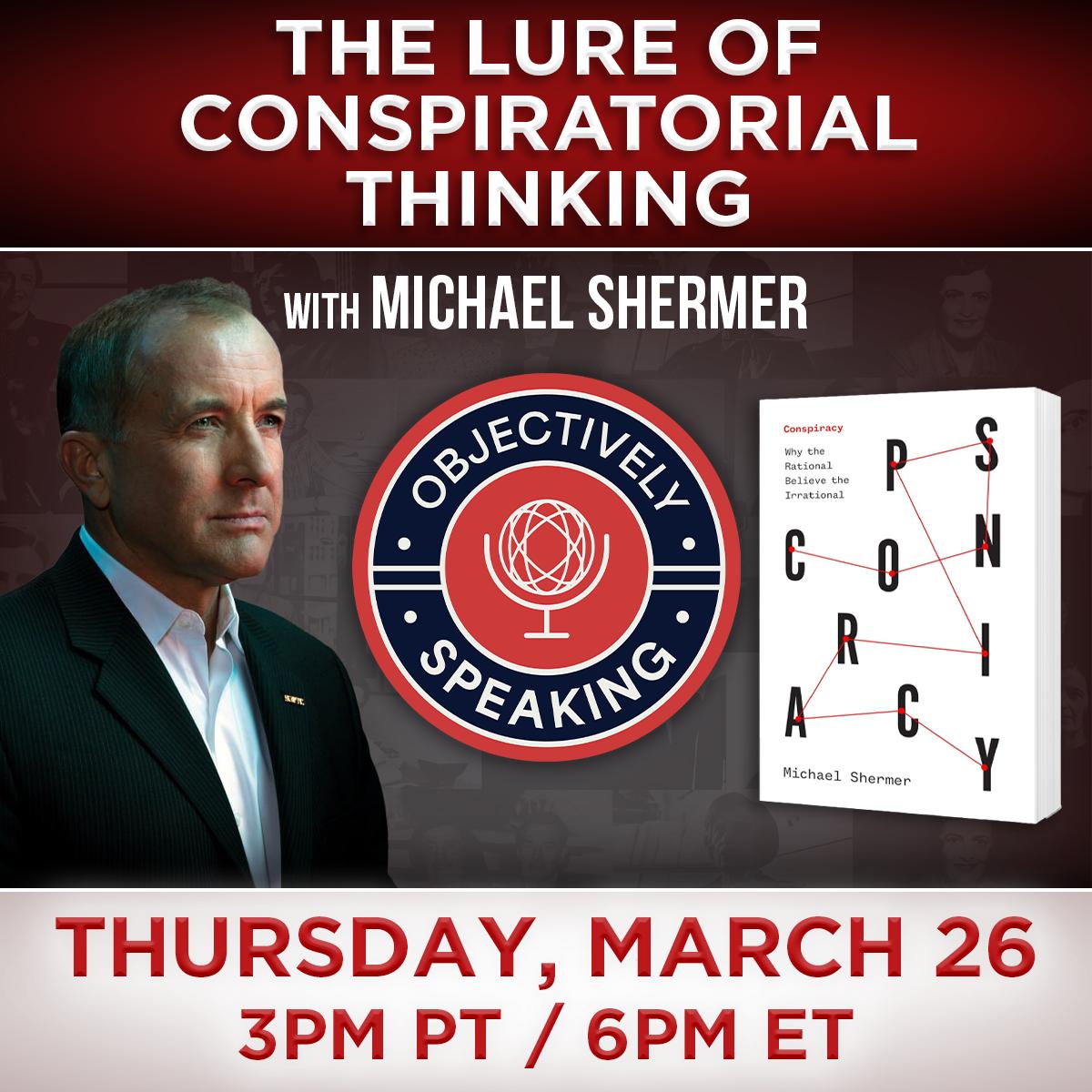
[00:00:00] Speaker A: Hi everyone, and welcome to the 295th episode of objectively speaking. I'm Jag, CEO of the Atlas Society. I'm so excited to have returning guest Michael Shermer join us today to talk about his book, Conspiracy why the Rational Believe the Irrational. Michael, thank you so much for joining us.
[00:00:24] Speaker B: Nice to see you, Jennifer.
[00:00:26] Speaker A: Yes, and I am very excited to announce that as of two minutes ago, Michael's going to be speaking at Galt's Gulch in San Diego and talking about his next book. So his, his most recent book. So here we are approaching our 300th episode of objectively Speaking. I remember when we had you on five years ago for our 31st episode to discuss your book, giving the Devil His Due, Reflections, Scientific Humanist. And I hope we'll have you back on to discuss your very latest truth. Why, what it is, how to find it, and why it still matters.
So, yes, a good friend of the Atlas Society for a very long time.
And as objectivists, of course, productivity is a virtue we prize and you certainly embody it more than most with well over a dozen best selling books, your podcast, your quarterly Skeptic magazine, your weekly sub stack column, teaching university courses for over 30 years. I guess, kind of two questions. How do you manage to do it all and still, as you said, find time to goof off and which of your many, many pursuits gives you the most fulfillment?
[00:01:45] Speaker B: Interesting. Well, first of all, I'm not in academia anymore. I retired from Chapman University two years ago.
Basically my contract was up and I was tired of driving 140 miles each way from Santa Barbara, so. But academia also, as you've heard, is, has gotten pretty crazy, you know, with the whole woke, far left, progressive, dei, trans, all that stuff. And you know, I fought the, the good battle as best I could as a presidential fellow there, but there's only so much you could do. I find I could do more if I'm, you know, writing and doing podcasts and things like that.
So I don't miss that, that's for sure. The magazine. Well, here's the latest issue, Skeptic, we still publish that. We started in 1992. Here's the volume one, number one, check it out. Isaac Asimov on the COVID There he is right behind me here. That's the original artwork, the way it used to be done in the old days.
So, you know, I have a good staff of people that helps with that. Most of the articles are written by, you know, outsiders looking to find a voice which we provide for them and.
Yeah, and then the podcast grew out of the fact that I was reading. I enjoy reading books, you know, mostly non fiction, new science and engineering and history, philosophy, economics and so on. And so I thought since podcast kind of came online and I'd done Rogan a bunch of times, I thought, well, I could do this. I could talk to these people. And these are people whose books I would read anyway. So I thought this would be sort of like having this guy over for dinner or this woman over, you know, for lunch, and I get to ask her questions about her new book, right? So I. But I could do it with a microphone, right? So I mean, I'm here in my studio and so it's, you know, the technology is so good now and it's virtually free. You know, anybody could buy these mics for a couple hundred bucks on Amazon. It's not, it's not hard as, you know, so, you know, kind of putting all that all together. And in my case as a writer and editor, I've been doing it for so long that if I don't do it, I feel a little anxious, you know, sort of like working out. You know, I work out every day. If I don't work out, I feel a little anxious, like, gotta get out there and move. If I don't write every day or edit something, you know, I feel like a little off, like, hey, come on, I gotta, you know, do my thing here. I enjoy it, you know, so for me, it was fortunate to find something that I like doing.
So it's not really work, you know, the, the. Do you know, the, the lottery test? You know, if you won the lottery, how would your life change? You know, mine pretty much wouldn't change at all. I'd be doing. Well, I shouldn't say that I would fly private, let's put it that way, that I would indulge in. But I don't own a yacht or a plane or any of that stuff. Flying private would be nice, but, you know, just riding my bike and hanging out with my friends and family and doing my, my riding stuff, I would just do that anyway, so.
[00:04:24] Speaker A: Well, so your journey from door to door evangelizing to founding Skeptic magazine is fascinating. Did that early phase of strong belief in the supernatural help you understand why rational people sometimes believe in irrational things?
[00:04:42] Speaker B: Oh, absolutely. Yeah, because. So I became a born again Christian in High School, 1971, when I was in 11th grade, at the behest of my friends who were all doing it. You know, when you're that age, you don't really know much about anything. So I just did it for fun.
But then over the. Over the years, I took it pretty seriously. And I went to Pepperdine University in Malibu. I was a member of the first graduating class, 1976, of Seaver College there in Malibu. And there I was, you know, in the circle of everybody there is a Christian. I mean, that's. It's a Christian college, Church of Christ. That's what they do. And so I kind of took the whole thing in. And by the way, everybody was reading this cinder block of a novel that I was pretty intimidated by. It's there on your shelf. I finally got around to reading it after graduation. I thought, oh, this is pretty good. I should have read this in school anyway. But then I went to a secular science program, experimental psychology graduate program, and no one was religious, or if they were, it didn't matter.
And so I realized you don't really need religion to take an interest in all these different topics and, you know, exposure to other ways of thinking about the big issues. Free will and determinism and God's existence and consciousness and, you know, why there's something rather than nothing and good and evil, all that. You know, everybody was talking about these issues without being Christian, and I thought, oh, okay. So, you know, there's a different worldview. Lots of different worldviews. So I tried, you know, a bunch of them on, and eventually I just kind of gave up on the Christianity part and. And just dropped it. I wasn't an evangelizing atheist or anything like that. That wasn't even a thing back in the 80s. And then I was a bike racer at the time. I started co. Started Race Across America and did that for a decade.
And. And then when we started skeptic in 1992, the whole science and religion thing kind of came online.
First with creationism. The teaching of creationism in public schools was a big culture issue, and science and religion became an issue. And so I kind of took the side of science more or less against religion, although I've softened up a bit in my older age.
But, you know, that, that, that gave me perspective. Now when I debate a theist or talk to a paranormalist or whatever, I totally understand what they're thinking because I. I was there. I believe what they're telling me. This is what I used to say. So, you know, it makes me more empathetic, I think, to like, all right, I know where this guy's coming from. When he says X, you know, I understand it. And that helps a lot.
[00:07:10] Speaker A: Well, speaking of the Paranormal. I can't not ask you about the haunted transistor radio from.
[00:07:17] Speaker B: Oh, good wedding day right here. Yeah, that's right. Here it is.
[00:07:23] Speaker A: Well, tell us what happened and, you know, whether that at least, you know,
[00:07:27] Speaker B: hey, let's see if we can get it. Let's see if we can get it to come on.
Nah, it's not coming on. All right, all right. Well, yeah, this is an off told story I wrote about in Scientific American and got a lot of interesting email. So these are under the category of, you know, weird things that happen, anomalous events that don't have natural explanations. Probably something with the radio coming on randomly had to do with some, you know, speck of dust or something inside. But it was dead for decades. It was my wife's grandfather's radio. She did not have a father. She was raised by a single mom. And so the grandfather hung out with her and they used to listen to this radio. Then he died. And anyway, then she met me and decided to come to America and shipped me the radio along with all her stuff. And I tried to get it to work. Wouldn't work. And then on our wedding day, you know, it came on. I mean, it was just in the back of the house. We just did a wedding at our house and it was playing this like perfectly tuned, beautiful romantic music.
And, you know, it was just a special moment for us. So I wrote about this and said, you know, it's okay to enjoy these weird, quirky, anomalous events that happen, you know, without creating a whole worldview of, you know, grandpa's there in the bedroom with us now. No, no, no.
Yeah, that would be weird. Okay, that would be weird.
[00:08:40] Speaker A: That was a pretty, pretty remarkable. And. And to have your skepticism keep it intact is also impressive.
So obviously, Atlas Society, we are a philosophy organization.
We embrace Rand's philosophy of objectivism. So I'm curious, which philosophical tradition do you consider yourself most aligned with?
[00:09:02] Speaker B: I mostly call myself a Enlightenment humanist. Now. I like the term which I got from Steven Pinker in his book Enlightenment now, but really it's just secular humanism or scientific humanism, whatever. It's humanism that is.
You know, the central tenets are there is a reality out there to be discovered. This is not all relative. There is a real right and wrong for most things. And, you know, we can know something about these issues empirically and rationally and so on, and that, you know, we can derive from that right and wrong, rights and so forth, as well as, you know, what kind of political and economic systems work best using empirical and, and logical reasoning and so on. And so that's pretty much what I embrace. I am an atheist technically, but it's not important to me. You know, it's not like there's an atheist worldview that I adhere to. I object to that because, you know, being an atheist just means I don't believe in God, full stop. But that doesn't tell you what I do believe. You know, why do you believe in rights or why do you believe in democracy or free market capitalism? That has nothing to do with atheism. You know, the fact that Soviet Union was atheist or whatever is irrelevant. I mean, that's not, you know, we're not talking about any of that. We're talking about, you know, positive things. Right. I took this early on when I read Vamisis Gave a.
He wrote something in the 1950s about the anti communists and he scolded them saying, you know, it's not enough to be anti communists, you have to be for something. What are you for?
You know, people can't get behind an anti program. Right. So I always took that to heart, like, yeah, okay, we are not anti religion, we're pro science. If you want to be religious, fine, but we're pro science and reason and rationality and, you know, you know, the fallibilism. We all could be wrong. Realism. There is an objective reality out there.
[00:10:52] Speaker A: That sort of thing sounds like a close cousin to Objectivism.
[00:10:56] Speaker B: It is, very close. I mean, I was influenced again, I read all of Rand's works. I thought Atlas was the best by far, but her nonfiction books were fairly clear and influential on me. And it's always been. So I'll ask you this because I ask everybody that has any connection to Ayn Rand this question. Why don't liberals like Ayn Rand? I find this astonishing, you know, because they call it identity politics. Right. So she ticks all the boxes. She's a female, she's an immigrant, she's pro choice.
You know, she's part of a minority, she's Jewish. You know, I mean, on and on and on, she takes these. Her. The heroes of her novels are women running major corporations. You know, liberals should love this, but they don't. So that makes me wonder. It's not identity, it's politics. More important. But what do you think?
[00:11:42] Speaker A: Well, yes, not only that, she's pro choice on the abortion issue.
[00:11:46] Speaker B: Yeah.
[00:11:47] Speaker A: You know, give her some.
[00:11:48] Speaker B: Get her anti racism.
[00:11:50] Speaker A: Yeah, Well, I. I had written about this actually in my Wall Street Journal op ed, can youn Love God? And Ayn Rand, in which I was just remarking upon how many religious people in my network were huge Ayn Rand fans.
And I, I said that I, I think one of the reasons that she makes people on the left, their heads explode, at least primarily here in the United States, she doesn't have that same kind of stigma overseas is number one, because she's so effective. You know, Ed Crane, a co founder of the Cato Institute, called her the greatest all time recruiter for the liberty movement.
And so, you know, making, making that portal, that intake center, radioactive has strategic value. But I think the, the other thing is that she refused to say that the impulse to collectivize, to move in a socialist direction came from lofty ideals. She severely criticized Hayek when he said, you know, that, that they have good motives. And she had a very different perspective. And I'm sure it was somewhat informed by her experience seeing the Bolshevik revolution and her father's shop get liberated for the greater good. And she, she said that she believed that it was more likely to be motivated by envy, entitlement, resentment, victimhood, and just sometimes pure nihilism. And I think that by refusing to allow the left the moral high ground, that really earned her a forever bad mark in their book. So that's my, that's my working theory. In any case, I would add one
[00:13:36] Speaker B: thing to that, that is personal responsibility. I mean, the characters in her novels, the good ones, are highly personal, responsible for their own actions, and the evil ones are not.
And you know, that's a central tenet that goes against a lot of modern liberalism, or at least progressivism, in which they claim that, you know, no one's really responsible, society made you do it. You know, what people who hurt people are hurting. You know, you hear these lines, kind of a blank slate. Ism. Criminals are victims of their society or their race or their gender. You know, it's the patriarchy, it's the capitalists doing this to you, it's the colonialists. It's this horrible background of slavery and colonialism that made you do these things.
They really shun personal responsibility.
And that's why they're mostly determinists. They don't believe in free will. They go strict determinism.
You didn't choose to do anything.
So I think her strong take on personal responsibility irks a lot of people.
[00:14:36] Speaker A: Yeah, and then there's just the whole postmodernist framework rejecting that there is an objective reality, that there is truth and that we can empirically pursue it, and that instead there's Only lived experience.
Yeah, there's a lot of places where I think a leftist would find her pretty challenging. But I think she would have really enjoyed your book, Conspiracy why the Rational Believe the Irrational.
In your prologue, you write, quote, the problem of today's conspiracism is urgent, arguably more pressing than at any time in our history. That's quite the statement. So what, what has led you to that alarming conclusion? Is it, you know, polling data, Violence born of conspiracy? What it, what, what's going on?
[00:15:27] Speaker B: Well, all of the above there. I mean, my general work is that people act on their beliefs, so what they believe really matters, which is why the truth matters. Because if you hold a false belief, then you may be acting what you think is rational, when in fact it's. It's.
There's an underlying rationale, but you're simply wrong. So I think a lot of moral acts that people make, you know, suicide terrorists or, you know, murderers or whatever, we know that 90% of homicides are moralistic in nature. The people, the murderers think the other person deserved to die.
They're mistaken. But, you know, for the most part.
But, you know, but, you know, a lot of these conspiracy theories that people hold are not true, but they think they're true. So that's the subtitle, why the Rational Believe the Irrational. They're actually kind of an underlying rationality. You know, if you really believe, like January6, if you really believe that the election was being stolen and, you know, the boss says, you know, we're going to all march over there to the Capitol, he did say peacefully and so on, but, you know, come on, you know, people get riled up, they get upset, they're mad. They think something bad is going on in there, you know, or the pizza gate, you know, if you really think there's a pedophile ring being run, you know, you know, going to go in there and break it up, because that's a terrible thing. Most conspiracies that people. Conspiracy theories that people hold, they really believe it. And so therefore, whether the conspiracy theory is true or not really matters. So that's why getting the book, I made sticks between conspiracy theories and conspiracies. I mean, conspiracies are real. So it's not irrational to think some of them might be true. Right? Some of the theories might be true. You know, Watergate and Iran Contra, the assassination of Abraham Lincoln, a lot of the CIA shenanigans in the 1950s and 60s of rigging elections in South American countries because the fascist dictators can do business with our companies better than the socialist dictators can. You know, a lot of that kind of stuff. MK Ultra, you know, the spying on of US citizens, civil rights activists, all the way up to Martin Luther King Jr. Was being spied on. His sex Capades were recorded by the FBI so they could blackmail him. I mean, there's hundreds of examples like, of what the US government did to its own people.
So when somebody says, you know, I'm, I think, you know, Sandy Hook was a false flag operation or whatever, it sounds completely crazy, you know, Alex Jones kind of stuff. But, but if you start to look at real conspiracies in US history alone, it's like, oh well, I mean, that's the pretty crazy stuff.
[00:17:57] Speaker A: So in your prologue you also quoted Hannah Arendt, who in her 1951 book the Origins of Totalitarianism observed that quote, the ideal subject of totalitarian rule is not the convinced Nazi nor the convinced communists, but people for whom the distinction between fact and fiction and the distinction between true and false no longer exist.
So has again referencing what I talked about, the spread of a postmodernism, the rejection of the concept of an objective reality in academia and elsewhere. Has that contributed to this kind of epistemological crisis?
[00:18:38] Speaker B: It's made it worse. We know from polling, early, early polling data and also some other interesting studies before that, that conspiracism has always been around. You just talk to historians, you know, all the way back to ancient Rome, conspiracies about what conspiracy theories, about what people are doing.
And that was certainly the case in the early Republic of, you know, what the British were really up to in the colonies and so forth. It got worse after the night after the Second World War in the 1950s, the creation of the CIA. And then, you know, a lot of this idea that conspiracy theories are just crazy, you know, anyone that holds one is a, is a crazy person. So I debunked that showing. In fact, a lot of conspiracy theories are true. So it's not irrational to believe some of them are true.
And you know, them floating the idea that anyone that thinks any conspiracy theories are real has to be crazy. That's not true. They're not crazy because a lot of them are true. Right? So, and then after, you know, the rise of the Internet in the 1990s, the acceleration and spread of conspiracy theories that were always there, but the speed at which they travel now is so much faster and so wider, that really begins with the, the, the self made film loose change. That 911 was an inside Job by the Bush administration.
Right. This was just made by a college kid, you know, with his Apple laptop in his, in his dorm room. I mean, it was nothing. It was seen by, you know, tens of millions of people. You know, this was unheard of. It was. And that launched everything. So as I like to say, you know, jfk, assassination conspiracists, you know, they used to mimeograph off these little newsletters and hold their meetings in a hotel room with 12 people. You know, now they have websites with, you know, tens of millions of people following them. That didn't used to happen. So it's the, you know, the delivery mechanism has changed.
[00:20:25] Speaker A: Well, I can't believe we've already gone more than 20 minutes. So I want to take a few of these audience questions before we go too further into the book.
My modern Gault has a question that I'm curious about as well. He's asking, is there a study behind what kind of people or personality type that is especially prone to conspiratorial thinking?
[00:20:48] Speaker B: There are some studies showing, you know, some people are more gullible than others. You know, you could, you could tag it to the big five. Openness to experience and conscientiousness. People that are highly open to experience but low in conscientiousness tend to be more open not just to conspiracy theories, but to everything, the supernatural, the paranormal, all kinds of weird ideas. So being highly conscious, being open minded is good, but. But also being conscientious about evidence for your beliefs, you know, could keep some of that in intact. Another component is power. Who has it, who doesn't. So, as they say, conspiracy theories are for losers. Pretty much every losing political party in an election that thinks the other side cheated. This is very common. So, I mean, what Trump did in 2020 about the rigged election, there was nothing new in that. Hillary did the same thing. He, he just, he has a much bigger platform, so it was much more prominent and lasted longer than it usually does, you know, because in 2016, after he won the election, he was still saying it was rigged. It's like you won. Conspiracy theories are for losers, not winners anyway, so, you know, there's some of that.
Most people, you know, also tag outsiders. So, you know, whoever the outsiders are in history, that's usually the Jews.
So one reason for why always the Jews, they're. There's many multiple reasons for this, but one is, you know, the Diaspora. They've been the outsider everywhere for thousands of years, and so they're always suspect of causing a disease or an accident or an economic collapse or anything. I mean, they get blamed for everything.
So that's pretty common. You know, insiders think the outsiders are doing. Then there's an up and down component. You know, the people down here think the people up there, the people with money, the people with political power, they're up to no good.
You know, studies show that most super rich people and most politicians have less power than the average person thinks they have. I mean, they have more than you and I do, but. But not as much as we think they do. You know, Bill Gates simply cannot run the world like people think he is. No one can. Right. So, you know, so there's all of that. And then, you know, the element of fear. If you're highly an, if you're a highly anxious, fearful person, you're more likely to buy a gun. But you're also more likely to think you need a gun because people are up to no good, even if they aren't.
[00:23:02] Speaker A: All right, lock, stock and barrel asks, how do we deal with the issue of two people looking at data and interpreting different results? It does seem as if, even if there is an objective reality, it can be hard to agree on what, what it is.
[00:23:20] Speaker B: Yeah, well, that's a super good question because that's what science is all about. It's a signal detection problem. Is it a hit or a miss? How do you know what's true? What should I believe, what should I not believe? And what happens when we're all looking at the same, and you say this and I say this, right? I mean, just think of the, the videos of the, of the, what's her name? Good. Renee Good death in, in Minneapolis. You know, within days you had, you know, people looking at the exact same video clip saying, you can clearly see here, she ran him over. You can clearly see here he never, she never touched him. It's like we're all looking at the same thing. What are you talking about? Right, but eventually, you know, when, when there was other camera footage and other eyewitnesses and you get a kind of a convergence of evidence.
Most people think this is what happened, not that over there. And that's a good kind of a window into how science works. There's always data. People are always arguing about data. So it's not just the data. Is there a consensus amongst the experts that this is the likeliest explanation and that one over there is less likely in a Bayesian way? Right. Not, not true with a capital T. But just, you know, 90% confident or 40% confident, whatever it is. And how many people are in that, you know, kind of in that direction or this other direction. And when there's no consensus, then we probably don't really know the answer to it. Now, this has gotten worse with social media.
This is why, you know, we have to consume more than one source of media.
Independent journalists are great, but they don't have a lot of fact checkers or none.
You know, I don't trust the New York Times or the Wall Street Journal, so I read them both. Right. Or, you know, plus half a dozen independent journalists and the Free Press and all these. You gotta. You have to. You have to consume a lot to see what do most people think. That doesn't make them right, but at least it gives you some confidence in a claim. So that's, you know, that's a hard problem.
[00:25:13] Speaker A: All right, well, in the book, you describe a study conducted by your colleagues at Chapman University on what Americans fear the most. What were some of the most surprising findings?
[00:25:25] Speaker B: Yeah, let me pull that up here. This was. Well, this was, you know, by my colleagues about, you know, correlating, like, fearfulness and. And conspiratorialism. So, you know, people that. Let me just pull this up here. Chapman.
I don't have it here. Okay. Darn.
Let's see. I think I have the data here.
Well, for example, people that think there's more conspiracies going on are more likely to buy guns. Or people that buy guns are more likely to think there's really conspiracies going on.
Let me just read a few of these here for you. You gave me this, too. I should have looked this up for you.
But. And also, people that are more fearful, they think something bad could happen to them, just in general, are more likely to believe conspiracy theories.
[00:26:12] Speaker A: And also, like, there was an interesting correlation if people thought that their spouse was potentially cheating on them.
[00:26:19] Speaker B: That's right. Yes.
[00:26:22] Speaker A: That also correlated with a higher tendency to see that.
[00:26:27] Speaker B: Right.
[00:26:28] Speaker A: Horses beyond one's control.
[00:26:30] Speaker B: Right. So thinking that your spouse is cheating on you as a proxy for just kind of general paranoia. Paranoia. And that other things might be, you know, at work there that you're not completely, completely aware of, that what those studies are showing is that there are proxies or predictors of conspiracism. Now, we're not sure which is the causal arrow. You know, people that buy guns are more conspiratorial or people that are more conspiratorial are more likely to buy guns. We don't know which causes which, but they're they're associated with each other. My favorite study in this area was Dead and Alive. It was called People that Ticked the Box that Princess Diana was murdered are also more likely to think she faked her death and is living somewhere in South America, you know, with Elvis or something. Well, they can't both be true. She can't be dead and alive. But what it is is a proxy for I don't really trust authorities.
And so whatever anybody thinks happened that, that are, that's an authority, I'm going to be doubtful of it. And that that also tends to be another one of these cases where, you know, these kind of components of conspiracies go along with a bunch of other things. If you tick the box for you think the moon landing was faked and the aliens are hiding in Area 51, you're also more likely to think JFK was assassinated by a conspiracy, that 911 was an inside job by the Bush administration. And on and on and on. So that's a kind of a general conspiracies.
[00:27:50] Speaker A: Yeah. I'm wondering, are Americans particularly prone to believing in conspiracies compared to, let's say, other cultures? And if that's the case, then why might that be?
[00:28:02] Speaker B: Yeah. Interesting. So there are studies from European psychologists on this and Europeans are very conspiratorial also.
My sub, my suspect is that this is the case in other countries. It's a human trait to be suspicious of other people and other groups, especially up to no good.
In the case of America, it's more prominent because of our freedom of press and just the widespread, you know, kind of openness to society where more things can be going on because you have the freedom to do so. You know, it'd be hard in China for people to pull anything off because they, you know, have so much top down control all those cameras. You know, in America, you know, we're pretty free. You know, the roads are public and open and wide and you can just move around. People don't even know what's going on. You know, and, and so, you know, the idea of conspiracism is easier to pull off in an open society where no one's checking you and therefore you should be.
[00:28:59] Speaker A: It's.
[00:28:59] Speaker B: In other words, back, back to my rationale part. You should be. It's a, it's rational to be a little paranoid about stuff going on. You know, they're really, there really are school shootings. There really are, you know, crazy people and we don't control them, you know, we don't lock them up all the stuff we've seen since Trump took office about the illegal aliens committing crimes, we're going to get rid of the worst first, and so on.
Well, that's because we have an open society that that's going on. We have all these people coming in, so more bad things are likely to happen. And therefore America is going to be a little more paranoid than say, Europeans, where there's a lot more control, or in China, where it's totally controlled.
And, and there. And plus the free press and all that stuff in the Internet, we're just allowed to kind of talk about it. So it's everywhere.
[00:29:45] Speaker A: All right. Iliacin asks, you mentioned how it's no longer a few people in a hotel, but hundreds online. Do you think the ease of finding any particular conspiracy makes people more susceptible?
[00:29:59] Speaker B: Well, it certainly puts it. Yeah, it does. It certainly puts them in more polarized positions where most people do not read multiple sources that contradict each other. They, they become, you know, in these boxes, in these little cylinders and, and they don't go out of it. And so we know from cognitive studies that people in a room where everyone agrees with each other become much more polarized on a position than if they have one or two. Let's say you have a dozen people in the room. If you have one or two people that are objecting to the consensus, then, then the entire group becomes less polarized, less extreme.
So it's good to have again, back to our free speech issue. You know, it's good to have somebody that speaks, stands up and says, no, I disagree. That immediately changes the entire tenor of the group. And that's a good thing, right?
[00:30:48] Speaker A: Yes, well, we certainly have that at the Atlas Society, and that'll be on display at Galt's Gulch, some feisty disagreements between our, between our faculty and scholars.
So I wanted to kind of get a little bit more into the theory of conspiracies. And you, you argue that conspiracy thinking is driven more by pattern seeking and apophenia, seeing connections where none exist than actual evidence. Can you walk us through one of the experiments or real world examples from the book that show how even highly rational people, people fall into that trap?
[00:31:29] Speaker B: Yeah. So this, I call that patternicity, the tendency to find meaningful patterns and in meaningless noise, and also agency, the tendency to infuse those patterns with intentional agents. So those are both elements of conspiracies and where we, you know, we look around the world and find, you know, these meaningful patterns. Now what's the element about that, that's interesting. So my thought experiment is, imagine you're a hominid on the plains of Africa 3 1/2 million years ago and you hear a rustle in the grass.
Is it a dangerous, Is it a dangerous predator? Is it just the wind? So it's a signal detection problem. If you think it's that, that the Russell in the grass is a dangerous predator and turns out it's just the wind, that's a false positive. But that's a low cost error to make as opposed to the reverse. If you think the rustle in the grass is just the wind and it turns out it's a dangerous predator, your lunch. You get a Darwin Award for taking yourself out of the gene pool early. So we are the descendants of those more likely to be a little paranoid. Assume the worst just in case. So there's a, an evolutionary element to conspiracism that's totally rational because there are dangerous things out in the world. There's a thousand ways to die on any given day, right. So it's good to be a little paranoid. So that's kind of line behind it. And then if you put people, the experiment you're referencing, if you put people in a condition of uncertainty, then show them ambiguous figures are more likely to see a meaningful pattern in the ambiguous figure than if they're not feeling a little paranoid or a little anxious.
And so all that is kind of the psychology of this. Again, it's not irrational to think that because these things do happen, or even the social proof experiments like the smoke in the room where everybody's an actor except the one guy filling out the form or whatever. And if no one moves with their smoke in the room, that's social proof that there's nothing to worry about. So it's not completely irrational. The guy sits there and doesn't jump up and run out the room. Right? So there's a lot of that that happens. The fact that we're a social primate species, we get our cues from other people, you know, and if you're siloed in these groups that only read about the conspiracy, say vaccines or whatever, you're not going to. You're taking your social cues from just that one group.
And so that's going to direct you into a particular, you know, extremism. That's not good.
[00:33:42] Speaker A: So another concept that really stuck with me from your book was this idea of the cognitive dissonance created when something truly horrific and historically impactful is perpetrated by a relatively insignificant individual or group of individuals. And how that dissonance creates susceptivity to believing that a larger conspiracy had to have been at play.
Maybe some examples of that. But it, it put me in mind immediately of the conspiracy theories that began circulating in, almost immediately in the wake of Charlie Kirk's assassination.
[00:34:26] Speaker B: Yeah, so, yeah, that, so this cognitive bias, cognitive dissonance and also kind of a bias toward large events need large causes, small events need small causes and so on. So the type specimen that, you know, the Holocaust, one of the most horrific crimes in the history of humanity, commanded by the Nazis, one of the worst political regimes in the world history. You know, there's a kind of a balance there, a resonance. It makes sense. But, you know, the idea that, you know, 19 guys with box cutters committed 9, 11 and took down the World Trade center buildings and.
You mean just lone nut Lee Harvey Oswald, you know, assassinated the leader of the free world. I mean, Princess Diana, I mean, she's beautiful. She's a princess, for God's sakes.
She died by drunk driving, speeding and no seatbelt like the rest of us. You know, there's, there's a dissonance there. So you have to add elements. Oh, no, it wasn't just Lee Harvey Oswald. It was the FBI and the CIA, KGB and the Mafia and the Cubans and the Russian, on and on and on. So it kind of balances there, right? A Princess Diana was murdered by the Royal Family and, or whatever, and, and so on. So there's a, you know, an attempt, you know, to kind of find some harmony there.
And, and the, the fact is, though, in a free and open society like the United States alone, not likely Harvey Oswald can get away with it. And so in the case of Charlie Kirk, he's famous, right? So famous people never just die like the rest of us, you know, Kurt Cobain and, and Elvis and, you know, you name it. It's, it's, you know, they can't have just died there either. They're still alive or something. There was some cabal behind it.
And, and so Charlie Kirk was famous, right? And, you know, it's just this. Again, a lone nut, you know, this Rob Tyler Robbins said, okay, maybe he had some influence of the weird furry trans culture, whatever that is. But, you know, but that's not enough for the conspiracists. They want Israel to be behind it now. Okay, I'm, I'm channeling Candace Owens here, who's a bit of a nut in my opinion, you know, but it's all right to ask these questions. You know, maybe Israel is behind, but I doubt it. Right. And again, the Jews are always behind everything because they're the outsiders and, you know, they're pulling the strings. They made Trump invade Iran. You know, I mean, it's everywhere, right?
[00:36:43] Speaker A: So anyway, yes, I, I sometimes say, you know, if only this were true, that Jews had so much power. You know, everybody would be reading Ayn Rand and Atlas Shrugged and the Atlas Society would have a $15 million.
[00:36:55] Speaker B: My Jewish friends, my Jewish friends are always telling me, man, I wish I had this power. They think I have special, special power.
[00:37:03] Speaker A: So, yeah, so I actually, you know, have always been confused by QAnon. Like, what exactly is it? So I, I thought that your deep dive into that whole subculture was really one of the most chilling parts of the book. So maybe first just kind of, for those who were similarly confused, what is it? And then what, what surprised you the most while researching it, especially the way it turned ordinary high functioning professionals into true believers.
[00:37:35] Speaker B: Well, okay, so in General, you know, QAnon is a, it's a proxy conspiracy theory. That is to say it, it stands in for something deeper in my opinion. I think, you know, if you, if you look at the specifics of it, you know, there's this like the whole Pizzagate part of QAnon, there's a deep state, there's these secret elements at work having to do with, you know, child molestation and drinking their blood, which is the old Jewish blood libel conspiracy theory.
And that it's happening at this pizzeria and Hillary and Tom Hanks and Beyonce are all part of it and so on. But did anybody really believe specifically that's what was going on? Well, one guy did. Edgar Welch, he drove to the Comet Ping Pong pizzeria in Washington D.C. with his rifle and, and shot the roof up when he got in there and he got upset. There was no basements and there was, people were just eating pizza. There was no pedophile ring and he went to prison and apologized for it all later. But the average person here, I would say, would say something like, nah, I don't know if Hillary actually did that, but she's the kind of person that would do that. Or those Democrats, they're the kind of people that would do that. Then it was also linked to this whole, you know, kind of billionaire tech bro, people that want to live forever. There's some truth to that. There are people doing that that are getting their blood cleansed. There are people that do that. That Brian Johnson guy, he's had blood injections from his son you know, it's not the same as what they're talking about with the, you know, the QAnon Deep State Pizzeria thing, drinking children's blood and pedophile. But there's a, you know, there's a little element to, it's like, oh yeah, I bet, I bet that's what the Democrats are doing, something like that. And then Trump gets in there, you know, and, and okay, we're going to expose the deep state now, the deep state idea. There is a deep state. Not officially. There's no, there's no department deep state. Right. But there are things that go on inside the government that, you know, most people don't know about, most senators don't know about. I mean, the whole uap, UFO thing, you know, it's probably just like DARPA stuff, but there's a lot of DARPA type projects that go on that most, most of us don't know about, most of the government doesn't know about. You know, who's funding those? Where does that money come from? There is so the deep state is not, again, completely irrational, you know, again, again, back to the 1950s and 60s and, and what the CIA was doing with MK ultra dosing, mind dosing with LSD. US citizens rigging elections in foreign countries, assassinating foreign leaders. Our government did all that. This was not approved by Congress.
In most cases, they didn't even know that this was going on. And in many cases, the President didn't even know what was going on. You know, plausible deniability. Don't tell me too much, you know, just make something good happen. Okay? You know, there's enough of that that, you know, when someone like Trump says, I'm going to expose the deep state people. Yeah, that's not completely crazy. But, but that doesn't mean everything that happens is a conspiracy.
[00:40:22] Speaker A: You know, I think one of the reasons people sometimes get their hackles up when they even hear the term conspiracy theory is that, you know, it wasn't too long ago when if you would say, hey, you want to know something? I think there's something to this natural immunity or gee, look at these two counties that have very different policies on school closures and there are virtually no difference in their infection rates. And you just said, can we talk about it? Can we look at the different evidence? At the time it was like, well, you are, you are spreading a conspiracy theory. And therefore, you know, I'm the government, I'm going to jawbone the social media folks and tell them to do something to your accounts, to so maybe just talk a little bit about the role of free speech and free inquiry and why that is important to. As a context as opposed to, let's say, kind of a ministry of truth or a ministry of disinformation.
[00:41:19] Speaker B: Yeah, it's a great point. I mean, I wrote much of conspiracy under Covid conditions, right. So Chapman closed and I'm giving these idiotic zoom lectures from home. And, you know, I'm up here in Santa Barbara and the beaches are closed. I mean, are you kidding me? The hiking trails are closed. I mean, what.
I mean, there was just. It was so insane. And then all these conspiracy theories about, you know, is it a lab leak or the, you know, zonomic. It was a, you know, the bats in the wet market.
Why was that a crazy conspiracy that this is entirely possible? I mean, viral labs doing research do have human errors. No one was saying the Chinese intentionally did this as a bioweapon. They're just saying they screwed up. I mean, this is still a viable conspiracy theory that could be true. As far as I'm concerned, it's more likely to be true than the wet market origins. And you know, Matt Ridley's really made a good case for this. But. But calling it, again, part of the point of my book, calling it a crazy conspiracy theory or a racist conspiracy theory is a way of shutting down discussion.
And that's one reason I wrote this book is like, no, it's not. Don't do that. Stop doing that. You know, just let people have their say. I mean, I'm as you know, because I was on before for this big free speech advocate. Let the Holocaust deniers have their say. I mean, they're wrong and they may very well be crazy anti Semites, but why are they wrong? You know, this was bothered me back in the 90s when I was researching the Holocaust deniers and I'd go to Holocaust historians and go, you know, they're making this argument here about the dorm mat house and or about the how many millions were killed at Auschwitz. And they're like, oh, that's just a bunch of anti Semitic claptrap. It's like, yeah, maybe, but. But why is it wrong?
I just want to write about this, explain. This is why this is no we.
And that really bothered me. Just let have people have their say. And then once everything is said and everybody knows what everybody thinks, then we can decide what's true. And usually that just makes them go away. It's the case of creationists and so on, you know, so I think that's that's why, again, you know, during COVID what I would have liked to see is our public policymakers and politicians be more Bayesian. That is to say, put a probability on it and just be honest. You know, just say, look, this is a rapidly moving target. We don't know a lot yet. We think the masks might work, but we're not sure. So for the next week, we're all going to wear masks and let's see how it goes. Then maybe next week we'll, well, whatever it is, open the schools back up or whatever. And it looks like, as near as I could tell, you know, that they should have opened the schools up in the fall of 2020, after they closed them in the spring of 2020, that we knew enough that the children were not going to be affected, anything like that. Adults and people with comorbidities like diabetes and obesity would be affected. Old people's homes, fine, close those down. Protect those schools, open them back up. Businesses, open them back up. As far as I could tell, they knew they could have done that and didn't do it. That is a kind of a conspiracy that is not right in a free society. And I have to, you know, I have to say I think that it's fair criticism there.
[00:44:28] Speaker A: Right. Well, it's also interesting context that this was happening while you were writing this book and a lot of things that should have been subject of a legitimate debate were being marginalized as crazy conspiracy theories. So. And I've returned to the subject of the many, many mistakes that were made during that time in terms of the policy interventions and precisely what you just said, which was that if our leaders hadn't panicked and had been perhaps just a little bit more humble in saying, you know, we think this might work, we're going to give it a try. We're going to look at the evidence and we're going to move forward from there. Okay. Taking a question from Iliacin wants to know, Michael, what do you think most people get wrong about skepticism? What role does and should empathy play in skeptical inquiry?
[00:45:22] Speaker B: Okay, well, that word empathy and also cynic is often lumped with skepticism.
Skepticism is just a way of trying to determine what the truth is. What should I believe is true?
And it's a. So it's a signal detection problem. You know, is this a hit or a miss? Am I right or wrong? What, what do we know? And oftentimes we don't know. Right. So it's not cynicism or lack of empathy or any of that. It's just let's be humble before the facts fallibilism. We could all be wrong again. I'm an atheist, but you know, if there is a God, I know one thing for sure. I'm not God and neither are you. So no one knows for sure about anything, not 100%.
So we have to have degrees of confidence and therefore we have to have an open society with open dialogue amongst experts and everybody, you know, let's just see the facts for ourselves and decide and, and really that's just science. I mean, my book, my books are really are pro science, pro reason and rationality and logic and so on. There are tools to determine these things. Not 100%, no capital T truth, but, you know, with a degree of probability. It's reasonable to offer your provisional assent that this is true for now. I might change my mind later. We'll see. But this is what I think is true.
[00:46:37] Speaker A: I think that sounds very healthy and I think more of us should incorporate that and adopt it in various areas of our lives. So another aspect of the book that I thought was interesting, kind of surprising, was how the entertainment value of some of these conspiracy theories contribute to their appeal. Can you unpack that for us?
[00:46:58] Speaker B: Yeah, well, it is entertaining.
I mean, most interesting movies, you know, have to do with plots and people up to no good and Behind Closed Doors and, you know, the whole X Files, you know, series was about that. And you know, a lot of great movies are, you know, about people doing secret things and, you know, plotting against others. You know, most of great literature has to do with people with power and people that don't have power and people that are deceiving, self deception and deception and so on. These are all very human elements.
And so it's entertaining because it's true. I mean, it's telling us something about the human condition that's real.
What really scares people, I think, is that no one is in charge. This, this is even worse, you know, like, how does the economy work? Well, you know, the idea of there's 12 guys in London called the Illuminati, running the world's economies is like, oh, that's bad. But now we found out about them. How about this? No one's running the economy, right? We all are.
It's like, wait, you mean no one's in charge? Yeah, no one's in charge. You know, this whole bottom up, emergent phenomenon of the economy, this bothers people. I think they'd rather think that there's, you know, there's a cabal up, somebody behind the closed doors Smoking cigars, you know, making these decisions. And I think that drives a lot of people, you know, into these kind of irrational conspiracy theories.
[00:48:19] Speaker A: What about the role of AI and how do you see it playing into America's particular penchant for conspiracism? On one hand, do you think that, that, you know, after enough tries of going to various chat bots and, and seeing that the evidence for the conspiracy that you, you know, are so cognitively committed to simply isn't there, or on the other hand, that. Do you think conspiracists will use things like deep fakes and, you know, just manufacturing evidence to spread their particular narrative
[00:48:54] Speaker B: could make it, could make it worse. Yeah, because you can't really trust the videos anymore and photos quite clear. It looks very real even though you know it's fake. That's a problem.
I mean, it's, maybe it's amusing in entertainment, but, you know, in terms of politics, what if you showed a video of, of Putin launching the missiles against the United States? You know, is Trump going to watch that and go, oh, we better counter launch? No, I don't think so. I think there's enough checks and balances there, but that's a concern.
I'm not an AI doomsayer. I, I think it's just going to be another tool to help, help us to do, you know, more great things.
I mean, it could be used for evil, I guess. You know, like the lawsuits against Meta that came out yesterday about, you know, they're, you know, hooking these teenagers and making them addicted, like on cigarettes. You know, I don't think I really go that far, but for the most part, I think it's, there's a lot more positive things to artificial intelligence and becoming AGI and the LLMs and, you know, Gemini Grok, I use all those. They're fun. It's very useful. And yeah, maybe there's a downside, but that's always been the case in the history of science and technology, in engineering and so forth. It's always the case that this next big thing is going to destroy society. And it doesn't, you know, not only does it not destroy we, things get better.
So I think for the most part, AI is going to just make life better for everybody and we'll deal with the new problems that come up, you know, as they come up. Right. I think it'll, it'll help us create more wealth for more people in more places and, you know, we'll see the end of poverty. Well, they've been saying about 2030, 20, 35 will be the end of poverty in the world. I think, you know, AI is going to maybe speed that up.
[00:50:35] Speaker A: What an exciting time to. To be alive. So given that you once said that writing conspiracy actually made you more optimistic about human reason in the long run, after four years of watching these ideas play out in real time, do you still feel that way?
[00:50:53] Speaker B: I do, yes. I. I do feel pretty optimistic. I mean, I'm by nature, I guess, an optimistic person, but I. I do think, studying human rationality, we get it right. Most of the time. What stands out is the weird. The weird things, the crazy conspiracy theories, the cults or whatever. Most people do not believe the really crazy conspiracy theories. Most people do not join cults. You know, this is called base rate neglect and Bayesian reasoning.
You know, we noticed the people that drank the Kool Aid or whatever it actually was in Jonestown. But how many people went to Jim Jones's church in the Bay Area, you know, you know, probably hundreds of thousands that would never join a culture. How many people have taken the crazy Scientology personality test down on Sunset Boulevard or what, a Hollywood boulevard, but never joined? They didn't take out a second mortgage on their house and give it over to the church? Or. Or that. You know that Tinder swindler video on Netflix about the four women they highlighted that got suckered in by this guy that they thought they were going to marry, and they wired him tens of thousands of dollars, but what we don't know is how many women did he try this out on and they told him to, you know, suck off. They weren't going to give him money. Or the Nexium cult. You know, how many women take this, you know, marketing empowerment program or whatever, but they never had their. This guy's initials branded in their crotch or anything like that? Most people are fairly rational. They don't fall for bullshit. You know, they just go along. And we know this because they're able to hold down jobs, have families, keep gas in the. In the car and food in the fridge, and they lead relatively normal lives. So I think, for the most part, we're. We're a good, rational, logical species.
[00:52:29] Speaker A: All right, Michael, we're about to come to the end of the hour. I want to give you the opportunity, if there's a question I should have asked you but didn't, or if there's anything else that we didn't get to talk about from this book, or perhaps you want to tease your most recent one.
[00:52:45] Speaker B: Oh, well, where's Galt's gulch I want to go.
[00:52:48] Speaker A: Okay.
[00:52:49] Speaker B: Well, yes, I've been looking all over Colorado, but apparently it's in San Diego this year.
[00:52:53] Speaker A: It's in San Diego and it's going to be great.
We have 150 young people coming from across the country and around the world.
And some other speakers that you already know, Greg Hurwitz and Heather McDonald, Kaizen Asiedu, who people who follow Elon know he's a big fan. So and now Michael Shermer, so very much grateful.
[00:53:21] Speaker B: I'll come and talk about reason and truth and science and for you, I am optimistic in that sense. I do think there's enough groups like yours and mine, you know, the people that care about the truth that think there is a reality and we can know something about it that are, you know, they do believe humans are pretty rational. We get it right enough of the time that, you know, if we, through education and open conversation and the Internet and so on, we all just, you know, kind of convey those ideas. Here's how to think about difficult things and we'll get better.
[00:53:51] Speaker A: Well, I can promise you once you meet these kids that are getting scholarships to attend, you will it'll be impossible for you not to walk away without significantly boosted optimism. So thank you, Michael, and hope to see you before long.
[00:54:08] Speaker B: All right. All right. Thank you. Thank you.
[00:54:10] Speaker A: All right. And thanks also to everyone else who joined to ask great questions. Be sure to join us next week when bestselling author and ghost writer Joshua Lisic joins us to talk about his co authored book on humans, A Secret History of Communist Revolutions and How to Crush Them. So we'll see you then.