Episode Transcript
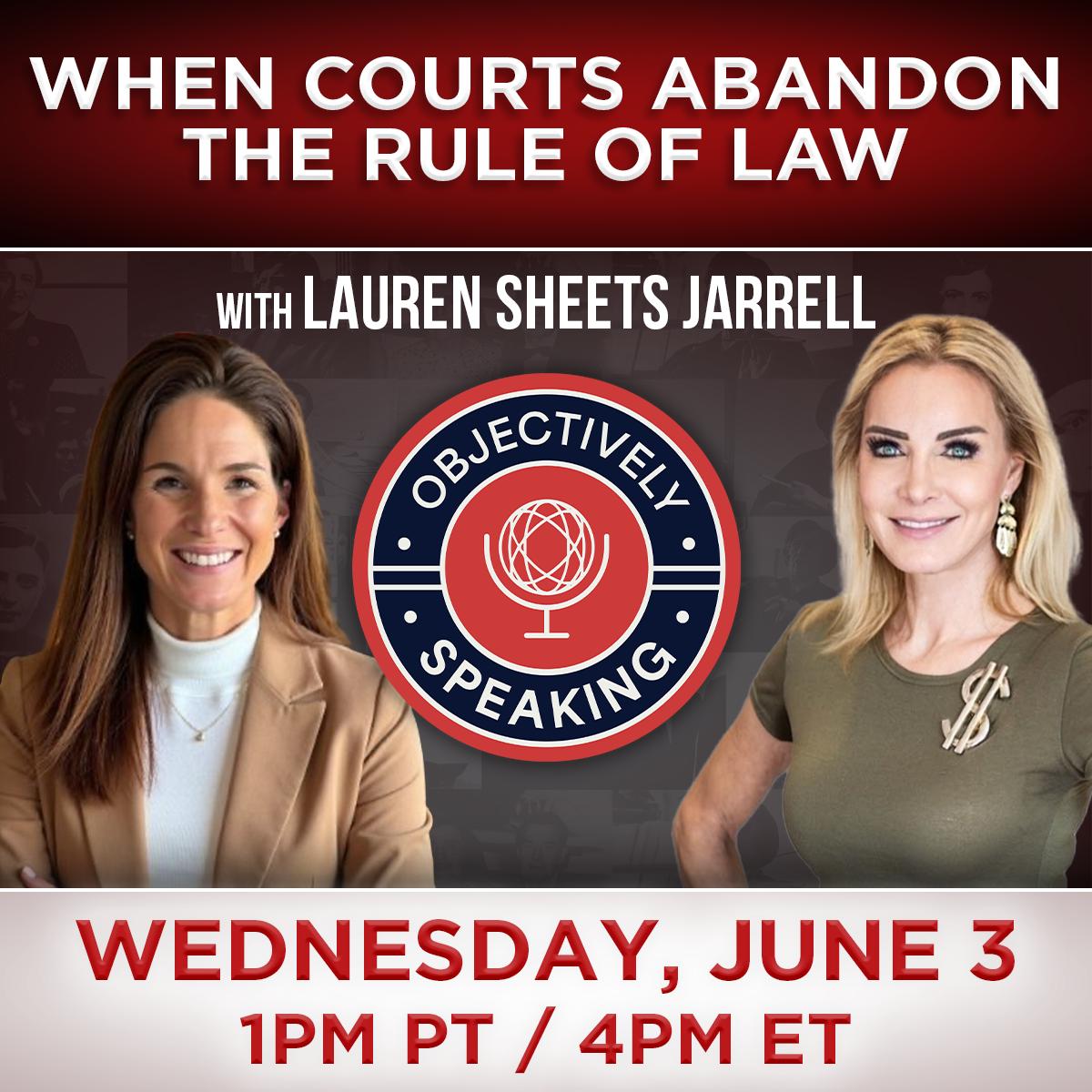
[00:00:00] Speaker A: Hello everyone and welcome to the 305th episode of objectively Speaking. I am very excited to have Lauren Sheets Jarrell join us to as part of our ongoing series about tort reform.
And you know me, I'm jag. We don't have our usual producer with us today, so I'm sorry we're a little bit late. We've been experiencing a few hiccups. Lauren is joining us to talk about tort reform and in particular the American Tort Reform Foundation's annual judicial Hell holds report and the relationship between civil litigation, accountability and the proper role of law in a free society. Lauren, thank you so much for joining us and thank you for your patience.
[00:00:51] Speaker B: Absolutely. Thank you. I'm looking forward to our conversation today. Happy to join.
[00:00:56] Speaker A: So you went to Georgetown University, including for law school. We just had Randy Barnett, the famed constitutional lawyer on for, I think it was last week. Any chance you had him as a teacher while you were there?
[00:01:14] Speaker B: I did. He was my constitutional law professor. So brings a name back from the past. He was wonderful.
[00:01:21] Speaker A: Well, he has certainly had a very colorful path to becoming a constitutional originalist. I'd like to hear about your path, how it was that you became a tort dissident, if you will.
[00:01:37] Speaker B: So the story actually begins back in high school. My mother had a severe back injury and had suffered from debilitating pain for years and and an opportunity to join an FDA test trial came about and she was actually a patient and received a test surgery, disc replacement surgery. We were fortunate that one of only two doctors in the country that was able to perform the surgery lived near us and was able to do it and it was a great success. It gave her her quality of life back and it was really wonderful experience. And when I was in law school, I learned that that the doctor that had performed that surgery was no longer practicing medicine and was being choosing to take early retirement because of the cost of living of insurance. They had become so prohibitively high and just so expensive that he felt like it wasn't something he could do anymore and so he stepped away.
And I was really upset to learn this, that patients around the country would no longer have access to this care, to this really important surgery and a large car reason for this was because of lawsuit abuse that contributes to the escalating cost of insurance. And so when I was in law school, I saw an internship posting from the American Tort Reform association and I decided to jump at the opportunity because I wanted to make a difference. I wanted to step in and educate others about the importance of the civil justice system and why it needs to be fair and balanced for everyone's sake.
[00:03:10] Speaker A: Wow, I was not expecting that. That is a very personal connection and as the daughter of a doctor myself, I can certainly relate. So. But for our audience, again, this is a little bit different, this series that we've been doing on tort reform.
At the most fundamental level, what is tort law and what is its role in a free society? Is it about compensation, deterrence, punishment, risk spreading or protecting individual rights?
[00:03:39] Speaker B: At the most fundamental level, tort law is about justice between private parties. It provides a mechanism for one person to seek redress through when another person has wrong, wrongfully caused harm. And it allows them to vindicate their personal rights through the courts.
The most intuitive purpose of the law is compensation because the tort system shifts those costs associated with an injury to the person responsible. The whole point is to the intention is to make the plaintiff whole and restore them to their status before the injury occurred. And so basic moral intuition, those who wrongfully caused harm should repair it when possible.
And the system also protects individual rights. It protects fundamental interests like bodily integrity, property rights, reputation, and then, as we'll talk about more later, freedom from fraud and coercion.
[00:04:35] Speaker A: So where is the line between holding a genuine wrongdoer accountable and using the courts to redistribute losses from a sympathetic victim to a party with deeper pockets? When does that line get crossed?
[00:04:49] Speaker B: The line is crossed when tort law stops focusing on that wrongful conduct and the causation standards and instead becomes primarily concerned with finding someone that's able to pay for the injury.
And so when there's no longer that that reasonable relationship between the injury suffered and causation, that's when there is a problem. Because the system exists to hold those people accountable for harms they wrongfully caused, but not to ensure that every injured person receives compensation regardless of fault. There must be that important causation mechanism.
[00:05:29] Speaker A: So what would a more rights respecting civil justice system look like in practice? Faster trials, criminal, clearer causation standards, limits on damages, loser pays better, expert standards, all of the above.
[00:05:43] Speaker B: I think they're all, you know, they're all important issues. I think when thinking about this, you need to look at it and balance it from both sides. You must ensure that genuinely injured plaintiffs can effectively recover from those wrongdoers, while also protecting defendants from liability that is going to exceed their actual responsibility. Because the goal with reform is to not make the lawsuits harder or to make it more difficult for plaintiffs to bring them, but to make the outcomes more closely track the fault, the causation, and the individual responsibility. So there are a few things that are really important to address when trying to achieve those goals. First is the stronger causation standards. Plaintiffs should be required to prove that the defendant's conduct actually caused their injury, rather than relying on speculation or statistical associations or these theories of collective responsibility.
The liability should be tied to what the defendant actually did, and not merely the fact that they participate in an industry or that they manufactured a lawful product that was used, or that they possess some sort of deep pocket or the financial resources to pay.
Also, better expert evidence standards are very important. And this is an issue that's really propelled to the forefront for our organization in recent years. Expert testimony often determines the most complex litigation and the outcomes of mass torts litigation. And unfortunately, judges are not fulfilling their role as gatekeeper and allowing junk science to come into the jury. Courts must rigorously screen expert testimony before it reaches the jury to make sure that they aren't tainted with junk science.
The scientific opinions that are offered in litigation should be based on reliable methodologies, testing, peer review, and established principles, rather than these litigation driven theories that we're seeing propel so much of the mass torts that we hear about today, specifically around Roundup and glyphosate and Talc.
And finally, proportional damages are very important from a tort reform perspective.
Damages should correspond to actual harm and actual wrongdoing and not this search for the deep pocket and just pay because they have the resources to do so.
[00:08:03] Speaker A: I'd like to talk about your organization's judicial hellholes report. How long has you been putting it out there? And what makes a jurisdiction a judicial hellhole? What are the criteria that you are examining?
[00:08:19] Speaker B: We began this report more than 20 years ago. I believe we're on the 24th edition this year, and it's a report that we release in December each year. And it shines a spotlight on jurisdictions where lawsuit abuse is the norm. Fairness and justice take a back seat. These courts are outliers in their approach to expanding liability. They oftentimes adopt these innovative theories that they're of liability, that they're presented by plaintiffs, they have low standards for expert evidence, and the playing field is just tilted in favor of the plaintiffs. Each year we highlight 5 to 10 of these judicial ho holes, and then we also have a watch list which is reserved for jurisdictions that either were previously judicial hell holes and have made reforms and taken steps to create a more fair system, or it includes jurisdictions that are starting to expand liability and show signs of becoming a full blown judicial hellhole.
[00:09:17] Speaker A: All right, we're going to get to audience questions in a second. And special thank you to the audience for your patience as we were experiencing a few technical difficulties. But the 2025, 2026 report says that these jurisdictions are often known for nuclear verdicts, litigation tourism, innovation, innovative liability theories, and state leadership eager to expand civil liability. Which of those trends worries you most right now?
[00:09:50] Speaker B: Right now, nuclear verdicts because they are the result of significant lawsuit abuse that is allowed to occur in the states and they lead to the litigation tourism that we see.
Opportunistic plaintiffs lawyers choose to bring their lawsuits in courts with a reputation of handing out these verdicts. And just for the audience, nuclear verdicts are those verdicts that include $10 million or more in subjective pain and suffering damages.
And when we see a high volume of these verdicts, of these excessive verdicts, it's an indicator light that many things are going wrong in that state that are leading to those verdicts. We're going to talk about some of the drivers later. I would mention phantom damages, jury anchoring and third party litigation financing are all things that are leading to these. And we'll dive into those details later.
[00:10:44] Speaker A: Los Angeles, right down the road from me here in Malibu, is of course ranked number one in the 2025, 2026 report, with the report citing a one billion dollar nuclear verdict among other issues. But can you talk about nuclear verdicts and why they're becoming more common?
[00:11:04] Speaker B: So California, according to recent reports, had the highest volume of nuclear verdicts over the last decade, not surprisingly, and it was capped off BY, yes, the $1 billion verdict we saw this year that was awarded to an 87 year old woman who suffered from, it was a talc case. She suffered from mesothelioma for a year and she was awarded that excessive number.
And as I mentioned, it's a real concern because the judge allowed a multitude of things to occur. You have and you have third party litigation financing, phantom damages, jury anchoring, all playing a role. But then the other part of this is juror sentiment. And we're seeing very significant anti business views and this idea that to make corporations pay and they're seeing the litigation system as a way to do that. And so that's a real concern is educating the public about the impacts of these verdicts and why they really why everyone should care about what we're seeing.
[00:12:12] Speaker A: You know, I got a something in the mail just a few days before this show and it was from some law firm Saying that they have won a, a case against European Wax Center. And it wasn't even for like, you know, they've been heating their wax too hot or they were injuring people, or they were unsanitary. It was like something having to do with their advertising.
And it, it said, you have, you know, you can come here and sign up and fill this out and you'll, you can, you're eligible for $15.
Like what, what is, is that sort of common practice these days?
[00:13:01] Speaker B: It is trialer advertising is a real, is a real concern because basically the more claimants they get to fill a class, the greater the pressure is on the corporations to settle. Even if they have a very justifiable defense. The numbers become so large that they just can't risk it. And so plaintiffs lawyers go to extremes and spend millions of dollars on advertising like that to find claims, to find claimants, to fill their classes, to exert that pressure. And the advertising also is an opportunity, not necessarily in this case, but in other instances, to peddle their junk science and to start to, to educate, educate the jurors so that they're prepared, if they are called, to serve. And so it's something that we track significantly. And yes, to your point, you know, the lawyers involved in that litigation will walk away with millions of dollars, while the actual consumers typically walk away with dollars, few dollars here and there. And it's, you know, it's not being done for the sake of the consumers. It's being done for the financial incentives of the plaintiff's bar.
[00:14:10] Speaker A: No, I thought it was really disgusting.
So you mentioned anti business sentiment. And obviously we now have a socialist running New York City. And so perhaps no surprise that New York City is number two on your list of judicial hellholes. And the American Tort Reform foundation has used the term fraudemic. Fraudemic to describe the staged crashes, slip and fall schemes, and inflated medical procedures. What is happening in New York that ordinary citizens should understand?
[00:14:48] Speaker B: So there is a fraudemic in New York City and across the state, and it has led to the nation's highest auto insurance rates. New York drivers pay approximately $4,000 a year on average for auto insurance, which is nearly $1,500 above the national average.
And they have one. New York has one of the most notoriously abused legal systems in the nation, as you mentioned. You mentioned all the elements of the fraudemic. There are staged construction accidents, there are staged car accidents. There are plaintiffs that are being forced to, under or tricked into undergoing unnecessary medical procedures to drive up the medical which then become the multiplier for their final damage award. And then you have these slip and fall schemes where people are being caught pouring water in a store on the ground and then slipping and falling. And the plaintiff's lawyers are involved in a lot of this. And unfortunately, the judges are playing a role too, because rather than penalize or rather than punishing or calling out these lawyers for their unscrupulous behavior, they are allowing these lawyers to voluntarily withdraw from cases when they're, when the fraud comes to light with no repercussions. And so they're allowed to walk away, dismiss their case, say no harm, no foul, when actually there really is a problem there. This is unfair. It is creating great costs for insurance companies and for other companies in the state. And as a result, it's driving up the cost of goods and services.
At the same time, state spending on trial lawyer advertising in the state has surged to nearly $180 million just in 2025. And this was a over 85% increase since 2023.
I think of the 1.2 million local serve local legal services ads that were broadcast last year, almost 80% were promoted by personal injury lawyers looking for motor vehicle and construction site accidents.
So lawsuit abuse is pervasive and is really creating issues. Now. I will say just last week, Governor Hochul signed into law two reforms or two measures that as part of the budget that is intended to strike at the rampant scams and the systemic fraud. And so we applauded her efforts.
It's a starting point. Much more work remains to be done, but we do look forward to seeing the impact of these measures. And we now look to the courts to make sure that they're actually going to implement them.
[00:17:19] Speaker A: All right, well, we are going to return to the judicial hellholes list, but we've got some great questions from my immensely patient audience.
Alan Turner asks, how do we deal with judicial accountability? How can we trust the system if judges express a bias or even disregard the law, like the judge who helped an illegal immigrant escape the police?
[00:17:45] Speaker B: This is something, you know, certainly is important. Judicial responsibility is key. And I think, you know, every state elects or appoints their judges differently. So in some states, there are elections and there's pros and cons to both systems. Some states they're elected, some states they're appointed. And I think that from our perspective, she shining a spotlight and calling them out when there are abuses and explaining why these decisions are outliers, why they're not correct, and why how the judge is handling litigation is not Mainstream is important. We have to educate both voters and elected officials about the role that judges play in the system and what they're doing to make sure they're held accountable through the public as well.
[00:18:30] Speaker A: Lock, stock and barrel. Asks, what do you think is the biggest impediment to tort reform? Lawyers, politicians?
[00:18:40] Speaker B: I will say, you know, the plaintiff's bar is a very, very powerful machine.
They spend millions of dollars on campaign contributions and they have very strong influence in a lot of, a lot of these states. And so I think that through that power that they exert is real because when you go to enact reform, that's going to their business model. And so they fight tooth and nail. And so I think that again, explaining to the average voter why they need to care about this and why they need to push back against the trial bar is important and getting elected officials to understand that they need to protect, protect their constituents from these profit driven lawyers.
[00:19:26] Speaker A: Candace Morena asks, is going to court more expensive in the United States compared to elsewhere in the world?
[00:19:35] Speaker B: I'm not sure about the cost as far as the litigation. Well, I'm not sure about how expensive it is to go to other places. I do know that our civil justice system is the most expensive system in the, in the world and that we, we what the, the abuses that we see here and the lawsuit abuse in the United States is different than it is anywhere else. Now some of these ideas are being exported to other countries and they're starting to face some of similar litigation in places like Europe and Australia.
But as of right now, the US has the most expensive civil justice system.
[00:20:08] Speaker A: Jackson Sinclair asks, what about juries? Is it harder to get good juries and or more of, or more of them to hostile to groups like private enterprises?
[00:20:22] Speaker B: It is. I mean, obviously it's going to vary by state, but in certain places it is very difficult.
Jurors are, you know, they're getting their news, they're getting their information from a variety of different sources. They, especially in the area of expert evidence they're receiving through advertisements and everything, they're being preconditioned to accept the plaintiff's arguments and their science as being real. And so it is a real challenge.
And as I mentioned, there is this anti business sentiment that is very real that we're seeing play out in the courts and nuclear verdicts and other damage awards.
[00:21:01] Speaker A: Well, that is what we are particularly fighting at the Atlas Society with championing Ayn Rand's work. So we clearly still have a lot of work to go.
So returning now to the judicial hellholes list, South Carolina asbestos litigation is number three. What makes asbestos litigation so prone to forum shopping, Relaxed causation or mass tort abuse?
[00:21:27] Speaker B: So this goes back to the judge's accountability. The problems in South Carolina began when and judge Janine Toll, who's a former supreme court justice, actually chief justice, was appointed to oversee the state's docket. She has, since taking over, she has implemented relaxed causation standards. She has increased jury awards when she didn't, when she felt as though the jury didn't go far enough in punishing a defendant, she's issued sanctions, debilitating sanctions.
And as a result, this has created, created this forum shopping. And plaintiffs lawyers from all across the country are flocking to South Carolina to file their claims because they want to leverage this pro plaintiff judge and this pro plaintiff reputation.
From 2024 to 2025 alone, there was a 300% increase in claims. And so it shows just how significant forum shopping has become in South Carolina. And asbestos is a little different because these are very old claims.
There's varying theories of causation that is, that is considered and that is allowed in courts. It's a, you know, do you look at the dosage, do you look at or allow for take home exposure when asbestos comes home on your spouse's clothes?
And also many of these defendants are defunct entities. And so they're searching for deep pockets to go after. And it's hard to prove that the asbestos that this person was exposed to 50 years ago was from working at this specific factory at this specific time. But if they have a deep pocket, then that that defendant is more likely to be brought to court. And so it's a very problematic jurisdiction and again, very specific to asbestos in this particular judge.
[00:23:18] Speaker A: So the report also has a points of light as well as the hell holes. What are some examples of states or courts and that are doing something right?
[00:23:27] Speaker B: Yes, we definitely want to highlight when their courts issue fair and balanced decisions. So last year in July, the Delaware Supreme Court strengthened the state standards for expert evidence and reinforced the judge's role of gate as gatekeeper to ensure that the proposed expert testimony is based on sound science and is reliable.
Also last year, the main Supreme Court rejected an attempt to expand, expand public nuisance liability and other broader theories of tort liability in connection with the opioid epidemic. And this is a very concerning trend that we've seen. These expansive theories of public nuisance are becoming a catch all claim to address societal ills. And so this is an area of the Law that was traditionally grounded in physical land use and restrictions on one's ability to enjoy their land.
But some courts are giving breath to these expansive views. So it was encouraging to see the main Supreme Court reject that. And finally, the North Carolina appellate court upheld a state law that set limits on non economic damages and medical liability cases.
I believe it's going to be appealed to the North Carolina Supreme Court. But this, these statutory limits, these statutory limits make sure that damages are reasonable and appropriate to the level of harm.
[00:24:52] Speaker A: You have described anchoring as a tactic where plaintiff's lawyers suggest an extremely high number that becomes the jury's starting point. How does that work psychologically?
[00:25:03] Speaker B: So usually at closing, a plaintiff's lawyer will, in states where this is allowed, which most often line up with our judicial hellholes, plaintiff's lawyers will suggest an unreasonably high dollar amount, as this as the suggested award. And this amount then becomes the starting point in a juror's mind. They make their decision, their damage calculations, based on that number. And there's been studies that have shown that where anchoring was allowed and where this number was offered, that the awards are ultimately significantly higher.
Because of that becoming the starting point, they decide whether to go up or down from that high number, as opposed to coming up with a number on their own. Oftentimes these anchor amounts are tied to salaries of professional athletes or expensive artwork, which really, well, clearly are numbers that have no connection to the litigation at hand. And it's just the plaintiff's lawyer's attempt to drive up the final damage ward as high as possible.
[00:26:04] Speaker A: You've also talked about phantom damages where juries may hear the billed medical amount rather than the amount actually paid. How does that change the equation?
[00:26:14] Speaker B: So these are inflated dollar amounts, as you said, that are never actually paid, but the billed medicals become a multiplier. And so ultimately, if you're using an inflated number, then you're going, in the end going to get a higher award. And so they've pushed we as part of our reforms, want actually paid the actual number that's paid after insurance negotiations or third party comes in and pays we or negotiates the final amount. But if you use that inflated number and you multiply that by say three to five, then it's going to be much larger than if you're using a smaller number.
[00:26:54] Speaker A: What is a no injury lawsuit? And why should people who care about real victims be concerned about them?
[00:27:02] Speaker B: No injury lawsuits are ones where plaintiffs have suffered no tangible actual injury, whether it be a financial injury or physical injury. And these class. Most often we see this in class actions, where classes are filled with class members that never suffered any injury. And it detracts from the legitimacy of real injuries. And it also decreases the recovery for people that actually suffered harm.
And so the more you fill these with no injury, then the less the people that were actually harmed recover. And it's very. It's problematic.
[00:27:41] Speaker A: Should legislatures build in a right to cure period before allowing lawsuits over technical violations?
[00:27:49] Speaker B: Yes. This is really important for small businesses specifically that are involved in Americans with Disability act litigation. We've seen some terrible abuses of the ADA laws in states like California and in New York, because oftentimes litigation is brought because of a technical violation. Like a mirror is an inch too high or too low, a wheelchair ramp is 1 degree sloped incorrectly.
And again, plaintiffs here are not. These are no injury lawsuits. There was no injury actually suffered. And it's just based on technical violations. So by giving these com, these businesses, these small, small businesses, an opportunity to cure and to fix the problem is a fair. It is more fair because without that, they're facing litigation that will put them, potentially put them out of business. Most of these small businesses can't afford the litigation costs. And so the right to cure, period.
[00:28:52] Speaker A: I think we lost your feed.
[00:28:58] Speaker B: Am I back?
[00:28:59] Speaker A: Let's see. There we go.
All right, terrific.
Let me switch gears. What is third party litigation funding and why has it become such a major driver of litigation costs?
[00:29:12] Speaker B: So third party litigation funding is when an outside third party that has no relation to the litigation at hand funds the litigation gives money to either the plaintiff themselves, him or herself, or to the lawyers to bring the litigation. And for example, we have, we have. There's two types. We have commercial litigation funding, which are hedge funds, investment banks investing millions of dollars into plaintiffs firms to receive a portion of the litigation, either the settlement or the final verdict. And these firms give money up front, funding up front for the plaintiff's lawyers to advertise for them, to secure, export expert evidence, and then to bring litigation that might not otherwise be able to be brought. So the funders are not only funding the litigation, but we actually argue that they're creating it as well.
You also see this on the consumer litigation side, where funding money is given directly to plaintiffs while they're bringing their claim. And then the funders receive a portion of their settlement or an award at trial. And these are considered non recourse loans, but because they only. The plaintiffs only have to pay back the money if they receive a settlement or a verdict, if they Lose at trial, they don't own anything. But because of this, the company, the funders are able to charge you serious rates. In some instances, we've seen 130% rate, interest rate. And so it creates this system where the litigation ultimately becomes about maximizing profit and maximizing return as opposed to justice.
And in some instances, especially in the consumer litigation side, litigation funding side, it is more beneficial for a plaintiff to lose a case and walk away with nothing than to win or to receive a settlement because of how much money they would then owe the funder. And so we've seen instances where they've owed way more than what they ultimately receive at trial, and they've had to go bankrupt or they've, they've suffered significant financial harm is litigation.
[00:31:15] Speaker A: It sounds to me like litigation funding is almost turning lawsuits into a financial asset class. And if that's the case, how does that change the moral purpose of civil justice in the first place?
[00:31:29] Speaker B: It absolutely is. On the commercial litigation funding, it's becoming all about return on investment and opportunity. And you're inserting the final financial interests of a third party that is otherwise not connected to the litigation. And this was never the intention.
Several years ago, there were things called champerty and maintenance where this wouldn't have been allowed. These, these common law ideas.
And these funders are dictating the settlement terms, and they're making it harder to settlement, to settle because they are looking to maximize their return on investment, and they don't care about other considerations. And they're the ones that are ultimately driving the lawsuit and the settlement decisions. And sometimes the lawyers involved or the judges, the other parties are unaware that the funders even exist. And so there's this mystery third party that's pulling the strings, and all of the parties aren't even aware of that. They don't know what they're up against. And so there's been an effort to push for mandatory disclosure so that at least all parties will be aware of these third party interests.
And hopefully that could again make a more fair system. But we have not seen that take hold in a majority of the country yet.
[00:32:44] Speaker A: You have noted that trial lawyers are using advertising to lay the groundwork for future litigation. And that medical device, pharmaceutical ads, can scare patients away from treatment.
Do the companies have any recourse at all?
[00:33:03] Speaker B: Unfortunately, they don't. And actually what we've seen is, on the other hand, they're looking to restrict what these pharmaceutical companies and medical devices, what they can advertise. And so, you know, they're trying to put out information about their drug and to educate folks, and they're being restricted from what they can do.
You can learn a lot about the advertisements you see on tv and you can learn where do the plaintiff's lawyers plan to go?
Where are they looking to bring their litigation as far as geography goes, and what is their new litigation target?
Again, they're also able to pedal junk science through those, through those advertisements and to start to lay the groundwork for future juries.
And so they're able to, or at least attempting to win over public opinion.
And as you mentioned, we are starting to see, or there's been some. Some research done to show that these ads do scare patients away from taking their treatment. The FDA did a study and found that in a group of like 60 some patients that were surveyed, a vast majority of them either stopped taking their medication or they.
Or they scaled back the dosage without discussing this with their doctor. And that is unfortunately led to dire effects that had dire effects. There were either strokes, there were heart attacks, and unfortunately, in some cases, patients died because of this change in medication. And so there's a real public health concern. I will say the one area where there's a little bit of recourse is when the plaintiff's lawyers use the emblems of the federal regulators to make it appear as though it's a federal government announcement. They'll use the FDA logo or they'll use other things to make it look more legitimate. And there's, you know, there's some things that you can do, the companies can do there to say, you know, this is false advertising.
And some would argue another argument is that this is the improper practice of medicine because they're trying to give medical advice through the airwaves. And obviously they are not.
They do not have that authority or the background to do that.
[00:35:14] Speaker A: So lawsuit advertisements that look like public health warnings but are really client recruitment campaigns, should those be considered free speech, or is there a case for fraud here?
[00:35:28] Speaker B: There's a case for fraud when you're using, when you're putting out, when you're offering yourself as the authority and making it appear that you're the authority on this and that you have the backing of the federal agencies and federal government, that some of this has been scaled back. You don't see it to the same degree because some states did start to. Some states enacted legislation that said that this was not allowed.
So I think some of that has been reined in. But they are still going to great efforts to be creative and to make their Advertisements look as legitimate as possible.
[00:36:04] Speaker A: From a rule of law perspective, why is it dangerous when liability turns on hired experts rather than objective scientific standards?
[00:36:15] Speaker B: The rule of law requires that legal outcomes are governed by these objective principles rather than the persuasiveness of competing advocates. And when the liability turns on the battles between hired experts rather than these reliable scientific standards, that is threatened. And there must be predictability. In our civil justice system, individuals and businesses should be able to understand in advance of doing anything what conduct is lawful and what conduct may result in liability. So if scientific causation and these hired experts become the main point of this, it's very hard to have a predictable system, because it's basically whatever a plaintiff's expert can persuade a jury to believe is, that will be difficult to predict. Also, the same conduct may produce liability in one court, and in another court, it's thrown out. And so it's very difficult to operate in this system. And it creates real concerns about fairness in due process. We've seen this when specifically in the roundup litigation and others, where certain experts are allowed to testify and they receive millions of dollars at trial. And then in other courts, the experts are ruled, are thrown out, and they're not allowed to testify. And then there's a defense verdict. And so it's really.
It creates this unfairness and this unpredictability.
[00:37:47] Speaker A: So kind of going back to the judicial hellholes, why do plaintiffs lawyers flock to certain courts? What makes a jurisdiction attractive to them? What are they looking for?
[00:38:00] Speaker B: They're looking for reputation for nuclear verdicts, reputation for liability, expanding decisions, or breathing life into or accepting innovative theories of liability. They're also looking for these. Where are the low standards of expert evidence? Where are judges abandoning their role as gatekeeper? And am I going to be able to put forward my expert? And then those jurisdictions with low barriers of entry, and often they flock to judicial hellholes. You have a. In Philadelphia, for example, there's the Court of Common Pleas Complex Litigation center. And that jurisdiction has been on the hellholes list for years.
After removing itself, it then went back on.
And plaintiffs from across the country flood that system because of the reputation the
[00:38:48] Speaker A: court has for being pro plaintiff in Atlas Shrugged. Productive businesses are often punished, not for, for any wrongdoing on their part, but because of the fact that they are productive, they have ability, they have resources.
Do the deep pockets arguments echo that kind of mentality?
[00:39:07] Speaker B: They do. And the jurors are more inclined to make them pay. I think in some cases they've been allowed, you know, plaintiffs have been allowed to put forward the CEO's annual salary or the financials for the company as if that is some reason that a company should be found liable in a case. And it is very concerning. And we're also seeing this especially in the tech sector right now and those, and with their innovation, there's this expectation, this unrealistic expectation that companies should always be doing more, that they should be innovating and addressing all potential problems that could ever come down the pipe. And because of their fast moving nature and that they're fast developing, that they are expected to solve any problem. And if they can't solve that problem, or if there is, God forbid, some sort of injury or accident, that they should pay because they have the resources to do so. And as a result, it's stifling innovation because it is creating so much liability that companies may end up stifling their own innovation, not being able to spend the money there because they're spending it all on litigation and it ultimately will harm, harm society.
[00:40:19] Speaker A: Well, and that's kind of the argument that many trial lawyers make in the courtroom. They, they in tort litigation, juries are urged to send a message or protect the community.
When does that become a collectivist misuse of the the courtroom?
[00:40:40] Speaker B: It's a, anytime that the litigation shift shifts its focus from resolving a dispute between specific parties to advancing these broader social, political or economic goals at the expense of individual rights, that's when it becomes a problem. And we are seeing that specifically in climate change litigation, there's real attempts to implement national policy to bypass the, you know, to bypass the appropriate channels, federal regulators, elected policymakers, all of that, and to what we call regulate through litigation. And that is where it has become a collectivist use of the courtroom. These appeals to send a message or protect are really encouraging jurors to look beyond the facts of the case and to use the defendant as a vehicle to achieve this broader societal objective. And that's an inappropriate use of the courtroom.
The case is about the specific facts about the specific parties and should not. Litigation should not be used to implement broader policy.
[00:41:46] Speaker A: So most people think that lawsuit abuse hurts only corporations or insurance companies.
Your story at the beginning showed how it actually affects ordinary families.
How do you help people understand that this is going to result in fewer treatments, higher costs, other ways that you know, also including products that you'll never see. Right, because it's discouraging innovation.
[00:42:18] Speaker B: Our organization really, or we work with an organization that releases an economic impact study every year and it looks at the excessive costs due to lawsuit abuse in the 50 states and at the national level. And according to this report, the excessive costs due to lawsuit abuse result in a tort tax of over 17 $70 per person, or almost $6,000 per family.
There's over 5 million jobs lost annually due to these excessive costs. And these numbers are even more pronounced in judicial hoes. For example, in California and New York, the number the tort taxes closer to 2500 and families of four are paying over $10,000. So at a time when affordability is so important and is obviously at the center of all the conversations, making sure that people understand that lawsuit abuse and litigation costs are playing a role in these escalating prices is very important.
So I think that's, that's part of the education is these are real numbers, these are real costs to families. And so it needs to be something that everyone is focused on to make sure that we can rein that in and allow healthy economy.
[00:43:35] Speaker A: What would you say to a young lawyer who wants to pursue justice, but is entering a profession where so much money can be made by exploiting the system?
[00:43:47] Speaker B: I think that I would say to them, never lose sight of the fact that every lawsuit is a question of rights and responsibilities.
So when you're helping a client seek redress, are you helping them for an actual injury, or are you simply identifying a defendant with a deep pocket? And they must go into this process, respecting the rights of both plaintiffs and defendants and making sure it's being done through the lens of fairness and reasonableness, I think is really important.
[00:44:21] Speaker A: What does, because we're wrapping up here, what does restoring the courtroom to its proper purpose ultimately require? Better laws, better judges, better juries, better legal ethics, or a better moral understanding of the role of justice.
[00:44:41] Speaker B: I think the foundation of change and the foundation to restore the courtroom is this better understanding of justice, this re education or education of the public to look at the civil justice system through the lens that it is for correcting wrongs and not distributing, distributing losses and going after deep pockets.
Laws, judges, juries, those are very important institutional safeguards, and they each play an important role.
And better laws, better judges, all of those things are necessary. But there has to be a different view or a better view of the civil justice system, because if we don't have that understanding and if we continue to try to pursue social policy through litigation or redistribute losses, then it's never going to be right.
[00:45:34] Speaker A: So as we're about to wrap up, Lauren, I don't know if there's anything else you want to to tell us about your organization or any other aspect of tort reform that we didn't have the chance to get to?
[00:45:48] Speaker B: I think this has been great. I would just encourage people to go to our Judicial Hellholes website and to be on the lookout for our new report that'll come out in December.
But you'll find information about specific jurisdictions if they're of interest and can read the full report there.
[00:46:06] Speaker A: Well, this has been terrific. Thank you for all of the great work that you do and thank you for joining us today. And thank you also for your patience with some of the hiccups we experienced early on. So.
[00:46:19] Speaker B: Well, thank you so much. It's my pleasure.
[00:46:23] Speaker A: Everybody else joined us. Thanks for bringing your questions. Please be sure to join us next week when returning guest Arthur Her Herman will talk about his very latest book, which I actually happen to have right here, founders fire from 1776 to the age of Trump. And now I am off to San Diego for our fourth golf sculpt student conference. See you next week.