Episode Transcript
[00:00:00] Speaker A: Hi, everyone.
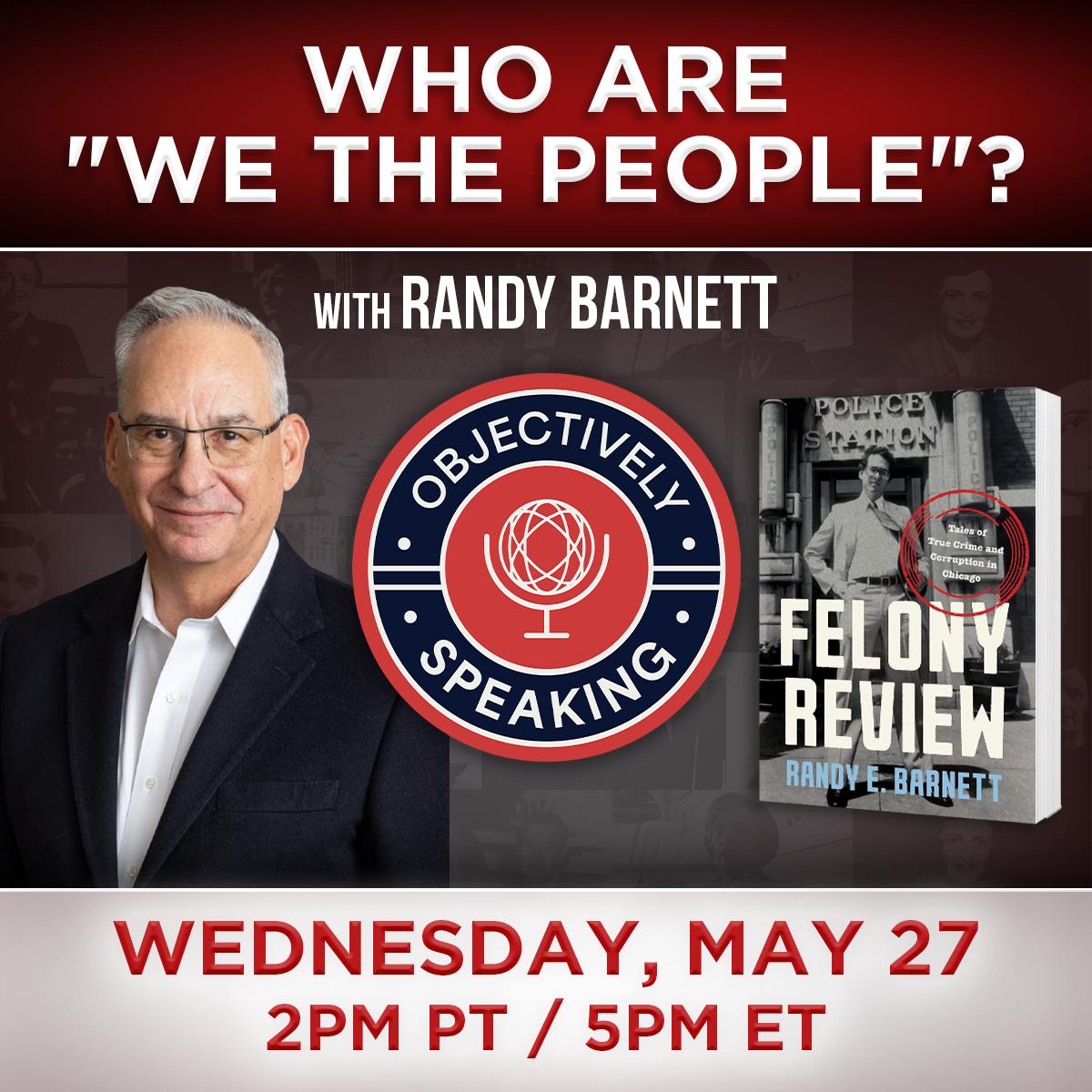
[00:00:01] Speaker B: Welcome to the 304th episode of objectively speaking. I'm Jag, CEO of the Atlas Society. I'm excited to have Randy Barnett. He is a professor of Constitutional law at Georgetown University Law Center. He's joining us to talk about a few of his, oh, I think maybe a dozen books, and those include Our Republican Constitution, Securing the Liberty and Sovereignty of We the People, Felony Review, Tales of True Crime and Corruption in Chicago, and my favorite, his memoir, A Life for the Making of an American Originalist. Randy, thank you so much for joining us.
[00:00:50] Speaker A: Well, thanks for having me, jag. I'm looking forward to our conversation.
[00:00:53] Speaker B: Well, as I mentioned, I immensely enjoyed your memoir and couldn't help but notice that your hometown town, Calumet City, shares a name with Ayn Rand's favorite novel, Calumet K.
Al Capone and the Blues Brothers also put Calumet City on the map. Your success demonstrates that you can take the boy out of Calumet City. But can you take Calumet City out of the boy?
[00:01:21] Speaker A: Well, I hope not. Calumet City, as you know from the memoir, is sort of a character in, in the story because it was such a formative influence on me growing up there, and a very positive one, although part of the positive impact was some of the negative things that happened to me there. But still, it was my beloved hometown, and which I go back to my reunions, my high school reunions, whenever they're held, and that is, you know, every few years. And so, yeah. And I, because of your sending me this information about Calumet K, I looked into it and discovered that Kelly McKay, which I'm now going to get a copy of and I'm going to read because it looks really interesting, is about the construction of grain elevators at the turn of the century. At the turn of the 20th century. Of the 20th century in Calumet harbor, which I would drive past, we would drive past as a family up Calumet Expressway. When we're getting to Chicago, you would pass on your right, these grain elevators, these silos, and this was about the construction of the earliest ones of those silos in Calumet harbor on the Calumet River. Calumet City is not that far away, named after the same Indian chief, not exactly in the same place. And the Calumet river would run behind my house in Calumet City. But anyway, I'm really happy to have this connection with, with Rand, and I'm going to take. I'm going to read this book now.
[00:02:38] Speaker B: Well, apparently it's One of many connections. You learned later that your father read the Fountainhead many years before you discovered Ayn Randall. But tell us about the time you found yourself reading Atlas Shrugged when the ice cream truck you were driving broke down.
[00:02:58] Speaker A: Yeah, well, you know, I have always had jobs. Since high school, I've always had jobs to work my way through school. And one of the jobs that I took, because my father thought it was the most responsible job, I passed up a job, the opportunity to be the advertising director of a newspaper in Chicago, which I ultimately ended up taking because the job he thought was better for me was this job being a Good Humor ice cream truck driver, which sounds like it'd be great, but actually, it was kind of a brutal job. I had to drive a half an hour from Calumet City to the west side of Chicago to pick up my truck, drive a half hour up to my route, whether it was a Deep south side or the Deep north side. That's three hours that I'm not selling any ice cream, for which I'm supposed to be getting a commission.
And I was pretty much fed up with. With this whole job, except I had one little bright spot, and that is that in this one little subdivision up near Wheeling or Buffalo Grove, I would pull into the subdivision, and there was this very pretty girl. And I'm in college at the time. There's this very pretty girl that would always come out, and she would be wearing a bikini, and she had a shirt of her that sort of, you know, covered her from the. As far as the neighbors were concerned. And she would greet me every day as I came by with my ice cream truck. And one day I was going there, and I was pulling into the subdivision, and I hated this job so much. I said, you know, I just wish my ice cream truck would break down.
And then I could just sit there. I could read Atlas Shrugged, which I had with me, and I could have some ice cream, and I could visit with this pretty girl. And just as I thought that thought, steam started coming out of the truck, and the truck broke down right in front of her house. And Good Humor would not let us call, you know, on AAA or somebody to come service us. They had to drive all the way up from the plant to rescue us if our trucks broke down. So I had plenty of time to eat ice cream, read Atlas Shrug, and visit with this very pretty girl, who I still can remember to this day sounds like heaven.
[00:04:47] Speaker B: So, more on a more serious note, what were some of your takeaways from Rand's philosophy for Example, did she contribute to your thinking about natural rights?
[00:04:57] Speaker A: Well, of course. And also at the time, the big connection was that before I'd ever heard of libertarianism or Objectivism or Ayn Rand, and I know Objectivists think there's a difference, and maybe they're right, we could talk more about that. But before I, before I heard of any of that, I became a philosophy major at Northwestern, studying under Aristotelian Thomas philosopher named Henry Veach.
And I became an Aristotelian Thomist, as under his tutelage, he would. He treated me like, even though I was an undergraduate, he treated me like a grad student. So this was really kind of an advanced experience I had with philosophy.
And then when I came across Ayn Rand and Objectivism and she was so interested in Aristotle, I thought, oh, wow, this is a fantastic fit with what I already knew, which was about natural law. And then I went to my professor, my mentor, Henry Veach, and I told him about Rand and I told him about natural rights. And I realized that both were subjects that were not the greatest subjects to raise with him because Rand was not a philosopher, that, that other. The professional philosophers respected that much. And although he, he tried to keep that to himself. And also I discovered that there's a whole natural law tradition that thinks natural rights was a bit of an aberration and a deviation from the true path, and they were not reconcilable with each other. And he sort of had that position, although he changed that view before his death. In his book Human Rights Factor Fancy, published in 1985, he endorsed a natural law theory of natural rights. But at the time I first presented it to him, I could see that I had said something that was like, not exactly what I was supposed to be thinking. Nevertheless, I went on to be a very strong adherent to natural rights as well as natural law. And that actually figures in the book that I'm now writing.
[00:06:39] Speaker B: So, you know, that interchange and your relationship with Veach and so many of the other mentors that you've had along the way showcase how even though, you know, you started out as a conservative, became a libertarian, you had professors who were progressive, had different ideologies than yours, and yet you were able to have these rich and mutually rewarding relationships.
It seems like that's become a lot rarer as things have become more politicized and the existence of conservatives and libertarians in academia has shrunk with. What's your take, having been in academia for so many decades?
[00:07:27] Speaker A: Well, I'm not the Best judge of this, because I have my life and my students and I'm not subject to my. Even my colleagues at Georgetown. So I don't really know. I don't really know what goes on in their classrooms that much because I'm not in their classrooms and I don't really know about how much they mentor students they don't agree with.
As the book also says, I had a huge problem with a professor in law school who I tried to develop as a mentor. I had Henry Veech as a model and undergraduate. I wanted a similar relationship with a professor in law school. And there was this one professor, my criminal law professor, my first year of law school, who was. He wanted to be a criminal lawyer, which is what I wanted to be. He was a prosecutor, which is what I wanted to be. And he was someone who wrote about natural law, which is something I had a pre existing interest in. So I tried to cultivate a relationship with him and it turns out he wanted nothing to do with me. He tolerated me. But when I went into the teaching market years later and I asked him to be a reference for me, he declined, which made it tough because he was actually. I wrote an independent study paper for him that ultimately was published in Ethics, one of the premier philosophy journals in the world, went on to be reprinted 14 to 20 times, and he. He declined to be a reference for me, which made it hard for me to enter into teaching. So there's an example back way back when, when politics entered into it. Why do I think politics entered into it? Well, when I find he was a professor at Harvard Law School years later, when I was invited, I became a law professor without any help from him, and then ultimately was invited by Harvard Law School to teach contracts at Harvard Law School. He took me out to lunch, or he said we should go to lunch together. He didn't actually take me out to lunch. We went to the faculty cafeteria, and when we both set our trays down, the first thing he asked me was, well, so who does a libertarian vote for this year? Which told me everything I suspected, which is when he saw me, he saw libertarian. And that was why he was not keen to be my mentor. So I faced some of the same situation then that people now face, and it's not good, but I don't think it's all that uncommon.
[00:09:27] Speaker B: All right, well, I promise I won't make this entire hour about your life, but you've had so many fascinating experiences that I know our audience will want to hear about, including your time with Murray Rothbard. Tell us how his failure to answer some of your questions on that night, you got to visit with him in his apartment planted an important seed.
[00:09:50] Speaker A: It's super important. It is the first day I met Murray, I ended up having a pretty close relationship with Murray over the years after that. So that was just the beginning of my relationship with him. But I was having a hard time as a libertarian dealing with the hypothetical questions I was being asked by my torts professor at the time. That was Charles Fried, actually. And they would ask these hypothetical questions about how cases should come out. And I'm reading all these cases and I'm trying to figure out, well, as a libertarian in principle, how should they come out? And I really wasn't sure.
And a classmate of mine, John Hagel iii, who was also at the time, president of the center for Libertarian Studies, as while he was a law student, he was having the same problem. And John, when we met, and John and I met because I wrote a fan letter to Murray Rothbard as an undergraduate, and he forwarded that my letter to John, who was starting Harvard Law School with me. That's how John and I hooked up. We started active being an activist, libertarian activist in Cambridge. And ultimately John took me down to New York where I was going to see a talk by Leonard Liggio, close friends of Murray Rothbard. Murray was in the room, this was at Fordham Law School, where Leonard was giving this talk. And we ended up, both of us ended up in Murray's living room that evening, which was a famous place to end up, a wonderful place to end up. And we started firing off the hypotheticals we were being tormented with by our professors in law school. And see if Murray, Mr. Libertarian, which is what he was known as, could answer these questions better than we could. And it turns out he couldn't. He was as baffled by them as we were. And that planted a seed of doubt about how much first principles can resolve individual, specific factual variations that you need the law to resolve.
And that doubt ultimately ended up resulting in the thesis of my book the Structure of Liberty, which was my first monograph. It was published by Oxford University Press, and it was about, and the subtitle is justice and the Rule of Law. And the justice part of the book is about the need for natural rights, which is what determines what justice is and distinguishes just from unjust conduct, and the rule of law, which is what is needed to give specificity to these abstract natural rights, the specificity that cannot be deduced logically from first principles, but must be consistent with first principles. And we need a conventional rule of law. There are many different ways of implementing these abstract principles, not just one.
And I described a common law system that could generate those specific doctrines. And the seed of that doubt, the seed of the need for a rule of law in addition to principles of justice, was planted that night in Murray Rothbard's living room.
[00:12:25] Speaker B: Amazing. So early on in your career, you started teaching a seminar called the Ignored Constitution. What are some examples of those lost or ignored components?
[00:12:37] Speaker A: Well, thank you for reminding me that I taught that seminar because I taught it for many years. And I forgot that I taught that seminar by that name. But that I think that went on to be what I was referring to in my first book about the Constitution, which is called Restoring the Lost Constitution. So I switched from ignored Constitution to the Lost Constitution. And, you know, the rundown then was slightly bigger than it is today. Some of these clauses have made a comeback, but, for example, the ninth Amendment, which says the enumeration in the Constitution of certain rights shall not be construed to deny or disparage others retained by the people. An amendment that, when I read it and as a lawsuit, I thought, oh, my gosh, this is fantastic. Only to turn the page of the casebook to find out that the Supreme Court basically said, it doesn't mean anything, doesn't do anything.
It's a syllogism or a tautology, which it's none of those things. It's actually extremely important. That was the first piece. There's the privileges or immunities clause of the 14th Amendment that says no stake shall make or enforce any law which shall abridge the privileges or immunities of citizens of the United States. That provision was gutted by the Supreme Court five years after it was enacted in 1868 and has remained gutted ever since.
There was the Second Amendment, which at the time I was in law school and later on had virtually no effect on the courts.
That's no longer the case. The Second Amendment now is something you can argue in court and you can prevail in court. Maybe not as much as you should be able to, but you still can.
The Commerce clause was given an overly expansive reading. It actually has limits in it.
I can't think. There's the contracts clause, there's the republican form of government, the republican guarantee clause. There's lots of clauses that have been lost, and the Constitution would be much better if we could bring some of those clauses back.
[00:14:18] Speaker B: All right, I'm going to turn to a few audience questions here, because what I find always happens is that I get so wrapped up with, with our guests and our audience is asking questions and by the time I get to them, the conversation has moved on.
We have a super chat from Chris Baker, author. Thank you. Asking whether, professor, you still hate Ron Paul and love Rudy Giuliani. I'm not sure what that's referring to, but any views on either of those.
[00:14:48] Speaker A: I know what it's referring to. I never hated Ron Paul.
I always thought he was a very imperfect spokesman for libertarianism, to be honest. And that is that during the time he was running for president, anytime he was asked a question, he would turn that question into a question about foreign policy, which was the only thing he really wanted to talk about. He was asked during debates questions about economic liberty.
He didn't care to answer those questions. He was not interested in economic liberty. He was interested in foreign policy.
And he was interested in the kind of foreign policy that I disagree with many libertarians that have is a kind of one sided, pacifist foreign policy, which is sort of pacifism for the United States and not for other countries.
That's sort of A2 system, A2 tier. At the time.
This is a reference to the fact that I wrote a op ed in the Wall Street Journal that said Ron Paul does not speak for me when it came for as a libertarian, when it came to foreign policy. He didn't then, he doesn't now.
And that was about an exchange that he had with Rudy Giuliani.
[00:15:49] Speaker B: All right, another question here from Ilyishin, who also says that he definitely recommends reading Veach as well.
He wants to know, how would you explain originalism to someone who assumes it means being trapped by the moral assumptions of the 18th century?
[00:16:09] Speaker A: Great question. And actually chat is usually the source of many, many good questions. On all the podcasts I listen to.
There's some great questions there. It's sort of like asking Chat GPT only if these are real people. At any rate, the answer to this question, actually, I just drew a blank on what the question was.
[00:16:28] Speaker B: Basically, how would you explain originalism?
[00:16:31] Speaker A: Okay, sure, I can explain originalism in one sentence. It's the, it's the philosophy of that the meaning of the Constitution should remain the same until it's properly changed by amendment. That's all it is. You put some, you put meaning into a writing like a contract or a constitution. I'm not saying the Constitution is a contract, but it is a writing. And when you put the meaning in there, when you publish that writing, it has a fixed meaning. That's the Meaning it has. And that meaning under our constitutional order should not change. That fixed meaning should not change, except properly so. And it dictates the way it's changed and the way it should be changed by amendment. That's all originalism is. And it is true that we are bound by the text that was authored by the founding generation, but that text has been amended 27 times and in very. In mostly very positive ways. And so the Constitution that originalists need to interpret today is not the Constitution of 1789. It's not the Constitution of 1791. It's the Constitution that we have today with 27amendments, which been greatly improved since the Founding.
[00:17:32] Speaker B: All right, well, speaking of ways in which the meaning of the Constitution has been stretched, what are some of the ways in which the Commerce clause in particular has been stretched far beyond its original meaning to allow the federal government to regulate almost any economic activity? Perhaps give some examples of that from your own career.
[00:17:54] Speaker A: Right. Well, this is a very common way. The way you've expressed this question is the way most people would express this question, the way most judges would express the question. But in fact, what took place during the New Deal was not so much an expansion of the Commerce clause, but an expansion of another clause at the end of the list of powers called the necessary and proper clause, which gives Congress all power to make laws which shall be necessary and proper to carry into execution the foregoing enumerated powers, and all other powers granted by the Constitution to the government of the United States or departments or officers thereof. That's the clause that has been expansively interpreted to give Congress the power to reach activities that the courts don't claim to be commerce, much less interstate commerce, but claim to be activities that affect interstate commerce in some way. And as soon as you go to an effects doctrine, which is done in The United States vs Darby case in the 1940s, as soon as you go to an effects doctrine like that that gives Congress the power to regulate pretty much anything, because almost anything could be said to affect interstate commerce. If you. Especially if you follow Wickard vs. Filburn, a very infamous case in which the court said you have to lump in all the similar activities to decide whether it has an effect or not. Well, but you put the substantial effects doctrine together with what's known as the aggregation principle, and basically Congress has a plenary power over the whole country. This was put to the test when I represented Angel Rach and Diane Monson in the medical marijuana case coming out of California. And I took that case from the filing of the complaint through the District Court, through the Court of Appeals, where we lost in the District Court, we prevailed in the Ninth Circuit, and then we ended up losing in the Supreme Court. A case I argued in 2004, it was decided in 2005.
And I tell the whole story about the Raich case, which is what it's known, Gonzalez versus Raich in the beginning of our life for liberty. I talk about the behind the scenes story of that lawsuit and all the things that happened during that lawsuit that bring us to the final resolution where we lost. But we did get three votes, which meant we beat the spread.
And Justices o' Connor and Thomas and Chief Justice Rehnquist voted for us, arguing that Congress had exceeded its powers under the Commerce Clause, plus the Necessary and Proper Clause, when it prohibited the possession by individual users in California of a controlled substance, Marijuana that had never moved in interstate commerce, was grown for their own use and is not a part of commerce at all. That was an overreach. And there's many, many, many people who believe that case was wrongly decided.
[00:20:26] Speaker B: Now, you were also part of the team that mounted a constitutional challenge to Obamacare in NFIB vs. Sebelius. What do you think compelled Justice Roberts to side with the majority upholding the mandate? And also the Supreme Court denied you the outcome you were seeking. Was there a silver lining in terms of precedent with how the Court ruled?
[00:20:48] Speaker A: There was. It's a very bizarre case. The way it turned out was very bizarre. I was the guy who came up with the reason or the constitutional argument for why the individual insurance mandate was unconstitutional. And I argued because it was, it was. It was. It did not conform to the necessary proper clause.
It was my previous experience in the Rage case and learning really what the relationship was between the Commerce Clause and the Necessary and Proper Clause that put me in a position to see why the individual insurance mandate went beyond even the New Deal doctrine that governed the reach of the Necessary and Proper clause. So that's why that was sort of how we got the lawsuit started. That's how all the lawsuits got started. It wasn't just the one that came up from Florida, which is the one. I ultimately was involved with that as a lawyer.
But what really was weird about this case is you normally think if you win on the law, you're going to win the case, and if you've lost the case, it's because you've lost on the law. And yet we had this bizarre circumstance in which five justices said that if the Affordable Care act actually called for an individual mandate, which is what it says it called for, and what Justice Roberts, Chief Justice Roberts said was the most natural reading of the statute, that would be unconstitutional. Why? Because we were right that it would be beyond the scope of the necessary proper clause. However, he said it could be construed not to be a mandate, but to be an option to either buy insurance or pay a non coercive tax. And if that's what it was, it did not go beyond the necessary proper clause to implement the tax power anyway. That's what he said. The silver lining here is that although we lost on Obamacare, and that was a very big loss because now that that system has been inflicted on the American people from then until that day until today, although we lost on that, it would have been worse to lose on the law because the government argued essentially an unlimited commerce power and the dissenters, or at least the liberals on the Court, adopted an unlimited commerce power in which they would have said anything in the country that is a national problem should have a national solution and Congress has the power to do those things.
And so if the government's theory of why the individual mandate was constitutional had been accepted, we would have basically lost the Constitution along with the health care system that got corrupted by Obamacare. So I think I'd rather have lost on Obamacare, which can be reversed by statute. If the Republicans would ever do something like that, which is what they should do, then lose on the Constitution. Because once we'd made that principle of bad law, I don't think we would be ever going back from that.
[00:23:31] Speaker B: Wow. Well, you also made the fascinating argument that Robert's vote helped accelerate the populist revolt against the Republican establishment. How so?
[00:23:43] Speaker A: Well, this is completely speculative and I'm just making a commentary as, as a, as an American observer of our political system, but I was very active in the Tea Party movement building up to the decision of the Obamacare case. I worked with the Virginia Tea Party people.
I did a Tea Party podcast where they didn't have podcasts and they were like video shows. Before YouTube did this stuff, they just had an online video show. So I was very active in the Tea Party and one of the amendments that I proposed in a piece I had in Forbes.com, a bill of federalism. The repeal amendment would have given all state super majority of states the power to repeal any federal law or regulation. The Tea Party loved this amendment and ran with it and it actually got introduced into both houses of Congress before it died out for not having enough dark money. To support the effort, the initiative, as a political initiative. So I got very active in the Tea Party, which, as you remember, was a very constitutionalist party. They were putting their faith in the Constitution. They put an awful lot of faith in our challenge. They thought we had a knockdown argument. They didn't realize what an uphill fight we had to win in the Supreme Court. They thought we ought to win, we should win. And I believe when John Roberts, like Lucy and Charlie Brown, when John Roberts pulled the football away from Charlie Brown, when he said, yeah, you're right on the law, this individual mandate is unconstitutional, but I can interpret this law to make it constitutional, I think they kind of gave up on the Constitution as a vehicle for political change.
He basically said, you got to go out in the political marketplace and solve this. In the political marketplace. Don't come to us, the courts, don't come to the judges to solve this for you. You go solve this yourself. And I think at that point, that was one of the contributing factors. Why when they saw Donald Trump come on the scene, they thought, that's the guy who's gonna do the stuff we want him to do. And all these other establishment Republicans are not going to do what we want them to do. They've pretty much like John Roberts have shown us what they are made out of. And so that's one of the reasons why they went for Donald Trump over the guy who. I was, I was a senior counsel advisor to Rand Paul, Ron Paulson. Going back to an earlier question, Rand asked me to be a senior advisor to him. And I was. I was actually part of the team that mooted him before he did a national debate. I became very close with him. He actually invited me in twice to interview Supreme Court nominees. And so. And I'm about to lecture for him again. And he has a summer of internship fellowship program where he has a series of lectures for D.C. interns that I'm going to be speaking at again.
So I have a very high regard for, for Rand.
But the Republican primary voters, at least a plurality of them, they prefer Donald Trump. I think they thought, because this guy was not like all the other suits up on that stage, he was going to do what we want him to do. And we need somebody who would go aggressively in, in a number of directions, a number of policy directions.
[00:26:30] Speaker B: All right, question from my modern Gault. Is there an issue between what is modified or clarified by amendments versus what is interpreted by terms or clauses which could be overly broad?
[00:26:45] Speaker A: I have to. I'm afraid I don't Understand the question. And I can't figure out how to translate into a question I do understand.
[00:26:51] Speaker B: All right, He's a regular, so he might give us another.
[00:26:56] Speaker A: Maybe he'll update, clarify it.
[00:26:59] Speaker B: All right. Kingfisher asks, are there recent Supreme Court decisions that you believe indicate too much power being handed to the courts?
[00:27:11] Speaker A: Well, there's too much power being handled to district court judges right now.
We have a system, we've evolved ourselves in the last few years into a system in which the federal government can't implement its policies unless each and every district court judge, of which there are over 500 in the country, go along with it. It because they're going to enjoin its operation. Now, the court did slap down the idea of universal injunctions, but there's still a problem with class action suits impeding pretty much anything the administration cares to do.
That's not the frame of government that we're supposed to have. That's not the check on government that courts are supposed to provide. And I'm a very strong advocate on judicial cliques checks on government power. But these are supposed to be deliberated up by through the system and not have individual judges stop things dead in their tracks while the court takes years to decide a case. And by that time a different political party might be in office.
And so one political party never gets its program implemented because it keeps being thwarted by the judiciary. So that's a serious problem we have, and I'm not exactly sure how we're going to get ourselves out of it.
[00:28:18] Speaker B: Your book, Our Republican Constitution, identifies two competing views of we the people, the people as a collective majority versus the people as individuals with pre existing rights. Why do you think the collective majoritarian reading becomes, became so dominant in modern constitutional thinking?
[00:28:40] Speaker A: I think there's a lot of reasons for that. I don't think there's just one. And I don't think I have a clear, you know, a complete answer to that. I think in terms of the political parties, it was the Democratic Party that was founded when Andrew Jackson was the president that adopted this collective reading of we the People. In fact, the Democratic Party in their first iteration referred to themselves as the Democracy, not just the Democrat. They were called in their second political platform, they called themselves the Democratic Party. In the first one, they called themselves both the Democratic Party and the Democracy. And that's how they were referred to. And they had the idea that they represented the will of the people against the other party who were then the Whigs, who did not.
It wasn't the idea that they were democratic in the voting sense, but that they, the party would speak for the will of the people. They had a very Rousseauian conception of the people, as opposed to the founding generation, who had a more individualistic conception of the people based on individual natural rights. The natural rights to which the Declaration of Independence refers, the inalienable rights to life, liberty and the pursuit of happiness, were rights that belong to individuals. They were not rights that belonged to groups. Those were what natural rights were.
But that started to be supplanted, and eventually natural law and natural rights were completely supplanted by the progressives near the end of the 19th and the beginning of the 20th century.
And we have ended up with, under a different political regime, starting at least with the Wilson administration, moving forward to today, that has a different view of the people. We, the people as a group means, since everybody cannot participate, it has to be the. The will of the majority that governs, and the will of the majority puts at risk the rights of the minority.
And so that is a big problem. And whereas an individual conception of popular sovereignty, which I defend in that book, says that the purpose of the governed, the governors, is to govern and protect the rights of those, the people that they. That they govern. So, and that's what the Declaration of Independence says. It says, to secure these rights, governments are instituted among men, deriving their just powers from the consent of the governed. But it's to secure the rights that governments exist among men. Governments are not us, that they're there to do a job for us. They're supposed to be our servants, protecting our rights. And those rights belong to all of us, each and every one of us.
[00:30:58] Speaker B: So you wrote a piece for the Wall Street Journal on birthright citizenship and Trump's position. Can you take us through your argument there and, and also talk a bit about Trump versus Barbara, whether you think there's any chance that it gets ruled in Trump's favor based on some of the skeptical questions the justices had for the Solicitor General?
[00:31:20] Speaker A: Well, to get to your second. To not answer your second question first, I learned when I was representing Angel Rage that the only thing the press wants to know about is my prediction of what's going to happen. And because, in part, I was not optimistic about what was going to happen, I adopted a policy that I have followed ever since, and that is I try not to publicly predict what the court will do. For one thing, thing, they always surprise you, or they oftentimes surprise you. But I think it's more important to focus on the merits and in Fact, the birthright citizenship case. The merits somewhat surprised me because for many years I didn't have a strong opinion. Even after having written a book on the 14th Amendment one way or the other. I heard the arguments on both sides. Neither side, frankly, impressed me. I didn't. I just wasn't sure what to think. But after the executive orders were issued and I had a chance to. To think harder about it, and especially over the last year, since more scholarship has been done than previously had been done, challenging the conventional wisdom, I came to believe that the Trump, the. The Trump administration and the President had a much stronger case than people were giving him credit for.
It's a complicated question if. Or I wouldn't have been sort of up in the air about it as long as I was. But let me just focus on so people understand what really is being debated and what is being agreed upon.
Everybody agrees that There is not one, but two requirements of citizenship under the 14th Amendment under the citizenship clause. One is you have to be born in the United States. That's one. The second is you have to be subject to the jurisdiction of the United States.
So being born in the United States, everybody agrees, is not enough.
You have to have the second thing, too. The debate is all about what does subject to the jurisdiction thereof mean. That's what the debate is about. Now you can see why it gets difficult to follow.
There's something else everybody agrees with. Everybody agrees that there were at least three categories of persons at the time the 14th Amendment was enacted that were considered to not be subject to the jurisdiction of the United States. Who were they?
Ambassadors. Children of ambassadors are diplomatic diplomats that are in the United States. Children that are born, as during the occupation by an invading army. People armies used to travel with families and they would have children, children who were the product of invading armies on. On American territory. They would not be subject to the jurisdiction of the United States. And also, perhaps most importantly, children of who. Who were members of Indian tribes, Native American tribes. They were not citizen subject to jurisdiction thereof. Okay, everybody agrees there were these three exceptions. Now the question is, is it only these three exceptions or do these three exceptions represent a principle that could be applied, potentially applied to other categories in the future, like people who may enter the country illegally or people who enter the country temporarily just to have a child and then get. Have. Take the baby and go somewhere else?
Are these covered by the principal or not? That's what the debate is about. Very few people will argue that these are the only three categories that could exist. What the debate is about is what principle explains these three categories and does that principle apply to the categories that the President's executive orders apply to? That's what the debate is about. That's what the historical evidence is about.
And that's and that's about as much as I think I can do here in explaining that.
But I hope that simplifies things.
[00:34:45] Speaker B: That helps a lot. All right. And simplifying and clarifying my modern Gault is going to give us another crack at his question. He says, or she I shouldn't assume to clarify, is there a danger that broad constitutional language allows judges to accomplish through interpretation what should properly require a constitutional amendment?
[00:35:09] Speaker A: I would say the answer to that is yes.
But generally speaking, throughout our history, what they have done through interpretation is given a very permissive reading of these clauses and the powers it gives to the other branches. So it isn't as though the courts have used broad.
There's exceptions to this, but generally speaking, these are less bad when this happens. It isn't as though the courts have taken broad language and themselves instituted policies. What they have done with this broad language is allowed Congress to do a lot more than Congress should be allowed to do or let the President do more than the President should be allowed to do. In other words, they use broad language to defer to the other branches and abdicate their responsibilities as courts to ensure that the other two branches are playing by the rules laid down by the Constitution. That's generally more what has happened to the extent other like rights provisions have been given that are stated in an abstract way have been given content by the court. Generally speaking, they have not over protected those rights they take. They tend to under protect those rights.
There are exceptions to that as well. So I guess if I had to say generally speaking, courts have not been doing this to run the country as much as to let other people run the country in ways perhaps they shouldn't.
[00:36:24] Speaker B: All right, here is another great question from Candace Moreno. What constitutional mistake from the past century most needs to be corrected?
[00:36:34] Speaker A: Well, there's a couple of prime candidates. I mean there's the income tax amendment. Prior to the income tax amendment, Congress, the United States made their money off of excise taxes and duties and, and other sorts of and tariffs, et cetera. I actually think consumption taxes are a way better policy than income taxes. And I think a constitutional amendment to bar act income taxes and substitute consumption taxes where you pay as you go, you pay as you spend as opposed to pay as you earn it would be a much less privacy intrusive way of collecting taxes.
So. But we'd have to abolish or limit the income tax. There's the direct election of senators that a lot of people that bother a lot of people because essentially the upper house of. Of the Senate and the Senate and the upper house of Congress was supposed to represent the interests of the states, cross states. But ever since the direct election of senators during the progressive. Another bad idea that we got during the progressive era, states have, you know, basically, senators represent the people of their states, but they don't represent the states as governments which have an independent stake in the country. And the Senate was meant to protect that stake that they have in the country.
So that's a couple of them.
[00:37:48] Speaker B: All right, well, over your career, originalism, and you probably had a bit to do with it, went from marginal to mainstream.
What did originalists get right strategically? What mistakes did they make along the way?
[00:38:03] Speaker A: Well, I think it's. I think you've accurately described it. And then the question is, you know, how did that come about?
And I think that came about in part through the tireless efforts of Antonin Scalia, Justice Scalia, who voted against me in the Raich case. And I was not always in agreement with him, and he was not always in agreement with me.
He was a tireless defender of originalism when it was only Hay and Justice Thomas of the nine justices who were committed to originalism. So that was very important.
The theory of originalism was developed. When I first heard about it, I was against originalism. I thought it was a bad idea. I was persuaded by the criticisms of it. And it was only by reading a libertarian, a radical libertarian named Lysander Spooner, which I assume that many of your audience will recognize, who's one of my heroes. And actually, I have visited his boyhood home. I raised $10,000 to put a. To put a monolith, to put a. To put a. An obelisk marker on his grave at Forest Hill Cemetery in Boston, because it was not an unmarked grave, but it was marked only by a plaque that was flushed to the ground and you couldn't see it. So I did that in honor of Spooner. I also paid to put a marker in front of his boyhood home in Athol, Massachusetts. So he's one of my heroes.
And he wrote a book in 1845 called the Unconstitutionality of Slavery, in which he argued for a version of originalism, original public meaning, originalism that I'd never heard before as a law professor and which was not on the table being debated as far as I knew. And so I thought when I read Spooner's version of originalism from this 1845 book, this is something I might be able to do something with myself. And I do think that that had. That was. That contributed a lot to the success that originalism has had.
Substituting the objective. And this is. We're on the objective broadcast speaking.
[00:39:52] Speaker B: Yes.
[00:39:54] Speaker A: Substituting the objective meaning of the text of the Constitution for the subjective intentions of the people who wrote it was a huge intellectual move that made originalism much more defensible. And I got that idea. I was not alone, by the way, in pushing that. Justice Scalia did as well. But I got the idea from Lysander Spooner. And I may be the only person in the country, in the history of the country who became an originalist because I read Lysander Spooner.
[00:40:19] Speaker B: Wow. Fascinating.
So I also enjoyed your new book, Felony Review. It draws from your time as a young prosecutor in Cook County. Would you say that courtroom corruption was worse back then than it is today?
[00:40:34] Speaker A: Well, for better or for worse, I haven't been a courtroom lawyer since 1981, so I haven't been in the system. And then I moved from Chicago to Boston and now to D.C.
in beginning in 1993. So I really can't be sure what it's like there.
But I strongly suspect, given the way that the story turns out in Felony Review. I don't want to spoil this, the surprise ending of Felony Review. And I'm glad that, Jack, that you haven't done that either. Some other interviewers of mine have just blurted out the ending of the book because of how the book ended. I actually think that did clean up a very important part of the corruption that was happening in Chicago, the monetary corruption that was happening in part because everybody in the system thought nothing would ever change. And the people that were engaged in this behavior were completely immune from consequences that turned out not to be the case.
And I do think that in the aftermath of this, I know many of the judges who are on the bench, and actually some of them are nearing retirement now. They were people who were prosecutors with me. I do think that in that regard, the system is much, much cleaner than it was when I was there.
[00:41:41] Speaker B: Did working homicide and felony cases make you more skeptical of government power or more aware of why government in many cases is necessary? Maybe a bit of both.
[00:41:54] Speaker A: Well, you mentioned earlier my father, who read the Fountainhead, unbeknownst to me, until he. Until he was. I found this out very late in life that he read this in the 1940s, I guess, when it first came out, whenever it first came out.
And he was a very cynical, hard headed small businessman on the south side of Chicago.
And he raised me to be similarly skeptical about government, which is where I got all my political principles I got from him. I didn't get it from Henry Veach, and I didn't really give it. Get it from Ayn Rand, who I should say I did see in person one time. Maybe we'll come back to that question next.
But I would. When I got into the, when I went into the Cook county criminal court system as a criminal prosecutor, which was my dream job, it actually turned out to be better than I expected. Why? Because although there was corruption all around me, my own office, the Cook County State's Attorney's office was not corrupt, and it turned out not to be corrupt, even upon, you know, hindsight.
And so it was actually a better system than I expected because I thought, well, everything's corrupting. It'll be, including my, my colleagues. And they were not. And so in that sense, as, as cynical as I was, I was actually happy to find out that it wasn't as bad as I thought it was going to be.
[00:43:10] Speaker B: Well, yes, we're going to have to immediately return to your having met Ayn Rand. And I. My first question is, why didn't it make it into your memoir?
[00:43:18] Speaker A: I thought, it's there. I think maybe you skipped over that chapter. I believe it's in there. Go back and look at it again. We'll have to check the index. I didn't, I didn't meet her, but I saw her in person. She, you'd give an annual lecture at the Ford Hall Forum.
And my friend John Hagel, my partner, my libertarian partner in crime at Harvard Law School. Who, the guy who introduced me to Murray Rothbard, the guy who was president of the center for Libertarian Studies. I was eventually invited, during my spring semester of my first year to be on the board of directors of the center for Libertarian Studies.
He knew all this stuff, you know, he was a libertarian before I was, and he, and he knew Rand gave this annual talk at the Ford Hall Forum in Boston, and we went there one year and in writing the book, that's why I know it's in the book somewhere, because in writing the book, I had, I didn't remember what she said. I remembered the scene we sat in the balcony. I remember that I'd looked down on her. You know, I was like in the first or second row. So I had a very good view of her.
She was dressed in black, but everybody. It was like the Rocky Horror Picture show and people show up and they're in costume from different characters and things. People would show up to her lectures in costume for different. Like the Dagny Tagger cat look. And they had cigarettes on cigarette holders and they did all the things. So it was like a very interesting group.
And I didn't. I remember that I don't remember what she said, but I was able to identify which Ford Hall Forum talk she gave. And I listened to it on YouTube, so you should go look for it.
When I wrote that chapter of the book to fill in what the substance of what she said is, although I had no personal recollection of it.
[00:44:50] Speaker B: Well, fascinating. What you're describing in terms of people showing up in different costumes reminds me of what we see today at comic Cons where people go and they wear costumes for their favorite comic book characters. And if you are wondering why does the CEO of the Atlas Society know anything about comic Cons? No, it's not because I go there. But it's because given the changes in young people's reading habits, we early on happened on a strategy of taking Ayn Rand's shorter works, recruiting a Marvel Comics illustrator, and adapting them into graphic novel form. And part of that was inspired by Ayn Rand's observation that she was. Would know that objectivism has succeeded when it ends up showing up in comic books. So we have managed to accomplish that.
So also wondering whether you're. Why did you end up leaving your time and what made you decide that you wanted to pursue more of an academic career rather than.
[00:45:56] Speaker A: I think this is because the through line of my whole career has been from that, from the beginning till today, is my commitment to justice and seeing that the world is a more just place. It wasn't until I got to college that I and I want to be a criminal lawyer. Since I was 10 years old and a TV show called the Defenders came on television and inspired me to be a criminal lawyer like I saw on television. I think the reason why the Defenders inspired me was because it was a show about a career in which you try to see justice was done. And that really appealed to me. But it wasn't until I got to college that I discovered there was this. There was this subject called philosophy. And in philosophy you're supposed to think about what justice is. There was that people have been thinking about this systematically for. For millennia. I didn't know anything about this coming out of high school in Calumet City and so this inspired me, and I thought, well, maybe I should be a philosophy professor instead of going to law school. But for personal reasons, I decided not to. And I'm glad I decided not to. But I. In writing my book, I found my law school applications. And. And even in my law school applications, I said that I might one day want to be a law professor teaching jurisprudence, meaning the philosophy of law.
And that's one reason I want to go to your law school in my application.
And so even then, I had the idea that after I was a criminal lawyer, I would be a philosophy. I would be a professor who could write about justice. It was great that I didn't need to get a PhD in Philosophy to write about justice as a law professor. All I needed was a J.D. a law degree. And so that's why I ultimately went into academia. By the time I became a prosecutor, I knew that one day I wanted to be a professor. And then I tell the story in the book of how difficult that was to go from being a county prosecutor to being a. To being a law professor. And. But I managed to. I managed to get that done.
[00:47:37] Speaker B: As a former prosecutor, how do you think about plea bargaining, confessions, and police testimony?
How did you think about it as a young prosecutor, and how do you think about them now?
[00:47:48] Speaker A: Well, I mean, I was pretty favorably inclined to plea bargaining on the grounds that if you're guilty and you say you're guilty, then you might deserve some discount on the. On the punishment from somebody who insists that they're not guilty when they really are and they have to go to trial and put the system and all the businesses, everything, through trouble of proving them guilty. Maybe they get a discount for just admitting it. That seemed to be reasonable, and it was certainly the way that most cases got processed, I now think.
And I'm not sure what we would do to change this, because I don't really write about this that much. But I now think that we need to revive the jury system, especially in civil cases.
And so I do think more cases should go to trial than plead out. And there is an enormous pressure on innocent people to plead guilty in order to get this discount available and not be punished for asserting their right to a fair trial. So that is a problem.
There is no magic solution to that problem, however, or I would. I would tell you what it was.
As for cops, I like cops. I like cops, then. I still do. And, you know, they're. They're human, so they make mistakes and they do bad things. And my job as a prosecutor was to Prevent any bad cop from being a bad cop. Facilitate good cops. That's what felony review is about. Felony review was a unit that we had, a full time unit in which no criminal charges could be brought by a Chicago police officer against anybody unless a prosecutor from the Cook County State's Attorney's office signed off and approved it. There had to be a full time unit to do that sort of thing. And the nine months I spent on felony review in police stations, not going to court, but evaluating the cases, interviewing them, interviewing the witnesses, interviewing the suspects if possible, and getting confessions if possible, that just was the most informative, life changing experience of my entire career as a prosecutor. And that's the reason why the book is named Felony Review. It's named after that unit that I was on before I became a trial lawyer in the State's Attorney's office.
[00:49:51] Speaker B: I'm curious if you have any thoughts on the more pronounced anti Israel aspect of some quarters of the libertarian movement today? I understand that Walter Block was ousted from the Mises Institute over his support of Israel after October 7th.
Was that warranted? Wouldn't seem so. What do you think Rothbard might have thought of it back?
[00:50:16] Speaker A: Well, yeah, you, I did get this. You did ask me this question in advance and I had a chance to respond. Think about it. First of all, Walter and I were close to each other when he, we were both on the board of directors of the center for Libertarian Studies when we both young men. So I knew him very well.
His defending the undefendable. The defendant. No, not defending the, the indefensible. I can't now remember his famous book which was, you know, everybody read and, and, and he has been moving in a direction similar to my movement in a direction about libertarianism and some of the problems that libertarianism has, which is the book I'm currently writing about libertarianism.
But when it comes to, you know, him getting excommunicated by the Mises Institute, this was shocking.
I, I agree with him. I agree with his support for Israel and I agree with part of the most of the reasoning he has for support supporting Israel.
And, and so I think this was awful.
I do think there's a pathology in some quarters of libertarianism that does not, is not shared by people who generally think of themselves as libertarian, especially the lawyers, law professors, etc, and that is kind of a conspiracy minded view of things.
That certainly was the case when I was in the movement. I myself was very interested in various kinds of conspiracy theories from the Kennedy assassination and after that. So there's A certain kind of person, personality attracted to this.
Again, I say, including myself and, and, and Jew, Jewish, the Jewish people and Judaism is the world's oldest conspiracy theory. And if you're attracted to conspiracy theories, you're probably attracted to this one. And there are various well known libertarians who are taking this view. And I think they're wrong. And I, but I think they're not only wrong about that, they're wrong about a lot of other things as well as well, which is why I'm, I'm writing this new book.
[00:52:06] Speaker B: Well, let's turn to that. I'd like to hear about your new book. And also we've got about five minutes left. If we covered three books in this hour, if there's anything that you wanted to return to that we didn't get to from any of those most more recent works.
[00:52:23] Speaker A: Well, there's a lot of things that are missing in the libertarian theory, the theory of libertarianism. And part of the reason for that is that unlike originalism, which has been debated amongst constitutional conservatives for decades, libertarians stopped debating the theory of libertarianism back in the 1980s when the center for Libertarian Studies with its annual Libertarian Scholars Conference and its Journal of Libertarian Studies folded and there was no infrastructure in which we could continue to debate the first principles of libertarianism. As a result, the libertarianism that exists today is really unchanged from 50 years ago. And a lot has happened in the last 50 years that might call into question some of these views that people once held. It's now kind of a list of policy positions that you must agree with or you're not a libertarian as opposed to a deep theory. Now I think Walter Block is finding a similar lack of satisfaction. He's with libertarianism. Interestingly, among the many things that libertarianism lacks, I think, and needs is something that objectivists have always complained about libertarians for, and that is, wait for it, a moral foundation in the natural law. That's something that libertarians like myself even said that libertarianism as a political philosophy didn't have anything to say about that, that it was compatible with multiple normative arguments, and that was one of its advantages. But I now think that that's an inadequate answer. I do think that the natural rights have to be based, libertarianism should be based on natural rights, and natural rights need to be based on natural law.
And Rand saw that. And that's one of the reasons, one of the many, one of the several reasons why she was so antagonistic towards libertarians, even though Rothbard himself was an ardent Aristotelian natural law person.
So in this book I'm writing, I'm I'm developing that natural law account, among other things.
[00:54:10] Speaker B: Well, I think that's an excellent place to end because I think that even though there's lots that objectivists would agree with in terms of the political aspects of libertarianism, one of the arguments in terms of making libertarianism stronger is balancing or maybe shifting away from just a consequentialist argument in favor of liberty to more of a moral one that is grounded in a theory of rights, which is also grounded in observation and understanding of human nature. So we look forward to that new book and perhaps we'll have you back when it's out. So thank you.
[00:54:52] Speaker A: Thanks. I look forward to finishing it and being on the show again. Thank you so much for this very, very thoughtful interview in which you actually read the books you're asking me about. That's not all that common of all the interviews I give.
[00:55:01] Speaker B: Oh, my dear. All right. Well, I mean, to me, I consider it one of the biggest perks of the job that I actually get paid to educate myself and read these terrific achievements, epic achievements from such great minds of our day. So I really appreciate you and hope to meet you in person one day, perhaps even out here on the West Coast. So great. Thank you. All right, everyone, thanks for your great questions. Please join us next week when Lauren Sheets Jarrell joins us to talk about the American Tort Reform Foundation's annual judicial Hellholes report and the relationship between civil litigation, accountability and the property role of law in society. I will see you then and perhaps I may even see some of you next week. In San Diego we have our Galt sculpture and of course, that includes on the 5th, our dinner cruise with Heather McDonald. So hope to see you then. Thank you.